A Question of Timing …

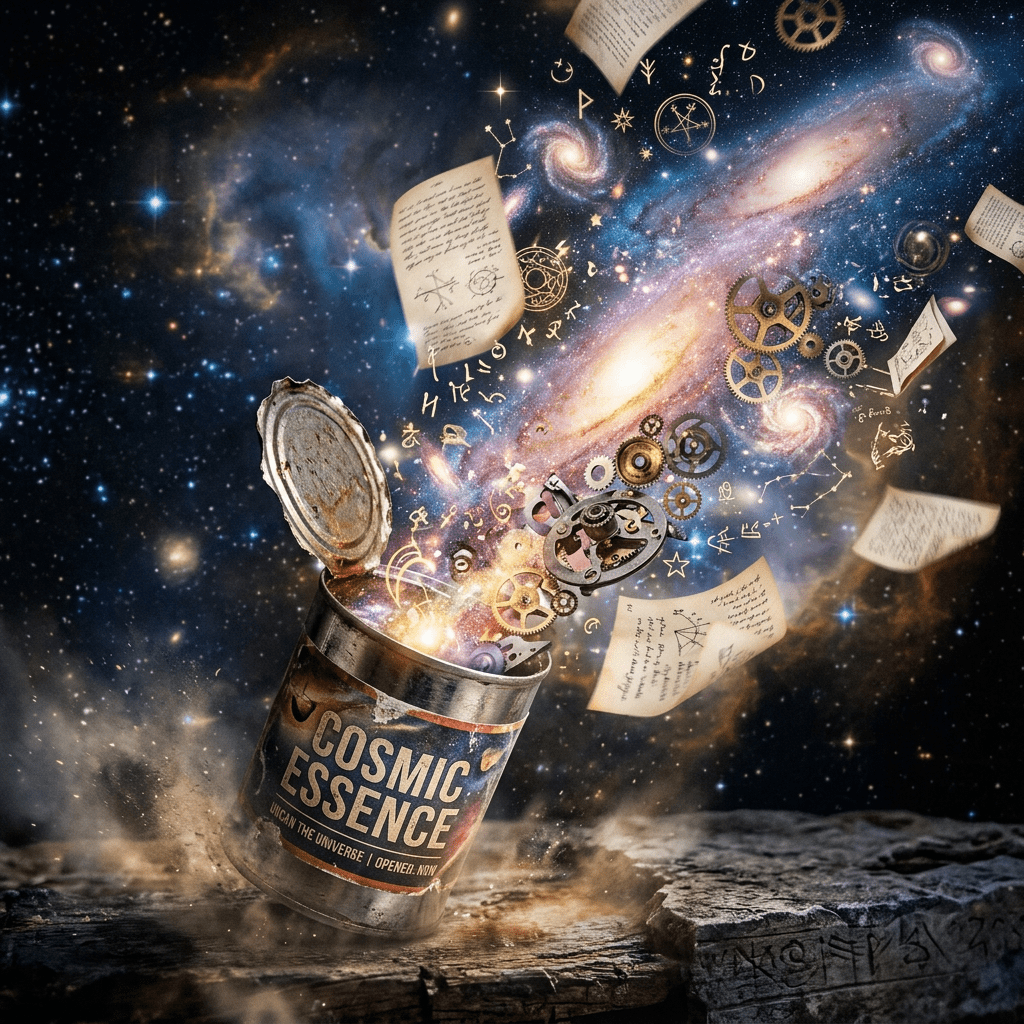
Open canister labeled "COSMIC ESSENCE" releasing galaxies, gears, symbols, and handwritten pages
A weathered canister releases galaxies, gears, symbols, and handwritten notes into a star-filled universe.

Original Question –

Roger I have a question for you. Recently I purchased a book by Forrester- The African Queen. I enjoyed the movie years ago and thought I would like to read the story. The main actors were great. The book highlighted that it showed what it was like being a female during the war, (1) which when I look back on now is one of its main points.

My question or thought on this book is tied around the library system. When I lived in Fredericton I wanted to give a bunch of books to the library, their first question to me was, “How old are the books? I told her and she said anything over five years in not being accepted. (2)

I wondered about this and the fact that many books in school are being removed, (3) how can we tell how much we have progressed? (4)

I don’t like predjudice but it seems we are throwing out too much. (5) Any thoughts on this. I don’t mind some of the history being trashed (6) because for Canada the consentation is for Quebec and Ontario.

Roger’s Response

(1) It’s also about the role of the nun in society. How do ‘holy women’ function in a male society? It sets the questions but doesn’t really give the answers. It’s a long time since I saw the film. I don’t think I ever read the book – the themes might well change in print. They are present (some of them) in The Handmaid’s Tale.

(2) The library system seems to have rules and an etiquette all its own. When I donated books to the library, they accepted some for their collections, but set others up for sale on the book tables by the door. My guess is that certain books are ‘best sellers’ and will be read, others are ‘dust gatherers’ and won’t be. They want the former, not the latter. They also have specialized collections. If the books fit the specialized collections, great. If they don’t, then they hit the unwanted category and are moved on. This is particularly true of the UNB Library System.

(3) This is an entirely different question, and one with very deep roots. It deals, in part, with the question of control – quis custodiet ipsos custodies – who shall guard the guards, who shall program the programmers? By controlling what people read, you control their thoughts. One of the worst signs of this was the book burnings of the Spanish Inquisition (16th – 17th centuries). The Jews were expelled from Spain in 1492. (And the Arabs / Moors, in 1609). Prior to that, they were ‘processed’ by the Inquisition. The original Inquisition was Papal, and was aimed at instructing the priesthood in Rome. It was corrupted in Spain by the Spanish Inquisition, a sort of secret police, which worked rather like the Gestapo in WWII. One of their jobs was to ensure that people who had converted, stayed converted and didn’t revert to their old religion, even in secret. Another was to ensure that reading material, religious material, and cultural material, particularly after 1527 (Martin Luther and his 97 theses) when the Reformation started, were all in line with the accepted thoughts of the time. All books were sent to the Censor who vetted them and either approved them or asked for changes, if he (they were all men) saw the slightest sign of dissent or heresy. Don Quixote, Book One, Chapter Six (DQ,I,6), deals with the book burnings of DQ’s personal library. In certain of the States (down south) books are already being banned. One that touches us closely is the banning of Margaret Atwood’s The Handmaid’s Tale.

(4) “There is no earth, no heaven, no extended body, no magnitude, no place and that nonetheless I perceive these things and they seem good to me. And this is the most harrowing possibility of all, that our world is commanded by a deity who deceives humanity and we cannot avoid being misled for there may be systematic deception and then all is lost. And even the most reliable information is dubious, for we may be faced with an evil genius who is deceiving us and then there can be no reassurance in the foundations of our knowledge.” René Descartes (1635)

Descartes expresses this much better than I can. It is one of the major dangers of the age in which we live. How do we distinguish between reality and alternate realities? Which reality is the real reality? What is or isn’t fake news? How do we tell? Who do we believe, and why?

(5) Part of the problem is that ‘certain people’ – who don’t believe in science and who exploit people’s ignorance to their own advantage – are willing to destroy the foundations of our knowledge. Burn everything down. And start again. And the new starting point is to impose what they believe upon everybody around them. This is a huge and crucial question that threatens us, as individuals. It also threatens the foundations of our knowledge, as well as the very world in which we live – climate change vs denial of climate change – profits over people. Once one starts looking at the AI systems with their immense persuasive powers and their seemingly uncontrollable spread of Mis-information and Dis-information, then we start to realize how serious the problem is.

(6) Those who ignore history are doomed to repeat it – Santana (I think). However, we must, in certain circumstances, adjust our current beliefs to current realities. Immigration is a major issue – as is how we deal with people, like me, of different cultures and beliefs? Not everything written in the past suits our current world view. I have been looking at old Westerns – “The only good injun is a dead one” (John Wayne). Really? I know some wonderful people in our first nations communities and I have taught them and worked with them and been taught by them. “Shoot first and ask questions afterwards.” Really? I won’t comment further on that one… and there are so many others.

All of this comes down to the big question – freedom of information or the release of just enough information to persuade other people of what we believe and what we want them to believe. Power and Control. Knowledge is Power – Michael Foucault. Control that knowledge and you have power over the people. Noam Chomsky has written widely on this – and his books have been banned in the USA. Bertrand Russell too – The Meaning of Meaning, for example, and his establishing – along with A. J. Ayer – of the doctrine of logical positivism – the removal by means of mathematics of all the emotional content of words.

My friend, you have opened a can of worms.

Long may they wriggle.

Comment:

A series of questions that have recurred throughout the centuries. Well worth re-asking them and rethinking them. Times change and the answers often change with them. The image, incidentally, is AI generated, based on an examination of my written words.
Earworms

Earworms

A meaningless collection of notes
swarms into my empty head
swimming round and round
like clustering tadpoles.

The ebb and flow of that mysterious
music clumps on and on, tight in
 my mind and will not let me go.

Earwigs, some call them,
those senseless repetitions,
day after day, night after night,
awake and asleep,
old tv adverts, short clips
of classical music or popular songs.

They are wheelbarrow songs,
hedge clippings, dead flowers,
crass grass, broken branches, weeds,
repetitive memes of meaning,
a syndrome of stuck songs destined
for the garbage dump and ritual burning
in the hell of an eternal turntable turning.

Comment:

Word magic from the Mikado – “My object all sublime I shall achieve in time, to make the punishment fit the crime” … And in this case I would tie the criminals who invented these ‘ballads, songs, and snatches’ to the stake, with earphones that endlessly repeated all the nonsense we hear day and night, so much of which sticks in the turntables of our brains turning round and round as we toss and turn in our beds at night. Just a case, I suppose, of hearing music while there’s no one there.

And how many earworms did you pluck out of that first paragraph? I can count six, maybe seven. Then, my mind may be very different from yours. Perhaps your mind isn’t in the outrageous Wilfred that mine is. Don’t get that joke, do you? And why should you? I guess you don’t remember Ray’s a Laugh, Round the Horne, Mr. Dimwitty, or Wilfred Pickles – and why should you.

Passent les jours et passent les semaines / ni temps passés ni les amours reviennent / sous le Pont Mirabeau coule la Seine – click on the link for the English version (my translation) and click on this link for a slightly improved revised version.

Yes, as Apollinaire says time flows on and by – or, after Heraclitus – you can never step in the same river twice. More important, perhaps, for those who worry about their past thoughts, words, and deeds – you can throw the stone into the pond, but you can’t control the ripples.

Not Enough

Not Enough
A Jackpine Sonnet

Is it enough to treat people
as if they were equals,
when some need much more
attention than others?

Think colds, flu, bronchitis,
pneumonia, covid. Equal
treatment no longer works.

We need to see each person
as an individual needing
exclusive care, a unique style.

We must let them know
that they are not lost and alone,
that they will be approached
individually, each and every one.

Treated equally, yes, but each
in his or her particular case
and cultural situation.

A dream? Perhaps.
But the alternative
is a nightmare.

Comment:

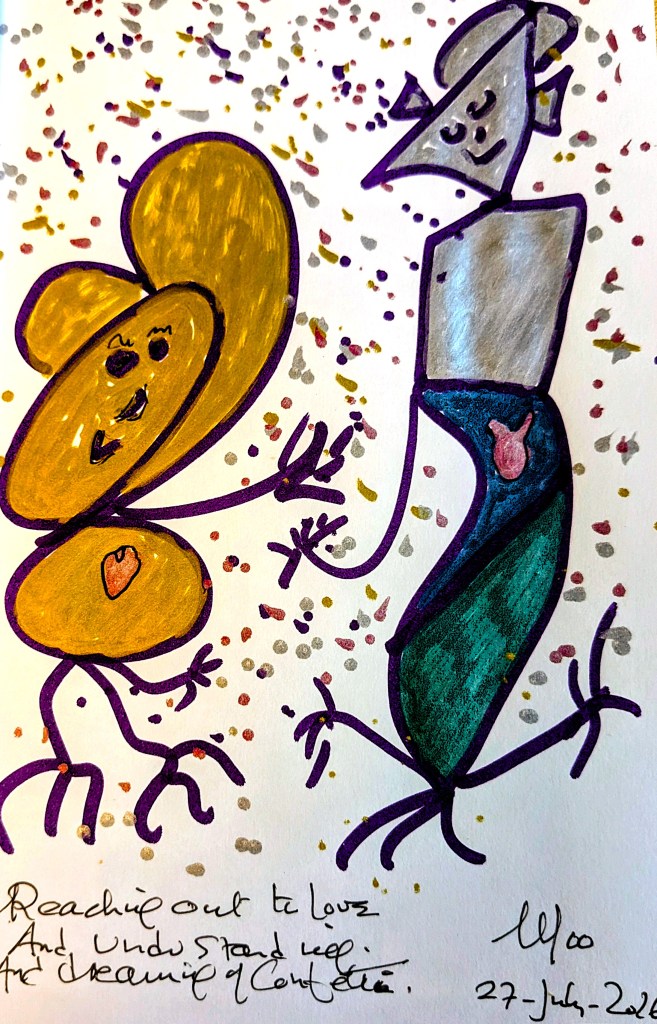
An interesting chat over the dinner table – de sobremesa – led us to the meaning of equality and treating people equally. The kernel of the discussion – I said I believed in treating all people equally, Moo’s guest for the evening, his Plus One, said that treating people equally was no longer right. It was necessary to treat each person as an individual, with different needs, and we must therefore go beyond equal treatment to individual treatment. A word to the wise from the wiser.

Treat other people as you would have them treat you. The phrase goes back a long, long way to Socrates, Seneca, and maybe beyond. It ties in with the ideals of Buddhism and also of early Chinese philosophers.

It centers on the meaning of ‘equally’ and is a wonderful topic for discourse analysis. If by ‘equally’ we mean one size fits all, then we merely drop the grid down upon the targeted individual and tick the boxes where the pieces fit. However, if we agree that such ‘equal treatment’ is in fact potentially discriminatory, then we must break ‘equally’ down and give it the extended meaning of ‘with equal care and attention‘ according to their individual needs and cultural, social, medical, educational, or religious beliefs.

So, here am I, sitting over the dinner table, musing with my family and friends on the meaning of meaning and learning that old ideas can be renewed and that yes, even an old dog like me, eighty plus years old and still counting, can learn a new trick or two [or several], from those who are brought up in a different, younger, more diverse world, and whom are consequently more habituated to this world than I am. It’s a good lesson – and I hope, well-learned.

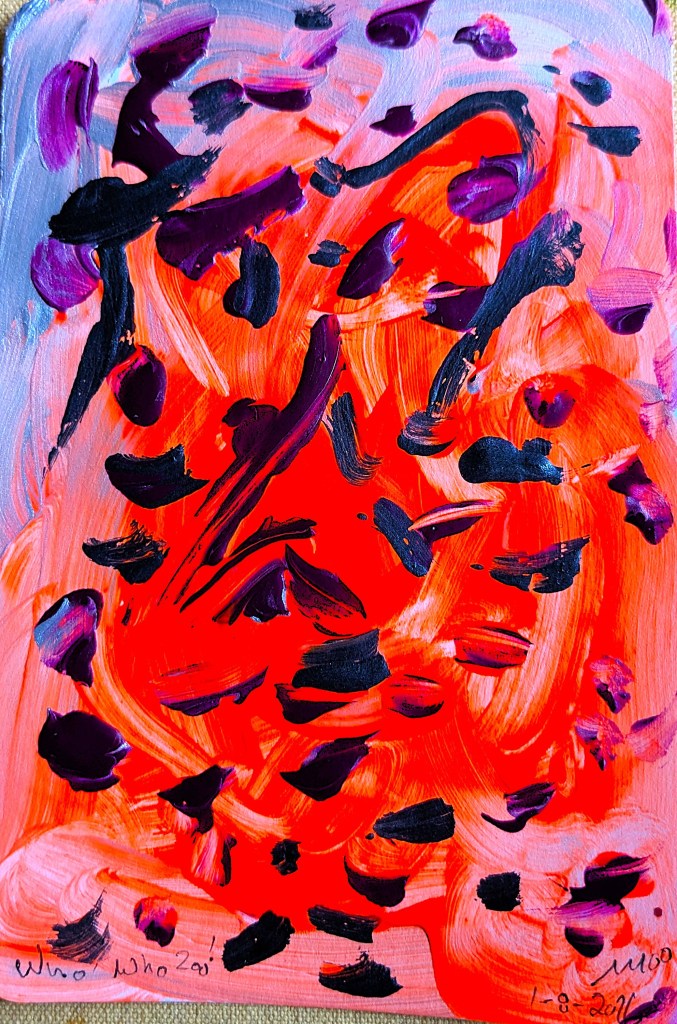
“And that,” said Moo, “is why I painted Who’s Who Zoo. Look carefully before you label who is who and where they stand in the Who’s Who Zoo.”

Questions

Questions

Jackpine Sonnet

each time you see a shooting star
a child is born or an angel falls
swarms of them in certain seasons
when our planet sails through
the meteor belt and rocks burn up
as they fall to earth through air and fire

written in the stars they say
and everyday I read my horoscope
to see what lies in stall
or rather what fate will me befall

warmth and love perhaps yet what
do cold unconscious planets know
about this life that people lead below

Eros Agape Philia
Jupiter Mercury Venus Mars
who knows what ancient
Greek and Roman gods
still play at being gods
among so many drifting
shifting shooting stars

Comment:

So, Moo is back to painting, at long last. Last night he painted two paintings to celebrate his return to a lovely clean, neat, washed, rearranged workshop desk that a certain KTJ tidied up for him. He was so happy. I could see him bouncing up and down on tip-toe, trying not to fall over with excitement. He even got to wash his brushes and ensure that all the remaining ones were solid and good.

“Back again,” he sighed. And that’s exactly what he painted. Of course, in the course of time some of his paints have dried up and a brush or two needed careful separation, fine squirrel hairs from dried paint. But with a little elbow grease and a lot of luck everything came together.

This time, I had poem that fitted Moo’s painting. It explores the idea that everything can be found in the heavens. Fray Luis de León phrases it this way –

Es más que un breve punto
este bajo y torpe suelo comparado
con aquel gran transunto
donde vive mejorado
todo lo que es, lo que será, lo que ha pasado?

Is it more than a brief speck
this low and clumsy earth compared
with that huge universe
where lives in betterment
everything that is, will be, and was?

Well, what a load of questions and all based on 16th Century Spanish Neo-Platonism. Yet old as the system of star reading is, people still read their daily horoscopes. Well, some people do. I guess they think that in the same way that the moon rules the tides and pulls them this way and that way, then the moon and stars rule our bodies – we are, after all, 95% water – and pull us this way and that way.

But hold on a moment. Nature or nurture. And what about free will – libre albedrío? Are we ruled by the stars? Or do we have free will to do as we want in this little world of ours? Good questions. What we do know is that certain people think they can do whatever they want, with no repercussions or consequences whatsoever, while others understand that certain societal norms and rules are there for a purpose. Oh dear – the eternal question. If the stars and planets know what we will do and when we will do it, can we speak of free will or are our lives pre-determined!

I guess Moo’s painting is more than a Who’s Who Zoo and more a who did what and with which and to whom zoo combined with when and why did they do it. “Alas, if thy mother knew it, sadly, sadly would she rue it.” And now’s the time to De La Rue it – so get out those playing cards, shuffle them carefully, read your fortune, and let’s see what is going to happen, and how, and when. Or you could read tea leaves, Viking Runes, or the lines on the palm of your hand. Speaking of which – question – what is the first sign of madness? – answer – hairs on the palm of your hand. Question – what is the second sign of madness? – answer – looking for them. – and you did, go on, admit it, you took a little peek, didn’t you. I know you did – it was written in the stars, and in the Tarot pack, and … and … and …. did you find one?

Windmill

Windmill
Jackpine Sonnet

When the scales fell from my eyes
I stood on them and wondered
what I weighed on the time’s great scales.

Miniscule. A featherweight.
A dandelion seed blown on the wind
that whirls the world through space.

Spiritus mundi – the great world spirit
inflating my lungs, each breath
a glimpse of the infinite
combining in my body and soul.

The sails of a windmill, my arms,
and the wind turning them,
dashing me down into the dust,
then raising me rejoicing to the skies.

Comment:

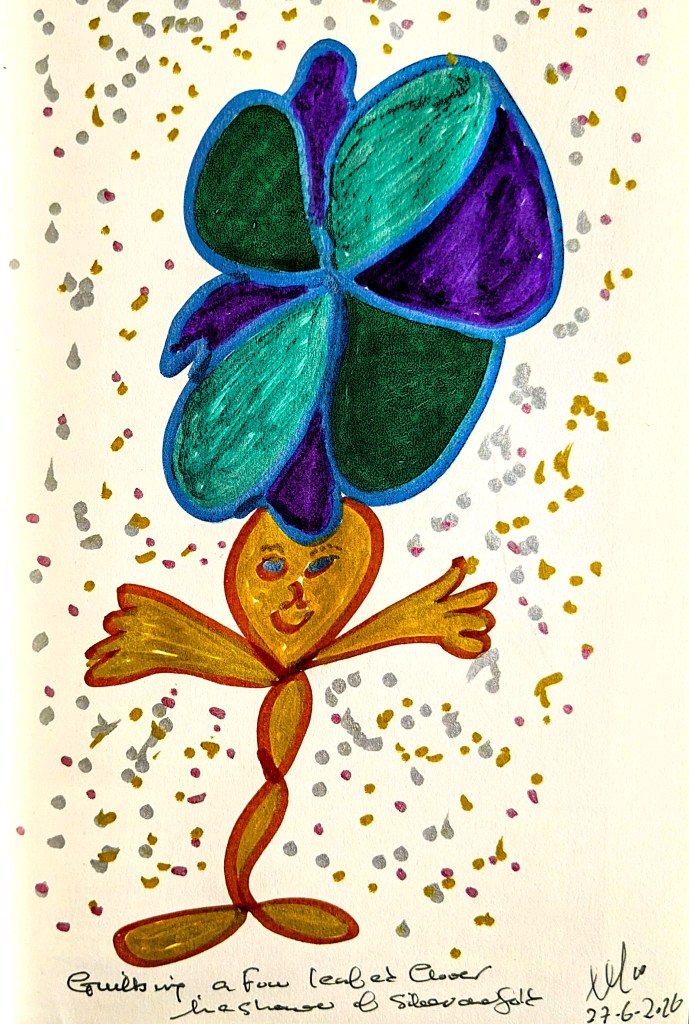
Moo said I needed cheering up, so he painted me a happy painting. “I know it’s not a windmill,” he told me, “but you can pretend it is. The leaves of the clover even look like they might be a windmill, and look, it’s got arms as well.”

“Thank you, Moo,” I said. My poem is a happy poem and it proves that the Black Dog of yesterday had been banished today, not by a happy dog, but by a four leafed clover standing beneath a shower of solver and gold.”

Intertextuality – texts speaking to texts. I wonder how many texts you can spot in this poem. I can count five, at least, and there are probably more. Milton Acorn, Miguel de Cervantes, Northop Frye, the Bible (not y Beibl Cymreig, unfortunately), Edmond Rostand. That’s quite the handful. Well, four fingers and a thumb, at least. Now all you have to do is spot the original sources which, blended, give my poem a saucy sauce of sorts. So, grab your AI and play hide and seek and see what you can find drawn from the dark recesses of my mind. Don’t give in too easily, now.

Mood swings – mood changes – Moody Me – Moody Moo – I’ll bet that you are Moody Too. Good mood, bad mood, who’s to say? We’ll leave that for another day!

Black Dog

Black Dog

The black dog leaps out
of the grandmother clock
and lands on my back.

His paws grip my shoulders,
then rake down my spine.

I try to shake him off,
but he growls, bares his teeth,
and won’t let go.

I love that clock,
its Westminster chimes,
the Roman numerals
standing guard
over the pointed arrows
of the hands as they march
round and round.

But I hate the hound
that makes its kennel
in the clock, leaps out,
snaps at me, bites and claws,
and grinds me
down into the ground.

Comment:

The Black Dog was Winston Churchill’s name for the depression that came over him, and overcame him, from time to time. It used to attack me when I was a young boy living in Swansea. My grandfather would point at the clock and say “He’s in there. He’s coming for you. I can see him. It’s the black dog.” Well, that used to drive me crazy and whatever it was that set me off became twice as bad when the black dog arrived. Alas, now I am entering into my dotage and my second childhood, the black dog has re-appeared to trouble my waking hours. I guess it’s the mood swings. Happy one moment, miserable the next. The good dog appears. The black dog drives it away. Then the good dog reappears and all is well again.

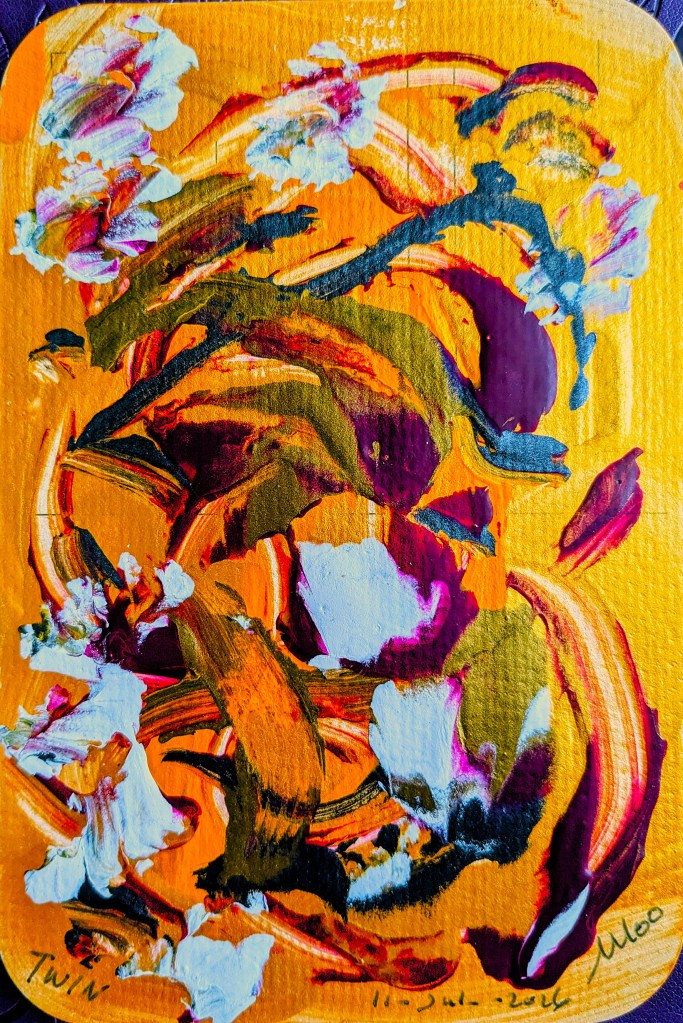
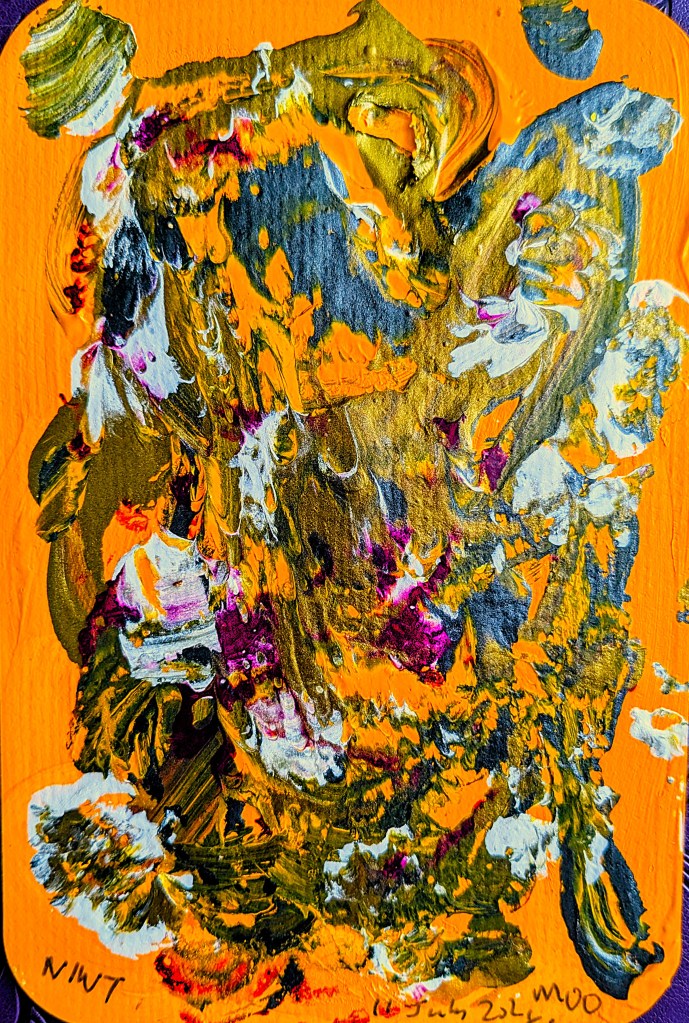
Moo understands me and my patterns very well. In fact he painted two paintings for me – Twin – the one above and Niwt – the one below. You can see evidence of the good dog and the black dog in each of them. But which is which?

I’ll leave you to guess which is the good dog and which the bad one. Really and truly, they are two sides of the same coin – heads and tails so to speak. Moo tells me you can think of the paintings as a mirror image, one of the other.

It’s like mood swings – either my mind or my body flips the coin and one of the two dogs jumps out visit me. Luckily, after a bit, the good one chases the bad one away, so it’s all swings and roundabouts and all the fun of the fair. Until I fall off the Ferris Wheel or see my own shadow while riding on the Ghost Train.

Twin, of course, is Niwt backwards. Or is it the other way round. Dylan Thomas, my favorite Welsh poet, set the standard for word reversal. After all, the town of Llareggub is bugger all backwards. What fun we can have when we twist our words, double up on our language, reverse words and their meanings, and generally weave the tangled webs of linguistic double-talk. Oh the mystery of missed and mixed up meanings. But are meanings meaningful or meaningless? Now that is the question. And when you have answered it for meanings, start thinking about double-meanings and their twins – or should that be quadruplets?

Mindfulness

Mindfulness

alive in the moment
a momentary cloud
crosses the sun face
brings shade to table

soon page and tabletop
ripple with light again

the pen’s shadow
pushes across the page
while the nib weaves
its spider fine lines
of well webbed words

meaningful mindful
each letter a moment
caught and held in time

Comments:

I caught myself forcing myself to write a poem – and it just wasn’t working. Meaningless words upon the page, each wound up, struggling like a little black fly in a spider web that promised only oblivion. Then I caught the one sentence that ends the above poem – each letter a moment caught in time. I had found what I was looking for. For the next half hour I played back and forth with a whole sequence of dibbles and dabbles that eventually led to what I have written above.

I showed it to Moo. “Tranquility,” he said. “I have just the painting for you.” Love at first sight – poet and painter, painting and poem, blissful in a true moment of blended tranquility and mindfulness. “Why, thank you, dear Moo,” I said and all our previous squibbling and squabbling was laid aside. We gave each other a big hug – I should add that we don’t often do that, as one or two of you out there might well know. But we did it today.

Meanwhile, I have received another set of fake invitations – oh, I would be so famous in the world of fakery if I gave away what little money I own to make myself truly famous – for my folly in believing the permanence of fakery. Why, only last week, I got an email mistaking me for my namesake and offering to help me publicize his most famous book – My Word is my Bond. The person involved was asking for a cool $250,00 for making the videos.

Oh dear. 007 is one thing. 006.5 is something else and someone else. Never mind – maybe one day someone real will call me and make me a genuine offer that I really can’t refuse. I probably wouldn’t believe that if it happened.

Enigma Variations

Enigma Variations

Our world is spinning on its edge, placed on
the perimeter of space, going who knows where.

Specks of dust, we float around and contemplate
night’s wonders wondering what might happen.

Out there, in the vastness that surrounds us,
worlds without end will never know we existed.

Bleak and blank our names, our deeds, our status,
the monuments sometimes raised in our praise.

And what of our thoughts, those sparks
of electricity that link us mind to mind?

Is each of our actions determined by a dance
performed by circling planets that shape us?

Are we nothing more than a code
of virtually meaningless dots and dashes?

Are we then pinballs bouncing between
a million trillion strings of flashing lights?

What star god plays trivial games of snakes
and ladders with our lives and names?

Commentary:

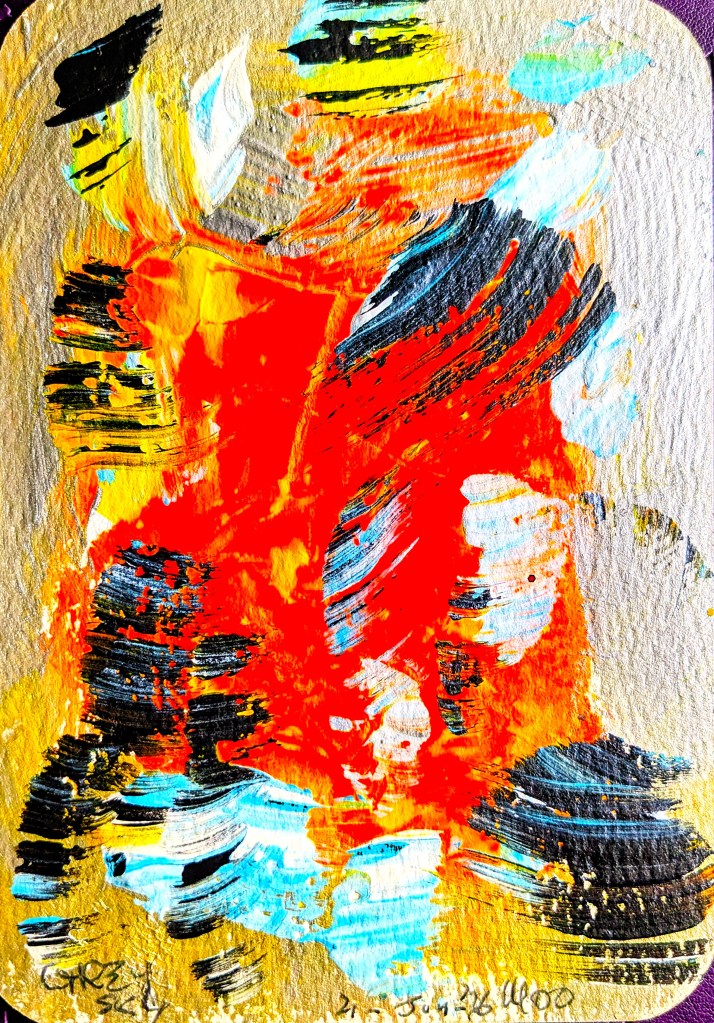
Moo’s painting is called Grey Sky with Bear Claws. He thinks it is a great companion to the poem. Actually, I rather think he likes to have his paintings published online without the necessity of lifting a finger to help. Oh dear – he heard that and just lifted his middle finger in my direction. “I am helping,” he said. “I also lift paint brushes. Remember that, you philistine.”

Philistine? Me? Now why would I be a Philistine? And what is a Philistine anyway? That’s where AI comes in. Thank you, Don Ryan. I wouldn’t know about AI without you. “And you wouldn’t know about painting without me,’ says Moo. “So tell me what a Philistine is,” I said to him. “Go look it up,” he scowled, wagging that finger in a menacing way. So I did.

AI to the rescue. A philistine is a person who is hostile, indifferent, or smugly oblivious to art, culture, and intellectual pursuits. The term typically describes someone whose interests are purely materialistic and practical, lacking any aesthetic refinement or appreciation for high culture.

Well, I don’t think that’s fair. Let’s see – hostile, indifferent, or smugly oblivious to art – no, that’s not me. I love Moo’s art, and he knows I do. I am not hostile to it at all, though I might be just a little teeny weeny bit hostile to him when I think he is lazy and doesn’t appreciate me. More – someone whose interests are purely materialistic and practical, lacking any aesthetic refinement or appreciation for high culture – no. I refuse to accept that. Purely materialistic? I give my poems away, free of charge, to my friends and anyone else who wants to read them. Moo isn’t materialistic either. He gives his paintings away to his friends. I know he does, because I have seen him do it. Come to think of it, I don’t think either of us is practical. We wouldn’t be living in Penury if we were.

Sorry. I won’t go any further. That’s all Isle of Wight Ferry, as they say in Hampshire. Well, I won’t call you a Philistine if you don’t know what they say in Hampshire. Okay – here goes. “What’s hot, black and smelly and comes steaming backwards out of Cowes?” Why, it’s the Isle of Wight Ferry, of course. Well, it was until they replaced it with a hovercraft. Now the joke [Cowes, the port / cows] doesn’t work any more. So, here’s a couple of questions at Philistine 100 level for you – (1) What have Margo and Reg got? If you don’t know, you’ll have to ask Stomping Tom Connors. And (2) what did Reggie give to Margo? Okay, okay. I give in. I’ll tell you.

Answers – (1) Margo’s got the Cargo and Reggie’s got the Rig. (2) A cowsy dungsy clock, of course. Made only in Canada. And you can check that one on AI too. And look up the song on YouTube while you are at it. Canada Day – July 1 – and Stomping Tom Connors is one of the best adverts for Canada. Go, check out his songs.

On Re-reading Quevedo’s Poetry

On Re-reading Quevedo’s Poetry

Was that where my life went,
a spent candle trailing dark studies
among the packed lines of your poems?

What about you, was your life gutted by that
same guttering candle by whose light you
scrawled your tight black spider rhymes?

Are they all meaningless, your insights
and my words? Few people now know who
you were and what you represented.

Am I, your scholar, a mere shadow
of your shadow struggling in the straggling
half-light of your existence?

Yet, I’m still intent on sharing light
and the word with a world that thinks
the two of us are out of date and absurd.

Avalanche

Avalanche

A single stone
starts the avalanche

The boy in the kitchen
bare legs held to the fire
‘this is what hell will be like’

The cupboard under the stairs
cold dark locked from the outside
an oubliette
the young boy left there
forgotten

Running upstairs
to safety beneath the bed
hands grasping at legs
and ankles
pulling him back down
for appropriate punishment

The belt the stick
the little red brush that cleans
the fireplace
with its foretaste of hell
beating battering
an avalanche of blows
the boy buried beneath them

Commentary:

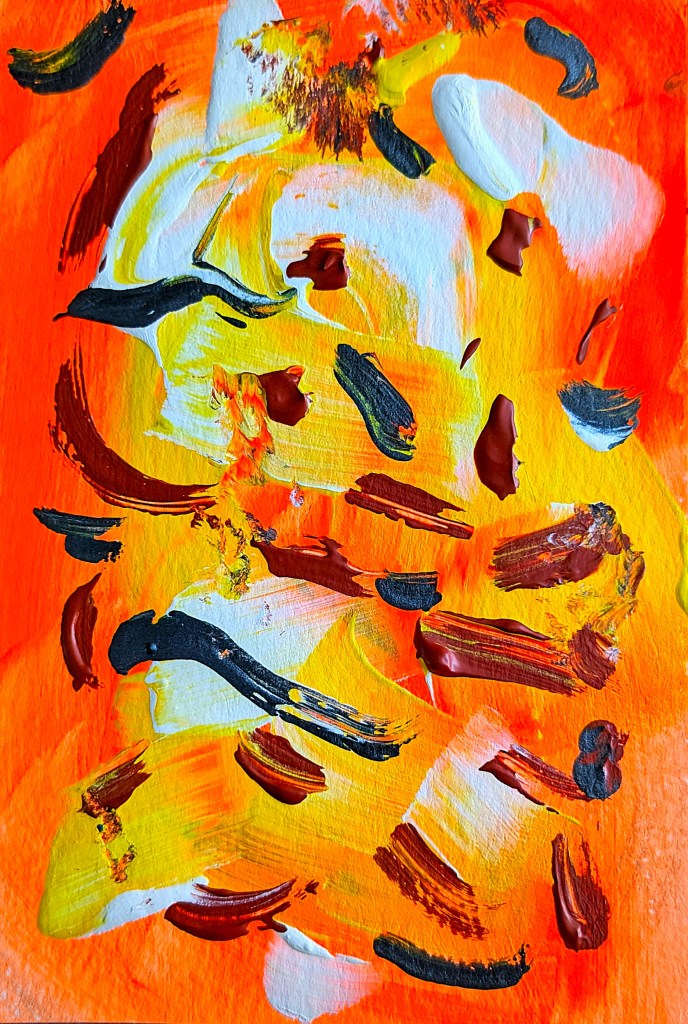
Another unsigned painting by Moo. He told me that he calls this one Orange-U-Happy. Well, it is a happy painting, until you read the poem that goes with it and discover that all the stones of the avalanche are floating around in Moo’s painting, including a nice selection of sticks.

“Sticks and stones will break my bones, but names will never hurt me.” But names do hurt. Names can be cast like stones, and the thrown stone, like the spoken word, can never be recalled. Liar. Cheat. Thief. Little Lord Fauntleroy. Bite the hand that feeds you. Are you laughing at me? I’ll teach you a lesson you’ll never forget. I’ll shake you until your teeth rattle.

Stones can be thrown into ponds. When they are, the ripples reach out, spread further, spread far and wide. Thrown words can enter the soul, ripple through the blood, and they can lodge in heart and brain, forever memories that never fade and never fly away. Heart stones, they are, that strike at the stroke of midnight and leave the victim suffering, gasping for air.

So many silent memories, buried deep, only to rise and parade around in dreams at night, revenants come to haunt and hunt, sharp words made even sharper than flint or obsidian to cut and fracture, and splinter, and slowly, slowly wear down the prey. Words – the jaws that bite, the claws that snatch. Think twice before you throw, speak, wound, injure …. then think again, bite your tongue, stay your hand, drop the stone, think rather of the hand of friendship, of comfort, the feathered wing of the guardian angel that consoles and brings succor.

Succour (or succor in American English) means assistance or support given to someone experiencing grief or hardship. It is a formal, often literary term used to describe help that offers actual relief or comfort to people in difficult situations, such as disaster victims or those struggling emotionally – Wikipedia.

And remember – many words have double meanings – spare – to forbear: deciding not to hurt, destroy, or punish, such as “sparing the life” of a captive or sparing the the rod. Spoil – to indulge: to treat someone, such as a child or pet, with pampering. It can also mean treating oneself to a luxury or relaxing day.

So, what does spare the rod and spoil the child mean? Clearly it is a phrase with a double meaning. Choose which one you will. But remember – “Let us pray” is a better prayer than “Let us prey“.