My Love For You

My Love for You

A Jackpine Sonnet

Yesterday fled quickly by
today limps slowly on and on
tomorrow draws near
yet never arrives
if and when it does
it becomes today

As for me I feast on shifting
shadows my story a tapestry
reversed – hanging
back to front unreadable

It is hard to slough your skin
the skin once shed can never
never be donned again

My body white bone grey gristle
no longer wrapped in skin
is bonded together by super glue
made from my love for you

Comment:

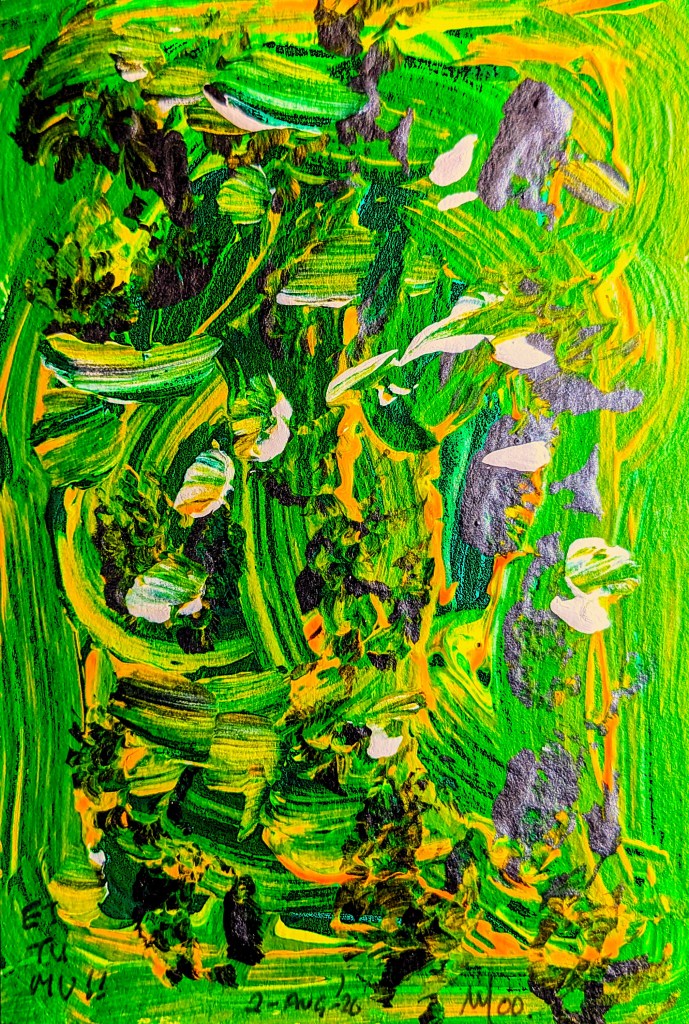
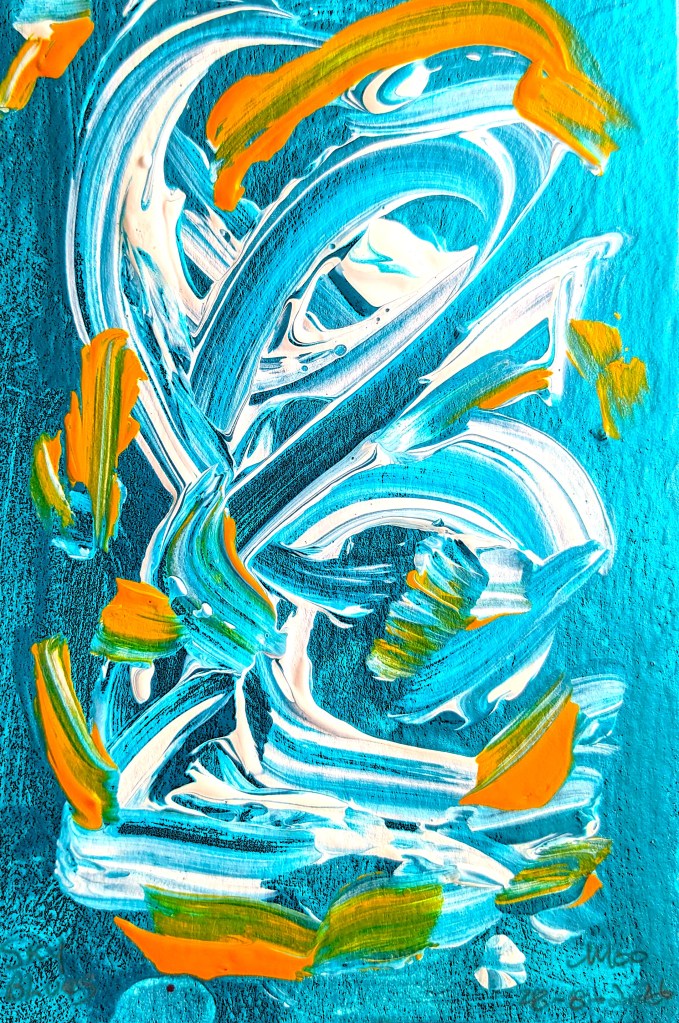
Moo assures me that this painting, unsigned and untitled, is actually his. After yesterday’s doubts, I must believe him. He says it is called U-R-My-Sunshine. He also thinks it would be a great painting to go with this strange little poem that crept somehow out of my head and landed on my page. It reminds me somewhat of the church cat – it crept into the crypt, crapped, and crept out again. “Oh what a naughty pussy cat.” Who U-R is up to the reader / viewer apparently. I doubt that I am his sunshine after what I said about him yesterday. Oh sorry. You didn’t read that blog? Well, shame on you! You’ve got to do your homework if you’re going to keep up with me and Moo.

What is A Jack Pine sonnet, you ask? Well, I don’t have a clue. But now that my other buddy, Ryan, has introduced me to AI, I will ask my AI what such a thing might be. Asking now. Hang on to your seats. It tells me it’s thinking. Aha! Here’s what I think it thinks it thinks.

AI says – A jackpine sonnet is an irregular, spikey poetic form created by Canadian poet Milton Acorn (from neighboring PEI), in the 1970’s. It typically acts as a 14-line sonnet with 7-13 syllables per line, but allows for flexible line counts (e.g., 12, 18, or 20), using internal and consecutive rhymes rather than strict, traditional rhyme schemes.

Key Aspects of the Jackpine Sonnet:

  • Origin: Developed by Milton Acorn, often known as the “People’s Poet,” as a uniquely Canadian, gritty form of expression.
  • Structure: While it aims for roughly 14 lines, it can vary in length based on the needs of the poem.
  • Rhyme and Rhythm: Uses internal rhymes (rhymes within a line) or consecutive end-rhymes (e.g., AABB) rather than standard sonnet structures.
  • Style: It is designed to be “irregular and spikey like a jack pine tree,” focusing on structure and integrity rather than rigid adherence to traditional verse rules.

So, now you know what a Jack Pine sonnet is. But I bet you’ve never heard of Milton Acorn! I have. Here’s the poem I wrote about one of my meetings with him. You can find it in The Nature of Art.

Milton Acorn

“Oy,” he waved strong carpenter’s hands, “Make this
work.” I typed in my code and the machine
came to life. “Go away,” he pushed me out
and slammed the copier room door behind my back.

Later, my secretary came in and caught him,
his face pressed to the glass. He pushed the button,
lights flashed, the machine whirred and copies emerged.

In his hand he held images of his feet,
arms, legs, head, all of his body parts.
“Tape, not masking, clear tape, 3M.”
Flustered she fled, brought Scotch tape,
watched as he stuck himself together.

Over lunch he showed me his work:
a self-portrait, shadowy and cloudy,
whiskered and worn, smelling still of printer’s ink.
That’s how I remember him: unique, stately,
unmistakeable, uncouth, unseemly:
a jack pine growing in its own self-image.

Farewell, my dear friend, Milton.
And that is how I remember you.

Red Cloud of Reality

Red Cloud of Reality

Far from the city lights
this night sky
a black umbrella
held above my head

the brolly’s fabric
pierced by pin-pricks
silent stars careless
in their indifference

las night a cloud of unknowing
descended – wrapped itself
blanket-like around my house
brought warmth and comfort

today I sit alone and lost
head in hand – searching for sustenance
seeking the freedom to sky walk
to turn schemes and dreams into facts

Person holding a glowing umbrella overlooking a neon cyberpunk cityscape at night
A figure under a starry sky, holding an illuminated umbrella.

Big Brother painted this.
He’s watching you.

Comments:

Me and Moo back sharing poems and paintings, thoughts expressed in words and paint. How nice to be together again. Never mind the weather, as long as we’re together. Careful now, The Red Cloud of Reality is not part of a Wild West Show. There are no elephants and kangaroos in this part of the world. How cryptic can we be? I don’t know. Look carefully at Moo’s painting. Can you see an elephant or a kangaroo? Not unless they are fossilized, methinks. Fossilized before our eyes. Oh what fun it is to ride on a one engine sky red slay along with the Scarlet Pimpernel and the Lone Ranger. But how can he be a Lone Ranger if he’s accompanied? Don’t ask me, ask Tonto. Jay’s the one who knows everything. He even knows who that masked man is. I know, I know – he’s a survive of Covid, very wise, because he always wore a mask. And what did you do during Covid? Well, I didn’t shine bright lights inside my system. I didn’t drink Drano – a cure all for everything, if you’re a drain pipe. Me? A drain pipe? I don’t even wear drainpipe trousers. Oh those were that days. No parking meters outside our doors to greet us! Fings aint what they used to be. Figs, neither. And that’s why Syrup of Figs is all the rage Even better than Cod Liver Oil. I bet you don’t remember Scott’s Emulsion? Indeed I do. I also remember Eno’s Fruit Salts. Made you really happy they did as you rowed merrily, merrily down the stream of consciousness into the Land of Nod. You mean Toytown – the land of Noddy, Big Ears, and Mr. Plod. Big ears? See – an African Elephant. I knew there was one in there somewhere. And here he comes, blowing his own trumpet. How does an elephant commit suicide? I won’t tell you. I refuse to give King’s Evidence, even if you do put me in the soup – Cream of Kangaroo Court, of course. I bet you didn’t see that one coming. Hop along, now. Here comes Cassidy les Calanques and he don’t wait for nobo-doddy even if his name’s really Ken. I don’t get it. I didn’t get it either. That’s how I stayed clear of Covid. Ha! Try translating that little piece from Welsh into Basque. You’ll end up in a basket, cased like all those other little boiled egos, with their little legos. Never mind – “il faut imaginer Moo heureux!” / We must believe that Moo is happy.

Orality and Literacy – Words – Spoken or written?

Ryan and Don Roger

13

Orality and Literacy
Words
Spoken or Written?

            We asked our AI friends what the rate of illiteracy was in Spain in 1605, the date of publication of DQI. According to them – Based on historical trends, the illiteracy rate in Spain in 1605 was extremely high, likely exceeding 90% to 95% of the general population. While exact nationwide surveys did not exist in 1605, historical insights from the period indicate that during the 16th and 17th centuries, the ability to read and write was generally restricted to elites, clergy, and urban professionals. Furthermore, female illiteracy was significantly higher, with hardly any women possessing writing skills during this era. And, in addition, literacy was slightly higher in major cities like Madrid or in northern Spain, while the rural south suffered from much higher illiteracy rates. Based on these insights it is easy conclude that well under 10% of the population in Cervantes’s time knew how to read and write.

            In Don Quixote, Cervantes reveals to us a rural society which is basically illiterate. Most of the multitude of characters can neither read nor write. Throughout the woven interplay of the novel, Cervantes juxtaposes the illusion of the literate nymphs and shepherds who come into the woods to dance and play with the reality of the goatherds, shepherds, and horse wranglers, like the Yanguesans (DQI, XV / 15) who, totally illiterate, work the woods for a living. This contrast is a theme of the times and can be clearly seen in the paintings of Velásquez. One has only to think of The Water Seller, The Old Lady Frying Eggs, The Topers, The Court Dwarves, and Vulcan’s Forge, to name a few paintings that illustrate the clash of youth, age, class.

            The question of learning is an interesting one, explored in depth by Walter J. Ong in Orality and Literacy (1982). Learning in an oral society is done by word of mouth. One method of handing down knowledge is the proverb, its wisdom passed down from generation to generation. Sancho Panza, totally illiterate, is famous for his stringing together of proverb after proverb. He is the prime example of what one might call oral sagacity. Don Quixote, on the other hand, amazes us at first with his mastery of the ballads and the major exploits of knights errant in the novels of chivalry that he recites and imitates at will, and later with his mastery of such themes as the Golden Age and Arms and Letters. 

As Ong points out, the presence of writing changes totally the ways in which people think and learn. The word, once spoken, can never be recalled. But, when the word is written down it can be redacted, erased, changed, crossed out. More, the immediate transference of ideas from person to person in the oral exchange of conversation is totally different from the thoughtful exchange of written letters and ideas. In the latter, one trains oneself to think before you ink. That thought process can then be transferred back to the thinking process, both by literate and illiterate people. In this way, the processing of thought changes. And that is what happens to Sancho Panza in DQII.

The question of authority arises here. In an oral society, authority rests with the older members, who have lived long, and understand much, and a great deal of it preserved in proverbs. In a literate society, the authority resides in the written word, especially when it is tested and approved by the Inquisition (in the case of Spain) and royal permission. In a literate society, those who have studied a subject become the authority in that subject. I know professors who never again took a course or opened their books after they attained their doctorates. The PhD gave them the right to be an authority and to know it all. I also know professors who never stopped learning, who continued reading, and publishing, and taking courses, and building their initial knowledge base into a life long learning process.

Is knowledge static? I certainly hope not. As T. S. Eliot writes in Burnt Norton, “Words strain, crack and sometimes break, under the burden, under the tension, slip, slide, perish, decay with imprecision, will not stay in place, will not stay still.” The lapidarian truth of the folkloric proverb softens as change surges around us. The authorities of the sixties, when I was in graduate school, faded gradually, and new names, new theories, new doctrines replaced them. We started to explore these ideas in 5 – Book Burnings and 6 – Censorship. With the proliferation of knowledge via the internet and the intrusion of an abundance of AI into our lives, this question of authority – what is true and what is false – must form a part of our current thought and teaching and learning methodology. How do we distinguish truth from fiction, real news from fake news?

In an oral society, with no writing, your word is your bond. Think of the cowboy movies – “White man speak with forked tongue.” Now make the appropriate gesture from the many Cowboy and Indian movies you have seen. White man wants it in writing. For the red man, his word is his bond, sealed maybe, with a slash of the knife across the wrist – blood brothers. We have entered a world with different cultures and expectations. Now ask yourself, how many written treaties has the white man broken across the centuries. Is his word, written or spoken, truly his bond? I guess it depends upon the courts and the lawyers.

            “My word is as good as my bond,” 007 aka James Bond aka Sean Connery aka Daniel Craig aka Pierce Brosnan aka Roger Moore aka 3M-007. How many levels of different linguistic reality, at the intertextual level, can you count in that delightful sentence? Just think about it. And tell me, if you are an authority on the subject, who is the real James Bond! Meanwhile, remember that The Olde Order Changeth Lest One Good Custom Should Corrupt The World. Now, could that be Tennyson, Idylls of the King, or is it a quote from The Wycliffe Star? You are the authority. You choose!

Mindfulness

Mindfulness

Poems arrive, as silent as the deer
that troop through my garden.

Some times they hurry past,
and catch them if you can.

Sometimes, they stay, wait, nibble
 at an overhanging branch.

Just when you think you can
reach out and grasp them,
they sense the bark of a dog,
the sigh of the wind
through leafless trees.

You blink, and they have gone.

Was your camera ready?
Was your note book open,
your pen in your hand?

Or did they flit away like dreams
 in the morning when the sun
comes into the bedroom
and sparks diamond fires
from the lashes that stand guard?

Nights

Nights

There are nights
when the trees
seem to whisper
your name,

cautioning you
against the wind’s
knife edge.

“What have I done,”
you ask,
“to merit this?”

The soft fall
of burnt brown leaves
weeps over
your woodland grave.

You will walk
these woods
no more, save
on a frosty night

when deer shiver
beneath naked trees
and the moonbeam’s
icy blade.

Comment:

Poems arrive, as silent as the deer that troop through my garden. Some times they hurry past, and catch them if you can. Sometimes, they stay, wait, nibble at an overhanging branch. Just when you think you can reach out and grasp them, they sense the bark of a dog, the sigh of the wind through leafless trees. You blink, and they have gone.

Was your camera ready? Was your note book open, your pen in your hand? Or did they flit away like dreams in the morning when the sun comes into the bedroom and sparks diamond fires from the lashes that guard your eyes?

The Golden Age

Ryan and Don Roger

11

The Golden Age

            Don Quixote begins his discourse on the Golden Age (DQI, XI/11) with these words: “Happy the age and happy the times on which the ancients bestowed the name of golden, not because gold, which in this iron age of ours is rated so highly, was attainable without labour in those fortunate times, but rather because the people of those days did not know those two words thine and mine. In that blessed age all things were held in common.”

            Several things of note. First, the length of the sentences. Remember we are reading about a society in which the majority of people were still illiterate, knowing neither how to read nor to write. Earlier, in the same chapter, when Don Quixote describes his role as a knight errant, we read that “The goatherds did not understand this gibberish about squires and knights errant, but just watched in silence …”

            Don Quixote goes on to describe the perfect pastoral life in the course of which nymphs and shepherds could go about their daily lives living in peace, love, and justice, and aways at one with the land. It is interesting to read about this idealistic and escapist pastoral myth that takes place in a land overflowing with milk and honey. Now compare it with the reality of the illiterate goatherds who slaughter and consume their own goats, devour dried, wrinkled acorns, and eat rock hard, age-old cheese.

Compare it too with the reality of the current age of iron, as described by Don Quixote who says “But now, in tis detestable age of ours, no maiden is safe even though she be hidden in the centre of another Cretan labyrinth; for even there, through some chink or through the air, by dint of its accursed persistence, the plague of love gets in and brings them to the ruin despite their seclusion.” Is Don Quixote’s description of this detestable age any more real than his description of the Golden Age? Whether it is or isn’t, Eon Quixote uses the contrast between the two worlds, past and present, for his own ends. I quote “Therefore, as times rolled on and wickedness increased, the order of knights errant was founded for their protection, to defend maidens, relieve widows, and succour the orphans and the needy.”

            We should also mention the illusion of the Don Quixote’s literary pastoral in which “all was peace then, all amity, and all concord” and the reality of the harsh life led by these real goatherds.

Reality and illusion is a common theme as we move from the Renaissance towards the Baroque. For those of us who follow Spanish Art, we have only to look at Velásquez’s paintings to understand the difference between the ugliness of the court dwarves and the beauty of the royalty they entertain. In his painting The Topers, for example, Velásquez shows the reality of the country folk. In Vulcan’s Forge he presents us with the workmen who labour around the furnace contrasting them with the god Apollo who addresses them from within a golden light.

            We will meet the pastoral myth on many occasions in Don Quixote I & II, for our adventurer meets with many suffering lovers who escape, or try to escape, their sufferings by fleeing to the countryside to live an idyllic life free from the stress of their supposed multiple love and relationship problems. The pastoral – escapist literary, it is, describing a perfect world that never existed. A suitable follow-up to Past Glories Restored #10 in this sequence of ours. Can such Edenic innocence ever be re-created in contemporary society, Don Quixote’s or our own? A leading question and one that readers must answer for themselves.

In Wales and in the Welsh language, we have a wonderful word to describe that longing for the Golden Age that is long past and unrecoverable. Hiraeth – a spiritual longing for a home that maybe never existed. Nostalgia for ancient places and times to which we can never return. It is the echo of the lost places of our soul’s past and our grief for them and their loss. It is in the wind, the rocks, the bays of the Gower coast, and the waves of the sea. It is nowhere and yet it is ubiquitous.

Past Glories Restored

Ryan and Don Roger

10

Past Glories Restored

            What is it about madmen like Don Quixote that they find it hard to live in the present and always want to see themselves restore past glories however impossible it is to do so? The search for the beauty and peacefulness of the past is always with us. Many seek the perfection of the Garden of Eden, but wise men know that Adam and Eve were expelled from the garden by an angel with a fiery sword, never to return.

            Jorge Manrique (1440-1479) begins his Coplas por la Muerte de su padre with the statement that “a nuestro parescer, cualquier tiempo passado fué mejor.” / It seems to us that any past time was better. Why do poets and madmen always look back to the past, all too often with a view to recreating that which can never be recreated?

            François Villon (1431 – 1463?) asks, in his famous refrain to La Ballade des Dames de Jadis – “Mais où sont les neiges d’antan!” / Where are last year’s snows! Indeed, the theme of ubi sunt / where is – where are is a constant throughout literature. And where is last year’s snow? Can you tell me? It certainly isn’t in our aquifer. I didn’t even use the snowblower last year. Tell me, where did the snow go? I live in Canada, and we didn’t see it. So where did it go?

            Marcel Proust (1871-1922) searched for those lost times in his novel À la recherche du temps perdu. This can be translated directly as In Search of Lost Time. It also occurs, more poetically as Remembrance of Things Past. Unfortunately, the word Remembrance rather cancels out the idea of Search, not to mention the twin ideas of recalling and re-establishing. However, in the case of the madman, Don Quixote, it can be argued that all those meanings are correct. But what exactly does Don Quixote want to restore?

            Above all, Don Quixote wishes to restore the lost age of knight errantry. He is besotted by the fantasy tales of these knights errant and believes that he can be one himself and restore their glory with the force of his arm alone.  In DQI, II/2, The knight addresses the ‘ladies of easy virtue’ at the inn in these terms: “I beg you, ladies, not to fly, nor to fear any outrage; for it ill fits or suits the order of chivalry which I profess to injure anyone, least of all maidens of such rank as your appearance proclaims you to be.’ His language, which was unintelligible to them, made them laugh more. So, knights errant protect women, especially damsels in trouble, and women of easy virtue. That is one of their most important tasks.

            In DQI, IV/4, our knight meets the boy, Andrés, who is being whipped by his master, the farmer. Don Quixote stops the thrashing and makes the man promise to pay the boy the wages that are owed him. The farmer promises to do so, but when Don Quixote leaves, he ties Andrés to a tree and whips him so soundly ‘that he laves him for dead.’ Protect the innocent, then, is another task, one at which Don Quixote fails miserably, as we will see later.

            In addition to restoring the high ideals of the ancient order of knights errant, Don Quixote also wishes to keep the words and deeds of the ancient romances / ballads alive, and this he does throughout the book. His constant quoting of passages and deeds from the books of chivalry, those that have driven him mad, serves to keep them alive. As we said earlier, you can burn the individual books, and destroy them, but you cannot destroy the ideas they contain. Don Quixote, in his constant and lively embodiment of those books serves to keep them, and their ideals and ideas, vibrant in the eyes and the minds of the readers.

            Cervantes, perhaps a wiser man than many, restructures the theme by rejecting it – no hay pájaros en los nidos de antaño / there are no birds in last year’s nests. However, as we shall see, it doesn’t stop Don Quixote the madman, from searching for the glories of past times and from fighting for them in an effort to restore them.

And don’t forget Guillaume Apollinaire (1880-1918), who perished in WWI – “Ni temps passés ni les amours reviennent / sous le Pont Mirabeau coule la Seine.” “Nor past times nor past loves return / beneath Mirabeau Bridge flows the Seine.”

Comment:

We don’t need a comment really except that The Olde Order Changeth Lest One Good Custom Should Corrupt the World. Interpret that as you will. And as Moo says to Ryan in the presence of Don Roger – “Hey, Ryan, look at all those changes in my painting.”

The Sowing of Acorns

Painting by Moo
PTSD Spatter
aka

The tangled web we weave
when first we practice to deceive

Ryan and Don Roger

9

The Sowing of Acorns

            Metatheatre can be defined as a play within a play. In DQI,7, the priest and the barber decide that one of the easiest ways to cure Don Quixote of his madness will be to wall up his library, so that he can find no trace of the room in which it was contained. They thought it might stop him from thinking about his books. Then they agreed to tell him that an enchanter had taken the books away, room and all.

            When Don Quixote asks the housekeeper about his books, she tells him that there is neither room nor books because the devil has taken them away. The niece joins in and corrects her saying that no, it wasn’t the devil. A sage enchanter descended one night in a cloud, dismounted from his dragon, went into the room, came out through the roof in a puff of smoke, and left no trace of room or books. He called himself Muñaton and said he had a grudge against the books’ owner. Don Quixote corrects her and tells her is must have been Freston. The housekeeper joined in with “Freston or Friton, but it ended in ton.”

            Cervantes has now planted several little acorns in the mind of the reader. Sooner or later, they will grow into large oak trees.

1. Metatheatre is based on a falsehood. The main character does not see the dramatic irony in the situation, but believes the lie that the other characters have spun for him. They write the play within a play, and Don Quixote becomes the actor in that play written specifically for him. This metatheatrical theme will recur throughout the novel and will become dominant in DQII.

2. The correction of speechMuñaton (housekeeper and niece) becomes Freston (DQ), becomes Freston (the housekeeper), and then Friton, or something ending in -ton. The correction of spoken language will play a much larger role later in the novel.

3. The role of the evil enchanter who dogs Don Quixote’s footsteps and robs him of his greatest triumphs. This will start in the very near future with the adventure of the windmills.

4. The intersection of illusion and reality. This is really important for several reasons. Cervantes, as author, causes his characters to reveal the truth behind any metatheatrical (or other) illusion that concerns Don Quixote. He does not wish to trade, like Lazarillo de Tormes in false miracle. Clearly, he has no wish to be, like Lazarillo, castigado.

The simplest conflict between illusion and reality occurs in the first sortie. Don Quixote sees an inn, a humble country inn. Totally deluded, he believes it is a castle. Nobody contradicts him. Inn – reality / castle / illusion – but nobody really points out the difference. The adventure of the windmills is similar. Don Quixote sees giants. Sancho Panza sees windmills. Now the conflict is supported by a sane and reliable witness aka his squire. When one of the characters reveals the illusion, the author does not need to step in and do so. Throughout part one of the novel (DQI), we will see Don Quixote reacting in different ways to the unmasking of the illusion in which he so strongly believed.  This situation, as we will see, will be presented in very different fashion in DQII. One fictional month between the two parts – but, in reality, ten years in which Cervantes thinks, plans, rewrites, and deepens his plots while polishing his skills.

So many little acorns. So many sown seeds. Hopefully, we will soon be able to watch them grow.

House of Dreams 5 & 6

House of Dreams

5

A leaf lies down
in a broken
corner
and fills me
with a sudden
silence.

I revise
our scrimshaw history
carving fresh tales
on the ivory
of new found bones.

6

A vixen
hunts for my remains.

She digs deep
at midnight
unearthing
the decaying teeth
you buried with
my borrowed
head.

Comment:

None of this makes sense. Why should it? Don’t ask me to explain it to you. Who am I to tell you what to think and what to do? You are not in elementary school now. Teacher is not leaning over you, teaching you how to shape letters with a pen, telling you to color in red, or yellow, or orange.

Learning – tell me what have you learned? Have you learned to think for yourself? Have you learned that life is mysterious, joyful, sad? Do you not know it can also be incredibly dangerous? Fear not the thunder. Rejoice in the rain and snow. Open your eyes to the world around you and be joyous wherever you go.

Meditation

I am the gatherer of words,
the weaver of wooly clouds.

I am the sheep dog
who shepherds the flock
in and out of the field.

I am the corgi
who snaps at the heels
of cows and pigs,
too small to be noticed.

I am the butterfly
turned into an eagle
who soars into the sky
and gazes on the sun
with an open eye.

Tell me,
my friend,
what and who
are you?

House of Dreams 3 & 4

House of Dreams
3 & 4

3

The light fails
fast, I hold up
shorn stumps
of flowers
for the night
wind to heal.

The pale magnolia
bleeds into summer:
white petals
melting on the lawn
like snow.

Sparrow sings
an afterlife
built of spring
branches.

4

Pressed between
the pages of my dream:
a lingering scent –
the death of last
year’s delphiniums –
the tall tree
toppled in the yard –
a crab apple flower-

a shard of grass
as brittle
as a bitter tongue
at winter’s
beginning.

Comment:

“La poesía se explica sola, si no, no se explica.” Pedro Salinas. Poetry explains itself. If it doesn’t, it can’t be explained.

This quote suggests that the poem is a self-contained entity that must be accepted and understood on its own terms. This is particularly true when metaphor rules and feelings and meaning are contained within the poem’s enunciation. In addition, the musicality of words can never be ignored. The rhythm they bear within them speaks for itself.

Show don’t tell – easy advice, but what exactly does it mean? So many people say so many different things. A cliché is always the simplest form of criticism.

“I don’t understand your poem,” Moo tells me.
“Neither do I,” I reply, “and I wrote it.”

“I don’t understand your painting,” I tell Moo.
“Neither do I,” Moo replies. “And I painted it.”

Words of wisdom.

Breathe deep.
Look and listen.
Don’t think.
Feel.

Hear the smell of color.
Touch the emanating light.
Taste the dry leaves crackling.

See the words shaping,
carving themselves
deep into your dream.