Star Field & Brush Fire

Star Field
&
Brush Fire

The evening and my mind
both slipping away
into the grey mesh of twilight
that bids farewell to day
and brings on night

Words no longer link
solitary stars they blink
and I no longer think
the way I used to
logic buried deep
no longer rules

Who am I who writes
these words each letter
a shooting star
trailing bright light
across night’s page

I hesitate confused
and know not what I write
what I want to write
hides out of sight
will not soar upwards
into starry fields of light

Commentary:

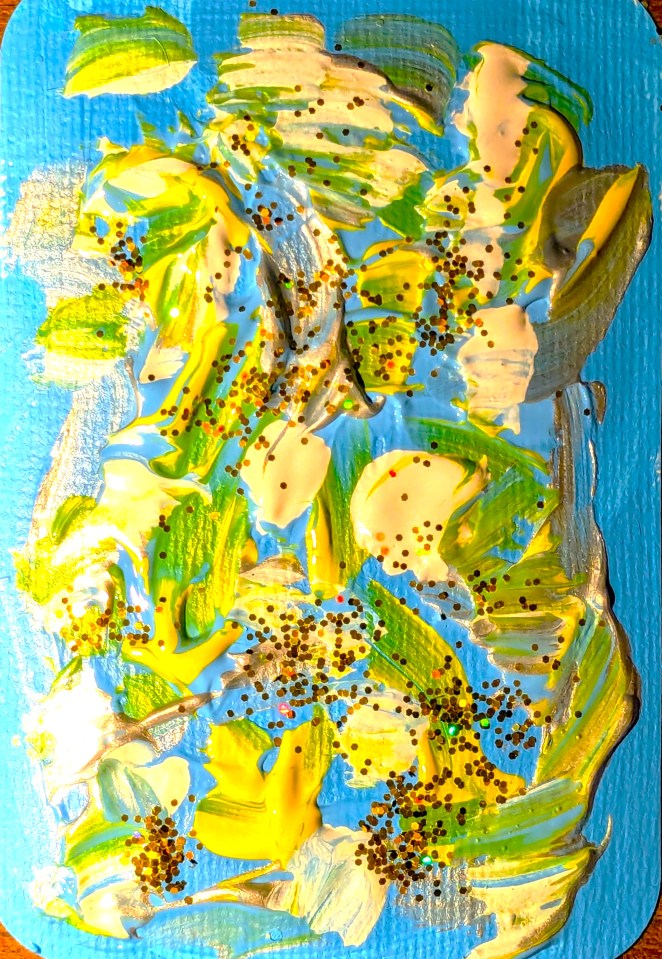
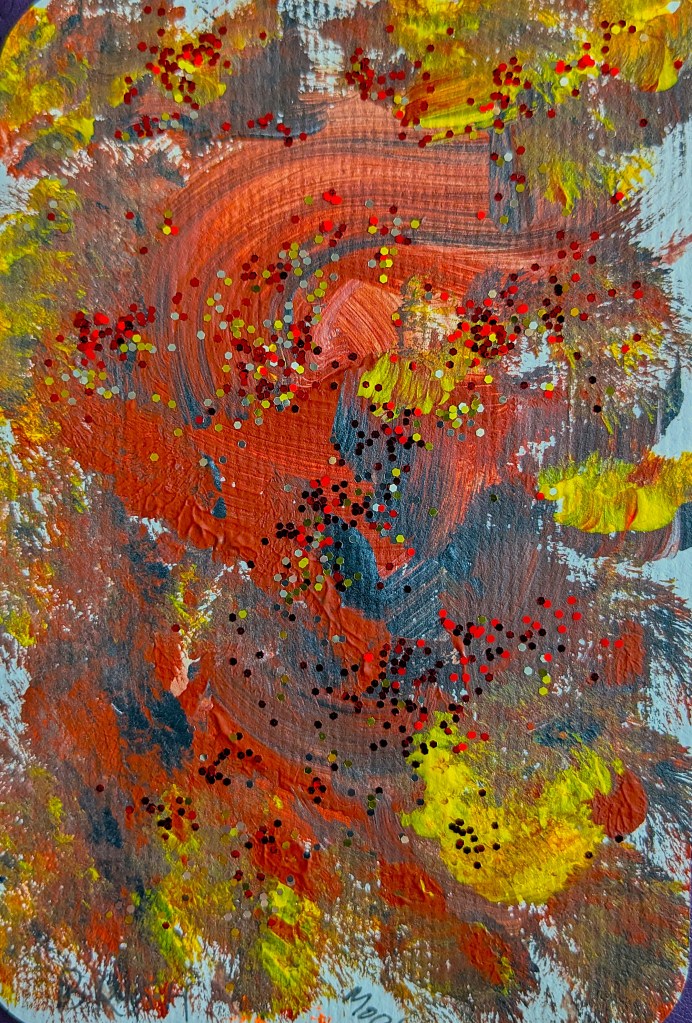
Brush Fire – that’s what Moo calls this painting. It wasn’t his idea to call it that. He didn’t have a clue what to call it. However, he explained to KTJ that the reason why he didn’t know what he had painted was because he had finished painting what he had wanted to paint but had some paint left on the paper saucer he uses for a palette, and he didn’t want to waste it. So, he pepper sprayed what you see above. “You mean you were just cleaning your brushes,” KTJ asked. “Yes, ” he replied. “I thought I might call it Sky Fire or Fire Storm or something like that.” “Brush Fire,” said KTJ. “You just burnt your brushes.”

Well, you don’t argue with someone who makes the world’s best peanut butter balls, not to mention superb devilled eggs. So Brush Fire it is. I think Moo is a bit ashamed of himself because he hid his signature on this painting, and you have to look really, really hard if you want to find it. In fact, you might have to borrow my new glasses and use a magnifying glass to spot those three tiny letters among all those sparks and flames – Brush Fire, indeed!!!!

Sun Bird

Sun Bird

You fill a hole in my life
with a strange unfamiliar
super glue
that bonds me to you

ties unseen unknown
bind us and stop me
from being alone

we neither touch
nor hug
yet a secret stream
links us joining us
mind to mind

manna from heaven
descends on the desert
more powerful
than mortal love

Nights

Nights

There are nights
when the trees
seem to whisper
your name,

cautioning you
against the wind’s
knife edge.

“What have I done,”
you ask,
“to merit this?”

The soft fall
of burnt brown leaves
weeps over
your woodland grave.

You will walk
these woods
no more, save
on a frosty night

when deer shiver
beneath naked trees
and the moonbeam’s
icy blade.

Comment:

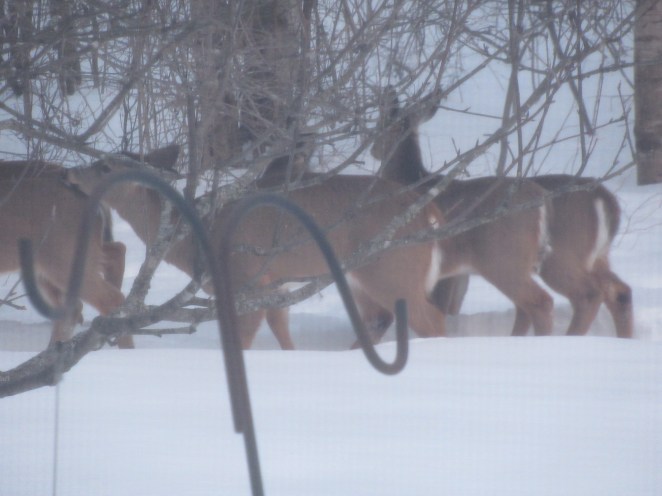
Poems arrive, as silent as the deer that troop through my garden. Some times they hurry past, and catch them if you can. Sometimes, they stay, wait, nibble at an overhanging branch. Just when you think you can reach out and grasp them, they sense the bark of a dog, the sigh of the wind through leafless trees. You blink, and they have gone.

Was your camera ready? Was your note book open, your pen in your hand? Or did they flit away like dreams in the morning when the sun comes into the bedroom and sparks diamond fires from the lashes that guard your eyes?

Carved in Stone 36

Carved in Stone
36

Words, cast stones,
ripples spreading out
across water, reaching out
and beyond this shore,
traveling, how long,
in time and space?

Will they last longer,
than the sanderling’s prints,
their silent words upon dry sand,
wet, when waves come in
to wipe them all away.

Gone forever,
until next day,
when the outgoing tide
permits new birds
to create fresh messages.

Commentary:
La poesía se explica sola, si no, no se explica. Pedro Salinas (Spanish Poet, Generation of ’27). Poetry explains itself, if it doesn’t, it’s inexplicable.

The quote certainly works well for this poem! Not much else we can say about it. The phot (taken by Clare at Pointe Wolfe Beach, Fundy National Park) shows sandpipers, sheltering from the wind, not sanderlings. They are both beautiful shorebirds and can often be seen together.

Two New Poems

Two New Poems

1

My Words

My words are black print
on white paper.
My memories flare
 – an aurora borealis of senses
sent crackling down the spine,
in and out of the mind,
tumbling the brain into a world
 … what sort of world?

An unimaginable world.
One never forgotten.
One never re-recreated.
One that never existed.
One that never could exist.
One for which the young child,
six or seven years old,
yearns for the rest of his life.
His unsatisfied life.
His unsatisfying life.
His meaningless life.
His absurd life.

2

Puppy

Oh, pity the poor puppy,
not knowing
 what he has done wrong,
not knowing
how to put things right,
always inadequate,
always in fear
of the angry word,
the quick, sly kick,
the vicious blow,
whining and cringing
at his master’s feet.

“Into your box!”

And always,
that cold puppy bed,
often soiled,
 where the long, chill snakes
of frail, wriggling dreams,
remind him of
the next day’s
punishment.

Commentary:

Both these poems evolved from the comments I made yesterday to my blog post. I have started noticing that those words, beneath the poems, sometimes have a rhythm and a magic all to themselves. I guess it is a little bit of the unconscious slipping upwards and spilling out.

Discovered poems – I never set out to write these two poems. When I re-read my commentary, I thought ‘wow, there’s a poem in there”, and I found not one, but two new poems. Interesting. As I age, I discover something new every day. What a wonderful world it is, unless, like earlier this week, I discover my tap leaking and am forced to call my friend, the plumber, into my water world. Alas, if only that tap were tapped into a maple tree and it weas spring once more. Ah well, I am a dreamer, I can always dream.

Candle Light

Candle Light

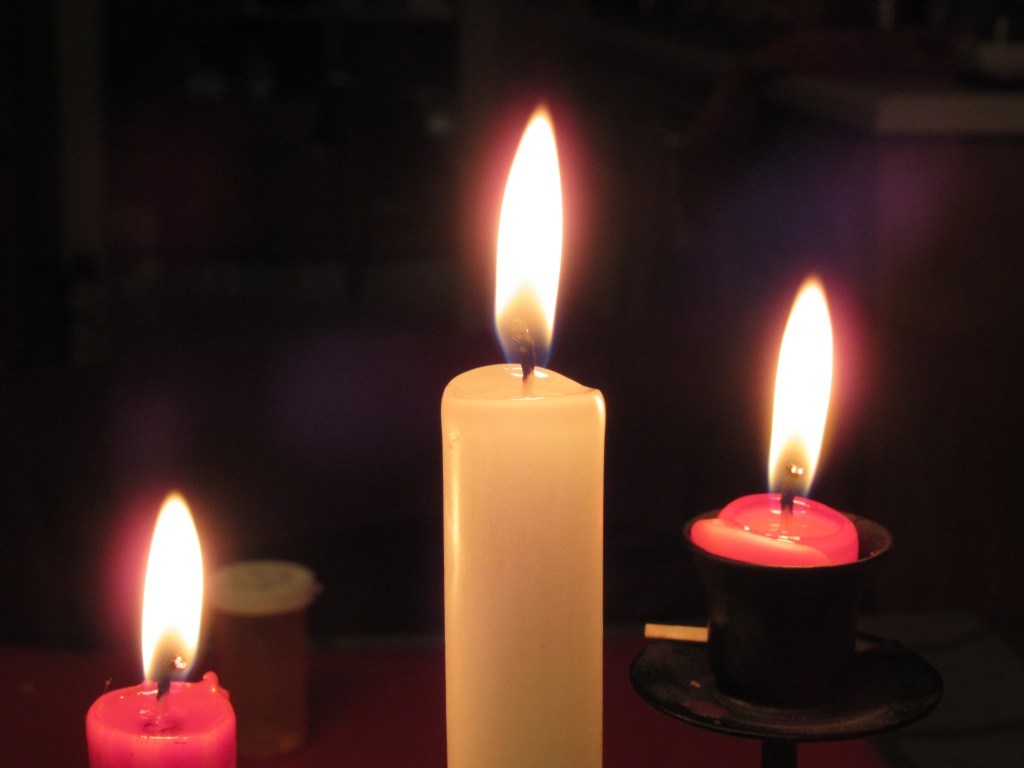
Candle light
softens your features
brings out the bone shape
makes me forget
the minor flaws
of ageing.

Bone shape,
rock shape,
land scape,
your face contours
traced by the flame,
counting the years,
like tree rings.

Beneath the surface
you are as you always were
and always will be.

When I look into your eyes,
I see your soul
dancing in the candle’s flame.

Great White Egret

Great White Egret

            The Great White Egret is Yolande Essiembre’s first chapbook of poetry. The title poem offers an image, a white egret, that is central to the whole collection. Summarized in this one poem are the concepts of pantheism, mindfulness, self-questioning, and receiving lessons and inspiration from the natural world that surrounds the narrator and her poetic voice.

            Pantheists often consider the universe, or nature, to be identical to the divinity. In simpler terms, it’s the old Greek idea of Gaia, the world spirit – spiritus mundi, in the Latin of Moncton’s Northrop Frye – that links nature and the divinity. Pantheism can be found in both religious and philosophical contexts, with some branches of pantheism rooted in traditional religious beliefs and others stemming from poetic perspectives. In the case of The Great White Egret, the narrative voice sees nature as an all-embracing poetic concept that makes possible a life, both physical and spiritual, in the immediate present.

            The lessons the narrator receives in the course of observing The Great White Egret are (1) to take one step at a time, (2) to be still, and (3) to be one’s own reflection. This third lesson reaches out to include the cover photograph. Verbal and visual blend when the egret, reflected in the water, parallels the reflection of the poet in the stillness of nature. This is further complicated by the double meaning of reflection as mirror image and of the thought process involved during the observation of the bird. The visual and mental images become reminiscent of the hymn “on the wings of a snow-white dove.”

Part of the beauty of Yolande Essiembre’s poetic meditations lies in the extension of image and metaphor beyond the page and into the mind of the reader where they create a mirror universe of reciprocal reminiscence and creativity. Other poems that reach out in similar fashion to explore the deity manifest within the natural world include A Force of Love in Our Universe, Breath of Life, Glimpses, and In the Sanctuary. This last poem works on the basis of repeated images that stand strong and clear, for example, “Life pressing through a blade of grass. / Leaves shimmering, dancing, waving. / Light flickering, casting shadows.” Life and movement, especially movement – pressing, shimmering, dancing, flickering, casting – create a sense of wonder in the natural setting where the poet finds sanctuary.

            Mindfulness is a mental state achieved by focusing one’s awareness on the present moment, while calmly acknowledging and accepting one’s feelings, thoughts, and bodily sensations. It is often used as a therapeutic technique and can be compared with the yoga techniques which our poet practices. This yoga technique is compounded in the poems where breathing is emphasized, as in Breath of Life, for example, where we read “Who are you breath of life / Who fills my lungs with air”. It can also be found in the poem In Your Presence “In the stillness of the morning / I breathe / I listen / I breathe”.         

This chapbook is more than a mere collection of poems. It is a compendium of personal feelings, inner thoughtfulness, and natural observations. It is the work of a thinker and feeler, in tune with the universe and continually seeking answers to some of life’s most important questions. Reading The Great White Egret, you too may start asking similar questions. More important, you may even find some meaningful answers.

The Great White Egret
Sitting, rocking, gazing upon a lake,
Pondering, reflecting, wondering.
How one can choose purpose over comfort?
How does one remain true to oneself?

On a wing span comes an answer.
A bird, a Great White Egret
Lands at the edge of the water.
Tall, magnificent, breathtaking.

Steps in slow motion, into the lake,
Advances one long leg at a time.
Proud, confident, in no hurry.
My first lesson: “Take one step at a time.”

The bird stops, remains still,
Listens, stretches its long neck,
So still that I hold my breath.
We wait.
Second lesson: “Be still.”

The majestic bird gracefully glides
In the calm clear water.
Its reflection a thing of beauty.
Like a mirror, reflects divinity.
Third lesson: “Be my own reflection.”             
Illumination

Two Poems to help you find your way in the dark!

1

Suit of Lights

I am a man of straw
          shivered by raw winds,
frosted by the cold
          enveloping this enigmatic body
with its rattle of drying bones.

I walk with two canes,
          not just a sick man,
but a stick man.

My broken body
          hangs on the coat hanger
of my battered bones,
          its worn-out sack
knitted from skin,
          bonded with blood.

The magic hour descends.

Earth glows
          with a different light,
my world is transformed,
          translucent, bright.

A touch of the almighty,
          this beauty surrounding me,
blessing me.

I wear a sudden clarity
          with this suit of lights.

2

Illumination

You must find it for yourself.
         Were I to tell you what it is
and where it dwells,
          the light it brings you
would be warped,
          untrue.

Only
          you can find
that light.

Only you
          can strike the match,
ignite that blaze,
          trap its warmth
in your own bone cage.

Enlightened,
          you must dig and dig,
deeper and deeper,
          until you lose yourself
in a bottomless pit.

When you are lost,
          look up.

In the dark above,
            you will find
a tiny pinhole of light,
          a star to guide,
a glow-worm
          to light your way
in the darkest night.

Silence

Silence

silence
          between words
tranquil movements
          the world
stands still
          suspended
in space

silent space
          between the stars

Aurora Borealis
          soundless night
drenched
          in silent light

listen –
          can you hear
your heart beat

can you hear
          the silence
of your house

time
          sifting silent
through an hour glass
         filled with light
drifting into
          night

Sun Flowers

Comment:
The poetry flows. But if I publish it here, I cannot use it in competitions and there are many around right now.

So, instead of a poem in words – a poem in colors and lines. I have portrayed several of my acquaintances and friends in the flower faces. Luckily, I am such a terrible artist that you will be unable to recognize yourselves! So choose one you like – and pretend that it’s you.

I hope this painting will cheer your day and bring some happiness and sunshine to you wherever you are.