For Yolande whose children left the same day as mine
the house’s silence speaks a dream language full of touch and tone and shared emotions that still reach out
floorboards creaking mimic the tip-toe dance of visitors now departed
the chair beside me at the breakfast table stands empty this morning
the armchair cushions in the tv room where they sat now sink beneath the weight of my hollow heart
Comment:
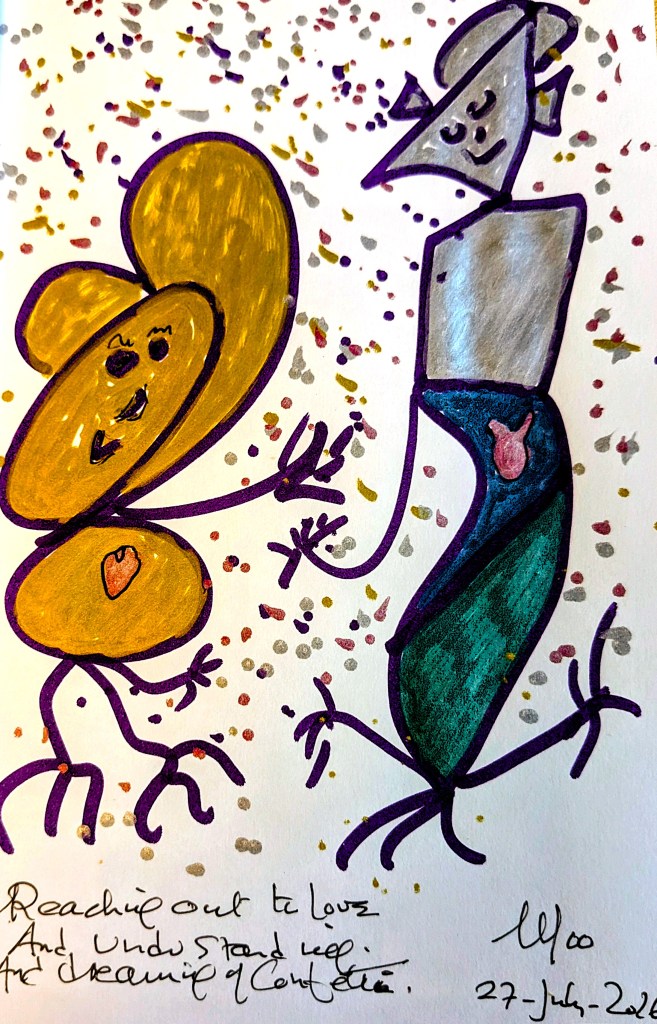
When Moo read this poem, he thought very carefully and, brow puckered, said “It’s not all bad. It’s not the dark night of the soul and I see Glimpses of blue sky. Here – this is the painting for that poem.” He gave me the one you see above, unsigned and unnamed. “I call it Glimpses of Blue Sky,” he told me.
Sometimes Moo can be very nice and sometimes he can be a pain in the you-know-what. I guess you’ve got one or two of those in your family too. Moody Blues, they are, who turn into Moody Moos, and act like sea-cows up at Skinner’s Pond, or else where on the Island. And no, that’s not the Island in Island View, not my Island View anyway, because here there are no Islands to be seen. We live on the far side from the river. The river – if this drought continues much longer, we end up with no river at all.
We used to get nine feet (three meters) of snow every winter. Two winters ago, I used my magic snow blower on three occasions. Last winter, I didn’t use it once. Jackie, my jovial black lab loved water. In the spring she could dive in the ditch and swim all the way around the block. Now the ditches run dry, the grass is gray rather than green, and the crab apples are about the size of raisins.
Global warming > climate change > climate crisis > climate disaster ….. you choose your own terminology, I don’t want to put words into your mouth, but don’t tell me that everything is business as usual and that there’s nothing to worry about.
A couple of our neighbors are worried about the aquifer we all share. They get dirty tap water. Wells are of varying depths. Several of the less deep drillings are showing sign of strain. And yes, the St. John River, the river that the local indigenous call the River of Plenty, is plenty empty right now and flowing very slow. The salmon disappeared a long time ago and now the waters are following them into oblivion.
Well, I suppose that is also a departure of sorts, a very worrying one for some of us. Moo can paint Glimpses of Blue Sky, but hard as I try, when I look at storm clouds building and the rain never falling, I find it difficult to see them.
My way or the high way – but by which route, the four-leaf clover, the new roundabout, or the old flyover?
Who cares when there’s only one bridge open to cross the river and that one with two lanes closed and the traffic flow now reduced to single file and an endless nose to tail.
Amazing how often our modern roads need repairing and how seldom local motorists are open to sharing and caring.
Comment:
Summer, holiday season, tourists in from all parts – add them together, and what do you get? Road works, of course. Construction. Old roads being newly tarmacked. Detours. And not a clue as to how to get from a – z without following a million arrows, none of which fly straight to your target.
As the crow flies. But no crow I know flies like this. Unless he’s discovered a supply of Newfoundland Super Screech with the power to lift an aircraft off the ground, not to mention to loop-the-loop with all the passengers safely wearing their seat-belts. Australia – here we come. The Antipodes, remember!
Earlier, of course, it was pothole season. And we all remember that. Now it is summer caravan and trailer time. This morning, as I was driving past the RV park, three half-tons pulling caravans pulled out ahead of me and three more tucked in behind. Now I know what it’s like being a thin slice of ham or cheese between six crusty loaves of bread.
Ah well, one-stop shopping. Get out – one stop – pick it all up – and get back home safe. That’s the way to do it, as we have done before!
A meaningless collection of notes swarms into my empty head swimming round and round like clustering tadpoles.
The ebb and flow of that mysterious music clumps on and on, tight in my mind and will not let me go.
Earwigs, some call them, those senseless repetitions, day after day, night after night, awake and asleep, old tv adverts, short clips of classical music or popular songs.
They are wheelbarrow songs, hedge clippings, dead flowers, crass grass, broken branches, weeds, repetitive memes of meaning, a syndrome of stuck songs destined for the garbage dump and ritual burning in the hell of an eternal turntable turning.
Comment:
Word magic from the Mikado – “My object all sublime I shall achieve in time, to make the punishment fit the crime” … And in this case I would tie the criminals who invented these ‘ballads, songs, and snatches’ to the stake, with earphones that endlessly repeated all the nonsense we hear day and night, so much of which sticks in the turntables of our brains turning round and round as we toss and turn in our beds at night. Just a case, I suppose, of hearing music while there’s no one there.
And how many earworms did you pluck out of that first paragraph? I can count six, maybe seven. Then, my mind may be very different from yours. Perhaps your mind isn’t in the outrageous Wilfred that mine is. Don’t get that joke, do you? And why should you? I guess you don’t remember Ray’s a Laugh, Round the Horne, Mr. Dimwitty, or Wilfred Pickles – and why should you.
Passent les jours et passent les semaines / ni temps passés ni les amours reviennent / sous le Pont Mirabeau coule la Seine– click on the link for the English version (my translation) and click on this linkfor a slightly improved revised version.
Yes, as Apollinaire says time flows on and by – or, after Heraclitus – you can never step in the same river twice. More important, perhaps, for those who worry about their past thoughts, words, and deeds – you can throw the stone into the pond, but you can’t control the ripples.
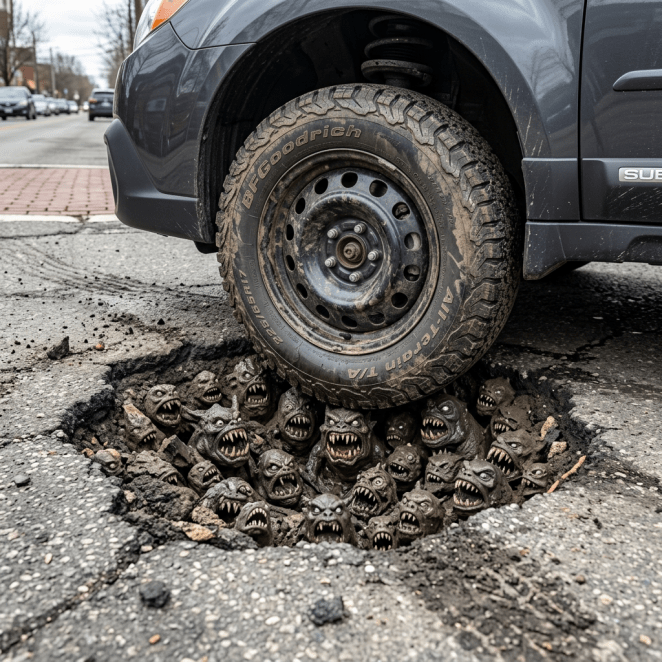
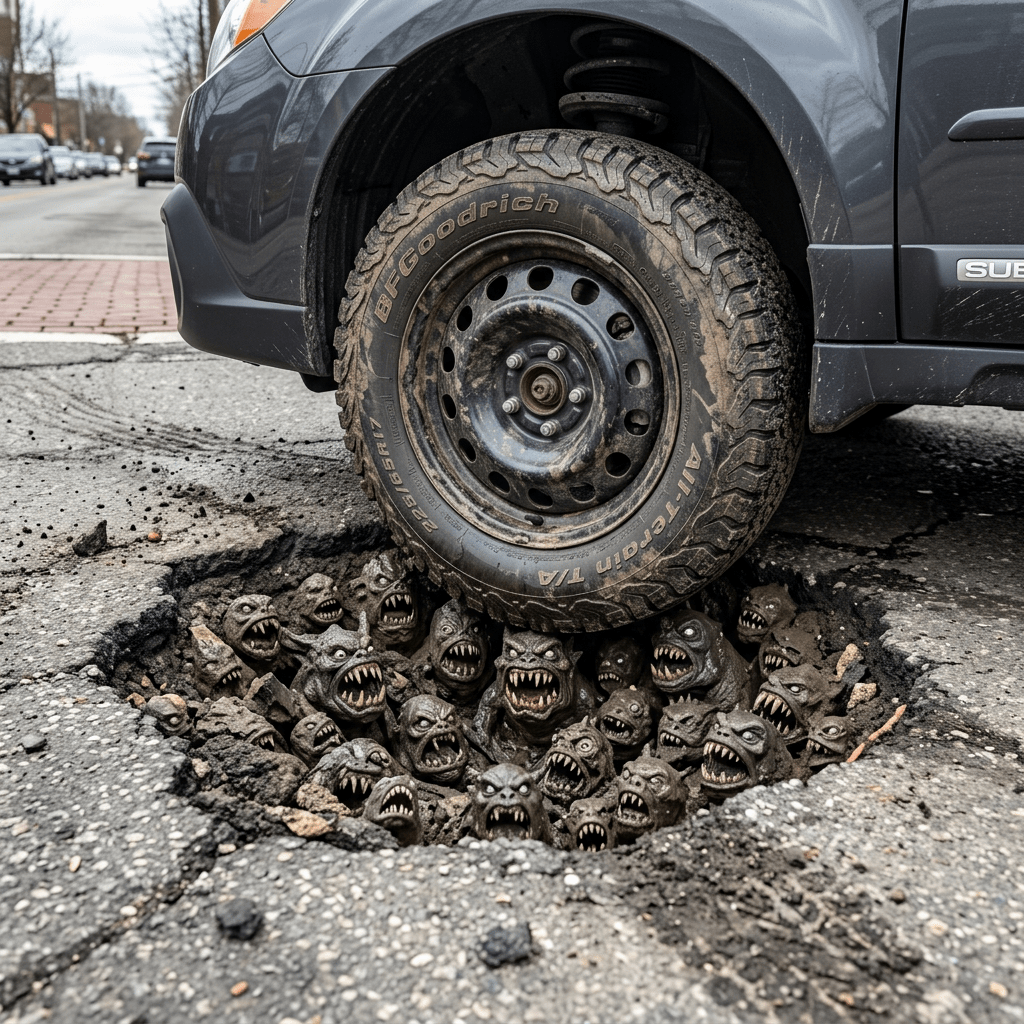
A car tire hovers above a pothole filled with snarling monster sculptures. Image AI generated.
Blood from Stones
The road ahead a bandage leaking grey blood from stones. The snow plow brutal, carelessly lifting scabbed edges until the gore overflows.
Spring always promises renewal, but freeze and thaw also open old wounds making them bleed.
A merry, mazy life we lead, threading the car’s needle through holes torn in the asphalt’s fabric.
Some holes are so large they have lives of their own, and names – Grand Canyon, Yawning Gap, Patty’s Peril, Big Bertha, each one well-known to neighbors.
Others are pornographic, their open orifices painted, laughing in scorn, dentated vaginas ready for anything.
Such decorated potholes are soon filled, their crude messages swiftly erased.
Comment:
Three flat tires in the last month and spring’s potholes still out there, waiting to trap me. Apparently, one neighborhood on the North Side of the river decided to decorate their potholes with pornographic drawings. These were swiftly filled and their messages totally erased. Alas, we on the South Side are not so daring. We don’t go out and paint our potholes. Personally, I wish we did. July – and many potholes are still there.
Not only that, the road into town is being repaired. Hooray! However, the tarmac was stripped off two weeks ago and has yet to be replaced. Boo! More than that, at the end of our street, just before the highway, one or two enormous potholes still gape. They lead directly to a dip that rises abruptly when it meets with the now stripped highway. A champion clunker that – a genuine tank-trap. I think at least two of my flat tires occurred after going over that one.
It reminds me of my grandfather’s stories about WWI and ‘going over the top’. Now, each time I approach it in the car, I call out loudly, “Look out, grandpa, here I come.” I call that particular pothole Grandpa’s Revenge. My own personal name. I don’t know what the neighbors call it. And I don’t know why grandpa is seeking revenge! But below the tires, the pothole awaits, gnashing its teeth.
alive in the moment a momentary cloud crosses the sun face brings shade to table
soon page and tabletop ripple with light again
the pen’s shadow pushes across the page while the nib weaves its spider fine lines of well webbed words
meaningful mindful each letter a moment caught and held in time
Comments:
I caught myself forcing myself to write a poem – and it just wasn’t working. Meaningless words upon the page, each wound up, struggling like a little black fly in a spider web that promised only oblivion. Then I caught the one sentence that ends the above poem – each letter a moment caught in time. I had found what I was looking for. For the next half hour I played back and forth with a whole sequence of dibbles and dabbles that eventually led to what I have written above.
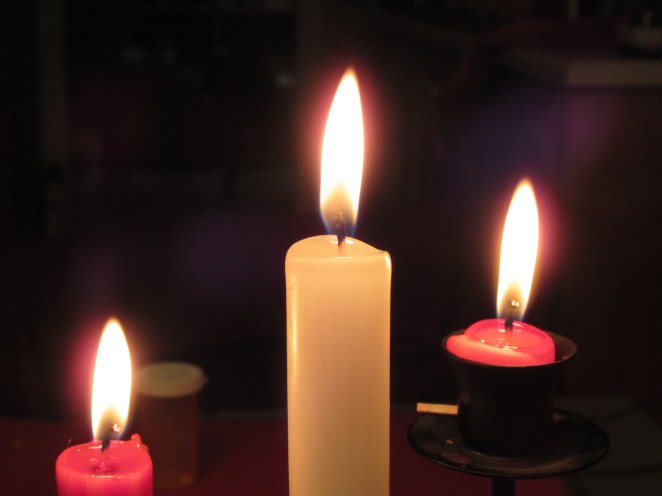
I showed it to Moo. “Tranquility,” he said. “I have just the painting for you.” Love at first sight – poet and painter, painting and poem, blissful in a true moment of blended tranquility and mindfulness. “Why, thank you, dear Moo,” I said and all our previous squibbling and squabbling was laid aside. We gave each other a big hug – I should add that we don’t often do that, as one or two of you out there might well know. But we did it today.
Meanwhile, I have received another set of fake invitations – oh, I would be so famous in the world of fakery if I gave away what little money I own to make myself truly famous – for my folly in believing the permanence of fakery. Why, only last week, I got an email mistaking me for my namesake and offering to help me publicize his most famous book – My Word is my Bond. The person involved was asking for a cool $250,00 for making the videos.
Oh dear. 007 is one thing. 006.5 is something else and someone else. Never mind – maybe one day someone real will call me and make me a genuine offer that I really can’t refuse. I probably wouldn’t believe that if it happened.
The boy in the kitchen bare legs held to the fire ‘this is what hell will be like’
The cupboard under the stairs cold dark locked from the outside an oubliette the young boy left there forgotten
Running upstairs to safety beneath the bed hands grasping at legs and ankles pulling him back down for appropriate punishment
The belt the stick the little red brush that cleans the fireplace with its foretaste of hell beating battering an avalanche of blows the boy buried beneath them
Commentary:
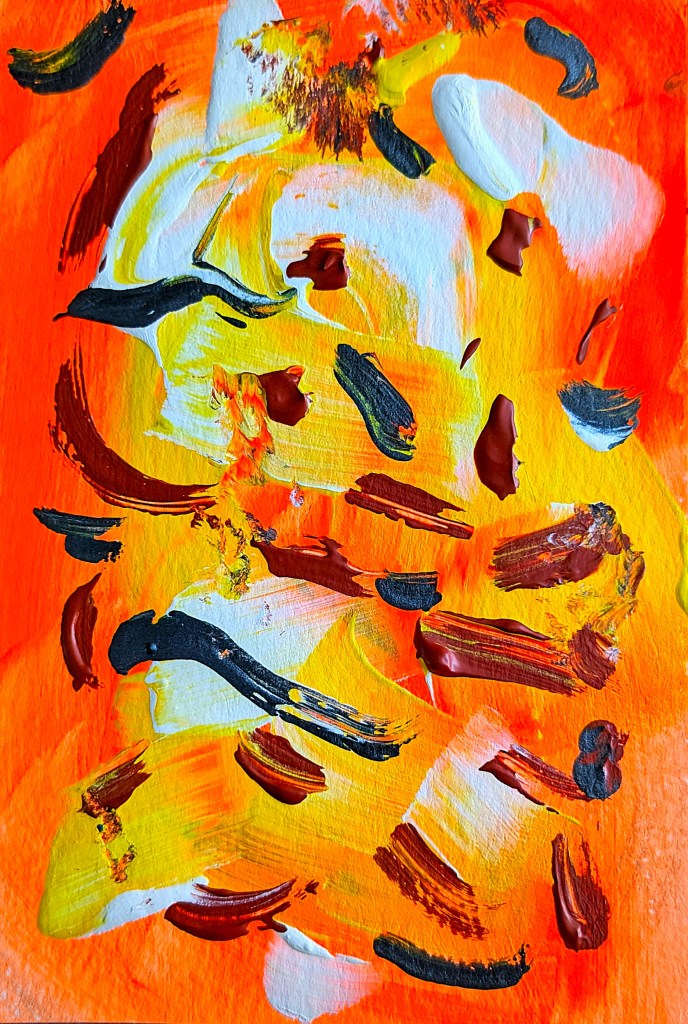
Another unsigned painting by Moo. He told me that he calls this one Orange-U-Happy. Well, it is a happy painting, until you read the poem that goes with it and discover that all the stones of the avalanche are floating around in Moo’s painting, including a nice selection of sticks.
“Sticks and stones will break my bones, but names will never hurt me.” But names do hurt. Names can be cast like stones, and the thrown stone, like the spoken word, can never be recalled. Liar. Cheat. Thief. Little Lord Fauntleroy. Bite the hand that feeds you. Are you laughing at me? I’ll teach you a lesson you’ll never forget. I’ll shake you until your teeth rattle.
Stones can be thrown into ponds. When they are, the ripples reach out, spread further, spread far and wide. Thrown words can enter the soul, ripple through the blood, and they can lodge in heart and brain, forever memories that never fade and never fly away. Heart stones, they are, that strike at the stroke of midnight and leave the victim suffering, gasping for air.
So many silent memories, buried deep, only to rise and parade around in dreams at night, revenants come to haunt and hunt, sharp words made even sharper than flint or obsidian to cut and fracture, and splinter, and slowly, slowly wear down the prey. Words – the jaws that bite, the claws that snatch. Think twice before you throw, speak, wound, injure …. then think again, bite your tongue, stay your hand, drop the stone, think rather of the hand of friendship, of comfort, the feathered wing of the guardian angel that consoles and brings succor.
Succour (or succor in American English) means assistance or support given to someone experiencing grief or hardship. It is a formal, often literary term used to describe help that offers actual relief or comfort to people in difficult situations, such as disaster victims or those struggling emotionally – Wikipedia.
And remember – many words have double meanings – spare – to forbear: deciding not to hurt, destroy, or punish, such as “sparing the life” of a captive or sparing the the rod. Spoil – to indulge: to treat someone, such as a child or pet, with pampering. It can also mean treating oneself to a luxury or relaxing day.
So, what does spare the rod and spoil the child mean? Clearly it is a phrase with a double meaning. Choose which one you will. But remember – “Let us pray” is a better prayer than “Let us prey“.
I see a face in the foliage. The Green Man of Wye stares out at me.
A light breeze moves his lips – what can he be saying? Sweat breaks on his brow – thin, drizzling rain.
Now I see other faces, all a myriad shades of green – young / old, male / female, sometimes somewhere in between.
They welcome this rain, fearing heat, as I do, parching them, making them thirst, and drying out the woods.
I sense their fear and I know how they fear that first spark of fire the worst.
Commentary
It has been a cold, damp spring and summer’s promised heat has not yet arrived. The result is a garden tinged with a thousand shades and hues of green. To many slight variations in color for my vocabulary to name them. Better by far this damp than last year’s raging heat that gave us the hottest summer ever with wild fires raging closer, ever closer.
They gave our subdivision a new name and placed us in a new area under new management. Early last year, before the heat really began, we received a booklet from our now community – What to do in case of forest fires. The first chapters provided some comfort – how to prepare three weeks ahead, one week ahead, three days ahead. But fear spreads s quickly as wild fires when we read – Evacuation – Three hours’ notice – Two hours’ notice – One hour’s notice.
It is amazing how little you can pack into one small car when you have only an hour in which to prepare and gather your things. Frightening. Very frightening. How much can you take? What must you leave behind? Which are your safe exits? Do you actually have an exit?
A car tire hovers above a pothole filled with snarling monster sculptures.
Big Sister replaced Big Brother and generously generated this image
“Watch out for that pot hole!” “Which one?” Snap, crackle, pop! “That one.”
Pot Holes
Jack Pine Sonnet
Welcome to Pot Hole time. It’s all yours and it’s all mine. Mine, possession, not land mine, though hitting one at speed will rattle your teeth, shake your spine, and leave you feeling far from divine.
Pot Holes, Pot Holes, everywhere, filled with water you can’t drink. They hide the depth of every hole with waters, dark as ink.
Spring’s freeze and thaw breed ever more Pot Holes than we had before. I think at night they stay out late, to fornicate, and celebrate.
A low spring sun in the driver’s eyes makes shadows shift and slide.
A mazy life full of chance drawing a labyrinthine thread through a maze of Pot Holes that we dread, the morning sun blinding our eyes so we cannot see the Pot Holes’ size nor how they move and dance.
Big Sister replaced Big Brother and generously generated this image
Comment:
This is wonderful fun. Moo has ceased to be jealous of Big Brother and Big Sister with their attempts to read my mind. And what a great job they do of it. All in the cause of the Pot Hole Dance Season. Have you seen the Pot Holes dance? You know, one minute there isn’t one and about and then a split second later – CLANK! The dreaded tire pressure light comes on. You turn it off. It comes back on. You turn it off. It comes back on.
You stop the car at the roadside, turn off the engine, get out, and check the tires. They look all right. You kick them or tap them with a stick. They all sound all right and they all sound the same. You get back into the car. You start the engine. All the lights come on. All the lights go off. Except one – the dreaded tire pressure light. Well, I can swear pretty well in about five languages. I turn the tire light off. Wonder of wonders, it goes away.
I am so happy. I turn on the radio. I clap my hands. And CLANK! I drive into another Pot Hole that appeared from nowhere and walked or danced or shimmied or slithered into the road right in front of your car. You guessed it – and the tire pressure light comes on!
… at the beginning of the end, when more things have gone than are with us and the summer’s sun withers the grass and wrinkles our faces baking us bright red – como un cangrejo te has puesto, hijo mío, en el sol de Somo, como un cangrejo – and — pulpo en un garaje — you grasp at the new words, the new colors, the new delights, your tongue trapped clumsily in your mouth like a red rag doll and the midnight bull charging the spectators who gather and olé, au lait … as the drunken bullfighter climbs the bull and kills the post. The red cape flutters in our memories and to the slaughterhouse we go where the open body hangs loose like a flag and the red meat of him held out for all to see and some to share … and this is his body and this is his blood, sacrificed in a circle of golden sand for our drunken amusement … for whatever I did, I never visited those bull fights when I was sober … at five thirty, they began, and at 3 o’clock we would gather in the city center and slowly wend our way from bar to bar, up the Calle de Burgos, past the street where you lived and upwards, ever upwards, towards the bull ring at the top of the hill, from bar to bar, I say, and the bota, the wine-skin filled and re-filled with that dark red fluid that will set us all baying for the bull’s blood, or the matador’s blood, it doesn’t matter whose blood, as long as someone bleeds and the bull is butchered, torn from this life by a man on horseback, armed with a lance, and he thrusts the heavy blade between the shoulders of the bull, the blood first dripping red, then gushing, a small stream over the rock of the bull’s shoulder, and down the bull’s front legs, to slither on the sand, and the bull still ready to charge the horse, and the bull’s head steadily dropping as the muscles in the back and neck are gashed and torn and there’s no hell like this gaping wound between the bull’s shoulders and the blood flowing freely and vanishing into the sand, the golden sand, once pristine, stained now with blood, and soon to be further blemished with feces and urine, and the picador, his job done, walks his blind-folded, armored horse out of the ring, and the bull, un-armored, un-enamored of the process which turns his torment into a spectacle staged for our drunken delight, as we pass the bota round, and the blood red wine travels from hand to hand, and we squirt the bull’s blood squarely between our lips and it dashes against tongue and teeth and we swallow the body’s sacrifice hook, line, and sinker, as the banderillero runs in, harpoons in hand, waving his banderillas and plunging their arrowed barbs into the gaping wound that flowers on the bull’s back, and the bull stands there, twitching, wriggling, saliva and drool slipping down, sliding stickily into the sand, as the matador doffs his hat, takes his vorpal sword in hand and treads the light fantastique in his laced-up dancing pumps, his waltzing matilda feet so swift, so sure, eluding the lumbering rush of the charging bull, the load of bull, that tumbles down the railway track towards him as he stands there, the matador, poised like a ballerina, as stiff and as steady as a lamp-post around which the bull circles like a drunken man, staggering a bit, but still bemused by the red flag tied to a stick which waves before his eyes and goads him onwards, ever onwards, in his plunge towards a brilliant death, as he pauses, feet together, and the matador makes his move, one, step, then two, and the bull lurching forward to impale himself on three or four feet of curved, immaculate steel, and the matador immaculate in his reception of the bull – and what is happening? What will happen next? Sometimes, the sword pierces the spinal cord and death is instantaneous. Sometimes, the sword pierces the heart, and death is more or less swift, but certainly certain. And sometimes the sword pinches against the bone and flies from the matador’s hand, and the matador must bend, and pick it up, and try, try again, the red rag below the bull’s nose, the bull drawn forward, yet again, to impale himself, yet again, on the sharp end of the sword, and this time, the sword goes in, but the wound is in the lungs and the peones, the pawns, the workers, the drones, the little men who help, turn the bull round and round in ever tighter circles so the sword will open and even larger wound, sever the main arteries perhaps, and the bull, blood spurting through nose and mouth, lurches now, then falls to his knees, and lies there, bleeding, and the matador chooses the descabello, that little sharp sword with the razor blade at the end and he tries to sever the spinal cord, there at the back of the neck, and sometimes he does, and sometimes he doesn’t, and if he can’t then it’s the little men again in their colorful parrot suits all gleaming with sequins and stars and they carry a sharp little instrument, with a pointed end, la puntilla, that short, double-edged, stabbing knife which is plunged into the occipito-atlantal space to sever the medulla oblongata in the evernazione method of mercy killing, and the puntilla is plunged again and again into the bull’s neck at this atlanto-occipital joint, until it severs the medulla oblongata, and when it is severed, in this glorious neck stab, then finally the bull drops dead, and the show must go on and on, and on, and the horses come in, black funeral horses with bright feathers on their heads and they loop a rope around the bull’s horns and away he goes, trailing blood, and urine, and shit, all across the sand and other little men appear to sweep the sands clean, and my neighbor who wears a large walrus moustache stained red now and purple with the wine that he has splashed about, shakes the wine skin and finds it as not as full as it was, so he sheds a bitter tear, and since the death was slow, the crowd all whistle and boo the matador and his merry men, but when the death is swift and quick then the crowd is aroused and they wave white hankies at the presidential box and the president awards the matador an ear, a salty, smelly, sticky ear which the peones cut off the bull before he is towed away, and then the matador throws the ear in the direction of his current sweet heart, the fairest lady in the crowd although she be as brown as the beauties baking daily on the summer sand where the sea horses dance and there are no bulls, and no bull shit, and no maids with mops, just the scouring sea, and sometimes the president gives away two ears, or two ears and the tail, dos orejas y el rabo, though this I have seldom seen, and what does the bull care that he dies bravely and well, for now he is dead he hasn’t a care in the world, and the butchers in the butcher’s shop are carving him away, carving him to the skeletal nothingness of skin and bone that awaits us all, the nothingness of this more or less glorious death, with our tails cut off and our ears hacked away to be pickled or smoked or otherwise kept in the fridge as the butcher’s trophy … and who now will walk stone cold sober into that magic circle of sun and shade and stand there, unbowed, before the might of the untamed beast, the untamed bestiality that drives us wild as it wanders through our nightmare cities and our wildest dreams … and now the crowd call ¡música, música! and the band strikes up and martial music plays as the bullfighter and his troupe march gaily round the ring, their trophies held high for all to see before they are thrown to the ravening crowd who bay like the dogs they are as they taste fresh, bloodied meat …