A Question for AI

A Question for AI

It is hard
to shed the skin
the skin once shed
can never
be worn again

Yesterday
is gone
today
slips slowly by

Tomorrow
always comes
but never arrives

Who and what
am I this child
who thrives on sorrow
on a sadness

that grinds
those bones to dust
and soft silk ash

Tell me
if you know
what will arrive
for this child
tomorrow
if and when
it comes

Comment:

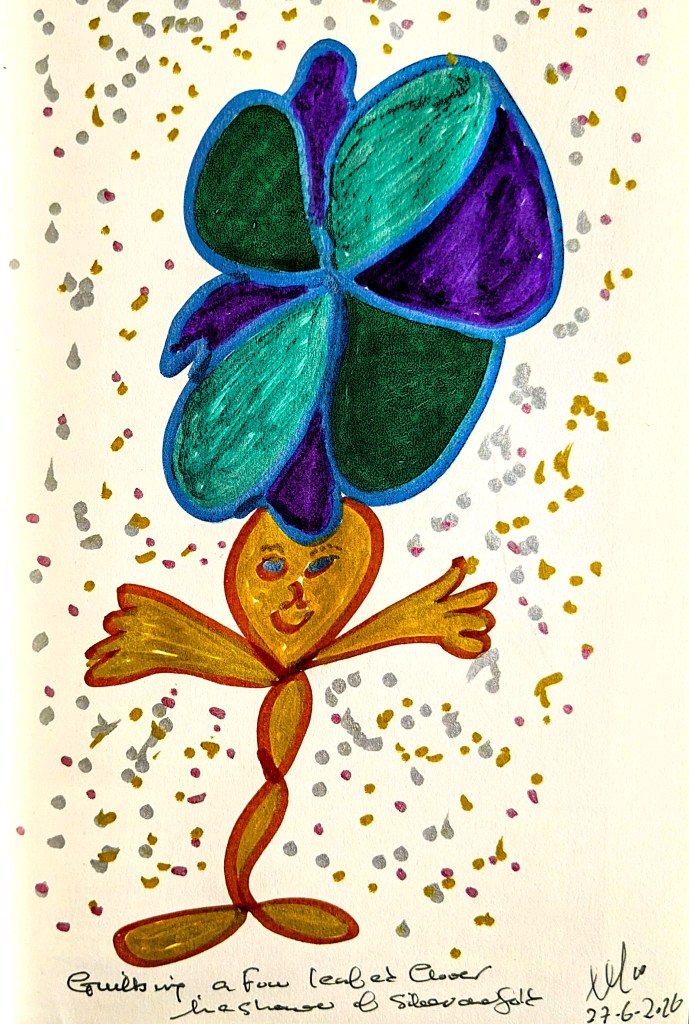
Moo is so happy when I don’t allow Ryan to persuade me to invite AI to paint my thoughts in pictures. “AI?” said Moo. “Have I got a painting for you!” And he showed me the AI Google Monster with its radio active fallout. “Nice,” I said. “I like the look and feel of that.” It looks like a two-eyed cricket bowling machine. It bowls Googlies out of the right eye and Chinamen out of the left one. Alas, we are no longer allowed to use the term Chinaman as it has been labelled ‘disrespectful’.

But what is a Googly? A Googly is an off-break bowled by a right-handed bowler with a leg break action. And a Chinaman is the reverse – a leg break delivered by a left arm bowler with an off-break action. Complicated? You bet it is. But AI and Google have demystified the mysteries of right and left arm wrist spin. Or have they?

It is one thing to know what they are – definition – but another to spot them as they leave the bowler’s hand, and yet another to play them as they whir through the air, then pitch and viciously spin. Of course, just to keep you up to date with Dennis Compton’s Three Card Trick, a top spinner, bowled with exactly the same action will come straight on and not turn at all.

It is hard to spot the spin when the ball is leaving the bowler’s hand, and the spin, once spun, can never be spun again! I am glad we sorted all that out. Oh sweet mysteries of the cricketer’s life. I once asked a top batsman how he spotted the difference between a leg- break, a googly and a top spinner. “I watch which way the stitches are moving when the ball leaves the bowler’s hand.” You need really good eye sight to do that. The Eggs Box, sorry, that’s the Two Ronnies, the X-Box will never do that for you.

But who is Dennis Compton and what is his three card trick? Good question. Dennis Compton, aka The Brylcream Boy, was one of England’s best ever batsman. You can look him up in the 1947 Wisden. Genuine paper pages, crackling as you turn them, much nicer than the metallic voice of AI. Compton was notorious for running out his partners with his three card trick – “Yes! No! Wait!” What do you mean, you don’t understand a word of what I am talking about? You’ve read Jabberwocky, haven’t you? Yes? No? Wait … if you haven’t read it you must do so. Immediately – but not if the slithy toves are gyring and gimbling in the wabe. Go Google it – and when you find it remember to sing “oh frabjous day, calloo, callay” as you chortle in your joy.

My Love For You

My Love for You

A Jackpine Sonnet

Yesterday fled quickly by
today limps slowly on and on
tomorrow draws near
yet never arrives
if and when it does
it becomes today

As for me I feast on shifting
shadows my story a tapestry
reversed – hanging
back to front unreadable

It is hard to slough your skin
the skin once shed can never
never be donned again

My body white bone grey gristle
no longer wrapped in skin
is bonded together by super glue
made from my love for you

Comment:

Moo assures me that this painting, unsigned and untitled, is actually his. After yesterday’s doubts, I must believe him. He says it is called U-R-My-Sunshine. He also thinks it would be a great painting to go with this strange little poem that crept somehow out of my head and landed on my page. It reminds me somewhat of the church cat – it crept into the crypt, crapped, and crept out again. “Oh what a naughty pussy cat.” Who U-R is up to the reader / viewer apparently. I doubt that I am his sunshine after what I said about him yesterday. Oh sorry. You didn’t read that blog? Well, shame on you! You’ve got to do your homework if you’re going to keep up with me and Moo.

What is A Jack Pine sonnet, you ask? Well, I don’t have a clue. But now that my other buddy, Ryan, has introduced me to AI, I will ask my AI what such a thing might be. Asking now. Hang on to your seats. It tells me it’s thinking. Aha! Here’s what I think it thinks it thinks.

AI says – A jackpine sonnet is an irregular, spikey poetic form created by Canadian poet Milton Acorn (from neighboring PEI), in the 1970’s. It typically acts as a 14-line sonnet with 7-13 syllables per line, but allows for flexible line counts (e.g., 12, 18, or 20), using internal and consecutive rhymes rather than strict, traditional rhyme schemes.

Key Aspects of the Jackpine Sonnet:

  • Origin: Developed by Milton Acorn, often known as the “People’s Poet,” as a uniquely Canadian, gritty form of expression.
  • Structure: While it aims for roughly 14 lines, it can vary in length based on the needs of the poem.
  • Rhyme and Rhythm: Uses internal rhymes (rhymes within a line) or consecutive end-rhymes (e.g., AABB) rather than standard sonnet structures.
  • Style: It is designed to be “irregular and spikey like a jack pine tree,” focusing on structure and integrity rather than rigid adherence to traditional verse rules.

So, now you know what a Jack Pine sonnet is. But I bet you’ve never heard of Milton Acorn! I have. Here’s the poem I wrote about one of my meetings with him. You can find it in The Nature of Art.

Milton Acorn

“Oy,” he waved strong carpenter’s hands, “Make this
work.” I typed in my code and the machine
came to life. “Go away,” he pushed me out
and slammed the copier room door behind my back.

Later, my secretary came in and caught him,
his face pressed to the glass. He pushed the button,
lights flashed, the machine whirred and copies emerged.

In his hand he held images of his feet,
arms, legs, head, all of his body parts.
“Tape, not masking, clear tape, 3M.”
Flustered she fled, brought Scotch tape,
watched as he stuck himself together.

Over lunch he showed me his work:
a self-portrait, shadowy and cloudy,
whiskered and worn, smelling still of printer’s ink.
That’s how I remember him: unique, stately,
unmistakeable, uncouth, unseemly:
a jack pine growing in its own self-image.

Farewell, my dear friend, Milton.
And that is how I remember you.

May Day

May Day

Trees in bud
sudden their break out
fresh today
a red fuzz here
catkins over there

Fairy lights
in the Mountain Ash
goldfinches
a mountaineer
this downy woodpecker
scaling the heights
a star
on top of the tree

Green the grass
in places
brown in others
from last year’s drought

New Brunswick violets
our provincial flowers
a patchwork of blue

Dark green
the early hollyhock leaves
pushing stubbornly
up and through
to greet the sky

Commentary:

Mysterious indeed it is – to plant a clepsydra and watch it grow. Will it, won’t it? Does it suit the climate zone? Will it flower? Have you ever seen a flowering Clepsydra? Moo has. He draws and paints them all the time. But can he make them grow in my garden? We’ll have to wait to find out. He can certainly paint them.

But why does he call them mysterious? When I printed Clepsydra in my chapbook series, I mis-counted the pages and ended up with one blank page. “Mine!” said Moo. And he grabbed his colored pens and pencils and set to work drawing Clepsydras. That was his Mysterious Clepsydra Plant. Down below he has painted a Lady Clepsydra in Flower. Will the ones he says he planted in my garden be yellow, red, or multi-colored? Who knows? I most certainly don’t. And I am pretty sure Moo doesn’t have a clue about the plant life he uses to brighten my pages and plant in my flower beds.

Do you know what a Clepsydra is? Let’s ask Big Brother to draw us one. Hey, Big Bro – paint us a Clepsydra. A voice emerges from nowhere – “Say pretty please and I’ll think about it.” “Pretty please.” The metalic voice vanishes and a sign appears – Thinking!

Replica of a Roman water clock with ornate brass components and a glass water container
A functioning replica of a Roman water clock circa 50 AD / CE – a clepsydra – displayed in a museum

CE – Common Error – well I never. I guess poor Mistaken Moo made a common error and thought a Clepsydra was a flower. Time flows like a flowers, but it never flows back. If you see Moo, don’t tell him about this. He won’t be happy to know he can’t tell a flower from a set of flower pots. And what the heck would he paint if he went to Flower Pot Rocks? Oh no!!!! Well I never did. I blame Moo entirely. Shame on Moo! He’s fooled me again!

Translation Theory

Ryan and Don Roger

15

Translation Theory
(revised 3 May 2026)

            In DQI, IX, Cervantes, in his role of first-person narrator, goes to the Alcana in Toledo, where he discovers an Arabic manuscript containing the adventures of Don Quixote. The first eight chapters of our novel contain no mention of a translator. Suddenly one appears. The narrator buys the manuscript, finds a translator, takes the translator to his house, and in six weeks receives a translation, from Arabic into Spanish, of the novel. Question – does the translation contain Chapters 1-8, already written by Cervantes, or not? Alas, we do not know. Is the translation accurate? We do not know that either, for the original Arabic manuscript is a literary illusion and does not exist.

            However, we do know that Cervantes writes that ‘reading a translation is like looking at the reverse side of a tapestry’. Speaking of the Italian poet, Boiardo, the priest, in DQI, 6, says “If I find him here speaking in any language but his own I shall show him no respect. But if he speaks his own tongue, I will wear him next to my heart.” The priest continues, “That is what happens with all authors who translate poetry into other languages. However much care they take, and however much skill they show, they can never make their translations as good as the original.”

            Of course, with no original for the Quixote, there can be no translation theory. So, let us try to construct one. In the course of my own work, I have studied various translations of Quevedo’s poem Miré los muros de la patria mía. I will use them to see how translations can function, and what happens when we look at the reverse side of the tapestry. First, Quevedo’s poem in the original Spanish. Then a direct, line by line translation of it, for those who do not read Spanish.

Miré los muros de la patria mía,
si un tiempo fuertes, ya desmoronados,
de la carrera de la edad cansados,
por quien caduca ya su valentía.

Salíme al campo, vi que el sol bebía
los arroyos del yelo desatados,
y del monte quejosos los ganados,
que con sus sombras hurtó su luz al día.

Entré en mi casa; vi que, amancillada,
de anciana habitación era despojos;
mi báculo más corvo y menos fuerte;

vencida de la edad sentí mi espada.
Y no hallé cosa en que poner los ojos
que no fuese recuerdo de la muerte.

            I looked at the walls of my fatherland, (line 1) if once strong, now crumbling, (line 2) from the passing of age tired, (line 3) which wears out their bravery. (line 4) I went out to the field, saw that the sun was drinking (line 5) the streams from the ice untied, (line 6) and of the hill complaining the herds, (line 7) whose shadows stole the light of day. (line 8) I entered my house; I saw that, stained, (line 9) of an ancient habitation it was the spoils; (line 10) my cane more curved and less strong; (line 11) conquered by age I sensed my sword. (line 12) And I didn’t find a thing on which to turn my eyes (line 13) that was not a reminder of death. (line 14).

            This very literal translation, with all its inaccuracies and its inability to express the hidden cultural depths of the original, is totally unpoetic and inadequate, compared to the genius of the original version. Other prose translations have been offered by J. M. Cohen and Elías Rivers, and they are much more accurate – and much better (!), than mine.

            Brave poetic translations, also at times somewhat distant from the original, have been published by Robert Lowell, David Gitlitz, and Griswald Morley / Charles Cobb revising the version of John Masefield. Alas, I do not have permission to replicate their versions. However, I called the translations ‘inadequate’, but they aren’t really they are just the best we can do. Robert Lowell, himself an outstanding poet, gave us much more than a translation. He gave us what I like to think of as a recreation, a new poem based upon the old original. Translations and re-creations, two very different kettles of fish! I offer you here two of my own efforts at recreating the poem!

1

I looked at the defenses of my native land:
empty silos, bombs and rockets melted down.
“Put your faith,” the TV said, “in diplomacy,
not in the metal walls of flying ships.” I went

outside. Cattle were lowing against the falling
temperature, tails to the wind. Steam
rose from their flanks, then was scattered
like an overnight dream of ghosts. Inside,

on the sink, a shrivelled tea bag, dried up stains;
my trusty coffee pot, rusty on the stove,
was chipped and raw at the rim. I took

my shot gun in my hand. Its crooked barrels
served me as a walking-stick. As I limped
around, my mother’s photo spoke to me of death.

2
I’ve got something to say, so here’s what I’ll do
I’ll write it out in rap with a rhythm just for you.
I once saw a town with a very small wall
that’s so fallen down it’s no wall at all.
It’s old and it’s rotten and it cannot last
like a runner on the track who’s run too fast
at the start of the race, and he’s run out of breath,
so he’s hit that wall, and he feels like death.
And there’s cattle lowing and the sun’s in the sky
but it’s winter time, so the sun’s not high,
and the shadows are long, and the wind’s getting cold,
and it’s all about a man who’s growing old.
He looks around his house and all he sees
are dead people’s faces and living memories.
He’s trapped on the ground floor, can’t climb stairs,
everything he touches he’ll leave to his heirs.
There’s a pain in his side, and he can’t catch his breath,
and all that he sees, reminds him of death!

            A rap sonnet (14 lines) containing nine pairs of rhymed couplets (18 lines)? The good Don Francisco de Quevedo will be turning in his grave and his still-warm ashes will once again be burning with love for Lisi and the joy of being alive, in one form or another, in spite of the River Styx, which the flame of his love could swim and not be lost forever.

            So, when looking at translation theory, what can we set down? First, it is very difficult to capture the full cultural meaning of the original because each word has an associative field that differs in each language. The associative field is the word itself, with all its secondary meanings and concepts. Mi espada / my sword is an excellent example. Quevedo, in spite of his infirmities, was a master swordsman. His sword remained unconquered, save by age itself. We no longer walk around with swords sheathed at our sides. The meaning, therefore, in all its sadness and profundity, cannot be captured by our translation skills. The words just do not have the weight.

            The grammatical structures, inversion of words, for example, cannot easily be reproduced in English translation.  Line 3 – from the passing of age tired – just doesn’t sound right. And yet, it is curiously accurate – but not English. Oh dear. Line 6 – the streams from the ice untied – Line 7 – of the hill complaining the herds – Line 10 – of an ancient habitation it was the spoils – no, sorry, these inversions just do not function in English.

            In addition, the rhythm and the syllable count of each line of the original is lost in translation. Whatever you say about it, the rhythm of my rap sonnet emphasizes the importance of beat and tempo. Great fun to read aloud, and when reading it to an audience, watch their faces and then their feet. I have actually seen some listeners tap-dancing during my reading! And the scowls of those who cannot believe the impertinence of a translator who translates into rap music the classical lines of a poetic genius. Finally, the rhyme scheme will almost always defeat the would-be translator who approaches it as a target, while never quite mastering the reproductive technique, other than approximation. The structure of Quevedo’s original rhyme scheme is 14 hendecasyllabic (eleven syllable) lines rhyming abba / abba / cde / cde.  This is all very difficult to reproduce in English with its eternal iambic pentameter. Therefore, we must be satisfied, like it or not, with the reverse side of the tapestry, as Cervantes calls it.

Inquisitor

Cracked heart-shaped rock with ancient carvings in a sandy desert
A cracked heart-shaped stone with carvings lies cracked in a desert landscape.

Inquisitor

He told me to read,
and plucked my left eye from its orbit;
he slashed the glowing globe of the other.
Knowledge leaked out: loose threads dangling,
the reverse side of a tapestry.

He told me to speak,
and squeezed dry dust between my teeth.
I spouted a diet of Catechism and Confession.

He emptied my mind of poetry and history.
He destroyed the myths of my people.
He filled me with fantasies from a far off land.
I live in a desert where people die of thirst,
yet he talked to me of a man walking on water.

On all sides, as stubborn as stucco,
the prison walls listened, and learned.

I counted the years with feeble scratches:
one, four, two, three;
for an hour, each day, the sun shone on my face;
for an hour, at night, the moon kept me company.
Broken worlds lay shattered inside me.
Dust gathered in my people’s ancient dictionary.

My heart was a weathered stone
withering within my chest.
It longed for the witch doctor’s magic,
for the healing slash of wind and rain.

The Inquisitor told me to write down our history:
I wrote how his church had come to save us.

Phoenix

Phoenix

for my dear friend
whose house burned down

the day my house burned down
nothing to say – nothing to do
the smoke reek stays with me still
my house on the hill overlooking the sea

it meant the world to me – I stood there
just stood – no words – no prayer – ashes
still hot burned through the soles of my shoes
shoe sole – body soul – all of me burned

invisible the scars – not fire burned
like the faces of Spitfire pilots
on fire from burning engine oil
deformed faces – nightmares one and all

the burn ward – grafting – rehabilitation
new skin replaced the old – inch by inch
so slow – not swift like fire – pilots
ashamed to be seen – hiding – afraid

the house – brick and concrete chimney
still standing – roof – windows – doors – gone
furniture flame devoured – I’m no coward
but I couldn’t face the heat – too hot –

now – in my mind’s eye – I look out and see
and what do I see – I see the blue-eyed sea
I see the house foundations – standing strong
I see my new house growing like a tree

old roots dig deep – a silver photo – framed
spared somehow from fire and flame
a diamond sparkling amid ash and dust
gold gone – the diamond sparkling on

will I have the will to rebuild – to till
the garden anew – the sundial standing still
counting only the happy hours – asleep
life’s storms and showers – closing it down

and this I know – rebuilding may be slow
but as sure as the sun will shine – the sundial
will awake – the phoenix will be reborn
from the flame – the house will rise again

Mindfulness

Mindfulness

Poems arrive, as silent as the deer
that troop through my garden.

Some times they hurry past,
and catch them if you can.

Sometimes, they stay, wait, nibble
 at an overhanging branch.

Just when you think you can
reach out and grasp them,
they sense the bark of a dog,
the sigh of the wind
through leafless trees.

You blink, and they have gone.

Was your camera ready?
Was your note book open,
your pen in your hand?

Or did they flit away like dreams
 in the morning when the sun
comes into the bedroom
and sparks diamond fires
from the lashes that stand guard?

Nights

Nights

There are nights
when the trees
seem to whisper
your name,

cautioning you
against the wind’s
knife edge.

“What have I done,”
you ask,
“to merit this?”

The soft fall
of burnt brown leaves
weeps over
your woodland grave.

You will walk
these woods
no more, save
on a frosty night

when deer shiver
beneath naked trees
and the moonbeam’s
icy blade.

Comment:

Poems arrive, as silent as the deer that troop through my garden. Some times they hurry past, and catch them if you can. Sometimes, they stay, wait, nibble at an overhanging branch. Just when you think you can reach out and grasp them, they sense the bark of a dog, the sigh of the wind through leafless trees. You blink, and they have gone.

Was your camera ready? Was your note book open, your pen in your hand? Or did they flit away like dreams in the morning when the sun comes into the bedroom and sparks diamond fires from the lashes that guard your eyes?

Spring Cleaning

Spring Cleaning

Sun’s yellow duster
arrived late this year
gray cobwebs still
clutter my mind

I try to brush them away
with clumsy fingers
but stubbornly they stick
and cling and will not go

Spring came in with snow
gales and icy rain

Warm winds will soon
spring showers bring
to revive cold clay
and help things grow

Comment:

We have lived in this house for 37 years, but only once have I seen ducks land on the snow-covered lawn. Whatever were they thinking? Good question – do ducks think? They are living beings, so of course they do. But I am totally unaware of what they think nor am I able to understand the nature of their mental computations.

We share this world with so many creatures that we do not understand. I wonder sometimes if they understand us. Who knows? If we cannot speak their multiple languages, if we cannot enter their culture and their minds, if we see them as nothing but food and devour them as fast as we can, never thinking of them at all, save as more or less savoury items on our dinner plate — les meurtiers et les victimes, as Albert Camus wrote. Murderers and victims – and we are both. Murderers of our victims and victims ourselves to our unbounded greed.

House of Dreams 5 & 6

House of Dreams

5

A leaf lies down
in a broken
corner
and fills me
with a sudden
silence.

I revise
our scrimshaw history
carving fresh tales
on the ivory
of new found bones.

6

A vixen
hunts for my remains.

She digs deep
at midnight
unearthing
the decaying teeth
you buried with
my borrowed
head.

Comment:

None of this makes sense. Why should it? Don’t ask me to explain it to you. Who am I to tell you what to think and what to do? You are not in elementary school now. Teacher is not leaning over you, teaching you how to shape letters with a pen, telling you to color in red, or yellow, or orange.

Learning – tell me what have you learned? Have you learned to think for yourself? Have you learned that life is mysterious, joyful, sad? Do you not know it can also be incredibly dangerous? Fear not the thunder. Rejoice in the rain and snow. Open your eyes to the world around you and be joyous wherever you go.

Meditation

I am the gatherer of words,
the weaver of wooly clouds.

I am the sheep dog
who shepherds the flock
in and out of the field.

I am the corgi
who snaps at the heels
of cows and pigs,
too small to be noticed.

I am the butterfly
turned into an eagle
who soars into the sky
and gazes on the sun
with an open eye.

Tell me,
my friend,
what and who
are you?