Translation Theory

Ryan and Don Roger

15

Translation Theory
(revised 3 May 2026)

            In DQI, IX, Cervantes, in his role of first-person narrator, goes to the Alcana in Toledo, where he discovers an Arabic manuscript containing the adventures of Don Quixote. The first eight chapters of our novel contain no mention of a translator. Suddenly one appears. The narrator buys the manuscript, finds a translator, takes the translator to his house, and in six weeks receives a translation, from Arabic into Spanish, of the novel. Question – does the translation contain Chapters 1-8, already written by Cervantes, or not? Alas, we do not know. Is the translation accurate? We do not know that either, for the original Arabic manuscript is a literary illusion and does not exist.

            However, we do know that Cervantes writes that ‘reading a translation is like looking at the reverse side of a tapestry’. Speaking of the Italian poet, Boiardo, the priest, in DQI, 6, says “If I find him here speaking in any language but his own I shall show him no respect. But if he speaks his own tongue, I will wear him next to my heart.” The priest continues, “That is what happens with all authors who translate poetry into other languages. However much care they take, and however much skill they show, they can never make their translations as good as the original.”

            Of course, with no original for the Quixote, there can be no translation theory. So, let us try to construct one. In the course of my own work, I have studied various translations of Quevedo’s poem Miré los muros de la patria mía. I will use them to see how translations can function, and what happens when we look at the reverse side of the tapestry. First, Quevedo’s poem in the original Spanish. Then a direct, line by line translation of it, for those who do not read Spanish.

Miré los muros de la patria mía,
si un tiempo fuertes, ya desmoronados,
de la carrera de la edad cansados,
por quien caduca ya su valentía.

Salíme al campo, vi que el sol bebía
los arroyos del yelo desatados,
y del monte quejosos los ganados,
que con sus sombras hurtó su luz al día.

Entré en mi casa; vi que, amancillada,
de anciana habitación era despojos;
mi báculo más corvo y menos fuerte;

vencida de la edad sentí mi espada.
Y no hallé cosa en que poner los ojos
que no fuese recuerdo de la muerte.

            I looked at the walls of my fatherland, (line 1) if once strong, now crumbling, (line 2) from the passing of age tired, (line 3) which wears out their bravery. (line 4) I went out to the field, saw that the sun was drinking (line 5) the streams from the ice untied, (line 6) and of the hill complaining the herds, (line 7) whose shadows stole the light of day. (line 8) I entered my house; I saw that, stained, (line 9) of an ancient habitation it was the spoils; (line 10) my cane more curved and less strong; (line 11) conquered by age I sensed my sword. (line 12) And I didn’t find a thing on which to turn my eyes (line 13) that was not a reminder of death. (line 14).

            This very literal translation, with all its inaccuracies and its inability to express the hidden cultural depths of the original, is totally unpoetic and inadequate, compared to the genius of the original version. Other prose translations have been offered by J. M. Cohen and Elías Rivers, and they are much more accurate – and much better (!), than mine.

            Brave poetic translations, also at times somewhat distant from the original, have been published by Robert Lowell, David Gitlitz, and Griswald Morley / Charles Cobb revising the version of John Masefield. Alas, I do not have permission to replicate their versions. However, I called the translations ‘inadequate’, but they aren’t really they are just the best we can do. Robert Lowell, himself an outstanding poet, gave us much more than a translation. He gave us what I like to think of as a recreation, a new poem based upon the old original. Translations and re-creations, two very different kettles of fish! I offer you here two of my own efforts at recreating the poem!

1

I looked at the defenses of my native land:
empty silos, bombs and rockets melted down.
“Put your faith,” the TV said, “in diplomacy,
not in the metal walls of flying ships.” I went

outside. Cattle were lowing against the falling
temperature, tails to the wind. Steam
rose from their flanks, then was scattered
like an overnight dream of ghosts. Inside,

on the sink, a shrivelled tea bag, dried up stains;
my trusty coffee pot, rusty on the stove,
was chipped and raw at the rim. I took

my shot gun in my hand. Its crooked barrels
served me as a walking-stick. As I limped
around, my mother’s photo spoke to me of death.

2
I’ve got something to say, so here’s what I’ll do
I’ll write it out in rap with a rhythm just for you.
I once saw a town with a very small wall
that’s so fallen down it’s no wall at all.
It’s old and it’s rotten and it cannot last
like a runner on the track who’s run too fast
at the start of the race, and he’s run out of breath,
so he’s hit that wall, and he feels like death.
And there’s cattle lowing and the sun’s in the sky
but it’s winter time, so the sun’s not high,
and the shadows are long, and the wind’s getting cold,
and it’s all about a man who’s growing old.
He looks around his house and all he sees
are dead people’s faces and living memories.
He’s trapped on the ground floor, can’t climb stairs,
everything he touches he’ll leave to his heirs.
There’s a pain in his side, and he can’t catch his breath,
and all that he sees, reminds him of death!

            A rap sonnet (14 lines) containing nine pairs of rhymed couplets (18 lines)? The good Don Francisco de Quevedo will be turning in his grave and his still-warm ashes will once again be burning with love for Lisi and the joy of being alive, in one form or another, in spite of the River Styx, which the flame of his love could swim and not be lost forever.

            So, when looking at translation theory, what can we set down? First, it is very difficult to capture the full cultural meaning of the original because each word has an associative field that differs in each language. The associative field is the word itself, with all its secondary meanings and concepts. Mi espada / my sword is an excellent example. Quevedo, in spite of his infirmities, was a master swordsman. His sword remained unconquered, save by age itself. We no longer walk around with swords sheathed at our sides. The meaning, therefore, in all its sadness and profundity, cannot be captured by our translation skills. The words just do not have the weight.

            The grammatical structures, inversion of words, for example, cannot easily be reproduced in English translation.  Line 3 – from the passing of age tired – just doesn’t sound right. And yet, it is curiously accurate – but not English. Oh dear. Line 6 – the streams from the ice untied – Line 7 – of the hill complaining the herds – Line 10 – of an ancient habitation it was the spoils – no, sorry, these inversions just do not function in English.

            In addition, the rhythm and the syllable count of each line of the original is lost in translation. Whatever you say about it, the rhythm of my rap sonnet emphasizes the importance of beat and tempo. Great fun to read aloud, and when reading it to an audience, watch their faces and then their feet. I have actually seen some listeners tap-dancing during my reading! And the scowls of those who cannot believe the impertinence of a translator who translates into rap music the classical lines of a poetic genius. Finally, the rhyme scheme will almost always defeat the would-be translator who approaches it as a target, while never quite mastering the reproductive technique, other than approximation. The structure of Quevedo’s original rhyme scheme is 14 hendecasyllabic (eleven syllable) lines rhyming abba / abba / cde / cde.  This is all very difficult to reproduce in English with its eternal iambic pentameter. Therefore, we must be satisfied, like it or not, with the reverse side of the tapestry, as Cervantes calls it.
Rage, Rage 48


Rage, Rage
48

I carry memories
and scars like a snail
wears its shell
and I leave behind me
a slither of silver words.

I’m a broken gramophone,
needle stuck in a groove
repeating the same verses
again and again.
This repetition
drives me insane.

My thoughts just drift.
My body is a ship
in the doldrums,
no wind to fill its sails.

I pick up my paint brush
and paint myself –
lonely and blue
as idle as a long-lost lamb,
alone with nothing to do.

Comment:

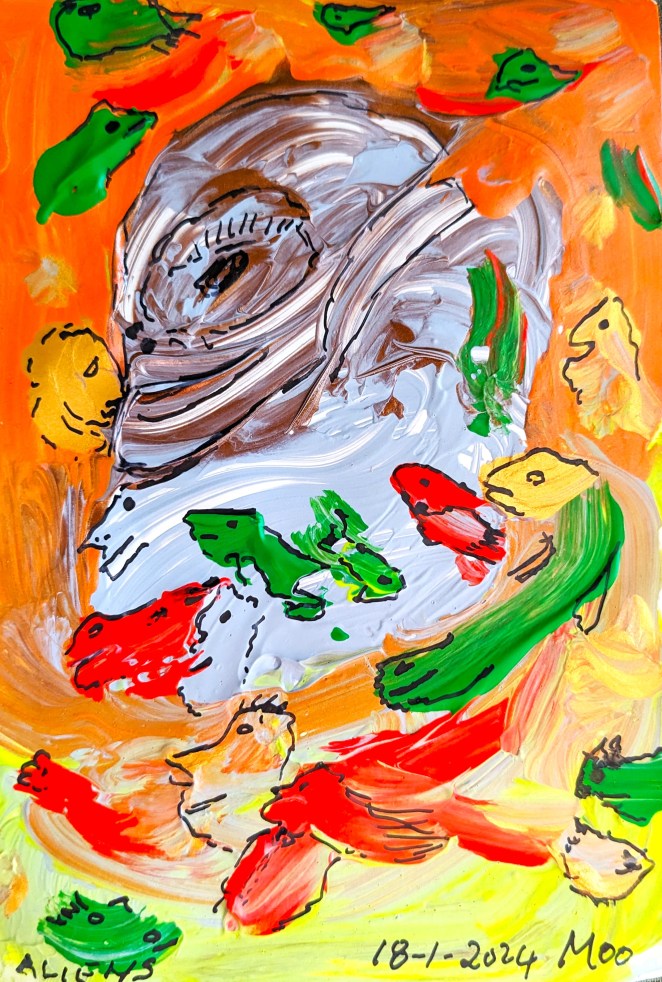
The alienation of an alien nation – and I wonder if they really are here, those aliens. So many strange happenings in my life. The silver slither of words drags me through so many lost moments in time. Fray Luis de León, I spoke to him last night, asked me the question – “Es más que un breve punto / este bajo y torpe suelo comparado / con aquel gran transunto / do vive mejorado / todo lo que es, lo que será, lo que ha pasado?”

It’s a lovely verse in Spanish, but not so easy to translate into English. Let’s try – first, word for word – “Is it more than a small dot this low and stupid soil compared with that great sky world where now lives improved all that is, all that will be, and all that has happened?”

A comment on the translation – first, the length of the sentence and the way in which it is complicated by inversions and ideas expressed in words which have little direct translation. Then there is the expression – 1. a small dot – un breve punto – a short moment in time. 2. low and stupid soil – este bajo y torpe suelo – clumsy earth below. That clarifies, a little the meaning. 3. that great sky world – aquel gran transunto – that great sky above. 4. where – do [short for donde – to keep the syllable count] – where – 5. lives improved – vive mejorado – lives a better life.

Here goes: “Is this clumsy earth below more than a short moment in time compared with that great sky above where now lives a better life all that is, all that will be, and all that has happened?” Not great, but we can live with it.

As Miguel de Cervantes said “To read in translation is to look at the reverse side of a tapestry.” So, to imagine the real side of the tapestry we need to count our syllables – they don’t match. We need to measure the length of our lines. They don’t match. We need to sharpen our metaphors and images – they don’t really match. And, last but not least, we have to imagine the Platonic, Terra-Centric universe in which the sun moves around the earth and the earth is the centre of all life.

I should add the cultural association of words. In every language, each word has an “associative field of cultural meanings”. Those “associative fields” differ from language to language. So, even getting the verbal meaning correct means that you do not necessarily get the cultural associations right. In fact, it’s almost impossible to do so. It’s a fascinating world and one which I have explored in various academic articles.

I would like to take cultural meanings a step further. In Don Quixote, II, 11 – I quote from J. M. Cohen’s Penguin translation of 1950 (rpt 1961) – Don Quixote says to Sancho ” … if I remember rightly, you said that she [Dulcinea] had eyes like pearls, and eyes like pearls suit a sea-bream better than a lady” (p. 533). I will leave aside, for now, Sancho’s comic mixing of the Petrarchan metaphors and concentrate on the single word sea-bream. To compare someone’s eyes to those of a sea-bream is comical in English. However, the word has several associative fields in Spanish which are worthy of deeper study. Secondary meanings of a sea-bream – besugo – include 1. a mild insult, as in no seas besugo / don’t be a fool / an idiot / stupid. 2. Diálogo de besugos – two people talking and neither one listening to the other. 3. Ojos de besugo – a blank or dazed expression. Quite simply, the translation besugo > sea-bream functions at the literal level, but by no means at the cultural level of the associative fields.

Alas, some days I’m a broken gramophone, needle stuck in a groove, repeating the same things again and again. Maybe one day I will get them right. And maybe I won’t. Better minds than mine have struggled with translating Spanish (poetry) into English (poetry), and most have failed. Many, dismally. We won’t mention names. Sometimes the best translations are not translations at all, but poems that recreate the original in the target language. I am quite happy with my translation of the meaning of Fray Luis de León’s poem – but how sad would be any attempt to transfer the verse form from Spanish to English? Five lines of seven and eleven syllables each – wow! Go for it. But remember – fools rush in where angels fear to tread.

Never mind. Maybe tonight I’ll have another little chat with Fray Luis de León and Miguel de Cervantes, Quevedo too, if I am lucky. Maybe their English will be good enough to give me a few hints. I’ll let you know later if any one of them does come to visit.

Butterflies

Butterflies
Miguel de Unamuno

… butterflies … temporal forms … fluttering …
existing for one sweet day … they perch … spread
their wings … fan us with their beauty … flourish …
catch our attention … then caught by a gust
tear their wings on a thorn … and perish … blink
your eye and they are gone … yet reborn … they
cluster and gather in dusty ditches …
congregate on bees’ balm … smother Black-Eyed
Susan and Cape Daisy … shimmer in shade …
butterflies by day … fireflies by night …
terrestrial stars floating in their forest
firmament … dark tamarack … black oak … bird’s
eye maple … silver birch … impermanence
surrounds us … dances beneath stars … sings with
robins … echoes the owl’s haunting cry …
eternity held briefly in our hands …
then escaping like water or sand … black
words on white paper capturing nothing …
… my dialog … my time … my place … butterflies …

Note: “La poesía da permanencia a las formas temporales del ser / Poetry gives permanence to the temporal forms of the self.” Miguel de Unamuno (1864-1936)

The temporal forms of the self – and so much today is unsettled, changing, insubstantial. I have often wondered how one makes time stop. Is it even possible to do so? Time and tide wait for no man. And why should they? Fray Luis de León – “Con paso silencioso, el cielo vueltas dando, las horas del vivir le va hurtando.” / With silent step, the ever-turning sky, steals away life’s hours. Or Fancisco de Quevedo – “Que sin saber ni cómo, ni adónde, la edad y la salud se hayan huído. Falta la vida, asiste lo vivido, y no hay calamidad que no me ronde.” Without me knowing how or where, age and health have fled. Life is lacking, past life flew by, and there isn’t a calamity that doesn’t hound me.

Ars longa, vis brevis – art endures, life flies by. My translations are freer than usual today, but I too feel like being creative in my own language. So, if we can’t slow time down, what can we do? We can create – poems, paintings, photos. We can read – and translate from one language to another. We can, like butterflies, perch on flowers and enjoy our brief days in the sun. Mindfulness – we can make the most of each moment by living it thoroughly and well. Carpe diem – we can seize each moment of every day and live it to its full measure. And, above all, we can write and read poetry – because, as Unamuno says – Poetry gives permanence to the temporal forms of the self.

Le Pont Mirabeau

IMG_1318 (3)

Le Pont Mirabeau

Beneath Mirabeau Bridge flows the Seine
and so does our love
must I be reminded yet again
that happiness always follows pain

Let night descend let the hours sound
the days go by … I’m still around

Hand in hand let us stay here face to face
while beneath the bridge of our arms
like flowing waves our gazes interlace

Let night descend let the hours sound
the days go by … I’m still around

Love flows away like waves that flow
love flows away
hope fills us with dismay
and life passes slow

Let night descend let the hours sound
the days go by … I’m still around

Days and weeks flow by bye bye
along with former loves
and past times that did fly fly fly
they will never come back again
Beneath Mirabeau Bridge flows the Seine

Let night descend let the hours sound
the days go by … I’m still around

Comment: It’s hard to give up on this. The poem has stayed with me since 1962 (58 years). A slight variant on an earlier version. Sorry, Guillaume.

Le Pont Mirabeau

Le Pont Mirabeau

Beneath Mirabeau Bridge flows the Seine
and so does our love
must I be reminded yet again
that happiness always follows pain

Let night descend let the hours sound
the days go by … I’m still around

Hand in hand let us stay here face to face
while beneath the bridge of our arms
like flowing waves our gazes interlace

Let night descend let the hours sound
the days go by … I’m still around

Love flows away like waves that flow
love flows away
hope fills us with dismay
and life passes slow

Let night descend let the hours sound
the days go by … I’m still around

Days and weeks flow by bye bye
along with former loves
and past times that did fly fly fly
they will never come back again
Beneath Mirabeau Bridge flows the Seine

Let night descend let the hours sound
the days go by … I’m still around

Comment: I spent the school year in Paris in 1962-1963 and I have always wanted to translate Le Pont Mirabeau from French into English. Today, I found both the time and energy to do so. It’s not a great translation, but it is mine. It also contains new revisions from an earlier post but note that the links in the earlier post no longer function. Click on the link above to get the French original.

Le Pont Mirabeau

Kingsbrae 8.4
8 June 2017

Le Pont Mirabeau
(click for French original)

The Seine flows down beneath Mirabeau Bridge
and so does our love
must I be reminded yet again
that happiness always follows pain

Let night descend let the hours sound
the days go by but I’m still around

Hand in hand let us stay here face to face
while beneath the bridge of our arms
our gazes interlock
like river waves flowing

Let night descend let the hours sound
the days go by but I’m still around

Love flows away like these flowing waves
love flows away
how slowly life passes
and hope is so brutal

Let night descend let the hours sound
the days go by but I’m still around

Days flow by and weeks flow by
nor times past nor former loves
come back again
under Mirabeau Bridge flows the Seine

Let night descend let the hours sound
the days go by but I’m still around

Comment: I spent the school year in Paris in 1962-1963 and I have always wanted to translate Le Pont Mirabeau from French into English. Today, I found both the time and energy to do so. It’s not a great translation, but it is mine. Click on one of the links above to get the French original.