Riddle-me-Ree

Riddle-me-Ree


What does the kettle whistle
to the grandfather clock
and why does its pendulum
call the kettle black?

A chime in time saves the cuckoo
just before it flies before our eyes …
and in August, fly it must.

Does anyone know how thyme
tells the time and whether or not
the dandelion clock
will learn how and when to chime?

Deep in a Gower Cave,
a woolly rhinoceros weaves
a web of time
on his mother’s knitting needles.

Beside him, in the rock,
a neolithic clock is fast asleep.
Was it Bill Haley put that rock
around the clock?

“You’ll never know,”
rings the sea-bell
tolling on its tidal surge,
“and I don’t have the urge to tell.”

Commentary:

Moo loves a riddle – that is why he fills his paintings with some many strange half people and animals that look out and King Lear at you. Mad as a hatter, is our Moo, especially when he’s feeling Moo-dy Blue. Moo is visually strange and now he is encouraging me to be verbally strange. So I took up the gauntlet, accepted the challenge, and road Nexus, my old dobbin, down to the end of the jousting lists, up with my lance and shield, and off I go.

Luckily Moo doesn’t know what I am talking about and he doesn’t have a dobbin anyway, let alone a lance. So, there he is, sitting on the sidelines, flicking paint at me with his paint brush. “The brush is mightier than the last,” he said. “Here’s mud in your eye!” And he must have been to PEI, because the mud was all red.

Alas, the Field Marshal thought I was bleeding, so he waved the white handkerchief and told me to leave the field of combat before PEI was swept away and vanished under a tide of big red mud along with Bud the Spud. And that made Stompin’ Tom stomping mad. “He might at least have used ketchup,” he cried, “because ketchup loves potatoes.” I found out, a lot later, that he had actually betted some money on me and was furious because he lost it.

“Never mind, Tom,” I told him. “Jousting isn’t the best game out there, and not every day does the best knight win.” “Hmmm,” said the Man from Skinner’s Pond. “I guess I could write a song about that. I think I’ll call it The Good Old Nexus Game. Nope. Doesn’t sound write. Jousting game? Nope. Hockey – that’s it – I’ll just go off, get my guitar, and tune up the old stompin’ bored.”


A Question for AI

A Question for AI

It is hard
to shed the skin
and skin once shed
can never
be worn again

Yesterday
is gone
today
slips slowly by

Tomorrow
always comes
but never arrives

Who and what am I
this child
who thrives on sorrow
and on a sadness
that grinds
bones to dust
and soft silk ash

Tell me
if you know
what will arrive
for this child
tomorrow
if and when
it comes

Comment:

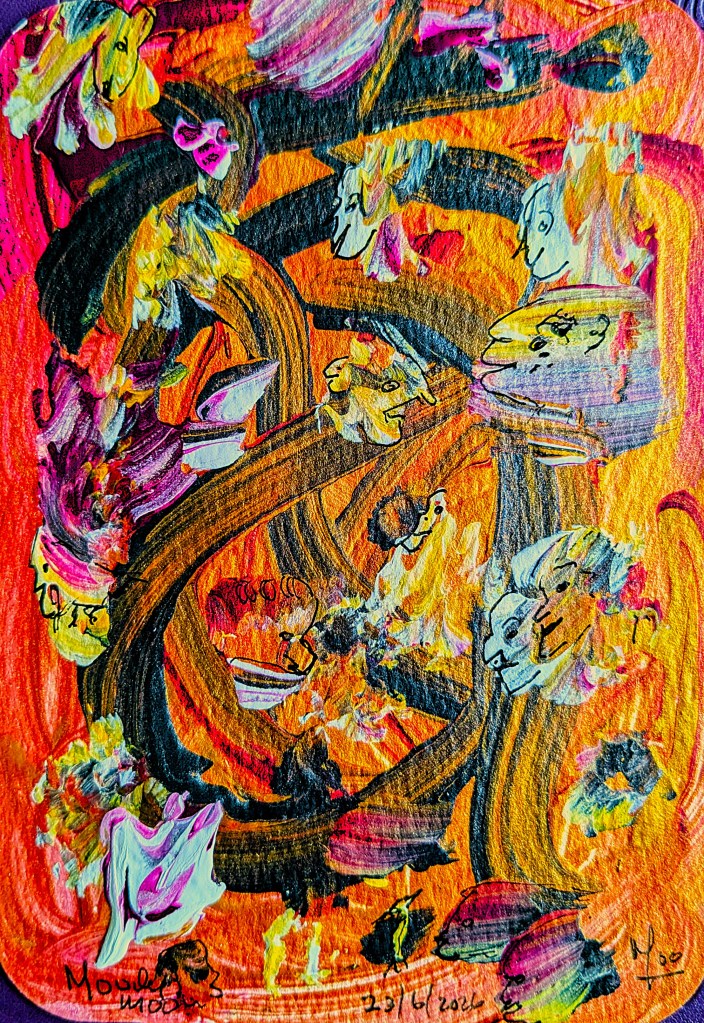
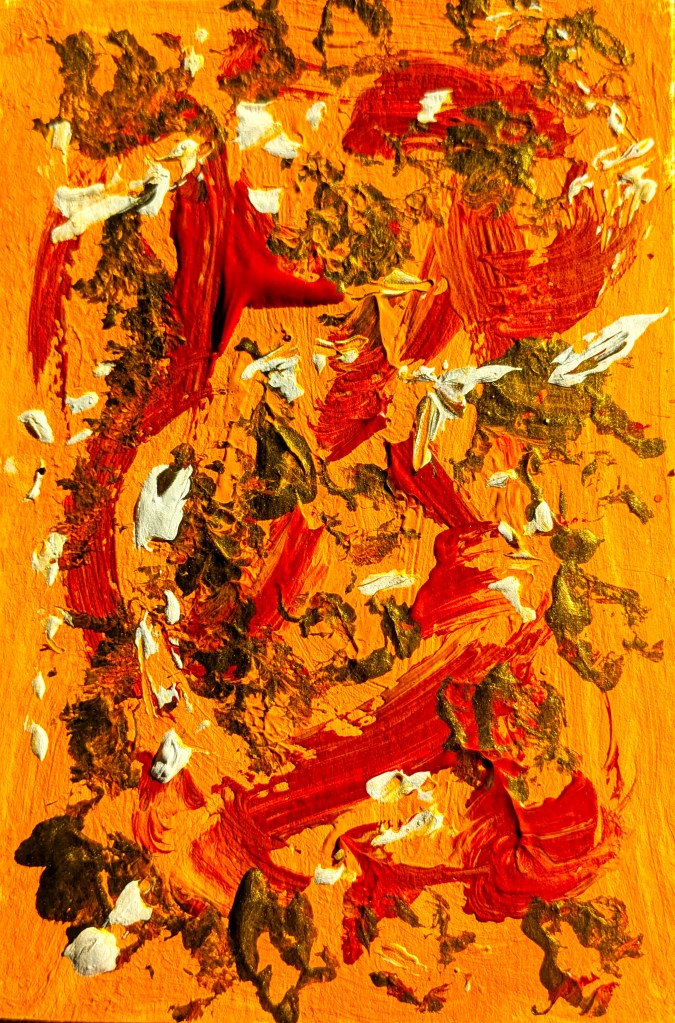
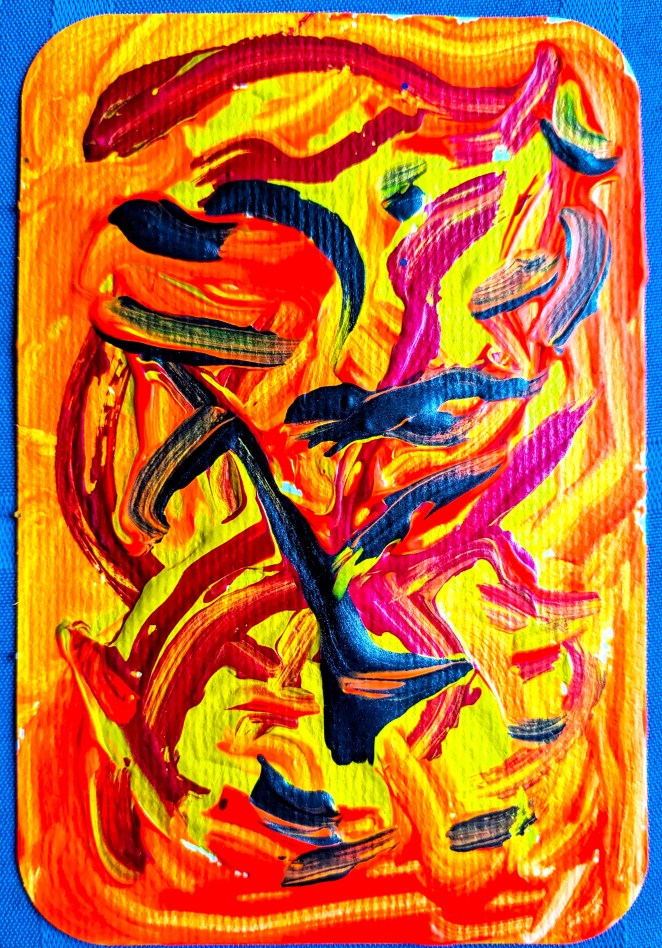
Moo is back painting and I am sure everybody is happy to hear that. Mind you, he’s a little bit on the Moo-dy side, if you know what I mean, as you can see from this painting. He calls it Moody Moo and he says it’s a Moo-d painting. He swears there’s a Moo Cow in it, but search as I have, I cannot see a Mrs. Moo. Let me know if you find one. Usual route – unless you have a drone of one sort or another. They have the road up leading into town and we had to wait a long time yesterday at the roadside while little men in yellow hats stood in front of the cars and wouldn’t let them move.

It was so bad, I put Pete Seeger on the disc player and turned the volume up full. “No pasarán, no pasarán, sang the Abraham Lincoln Brigade.” I thought it was rather funny. The person holding the placard that said STOP didn’t seem to be amused. I don’t if it was the volume. Maybe he spoke Spanish and knew all about the Spanish Civil War and how the Abraham Lincoln Brigade stopped Franco’s troops and wouldn’t let them pass! No pasarán, no pasarán – those yellow hatted road buccaneers certainly closed down the narrow straits that led to our house and they wouldn’t let anyone through. No pasarán, no pasarán.

Meanwhile, old Welsh logic – tomorrow never comes, because by the time it gets here, its today. “Good one,” says Moo, checking the way I have reproduced his painting. Oh yes, the original is for sale, Moo says – going cheap for a five figure sum. And that’s not counting the two zeros after the dot! I think Moo is really asking too much. OW! He just kicked me. Sorry, Moo. That’s a very fair price. Now he seems happy. But I don’t think you’ll get it. Now he seems sad – oh dear, just like I said – “Moody Moo”!

I’d better be careful, or he will be doing some Blue Moo paintings next, and he’ll be turning the air blue while he’s painting them. Meanwhile, speaking of AI – here’s the news that’s rolling round the rock at Island View. There’s a new book on the market. A limited Edition. Only 50 copies. Keep your eyes open. They will soon be a collector’s item. In fact, they already are. Go for it -Don Roger and Don Ryan. Oh yes. Moo did the cover painting for that one too. But he’s not selling it – he’s already given it away to another friend.

Obsidian’s Edge 2
An AI Analysis

Don Roger & Don Ryan

Rage, Rage 49 & 50

Rage, Rage
49

Waiting in the doctor’s office,
I hear two old women
gossiping about friends
and family, the intimate
details all laid out
to fester in my fertile mind.

Never will I be able
to put faces to those girls
with breast cancer,
to the women
weighed down
with diabetes,
to the old men
with their strokes
and heart attacks.

50

“Just one of those things,”
one of them whispers,
“my husband gone
leaving me alone
with the grandkids.”

“Is it four years? Or five?
I remember his name,
but I forget his face.”

“And our fourteen-year-old,
her belly already swelling …”

“You’ll cope somehow …”

Silence wraps its scarf
around their flapping mouths.
I think of all my own lost loves,
buried before their proper time.

Lives and worlds end …
new ones begin.

Comments:

Lives and worlds end … new ones begin. How true it is. The olde order changeth lest one good custom should corrupt the world. Tennyson, I believe, from Idylls of the King. King Arthur and his knights of the round table. Each of them rode into that dark night, some quickly, some more slowly, but all were lost, as so many things are lost.

That was also the heading of the departures section of my old school magazine. At the end of the year, pupils left the school, many graduating, never to return, and the old order did indeed change. The fourth formers moved up to the fifth, the fifth to Transitus, then to the sixth, and finally, the scholarship students arrived in Ichabod. Ichabod, Ichabod, the glory that used to be. I look at old school photos and I wonder what became of so many of my childhood friends. The website for my old school also contains an obituary section. I consult it, every so often, to see who else has passed on. Fewer names than I would expect. Not everybody keeps in touch. I am in contact with few old boys from school, but nobody from my undergraduate university. Ships passing in the night, all of us. Our conversations lost in the mists of time.

The old order changes and the language changes with it too. When I was visiting Spain regularly, my first stop, every year, would be the local barber’s shop. I just sat there and listened while I waited to get my haircut, Spanish style. I listened for the new buzz words, the names that now floated around, the latest jokes, the ideas that were currently in fashion. Change is everywhere.

Covid changed the Spanish language, gave it a whole new set of terms that I do not recognize. The same thing happens with English, French, any language. French is not the same in Moncton, New Brunswick, as it is in Shediac. And the Acadian Peninsula is slightly different. As is the language of Grand Falls, and that of Little Falls, aka Edmundston, the capital of the Republic of Madawaska. The language also changes close to the border of Quebec where Joual can be heard. Same thing along the St. Lawrence river and out from Matane to Mont Albert and beyond. Small changes, sea changes, enormous varieties of change.

I often wonder what is happening in Wales both to Welsh itself and to the English language as it is spoken there. English in Swansea / Abertawe was never the English of Llanelli, nor was it the English of the Rhondda Valleys. How could it be? And Cardiff / Caer Dydd was always different. As was Newport / Cas Newydd. I haven’t been back there since 1988. 38 years of change – friends gone, family gone, nobody left. I couldn’t bear to stay in a hotel in a town where once I lived in my family’s homes.

How does one end a rant like this? In silence, of course. For silence wraps its silken around flapping mouths. I think of all my own lost friends and loves, buried so long ago, many before their proper time.

Rage, Rage 20

Rage, Rage
20

Words emerge
from the silence 
of blood and bone.

They break that silence
the day they are born.

Silence, once broken,
cannot be repaired
and a word once spoken
cannot be recalled.

The greatest gifts –
knowing how and when
to sink into silence,
knowing how to be alone
in the middle of a crowd,

So many word-worlds
smothered at birth
and those worlds, dismissed,
forgotten, still-born,
their names never spoken.

Comment:

So, are you paying attention? Did you notice anything? Has something gone missing? Moo tells me that he doesn’t think anyone will notice what I have. Can you prove him wrong? Good question! Whatever, as they say, or “So what?” as Miles Davies plays. Or, as Buddy Holly once sang “I guess it doesn’t matter any more.”

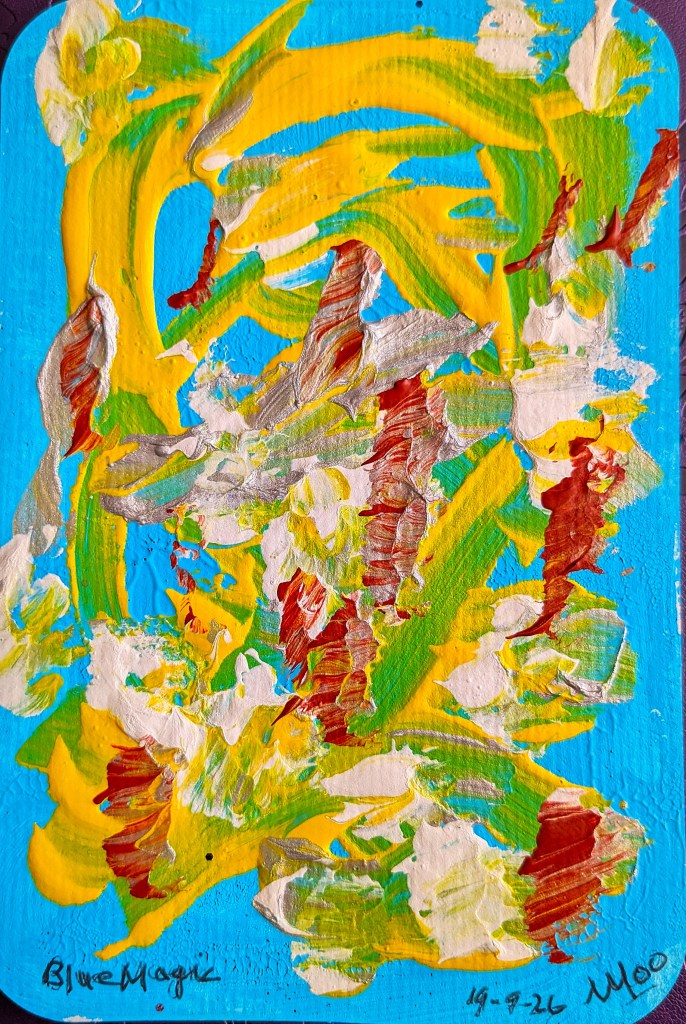
Moo wants me to tell you that he painted this painting last night. He calls it No More Blues. Guess what? There are no blue shades in it. Cunning, eh? And daylight hours are back up to 9:30 – 9.5 hours sunlight on this cold, wintry day. And it is cold at -14C. On the other hand, Moo’s painting is toasty warm and you can hold up your chilled fingers and warm them on his painted fires.

As for me, I am having great fun preparing my writing for competitions that I never win. I am also paying to enter them. But I choose carefully nowadays – so many publications and competitions want so much money just for sending them a manuscript they will possibly never read and probably (nay, almost certainly) reject. I am so happy that I do not have to live off my earnings. I have 17 books on KDP Amazon and guess what? I received $3.61 in earnings in 2025. And I must declare it on my tax forms. I hope it doesn’t send me up a tax bracket!

I guess it’s a case of Fly me to the stars and let me see what writing pays on Jupiter and Mars. Not much probably. I bet they don’t read poetry in any of those Mars Bars I am always reading about. That said, I wonder what language Mars Barmen speak? And do they have Mars Bar Flies, like we have Bar Flies here on earth? Oh the wonders of language and the Joy of Words. The Joy of Six, as well – and that’s Sex in Latin. Get the joke? Oh, to be multilingual, now that spring’s a coming. Easy now. Don’t get too excited. And look at all those little white angels flying in Moo’s painting.

Rage, Rage 8 & 9

Rage, Rage
8

A late summer storm
lays waste to the doggy daze
that clouds my mind.

Carnivorous canicular,
hydropic, it drains my soul,
desiccates my dreams,
gnaws me into nothingness.

Tonight, the old black hound
will dog me,
sending my head spinning.

It will force me
to chase my own tail,
round and round
in ever-decreasing circles.

It will devour my future,
leaving past failures
to ghost through my mind.

9

Where now are the hands
that raise me up,
that rescue me
from dark depression,
that haul me out
from life’s whirlpool,
that forestall
the jaws that bite,
that save me
from the claws
that snatch?

Where are the hands
that move the pieces
on the chess board
of my days and nights,
that prepare my breakfast,
that bake my birthday cake
and count the candles
that they place and light?

What will I do
without them
now they are gone?

Commentary:

Gnawed into nothingness – the umbra nihili of the medieval mystics, the shadow of nothingness that sometimes falls upon us, threatening our peace of mind. An AI search offers – Umbra Nihili (Latin for “Shadow of Nothingness”) refers to a concept of cosmic loneliness or existential void famously cited by Meister Eckhart. A great many of my friends have recently discovered this umbra nihili. I am not sure why. I guess it varies for each one of us. Mal de todos, consuelo de tontos / that everyone suffers consoles only fools, the Spaniards say. What can we do at such times? Reach out, help when we can, count only the happy hours, as the inscription on the Roman sundial tells us – horas non numero nisi serenas.

Many have walked this way before. But that should not be a consolation in itself. Rather, it should be an acknowledgement that there is an exit to the maze, a key to unlock misery’s door, a thread to lead us out of the labyrinth. We must just acknowledge that fact and search for the exit, the key, the thread, that will prove to be our personal salvation, and hopefully the salvation of other fellow sufferers as well.

Carved in Stone 33

33

A child’s swing in the orchard
hangs below the apple tree.

Early bluebells
tinkle in the hedgerow.
Why do foxes wear gloves,
I ask, in my innocence?

My grandmother,
a young woman once more,
stands in her kitchen
humming her morning music
while she bakes the day’s bread.

My grandfather,
skeletal in the evening sunshine,
shifts his long, black shadow
from side to side
as he scythes the grass.

34

Time’s fragility
dwells in all our bones,
but rarely in our minds.

I look at them,
those twin tomb stones,
with names and dates

time-worn now,
carved into their stone.

I blink, as they sway
in the twilight
of my own
fast failing eyes.

Commentary:

A Mexican Mask outlining a person’s three three ages. The small, pearl in the centre – seed of the child. The central face, bearing the pearl beneath the nose – youth and beauty. The second face – old age. The white skull – the individual’s death. How quickly life passes. I turn and look, and so many ages have passed me by. And so it is with all of us.

One of my friends dropped in to see me today. I coached him rugby (Jeux du Canada Games, 1985), when he was 18 years old, heading for 19. Now he is 59 years old and heading for 60, if he hasn’t already left it behind. Oh the memories – tread softly, for you tread on my dreams (Yeats). And it is so easy to substitute memories for dreams.

Time’s fragility dwells in all our bones, but rarely in our minds. Alas, in our minds as well. I notice how forgetful I have become. I see life my past as a railway track, the two rails joining, undivided, as they fly into the distance. “Railway train, running down the track, always going on, never turning back – choo-choo – I’ve got a one way ticket to the blues.” I remember the words and the tune, but I don’t remember who sang. Clearly time’s fragility is beginning to enter my mind as well.

Clepsydra 49 & 50

49

… I am walking backwards
     a step at a time
          into my second childhood


my face in the mirror
     is no longer that of the little boy
          I used to be


I open so many boxes
     stored in my mind’s attic
          but find only dust and ashes
               the burnt-out remains
                    of long-gone days …


50

… sitting in the car
     waiting for my beloved
          to finish her shopping

who are they
     these faceless people
          these ghosts
               who look at me
                    then avert their eyes

I see their faces
     distorted in the puddles
          left by last night’s rain

why don’t they speak to me
     why do they always
          avoid my eyes

is it the blue sticker
     in the windscreen …  

Commentary:

I see their faces distorted in the puddles left by last night’s rain.

Writing in the Red Zone

Writing in the Red Zone

The Red Zone:
it’s a familiar concept.
Monday Night football
talks about it all the time.

“Success percentage
in the Red Zone,
offense and defense.”

It’s not just football.
Other sports, soccer, rugby,
have their red zones.
So does life, my life,
for better or for worse,
and now I know I’m in
the Red Zone.

I can see the goal line.
I can feel the tension rising.
I know the clock’s ticking down.
I can sense it, but can’t see it.
I no longer know the score,
and I don’t know whether
I’m playing offense or defense.

They tell me it’s a level playing field,
but every day they change the rules,
and today I wonder what the heck’s
the name of the game I’m playing.

Crystal Liturgy

Crystal Liturgy

Here, in the abyss,
where song-birds pluck their notes
and send them, feather-light,
floating through the air,
here, you’ll find no vale of tears,
no fears of shadow-hawks,
for all blackness is abandoned
in the interests of sunlight and song.

Here, the crystal liturgy surges,
upwards from the rejoicing heart,
ever upwards, into the realms of light,
where color and sound alike
brim over with the joy that, yes,
brings release to head and heart.

Here, seven-stringed rainbows reign,
the everlasting harp is tuned and plucked,
and an eternity of music cements
the foundations of earth and sky.

Here, the master musician conducts
his celestial choir, their voices rising,
higher and higher, until they reach
the highest sphere, and song and voice
inspire, then expire, passing from our eyes
and ears into unbounded realms of light.

Here, the seven trumpets will sound
their furious dance, a dance that will announce
the end of this singer, the end of his song,
but never the end of song itself.

Comment:

Crystal Liturgy is the first poem in the first sequence of my poetry book Septets for the End of Time. My friend Moo, the painter, supplies the paintings for the book covers. He and I have decided to hold a dialog on our views of how the painting and the poem relate to each other. Hopefully, we will continue this dialog throughout Septets for the End of Time.

“I have tried to join the ideas of sound, light, song, and voice to the idea of the Platonic Universe, where the planets dance to the music of the spheres. I wrote these poems listening to Messiaen’s Quartet for the End of Time. I allowed the music to flow through me and I responded, in words, to the images that came from the sounds, and the silences, of the music.”

“I see no sorrows here, no woes,” Moo told me. “I only see the the joy of light and existence. The shadows have been dispersed, and my painting contains a generous helping of sunshine and light. I find it very suitable for this particular poem. My painting’s starburst of energy enhances the poem’s sense of movement, strength, and light. It also contains the message that all will be well.”