Carnival

Carnival:

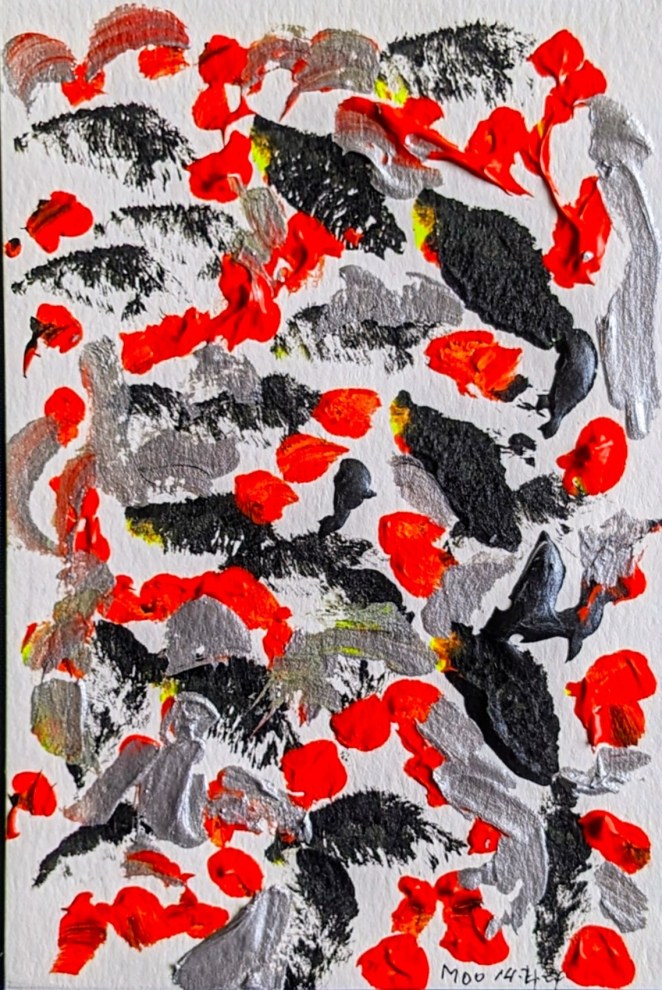
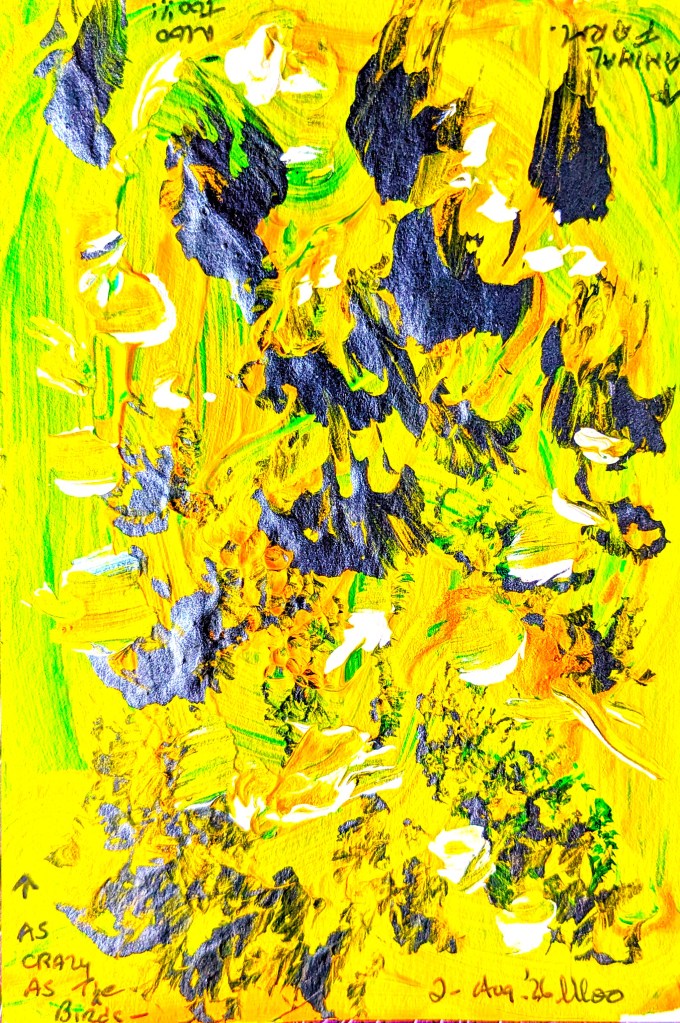
Bakhtin’s Carnival – the world turned upside down and inside out. And here it is. Moo has painted an upside down world. From the above angle, the world is full of birds and is “as crazy as the birds“. Lovely image. There they go, birds of a feather, flocking together, soaring, sinking, doing what birds do when they are as crazy as bat shit – and Moo told me, he nearly gave his painting that name – Crazy as Bat Shit.

But hang on a moment – if the world is upside down, what happens when you turn Moo’s painting upside down? Let’s try it and see.
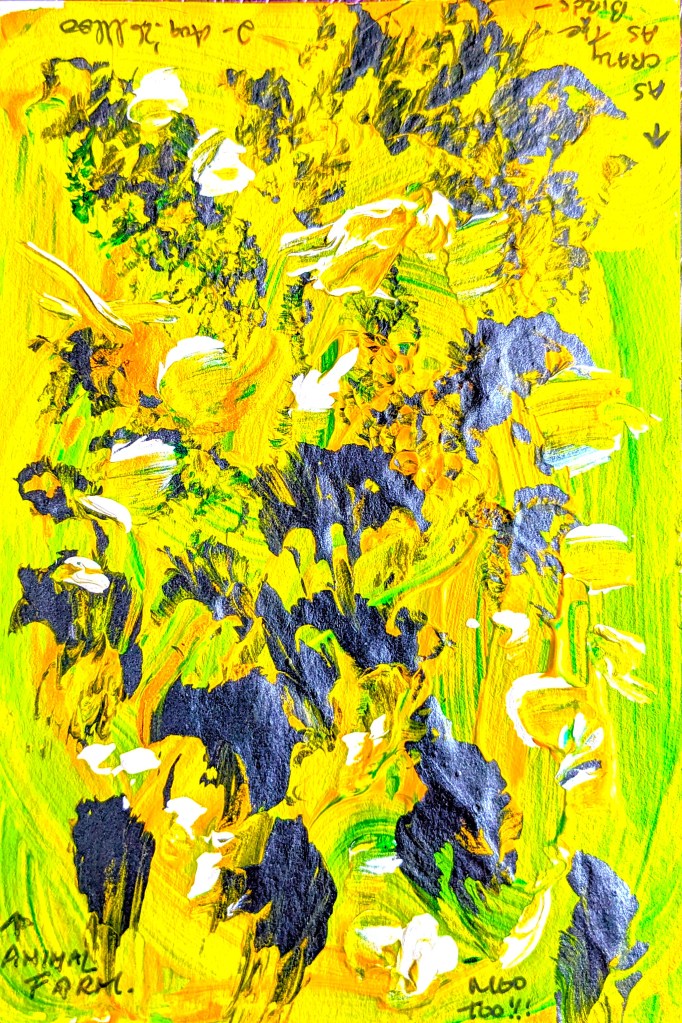
Would you believe it – the birds are no longer birds, they have turned into animals. From this point of view, we have Animal Farm. Moo thinks he can sell this painting for double the price now he has discovered it means something different the other way up. Now – what if …. Nope. Let’s leave it there. We are not going to turn it sideways, nor inside out. That’s asking too much of Moo and his painting skills.

But we have a tiny little lesson, and with no poem attached to it. Perspectivism – the same object seen from two different points of view by two different people can elicit different functions and different interpretations.

Think of the Barber’s Basin in Don Quixote. One group of people see it as a barber’s basin. A second group see it as Mambrino’s Helmet, missing a visor. Cervantes resolves the problem by adding yelmo to bacía to give a new word – a baciyelmo. A helmet that serves as a basin and vice-versa. Does such a combination exist in English? Whyever not! We can call it a bassinet, as in a pig-faced bassinet. That is to say, a helmet with a snout that ends in a bassin – well, we can forgive the -ss- if we are generous.

And now we come to the important part of our lesson. Most things can be changed from one meaning to another, if we change our position and our point of view. Birds can become animals. Animals can turn into birds. A good mood can be turned into a bad mood. A bad mood can be turned into a good one.

There is so much depression around us at the current time. “Turn that frown upside down” – and turn the world on its head and inside out. I bet you can do it if you really try. After all, Moo has shown you how and I assure you that Moo – and I know him well – is no genius. However, in spite of that, every so often he stumbles on a tiny truth, just like he has in this painting.

So – don’t get frightened and depressed by the black dog when he leaps out at you from the grandmother clock. Turn him from a dog into a bird and let him fly away into the blue, taking the black dog’s blues along with him. And remember – if Moo can do it, so can you. So “turn that frown upside down” and remake your world in the shape you would like it to be. And remember – if Moo can do it, so can you.
Sun Bird

Sun Bird

You fill a hole in my life
with a strange unfamiliar
super glue
that bonds me to you

ties unseen unknown
bind us and stop me
from being alone

we neither touch
nor hug
yet a secret stream
links us joining us
mind to mind

manna from heaven
descends on the desert
more powerful
than mortal love

Tuseday’s Child

Tuesday’s Child

1

Thursday’s Child has far to go …
so too does Tuesday’s child,
especially this one, when he sets out
on a Tuesday on a long journey.

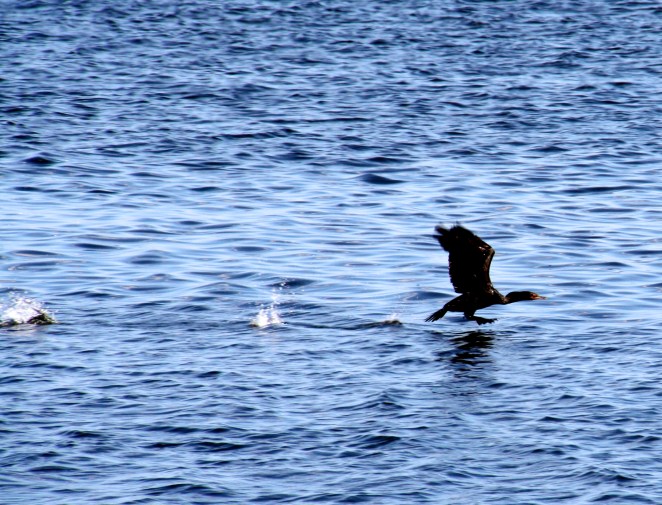
Just by chance, I caught this cormorant.
“Behind you, quick,” said Clare.
I turned and ‘Click!’

2

Such a miracle:
the first steps of flight
taken over water.
That first step heavy,
the second one lighter,
and the third one
scarcely a paint brush
pocking the waves.

3

The need for Tuesday’s Child
to take flight lies deep within me.
Fleeing from what?
Running towards what?
Who knows?

All I know is that the future
lies to the right of this photo
and the past lies to the left,
and I don’t know
what either might contain.

4

But I do remember the words
of Antonio Machado:

‘Caminante, no hay camino,
sólo hay estela sobre la mar.’
traveler, there is no road,
just a wake across life’s sea.

5

We may not know what lies ahead
but, like a ship at sea,
we leave white water behind us
and that wake tells us
where we have been
and what we have done.

In a country garden …

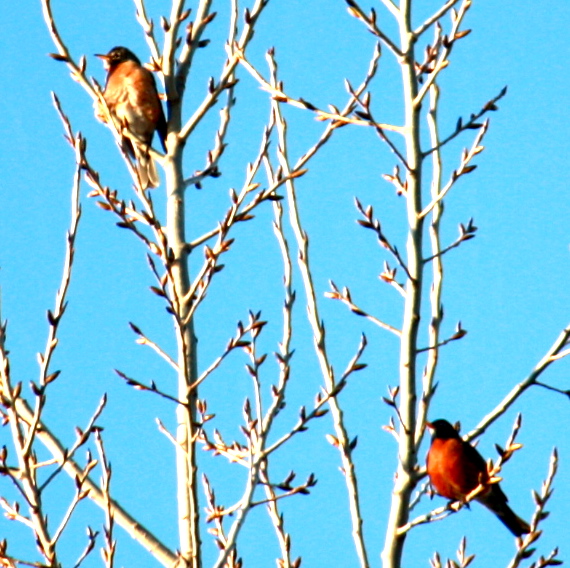
Each day sees another spark of brightness in the grass, in the trees, or at the feeder. Where, I wonder, have they been? In whose back yard did they winter?  Some, stray thoughts perched for a moment on a branch in the mind, fluttered last fall in the falling snow and melted away. Others, I know, stayed here with us and we fed them throughout the short cold days.

IMG_0017.jpg

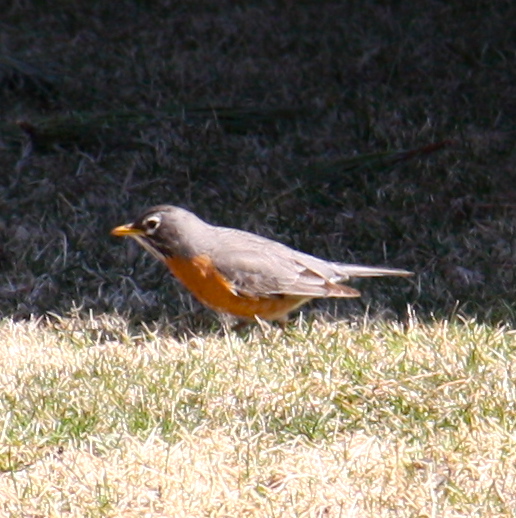
The robins, even though they are not my English robins, are my favorites, perhaps because they remind me of my childhood home. Less bold than those of my youth, they fly when we draw near and do not sit on the spade handle watching for worms as we turn the early earth and shake the garden back to life.

IMG_0033.jpg

Sentry duty: and they march up and down the lawn pacing their quicksteps, then standing to attention. They strut their stuff, turn their heads, listen, and look like guardsmen on parade outside our pastoral palace.

IMG_0014.JPG

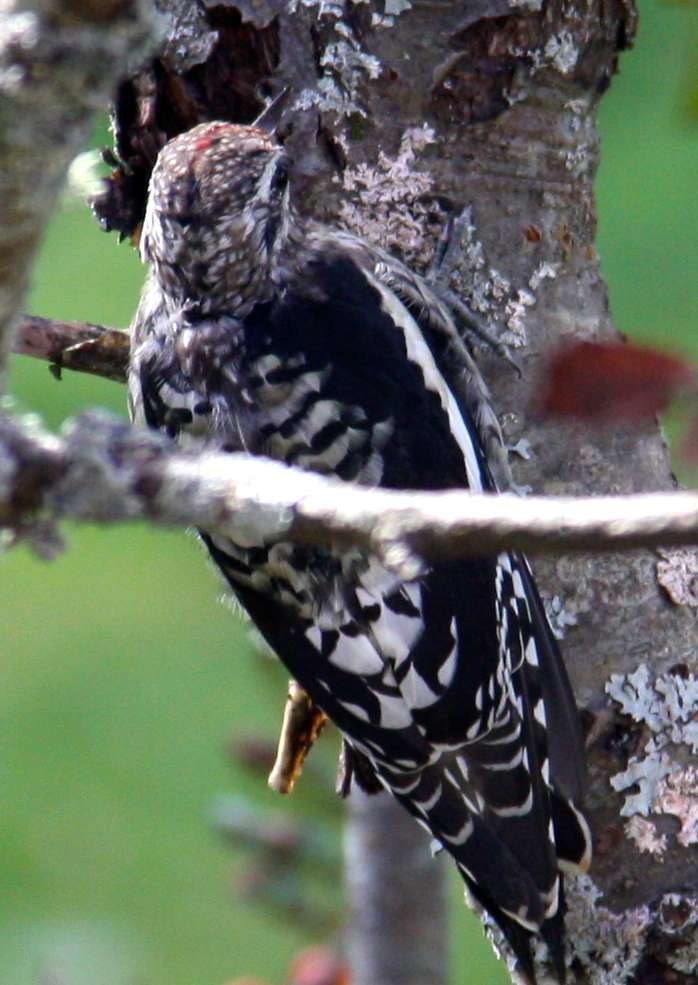
With the guardsmen come the workmen, the busy birds, the ones who tap on the trees in search of insects or to set the juices running. Shy, they turn away and hide behind the trunk. But if we are quick, we can catch them, heads turned, when absorbed in their work, they forget to fear us.

IMG_0063.JPG

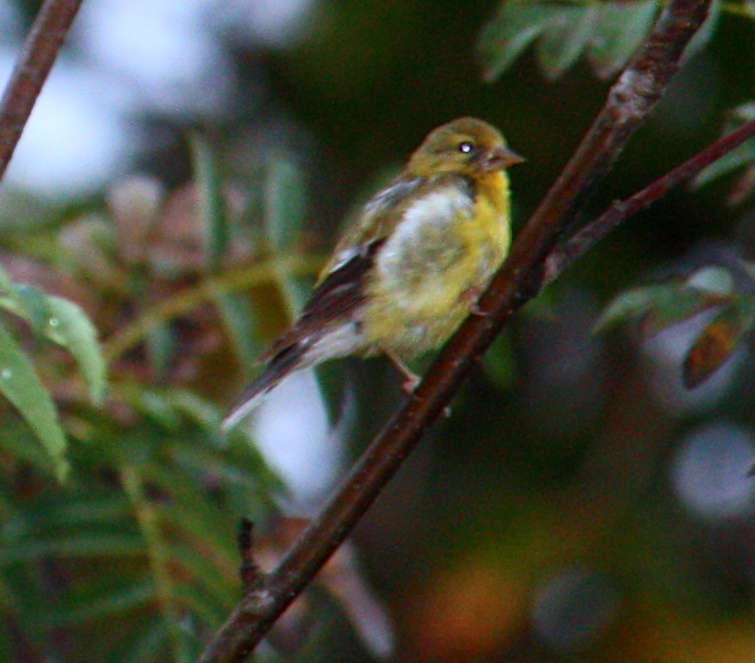
And the song-birds, shiest of all, often heard, their melodies, but their quicksilver spirits seldom seen except by chance and the artist’s luck and speed of finger. But listen: other songs throb their melodies on the wind and most days now we wake to music. A calling in the trees in the evening’s glow also tells us the world has turned once more and the birds, the glorious birds, the dwindling flocks of endangered birds, less this year than last year or the year before, are back. We must welcome them and cheer them while they are still with us.  Neither we nor they may  endure much more.

Spring Cleaning

Spring Cleaning

Sun’s yellow duster
arrived late this year
gray cobwebs still
clutter my mind

I try to brush them away
with clumsy fingers
but stubbornly they stick
and cling and will not go

Spring came in with snow
gales and icy rain

Warm winds will soon
spring showers bring
to revive cold clay
and help things grow

Comment:

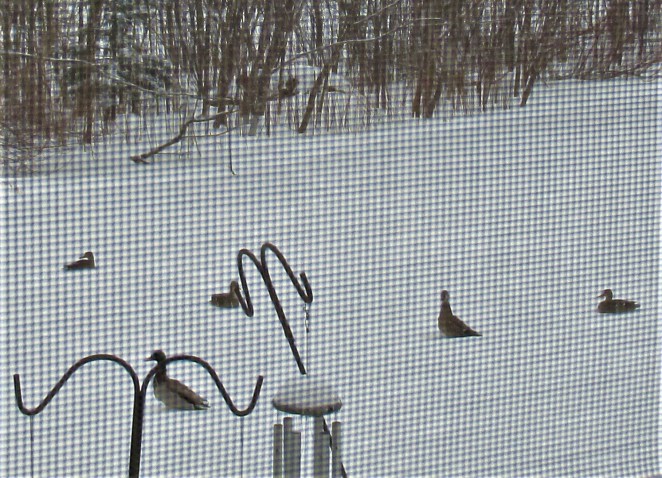
We have lived in this house for 37 years, but only once have I seen ducks land on the snow-covered lawn. Whatever were they thinking? Good question – do ducks think? They are living beings, so of course they do. But I am totally unaware of what they think nor am I able to understand the nature of their mental computations.

We share this world with so many creatures that we do not understand. I wonder sometimes if they understand us. Who knows? If we cannot speak their multiple languages, if we cannot enter their culture and their minds, if we see them as nothing but food and devour them as fast as we can, never thinking of them at all, save as more or less savoury items on our dinner plate — les meurtiers et les victimes, as Albert Camus wrote. Murderers and victims – and we are both. Murderers of our victims and victims ourselves to our unbounded greed.

Rage, Rage 57

Rage, Rage
57

Time’s oxen
have plowed their furrows
in my face.

A silvery thatch
bears witness
to the winter
of my withering.

My broken body
hangs from the coat hanger
of my shoulders,
its worn-out sack
knitted from skin,
bonded with blood.

I walk with two canes,
not just a sick man,
but a stick man.

When I fall asleep,
my enigmatic body
haunts me with
its death-rattle
of drying bones.

Comment

Sometimes no comments are needed. However, when it comes down to it, I guess it’s worth saying that I am raging, raging against the dying of the light.

The dying of the light – in the evening, when the sun goes down, the house grows silent and cools around me. Some nights, when the news is bad or depressing, I feel we are entering another dark age. Luckily, spring is on its way, with summer not far behind. But what will spring and summer bring?

I fear the heat, the gathering of muttering trees, the ambush nature is setting up for humanity. We live among trees. Trees, all around the house. Trees, climbing the hills into the distance. I loved them when I came here first. The maples, the paper birches, the mountain ashes with their spring finery and the light green fuzz of forming leaves. Winter – the firs and pines dressed in their winter coats.

Last summer, fires broke out all over the province. The closest was a mere 30 kms down the road from us. We could smell the fire, see the smoke, and sense the discomfort of the proximity of possible outbreaks closer to home.

As I grow older, I become more fearful. Walking downstairs in the morning – cada pie mal puesto es una caída, cada caída es un precipico / each badly placed foot is a fall, each fall is down a precipice. Luis de Gongora. ( d. 1627). Alas, it’s that time of life, and it comes to anybody who, like me, has walked this far.

It’s the animals that I pity. The birds who move on and away and no longer stay with us. The deer who also have nowhere to go when their habitat is destroyed. The moose, the bears, the coyotes, the foxes, the jack rabbits and yes, they have all been visitors to our backyard.

Last summer, the local council circulated some ideas on how to prepare for immediate evacuation of our property- what to pack with a day’s notice, three hours’ warning, two hours’ warning, one hour’s warning. I hope it never comes to that. But now, I no longer know, and so I rage, rage, against the dying of the light.

Rage, Rage 49 & 50

Rage, Rage
49

Waiting in the doctor’s office,
I hear two old women
gossiping about friends
and family, the intimate
details all laid out
to fester in my fertile mind.

Never will I be able
to put faces to those girls
with breast cancer,
to the women
weighed down
with diabetes,
to the old men
with their strokes
and heart attacks.

50

“Just one of those things,”
one of them whispers,
“my husband gone
leaving me alone
with the grandkids.”

“Is it four years? Or five?
I remember his name,
but I forget his face.”

“And our fourteen-year-old,
her belly already swelling …”

“You’ll cope somehow …”

Silence wraps its scarf
around their flapping mouths.
I think of all my own lost loves,
buried before their proper time.

Lives and worlds end …
new ones begin.

Comments:

Lives and worlds end … new ones begin. How true it is. The olde order changeth lest one good custom should corrupt the world. Tennyson, I believe, from Idylls of the King. King Arthur and his knights of the round table. Each of them rode into that dark night, some quickly, some more slowly, but all were lost, as so many things are lost.

That was also the heading of the departures section of my old school magazine. At the end of the year, pupils left the school, many graduating, never to return, and the old order did indeed change. The fourth formers moved up to the fifth, the fifth to Transitus, then to the sixth, and finally, the scholarship students arrived in Ichabod. Ichabod, Ichabod, the glory that used to be. I look at old school photos and I wonder what became of so many of my childhood friends. The website for my old school also contains an obituary section. I consult it, every so often, to see who else has passed on. Fewer names than I would expect. Not everybody keeps in touch. I am in contact with few old boys from school, but nobody from my undergraduate university. Ships passing in the night, all of us. Our conversations lost in the mists of time.

The old order changes and the language changes with it too. When I was visiting Spain regularly, my first stop, every year, would be the local barber’s shop. I just sat there and listened while I waited to get my haircut, Spanish style. I listened for the new buzz words, the names that now floated around, the latest jokes, the ideas that were currently in fashion. Change is everywhere.

Covid changed the Spanish language, gave it a whole new set of terms that I do not recognize. The same thing happens with English, French, any language. French is not the same in Moncton, New Brunswick, as it is in Shediac. And the Acadian Peninsula is slightly different. As is the language of Grand Falls, and that of Little Falls, aka Edmundston, the capital of the Republic of Madawaska. The language also changes close to the border of Quebec where Joual can be heard. Same thing along the St. Lawrence river and out from Matane to Mont Albert and beyond. Small changes, sea changes, enormous varieties of change.

I often wonder what is happening in Wales both to Welsh itself and to the English language as it is spoken there. English in Swansea / Abertawe was never the English of Llanelli, nor was it the English of the Rhondda Valleys. How could it be? And Cardiff / Caer Dydd was always different. As was Newport / Cas Newydd. I haven’t been back there since 1988. 38 years of change – friends gone, family gone, nobody left. I couldn’t bear to stay in a hotel in a town where once I lived in my family’s homes.

How does one end a rant like this? In silence, of course. For silence wraps its silken around flapping mouths. I think of all my own lost friends and loves, buried so long ago, many before their proper time.

Rage, Rage 5 & 6

Rage, Rage
5

Empty now the house,
clean the floors
where she scattered her toys,
polished the grubby tables,
where her small hands
splattered food,
wanted and unwanted.

Empty the bathroom,
the tub where she took
her daily bath,
dry the towels she dampened,
wrinkled the toothpaste tubes
she happily emptied.

Empty too
this heart of mine
wherein she built her nest.

Like a wild bird, she has flown,
joined the end of summer migration,
yet I still possess a part of her
within my emptiness.

6

I remember how she stood
at the window, excited,
gazing at the birds.

“Finch,” I pointed.
“Goldfinch. Grosbeak.”

Her hands plucked at the air,
not a feather fell,
she caught nothing.

“Yellow, she cried, “yellow,”
jumping up and down with joy.

Her nose, all wet and runny,
left damp, sticky smudges
on the cold window-pane.

I see the greasy smears
that remain where her nostrils
pressed against the pane.

Still the glass stays unwashed
and now that shadow stands
between me and the sun.

Commentary:

Empty house, empty nest. How many homes have just enjoyed the festive spirit, rejoicing in the company of family and friends. Alas, the holiday is almost done. In many houses, the taxis have left for the airport, the cars have driven away, the rooms that were filled with warmth, joy, and laughter are cold and empty. Only the shadows remain. The echo of voices that are now silent.

The old remain, as they were before the festive invasion, old and lonely. The young have flown back and away to their usual lives, their schools, their jobs. I sit before my screen and type these words. My beloved sits in another room and watches TV. When the adverts come on, the volume increases and the same tedious voices mouth their joyless messages. My nest may be empty, but I do not have an empty head. And I don’t want it swamped by the commercial acumen of the tv set.

My head contains many rooms and many of those rooms are filled with memories that will, as Albert Camus said, last me a lifetime. One summer afternoon, examined in its intensity, will last forever, or for as long as the viewer lasts. Alas, I mourn for those who age, who suffer from Alzheimer’s and the like, and whose heads are empty. What do they think, what do they feel, what twilight memories flicker through the empty nests of their ageing brains? I hope and pray I never know.

Carved in Stone 63

Carved in Stone
63

Words descend, soft and peaceful.
They brush my mind
with the hushed touch
of a grey jay’s soundless wings.

Yet the grey jays have gone,
vanished along with the grosbeaks,
evening, pine, and rose breasted.

Words can hardly express what I feel
in this diminishing world
when I inhale color and light.

Dawn bursts into bloom,
and the indoor hyacinth starts,
once more, to blossom.

Its immanent beauty
fills me with a warmth
that disperses night’s shadows,
taking away all sense of gloom.

Commentary:

The indoor hyacinth starts, once more, to blossom. Its immanent beauty fills me with a warmth that disperses night’s shadows, taking away all sense of gloom. Indeed it does. Once upon a time, it became infested with little bugs and was reduced to one leaf. Clare worked with it, spoke to it, cajoled it, and bit by bit it came back to life. Now it lives in the front porch in summer and returns to the house, southern aspect, in winter, to flourish when least we expect it.

Hyacinth, Jamaica in Spanish. And nothing more delicious than the miel de jamaica that one is offered in Oaxaca, fruit juice squeezed from the hyacinth flowers. “My wife has gone to the West Indies.” “Jamaica?” “No, she went of her own accord.” Humor flows and the hyacinth flowers, and I spend my winter hours sitting and watching my indoor flowers.

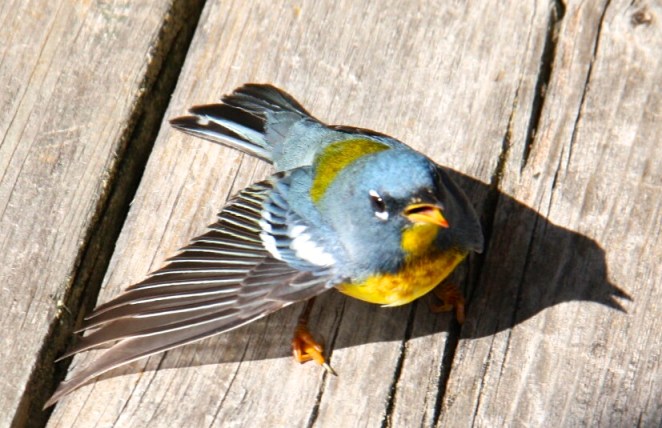
Yet the grey jays have gone, vanished along with the grosbeaks, evening, pine, and rose breasted. They used to flock on the picnic tables but as the weather warmed, they went further north. I remember when 64 mourning doves perched on the power lines. Now, we have two or three who look lonely in the garden and sound even lonelier. Words can hardly express what I feel in this diminishing world when I inhale color and light, but long for the passerines’ morning and evening flight.

But, in spite of all that, sad as it is, the hyacinth’s immanent beauty fills me with a warmth
that disperses night’s shadows, taking away all sense of gloom.

Carved in Stone 37

Carved in Stone
37

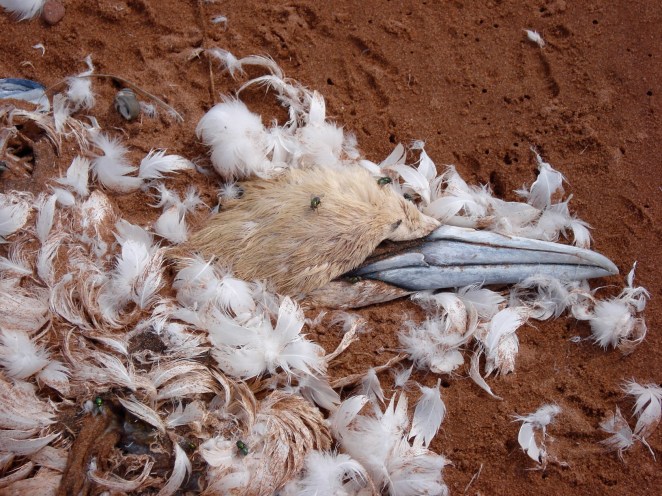
A great blue heron,
half-buried in the sand,
lies, covered in flies.

What words could I carve
in sand beside his grave?

What words would I carve
on mine?
What could anyone say?

I guess I could say
that I was happy,
in spite of the pain,
but would I do it
all again?

Commentary:

I guess I could say that I was happy, in spite of the pain, but would I do it all again? – Good question, and I have no answer to that question. Is life circular? Do we pass on from existence to existence, learning as we go? Some religions think so. Do the participants and believers have a choice? That I do not know.

Would we, like the English cricket team currently in Australia, make the same mistakes again and again, never learning from each dismissal, never learning from the blows given to another’s body or head? All good questions. Or would we learn from each life, each circumstance, slowly ascending a sort of Platonic Ladder until we climbed to the highest level of perfection? Who knows? I most certainly don’t. Nor do I know where the light and the flame go when I blow out the candle.

So many mysteries, as the fate of my little bird was a mystery, as the fate of the fish in the first photo was also a mystery. Albert Camus – meurtriers ou victimes? Are these the only choices that we have, to be the predator or the prey? I most certainly hope not. Libre albedrío – free will in the Calderonian world of the seventeenth century in Spain. But how free are we? What cultural and developmental chains bind us, pull us down, and are we surrounded by our childhood and our culture, and our education, in such a way that we have little or no choice in how we think and what we do?

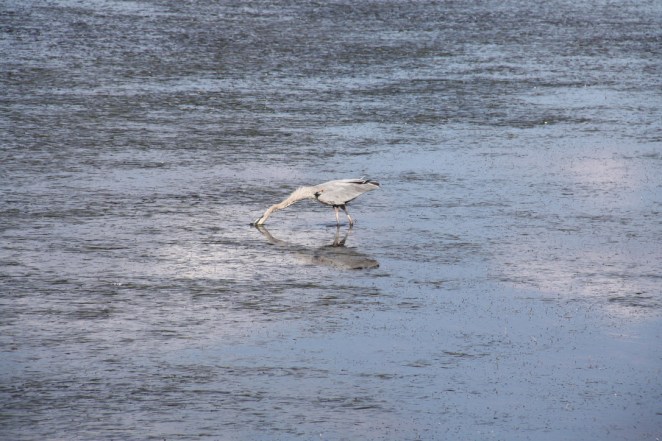
Answers by air mail, please, and tied to the back of a great blue heron, preferably the one in the upper photo, not in the lower one!