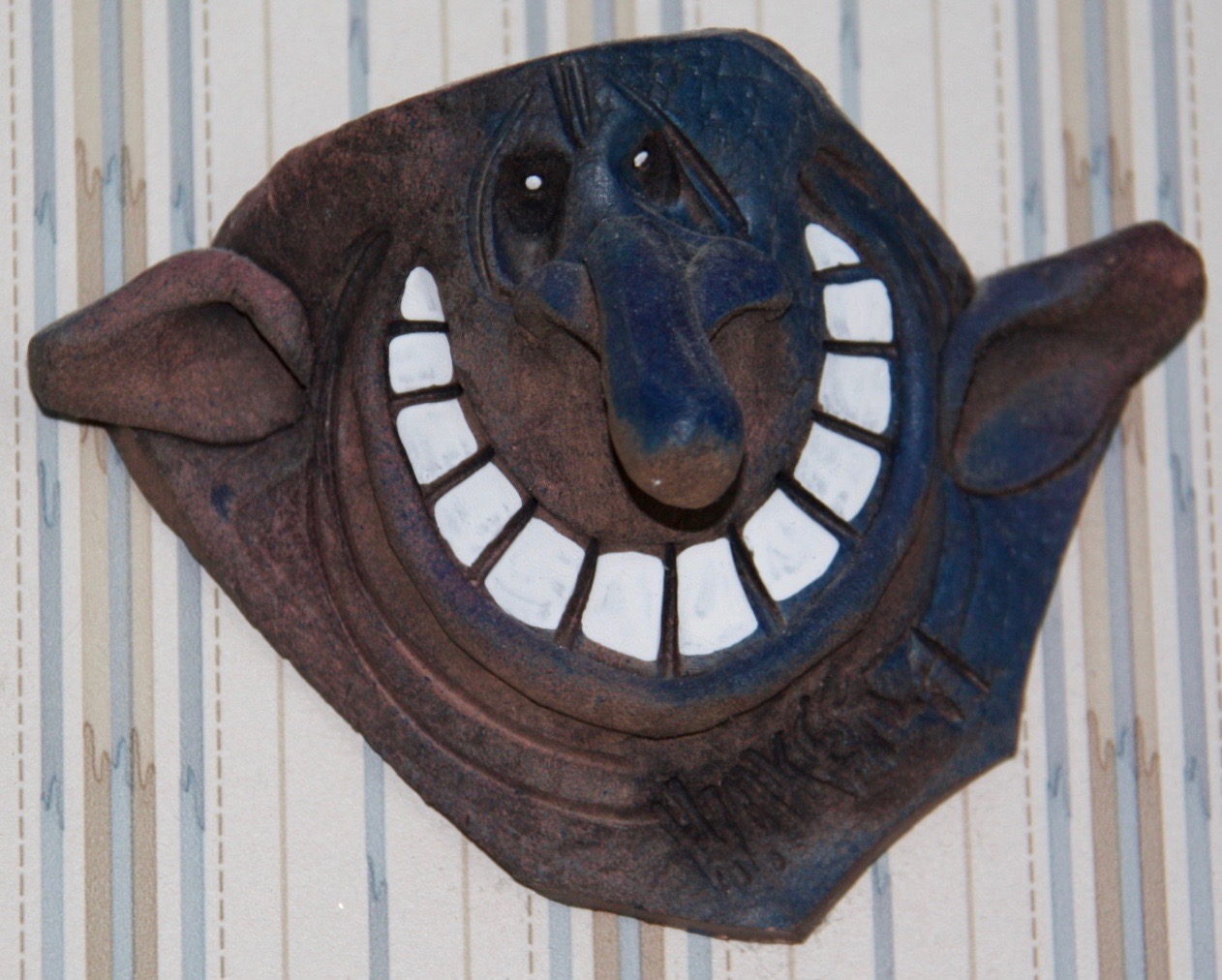
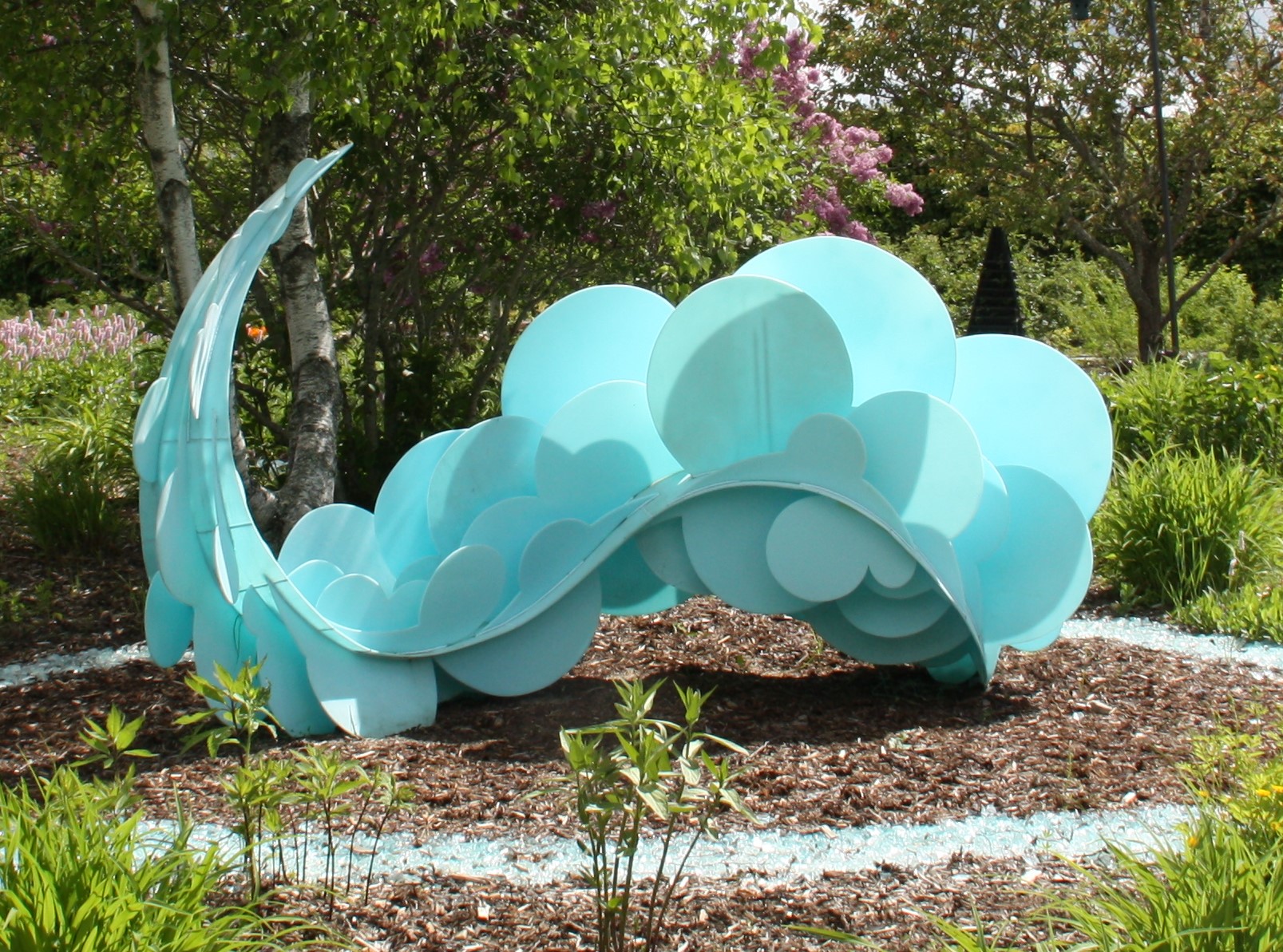
Bullfight

Los Toros de Guisando

Bullfight

… at the beginning of the end, when more things have gone than are with us and the summer’s sun withers the grass and wrinkles our faces baking us bright red – como un cangrejo te has puesto, hijo mío, en el sol de Somo, como un cangrejo – and — pulpo en un garaje — you grasp at the new words, the new colors, the new delights, your tongue trapped clumsily in your mouth like a red rag doll and the midnight bull charging the spectators who gather and olé, au lait … as the drunken bullfighter climbs the bull and kills the post. The red cape flutters in our memories and to the slaughterhouse we go where the open body hangs loose like a flag and the red meat of him held out for all to see and some to share … and this is his body and this is his blood, sacrificed in a circle of golden sand for our drunken amusement … for whatever I did, I never visited those bull fights when I was sober … at five thirty, they began, and at 3 o’clock we would gather in the city center and slowly wend our way from bar to bar, up the Calle de Burgos, past the street where you lived and upwards, ever upwards, towards the bull ring at the top of the hill, from bar to bar, I say, and the bota, the wine-skin filled and re-filled with that dark red fluid that will set us all baying for the bull’s blood, or the matador’s blood, it doesn’t matter whose blood, as long as someone bleeds and the bull is butchered, torn from this life by a man on horseback, armed with a lance, and he thrusts the heavy blade between the shoulders of the bull, the blood first dripping red, then gushing, a small stream over the rock of the bull’s shoulder, and down the bull’s front legs, to slither on the sand, and the bull still ready to charge the horse, and the bull’s head steadily dropping as the muscles in the back and neck are gashed and torn and there’s no hell like this gaping wound between the bull’s shoulders and the blood flowing freely and vanishing into the sand, the golden sand, once pristine, stained now with blood, and soon to be further blemished with feces and urine, and the picador, his job done, walks his blind-folded, armored horse out of the ring, and the bull, un-armored, un-enamored of the process which turns his torment into a spectacle staged for our drunken delight, as we pass the bota round, and the blood red wine travels from hand to hand, and we squirt the bull’s blood squarely between our lips and it dashes against tongue and teeth and we swallow the body’s sacrifice hook, line, and sinker, as the banderillero runs in, harpoons in hand, waving his banderillas and plunging their arrowed barbs into the gaping wound that flowers on the bull’s back, and the bull stands there, twitching, wriggling, saliva and drool slipping down, sliding stickily into the sand, as the matador doffs his hat, takes his vorpal sword in hand and treads the light fantastique in his laced-up dancing pumps, his waltzing matilda feet so swift, so sure, eluding the lumbering rush of the charging bull, the load of bull, that tumbles down the railway track towards him as he stands there, the matador, poised like a ballerina, as stiff and as steady as a lamp-post around which the bull circles like a drunken man, staggering a bit, but still bemused by the red flag tied to a stick which waves before his eyes and goads him onwards, ever onwards, in his plunge towards a brilliant death, as he pauses, feet together, and the matador makes his move, one, step, then two, and the bull lurching forward to impale himself on three or four feet of curved, immaculate steel, and the matador immaculate in his reception of the bull – and what is happening? What will happen next? Sometimes, the sword pierces the spinal cord and death is instantaneous. Sometimes, the sword pierces the heart, and death is more or less swift, but certainly certain. And sometimes the sword pinches against the bone and flies from the matador’s hand, and the matador must bend, and pick it up, and try, try again, the red rag below the bull’s nose, the bull drawn forward, yet again, to impale himself, yet again, on the sharp end of the sword, and this time, the sword goes in, but the wound is in the lungs and the peones, the pawns, the workers, the drones, the little men who help, turn the bull round and round in ever tighter circles so the sword will open and even larger wound, sever the main arteries perhaps, and the bull, blood spurting through nose and mouth, lurches now, then falls to his knees, and lies there, bleeding, and the matador chooses the descabello, that little sharp sword with the razor blade at the end and he tries to sever the spinal cord, there at the back of the neck, and sometimes he does, and sometimes he doesn’t, and if he can’t then it’s the little men again in their colorful parrot suits all gleaming with sequins and stars and they carry a sharp little instrument, with a pointed end, la puntilla, that short, double-edged, stabbing knife which is plunged into the occipito-atlantal space to sever the medulla oblongata in the evernazione method of mercy killing,  and the puntilla is plunged again and again into the bull’s neck at this atlanto-occipital joint, until it severs the medulla oblongata, and when it is severed, in this glorious neck stab, then finally the bull drops dead, and the show must go on and on, and on, and the horses come in, black funeral horses with bright feathers on their heads and they loop a rope around the bull’s horns and away he goes, trailing blood, and urine, and shit, all across the sand and other little men appear to sweep the sands clean, and my neighbor who wears a large walrus moustache stained red now and purple with the wine that he has splashed about, shakes the wine skin and finds it as not as full as it was, so he sheds a bitter tear, and since the death was slow, the crowd all whistle and boo the matador and his merry men, but when the death is swift and quick then the crowd is aroused and they wave white hankies at the presidential box and the president awards the matador an ear, a salty, smelly, sticky ear which the peones cut off the bull before he is towed away, and then the matador throws the ear in the direction of his current sweet heart, the fairest lady in the crowd although she be as brown as the beauties baking daily on the summer sand where the sea horses dance and there are no bulls, and no bull shit, and no maids with mops, just the scouring sea, and sometimes the president gives away two ears, or two ears and the tail, dos orejas y el rabo, though this I have seldom seen, and what does the bull care that he dies bravely and well, for now he is dead he hasn’t a care in the world, and the butchers in the butcher’s shop are carving him away, carving him to the skeletal nothingness of skin and bone that awaits us all, the nothingness of this more or less glorious death, with our tails cut off and our ears hacked away to be pickled or smoked or otherwise kept in the fridge as the butcher’s trophy … and who now will walk stone cold sober into that magic circle of sun and shade and stand there, unbowed, before the might of the untamed beast, the untamed bestiality that drives us wild as it wanders through our nightmare cities and our wildest dreams … and now the crowd call ¡música, música! and the band strikes up and martial music plays as the bullfighter and his troupe march gaily round the ring, their trophies held high for all to see before they are thrown to the ravening crowd who bay like the dogs they are as they taste fresh, bloodied meat …
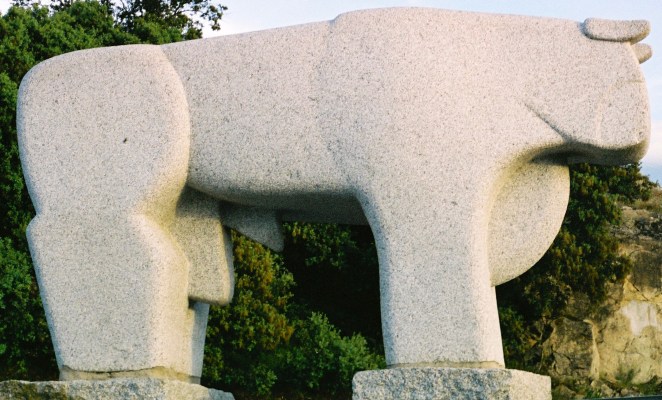
Contemporary stone bull

Mi verraco de Avila
gracias a Juanra
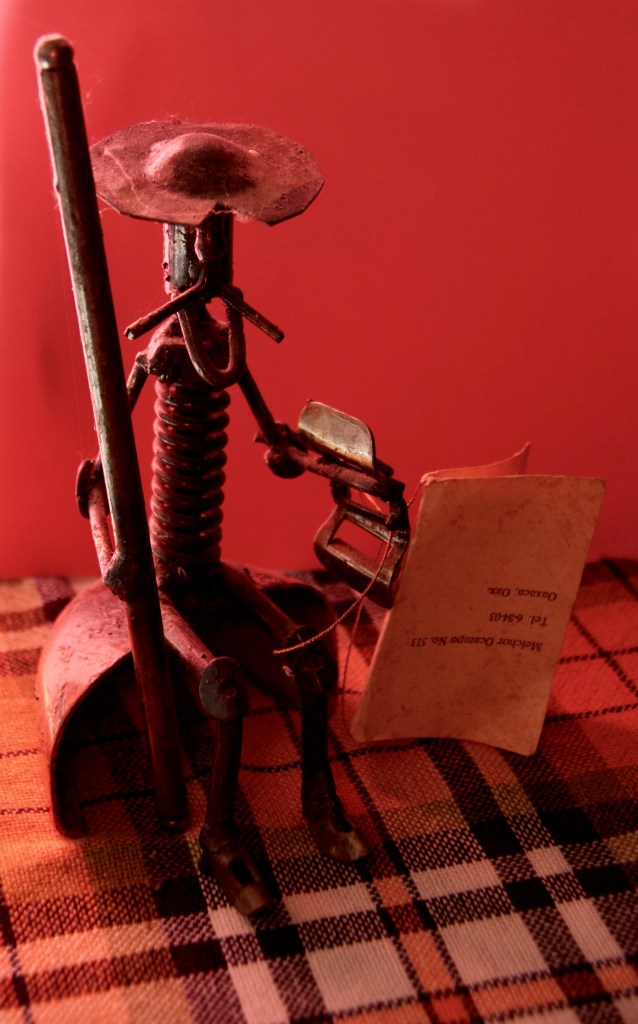
What’s in a Name?

Ryan and Don Roger

2

What’s in a name?

            Don Quixote was first published in Spain in 1605. In 1609, Thomas Shelton translated it into English. By 1611 / 1612 the adjective quixotic, was already in use within English society. An AI search tells us that “In the 17th century, the term quixotic was used to describe a person who does not distinguish between reality and imagination. The etymology of the word began after the publication of Don Quixote in 1605.”

But what does quixotic mean exactly? Another AI search reveals that “Quixotism (adj. quixotic) is impracticality in pursuit of ideals, especially those ideals manifested by rash, lofty and romantic ideas or extravagantly chivalrous action. It also serves to describe an idealism without regard to practicality.”

            Why is this important? Quite simply because in English we say Don Quixote / Quick-sot, not Don Key-hoe-tay a bastardized version of the Spanish. Please note that the adjective, in English, is quixotic not “key-hoe-tay-ic” which is too chaotic to be practical. Note too that the French translators offer us Don Quichotte, while the Italians suggest Don Chisciotte. Both these languages conserve the original pronunciation – a voiceless postalveolar fricative /ʃ/, which is the same sound as the English “sh” in “ship”. This is clear evidence that the X of the original had a different pronunciation in the seventeenth century than it does today.

            My wonderful friends on AI confirm this as follows, and I quote:

In 17th-century Spain, the letter ‘X’ primarily represented a voiceless postalveolar fricative /ʃ/, which is the same sound as the English “sh” in “ship”. During this period, which coincided with the Spanish Golden Age and the “readjustment of the sibilants,” this sound underwent a transformation, shifting from the “sh” sound to the modern velar fricative /x/ (similar to the German ch in loch or the modern Spanish ‘j’). 

Here are the key details about the pronunciation of ‘X’ during that era:

Initial “Sh” Sound: Early in the 17th century (and before), words that are now spelled with ‘j’ or ‘g’ were spelled with ‘x’ and pronounced as “sh.” For example, Don Quixote was pronounced “Don Keesh-o-teh”.

The Sibilant Shift: During the 16th and 17th centuries, the sound /ʃ/ (written as ‘x’) and the voiced /ʒ/ (written as ‘j’) merged into a single voiceless sound /ʃ/. Later in the 17th century, this sound moved backward in the mouth, evolving into the modern velar /x/ (the modern ‘jota’).

And this is just the beginning and what’s in a name? For example, what is the real name of Sancho Panza? Is it Sancho Panza or Sancho Zancas [DQI,9]? How about his wife? Is it Juana Gutierrez or Mary Gutierrez [DQI, 7]? In the same chapter she is called Teresa Panza, the name that stays with her throughout the novel.

And what about Don Quixote himself? Is his real surname Quixada, Quesada, Quexana [DQI,1] or Alonso Quijano el Bueno [DQII,74]? Don Quixada de la Mancha aka Don Quesada de la Mancha aka Don Quexana de la Mancha – and we won’t mention the alternate names he takes – the Knight of the Sad Countenance or the Knight of the Lions!

Fascinating, eh? So, after all that, tell me – what’s in a name?

KIRA Boutique Writing Retreat


IMG_0124

KIRA Boutique Writing Retreat

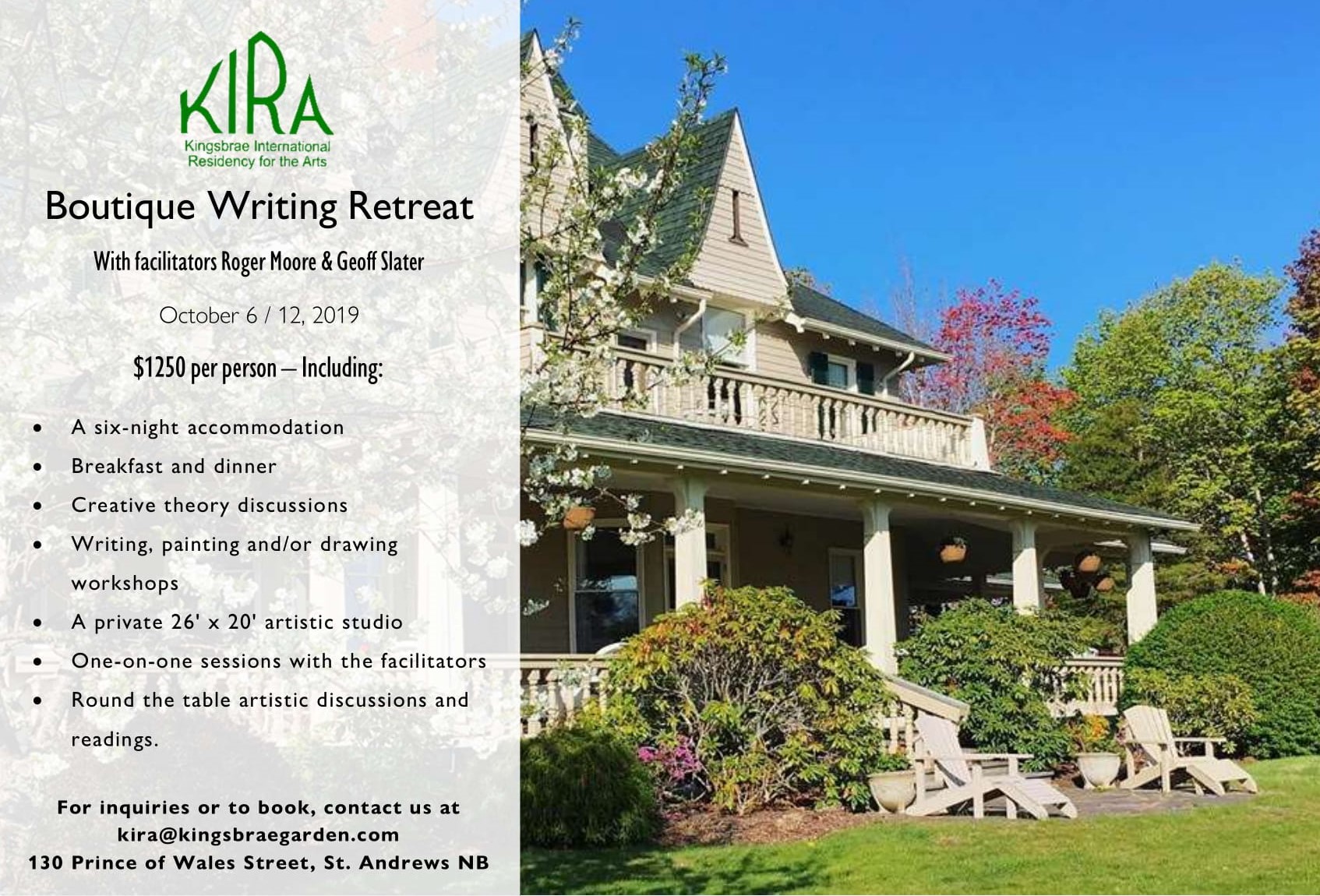
The 2019 KIRA Boutique Writing Retreat will take place from October 6-12 at KIRA (picture and details below) just outside Kingsbrae Gardens in the beautiful New Brunswick town of St. Andrews. More information is available from kira@kingsbraegarden.com 

IMG_0126 (2)

The KIRA Boutique Writing Retreat, aka The Art of Writing, is unique in that it concentrates on Creativity: how we channel it, how we express it, and how it changes us. Geoff Slater (artist and line painter) and Roger Moore (award winning teacher, poet, and short story writer) concentrate on different forms of creativity with, in addition to the free time at the retreat, workshops on drawing and painting (Geoff) and poetry and prose (Roger). The morning talks and the evening readings allow each individual to explore themselves and their creativity in a unique setting.

KIRA Boutique Writing Retreat Advertisement

Attendance is limited to five residents. This allows us to offer one on one time with each of the instructors if and when it is needed.

IMG_0068 (2)

Fisher King

IMG_0068 (2)

King-Fisher-King

King-fisher, wounded wing, Fisher-King
ruling a shallow lake, water-logged,
beaver-gnawed trees, trunks and branches

rotting under water, green growth bearded
upon them, lily-padded the pond,
transformed year after year, to meadows, silt

gathering, filling in smaller channels,
only the mainstream flickers, flows beneath
freckled sunshine. Change hides in plain sight.

All things wither, perish. Cherish this changing,
these modified moods, sun and cloud, the land
recovering, coming back to fertility.

Swift the flight of the swallow’s low dip,
mottled the osprey, aloft in her nest.
King-fisher flying, return of the King.

MT 1-3

img_0181

MT 1-3
Monkey Statue

(after Rabelais and his many experiments with goose down and geese)

Covered in concrete
a conquering hero
stands in the yard.

Pigeons feed on scattered breadcrumbs.
Squabs squat on the statue’s head.
They gift his shoulders with the fresh
white lime of guano,
as dry as dandruff.

Is this what all monkeys will become,
statues in a square, pooped on by pigeons?

The statue stretches out a hand,
clutches at a passing pigeon,
thrusts it head first between his legs,
strains hard, then wipes his …

Monkey takes the hint,
dons an anonymous grey
suit of medieval armor,
and runs.


Coming Together

Coming Together

A coming together of cultures,
these three statues,
placed equidistant,
forming an equilateral triangle,
all things being equal.

Three founding cultures:
English, French, Indigenous,
in alphabetical order.
They stand face to face to face,
a triangulation,
silhouetted in profile,
sharing positive and negative space.

At the center of their union,
at the still point where nothing moves,
a living, breathing space,
that takes away your breath.

When you breathe again,
you take in air
and light and sun and
hope renewed.

Faith runs tingling round your body,
hand in hand with joy and life
and love reborn.

Sandman 2

IMG_0052.JPG
Kingsbrae 17.1
17 June 2017

Sandman 2

The sandman brings sand
to put in the sandwiches
we have packed for the beach.
It’s as coarse and fierce as salt
flowing through an hourglass,
or red sand in an egg-timer,
not clockwork and wound,
but the sort you turn upside
down. Sand: it counts each
minute of each day, turns
minutes into hours, hours
into days, sands the stone
block of our lives, like a sculptor,
into smaller, more manageable
shapes and chunks. Sand sticks
to our clothes, makes us wash
our hands and brush ourselves
thoroughly before we sit down
to eat the sand that has sneaked
into the lunch-time sandwiches
we brought to nibble on the sands.

Comment: This is another example of the effects of a rewrite that takes place in a different time and place. The original of this poem appeared in the blog on my father’s birthday, 17 May 2017. Sandman 1 can be see by clicking on the title. A quick comparison shows how the themes have changed an meaning has been deepened in the later version, Sandman 2, published above. I am intrigued by the differences caused by a change of time and place.  There is room for still more development in this poem. It will be un to see Sandman 3, if it evolves further.

Eyeless in Kingsbrae

IMG_0150.JPG

Kingsbrae 15.3
15 June 2017

Eyeless in Kingsbrae

There’s warmth in a color,
and heat’s visible to the touch.
Shocking pink has a different
feel beneath the fingers,
and it has no name that you
and I, sighted, would ever know.

They push me, blindfolded,
around the garden. Gravel’s
crunch beneath the wheels
sharpens my inability to know,
to be sure of shadows and shapes
that are no longer there.

The ones who push me talk
and tell but cannot show.
How could they hold a rain
-bow before my eyes or
explain those lights that
crisp and crackle in the sky,
a visible Niagara Falls
with fairy lights
dancing up and down?

And those glorious choirs,
angel voices rising, falling,
grasping my eye-lashes,
trying to pry my eye-lids open.

Oh song of songs, and the singer
deaf to his own sublimity.
Oh dealer of false cards,
fingerless pianist, and dancer
shuffling on amputated stumps.

Stone Carving

Elise

Elise in her Studio

Kingsbrae 6.2
6 June 2017

Stone Carving
Elise Muller

Last night, Elise Muller led the second of our after supper artistic discussions. She told  how her grandmother had been a sculptor, but had never talked to her directly about stone sculpting. Later, when at art school, Elise took a course on stone carving and knew immediately that it was what she wanted to do. Something appealed to her and she was hooked.

Elise then showed us a series of photographs that displayed her sculptures in chronological order. She talked about each one individually, the stone from which it was carved, the manner in which she carved, and the effects she was trying to achieve. Movement interested her and she was trying to sculpt a series of movements into her stonework. Her early sculptures featured different forms of movement, fathers and mothers carrying their children, a woman wading,  and so on. At this early stage movement was present, but it was not conceived as an intentional thematic link between sculptures. Her later sculptures, some commissioned, some made for friends and family, were conscious attempts at carving movement into stone.

A statue called Ballerina was sculpted by Elise for her grandfather and shows her own daughter dancing. The slender figure moves elegantly, poised and posed in stone. A companion piece, Ballerino, shows a male figure dancing. Even a perched bird, a Whisky Jack or Grey Jay, carved in stone and perched on a stone pedestal, leans forward in a moment caught by the camera that photographed the stone. Movement, caught in still stone and photos, is everywhere in the later sculptures. Looking at them, time stands still and the stone flows.

Open discussion followed and we chatted about the healing qualities of crystals and how stones too held their magnetism and personalities. Elise talked about the different types of stone, the various marbles, soapstone, granite, and we discussed the fundamental cost of the actual stone, before it was even turned into the work of art. Elise told us how she was attracted to different types of stone and how the raw material would “call” her and attract her attention. Sometimes, she said, she drew her ideas from the stone, however, on other occasions, she would sketch what she wanted to carve and then find a stone that would be suitable. This latter method she associated more with her commissioned work. Elise also told us about the effect of weather upon stone and how some stones could be left outside in sun, rain, and snow,  while others needed more protection.

Art lag, something similar to jet lag, but far more pleasant, was setting in and, a weary group, we adjourned early, leaving behind, with regret, some wonderful ideas and memories, but taking with us images Elise’s creative techniques and mind pictures of the creations that Elise had plucked from her stones.