A hand holds a pen poised to write on a blank notepad next to a coffee cup AI generated
Frustration A Jackpine Sonnet
Hand hovering pen poised a black shadow hangs over the blank page threatening to erase any ink marks that may emerge
Eyes and mind blank no butterfly kiss delicate in its touch of nib to page a black cloud of nothingness damns creativity at its source
Who can prise the worm out from the chrysalis gift wings to the pupa change it from slug or snail into that glorious moment when sunshine’s beauty stutters into fluttering flight
Comment:
The top photo, AI generated, was based on the wording of the poem. The bottom one was a Moo choice from his pre-painting selections when he claimed to be a photographer. I like both, but for different reasons.
The first one emphasizes the fear of the blank page, the blank canvas, the blank mind, the overnight snowfall that is awaiting its first foot or hoof print, its first instant of inspiration, its first splash of paint, its first letter or word. And yet, according to many with whom I have spoken, artistic creativity is one per cent inspiration and ninety-nine per cent perspiration. So, why hesitate? Get on with it. Make those first marks. Take that first step. And remember, even the longest journey begins with the first step.
The second photo expresses the duality of creativity. At the front end of the butterfly, its poised, fragile beauty. At the rear end, the fearsome face it assumes if approached in the wrong way from the wrong direction. Front end – the moment of creation. Rear end – the fear of that first step and the consequent sense of frustration.
So – at the moment of creating, we must consider several things – the fear of failure. But the only way to never fail is to never try. Each failure, however bad, is not a crime, it is a stepping stone on the way to ultimate success. The fear of the first step – this ties in with the fear of failure. Will we slip on the first damp stepping stone across the stream? How long will we permit our selves to search for a safer passage? Is there really a bridge around the bend, a bridge that will stop us from getting our toes wet? And what’s wrong with wet toes anyway?
When we dip our toes in the sea, we feel the cold of the water. When we take the plunge, dive in head first, we feel the full force of the ocean. And that ocean is the creative energy that yes, can sweep us away, can carry us up, can pull us down. Is that what we are afraid of, being overwhelmed by the creative powers within us? Of losing the meagre control we hold over our lives? I truly believe that in many cases it is just that element of being swept away by our own unleashed creativity that fills us fear. But if we never take that first step we’ll never know who or what we are, nor will we understand what we are afraid of, nor will we be able to conquer that fear and accept our creativity for what it is.
sand in my sandals sand like sandpaper sanding me down
tides rise and fall sea gulls call the bay so big and me so small as tiny as a tiny grain of sand
Comment:
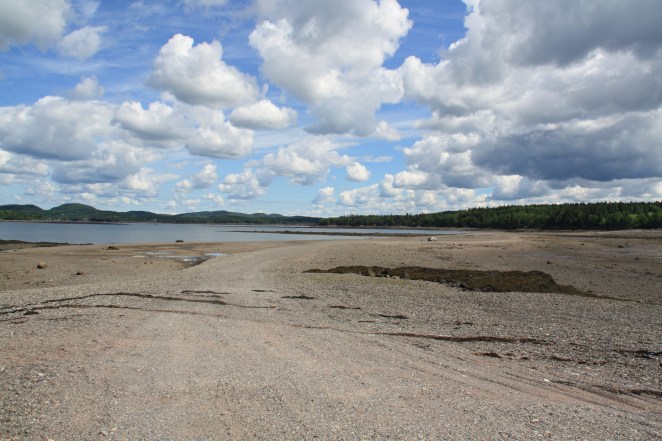
Not Swansea Sands at all, sorry. But a sandy beach all the same, here on the southern shores of New Brunswick, down by St. Andrews. The theme of the poem comes from Blake’s ‘to see the world in a grain of sand’. It might not be Swansea Sands, but there’s a great deal of sand down on the southern shores of NB. I worked on this poem with one of my writing buddies, who visits me regularly. We shared an impromptu creative writing session over the kitchen table in Island View a couple of days ago. Alas, as you probably know, there are no islands in Island View, and there’s not a grain of sea sand in sight. So we improvised.
We started with a central idea – a grain of sand – and from there we talked about how to generate a poem, from scratch so to speak, in three steps.
(1) The first draft.
Write as it comes to you – just write. Just bounce from word to word, line to line, like a supercharged, literate budgie. Take about 3-4 minutes for this. Then read it aloud to partner / writing buddy, checking on sound and rhythm.
(2) Second draft.
– Eliminate words and ideas that do not fit the central image. Remove anything loose or unclear. Then read it aloud to partner / writing buddy, concentrating on sound and rhythm.
(3) Third draft.
Polish and finalize the poem. Sometimes a fourth draft is needed, but in this case we settled with the third draft. At this stage, pay careful attention to the poem’s ending (closure is always difficult). Reorder, add, and polish, as necessary. Then read it aloud to partner / writing buddy, checking on sound and rhythm.
From the initial image – to see the world in a grain of sand – I generated two poems. My partner / writing buddy generated a short story that would fit into their current sequence of childhood memories. Other ideas for further poems also came through.
Conclusions;
Make your poems alive, make them personal, make them an experience!
Remember rhythm. And never forget the necessity of a live reading or series of readings in which you can feel and hear the words.
An alterative to a live reading with a partner / writing buddy is to record your own voice. The recordings can then be sent to friends who can comment on them.
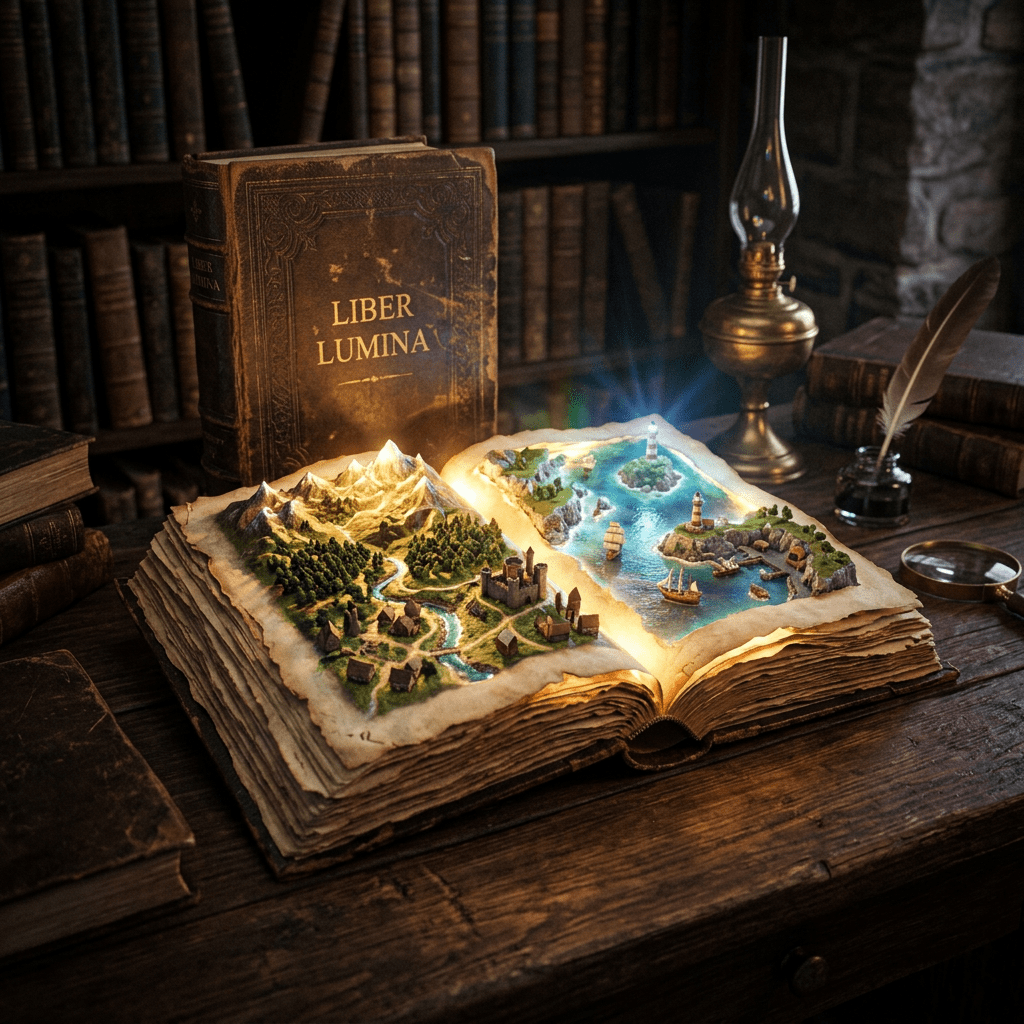
A magical book opens to reveal a glowing 3D map with mountains and sea landscapes.
Image generated by AI
Ryan and Don Roger
14
Tales within a Tale
Don Quixote, the novel, is a tale that tells the story of Don Quixote and his adventures. While the adventures of Don Quixote and Sancho Panza, and their delightful dialogs are the essence of the story, other stories abound. These ‘other stories’ are known, in academia, as the intercalated novels. They are tales told of and by other characters within the main history of the adventures of the ingenious hidalgo. While the characters within some of these intercalated novels mix at one level or another into the story of Don Quixote, some of them do not.
The Tale of Foolish Curiosity, DQI, XXXIII / 33 -XXXV / 35, has very little to do with the story of Don Quixote, other than the fact that our knight is present in the inn while the tale is being told. We know that in Italy, Boccaccio’s Decameron, was a key player in the genre of story-telling. Our friends at AI tell us that “the Decameron is a collection of short stories by the 14th-century Italian author Giovanni Boccaccio (1313–1375). The book is structured as a frame story containing 100 tales told by a group of seven young women and three young men. They are sheltering in a secluded villa outside Florence to escape the Black Death. No television, no radio. They amuse themselves by telling stories. The various tales of love in The Decameron range from the erotic to the tragic. Tales of wit, practical jokes, and life lessons also contribute to the mosaic. In addition to its literary value and widespread influence (for example on Chaucer’s The Canterbury Tales, it provides a document of life at the time. It is considered a masterpiece of early Italian prose.”
What is The Tale of Foolish Curiosity doing in the Quixote?One suggestion is the hinge theory – the tale links thematically to the ideas expressed in the Quixote. We have just met several intercalated novels in which the theme of love plays a major role. TheTale of Foolish Curiosity is a psychological novel, written in the Italianate style favored by Cervantes, that explores the theme of folly in love. A second theory is that The Tale of Foolish Curiosity is there merely for entertainment. A third is that it is there to demonstrate Cervantes’s writing skills. Whichever reason pleases us most, and all can be equally true, we know from DQ2, III /3, that not every reader was happy with the inclusion of this tale in DQI.
In this chapter, Sampson Carrasco, the Bachelor, tells us that “One of the faults they find in this history … is that the author inserted a novel called The Tale of Foolish Curiosity – not that it is bad or badly told, but because it is out of place and has nothing to do with the story of his worship Don Quixote.” In response, our knight replies “Now I believe that the author of my story is no sage but an idle chatterer.” The Tale of Foolish Curiosity is the only intercalated novel criticized in this fashion. Let us take a brief look at the others.
The story of Chrysostom and Marcela (DQI, XII, XIII, XIV) involves our knight errant, for the characters in the intercalated novel, interact with Don Quixote, Marcela, in particular. When she wishes to leave the scene, the young men who love her and follow her against her will wish to follow her, but Don Quixote defends her, and prohibits their pursuit of the shepherdess. In similar fashion, the tale of Cardenio and Lucinda is woven into the narrative of Don Quixote’s adventures, Cardenio appearing in DQI, XXIII, XXIV, and again in XXVII. The first meeting between them (DQI, XXII) is justly famous. Two foolish people, the Ragged Knight and the Knight of the Sad Countenance, meet, embrace, and look deeply into each others mad eyes.
Almost immediately (DQI, XXVIII), Dorothea appears on the scene and starts to tell the tale of her own misfortunes. They are interwoven with the tale of Cardenio and Lucinda, although they are not aware of it. Dorothea learns of the plot to deceive Don Quixote and bring him back to his village and willingly agrees to play the part of a distressed lady in search of a knight errant to rescue her. Don Quixote accedes to her request. When they spend the night at an inn, first they hear The Tale of Foolish Curiosity and the captive, recently escaped from Algiers, appears and tells his tale (DQII, XXXIX, XL, XLI). Yet more adventures occur at the inn, and several more characters weave their own tales into the tale of Don Quixote.
Two clear patterns emerge. (1) Tales that are independent in their majority, of the knight’s story. (2) Tales that are interwoven closely with the adventures of Don Quixote and Sancho Panza. This style of events changes in DQII, after the intervention of ten years (1605-1615) during which Cervantes receives and processes feedback from his many readers. As we will see when we get there, Don Quixote and Sancho become the key figures in what will become the first self-referring novel (more about that later), and all the tales told within DQII will be woven into the stories of what will become, thanks to the split narrative, our two adventurers.
Meanwhile, in 1613, Cervantes published his Novelas ejemplares, a collection of twelve short stories (novellas) that showcase his mastery of narrative beyond Don Quixote. These tales range from realistic depictions of 17th-century Spanish life to idealized, romantic adventures, designed to offer both entertainment and moral instruction. Some critics have speculated that Cervantes might have been thinking of including these novels is an expanded version of DonQuixote. However, if he did have that idea, he certainly abandoned it, given his own criticism of The Tale of Foolish Curiosity. I think, given the quality and expanded dimensions of DQII (1615), we can all be happy that he abandoned that idea!
Warm air. Cold snow. Grey ghosts of memory drift beneath the trees.
If it were fall … … if the sun were to shine … rainbows would grace the spun webs of spiders clinging to the trees.
If, if, if …
A warm winter day, or so they say, snow diminishing, a wind from the south, up from Florida, rain on its way.
My birthday tomorrow. The temperature to fall way below the date.
-16C on January 16.
My fate to be a winter baby, to never know what the weather will be like on that date.
2 My Birthday
I won’t sit here with head in hands fearing the future or brooding on the past.
Every day I survive is a bonus now, each sunrise a celestial celebration.
I welcome daylight with open arms and now, on my birthday, I will accept all gifts with joy.
Sunshine floods through me. It fills me with hope. Its beacon beams . A full tide of love overflows in my heart.
Comment:
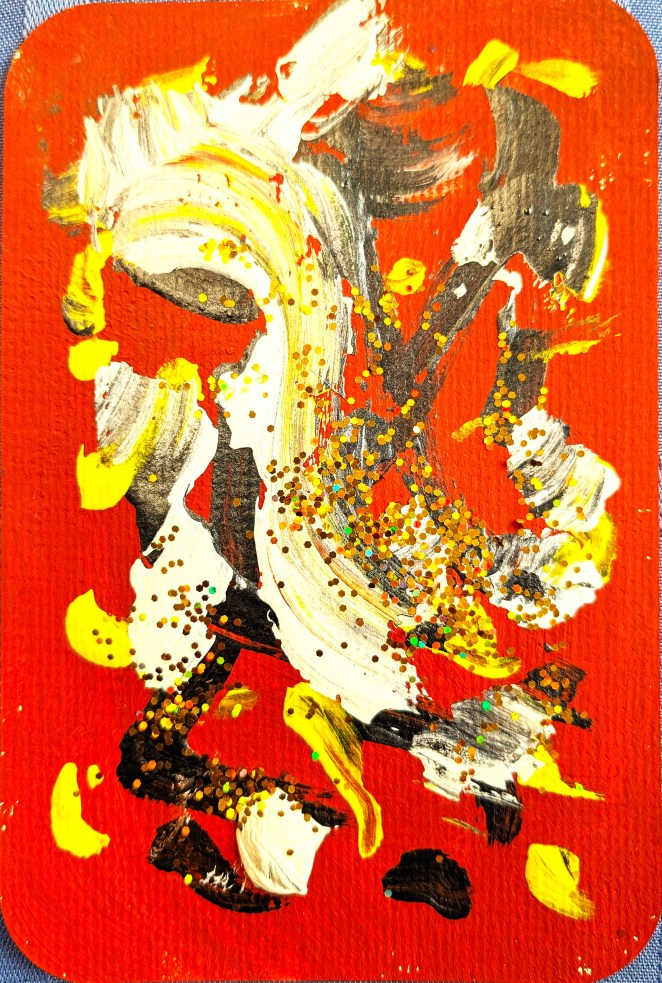
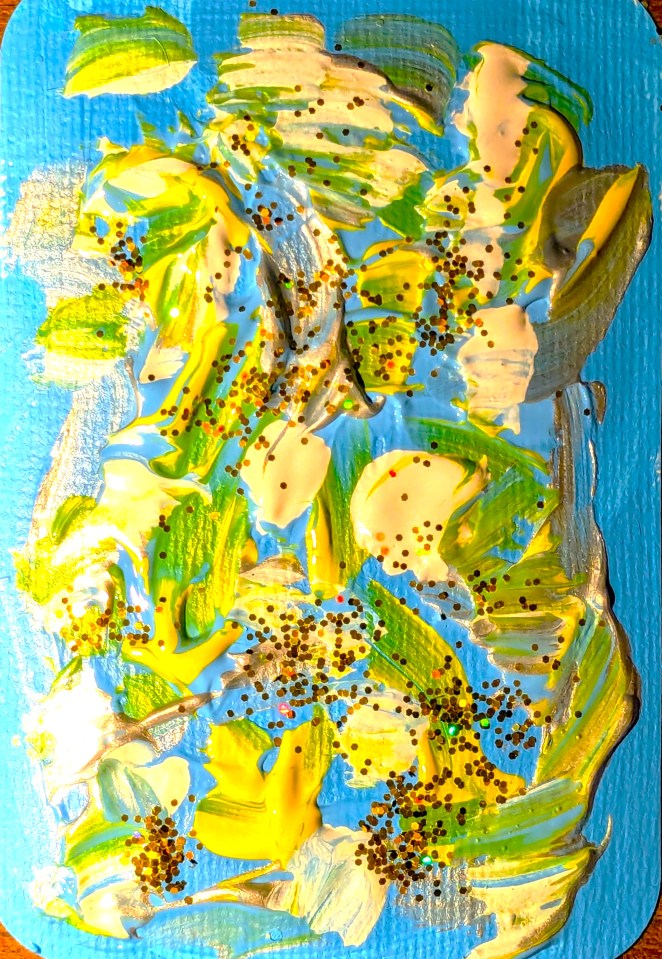
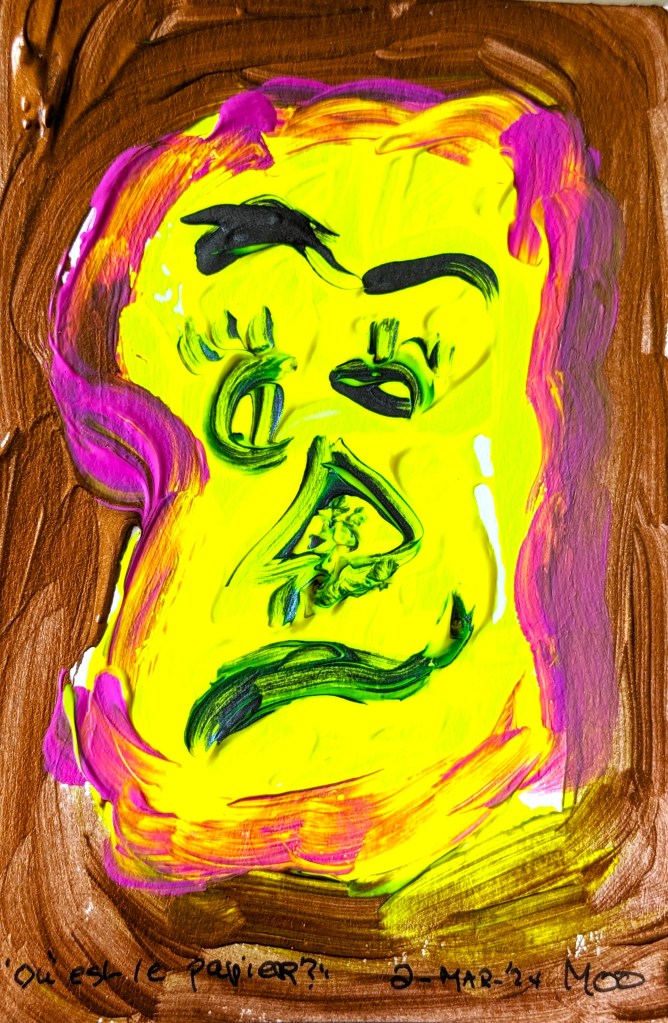
Bilbo Baggins gave away presents on his birthday. Today it is my birthday and I have joined with Moo to give away two poems, the first written yesterday, and the second today. Moo painted the picture, as always, and presented it to me for my birthday. A nice gift. Thank you, Moo.
I got some other nice gifts too. In the local superstore I discovered Polvorones. I have never seen them there before. It is a long time since I have seen them here in New Brunswick. So, what a lovey find that was. Tengo polvorones.
I don’t make New Year’s Resolutions. That’s why I never break them. That said, I do intend, and Moo agrees with me, to start posting regularly once more. So hang on to your hats – and let’s see how long that intention lasts.
Modern shamans roam the pyramid’s flat top, looking for its energy point, not knowing that, seated, peacefully in silence, that power will seek them out.
The more they seek, the less they find, yet that power seeks me out, because I no longer seek it. Is that the secret of creativity?
Commentary:
A long time ago my judo instructor taught me the following –
“The more you strive, you cannot grasp it, the hand cannot hold it, nor the mind exceed it. When you no longer seek it, it is with you.”
It was the same with the St. John Ambulance course that I took. The instructor told us that we might not remember now exactly what we were doing, but if the occasion arose, everything we were practicing now would appear before us and we would just do it, knowing exactly what to do. A rugby coach, I saw and met and solves several such injuries on the field of play. Something took me over and I did what I had to do.
I still don’t know how or why. But it is the same with creativity. “When you no longer seek it, it is with you.”
My words are black print on white paper. My memories flare – an aurora borealis of senses sent crackling down the spine, in and out of the mind, tumbling the brain into a world … what sort of world?
An unimaginable world. One never forgotten. One never re-recreated. One that never existed. One that never could exist. One for which the young child, six or seven years old, yearns for the rest of his life. His unsatisfied life. His unsatisfying life. His meaningless life. His absurd life.
2
Puppy
Oh, pity the poor puppy, not knowing what he has done wrong, not knowing how to put things right, always inadequate, always in fear of the angry word, the quick, sly kick, the vicious blow, whining and cringing at his master’s feet.
“Into your box!”
And always, that cold puppy bed, often soiled, where the long, chill snakes of frail, wriggling dreams, remind him of the next day’s punishment.
Commentary:
Both these poems evolved from the comments I made yesterday to my blog post. I have started noticing that those words, beneath the poems, sometimes have a rhythm and a magic all to themselves. I guess it is a little bit of the unconscious slipping upwards and spilling out.
Discovered poems – I never set out to write these two poems. When I re-read my commentary, I thought ‘wow, there’s a poem in there”, and I found not one, but two new poems. Interesting. As I age, I discover something new every day. What a wonderful world it is, unless, like earlier this week, I discover my tap leaking and am forced to call my friend, the plumber, into my water world. Alas, if only that tap were tapped into a maple tree and it weas spring once more. Ah well, I am a dreamer, I can always dream.
… as free as the birds a sky full at North Cape where shores retreat year after year
the big red mud diminishes under advancing waters sea-threatened cliffs undermined roads houses the lighthouse
gulls follow the fishing boats herring gulls blotting out sun and sky above the reef
with its seals basking in sunshine knowing themselves being themselves thinking themselves safe
kings and queens of their sealdom never questioning …
19
… an osprey sudden the swoop turned into a stoop
water shattered total immersion then emerging with lusty thrusts of wings
claws clasping imprisoned prey prised from the sea raised to the skies up and away murderer and victim
oblivious below the black horse with cart and farmer gathering seaweed
all of them having no doubts safe in the security of their roles …
20
… while lost in the labyrinth I searched for a thread on life’s loom
a thread woven by an unknown unseen hand a hand and thread I could never control
yet one day that thread will lead me out from the dark
then shall I see the sun’s great candle beneath which red rocks wave and water battered crumble
here at North Cape in a way that nobody can understand …
Commentary:
The osprey “emerging with lusty thrusts of wings, claws clasping, imprisoned prey prised from the sea, raised to the skies, up and away, murderer and victim.” The words are based on the photograph. A quiet day, somebody shouted, and pointed, and clickety-click, I was lucky enough to capture the whole thing on my digital camera. This one shot summarizes it all.
The stanzas (16 & 17) that precede this moment are available here. Clepsydra, the book, is one single poem, one single sentence, that rambles on and on. Each stanza stands alone, each poem (numbered) stands alone, and the whole book stands alone as a single sentence summarizing what I have seen and where I have been. Bakhtinian Chronotopos – my dialog with my time and my place. In this case, my many dialogs with my multiple times and multitudinous places.
Albert Camus lent me the phrase ‘murderer and victim’. ‘Nous sommes, ou meurtrier ou victime‘. Quoted from memory. I hope I am not too far wrong. My memory fades as I age. Louis Aragon suggested I borrow his line “rois tombés de leurs chariots” – that I found in his collection Il ne m’est Paris sans Elsa. Here, I have applied it to the seals at North Cape, PEI – “seals – basking in sunshine – kings and queens of their sealdom.” Intertextuality – texts talking to texts and recalling segments of texts within other texts.” Wonderful. Alas, I fear the coming days when the memory may no longer be so clear. ‘What will be, will be’ said the Osprey as he pulled the flounder from the sea and carried him too his nest in a nearby tree.
A dry storm lays waste the days that dog my mind. Carnivorous canicular, hydropic, it drinks me dry, desiccates my dreams, gnaws me into nothingness.
At night a black dog hounds me, sends my head spinning, makes me chase my own tail, round and round. It snaps at dreams, shadows, memories that ghost through my mind.
Tarot Cards and Tea Leaves are lost in a Mad Hatter’s dream of a dormouse in a teapot on an unkempt table. Hunter home from the hill, I awake to find my house empty, my body devastated, my future a foretold mess.
Desperate I lap at salt-licks of false hope but they only increase my thirst and drive me deeper into thick, black, tumultuous clouds. Dry lightning. The drought continues and no raindrops fall.
Dog Daze 2
The drought continues and no raindrops fall. Desperate I lap at salt-licks of false hope but they only increase my thirst and drive me deeper into thick, black, tumultuous clouds. Dry lightning.
Tarot Cards and Tea Leaves are lost in a Mad Hatter’s dream of a dormouse in a teapot on an unkempt table. Hunter home from the hill, I awake to find my house empty, my body devastated, my future a foretold mess.
At night a black dog hounds me, sends my head spinning, makes me chase my own tail, round and round. It snaps at dreams, shadows, memories that ghost through my mind.
A heat wave lays waste the hopes that dog my days. Carnivorous canicular, hydropic, it drinks me dry, desiccates my dreams, gnaws me into nothingness.
Dog Daze 3
The drought continues. No raindrops fall. No fresh water. None at all.
Dark clouds gather in the sky. No rain falls. The ground is dry.
Grass all burned. No more hay. How much livestock will they slay?
No rain comes, but a flash of light sets the woods and fields alight.
Home from the fields, some farmers confess their future is an unpredictable mess.
Desperate farmers are losing hope. Out in the barns, they keep some rope.
The roof beams are sturdy and built high. One little jump and problems good-bye.
Commentary:
Dog Daze 1 is a reverse sonnet. Instead of being structured 4-4-3-3 it moves in reverse 3-3-4-4. What fun to pretend to be Milton Acorn, and to turn my sonnet upside down. It should rhyme, but I abandoned rhyme in favor of metaphor a long time ago. Was I right to do so? What, if anything, catches you unawares in Dog Daze 1? Does it work for you? What would happen if we turned it upside down? You be the judge.
Dog Daze 2 is more or less the same sonnet returned to its normal stanzaic shape 4-4-3-3. In what ways has the poem now changed? Clearly there is a structural difference. Obviously some of the lines and images have changed. Is the poem stronger? Weaker? Does each one affect you in a different fashion? Do you prefer one version to the other?
Mission Impossible – How many more adaptations can we make to this poem and how would each one affect the poem and the reader’s reception of it? For example – Dog Daze 3 sees our sonnet turned into a poem composed of seven rhyming couplets. Couplets are easy to rhyme. But do they simplify the thoughts too much? Is the poem now too dark? Can you lighten the mood? How? Your mission, should you decide to accept it, is to rewrite the poem in seven non-rhyming couplets. That will make a change from the Daily Sudoku and the Cross-word puzzle. If you do take up the challenge, let me see what you do! And remember, you can make it personal to you, your life, and your garden.
They drove me there, passed through the gates, unpacked my trunk, chatted with the head, shook my hand, then drove away.
The metallic clang of the closing gates still lives with me.
How old was I? Six? Seven? I no longer know and there’s nobody left alive to tell me.
I remember so well the woodgrain on the desk, the carved initials, the loneliness that bit, the barred windows of that empty classroom.
2
An only child, taken away, left among strangers?
Why, why, why? Doubt’s pinball bounces round my empty skull.
What am I? Who am I? Why am I?
How did I become whatever it is that I became?
mea culpa mea culpa mea maxima culpa
Was I the one to blame?
Comment: I prefer it as two poems, rather than a poem and a commentary. It may even be better written in the third person. I’ll have to think about that! It’s always a good way to work. Thank you to all who commented, by email or otherwise! Your comments always help me think, and re-think.
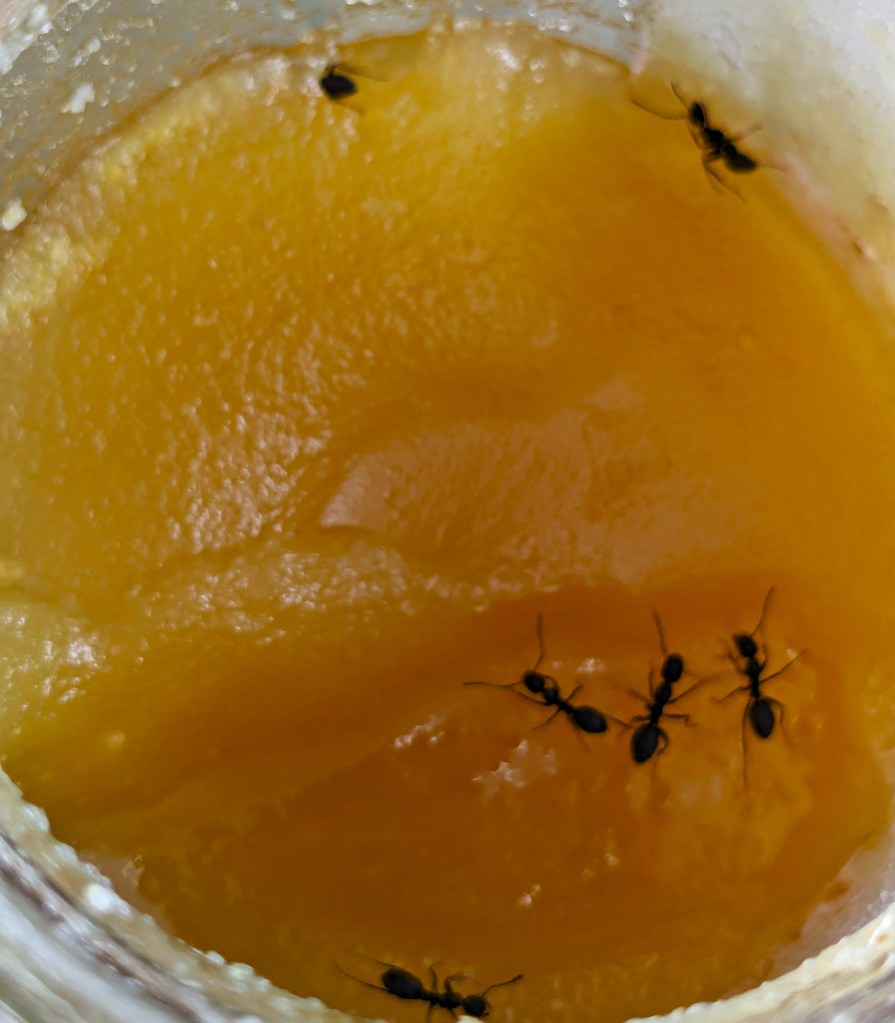
Depends on how you define performance, doesn’t it? Here’s one from a couple of days ago. I left the lid of my pot of wildflower honey slightly open and, guess what? This is what I saw inside. Actually, there were fourteen of them. Some ran for it. Some were so absorbed that they just lay there, inebriated. I grabbed my cell phone and took this shot.
It could have been a video. The seven that fled, it might have been eight, looked like a broken line of can-can girls fleeing from the Moulin Rouge. But look at the color of that honey. Such a rich, warming gold. It was, quite simply, one of the best honeys I have ever tasted. And I have to say, that I cannot blame the ants for invading such a honey-trap paradise.
The live performance was the running, fleeing, burying into the honey, and wild whimpering of the ants. Then, when I squished them, it was their feeble twitching, followed by their gradual submission to a force majeur.
The Nature of Art and the Art of Nature – a live performance, followed by a still life. A nature morte, as they say in French, or a naturaleza muerta, as the Spanish say. On the bright side, I like to think that they found their land of milk and honey, their earthly paradise, before they met their tragic end.






 rogermoorepoet