Inquisitor

Cracked heart-shaped rock with ancient carvings in a sandy desert
A cracked heart-shaped stone with carvings lies cracked in a desert landscape.

Inquisitor

He told me to read,
and plucked my left eye from its orbit;
he slashed the glowing globe of the other.
Knowledge leaked out: loose threads dangling,
the reverse side of a tapestry.

He told me to speak,
and squeezed dry dust between my teeth.
I spouted a diet of Catechism and Confession.

He emptied my mind of poetry and history.
He destroyed the myths of my people.
He filled me with fantasies from a far off land.
I live in a desert where people die of thirst,
yet he talked to me of a man walking on water.

On all sides, as stubborn as stucco,
the prison walls listened, and learned.

I counted the years with feeble scratches:
one, four, two, three;
for an hour, each day, the sun shone on my face;
for an hour, at night, the moon kept me company.
Broken worlds lay shattered inside me.
Dust gathered in my people’s ancient dictionary.

My heart was a weathered stone
withering within my chest.
It longed for the witch doctor’s magic,
for the healing slash of wind and rain.

The Inquisitor told me to write down our history:
I wrote how his church had come to save us.

Bees

Bees

This year, we mark them by their absence.

There is a stillness in the bee’s balm,
a withering of early blossoms and still no bees:
will they ever come back? The bee-keepers
don’t seem to know as they scratch their heads
and search dry colonies only to find
dead and dusty hives, with cells devoid
of the lust and life of their former inmates.

Each day we watch over the flowers,
and hum as we wait for the bees to buzz:
“will ye no come back again …”

Rage, Rage 25

Rage, Rage, 25

A carton of eggs,
milk left behind,
a walking stick

abandoned on a cart,
discovered
in the lost and found
in the supermarket.

My cousin’s face,
her daughter’s name,
the parking spot
where I left my car.

Time and place
wave goodbye
and are quickly gone.
So much has become
ephemeral.

“What day is it today?”
I check my watch
for the third or fourth time.
I forget phone numbers.

I look at photos
but they are blank spaces,
gaps in the photo album.

Scenes on the tv screen –
“I recognize those faces,” I mutter,
“who are they?

Where did I see them before.

Comment:

Ephemeral – “Something that is fleeting or short-lived is ephemeral, like a fly that lives for one day or text messages flitting from cellphone to cellphone.” Heraclitus says we can never step in the same stream twice – because the waters are not the same and neither are we. We change, things change. They do not stay the same. Here today and gone tomorrow. Like the flowers our kind neighbor brought us when our kitty cat passed away last week. She, too, was ephemeral. Just like the flowers. Just like us.

Some things leave us with sorrow – our pussy cat was 18 years old, and her passing took away her pain. Yet she still left us sad and grieving. And those 18 years seemed to pass in a dream. Where did they, where did she go? There is sorrow too in memory loss. The days of our lives, once fresh their memories, now filling with a sadness as we try to recall them. Memory loss – one of the great sorrows of aging.

So many things slipping away. Seasons passing. Daylight hours waning then waxing again, just like the moon. Water between fingers. Grains of sand through the hour glass. So many blank faces in the photo album. “Who is that?” “I can’t remember.” More and more of the family names fading away, slipping into the distance. And all too soon, we shall join them, leaving an empty nest, for, as Cervantes once wrote – “No hay pájaros en los nidos de antaño” there are no birds in last year’s nests.

Rage, Rage 10

Rage, Rage
10

My body’s house
has many rooms
and you, my love,
are present in them all.

I glimpse your shadow
in the mirror, and your breath
brushes my cheek
when I open the door.
Where have you gone?

I walk from room to room,
but when I seek,
I no longer find
and nothing opens
when I knock.

Afraid, sometimes,
to enter a room,
I am sure
you are in there.

I hear your footsteps.
Sometimes your voice
breaks the silence
when you whisper my name
in the same old way.

Comment:

Rage, Rage – and still I rage against the dying of the light and, like Dylan Thomas, ask the ageing of this world not to go gentle into that dark night. Yet, as my beloved and I age, we watch day’s shadows growing longer, and night stealing steadily along. What can we do?

Well, since the winter solstice, we can start counting the minutes as each day adds a minute or two and gifts some more light and strength to the sun. Sunrise today – 8:03 AM. Sunset today – 5:09 PM. That means 9 hours and 6 minutes of sunlight. Well, it would, if it weren’t cloudy, with a cold wind, and a dropping temperature. My guess is that it will get dark much before it ought to. And that’s not nice – no respect!

Of course, my beloved is a sun bunny and a Leo, and she perishes in these shortened days. I was born in them and they don’t affect me as badly as they do her. But I can still Rage, Rage, because there is so much to rage about – icy streets, the usual potholes, roads that hide ice beneath a thin covering of snow, some strange drivers who don’t seem to have bought winter tires. Oh yes, I love them. One came twisting and turning down the same side of the road as me only this morning. Luckily he hit the snow bank before he hit me. But, I ask you, what was he thinking?

So there’s Rage, and Rage Rage, and also Road Rage. Way to go! I think we should call a national rage day and all stay home for 24 hours, just to cool us all down for a bit. Oh dear, that might lead to cabin fever – and that would be an outRage.

Carved in Stone 59 & 60

Carved in Stone
59

St. David of Wales once said,
“Do ye the little things in life.” 

I do, and I wander
along the banks of the River Taff,
admiring how wild daffodils
flourish each spring, in Wales.

Young, I run on the beaches,
Brandy Cove, Pwll Ddu, Langland,
Caswell, Swansea Bay,
and, as I write these words,
I hear my footsteps
echoing back through time.

Baudelaire’s words ring in my mind,
“Creativity is nothing more nor less
than childhood recovered at will.”

Or, as Pablo Picasso said,
“I have spent my life
learning to see, paint,
and write again, like a child.”

And on and on I go –
child-hood, youth, maturity, age,
then back to my second childhood,
when I can recreate
that youthful world
in all its joyous beauty.

60

Does life flows through me,
like water in a clepsydra?

Does it flicker like a candle
guttering on a church altar?

Is it circular, like a sundial,
or the Roman numerals
on the face of the clock?

Am I just flesh and blood,
doomed to blossom and flourish,
then wither and perish?

Or will some small part of me
linger on, an unchained melody,
with all my memories slowly erased.

Commentary:

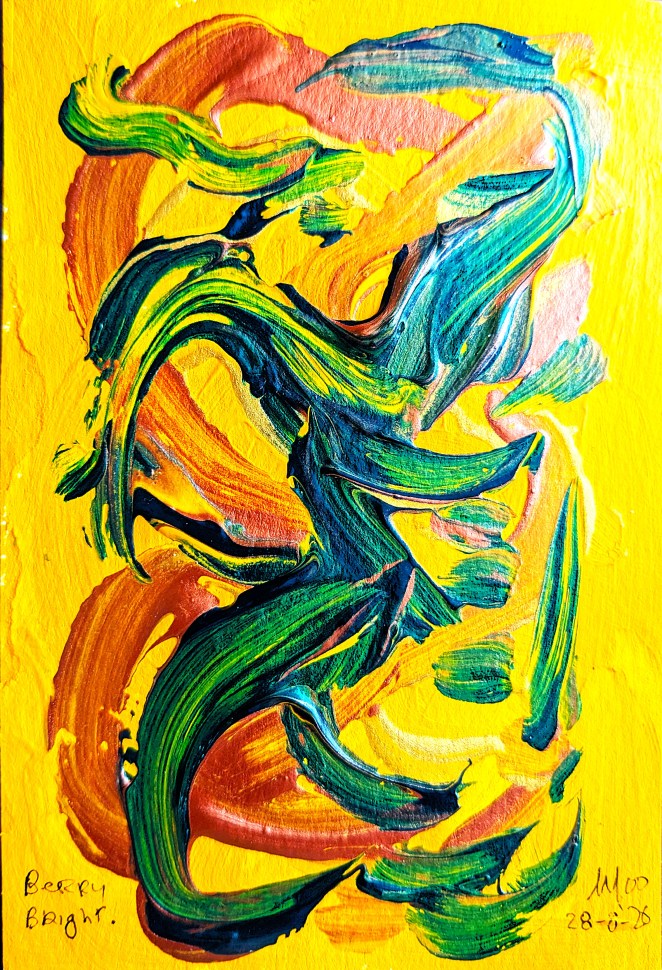
Moo’s daffodils are painted and potted, not growing wild at all. They are still the national flower of Wales and they still grow wild, in the spring, in Blackweir Gardens and beside Roath Park Lake. At least, I hope they do. I haven’t been back to check for 37 years now. Maybe things have changed, and the daffodils have gone the way of the sky lark, the cuckoo, the cowslips, and the bluebells. I wonder if the foxes still wear gloves? Let me know if you know the answer to that one. Just write “I do” on the back of the usual postcard. And you know what to do with it.

As for me, I am moving into my second childhood and, in may ways it is so much better than my first one. Here, I am free to look back on my life, to harvest my memories, to paint what I want – well, what Moo wants, anyway – and to think my own thoughts. Thank heavens Moo doesn’t think for me, though he does get his fingers covered in paint when he reads my mind and puts paintbrush to postcard, and designs his designs.

I feel very sorry for Moo. I guess he never had a childhood, so therefore, ipso facto, he can never have a second one. How much he is missing even he doesn’t know. How could he? Mysterious Moo – I like that idea. Sólo el misterio nos hace vivir, sólo el misterio. Only the mystery keeps us alive, only the mystery. And if you guessed that the author was Federico García Lorca, then you can award yourself a glow of satisfaction, for I have no prizes to hand around.

But hold on a moment, that was the title of one of Lorca’s drawings, so he was the artist, yes, but maybe not the author. Picky, picky nit-picky! Another of the joys of second childhood – annoyingly spotting the minor slips of other second-childhood thinkers – and never, never ever admit the mistakes you might, or might not make, are your own. Blame someone else. There’s always somebody out there whether to own up to your errors, especially if the price is right.

Banks of the Seine

Banks of the Seine

Gnawing at the carcass of an old song,
my mind, a mindless dog, chasing its tail,
turning in circles, snapping at the fragment
of its own flesh, flag flourished before it,
tournons, tournons, tournons toujours,
as Apollinaire phrased it, on a day
when I went dogless, walking on a mind-leash
before the Parisian bouquinistes who sold,
along the banks of the Seine, such tempting
merchandise, and me, hands in pockets,
penniless, tempted beyond measure,
by words, set out on pages, wondrous,
pages that, hands free, I turned, and turned,
plucking words, here and there, like a sparrow,
or a pigeon, picks at the crumbs thrown away
by pitying tramps, kings, fallen from chariots,
as Éluard wrote, and me, a pauper among riches,
an Oliver Twist, rising from my trance, hands out,
pleading, “Please, sir, can I have some more?”

Commentary:

Intertextuality – how many different texts can you recognize in this one piece of verse? I can count six reminiscences of other poets, ones that have influenced me to a lesser or greater extent. A couple of novelists lurk in the shadows as well. Fascinating, eh? Do these voices echo in any other ears than mine? Good question – and does it matter if they do or they don’t? The main thing is that they harmonize, the old world with the new, the centuries that went before with the one that is with us now. Quevedo – “Vivo en conversación con los difuntos y escucho con mis ojos con los muertos.” I live in conversation with the defunct and I listen with my eyes to the dead.

And look at that painting. No, not the Banks of the Seine, but the banks of the Fundy, near St. Andrews. And it’s Moo, at his best, doing a cross between a cartoonist, a genuine artist, a surrealist, and an amateur artist who lends his paintings to friends when they want a picture of water, or a river bank, or something or someone else that will add to the intertextuality of his works. Yea, Moo. Go Team Moo, go. Long may you survive and work together.

Carved in Stone 51 & 52

Carved in Stone
51

Time, shape, and location –
the Templars’ Castle
in Ponferrada,
considered impregnable,
but it had no water works,
no moat.

Napoleon placed his cannon
on the hills above
and fired down into the bailey,
shattering walls, gates, and doors.

Again, only the ruins remain
inhabited by choughs
that nest in the walls,
and rise up in stormy clouds
when visitors disturb them.
 
I go there on a sunny day
and wonder when the castle drowses
if it dreams of its former glories,
ground down into the dust.

52

I climb a ruined wall
and watch white clouds
as they gather over the hills,
then roll down into the valley –
a cavalry charge of plunging horses.

So easy to see
Santiago Matamoros,
St. James the Moor Slayer,
descending from the clouds
to rescue the Christian army.

I study the skies
and see something secret,
almost mythical,
carved from the mists of time.

But this not my land
and these are not my people
nor my legends.

I sense I am not welcome here,
that I can never belong,
and I decide to move on.

Commentary:
“I sense that I am not welcome here, that I can never belong, time to move on.” Sad words – but we live in a world that, all too often, has turned its back on people. More, it has turned them into numbers and statistics, and number sand statistics are not flesh and blood. Tragic really. And doubly tragic the labels that are stuck on people. So hard to get off, those sticky labels, for they are designed not to come off easily, but to linger, like sticky plastic wrappers in the grocery store.

James Bond – 007 – interesting – but I am not a number, though I have had numbers attached to me all my life, as have you and all the people you know. Number plates on cars, telephone numbers, Medicare numbers, dental care numbers, bank account numbers, driving license numbers, student numbers, graduate student numbers, library card numbers – and now passwords, a mixture of numbers, letters (small and capital), and signs, all jumbled in such a way as to make things inaccessible for those who do not know the numbers. An alien world, my friends, for the numbers, those numbers, are much more important than we are, and each of us, like it or not, is reduced to a number, or a label, or a recognizable feature or nick-name.

So, how do we belong? How do we fit in? How do we survive? If we are lucky, we have small communities that thrive around us and look after us. But sometimes we are left alone. All alone. And then we have nothing to belong to, no sense of being, of belonging, no sense of a valued place in life, of being worthy. And when our worthlessness sinks in, then we sink lower, and lower, and we wake up one day and realize that it is all over and that the end is near, for we have nothing, not even the desire to live on.

Carved in Stone 48 & 49

Carved in Stone

48

Moats. Everywhere.
Defensive, offensive,
and the mote
in the other’s eye
much more offensive
than the beam in your own.

49

Caerphilly Castle –
the largest water defenses
in the United Kingdom,
but unable to compete
with the changing times.

Cromwell’s cannons came,
destroyed the towers,
broke down the walls.

His army bridged the moat,
destroyed every one inside that castle
with fire and sword.

Only the desecrated towers,
vast, legless trunks of stone,
eyeless, toothless,
remain as a reminder.

Clepsydra 37 & 38

37


… now I am absent from myself
     but can an absence
          be a presence

 I guess it can
     like when I lose a tooth
          I lament the loss of its presence
               and run my tongue
                    around the tender gum

a space where my tooth once stood
     where the candle flame
          once flickered and flared
               before it disappeared …

38

… I grieve for my mother
     standing in the garden
          her magnolia bleeding
               ivory petals
                    as soft as spring snow

some settled on her head
     crowning her
          with youthful beauty
               as she walked towards me
                    eyes shining arms held out

yet when I try
     to recapture that scene
          I only see a winter garden
               with withered blossoms
                    on a leafless tree …

Commentary:

“Can an absence be a presence?” Good question I asked Moo that and he showed me several paintings of trees in winter and vacant faces that he had knowingly filled with sorrow. But I preferred the image of “I only see a winter garden with withered blossoms on a leafless tree.” So I chose my own photo. Moo was very upset and asked me to put in one of his winter paintings anyway, so here it is.

Now Moo is very happy, and he needs to be, because he has had a bad day. I am so glad I am not Moo when he has a bad day. His cardiologist wanted Moo to wear a Holter. Moo didn’t want to wear one. But he listened to his specialist, and obeyed. He was very stressed when he went into the hospital. The acquisition of the Halter was meant to take 15 minutes, maximum. Moo sent 75 minutes sitting in a cold room with no shirt on, terminals attached, and no Holter available. “Can an absence be a presence?” Indeed it can. And Moo is still very upset and very stressed. Nobody’s fault. Things happen. “The candle flame once flickered and flared before it disappeared.” Now you see it, now you don’t. And Moo laments the absence of what should have been a presence and then became a delayed presence. Oh fickle life and times!

I still grieve for my mother, standing in the garden, her magnolia bleeding ivory petals as soft as spring snow. I remember that some settled on her head crowning her with youthful beauty as she walked towards me, eyes shining arms held out. Yet when I try to recapture that scene I only see a winter garden with withered blossoms on a leafless tree. Maybe Moo, with all his stressed out Moo-ds saw that scene more clearly than I did. So, Moo boosts me, and I boost Moo, and that’s what best friends always do. So you go out and boost your best friend too. Blessings and blossoms. And may you all help each other to fare well.

Memories

Memories

All that remains of you: memories
and these swift-flowing rivers of blood
embodied within my flesh and skin.

A lifeless kite, each word I write,
too heavy to rise. Each sentence,
a wasted movement of lips and tongue.

And you, a black and white snap-shot,
of blooded washing hanging on the barbed
wire fence we grew each day between us.

Today, sunlight streams through stained
glass windows of the house you no longer
inhabit. Dust rises from artificial flowers.

Your poinsettia’s dry silk leaves, now mine,
brush a taut, barren kiss against my face.
I dream of the drowned lying cold on a beach.

Fresh memories pound through my head.
Waves on a rocky shoreline. Each word
a grating grind of shingle and sharp stones.

Commentary:

Moo calls it going Bodmin but the idea comes from Doc Martin and Porthwen. People lose their minds, their directions, and end up ‘going Bodmin’. This means they wander about, lost, on the Bodwin Moor and can’t find their way home. As we age, it happens to many of us. Not only do we go Bodmin, but our memories betray us. Sometimes we remember what we did as children, but forget what we did a few moments ago.

WWI – my grandfather told me all about it. “We’ll hang out our washing on the Siegfried Line, have you any dirty washing mother dear?” Or worse, “If you want to find the Sargent, I know where he is, he’s hanging on the old barbed wire.” Unbroken wire, covered by enemy machine guns, we who die like cattle – such bitter memories. And the French, walking to the front, baaing like lambs being led to the slaughter, decimated, one in ten (10%) being shot for cowardice or insubordination. “If you want the whole battalion, I know where they are, they’re hanging on the old barbed wire.”

And now you must think of the barriers, the fences, that we grow between us, day after day, as we grow old, and older. Artificial flowers, houses we no longer inhabit, dust motes floating in the air through rooms well-remembered, but no longer open to us. “Each word, each memory, a grating grind of shingle and sharp stones.”

Look at them, those lost people, those forgotten faces. You may even recognize one or two of them. Listen – well-remembered voices, bugles calling from sad shires, and every night, a drawing down of blinds.