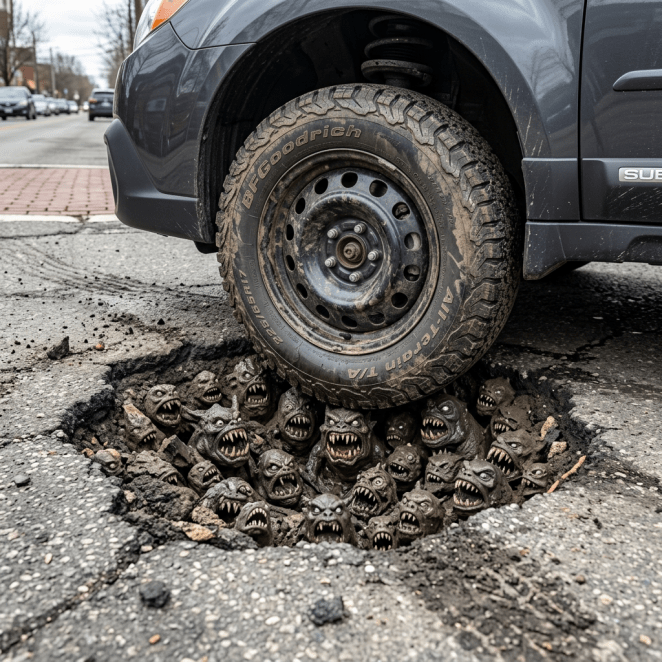
A car tire hovers above a pothole filled with snarling monster sculptures. Image AI generated.
Blood from Stones
The road ahead a bandage leaking grey blood from stones. The snow plow brutal, carelessly lifting scabbed edges until the gore overflows.
Spring always promises renewal, but freeze and thaw also open old wounds making them bleed.
A merry, mazy life we lead, threading the car’s needle through holes torn in the asphalt’s fabric.
Some holes are so large they have lives of their own, and names – Grand Canyon, Yawning Gap, Patty’s Peril, Big Bertha, each one well-known to neighbors.
Others are pornographic, their open orifices painted, laughing in scorn, dentated vaginas ready for anything.
Such decorated potholes are soon filled, their crude messages swiftly erased.
Comment:
Three flat tires in the last month and spring’s potholes still out there, waiting to trap me. Apparently, one neighborhood on the North Side of the river decided to decorate their potholes with pornographic drawings. These were swiftly filled and their messages totally erased. Alas, we on the South Side are not so daring. We don’t go out and paint our potholes. Personally, I wish we did. July – and many potholes are still there.
Not only that, the road into town is being repaired. Hooray! However, the tarmac was stripped off two weeks ago and has yet to be replaced. Boo! More than that, at the end of our street, just before the highway, one or two enormous potholes still gape. They lead directly to a dip that rises abruptly when it meets with the now stripped highway. A champion clunker that – a genuine tank-trap. I think at least two of my flat tires occurred after going over that one.
It reminds me of my grandfather’s stories about WWI and ‘going over the top’. Now, each time I approach it in the car, I call out loudly, “Look out, grandpa, here I come.” I call that particular pothole Grandpa’s Revenge. My own personal name. I don’t know what the neighbors call it. And I don’t know why grandpa is seeking revenge! But below the tires, the pothole awaits, gnashing its teeth.
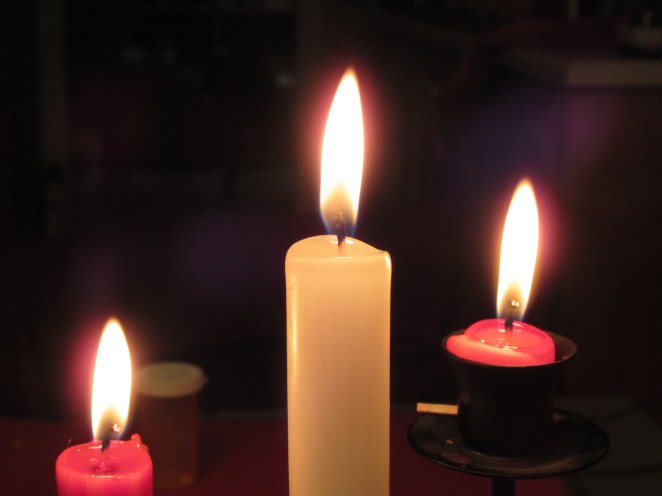
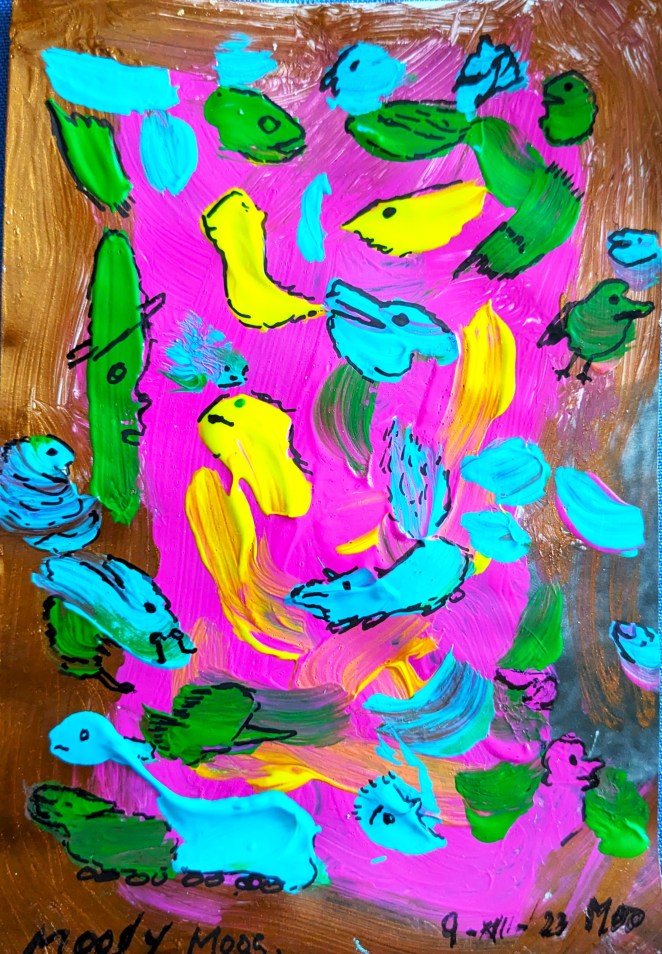
alive in the moment a momentary cloud crosses the sun face brings shade to table
soon page and tabletop ripple with light again
the pen’s shadow pushes across the page while the nib weaves its spider fine lines of well webbed words
meaningful mindful each letter a moment caught and held in time
Comments:
I caught myself forcing myself to write a poem – and it just wasn’t working. Meaningless words upon the page, each wound up, struggling like a little black fly in a spider web that promised only oblivion. Then I caught the one sentence that ends the above poem – each letter a moment caught in time. I had found what I was looking for. For the next half hour I played back and forth with a whole sequence of dibbles and dabbles that eventually led to what I have written above.
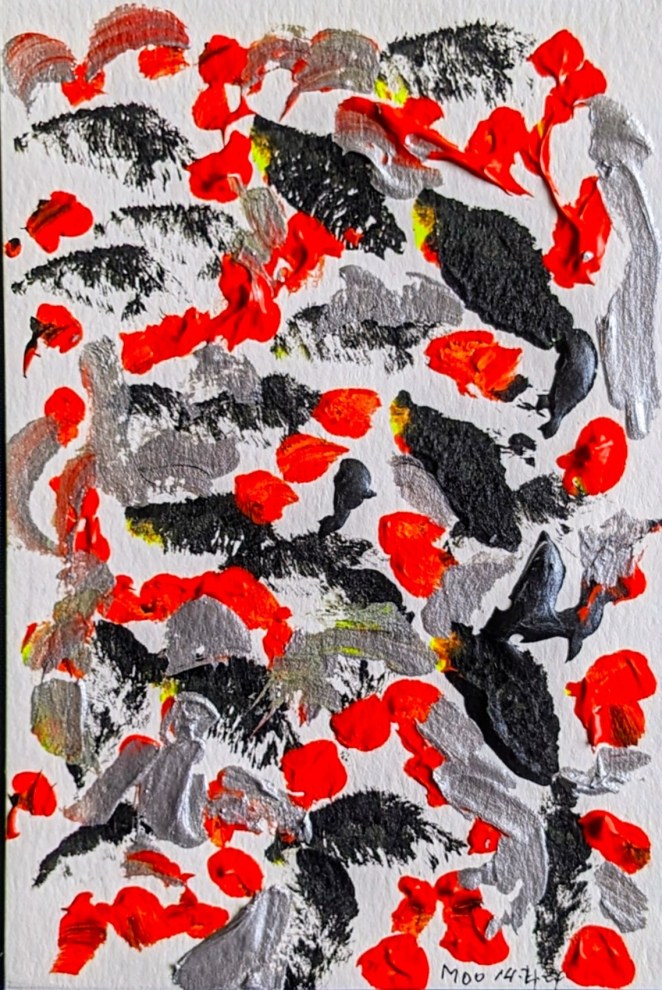
I showed it to Moo. “Tranquility,” he said. “I have just the painting for you.” Love at first sight – poet and painter, painting and poem, blissful in a true moment of blended tranquility and mindfulness. “Why, thank you, dear Moo,” I said and all our previous squibbling and squabbling was laid aside. We gave each other a big hug – I should add that we don’t often do that, as one or two of you out there might well know. But we did it today.
Meanwhile, I have received another set of fake invitations – oh, I would be so famous in the world of fakery if I gave away what little money I own to make myself truly famous – for my folly in believing the permanence of fakery. Why, only last week, I got an email mistaking me for my namesake and offering to help me publicize his most famous book – My Word is my Bond. The person involved was asking for a cool $250,00 for making the videos.
Oh dear. 007 is one thing. 006.5 is something else and someone else. Never mind – maybe one day someone real will call me and make me a genuine offer that I really can’t refuse. I probably wouldn’t believe that if it happened.
The boy in the kitchen bare legs held to the fire ‘this is what hell will be like’
The cupboard under the stairs cold dark locked from the outside an oubliette the young boy left there forgotten
Running upstairs to safety beneath the bed hands grasping at legs and ankles pulling him back down for appropriate punishment
The belt the stick the little red brush that cleans the fireplace with its foretaste of hell beating battering an avalanche of blows the boy buried beneath them
Commentary:
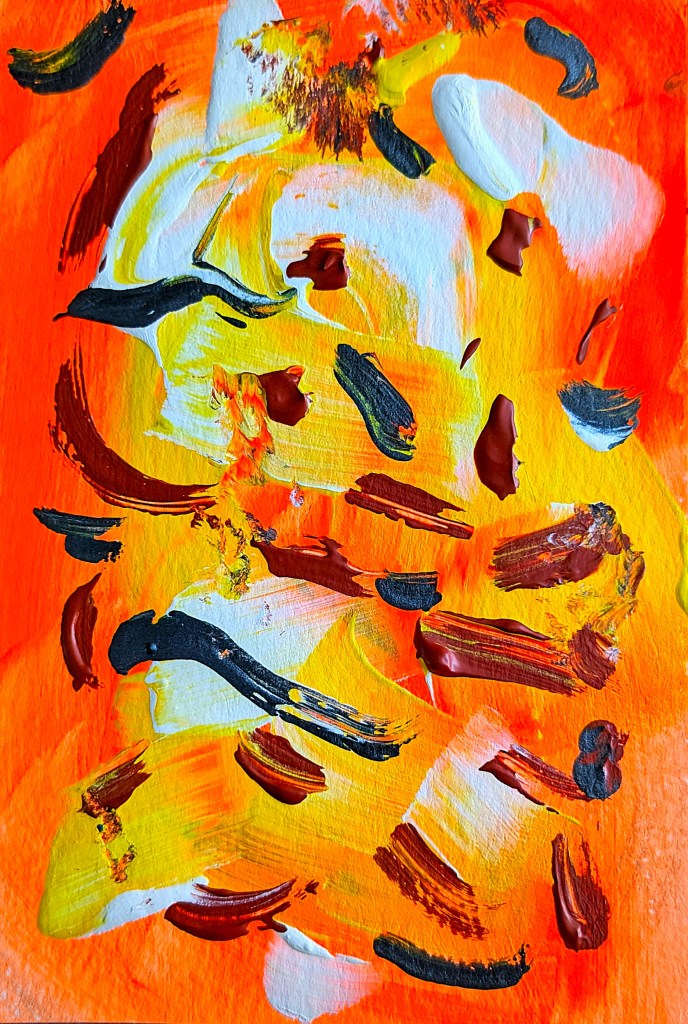
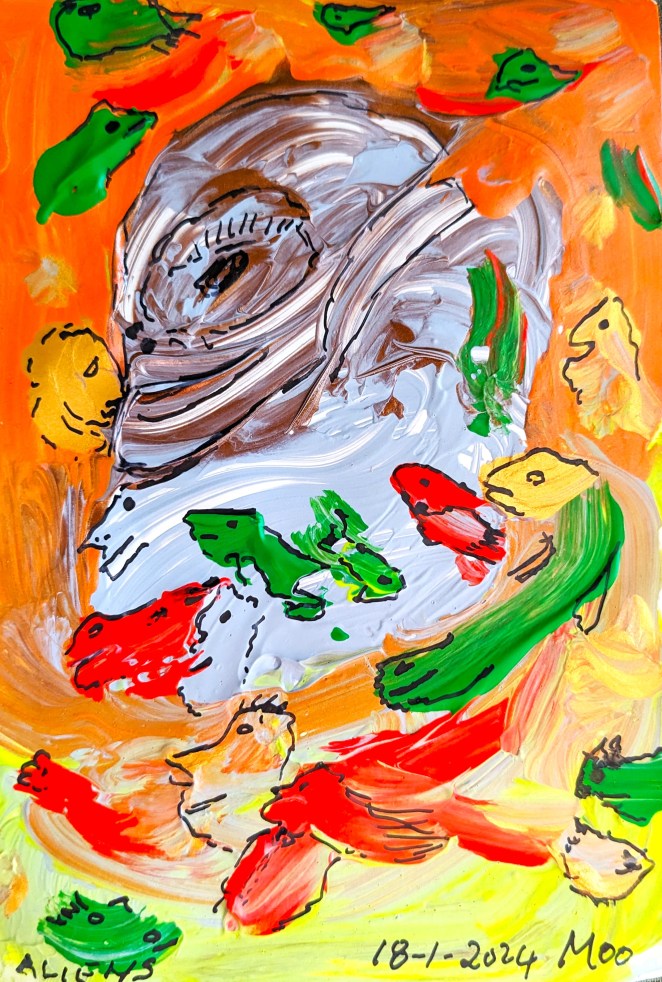
Another unsigned painting by Moo. He told me that he calls this one Orange-U-Happy. Well, it is a happy painting, until you read the poem that goes with it and discover that all the stones of the avalanche are floating around in Moo’s painting, including a nice selection of sticks.
“Sticks and stones will break my bones, but names will never hurt me.” But names do hurt. Names can be cast like stones, and the thrown stone, like the spoken word, can never be recalled. Liar. Cheat. Thief. Little Lord Fauntleroy. Bite the hand that feeds you. Are you laughing at me? I’ll teach you a lesson you’ll never forget. I’ll shake you until your teeth rattle.
Stones can be thrown into ponds. When they are, the ripples reach out, spread further, spread far and wide. Thrown words can enter the soul, ripple through the blood, and they can lodge in heart and brain, forever memories that never fade and never fly away. Heart stones, they are, that strike at the stroke of midnight and leave the victim suffering, gasping for air.
So many silent memories, buried deep, only to rise and parade around in dreams at night, revenants come to haunt and hunt, sharp words made even sharper than flint or obsidian to cut and fracture, and splinter, and slowly, slowly wear down the prey. Words – the jaws that bite, the claws that snatch. Think twice before you throw, speak, wound, injure …. then think again, bite your tongue, stay your hand, drop the stone, think rather of the hand of friendship, of comfort, the feathered wing of the guardian angel that consoles and brings succor.
Succour (or succor in American English) means assistance or support given to someone experiencing grief or hardship. It is a formal, often literary term used to describe help that offers actual relief or comfort to people in difficult situations, such as disaster victims or those struggling emotionally – Wikipedia.
And remember – many words have double meanings – spare – to forbear: deciding not to hurt, destroy, or punish, such as “sparing the life” of a captive or sparing the the rod. Spoil – to indulge: to treat someone, such as a child or pet, with pampering. It can also mean treating oneself to a luxury or relaxing day.
So, what does spare the rod and spoil the child mean? Clearly it is a phrase with a double meaning. Choose which one you will. But remember – “Let us pray” is a better prayer than “Let us prey“.
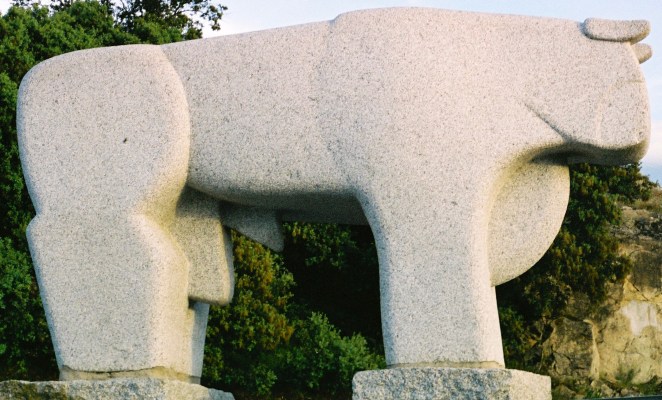
… at the beginning of the end, when more things have gone than are with us and the summer’s sun withers the grass and wrinkles our faces baking us bright red – como un cangrejo te has puesto, hijo mío, en el sol de Somo, como un cangrejo – and — pulpo en un garaje — you grasp at the new words, the new colors, the new delights, your tongue trapped clumsily in your mouth like a red rag doll and the midnight bull charging the spectators who gather and olé, au lait … as the drunken bullfighter climbs the bull and kills the post. The red cape flutters in our memories and to the slaughterhouse we go where the open body hangs loose like a flag and the red meat of him held out for all to see and some to share … and this is his body and this is his blood, sacrificed in a circle of golden sand for our drunken amusement … for whatever I did, I never visited those bull fights when I was sober … at five thirty, they began, and at 3 o’clock we would gather in the city center and slowly wend our way from bar to bar, up the Calle de Burgos, past the street where you lived and upwards, ever upwards, towards the bull ring at the top of the hill, from bar to bar, I say, and the bota, the wine-skin filled and re-filled with that dark red fluid that will set us all baying for the bull’s blood, or the matador’s blood, it doesn’t matter whose blood, as long as someone bleeds and the bull is butchered, torn from this life by a man on horseback, armed with a lance, and he thrusts the heavy blade between the shoulders of the bull, the blood first dripping red, then gushing, a small stream over the rock of the bull’s shoulder, and down the bull’s front legs, to slither on the sand, and the bull still ready to charge the horse, and the bull’s head steadily dropping as the muscles in the back and neck are gashed and torn and there’s no hell like this gaping wound between the bull’s shoulders and the blood flowing freely and vanishing into the sand, the golden sand, once pristine, stained now with blood, and soon to be further blemished with feces and urine, and the picador, his job done, walks his blind-folded, armored horse out of the ring, and the bull, un-armored, un-enamored of the process which turns his torment into a spectacle staged for our drunken delight, as we pass the bota round, and the blood red wine travels from hand to hand, and we squirt the bull’s blood squarely between our lips and it dashes against tongue and teeth and we swallow the body’s sacrifice hook, line, and sinker, as the banderillero runs in, harpoons in hand, waving his banderillas and plunging their arrowed barbs into the gaping wound that flowers on the bull’s back, and the bull stands there, twitching, wriggling, saliva and drool slipping down, sliding stickily into the sand, as the matador doffs his hat, takes his vorpal sword in hand and treads the light fantastique in his laced-up dancing pumps, his waltzing matilda feet so swift, so sure, eluding the lumbering rush of the charging bull, the load of bull, that tumbles down the railway track towards him as he stands there, the matador, poised like a ballerina, as stiff and as steady as a lamp-post around which the bull circles like a drunken man, staggering a bit, but still bemused by the red flag tied to a stick which waves before his eyes and goads him onwards, ever onwards, in his plunge towards a brilliant death, as he pauses, feet together, and the matador makes his move, one, step, then two, and the bull lurching forward to impale himself on three or four feet of curved, immaculate steel, and the matador immaculate in his reception of the bull – and what is happening? What will happen next? Sometimes, the sword pierces the spinal cord and death is instantaneous. Sometimes, the sword pierces the heart, and death is more or less swift, but certainly certain. And sometimes the sword pinches against the bone and flies from the matador’s hand, and the matador must bend, and pick it up, and try, try again, the red rag below the bull’s nose, the bull drawn forward, yet again, to impale himself, yet again, on the sharp end of the sword, and this time, the sword goes in, but the wound is in the lungs and the peones, the pawns, the workers, the drones, the little men who help, turn the bull round and round in ever tighter circles so the sword will open and even larger wound, sever the main arteries perhaps, and the bull, blood spurting through nose and mouth, lurches now, then falls to his knees, and lies there, bleeding, and the matador chooses the descabello, that little sharp sword with the razor blade at the end and he tries to sever the spinal cord, there at the back of the neck, and sometimes he does, and sometimes he doesn’t, and if he can’t then it’s the little men again in their colorful parrot suits all gleaming with sequins and stars and they carry a sharp little instrument, with a pointed end, la puntilla, that short, double-edged, stabbing knife which is plunged into the occipito-atlantal space to sever the medulla oblongata in the evernazione method of mercy killing, and the puntilla is plunged again and again into the bull’s neck at this atlanto-occipital joint, until it severs the medulla oblongata, and when it is severed, in this glorious neck stab, then finally the bull drops dead, and the show must go on and on, and on, and the horses come in, black funeral horses with bright feathers on their heads and they loop a rope around the bull’s horns and away he goes, trailing blood, and urine, and shit, all across the sand and other little men appear to sweep the sands clean, and my neighbor who wears a large walrus moustache stained red now and purple with the wine that he has splashed about, shakes the wine skin and finds it as not as full as it was, so he sheds a bitter tear, and since the death was slow, the crowd all whistle and boo the matador and his merry men, but when the death is swift and quick then the crowd is aroused and they wave white hankies at the presidential box and the president awards the matador an ear, a salty, smelly, sticky ear which the peones cut off the bull before he is towed away, and then the matador throws the ear in the direction of his current sweet heart, the fairest lady in the crowd although she be as brown as the beauties baking daily on the summer sand where the sea horses dance and there are no bulls, and no bull shit, and no maids with mops, just the scouring sea, and sometimes the president gives away two ears, or two ears and the tail, dos orejas y el rabo, though this I have seldom seen, and what does the bull care that he dies bravely and well, for now he is dead he hasn’t a care in the world, and the butchers in the butcher’s shop are carving him away, carving him to the skeletal nothingness of skin and bone that awaits us all, the nothingness of this more or less glorious death, with our tails cut off and our ears hacked away to be pickled or smoked or otherwise kept in the fridge as the butcher’s trophy … and who now will walk stone cold sober into that magic circle of sun and shade and stand there, unbowed, before the might of the untamed beast, the untamed bestiality that drives us wild as it wanders through our nightmare cities and our wildest dreams … and now the crowd call ¡música, música! and the band strikes up and martial music plays as the bullfighter and his troupe march gaily round the ring, their trophies held high for all to see before they are thrown to the ravening crowd who bay like the dogs they are as they taste fresh, bloodied meat …
You cannot hide when the black angel comes and knocks on your door.
“Wait a minute,” you say, “While I change my clothes and comb my hair.”
But he is there before you, in the clothes closet, pulling your arm. You move to the bathroom to brush your teeth.
Now,” says the angel.
Your eyes mist over. You know you are there, but you can no longer see your reflection in the mirror.
Comment:
The last poem in the series and Rage, Rageagainst the dying of the light is over and done. Many of you will recognize the title from Dylan Thomas’s poem Do not go gentle into that dark night. I guess the theme itself has become part of the Welsh culture. And now we have exported it to New Brunswick, Canada, and perhaps beyond.
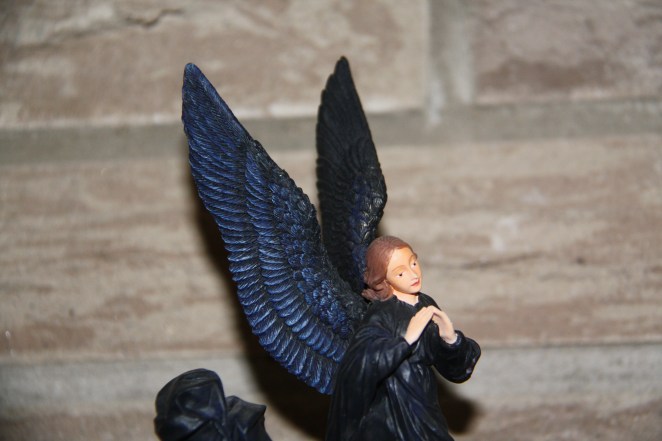
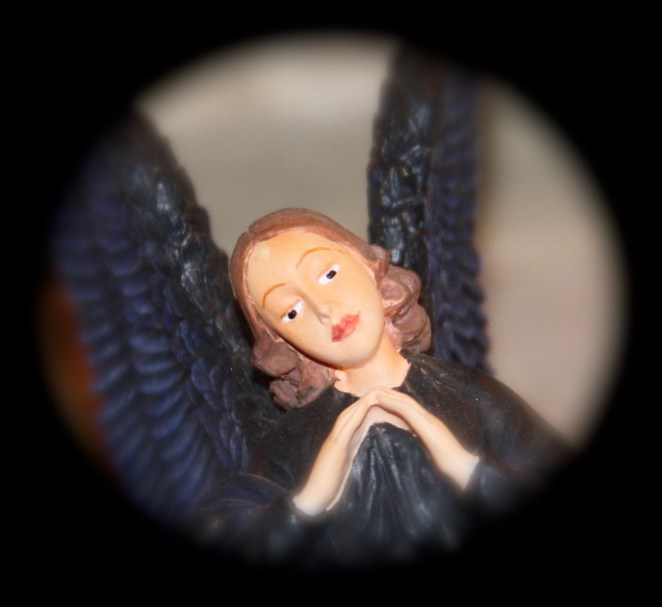
I bought The Black Angel, pictured above, in Avila, Spain. It is a plaster cast of one of the Angels in Roger Van der Leyden’s paintings, if I remember correctly. Here is the angel’s face in close up.
She or he brings a promise of rest and peace, a freedom from earthbound woes and sorrows. She stands on the shelf above the fireplace insert in our sitting room and brings blessings to the house. I look at her every time I light the fire. And she smiles down and blesses me. I think of her as a lady, but her peace and beauty outweigh any formal signs of sex.
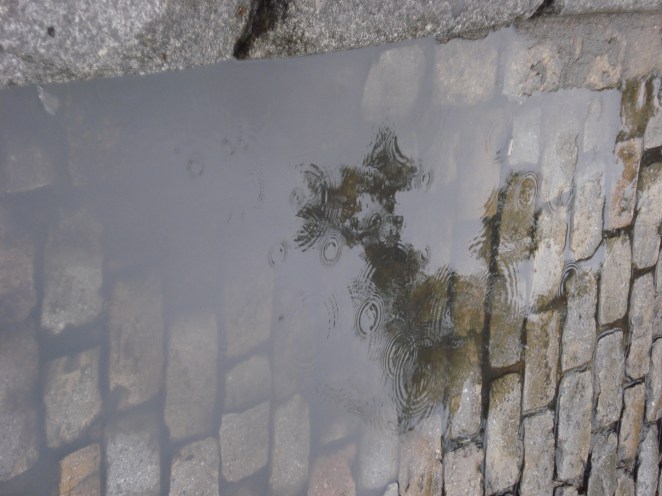
As for that reflection in the mirror, well, I don’t have one of me. But her is a photo to reflect upon:
Raining in Avila and puddles in the street. Now you see me, now you don’t. But I am there, holding the camera, and looking down at the water where —- rain has stopped play. The bails have been removed. Old Father Time has gone back to the Pavilion at Lord’s, and the cricket game is over for the day.
A silvery thatch bears witness to the winter of my withering.
My broken body hangs from the coat hanger of my shoulders, its worn-out sack knitted from skin, bonded with blood.
I walk with two canes, not just a sick man, but a stick man.
When I fall asleep, my enigmatic body haunts me with its death-rattle of drying bones.
Comment
Sometimes no comments are needed. However, when it comes down to it, I guess it’s worth saying that I am raging, raging against the dying of the light.
The dying of the light – in the evening, when the sun goes down, the house grows silent and cools around me. Some nights, when the news is bad or depressing, I feel we are entering another dark age. Luckily, spring is on its way, with summer not far behind. But what will spring and summer bring?
I fear the heat, the gathering of muttering trees, the ambush nature is setting up for humanity. We live among trees. Trees, all around the house. Trees, climbing the hills into the distance. I loved them when I came here first. The maples, the paper birches, the mountain ashes with their spring finery and the light green fuzz of forming leaves. Winter – the firs and pines dressed in their winter coats.
Last summer, fires broke out all over the province. The closest was a mere 30 kms down the road from us. We could smell the fire, see the smoke, and sense the discomfort of the proximity of possible outbreaks closer to home.
As I grow older, I become more fearful. Walking downstairs in the morning – cada pie mal puesto es una caída, cada caída es un precipico / each badly placed foot is a fall, each fall is down a precipice. Luis de Gongora. ( d. 1627). Alas, it’s that time of life, and it comes to anybody who, like me, has walked this far.
It’s the animals that I pity. The birds who move on and away and no longer stay with us. The deer who also have nowhere to go when their habitat is destroyed. The moose, the bears, the coyotes, the foxes, the jack rabbits and yes, they have all been visitors to our backyard.
Last summer, the local council circulated some ideas on how to prepare for immediate evacuation of our property- what to pack with a day’s notice, three hours’ warning, two hours’ warning, one hour’s warning. I hope it never comes to that. But now, I no longer know, and so I rage, rage, against the dying of the light.
I search for the key that will re-wind me, but I fail to find it.
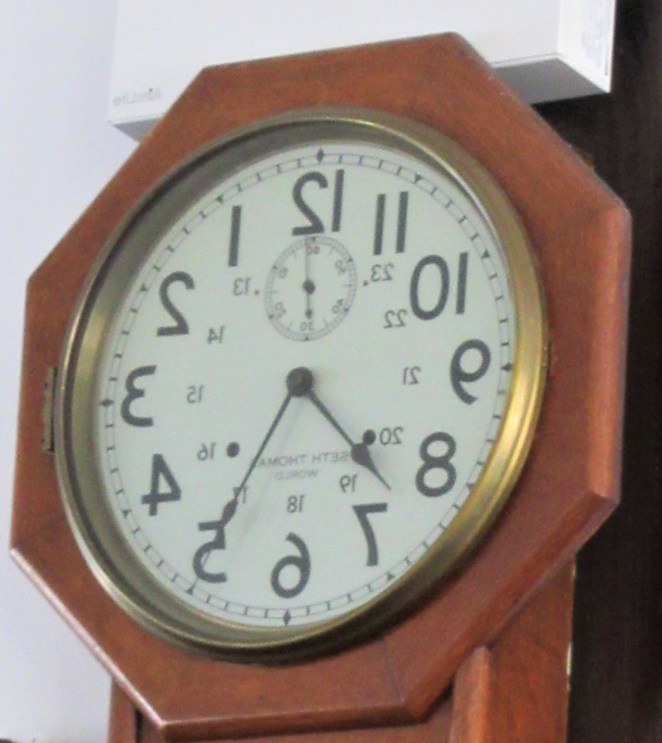
Who will winch up the pendulums on my grandfather clock, resetting it in spring and fall?
Who will watch time’s sharp black arrows as they point the path of moon change and the fleeting hours?
Each hour wounds, or so they say. Who will tend me when that last one kills?
Comment:
Omnia vulnerant, ultima necat. / Each one wounds, the last one kills. That’s how the Romans thought about the collection of hours that make up a day. An interesting way of putting it. In lapidarian fashion. Four words that are worth a whole book of philosophical thought.
What is this thing called time? Good question, and one which is being asked more and more. Clearly time does not flow evenly within the human mind, though it is remarkably regular on the clocks we have invented to mark time for us. And remember, there are many types of time – seasonal time – spring time, summer time, autumn time, winter time. Strange that autumn – or fall as I have now learned to call it – is the only one that doesn’t have the word time attached to it.
And what about time changes – spring forward, fall back – when we change our clocks in order to make the most of daylight hours. A tedious process for many of us. I see some provinces are rejecting those changes and sticking to the same time, all the year round, from season to season. Personally, I would prefer life without those time changes, as would many of my friends.
Celestial time also known as sidereal time – the time as showed by the planets as they seem to march around the earth in the terra-centric universe. Rephrased, the positions of the planets as the earth turns slowly round the sun in the helio-centric universe.
Then there is the personal time of individual experience. An hour watching football or rugby on the tv set passes much more quickly than an hour passed in the doctor’s waiting room or the dentist’s chair. Of course, an hour watching a five day cricket test can also be a slow process, unless England are playing Australia in the Ashes. As one friend of mine commented, a long time ago, “I thought those English cricketers were unfit. But I’ve never seen anyone go out to bat and come back to the pavilion so quickly. They must be super-fit.” Alas, their cricketing problem, as usual, was centered on the three cants – can’t bowl, can’t bat, can’t catch.
En fuga irrevocable huye la hora. La que el mejor cálculo cuenta en lectura y lección nos mejora.
Irrevocable is the hour’s flight. The one that counts the most in learning or reading improves us.
Francisco de Quevedo (1580-1645)
And remember – the hours fly by and your time is limited – spend it wisely and enjoy each and every day to the full limits of your abilities.
This is the hospital’s forgetting place, the left-luggage office where, a human parcel wrapped in a blue gown, I wait to be claimed.
Tagged with a label on my wrist, I find myself alone with my fate.
53
All choice disappeared when I came here and surrendered myself to the system.
Now I lack free will and freedom of choice.
Yet I still dream of choosing my destination, and the ways and means of arriving there.
Comment:
A terminus – what an interesting word. Terminus a quo or terminus ad quem? Or just a railway terminus or a bus terminus where we sit and wait to change buses of trains? Or maybe just a terminus in terms of being terminal? Oh what a tangled web we weave when we first start to analyze our words in order to see exactly where we might go and where they might lead us.
And what a journey I was on when I first wrote that poem. Sitting in the waiting room, outside the radiation room, waiting for the lady who would wag her finger and point at the machine’s next victim. Would it be me? The man next to me? That woman over there? Many of us avoided each other’s eyes and just sat there stunned – and now you know the meaning, in context, of ojos de besugo – do you remember that from Rage, Rage, 48?. Others chatted. Some sat there quietly while their teeth chattered. Few of us knew each other, except from the hospice where we stayed if we weren’t day patients travelling in on a daily basis and rushing home afterwards.
Libre albedrío – free will. We can say so much about free will and determinism. But when we enter the system, it’s the system that rules. We have free will to enter – and they [the authorities] say we have free will to exit when we wish – but do we? Good question. A very good question. Once tagged, we are as free as the birds, as free as the salmon, as free as the whales – but within that freedom we are tracked, followed, taken in hand, advised, persuaded, manipulated … and whales have a whale of a time when they’re trapped up in fish netting …
Then there are the follow-ups. The appointments. The emails. The telephone calls. The check-ups. The blood tests. The MRIs. The X-rays. The Holter appointments. The various scans. Who is brave enough to get off the wagon or to open the aircraft’s door half way through its flight over the Atlantic and step out? Would you jump from the save-yourself-train – not at all like the gravy train – and think carefully – are you really saving yourself or are you getting yourself into hotter and deeper water? Come along then, let’s open the aircraft’s door and step out over the Atlantic. And tell me, what exactly are we stepping into?
Stop the world, I want to get off! Not so easy to do, my friends, not so easy to do. Not even when you think the terminus in which you are sitting is taking you to hell in a hand-basket. You start to stand up. And the little lady appears, smiles at you, crooks her finger, nods her head, and – as obedient as one of Pavlov’s well-trained puppy dogs – off you go, following in her footsteps.
I carry memories and scars like a snail wears its shell and I leave behind me a slither of silver words.
I’m a broken gramophone, needle stuck in a groove repeating the same verses again and again. This repetition drives me insane.
My thoughts just drift. My body is a ship in the doldrums, no wind to fill its sails.
I pick up my paint brush and paint myself – lonely and blue as idle as a long-lost lamb, alone with nothing to do.
Comment:
The alienation of an alien nation – and I wonder if they really are here, those aliens. So many strange happenings in my life. The silver slither of words drags me through so many lost moments in time. Fray Luis de León, I spoke to him last night, asked me the question – “Es más que un breve punto / este bajo y torpe suelo comparado / con aquel gran transunto / do vive mejorado / todo lo que es, lo que será, lo que ha pasado?”
It’s a lovely verse in Spanish, but not so easy to translate into English. Let’s try – first, word for word – “Is it more than a small dot this low and stupid soil compared with that great sky world where now lives improved all that is, all that will be, and all that has happened?”
A comment on the translation – first, the length of the sentence and the way in which it is complicated by inversions and ideas expressed in words which have little direct translation. Then there is the expression – 1. a small dot – un breve punto – a short moment in time. 2. low and stupid soil – este bajo y torpe suelo – clumsy earth below. That clarifies, a little the meaning. 3. that great sky world – aquel gran transunto – that great sky above. 4. where – do [short for donde – to keep the syllable count] – where – 5. lives improved – vive mejorado – lives a better life.
Here goes: “Is this clumsy earth below more than a short moment in time compared with that great sky above where now lives a better life all that is, all that will be, and all that has happened?” Not great, but we can live with it.
As Miguel de Cervantes said “To read in translation is to look at the reverse side of a tapestry.” So, to imagine the real side of the tapestry we need to count our syllables – they don’t match. We need to measure the length of our lines. They don’t match. We need to sharpen our metaphors and images – they don’t really match. And, last but not least, we have to imagine the Platonic, Terra-Centric universe in which the sun moves around the earth and the earth is the centre of all life.
I should add the cultural association of words. In every language, each word has an “associative field of cultural meanings”. Those “associative fields” differ from language to language. So, even getting the verbal meaning correct means that you do not necessarily get the cultural associations right. In fact, it’s almost impossible to do so. It’s a fascinating world and one which I have explored in various academic articles.
I would like to take cultural meanings a step further. In Don Quixote, II, 11 – I quote from J. M. Cohen’s Penguin translation of 1950 (rpt 1961) – Don Quixote says to Sancho ” … if I remember rightly, you said that she [Dulcinea] had eyes like pearls, and eyes like pearls suit a sea-bream better than a lady” (p. 533). I will leave aside, for now, Sancho’s comic mixing of the Petrarchan metaphors and concentrate on the single word sea-bream. To compare someone’s eyes to those of a sea-bream is comical in English. However, the word has several associative fields in Spanish which are worthy of deeper study. Secondary meanings of a sea-bream – besugo – include 1. a mild insult, as in no seas besugo / don’t be a fool / an idiot / stupid. 2. Diálogo de besugos – two people talking and neither one listening to the other. 3. Ojos de besugo – a blank or dazed expression. Quite simply, the translation besugo > sea-bream functions at the literal level, but by no means at the cultural level of the associative fields.
Alas, some days I’m a broken gramophone, needle stuck in a groove, repeating the same things again and again. Maybe one day I will get them right. And maybe I won’t. Better minds than mine have struggled with translating Spanish (poetry) into English (poetry), and most have failed. Many, dismally. We won’t mention names. Sometimes the best translations are not translations at all, but poems that recreate the original in the target language. I am quite happy with my translation of the meaning of Fray Luis de León’s poem – but how sad would be any attempt to transfer the verse form from Spanish to English? Five lines of seven and eleven syllables each – wow! Go for it. But remember – fools rush in where angels fear to tread.
Never mind. Maybe tonight I’ll have another little chat with Fray Luis de León and Miguel de Cervantes, Quevedo too, if I am lucky. Maybe their English will be good enough to give me a few hints. I’ll let you know later if any one of them does come to visit.