Windmill

Windmill
Jackpine Sonnet

When the scales fell from my eyes
I stood on them and wondered
what I weighed on the time’s great scales.

Miniscule. A featherweight.
A dandelion seed blown on the wind
that whirls the world through space.

Spiritus mundi – the great world spirit
inflating my lungs, each breath
a glimpse of the infinite
combining in my body and soul.

The sails of a windmill, my arms,
and the wind turning them,
dashing me down into the dust,
then raising me rejoicing to the skies.

Comment:

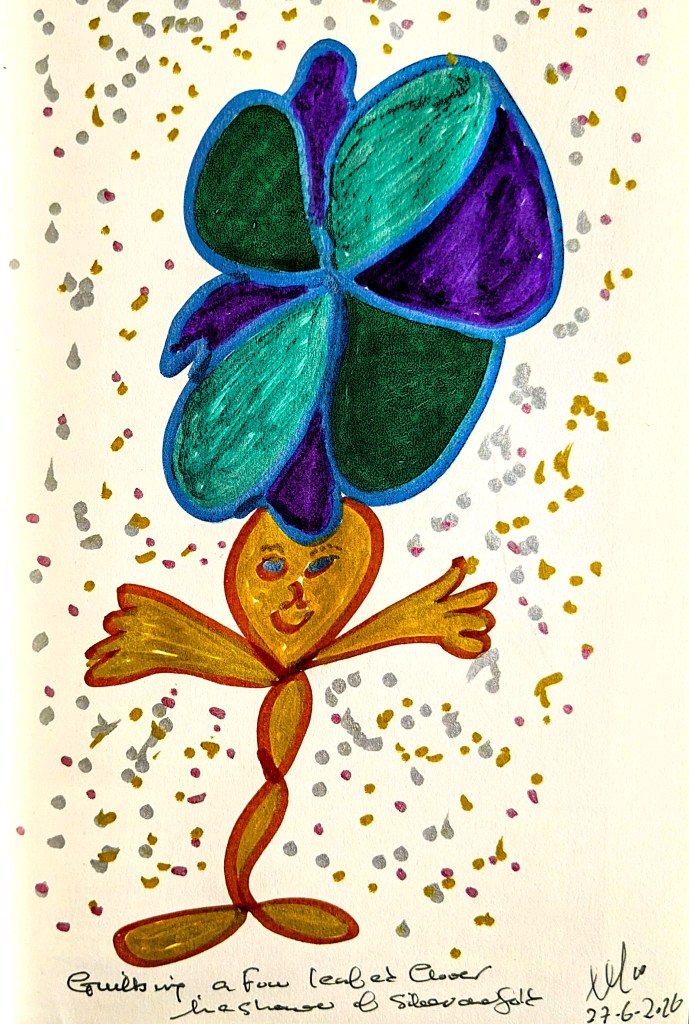
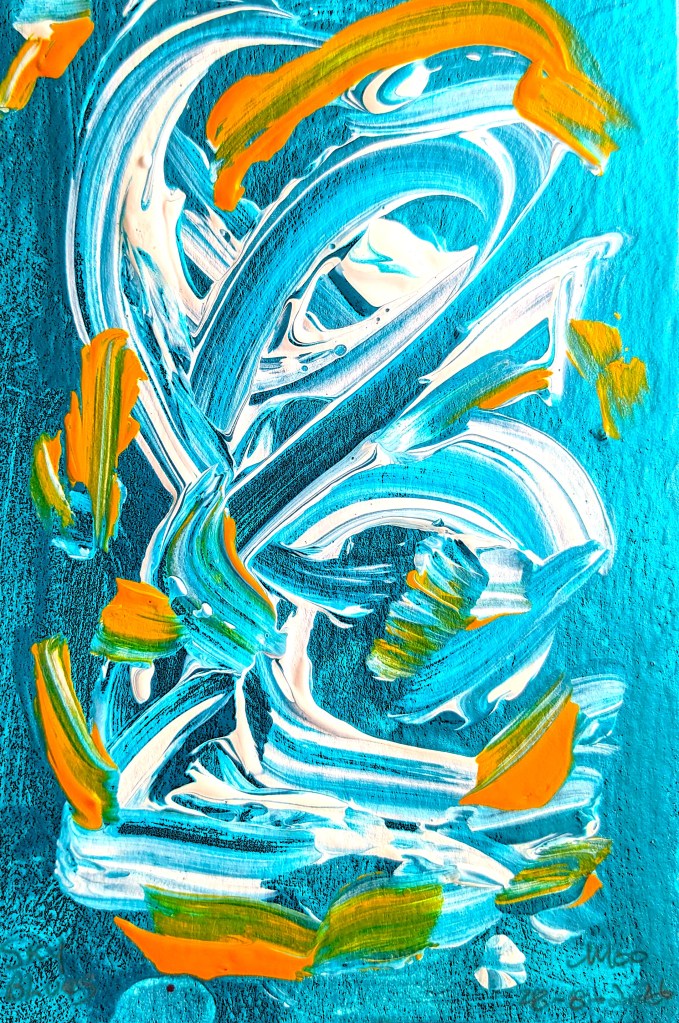
Moo said I needed cheering up, so he painted me a happy painting. “I know it’s not a windmill,” he told me, “but you can pretend it is. The leaves of the clover even look like they might be a windmill, and look, it’s got arms as well.”

“Thank you, Moo,” I said. My poem is a happy poem and it proves that the Black Dog of yesterday had been banished today, not by a happy dog, but by a four leafed clover standing beneath a shower of solver and gold.”

Intertextuality – texts speaking to texts. I wonder how many texts you can spot in this poem. I can count five, at least, and there are probably more. Milton Acorn, Miguel de Cervantes, Northop Frye, the Bible (not y Beibl Cymreig, unfortunately), Edmond Rostand. That’s quite the handful. Well, four fingers and a thumb, at least. Now all you have to do is spot the original sources which, blended, give my poem a saucy sauce of sorts. So, grab your AI and play hide and seek and see what you can find drawn from the dark recesses of my mind. Don’t give in too easily, now.

Mood swings – mood changes – Moody Me – Moody Moo – I’ll bet that you are Moody Too. Good mood, bad mood, who’s to say? We’ll leave that for another day!

Black Dog

Black Dog

The black dog leaps out
of the grandmother clock
and lands on my back.

His paws grip my shoulders,
then rake down my spine.

I try to shake him off,
but he growls, bares his teeth,
and won’t let go.

I love that clock,
its Westminster chimes,
the Roman numerals
standing guard
over the pointed arrows
of the hands as they march
round and round.

But I hate the hound
that makes its kennel
in the clock, leaps out,
snaps at me, bites and claws,
and grinds me
down into the ground.

Comment:

The Black Dog was Winston Churchill’s name for the depression that came over him, and overcame him, from time to time. It used to attack me when I was a young boy living in Swansea. My grandfather would point at the clock and say “He’s in there. He’s coming for you. I can see him. It’s the black dog.” Well, that used to drive me crazy and whatever it was that set me off became twice as bad when the black dog arrived. Alas, now I am entering into my dotage and my second childhood, the black dog has re-appeared to trouble my waking hours. I guess it’s the mood swings. Happy one moment, miserable the next. The good dog appears. The black dog drives it away. Then the good dog reappears and all is well again.

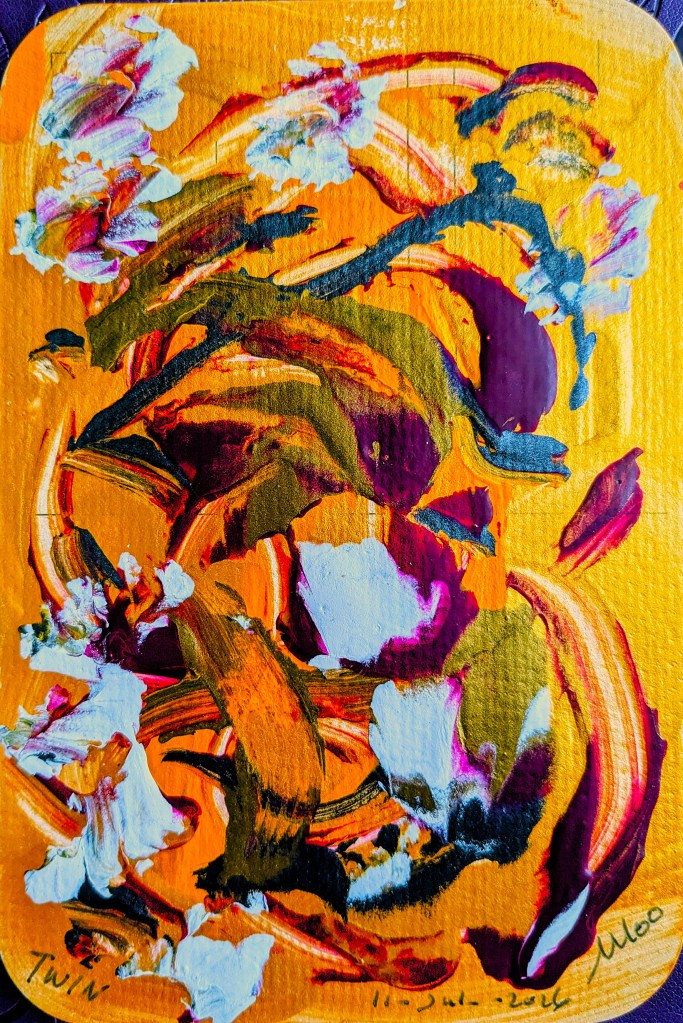
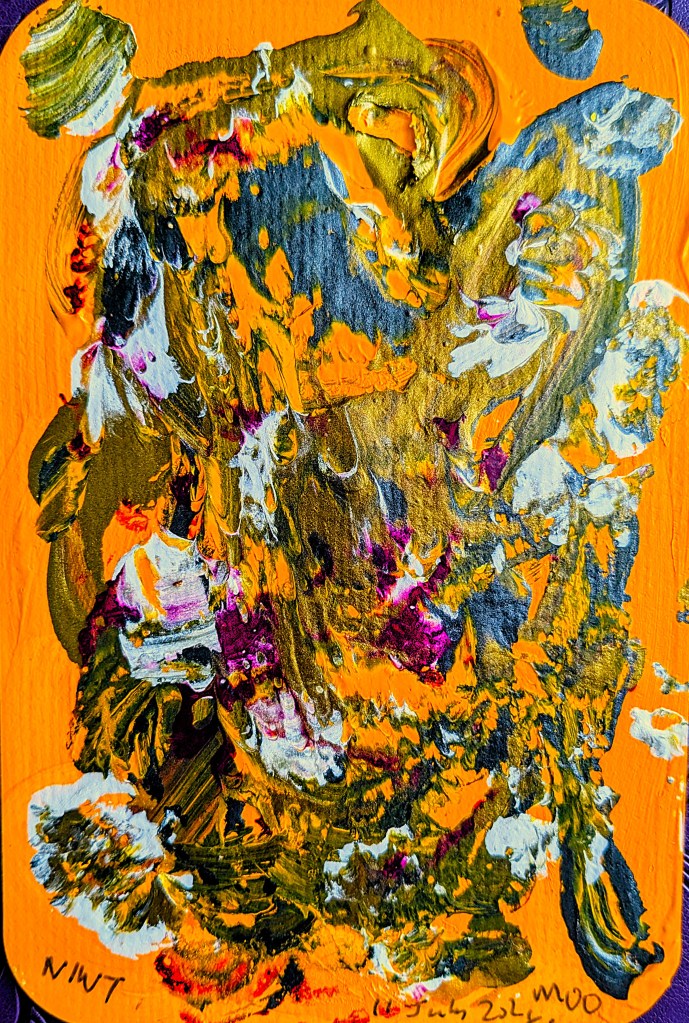
Moo understands me and my patterns very well. In fact he painted two paintings for me – Twin – the one above and Niwt – the one below. You can see evidence of the good dog and the black dog in each of them. But which is which?

I’ll leave you to guess which is the good dog and which the bad one. Really and truly, they are two sides of the same coin – heads and tails so to speak. Moo tells me you can think of the paintings as a mirror image, one of the other.

It’s like mood swings – either my mind or my body flips the coin and one of the two dogs jumps out visit me. Luckily, after a bit, the good one chases the bad one away, so it’s all swings and roundabouts and all the fun of the fair. Until I fall off the Ferris Wheel or see my own shadow while riding on the Ghost Train.

Twin, of course, is Niwt backwards. Or is it the other way round. Dylan Thomas, my favorite Welsh poet, set the standard for word reversal. After all, the town of Llareggub is bugger all backwards. What fun we can have when we twist our words, double up on our language, reverse words and their meanings, and generally weave the tangled webs of linguistic double-talk. Oh the mystery of missed and mixed up meanings. But are meanings meaningful or meaningless? Now that is the question. And when you have answered it for meanings, start thinking about double-meanings and their twins – or should that be quadruplets?

Decision Time

Decision Time

When down means up
and up has nowhere to go
save for the desert sand
barren and bare shifting
through helpless fingers
or the hour glass waste
with two trunkless stones
propping up the sundial’s
wrinkled face and time’s sneer
of command its wilderness
voice always a choice
between thinking and feeling
for yourself or believing
frozen words dropped
from winter’s snowflakes
to melt in the toothless mouth
of a new day another decision
the future laid out ahead
and you with no map
no GPS nothing to get you
to the last place you want to go

Comment:

Some strange touches of surrealism in this little poem that weaves its way through an intertextual maze recognizable, I hope, to many of those who read this blog and follow these comments on a regular basis. Travelers from far-off lands tinkle their echoes through the lines.

How many of you have read the South Wales Echo or listened to the paperboy, almost always an old man, chant his late afternoon song outside Cardiff Market or Down by what used to be Howell’s, not so long ago, when my world was so much younger and I too lived in a far-off land before I became a traveler. What sort of traveler, you ask. Why, a traveler in time and space, of course. Listen. Can you hear him? “Echo. South Wales Echo.” As regular as clockwork.

But in Swansea, everything was different. There it was the South Wales Evening Post, chanted by a paper boy turned old man who sang out – “Po-ost, Po-ost, Evening Po-ost, South Wales Evening Po-ost!” That double or extended vowel was a signature tune that brought on the evening and the turning on of the old gas lights that used to light up the streets.

Living in Santander, Spain, the street calls were totally different. There it was the lottery man, usually blind, who stood on the street corners crying out “Para hoy! Tengo para Hoy!” Today’s lottery. I have tickets for today’s lottery. So many lotteries in Spain. So much fun. In the laundry at the bottom of Perines, where I used to lodge, if your laundry ticket number matched the winning lottery number of the Ciegos – the Blind People’s Lottery, then you could claim a free wash that day.

So many memories. The past fading slowly away. The future coming ever closer. I look out of my window, and what do I see? Well, there’s always a bird in a tree, but today the clouds are building, playing piggy-back, and climbing on top of each other, reaching higher and higher into the sky and, sooner or later, there will be rain. Blessed, comforting rain. The gardens are dry. The aquifers are low, and yes, we need that rain. Para hoy – today – please!

And then maybe the desert will bloom again. The woods will flourish and, guess what KTJ saw in the woods the other day? You can’t guess? Well, I’ll tell you what KTJ told me – “I saw a partridge, then an owl, then two bear cubs, and the mother cub, followed by a third cub, and then a mother moose with a wobble-legged baby moose trailing behind …” If you ever see a mother bear with cubs – oh-oh, decision time, remember to make the right decision – don’t get between the cubs and the mother. Or you might end up as the Teddy Bears’ Picnic. And you wouldn’t want that!

And each time you meet a wild animal, you make a decision. To stop or not to stop. To take a picture or not to take a picture. To shoot or not to shoot – with a gun this time [nasty!] not with a camera [nice]. And remember, Santa’s got a list and he remembers who is naughty and who is nice. So think twice before you make that decision – you wouldn’t want to end up on the wrong list at Christmas Time, would you.

In Praise of The Other

In Praise of the Other

I have lived with the Other.
He treated me well.

To him I was the Other,
yet he fed me when I hungered,
gave water when I ran dry.

I fell ill and he cared for me,
nursed me back to health.

He taught me his language,
culture, history, and skills.

He loved me, never forced me
to forget myself and become
something I could never be.

He made me what I am today:
a believer in humanity,
not man’s inhumanity to man.

Commentary:

Words for a divided world where man’s inhumanity to man sometimes seems to over-ride man’s humanity. Sometimes I am afraid to publish poems like these. Self-censorship is the worst form of censorship because it bottles things up until they rot inside you. Somebody has to speak out. Somebody has to stand up. So many, myself included, are afraid to do so.

Moo asked me to use his painting for this one. “Yours,” he told me, “is a cri de coeur, a cry from the heart. It must be heard. I’ll stand by you, side by side, and support you with this painting. It’s a Golden Oldie, but it’s good.”

I turned to thank Moo, but when I looked, he had gone. So much for shoulder to shoulder and side by side. Never mind. The poem’s not mine really. It belongs to others, many others. The start is from the Bible – The Good Samaritan. The ending is from Robbie Burns, changed slightly. There – now I have people who will stand beside me and echo my cri de coeur. And wow, look, here’s Moo, back again.

Wonderful. Now we can stand together. Should to shoulder. Side by Side. With no walls to divide us (Billy Bragg).

No, Moo. Sorry. I don’t have twenty dollars to lend you. Oh dear. There he goes again. Once more I am the monarch of all I survey and shoulder to shoulder with Alexander Selkirk I ask that other question – “Oh solitude, where are thy charms?” He ought to know if anyone did for he too made his cri de coeur from another horrible place.

Riddle-me-Ree

Riddle-me-Ree


What does the kettle whistle
to the grandfather clock
and why does its pendulum
call the kettle black?

A chime in time saves the cuckoo
just before it flies before our eyes …
and in August, fly it must.

Does anyone know how thyme
tells the time and whether or not
the dandelion clock
will learn how and when to chime?

Deep in a Gower Cave,
a woolly rhinoceros weaves
a web of time
on his mother’s knitting needles.

Beside him, in the rock,
a neolithic clock is fast asleep.
Was it Bill Haley put that rock
around the clock?

“You’ll never know,”
rings the sea-bell
tolling on its tidal surge,
“and I don’t have the urge to tell.”

Commentary:

Moo loves a riddle – that is why he fills his paintings with some many strange half people and animals that look out and King Lear at you. Mad as a hatter, is our Moo, especially when he’s feeling Moo-dy Blue. Moo is visually strange and now he is encouraging me to be verbally strange. So I took up the gauntlet, accepted the challenge, and road Nexus, my old dobbin, down to the end of the jousting lists, up with my lance and shield, and off I go.

Luckily Moo doesn’t know what I am talking about and he doesn’t have a dobbin anyway, let alone a lance. So, there he is, sitting on the sidelines, flicking paint at me with his paint brush. “The brush is mightier than the last,” he said. “Here’s mud in your eye!” And he must have been to PEI, because the mud was all red.

Alas, the Field Marshal thought I was bleeding, so he waved the white handkerchief and told me to leave the field of combat before PEI was swept away and vanished under a tide of big red mud along with Bud the Spud. And that made Stompin’ Tom stomping mad. “He might at least have used ketchup,” he cried, “because ketchup loves potatoes.” I found out, a lot later, that he had actually betted some money on me and was furious because he lost it.

“Never mind, Tom,” I told him. “Jousting isn’t the best game out there, and not every day does the best knight win.” “Hmmm,” said the Man from Skinner’s Pond. “I guess I could write a song about that. I think I’ll call it The Good Old Nexus Game. Nope. Doesn’t sound write. Jousting game? Nope. Hockey – that’s it – I’ll just go off, get my guitar, and tune up the old stompin’ bored.”


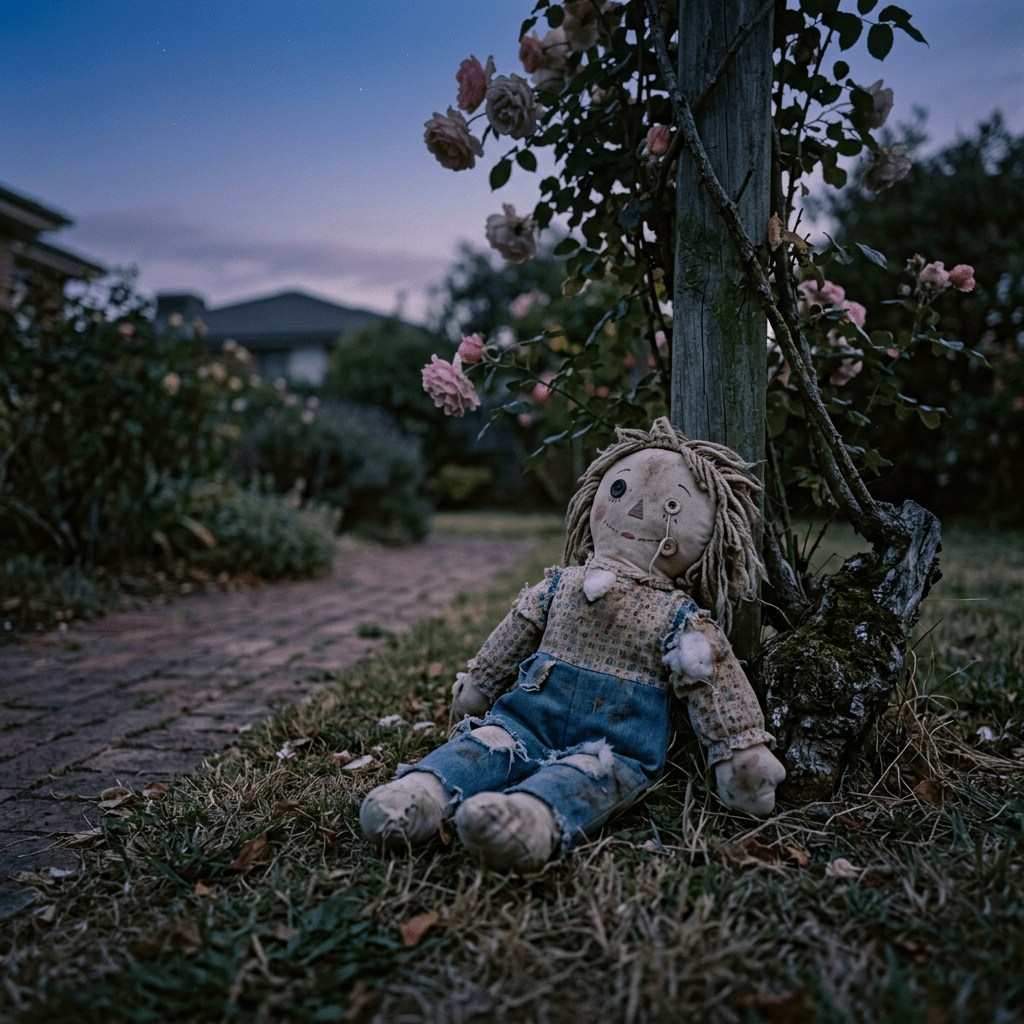
Rag Doll

A rag doll with button eyes and a patched outfit sitting against a wooden post near pink rose bushes in a garden at dusk.
A well-loved rag doll leans against a wooden post surrounded by blooming roses at twilight.

Big Brother read my mind
and painted the picture

Rag Doll

Jack Pine Sonnet

They fought over her
whenever they met
each one holding her
by a leg or an arm

An eternal tug of war
a terrestrial dog fight
with no truce called
and neither giving in

One day they went
a step too far and tore
the doll in two neither happy
with an arm and a leg each

as for the rag doll
torn apart in fury
she was discarded
thrown in the garbage

when nobody was looking
one child returned
rescued the rag doll
sewed her back together
and filled her with love

Comment:

Tragic, really, and really tragic. A reversed Judgement of Solomon in so many ways. An Allegory applicable to so many situations in this tiny, overcrowded world of ours. Every night, on the television, we can watch hour after hour of shows like this – minus the last stanza. Some endings can never be happy.

One night, for the fun of it, I counted all the deaths, shooting and murders on selected shows over a three or four hour period. I saw over 150 violent deaths. What sort of legacy are we leaving our children, our grandchildren. And what will their children learn in their turn? Food for thought to be taken three times a day while avoiding exposure to reality – or is this the alternative reality to which we will all be exposed?