Who threw the frog that blocked the word stream flowing through my throat?
The full moon whispered her secret as she drifted past my window.
I tried to repeat her words but I couldn’t move my lips and my dry mouth tied my tongue into little knots.
No sounds rose through the airways of my lungs, even though I am able to speak in several different tongues.
The languages I love were all backed up in the narrow straits of my throbbing throat, never to be untied by this sad season’s tide.
Comment:
So many allusions, so many illusions, so many elusions – where should I begin? Possibly with the loss of speech and then of language. How does one lose one’s speech? So many ways. A cough, a cold, laryngitis, a frog in the throat, a cake crumb caught half way down that makes one choke and splutter and rendered speechless. Stage fright can do it too. Standing there, in the spotlight, mouth open, no sound emerging.
Fear can act the same way – the word once said, can never be recalled – and so, one day, suddenly, we are afraid to open our mouths, afraid to share our thoughts aloud, afraid to speak out, afraid to stand out from the crowd. Hush. Keep quiet. Don’t say it aloud. Disobedience and doubt are no longer allowed.
Oh look, there’s Moo, peering over my shoulder. “Sky Blues,” he says. “My paintings speak for themselves. They don’t need words and they know no fear. That’s why I am here. To let color and line (and the proper spelling of colour) disperse your fear. ‘A rose by any other name would smell as sweet.’ And one day I will paint you a rose, and you can see that it is a rose and you can call it what you want, but it will still be a rose and smell as sweet.” “You mean you put perfumes in your paints,” I asked him, “so that a painted rose smells like a real rose?” “Do you mean you stick frogs in other people’s throats,” he replied, “and create word dams so that language doesn’t flow?” “I don’t do that,” I replied. “Other people do it to me.”
“Now, now,” said Moo. “Remember Juan Ramón Jiménez – “No la toques más. Así es la rosa.” “Don’t retouch it any more. Roses are just like that.” “And word dams,” I asked him. “You can always remove them with a paint brush, and a little touch of the imagination,” Moo replied. “Well,” I said. “Can you now? Imagine that!”
How quietly she moves, the old one, scarcely disturbing the floorboards way above my head.
Such a light touch as she tip-toes from room to room, her floor my ceiling.
Not at all like the young one with her two left feet, both flat, and her elephantine shaking the floor overhead.
We often wondered if the earth was quaking, the house shaking, with the ceiling about to come tumbling down upon our waiting heads.
Comment:
How silent, the house, with the visitors gone and me and my beloved back together, alone, as we have been for so many years. The silence is broken only by the tick-tock of the grandfather clock, an occasional creak from a floorboard expanding in the sun, or creaking in the shade, the hiss of the kettle … a silence so deep that sometimes we gesture to each other or whisper low.
Don Ryan came over to visit and joy and noise returned. I made him coffee and he brought us a fudge delight. My beloved took refuge in the silence of the front porch and Don Ryan and Don Roger planned their future adventures. We will be working again together soon. Our first task – to finish reading Don Quixote and to complete our notes on our readings, suspended, alas, during the summer work season, but soon to return when university goes through its September Rebirth.
After Don Quixote, we will probably explore two picaresque novels, Lazarillo de Tormes and The Swindler. That will be great fun for both of us, and I look forward to preparing the readings and their annotations.
When Don Ryan left, our table top noise melted away, silence returned, and Clare with it. Other friends will be visiting soon. They will break the silence with a soft tap on the door and a gentle voice calling “Hello!” We look forward to that. Meanwhile all is quiet and silence is golden.
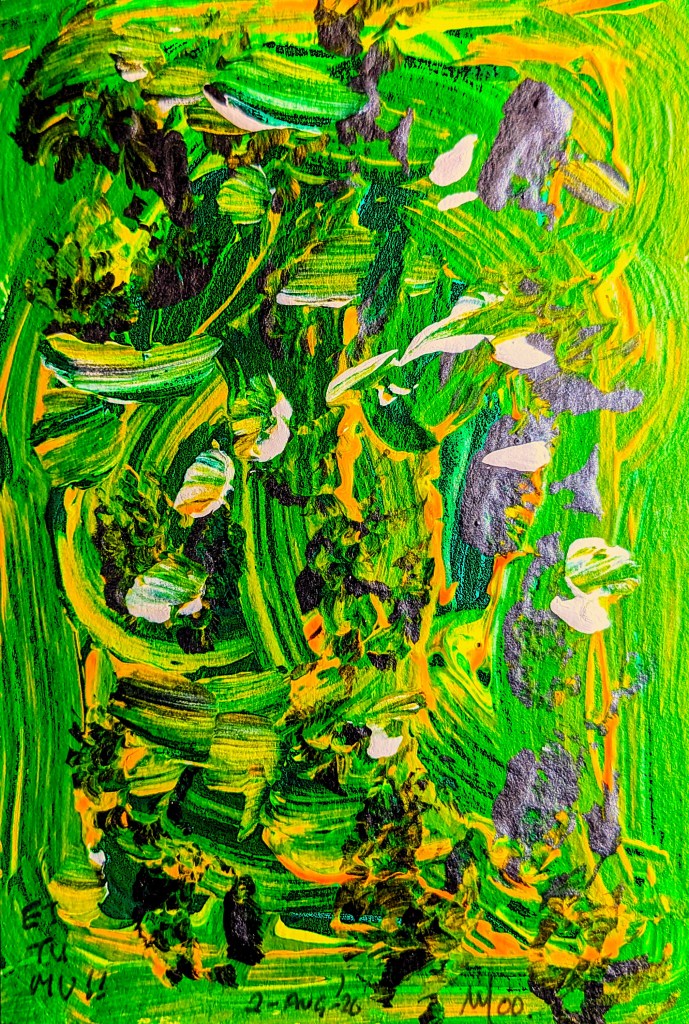
Until the arrival of Moo. “Hello,” he bellows. “Writing again? Have I got a painting for you. You thought the little ones were noisy… well, speak for your self. Here’s your painting, Et Tu, Mu. It comes from Julius Caesar, the play. And remember, when you and Don Ryan get together you’re just as noisy as the little ones. And I am too, when I’m with you. That’s why the painting’s called Et tu, Mu. Time to go.”
Out he went, thumping and clumping, and left me to the tap of the computer keys and the ticking of the grandfather clock.
For Yolande whose children left the same day as mine
the house’s silence speaks a dream language full of touch and tone and shared emotions that still reach out
floorboards creaking mimic the tip-toe dance of visitors now departed
the chair beside me at the breakfast table stands empty this morning
the armchair cushions in the tv room where they sat now sink beneath the weight of my hollow heart
Comment:
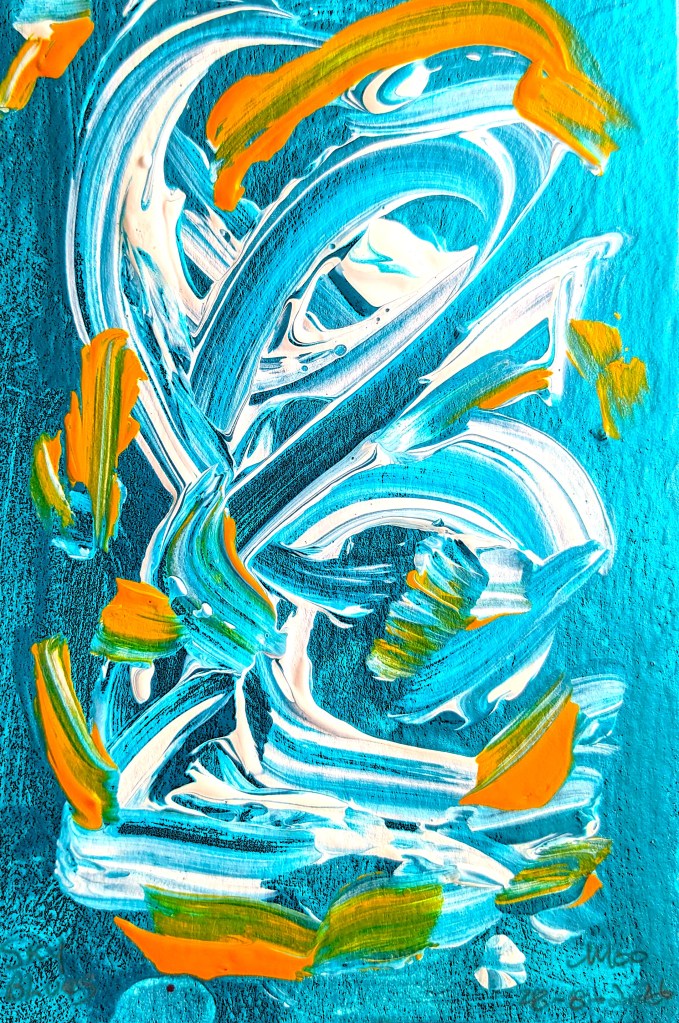
When Moo read this poem, he thought very carefully and, brow puckered, said “It’s not all bad. It’s not the dark night of the soul and I see Glimpses of blue sky. Here – this is the painting for that poem.” He gave me the one you see above, unsigned and unnamed. “I call it Glimpses of Blue Sky,” he told me.
Sometimes Moo can be very nice and sometimes he can be a pain in the you-know-what. I guess you’ve got one or two of those in your family too. Moody Blues, they are, who turn into Moody Moos, and act like sea-cows up at Skinner’s Pond, or else where on the Island. And no, that’s not the Island in Island View, not my Island View anyway, because here there are no Islands to be seen. We live on the far side from the river. The river – if this drought continues much longer, we end up with no river at all.
We used to get nine feet (three meters) of snow every winter. Two winters ago, I used my magic snow blower on three occasions. Last winter, I didn’t use it once. Jackie, my jovial black lab loved water. In the spring she could dive in the ditch and swim all the way around the block. Now the ditches run dry, the grass is gray rather than green, and the crab apples are about the size of raisins.
Global warming > climate change > climate crisis > climate disaster ….. you choose your own terminology, I don’t want to put words into your mouth, but don’t tell me that everything is business as usual and that there’s nothing to worry about.
A couple of our neighbors are worried about the aquifer we all share. They get dirty tap water. Wells are of varying depths. Several of the less deep drillings are showing sign of strain. And yes, the St. John River, the river that the local indigenous call the River of Plenty, is plenty empty right now and flowing very slow. The salmon disappeared a long time ago and now the waters are following them into oblivion.
Well, I suppose that is also a departure of sorts, a very worrying one for some of us. Moo can paint Glimpses of Blue Sky, but hard as I try, when I look at storm clouds building and the rain never falling, I find it difficult to see them.
My creativity lay crippled. I picked up two fountain pens, held one in each hand, a pair of walking sticks or crutches, but nothing happened.
My mind did not pick up its bed and walk. My tongue tripped between my teeth and refused to move, let alone to talk the talk.
Reason and rhyme fled from my head, and walked a cross between a plank and a frost crossed midnight road of petty, lisping syllables that struggled and limped and lost themselves as they wandered the labyrinth that wrapped and mapped my empty head.
Comment:
Moo and I have both been on walkabout, absent without leave, wandering a deserted desert road filled with rocks and sand and not a glimpse of grass or a flower. Hour after hour, day after day, not a singe inspiring thought or brush stroke coming our way. We sat at the table, looking at an empty page of snow, with not a footprint upon it.
Why do these things happen? I don’t know. I have never worried about writer’s block, and Moo has never worried, to my knowledge, about painter’s block. The shock of the shadow of nothingness lay upon us both and even the coffee tasted differently.
Then, suddenly the dam broke. Moo painted five paintings in two days. I wrote four poems in that same time period. Suddenly, the silence lay broken, the plank had been walked, and we found ourselves safe on the other side of whatever it was that had come between us and our respective joys.
A dark night of the creative soul, perhaps. Luckily it was followed by a creative dawn. Light broke where no sun shone and suddenly those minds of our sparkled with creative gems once again. I reached out to Moo and we hugged each other. “It’s over,” we said. Then we changed ends and life and the grass was so much greener on the other side.
May it never happen again, we sighed. But I am sure it will. And I hope it never happens to one of you. If it does, just breathe deep, believe, examine the joys of that silent midnight, and wait for the dawn.
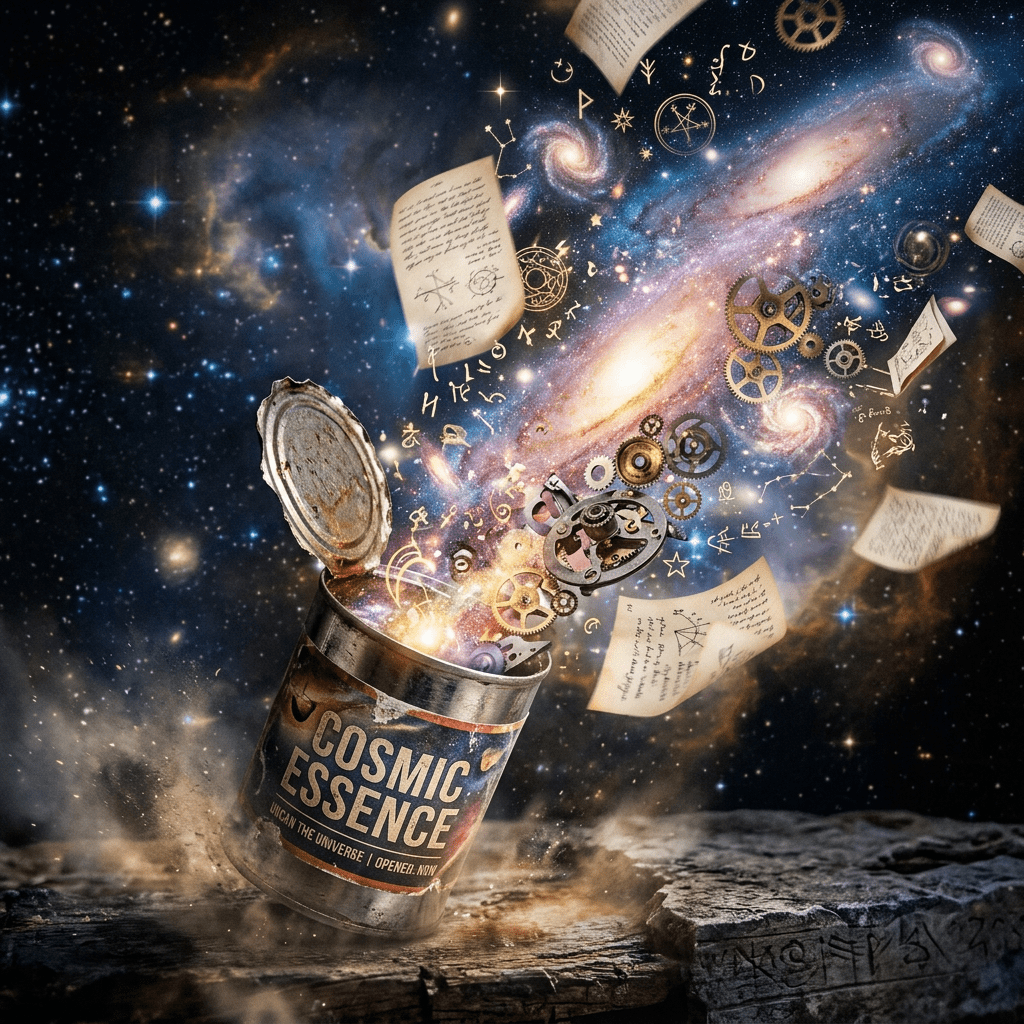
A weathered canister releases galaxies, gears, symbols, and handwritten notes into a star-filled universe.
Original Question –
Roger I have a question for you. Recently I purchased a book by Forrester- The African Queen. I enjoyed the movie years ago and thought I would like to read the story. The main actors were great. The book highlighted that it showed what it was like being a female during the war, (1) which when I look back on now is one of its main points.
My question or thought on this book is tied around the library system. When I lived in Fredericton I wanted to give a bunch of books to the library, their first question to me was, “How old are the books? I told her and she said anything over five years in not being accepted. (2)
I wondered about this and the fact that many books in school are being removed, (3) how can we tell how much we have progressed? (4)
I don’t like predjudice but it seems we are throwing out too much. (5) Any thoughts on this. I don’t mind some of the history being trashed (6) because for Canada the consentation is for Quebec and Ontario.
Roger’s Response
(1) It’s also about the role of the nun in society. How do ‘holy women’ function in a male society? It sets the questions but doesn’t really give the answers. It’s a long time since I saw the film. I don’t think I ever read the book – the themes might well change in print. They are present (some of them) in The Handmaid’s Tale.
(2) The library system seems to have rules and an etiquette all its own. When I donated books to the library, they accepted some for their collections, but set others up for sale on the book tables by the door. My guess is that certain books are ‘best sellers’ and will be read, others are ‘dust gatherers’ and won’t be. They want the former, not the latter. They also have specialized collections. If the books fit the specialized collections, great. If they don’t, then they hit the unwanted category and are moved on. This is particularly true of the UNB Library System.
(3) This is an entirely different question, and one with very deep roots. It deals, in part, with the question of control – quis custodiet ipsos custodies – who shall guard the guards, who shall program the programmers? By controlling what people read, you control their thoughts. One of the worst signs of this was the book burnings of the Spanish Inquisition (16th – 17th centuries). The Jews were expelled from Spain in 1492. (And the Arabs / Moors, in 1609). Prior to that, they were ‘processed’ by the Inquisition. The original Inquisition was Papal, and was aimed at instructing the priesthood in Rome. It was corrupted in Spain by the Spanish Inquisition, a sort of secret police, which worked rather like the Gestapo in WWII. One of their jobs was to ensure that people who had converted, stayed converted and didn’t revert to their old religion, even in secret. Another was to ensure that reading material, religious material, and cultural material, particularly after 1527 (Martin Luther and his 97 theses) when the Reformation started, were all in line with the accepted thoughts of the time. All books were sent to the Censor who vetted them and either approved them or asked for changes, if he (they were all men) saw the slightest sign of dissent or heresy. Don Quixote, Book One, Chapter Six (DQ,I,6), deals with the book burnings of DQ’s personal library. In certain of the States (down south) books are already being banned. One that touches us closely is the banning of Margaret Atwood’s The Handmaid’s Tale.
(4) “There is no earth, no heaven, no extended body, no magnitude, no place and that nonetheless I perceive these things and they seem good to me. And this is the most harrowing possibility of all, that our world is commanded by a deity who deceives humanity and we cannot avoid being misled for there may be systematic deception and then all is lost. And even the most reliable information is dubious, for we may be faced with an evil genius who is deceiving us and then there can be no reassurance in the foundations of our knowledge.” René Descartes (1635)
Descartes expresses this much better than I can. It is one of the major dangers of the age in which we live. How do we distinguish between reality and alternate realities? Which reality is the real reality? What is or isn’t fake news? How do we tell? Who do we believe, and why?
(5) Part of the problem is that ‘certain people’ – who don’t believe in science and who exploit people’s ignorance to their own advantage – are willing to destroy the foundations of our knowledge. Burn everything down. And start again. And the new starting point is to impose what they believe upon everybody around them. This is a huge and crucial question that threatens us, as individuals. It also threatens the foundations of our knowledge, as well as the very world in which we live – climate change vs denial of climate change – profits over people. Once one starts looking at the AI systems with their immense persuasive powers and their seemingly uncontrollable spread of Mis-information and Dis-information, then we start to realize how serious the problem is.
(6) Those who ignore history are doomed to repeat it – Santana (I think). However, we must, in certain circumstances, adjust our current beliefs to current realities. Immigration is a major issue – as is how we deal with people, like me, of different cultures and beliefs? Not everything written in the past suits our current world view. I have been looking at old Westerns – “The only good injun is a dead one” (John Wayne). Really? I know some wonderful people in our first nations communities and I have taught them and worked with them and been taught by them. “Shoot first and ask questions afterwards.” Really? I won’t comment further on that one… and there are so many others.
All of this comes down to the big question – freedom of information or the release of just enough information to persuade other people of what we believe and what we want them to believe. Power and Control. Knowledge is Power – Michael Foucault. Control that knowledge and you have power over the people. Noam Chomsky has written widely on this – and his books have been banned in the USA. Bertrand Russell too – The Meaning of Meaning, for example, and his establishing – along with A. J. Ayer – of the doctrine of logical positivism – the removal by means of mathematics of all the emotional content of words.
My friend, you have opened a can of worms.
Long may they wriggle.
Comment:
A series of questions that have recurred throughout the centuries. Well worth re-asking them and rethinking them. Times change and the answers often change with them. The image, incidentally, is AI generated, based on an examination of my written words.
A meaningless collection of notes swarms into my empty head swimming round and round like clustering tadpoles.
The ebb and flow of that mysterious music clumps on and on, tight in my mind and will not let me go.
Earwigs, some call them, those senseless repetitions, day after day, night after night, awake and asleep, old tv adverts, short clips of classical music or popular songs.
They are wheelbarrow songs, hedge clippings, dead flowers, crass grass, broken branches, weeds, repetitive memes of meaning, a syndrome of stuck songs destined for the garbage dump and ritual burning in the hell of an eternal turntable turning.
Comment:
Word magic from the Mikado – “My object all sublime I shall achieve in time, to make the punishment fit the crime” … And in this case I would tie the criminals who invented these ‘ballads, songs, and snatches’ to the stake, with earphones that endlessly repeated all the nonsense we hear day and night, so much of which sticks in the turntables of our brains turning round and round as we toss and turn in our beds at night. Just a case, I suppose, of hearing music while there’s no one there.
And how many earworms did you pluck out of that first paragraph? I can count six, maybe seven. Then, my mind may be very different from yours. Perhaps your mind isn’t in the outrageous Wilfred that mine is. Don’t get that joke, do you? And why should you? I guess you don’t remember Ray’s a Laugh, Round the Horne, Mr. Dimwitty, or Wilfred Pickles – and why should you.
Passent les jours et passent les semaines / ni temps passés ni les amours reviennent / sous le Pont Mirabeau coule la Seine– click on the link for the English version (my translation) and click on this linkfor a slightly improved revised version.
Yes, as Apollinaire says time flows on and by – or, after Heraclitus – you can never step in the same river twice. More important, perhaps, for those who worry about their past thoughts, words, and deeds – you can throw the stone into the pond, but you can’t control the ripples.
I love the way the light rises in the morning, stands still and stately at noon, and fades as day slips into night.
Each day I watch the berries on the mountain ash changing color as daylight strides strong across the sky then slopes away to the west.
A long time ago, in Paris, I saw Monet’s paintings of the Cathedral at Rouen – morning, noon, afternoon.
Seurat, Monet, and Sisley taught me to appreciate the multiple ways in which light fragments and scatters into many colors the cloak of berries on my tree.
Comment:
Moo thought this would be a lovely painting to accompany today’s poem. “Red berries,” he said, “and faces amongst the glowing foliage to match the low fires of the westering sun.” Sometimes Moo has a trick with words that is even better than his tricks with paint. Not that he would ever claim to be a poet, as I would never claim to be a painter. That said, by chance or fate, we sometimes luck out.
I saw those Monet paintings at Le Jeu de Paume in Paris, 1963 I believe it was. A long time ago. I remember standing in a circular room surrounded by water lilies – and I stood there, amazed, floating like a cloud in a floral paradise. Funny how those moments can linger, stamped on the retina, and recalled in the strangest of ways. I like the works of all three painters, but I must admit that Seurat, the founder of chromo-luminarism, also known as pointillism, can drive you dotty until you work out how all those little berries join together to make a perfect image.
Sisley, to my mind, is more akin to Monet – except for the actual choice of subjects, but that might just be my misinterpretation of their combined talents. No matter – what I see when the light hits the berries on my tree is a combination of creative memories that gift me with an insight into the multiple meanings of the structure of the evening light – the magic hour – as my friend Tony Bear calls it – that brings joy and delight to my garden each sunny evening, as it fades into night.
We need to see each person as an individual needing exclusive care, a unique style.
We must let them know that they are not lost and alone, that they will be approached individually, each and every one.
Treated equally, yes, but each in his or her particular case and cultural situation.
A dream? Perhaps. But the alternative is a nightmare.
Comment:
An interesting chat over the dinner table – de sobremesa – led us to the meaning of equality and treating people equally. The kernel of the discussion – I said I believed in treating all people equally, Moo’s guest for the evening, his Plus One, said that treating people equally was no longer right. It was necessary to treat each person as an individual, with different needs, and we must therefore go beyond equal treatment to individual treatment. A word to the wise from the wiser.
Treat other people as you would have them treat you. The phrase goes back a long, long way to Socrates, Seneca, and maybe beyond. It ties in with the ideals of Buddhism and also of early Chinese philosophers.
It centers on the meaning of ‘equally’ and is a wonderful topic for discourse analysis. If by ‘equally’ we mean one size fits all, then we merely drop the grid down upon the targeted individual and tick the boxes where the pieces fit. However, if we agree that such ‘equal treatment’ is in fact potentially discriminatory, then we must break ‘equally’ down and give it the extended meaning of ‘with equal care and attention‘ according to their individual needs and cultural, social, medical, educational, or religious beliefs.
So, here am I, sitting over the dinner table, musing with my family and friends on the meaning of meaning and learning that old ideas can be renewed and that yes, even an old dog like me, eighty plus years old and still counting, can learn a new trick or two [or several], from those who are brought up in a different, younger, more diverse world, and whom are consequently more habituated to this world than I am. It’s a good lesson – and I hope, well-learned.
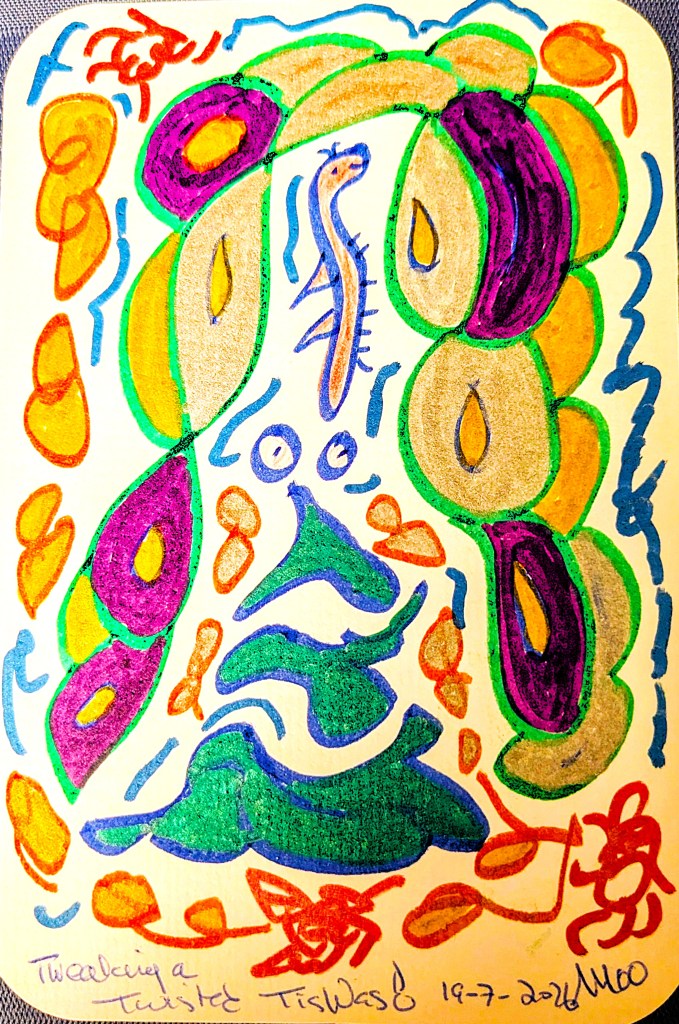
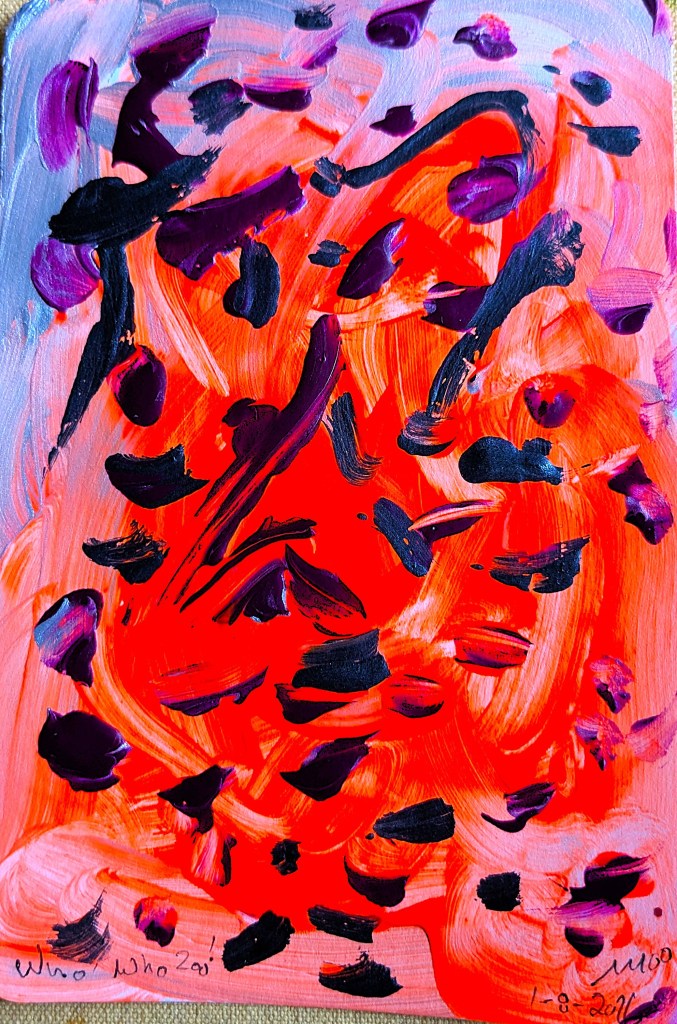
“And that,” said Moo, “is why I painted Who’s Who Zoo. Look carefully before you label who is who and where they stand in the Who’s Who Zoo.”
elbows on the table my hands clasped around this soccer ball I call my skull
its global reach the totality of all I hold and know and understand
past games long forgotten gone the skills of which I was so proud
my life the circumference of this paneled circle wrinkled and peeling
the ancient onion skins of old corruptions newly found
Comment:
Moo calls this painting, which he forgot to sign, Crater with Creatures. He thought it would be a good painting for this circular poem that also goes round and around like the creatures in the crater. Wild thoughts, they are, gnawing at each other as they circle. I had to tell Moo what FIFA meant. At first, he thought I had written FIFI, the name of his cat. No, I told him, it’s FIFA, not FIFI, and that’s why I call my skull a soccer ball. “But FIFA isn’t corrupt,” Moo said. Well, that made me laugh. “I wasn’t referring to FIFA as being corrupt,” I explained. “The corruptions are all my own.” “But you aren’t corrupt,” Moo exclaimed. “Think of them not as corruptions, but of little errors, little sins, the little mistakes we all make in life.” “Oh, those,” said Moo. “Nobody cares about those things. They are all little nothings, best forgotten.” “I usually do forget them,” I said, “but once in while I pick at them like I pick at a scab, and then they all start bleeding again, or flaking away like thin layers of onion rings.”
Moo looked at me, long and hard. “You are just like a world cup soccer team manager,” he told me. “First you pick your nose, then you pick yourself, then you pick your best friends and put them on the team. But that’s not corruption. That’s the way of the world. Everybody does it.” “Not everybody,” I said. “That’s because not everybody is a soccer coach,” he replied.
Good old Moo. Such a world wise philosopher. I remember when he had his index finger in plaster. “What wrong with your finger,” I asked him. “It broke,” he replied. “How on earth did that happen?” “Someone punched me in the nose.” “Well that shouldn’t have broken your finger,” I said, amazed and rather doubtful. “It was in my nose at the time,” he sighed. Que lo creas tú.
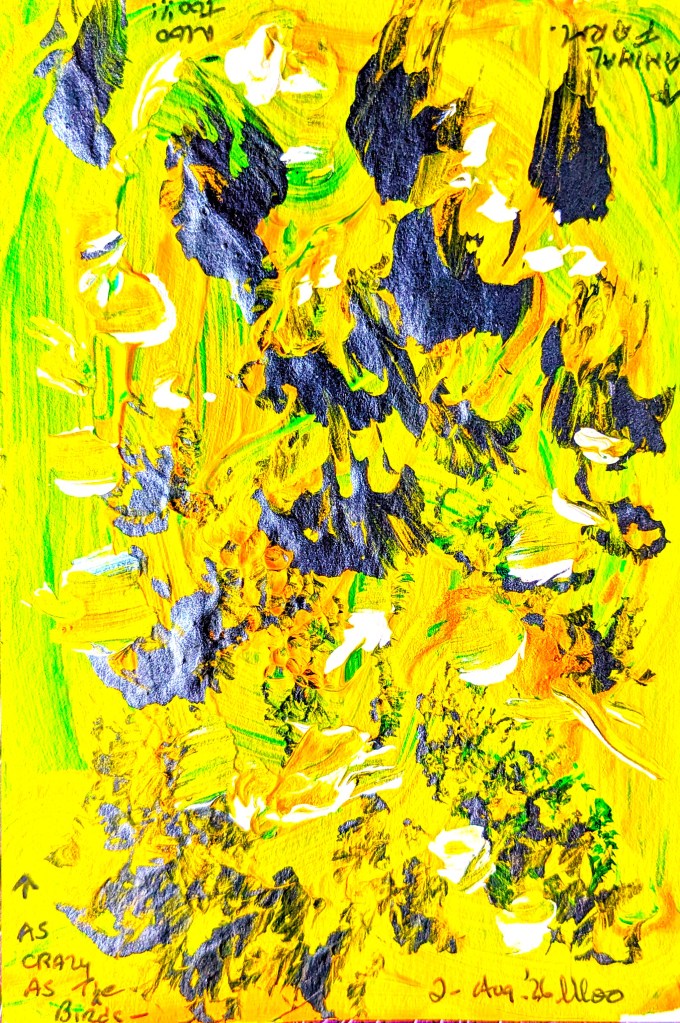
Bakhtin’s Carnival – the world turned upside down and inside out. And here it is. Moo has painted an upside down world. From the above angle, the world is full of birds and is “as crazy as the birds“. Lovely image. There they go, birds of a feather, flocking together, soaring, sinking, doing what birds do when they are as crazy as bat shit – and Moo told me, he nearly gave his painting that name – Crazy as Bat Shit.
But hang on a moment – if the world is upside down, what happens when you turn Moo’s painting upside down? Let’s try it and see.
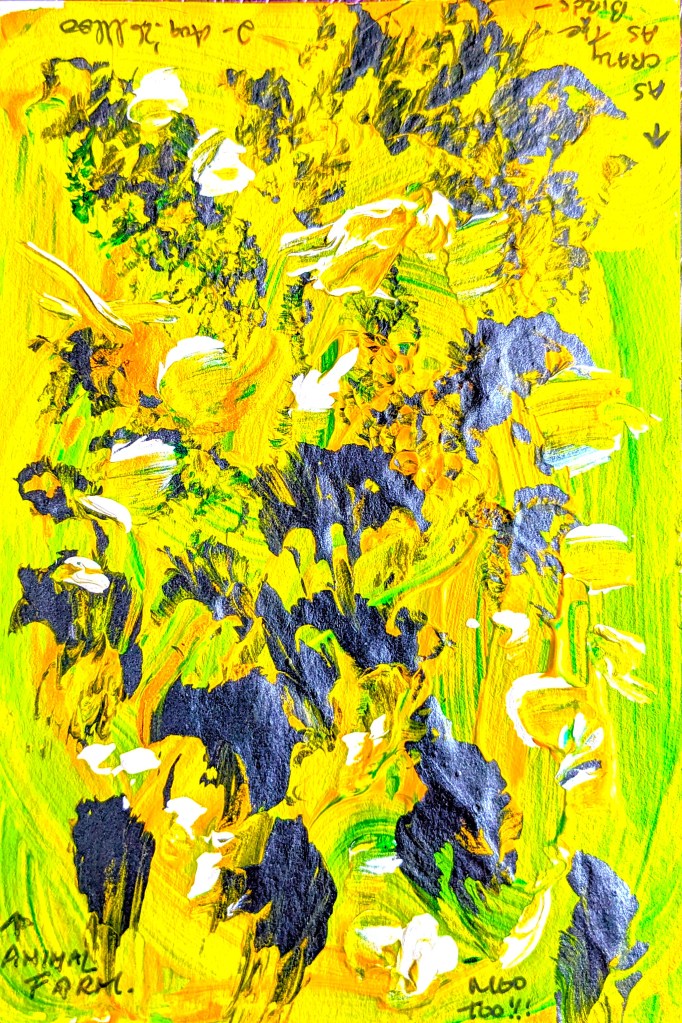
Would you believe it – the birds are no longer birds, they have turned into animals. From this point of view, we have Animal Farm. Moo thinks he can sell this painting for double the price now he has discovered it means something different the other way up. Now – what if …. Nope. Let’s leave it there. We are not going to turn it sideways, nor inside out. That’s asking too much of Moo and his painting skills.
But we have a tiny little lesson, and with no poem attached to it. Perspectivism – the same object seen from two different points of view by two different people can elicit different functions and different interpretations.
Think of the Barber’s Basin in Don Quixote. One group of people see it as a barber’s basin. A second group see it as Mambrino’s Helmet, missing a visor. Cervantes resolves the problem by adding yelmo to bacía to give a new word – a baciyelmo. A helmet that serves as a basin and vice-versa. Does such a combination exist in English? Whyever not! We can call it a bassinet, as in a pig-faced bassinet. That is to say, a helmet with a snout that ends in a bassin – well, we can forgive the -ss- if we are generous.
And now we come to the important part of our lesson. Most things can be changed from one meaning to another, if we change our position and our point of view. Birds can become animals. Animals can turn into birds. A good mood can be turned into a bad mood. A bad mood can be turned into a good one.
There is so much depression around us at the current time. “Turn that frown upside down” – and turn the world on its head and inside out. I bet you can do it if you really try. After all, Moo has shown you how and I assure you that Moo – and I know him well – is no genius. However, in spite of that, every so often he stumbles on a tiny truth, just like he has in this painting.
So – don’t get frightened and depressed by the black dog when he leaps out at you from the grandmother clock. Turn him from a dog into a bird and let him fly away into the blue, taking the black dog’s blues along with him. And remember – if Moo can do it, so can you. So “turn that frown upside down” and remake your world in the shape you would like it to be. And remember – if Moo can do it, so can you.



 rogermoorepoet