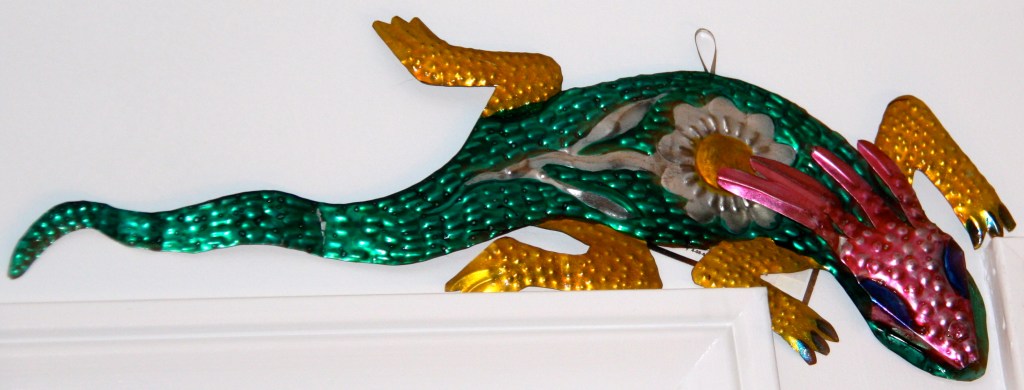
There are striations in my heart, so deep, a lizard could lie there, unseen, and wait for tomorrow’s sun.
Timeless, the worm at the apple’s core waiting for its world to end.
Seculae seculorum: the centuries rushing headlong. Matins: wide-eyed this owl hooting in the face of day.
Somewhere, I remember a table spread for two. Breakfast. An open door. “Where are you going, dear?”
Something bright has fled the world. The sun unfurls shadows. The blood whirls stars around the body. “It has gone.” she said. “The magic. I no longer tremble at your touch.”
The silver birch wades at dawn’s bright edge. Somewhere, tight lips, a blaze of anger, a challenge spat in the wind’s taut face.
High-pitched the rabbit’s grief in its silver snare. The midnight moon deep in a trance. If only I could kick away this death’s head, this sow’s bladder, this full moon drifting high in a cloudless sky.
Comment:
La poesía se explica sola. Si no, no se explica.
Pedro Salinas.
Poetry explains itself. If it doesn’t, it’s inexplicable.
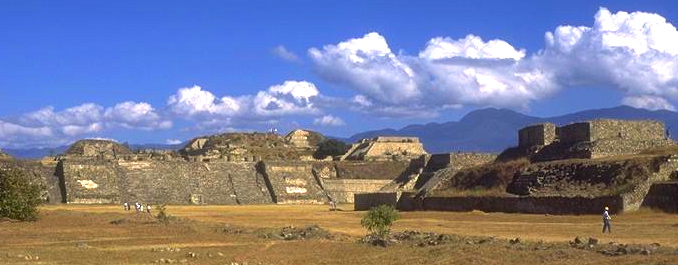
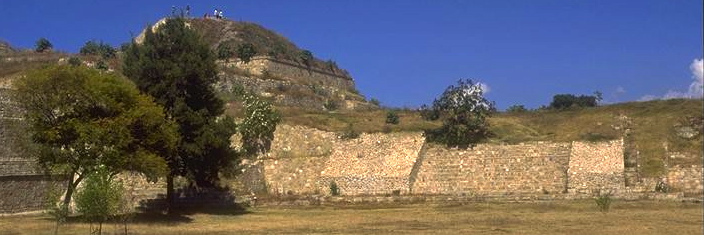
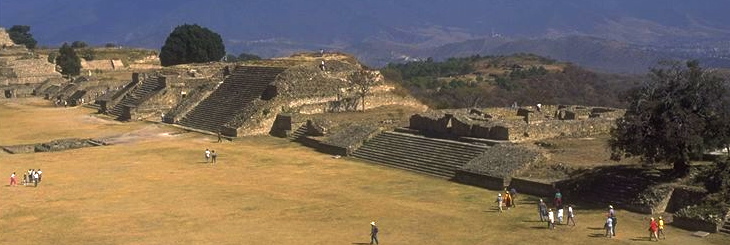
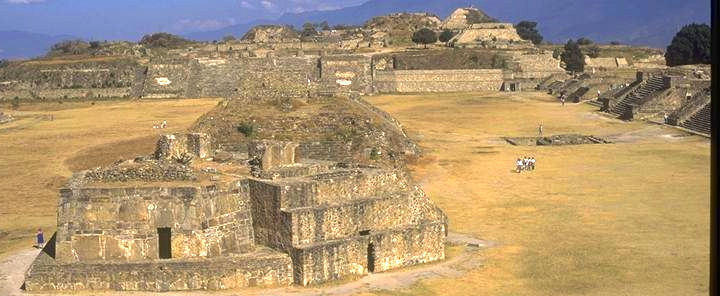
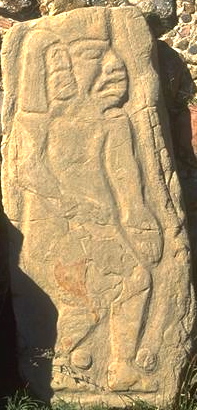
My poem, The Dancers and the Dance, refers both to the danzantes and to Monte Albán. Monte Albán was the capital of the Zapotecs and the principal city in the Oaxaca Valley (Mexico) between its foundation in approximately 500 BCE and its abandonment in approximately 750 CE. The White Mountain, thus named by the Spanish conquistadores, is justly famous for its temples, its tombs, and its carvings.
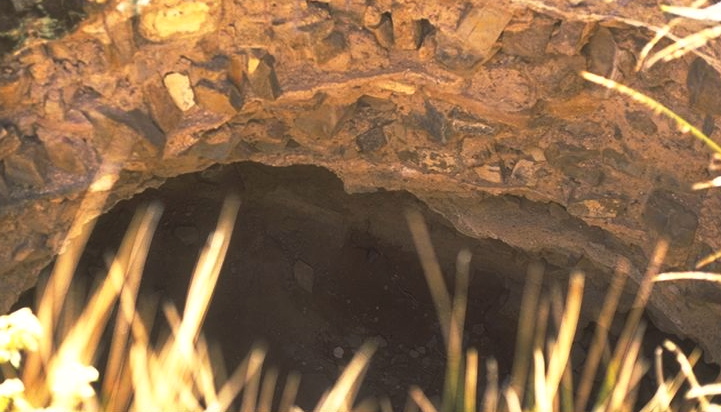
Two natural phenomena affected Monte Albán and its population. The first was drought and the dried earth with its brown and yellow tinges is clearly visible in these photos. The second natural problem came from earthquakes, for this is indeed an earthquake zone with active volcanoes causing tremors at regular intervals. The temples, even today, sometimes need repairing as earthquakes have been known to destroy even the reconstructed temples.
In fact, the abandonment of Monte Albán may well have been caused by an earthquake that cracked the enormous natural cistern in which the population’s water supply was stored.
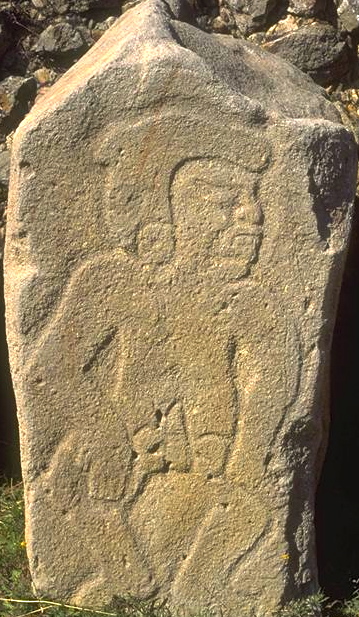
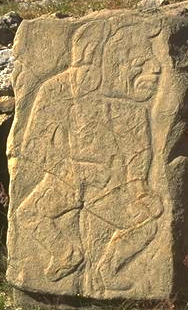
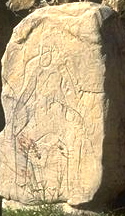
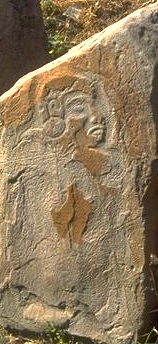
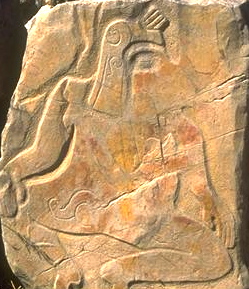
The Danzantes are strange, grimacing characters that have been carved into prisons of stone. They may be captured warriors awaiting sacrifice or the chieftains of conquered tribes humiliated, perhaps tortured, and then flash frozen into stone photographs where for centuries they have danced out their torment. Whoever and whatever they may be, they still dance on Monte Albán.
My poem, The Dancers and the Dance, captures a different form of dancing. It is taken from my book Sun and Moon: Poems from Oaxaca (2000) and contains echoes of the vibrant folkloric culture that thrives to this day both in the city of Oaxaca and in the Oaxaca Valley. Here, traditions are remembered and relived. Each year, on the Day of the Dead, for example, families place food and drink alongside photos of the dearly departed on altars inside their houses and their doors are thrown open to welcome their deceased family members as they return along the marigold paths that lead to their former homes.
The Dancer and the Dance
1
she comes here to dance for me only for me does she dress this way she shows me her dreams unfolding them one by one silk and cotton garments drawn fresh from her scented closet thin copper bracelets carved wooden mask only her eyes reveal subversive flesh and blood
2
she orchestrates her story skin drum rattle of seeds in a sun-dried pod single violin string stretched across an armadillo’s shell I too am tense like an instrument waiting to be played the bones of my love reach out towards her
3
when she makes her music familiar spirits return to the earth dancing in a sash of moonlight she recreates an ancient spell gold letters plucked from dark scrolls no wands no words just water’s purity flicked fresh across lips and face she binds me with the string of notes she undoes with her hair our bodies form an open altar we worship with mysterious offerings drawn from wells set deep within us
4
Rain falls from the sky Moon turns his face away suddenly in darkened alleys clouds hold hands and dance dense streamers of light dangle from street lamps shadows remember their forgotten steps gently she draws me to her I try to follow frail whirlpools of withered leaves fragment weak sunshine in light’s watery pool
5
her magic grows I take my first step an unmapped journey into desert space we move to old rhythms across moon flecked clouds raindrops fall more slowly faltering drum beat diminishing water
6
high above us the ghost of a melody shaking its head wringing its hands we return at last to light and air the moon’s vacant face scowls in an empty field someone has plucked the stars one by one and threaded them like a chain of daisies now there are no sky flowers to adorn the night
7
noche de rábanos someone has taken a knife and peeled an enormous radish this cartoon moon face this full skull hanging from nothing this lantern lighting from above now my lover sculpts time and space into small chunks each sacrifice a jewel between her fingers I pin to my chest three small notes and a skeleton of words
8
inside my dancing head the fires have gone out without her hands to guide me my feet have turned clumsy scars layer my wrists and ankles star crossed bindings cutting against the grain I gather a harvest of stars she holds them in her eyes her fingers are grasshoppers making love in my hair when she kisses my fingernails one by one we both know our bodies will never be the same
9
together we weave a slender cage she cuts out my heart with her tongue placing it on an altar inside the bars she locks the tiny door a silvery key wrought from moonstone my fluttering heart grows miniature wings next time the door is opened my wings will fly me to her lips my heart is a caged bird on a tiny perch it chirrups a love song its image in the mirror answers back breathless it scrapes its wings on the moon its body striving upwards to the stars
10
on Monte Albán the danzantes sway to soft music their shadows dance in and on stone as they have danced for centuries wind rustles the grass moon casts sharp shapes darkness ascends the temple steps huge fingers grasping upwards an owl’s feathers clutching at the skies at dawn tomorrow the sun will rise beneath our feet we will squint down on its majesty we will pluck the ripeness of its orange in our outstretched hands
11
our last night together I pluck a blossom from the tulipán tree a final offering of my love she gives it back I place it in the pocket of flesh where I once kept my heart tomorrow when the flower breaks it will stain my shirt a damp splash of blood no longer running in my veins the scent of our happiness will cling forever to my fingers
Mitla is a sacred burial place in the Oaxaca Valley. The caves in the hills above the town are said to lead directly to an underworld from which demons and devils emerge at night and by means of which humans can communicate with the souls of the dead. Mitla, in fact, is often called the city of the dead. Legend has it that if you embrace a certain magic column in the Palace at Mitla, the time left for you to live can be measured by the distance between your fingers as they reach round the pillar and almost touch. The pillar, they say, grows and shrinks according to the length of the seeker’s life. Petrus, a rock, in Latin, evolves into piedra, a rock or stone in Spanish: upon this rock will I build my church.
1 We walk on tiptoe round the garden peeling free the sunlight cloud by cloud
sometimes the heart is a sacrifice of feathers bound with blood to an ornate altar
petrus this rock cold against my chest piedra centuries of glyphs alive in your face
if our arms meet round these all too human columns what will become of us?
2 beneath your skin the woad lies as blue as this evening sky yellow light bends low in the fields below us each darkened pool a warrior fallen beneath the scythe
the moon paints a delicate circle its great round open eye stands out above the rooftops tonight it bears an eye lid carved from cloud
our teeth are diadems of whiteness we tie shadows to our heels and dance in triumph through street and square
3 daylight bends itself round rock and turns into shadow we flourish in blocks of fire
dreaming new selves from roots and branches we clasp each resurrection with greedy fingers will the moon rise again tonight and will we watch?
dark angel bodies with butterfly wings our shadows have eloped together
we can see them sitting side by side bumping knees at a table in the zócalo
4 church bells gild the barrio‘s rooftops our fingers reach to the skies and hold back light we draw shadow blinds to shut out the day night fills us with stars and silhouettes
we dream ourselves together in a silent movie closed flesh woven from cobwebs lies open to a tongue-slash of madness
the neighbor’s dog wakes up on the azotea he barks bright colors as dawn declares day and windows and balconies welcome the sun
can anyone see the dew-fresh flowers growing from our tangled limbs?
your fingers sew a padlock on my lips “Listen to the crackle of the rising sun!”
Dreams are important in Oaxacan mythology. Do we create them ourselves? Or do they come to us as celestial messages? Can they exist without us? Or do we form a symbiotic relationship each dependent on the other?
Eight Deer or Tiger Claw / Ocho Venado or Garra de Tigre is a Mixtec Hero; his name is composed of two parts: (1) day name (ie the name of the day on which he was born) Eight Deer and (2) nickname Tiger Claw. His symbol in the códices is a small circle with a comma like a tiger claw. Nuttall is the twentieth century editor of the Zouche Nuttall Codex in which Eight Deer’s history of conquest is recounted. Nine Wind / Nueve Viento is another Mixtec Hero and the founding father of the race, according to some códices.
Once I stole the nose from a sacred statue; today I watch it cross the square attached to a face.
Eight Deer walks past with a fanfare of conches: you can tell him by his donut with its little tail.
A shadow moves as zopilote wings his way across the square. I caught him once on a midnight bus; he begged me to fold his wings and let him sleep forever.
A gringa called Nuttall sells tins of watery soap. Her children fill my days with enchantments: bubbles born from a magic ring.
Eight Deer, eight years old, sets out on his conquests. Nine Wind births his people from a flint, or was it the magic tree in Apoala?
The voices in my head slip slowly into silence. Sometimes I think they have no need of me, these dreams that come at midnight, and knock at my window.
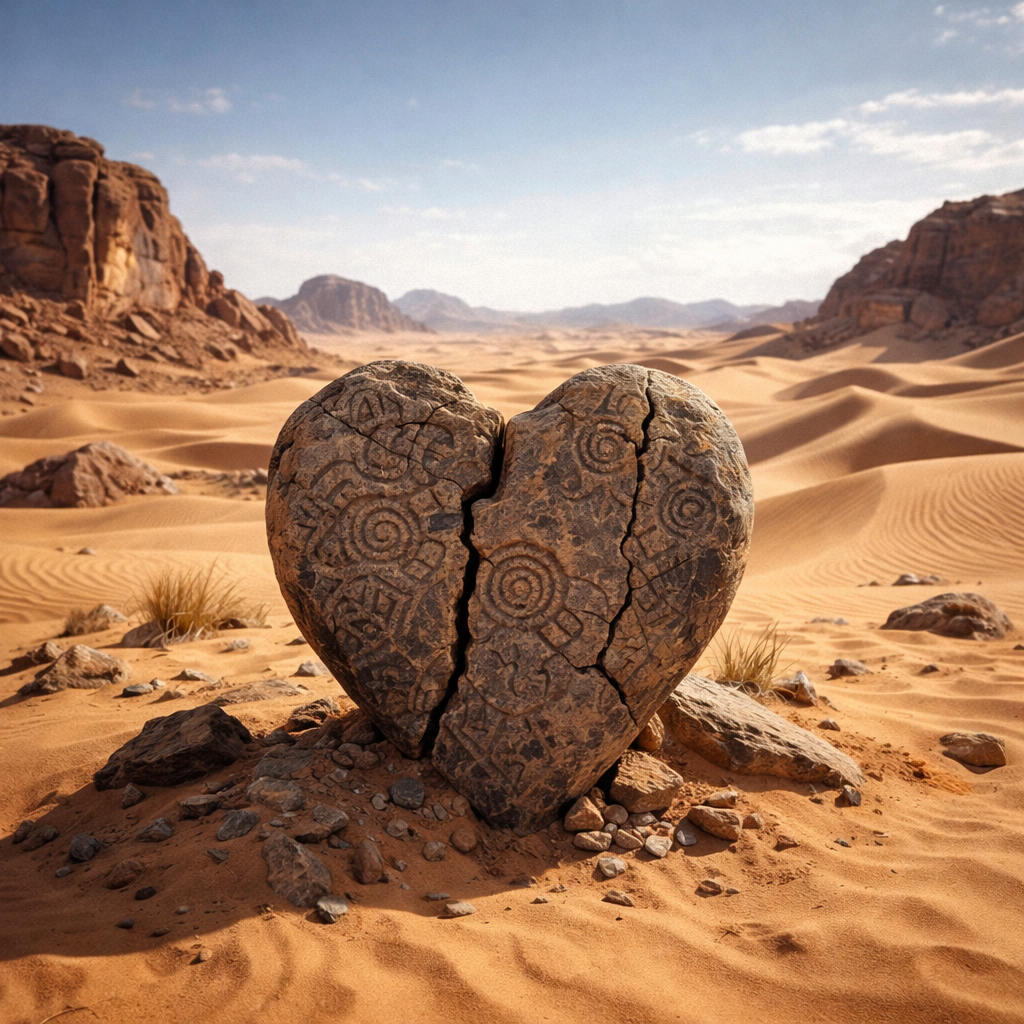
A cracked heart-shaped stone with carvings lies cracked in a desert landscape.
Inquisitor
He told me to read, and plucked my left eye from its orbit; he slashed the glowing globe of the other. Knowledge leaked out: loose threads dangling, the reverse side of a tapestry.
He told me to speak, and squeezed dry dust between my teeth. I spouted a diet of Catechism and Confession.
He emptied my mind of poetry and history. He destroyed the myths of my people. He filled me with fantasies from a far off land. I live in a desert where people die of thirst, yet he talked to me of a man walking on water.
On all sides, as stubborn as stucco, the prison walls listened, and learned.
I counted the years with feeble scratches: one, four, two, three; for an hour, each day, the sun shone on my face; for an hour, at night, the moon kept me company. Broken worlds lay shattered inside me. Dust gathered in my people’s ancient dictionary.
My heart was a weathered stone withering within my chest. It longed for the witch doctor’s magic, for the healing slash of wind and rain.
The Inquisitor told me to write down our history: I wrote how his church had come to save us.
“What is this sound?” It is your own death sighing, groaning, growing while you wait for it to devour you.
“What is this feeling” It is the itch of your own skin wrinkling and shrinking, preparing to wrap you in the last clothes you’ll wear.
“What is this taste?” It is the taste of your life, bottled like summer wine once sweet tasting, now turning to vinegar.
“What is this smell?” It is waste and decay, the loss of all you knew and of all that knew you.
“That carriage outside?” It is the dark hearse come to carry you to your everlasting home.
Comment:
Moo thinks that his portrait of me is perfectly good for this poem. He told me not to rage, rage against the accuracy of the portrait, but he did tell me to rage, rage against the lack of paper. Où est le papier, indeed. As for the rest of it, he said it’s the same for everyone, so stop making a fuss about it. “You’ve got one last bottle of mescal on the shelf,” he told me. “I know. I’ve seen it. Just swig it down, worm and all, and you’ll have nothing to worry about.”
Oh dear. The worm in the bottle. They used to sell the gusanos in Oaxaca’s mescal street at a price of five for ten pesos. I used to buy a two litre coke bottle, filled with mescal from a barrel, and drop ten worms in it. They made yellow streaks as they descended through the liquid. Sweet dreams when you chewed on that lot – and an end to your worries. El brujo, the witch doctor, told me to stick a marijuana plant in the bottle of mescal and when the leaves turned white to rub the liquid into my arthritic knees. “Which doctor was that?” one of the tourists in my apartment block asked me. But I didn’t tell her. Nor did I do it. A waste of good mescal. And to think I now have one last half bottle left. And one little squirmy, crunchy, chewy worm.
Speaking of chewy, crunchy – I had never eaten chapulines, fried grasshoppers, until I went to Oaxaca. I didn’t like the look of them. At the first party I attended was confronted by the host who demanded I eat some. I told him they were taboo, against my religion. He shrugged. When he, and the other guests lost interest in my presence, I tried a couple. They were delicious. A real delicacy. I loved their crunchy little legs.
I guess one is always afraid of the unknown – the gusano in the mescal, the chapulines on the plate, that first plate of calamares en su tinta – squid in its own ink. I love bara lawr – Welsh laver bread – or Welsh caviar, as Richard Burton used to call it. I also know that people who have never eaten bara lawr won’t go near it – it looks like cow pats – but luckily doesn’t taste like them. Don’t ask me how I know. Some people get over their fear of the unknown, others don’t. I guess we’ll just have to wait and see what happens.
In my dreams, I track the sails of drifting ships, white moths fluttering before the wind.
I think I have caught them in overnight traps, but they fly each morning in dawn’s unforgiving light.
I give chase with pen and paper, fine butterfly nets with which to catch and tame wild thoughts.
I grasp at things just beyond my fingertips.
I wake up each morning unaware of where I have traveled in my dreams.
Comment:
White moths fluttering before the wind – my dreams at night. How do I trap them, catch them, squeeze them between my fingers, hold them, pin them to the show case of memory? I remember in Oaxaca – the young boys, trapping the moths. Huge, gigantic butterflies, moths, as large as birds. They severed their wings, and sold them to the passing tourists. Such beauty, such colour.
I heard an angry buzzing, looked down, and saw flightless bodies, wings clipped, rowing their stumps of bunt oars, skidding sideways across the gutters, and dreaming painfully of the stars.
BonusPoem
Dreams
White moths fluttering before the wind my dreams at night.
How do I catch them, trap them, pin them in memory’s showcase?
In Oaxaca young boys traps moths. Gigantic moths, huge jungle butterflies, as large as birds.
They cut off their wings, sell them like postcards to passing tourists.
I hear an angry buzzing and look down.
Flightless bodies, wings clipped, rowing stumps of blunt oars, skidding sideways across the gutters dreaming painfully about the stars.
In my dreams, I track the sails of drifting ships, white moths fluttering before the wind.
I think I have caught them in overnight traps, but they fly each morning in dawn’s unforgiving light.
I give chase with pen and paper, fine butterfly nets with which to catch and tame wild thoughts.
I grasp at things just beyond my fingertips.
I wake up each morning unaware of where I have traveled in my dreams.
Comment:
White moths fluttering before the wind – my dreams at night. How do I trap them, catch them, squeeze them between my fingers, hold them, pin them to the show case of memory? I remember in Oaxaca – the young boys, trapping the moths. Huge, gigantic butterflies, moths, as large as birds. They severed their wings, and sold them to the passing tourists. Such beauty, such colour.
I heard an angry buzzing, looked down, and saw flightless bodies, wings clipped, rowing their stumps of bunt oars, skidding sideways across the gutters, and dreaming painfully of the stars.
Flames flow sparkling waters, a cataract of fire, down church walls as the Castillo burns.
Fireworks claw upwards to knock on heaven’s door and waken the sleeping gods reminding them not to forget their people.
A knife edge slices sun from shadow, heat from cool, solombra, Paz calls his neologism with its combination of sun and shade / sol y sombra.
66
I will never forget the taste and smell of my own sweat as I walk beneath the heaviness of a midday sun, its heat falling vertical and rebounding in waves from concrete and cobbles.
I recall the roughness of hand-hewn stone heated by that burning sun, the smoothness of silk contrasting with the harshness of tares in hand-woven wool, marketed in the central square.
Commentary:
Fireworks claw upwards to knock on heaven’s door. The celebrants would buy their rockets in groups of 3, 6, or 12. When the first rocket went up – whoooosh – BANG! – we would wait for the fourth. When the sixth rocket went up, same thing – do they have a full dozen? And when the seventh rocket goes up, indeed, we know they do. Sometimes, we would be woken up in the early morning, as the joyful people returned home after a night of reveling. When that seventh rocket flew skywards – we knew it was useless to try and go back to sleep!
I remember leaving the zócalo one night, turning into a side street, and being met by a wall of people. A whole village, with its accompanying band stood there, waiting. Up went the first rocket, the band started to play, and the dancing broke out. No sleep for the gods that night. Their people needed them and had come knocking on the door. I was always amazed by the way the old gods stood shoulder to shoulder with the new gods of Christianity. The number of people who worshiped both also surprised me.
I last visited Oaxaca in 2001. I wonder how much has changed. I hope the dancing trees never change. Inside them, young children, their eyes peering through the bark, followed the band music. Occasionally, one of them would stop, open his or her tree, and invite you in. Alas, I never had the courage or the skill to accept the invitation. Even by 2001, the traditional carnival figures – monos – were gradually being replaced by Donald Duck and Mickey Mouse. Tragic, in so many ways. I hope they keep the traditions of the rockets and the music and the trees.




 rogermoorepoet