Dreams are important in Oaxacan mythology. Do we create them ourselves? Or do they come to us as celestial messages? Can they exist without us? Or do we form a symbiotic relationship each dependent on the other?
Eight Deer or Tiger Claw / Ocho Venado or Garra de Tigre is a Mixtec Hero; his name is composed of two parts: (1) day name (ie the name of the day on which he was born) Eight Deer and (2) nickname Tiger Claw. His symbol in the códices is a small circle with a comma like a tiger claw. Nuttall is the twentieth century editor of the Zouche Nuttall Codex in which Eight Deer’s history of conquest is recounted. Nine Wind / Nueve Viento is another Mixtec Hero and the founding father of the race, according to some códices.
Once I stole the nose from a sacred statue; today I watch it cross the square attached to a face.
Eight Deer walks past with a fanfare of conches: you can tell him by his donut with its little tail.
A shadow moves as zopilote wings his way across the square. I caught him once on a midnight bus; he begged me to fold his wings and let him sleep forever.
A gringa called Nuttall sells tins of watery soap. Her children fill my days with enchantments: bubbles born from a magic ring.
Eight Deer, eight years old, sets out on his conquests. Nine Wind births his people from a flint, or was it the magic tree in Apoala?
The voices in my head slip slowly into silence. Sometimes I think they have no need of me, these dreams that come at midnight, and knock at my window.
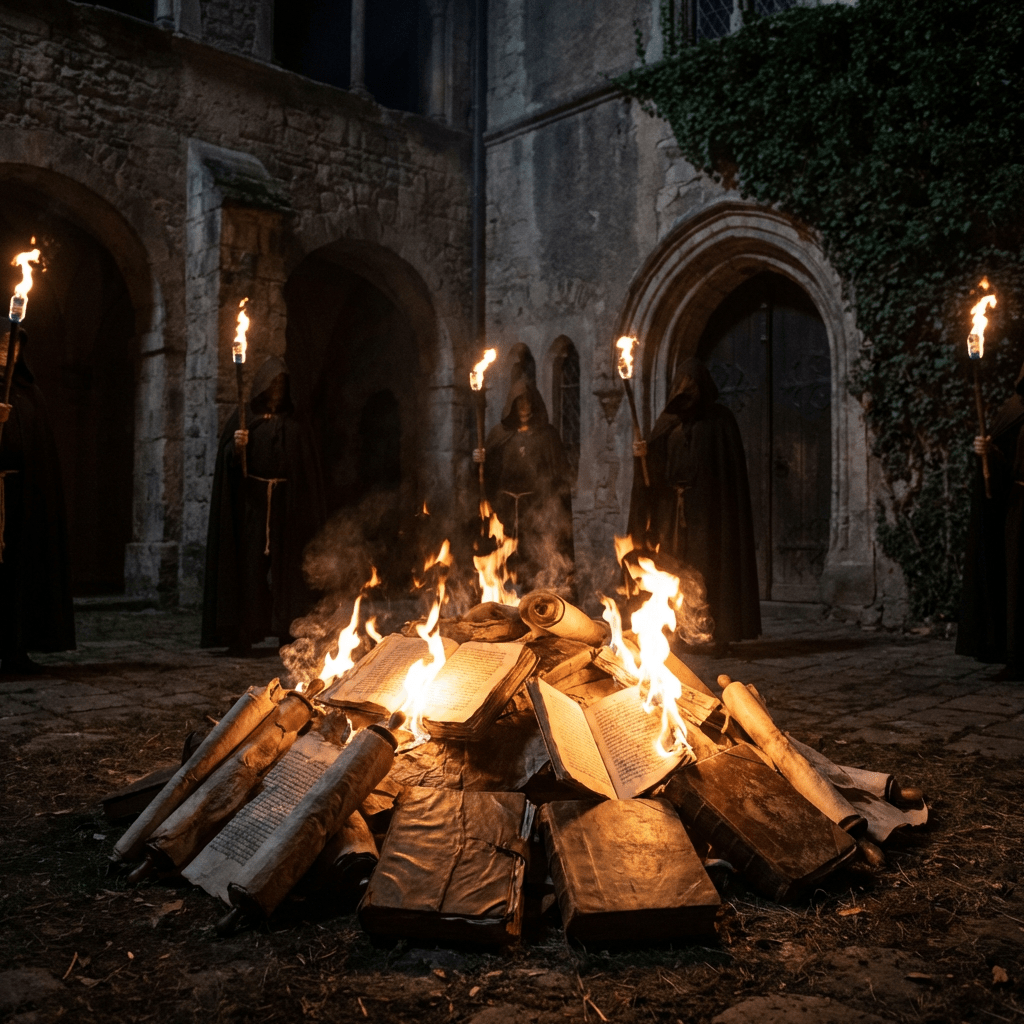
A group of cloaked figures stands in a dimly lit stone courtyard as they burn ancient scrolls and books in a large central fire.
Image generated by AI
Ryan and Don Roger
5
Book Burnings
In 1492, the Spanish Jews were given the choice of conversion to Catholicism or of being expelled from Spain. Many chose to leave. Those who converted, and remained, were kept under constant supervision. In an effort to stamp out their faith, their books were condemned to the flames by the Spanish Inquisition. A similar burning of the books in Don Quixote’s library occurs in DQI, 6. Is book burning effective? Some people think so. Other people aren’t so sure.
The Spanish conquest of Mexico, led by Hernán Cortés, concluded on August 13, 1521, when Spanish forces and their native Tlaxcalan allies captured the Aztec capital of Tenochtitlan and emperor Cuauhtémoc, marking the end of the Aztec Empire and the beginning of Spanish colonial rule. The country was then called New Spain.
Mexico is famous for its codices. These are fan-fold picture histories, drawn on vellum covered with gesso, of tribal conquests, social norms, tables of the gods, in fact a whole cultural and historical record of pre-Hispanic Mexico. The Zouche-Nuttal codex, for example, sets out the conquests of Ocho Venado / Eight Deer, nicknamed Garra de Tigre/ Tiger Claw, a Mixtec warrior, who lived between 1063 and 1115. Five of the Mixtec codices survive. Many, many more were burned. The cover of the Vindobonensis shows the burn marks where some daring person pulled the codex from the flames and saved it. Without such saved codices, we would have much less knowledge of pre-Hispanic Mexico.
Why is this anecdote important? Because prior to the invention of printing, in 1474, manuscripts were written by hand. Yes, some were copied, but many copies were single and unique. Burn the manuscript, destroy the knowledge it contains. Post 1474, with the printing of multiple copies of books, the individual book might be destroyed, but some books would survive from the printing sequence. Apply this to Don Quixote’s library and we note several things. First, Don Quixote’s copies are destroyed. Second, other copies of his books survive elsewhere. In addition, although Don Quixote’s books are burned the ideas in those books survive in the knight’s head and he lives by their rules. Those ideas are spread throughout the history of his adventures to everybody with whom he comes in contact. Conclusion – you can destroy the books. You cannot destroy the ideas that those books contained.
Ray Bradbury, in Farhenheit 451, describes the burning of books in his dystopian novel. 451F incidentally is the temperature at which paper burns. The books are burnt in Bradbury’s world, but the book people survive. The book people are those who memorize their books and are able to quote them from memory and pass them on orally to other people.
And people protect their books. How? By placing them in small rooms within their houses and walling up those rooms so that the books could not be found. This happens in DQI, VI – 6. Don Quixote awakes, goes to find his library, but it has disappeared. The housekeeper swears that a sage enchanter descended on a dragon and the library vanished in a puff of smoke. Don Quixote believes the metatheatrical lie and acts as if it were the truth. He then bemoans the fact that he is pursued by malignant sorcerers. These evil enchanters will pursue him throughout the novel whenever he wakes up from his illusions and is faced by reality. Clearly, the sage enchanters have robbed him of his moment of glory (illusion) and reduced him to sorry (the truth).
Curiously enough, a 16th Century walled-up library was found in a house in Barcarrota, Spain not so long ago. The books were hidden, probably from the Inquisition, so that their owner could escape prosecution. The discovery sheds light on how individuals hid literature from the Inquisition during the 16th century in Spain. It also illustrates how closely Cervantes followed the reality of his times when writing the Quixote.
You can destroy books. But it is very difficult to destroy the ideas they contain. In this fashion, although the burning of that one book ends the life of that particular volume, it rarely ends the life of the ideas contained within its covers. We might not recognize the names of the characters that Don Quixote quotes from his memory of those histories, but many of the people who encounter the knight during his adventures know them and remember them. Amadis of Gaul is never dead, not when his name lives on. The same is true of King Arthur and his Knights of the Round Table. King Arthur is said to fstill be alive and can be seen in the shape of a White Crow, bran gwen, in Welsh. And even Walt Disney knew, and profited from, the legend of the sword in the stone.
We will also see, as we continue our journey, that in the same way that tall oaks grow out of small acorns, large parts of later events found in the Quixote already have their seeds sown in these early chapters. Metatheatre, illusion and reality, authorship and censorship, truth and falsehood, waking events and dream sequences – and that is just the start.
I cannot bring you the sounds and smells of my own backyard, let alone those of Oaxaca.
The pungent odour of the first drops of rain, falling from a blue sky into dry dust.
The tang of bees’ wax candles, burning in the cathedral’s darkness where la Virgen de la Soledad clad in black velvet sequined with stars stands on guard in her small side chapel
Nor can I bring you the high notes sung at the golden altar in Santo Domingo by the old woman, dressed in black, who sings here every day.
The central market is a bustle of bursting scents, rooftop goats snicker above me, my neighbor’s German Shepherd patrols the roof-garden and growls in my ear.
Commentary:
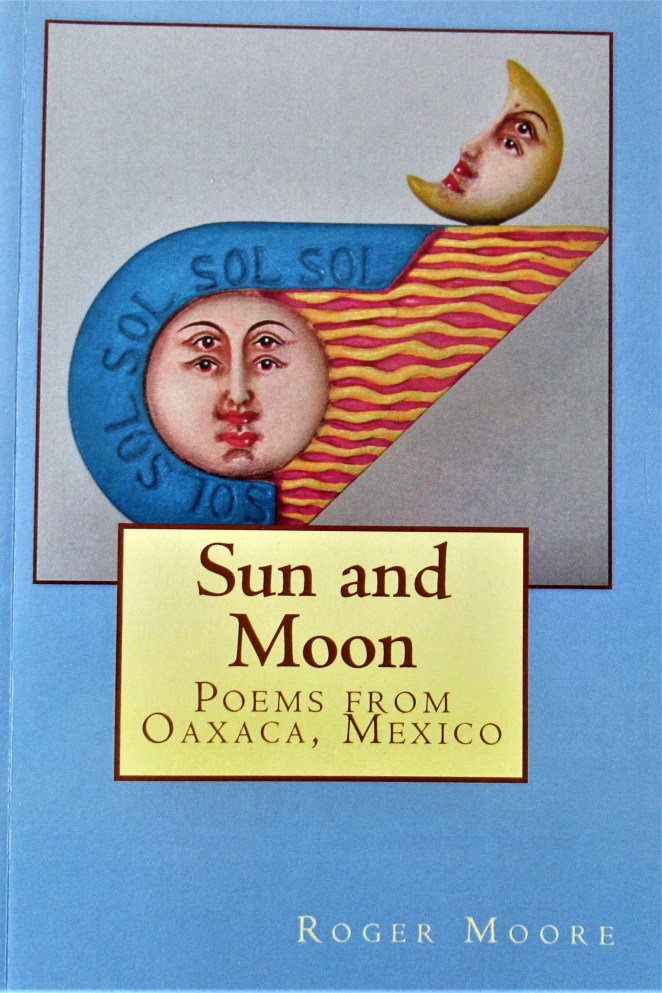
Sun and Moon is the first book in the Oaxacan Trilogy – Sun and Moon, At the Edge of Obsidian, Obsidian 22. I travelled to Oaxaca for 6-8 weeks each year between 1995 and 2001. I taught there and also researched the language, the culture, and the Mixtec Codices. Quite simply, my Oaxacan experiences changed my artistic, linguistic, educational, and cultural life. How? I earned to distinguish between what I could, and couldn’t do. A simple lesson, but one that needs to be understood at the deepest level of understanding.
The lessons took in all of my five senses – touch– dry dust, carved wood and stone, the tares in woven blankets -, taste– mole, flor de calabaza -, sight – the castillo burning -, sound – animals, goats and sheep, herded to the market-, smell– the central market is a bustle of bursting scents – hearing – rooftop goats snicker above me. A select few that blended with music of guelaguetza and the dancing that accompanied the village bands. But the experience(s) went beyond that. I began to realize, deep down, who I was, what I was, and, perhaps more importantly, what I wasn’t, what I could never be a part of, what separated myself from the other, the other whom I loved, who loved me, but who could never be a part of me.
He told me to read, and plucked my left eye from its orbit. He slashed the glowing globe of the other. Knowledge leaked out, loose threads dangled. He told me to speak and I squeezed dry dust to spout a diet of Catechism and Confession.
He emptied my mind of poetry and history. He destroyed the myths of my people. He filled me with fantasies from a far-off land. I live in a desert where people die of thirst, yet he talked to me of a man who walked on water.
On all sides, as stubborn as stucco, the prison walls listened and learned. I counted the years with feeble scratches: one, five, two, three.
For an hour each day the sun shone on my face, for an hour at night the moon kept me company. Broken worlds lay shattered inside me. Dust gathered in my people’s ancient dictionary.
My heart was like a spring sowing withering in my chest It longed for the witch doctor’s magic, for the healing slash of wind and rain.
The Inquisitor told me to write down our history: I wrote … how his church … had come … to save us.
Commentary:
No wonder the little girl in Moo’s painting looks so sad. She must have read this poem and understood how the exercise of power and authority, be it religious or secular, can effect those upon whom it is exercised. Times change, but so many things remain the same. The pendulum swings, and it moves from chaos to order and back again. The meaning of meaning – how we define chaos and how we define order define who we are.
Birds of a feather flock together. Manners maketh the man. Wonderful sayings. But fine words do not necessarily make for fine men or women at that. Serpents and senators, both can speak with forked tongues. It is up to us to apply discourse analysis and distinguish between what they say and what they actually mean. As my friend Jean-Paul Sartre once said – “L’homme n’est rien d’autre que ce qu’il fait.” A man is nothing more than what he does. His deeds reveal his true inner self – and remember – the plumage doesn’t necessarily make the bird.


 rogermoorepoet