Railway Station 2

Railway Bridge

1

walking away
from Swansea sands

me crossing the bridge
shaking sand
from my sandals

a rare event
Swansea Bay Station
Cline Valley Line
a train at the platform

the station master
blows his whistle
doors close
slowly the train goes
under the bridge

I stand in a cloud
wrapped up
half-blinded
in huge puffs of smoke

filling my lungs
assaulting nostrils and eyes
with the sting of cinders
the stench of burning coal

sting and stench
and that short sharp whistle

they linger and cling
unforgettable
in my mind’s dark corner

Railway Bridge

2

walking away
from Swansea sands

me crossing the bridge
shaking sand
from my sandals

a rare event
Swansea Bay Station
Cline Valley Line
a train at the platform

the station master
blows his whistle
doors close
slowly the train goes
under the bridge

I stand in a cloud
wrapped up
half-blinded
in huge puffs of smoke

filling my lungs
assaulting nostrils and eyes
with the sting of cinders
the stench of burning coal

sting and stench
they linger and cling
unforgettable cobwebs
in my mind’s dark corridors
and never forget
that short sharp whistle


Comment 1:

Me and my writing buddy also discussed linked poems. This is simply a chain in which each poem links back to another one. Yesterday, we wrote about Swansea Sands and how the poem was generated. Today we can look at the linking between that poem and this one, the old railway bridge that crossed the railway lines by Swansea Bay Station, and led back into Swansea, a town in those days, and the Civic Centre. Note, now, that each of those names could generate further links, further poems in the chain.

When we think of the great chain of being, we think of how all things are linked. From the Great Western Railway (GWR), to the Mumbles Railway, to the Cline Valley Branch line, and beyond. Each poem a railway station along the way. Main line, branch line, express train, goods train … links everywhere, and each link encapsulated in a memory of one kind or another. How could we not write poetry about such things?

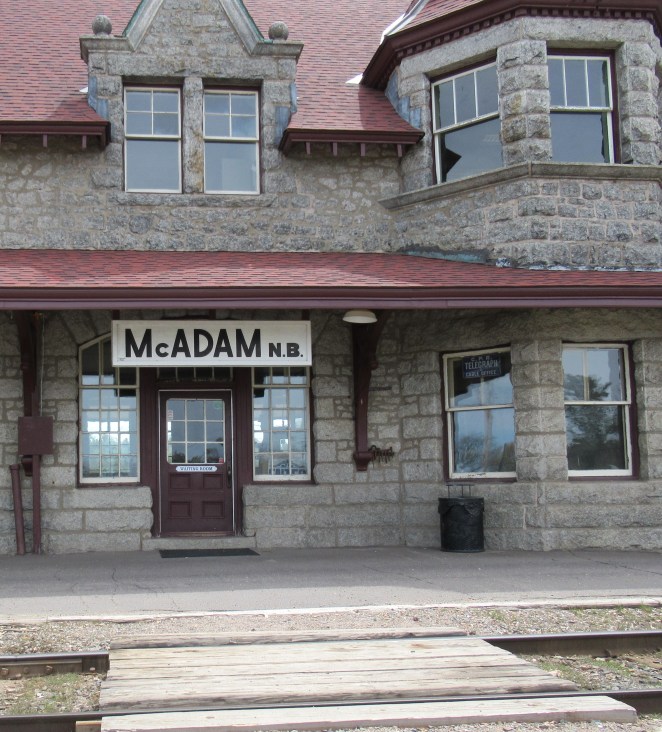
McAdam Railway Station, in New Brunswick, Canada. 60 trains a day used to stop here. Now the station is a landmark, a memory, a place where ghost trains run and shadowy figures run wild up and down the grass grown tracks where the sleepers sleep, their dreams undisturbed. I could write a book of poems about this station. Wait a second, I already have and Geoff Slater, my painting buddy, decorated it for me with his wonderful paintings and drawings. What more can I say? Each link in the chain, a potential poem. Each stop along the way, material enough for a painting, a poem, or a book.
Comment 2:

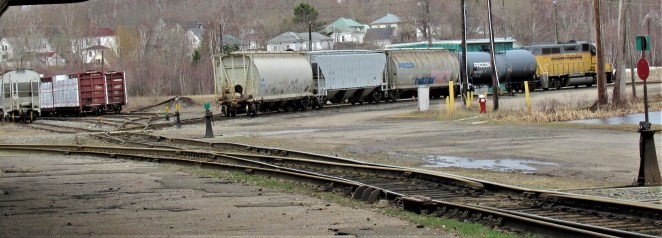
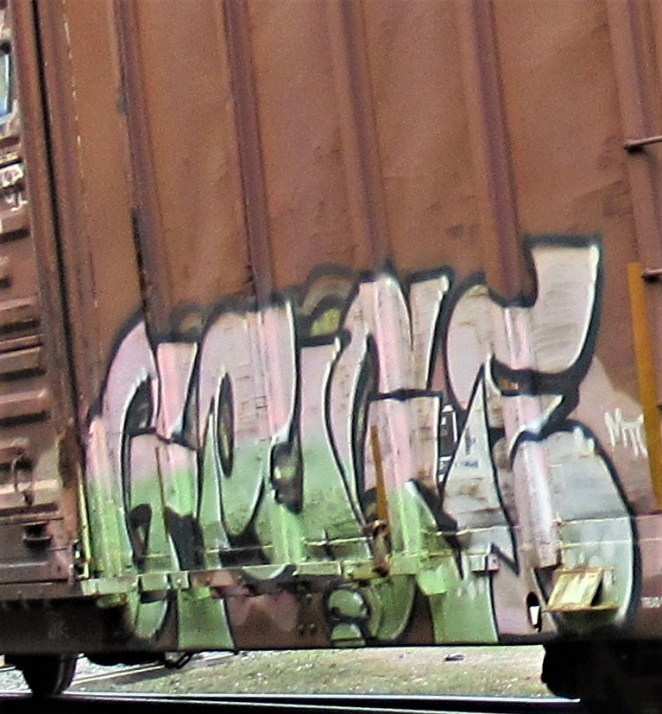
So, what happens when we change the photo? What if we add a branch line or two to the original poem? How does this affect our idea of creativity, poetic creativity? What happens when we add a different sketch from my painting buddy’s wonderful set of drawings? Oh-oh, that’s not my painting buddy – that’s a set of graffiti on a passing railway car. Sorry, painting buddy, please forgive me. But hey, wait a minute – de gustibus non est disputandothere is no arguing about taste. Somebody painted that box car and enjoyed doing it. Where does art begin? Where does it end? How formal can it be? How informal? How many railway stations do we stop at? I guess it depends on the length of the journey. But one thing I know, don’t get off the train until you reach your destination!
Swansea Sands

Swansea Sands

walking home
over the railway bridge

sand in my hair
sand in my socks

sand in my sandals
sand like sandpaper
sanding me down

tides rise and fall
sea gulls call
the bay so big
and me so small
as tiny as a tiny
grain of sand

Comment:

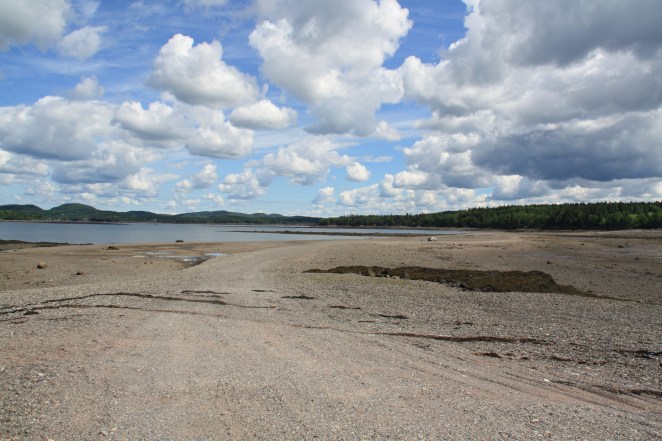
Not Swansea Sands at all, sorry. But a sandy beach all the same, here on the southern shores of New Brunswick, down by St. Andrews. The theme of the poem comes from Blake’s ‘to see the world in a grain of sand’. It might not be Swansea Sands, but there’s a great deal of sand down on the southern shores of NB. I worked on this poem with one of my writing buddies, who visits me regularly. We shared an impromptu creative writing session over the kitchen table in Island View a couple of days ago. Alas, as you probably know, there are no islands in Island View, and there’s not a grain of sea sand in sight. So we improvised.

We started with a central idea – a grain of sand – and from there we talked about how to generate a poem, from scratch so to speak, in three steps.

(1) The first draft.

Write as it comes to you – just write. Just bounce from word to word, line to line, like a supercharged, literate budgie. Take about 3-4 minutes for this. Then read it aloud to partner / writing buddy, checking on sound and rhythm.

(2) Second draft.

– Eliminate words and ideas that do not fit the central image. Remove anything loose or unclear. Then read it aloud to partner / writing buddy, concentrating on sound and rhythm.

(3) Third draft.

Polish and finalize the poem. Sometimes a fourth draft is needed, but in this case we settled with the third draft. At this stage, pay careful attention to the poem’s ending (closure is always difficult). Reorder, add, and polish, as necessary. Then read it aloud to partner / writing buddy, checking on sound and rhythm.

From the initial image – to see the world in a grain of sand – I generated two poems. My partner / writing buddy generated a short story that would fit into their current sequence of childhood memories. Other ideas for further poems also came through.

Conclusions;

  1. Make your poems alive, make them personal, make them an experience! 
  2. Remember rhythm. And never forget the necessity of a live reading or series of readings in which you can feel and hear the words.
  3. An alterative to a live reading with a partner / writing buddy is to record your own voice. The recordings can then be sent to friends who can comment on them.

Listen!

Listen

When I cannot write,
I take a paint brush,
and start to paint.

When I paint, I listen
to the brush as it moves
itself over the canvas.
I listen to the colors
as they demand attention
and tell me where to place them.

I listen to the paint as it says
‘just here, not too thick,
not too thin, a swirl please,
gently now.”

I also listen to flowers, trees,
the wind in the willows,
the songs of falling leaves,
and the voices of birds
that mourn their empty nests,
abandoned on the branches.

Comment:

This poem also came from yesterday’s prompt – what do you listen to? The act of ranting, based on a prompt, usually generates imagery and ideas that can then be used in either poetry or prose. For me, the secret is to cut away the dross and to search for the gems that are often hidden within verbal outpour. This leads, in my opinion, to enhanced creativity.

Mystery and Magic

Mystery and Magic Rule

            “Sólo el misterio nos hace vivir, sólo el misterio / Only the mystery keeps us alive, only the mystery.”(Federico García Lorca, 1898-1936). The poet and the artist both create metaphors, mysteries, magic. The search for meaning, the attempt to unravel the Gordian knot that surrounds the inner core of mystery is what keeps us, as viewers, viewing, and us, as readers, reading. Sometimes, as in a mystery novel, the ending is closed. The mystery that has spurred us on is revealed and the novel ends. Sometimes, as in many of the poems and stories in my books, the ending is open. The mystery continues and we never leave the land of wonderment that we first entered when we opened the book. There is no closure. Words and memories, metaphors and images, lines and rhythms, remain trapped in our mind with the brightness of butterflies that flutter before our eyes and flitter away before they can be caught. Beauty is in the eye of the beholder. And in poetry, each beholder becomes a new creator, a new artist creating a private, imagined world.

A private, imagined world: reading The Hobbit or The Lord of the Rings is one thing. The characters came alive and I recreated them in my own mind. I remember the first cartoon rendition of The Lord of the Rings. The characters were no longer mine. I did not respond to them. I left the film early and went off to the closest bar. To drown my sorrows and forget. Same thing with Harry Potter. My own inner visions were not the external visions created for me by Hollywood or whoever. In fact, after seeing one film, I gave up on the whole series. Not my inner creations, not my heroes, not my people.

This might be a generational problem. I grew up in the age of radio, no TV, not until I was 9 years old. I remember listening to the Wind in the Willows on BBC Radio. Voice echoed in my head and each character, each episode was recreated in my own mind. I read my first copy, carefully preserved since childhood, the other night, and Ratty, Moley, and Badger were just as I first remembered and recreated them. The same with The Chronicles of Narnia, read, before they were seen.

Perhaps someone else’s visuals destroy the magic and the mystery we have created. Perhaps there is a huge difference between reading first and seeing first, or seeing first and then reading the novel. I once used A Room with a View as a textbook in a reading and writing class. Many participants had enormous problems with the written version. In fact, they did not understand the written version until after they had seen the Merchant Ivory film. “Oh woe is me: shame and scandal in the family”. But whose shame? Whose scandal? The world is changing ever more rapidly. There seem to be few absolute rights and wrongs. So many things seem to be relative. Mystery and Magic: are these the things that keep us alive?

Poetry or Prose?

Poetry or Prose?
Wednesday Workshop
22 September 2021
Patos de setiembre.

When I write, I do not distinguish between poetry or prose. More often than not I think in terms of the rhythm and musicality of the words I am using, if the words sound right, when read out loud, they probably are. Here is a prose poem, Cage of Flame. It is written in prose, but it’s meaning is dependent on imagery, metaphors, associative fields, and musicality. Read it as you would any piece of prose, in sentences, following the guidance of the grammar. Read it two or three times quietly to yourself then, when you have grasped the poem’s rhythms, try reading it out loud. If you want to know how I would read this poem, check my recorded readings on my blog, Spotify or SoundCloud.

Cage of Flame

Now you are a river flowing silver beneath the moon. High tide in the salt marsh: your body fills with shadow and light. I dip my hands in dappled water. Twin gulls, they float down stream, then perch on an ice-floe of half-remembered dreams. Eagle with a broken wing, why am I trapped in this cage of flame? When I turn my feathers to the sun, my back is striped with the black and white of a convict’s bars. Awake, I lie anchored by what pale visions fluttering on the horizon? White moths wing their snow storm through the night. A feathered shadow ghosts fingers towards my face. Butterflies stutter against a shuttered window. A candle flickers in the darkness and maps in runes the ruins of my heart. Eye of the peacock, can you touch what I see when my eyelids close for the night? Last night, the black rock of the midnight sun rolled up the sky. The planet quivered beneath my body as I felt each footfall of a transient god.

Clearly the above is prose because it has no line breaks. But what happens when we break that prose into shorter lines and turn it into a poem?

Cage of Flame

Now you are a river flowing
silver beneath the moon.
High tide in the salt marsh:
your body fills with shadow and light.
I dip my hands in dappled water.

Eagle with a broken wing,
why am I trapped in this cage of flame?
When I turn my feathers to the sun,
my back is striped with the black
and white of a convict’s bars.

Awake,
I lie anchored by what pale visions
fluttering on the horizon?
White moths wing their snow
storm through the night.
A feathered shadow ghosts
fingers towards my face.
Butterflies stutter against
a shuttered window.
A candle flickers in the darkness
and maps in runes the ruins of my heart.

Eye of the peacock,
can you touch what I see
when my eyelids close for the night?
The black rock of the midnight sun
rolled up the sky.

Last night, the planet quivered
beneath my body and I felt
each footfall of a transient god.

            It seems to be the same text, but is it? And what happens if we change those line breaks? It will change the external structure of prose > to poem > to new poem, but it will not alter the internal structures that survive all format changes. Does the rhythm stay the same in both cases? It certainly does when I read it, but how about you? Poetry or prose? And what’s the difference anyway if the words roll off your tongue and metaphors, mystery, and magic rule?

Comment:
Clearly poetry and prose are not interchangeable, for they both fulfill different functions. The classical difference is often said to lie between history, what actually happened, and poetry, the formal arrangements of words in song. This seemingly simple definition becomes blurred, of course, when history, written in prose, is confused with epic, the retelling of history in poetic form. Prose fiction is a much later development and it is Miguel de Cervantes who gives us, in Don Quixote, his own Renaissance solution: “La épica también puede escribire en prosa” / the epic can also be written in prose. The mingling of poetry and prose underlines the use of rhetorical tropes in writing. Later, Baudelaire will offer us us his Petits poèmes en prose thus gifting the world with prose poems. Much of what I write is prose poetry or poetry in prose. Rhythm, metaphor, allusions, alliteration, similes, intertextuality all combine to decorate my writing. And yes, I am very clear about what I am trying to do.

The Art of Narrative

The Art of Narrative

            Art has almost always told a story, even though, as in the case of the Cave Paintings in Altamira, Puente Viesgo, Lascaux, and elsewhere, we may not know exactly what that story is. On the other hand, many of the great paintings of the Spanish Golden Age (1525-1680) have a hidden narrative that we can often work out. Take, for example, Vulcan’s Forge (1630), painted by Diego Velázquez after his first trip to Italy (1629). On the surface, this is a painting of a typical Spanish Forge of the seventeenth century. Ordinary workmen labour away at their daily tasks, but, and there is always a but, the figure on the left is adorned with a god-like halo. Why? Because he is the bearer of a message. Vulcan’s wife, Venus, has been having an affair with Mars, the god of war. Vulcan has forged a net of fine, golden chains and placed it over the bed where they will loiter. Now, Mars and Venus are trapped in that net, caught in the act, so to speak. No wonder the mouths of Vulcan’s helpers are open in wonderment.

Bisonte Parado: Cenicero de Altamira.

            Before the arrival of photography, painting was the only way to record the world, to make a picture of what was happening, to tell a story in paint. That is why a picture is worth a thousand words. I have retold the narrative of the painting of Vulcan’s Forge in 128 words. There is, of course, a great deal more to tell about his and other paintings and how they represent the artist’s narrative reality. The advent of photography changed the artist’s vision of the world. As photography developed and became quicker, faster, and offered what some might consider to be a more accurate version of reality, so artists rethought their role. Was it to capture, in paint, the world as they saw it, with a single visual entry point, and a constant perspective? Or was it to catch the way light fell upon objects (Monet), or to offer multiple entry points (Braque), or to paint the turmoil of the inner mind (Picasso, Miró, Pollock)? Artists could do such things. Until recently, with the advent of the computer, it was much more difficult for the camera to do so. The camera recorded, but artists created and re-created their own narratives of the world around and inside them. Now we can enter photoshop and the equivalent and play around with out own photos of reality, distorting them and twisting them as we please.

Verbal to Visual to Verbal

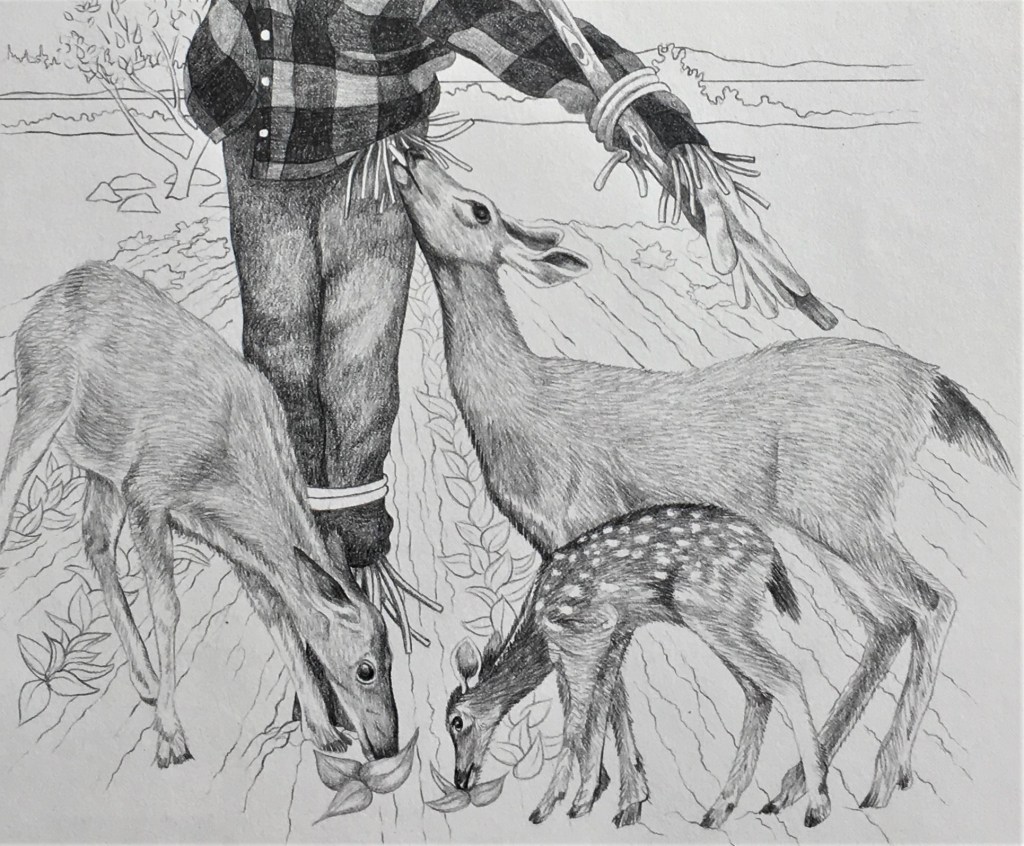
            Which came first, the chicken or the egg, the verbal or the visual? Or was there a sort of spontaneous combustion? In the case of Scarecrow, the artistic collaboration between myself, the author, and Geoff Slater, the artist, the words came first: “In the beginning was the word.” He heard me reading my story, started to sketch the characters, and within six months we had produced an illustrated book.

Wonderful drawings. Thank you, Geoff.

Words and narrative first, then an artist’s rendition of key moments in the narrative. However, in the case of Twelve Days of Cat, our second artistic collaboration, Geoff sent me 12 drawings of a cat and I looked at them and worked out a narrative that would join them together in a symbiotic relationship. Scarecrow is an illustrated narrative in prose. Twelve Days of Cat is a narrative in poetry based on what was once an independent series of charcoal sketches. Who cares which came first, verbal of visual, when the results are so pleasing to ear and eye.

Intertextuality

Intertextuality

Wednesday Workshop
25 August 2021

            This is another academic word that has a simple meaning. In essence, it means texts talking to texts. Quevedo (1580-1645) writes escucho con mis ojos a los muertos’ / ‘I listen with my eyes to dead men.’ He is suggesting that, each time we read a text written by another person we enter into a dialog with that text and that author. His metaphoric conversations with the writings of the long-dead Seneca become intertextual the moment he put pen to paper and wrote about them.

This intertextuality is a key component of my writing.  You may not recognize all the phrases that I have used previously by other writers. I do. Some other readers will. Just take, as an example, the titles of some of my earlier books. The title of Broken Ghosts (Goose Lane, 1986) comes from these lines penned by the Swansea poet, Dylan Thomas (1914-1953). ‘Light breaks where no sun shines; / where no sea runs, the waters of the heart / push in their tides; and, broken ghosts with glow-worms in their heads, the things of light / file through the flesh where no flesh decks the bones.” Stars at Elbow and Foot, the title of my Selected Poems (Cyberwit.net, 2021) was also inspired by one of Dylan Thomas’s poems. “And death shall have no dominion. Dead men naked they shall be one with the man in the wind and the west moon; when their bones are picked clean and the clean bones gone, they shall have stars at elbow and foot.” The title of Though Lovers Be Lost (Kindle, 2016) also comes from this same poem, one of my favorites, obviously.

Sometimes readers are aware of these intertextual clues that I sow throughout my poems. Sometimes not. It doesn’t matter. There is a resonance in such chosen words and that resonance is there, irrespective of whether you are aware of the word-source or not. That said, the recognition and acknowledgement of intertextual relationships expands the poetic meanings of the creative world even further. It also establishes verbal links between author and author, epoch and epoch, genre and genre, thus establishing a wider intertextual network and a stronger chain of linked literary thoughts and meanings. In our creative journeys, we rarely walk alone, whether we are aware of it, or not.

The art of writing poetry about paintings is known as ekphrasis – which basically just means a verbal description of a visual work of art, whether it’s real or imaginary. The conversion of the visible (painting) to the printed page (verbal) is another link in the great chain of intertextuality, for paintings, too, are narratives with a different form of text. Other component parts are audible to verbal (alliteration, onomatopoeia), touch and feel (tactile) to verbal (as in synesthesia or the mixing of the senses) and the transfer of taste to verbal forms. Many of these transitions and transformations are present, not only in my own poetry, but in surrealism (verbal and visual) as well.

Sense and Nonsense

A whole lot of pens. But will they write one word of poetry?

Sense and Nonsense
Wednesday Workshop
18 August 2021

Iterative Thematic Unity

            Iterative thematic imagery is complicated term, used by academics, for a literary device that is really very simple. When the same or similar images are used again and again in a text this is repetition or reiteration, hence iterative. When they are bound thematically or within the associative fields already present in the poetry, then the repetition is said to be thematic. A work’s unity may be found within the three classical unities of time, space, and action, or it may be found within the imagery that links and unites. It seems complex, but it isn’t really.

“Now you are a river flowing silver beneath the moon. High tide in the salt marsh: your body fills with shadow and light. I dip my hands in dappled water.” The key images fall into two categories, (1) water: river / high tide / salt marsh / water and (2) light: silver / moon / shadow and light / dappled. Now the sense of the words becomes clear. You / your body is likened to a river seen in the moonlight. It can be touched: I dip my hands. This adds an extra sensory dimension and the depth of the images is apparent. And no, it is not a simple message, but it can be decoded and enjoyed because now you can make it yours.

Sense and Nonsense

            When we talk poetry, what do we mean by sense and nonsense? Let us begin with automatic writing. Automatic writing is nonsense. Put your pen on the paper, do not let it off, write for five minutes, whatever comes into your head. The Surrealists published these thoughts, however distraught and distracted as meaningful poetry. Major poets (Lorca, Paz) have used these techniques to engender metaphors and images. However, they have searched among their subconscious thoughts and have rejected the dross to choose the genuine images that enlighten the inner world.

            Sense or nonsense? “Eye of the peacock, / can you touch what I see / when my eyelids close for the night?” Key images: eye > see > eyelids > and these are linked to the eyes of the peacock, as displayed on his feathers, and this links to the ancient tale of the Argos and the Argonauts, and to the person who closes his eyes to sleep for the night, and the sense that we can touch (tactile) when we dream (visual), a mixing of the senses. The straightforward logic of the nightly news? Definitely not. But the logic of the subconscious world, of the dream world as defined by Carl Jung? Definitely. These words contain internal meanings that are different for each one of us. Logical meaning? Definitely not. Internal sensation that may generate ease or unease? Definitely. Sense or nonsense? That will depend upon the readers and how they react not in their logical minds but in that deep-seated region of subconsciousness where all imagery is related to what Carl Jung calls the racial subconscious.

            Are there words or ideas here that you do not understand? Names and theories that you do not know? Literature in general and poetry in particular take you to places where you have never been and to places that you might never have thought of visiting. However, these are lands that will open their delights before you, if you deign to open up heart, mind, and eyes, and venture out to explore them. Use your dictionary, your thesaurus, your google search tool, and expand your verbal and linguistic horizons. Poetry is not an advert. It doesn’t sell you anything. But it can and does open new worlds and it encourages you to explore old worlds set within you. It will not persuade, cajole, and limit your mind and your choice, rather it will embolden you and help to open new horizons.

Closed and Open Images

Open and closed blossoms on the geranium

Closed and Open Images
Wednesday Workshop
28 July 2021

            A closed image is one that leads the reader in a specific direction and offers a fixed vision of the world. For example, “White moths wing their snow / storm through the night” (Cage of Flame, below). One summer evening, a long time ago, when I was in Chatham, N.B., now Miramichi City, I saw white moths swarming beneath a street light. The air was thick with them and they circled and dazzled like falling snow. A reader may not catch this image first time through. However, after a couple of readings and a little thought the image makes perfect sense. Now add the personal dimensions. Have you had a similar experience? What associative fields do you structure around white moths > wing > their snow storm >? This is where the image opens up and becomes more personal. You may not have been in Chatham that night, but you may well have experienced something similar.

            An open image is one that leads you outwards into your own world. “Now you are a river flowing silver beneath the moon” (Cage of Flame, below). Now the image is more open and asks questions of the reader. Who is the you referred to in the second word? Is it the reader? Is the narrator speaking to a third person? You are a river: how can a person be a river, more, can we be sure this you refers to a person? What else could it refer to? You are flowing silver: there is no sense of concrete meaning here. This is not a piece of information to be processed as you would process a headline in the newspaper (print or digital). What does it mean? I don’t know but, as Salvador Dalí said of one of his own paintings “I don’t know what it means but I know it means something.” And that something is the essence of poetry. That one word, river, will conjure up different images for each individual who reads the poem. River: which river does the poet mean? Is he referring to the Miramichi, the St. John / Wolastoq (Wəlastəkwewiyik means “People of the Beautiful River,” in Maliseet), the Thames / Támesis (to the Spanish who lived in London in 1560-1580), the Severn / Sabrina (to the Romans who invaded Britain in 55-54 BC) that divides Wales from England? And what happens when we restore the old names to the rivers that former generations, some of them our forefathers and foremothers named? How does it change our picture of the permanence of rivers and the impermanence of names and people?

            Metaphors are always hard to understand. This is because they have no exact meaning and vary with each reader. Take a metaphor like icy fire. We know that ice can seem to burn the skin, but what does icy fire mean? Think of those drawings in which a vase becomes a face and the face metamorphoses into in a vase. Most people can see each image separately, but it is difficult to hold both shapes in the mind’s eye at the exact same time. The image flits between them with the result that the reader’s determining mind, the one that yearns for le mot juste, the exact meaning of words, is trapped between two mirrors and moves from the one to the other without being able to settle on either.  This is what happens with metaphoric meanings: a flickering between the different terms of the metaphor and an inability to settle. Take this couplet, for example: “there is nothing so hot as the female desire, / as cold as new snow yet it burns you like fire” (In Praise of Small Women, El Libro de Buen Amor, Arcipreste de Hita, circa 1283 -1350, my translation). Such metaphors have been around for a long time, as has the juxtaposition between hot and cold, the Petrarchan ice and fire, used as a poet’s description of lovers.

            No, poetry is not, definitely not, an exchange of information. It is more an exchange of dreams, cultures, multiple meanings, each constructed, de-constructed, re-constructed in the space between the minds of reader and writer. A poetry book is very similar to a river. You must take it on its own terms, adapt to it, work with it, run your fingers and hands in its waters, paddle in it, swim if you want to. You must do all of this on your own terms and in your own way. Whatever you do, don’t, don’t get out of your depth. And please, please, don’t let yourself drown. Just lay back on the water, look at the clouds in the sky, choose the ones you want to follow, and float a few minutes of the day away.

Poetic Structures

Poetic Structures
Wednesday Workshop
21 July 2021

External Structures

            Roman Armies, men and words, were structured, highly structured. Poetic structure can take many forms: external structure, the sonnet, for example, with its 14 lines and its 4+4+3+3 verse form which can also be 4+4+4+2 or 5+5+4, or 5+4+5 or 2 x 7 or 3+3+3+3+2. I have experimented with all of these sonnet forms, and many more, at one stage or another in The Nature of Art. Milton Acorn, the Governor-General’s Poetry Award Winner for poetry, wrote a book called Jackpine Sonnets. His Jackpine Sonnets are wild and beautiful, growing this way and that, totally individual and out of shape, just like wind-swept jackpines of Tara Manor in St. Andrews on the East Coast of New Brunswick, Canada, where I penned some of these poems.

Internal Structures

            In the same way that poems can be given a formal structure, so can lines. Structure can be external, flowing from line to line in an unbroken sequence, or it can be internal, limited to each line. Some of my poems include stanzas where the individual line flows into the stanza and the result is an amalgamation of both the individual and the whole. Individual lines can be structured by syllable count, 10, 11, 12 or more per line. They can also be structured by stress, the stress of normal speech or the stress of forced rhythm. Structures can have Greek or Latin names, English ones too. Or it can be the structure of simple, everyday speech. Fray Luis de León, (1527-1591) wrote that he counted his syllables when he spoke and he wrote prose and poetry the same way he spoke. Syllables, a strange term nowadays, not understood by all. Try the ‘beat’ of music: “You can’t always get what you want” (Rolling Stones) or “All you need is love,” (Beatles). Simple really, but it is all too easy to complicate these concepts.

Comment: Clearly this is a simplification of what can be an intensely scientific and academic subject. We have only to think of the books of rhetoric, with their long lists of Greek names for the different syllables, long and short, and the different line lengths that run from Iambic Pentameter to Hymns Ancient and Modern. However, the purpose of these thoughts is to simplify and not to complicate. More important, perhaps, rhythm, in one form or another is akin to structure and many of us have an innate sense of verbal rhythm, whether we count our syllables on our fingers, as I do, or count them not, as is the modern trend in some poets. Think daisy petals: she loves me, she loves me not, I count them, I count them not. Yet still the rhythm is there and that, in many ways, is one of the key secrets of our unique poetic voices: we all speak and write in different fashions and that is one of the things that makes us unique.