How quietly she moves, the old one, scarcely disturbing the floorboards way above my head.
Such a light touch as she tip-toes from room to room, her floor my ceiling.
Not at all like the young one with her two left feet, both flat, and her elephantine shaking the floor overhead.
We often wondered if the earth was quaking, the house shaking, with the ceiling about to come tumbling down upon our waiting heads.
Comment:
How silent, the house, with the visitors gone and me and my beloved back together, alone, as we have been for so many years. The silence is broken only by the tick-tock of the grandfather clock, an occasional creak from a floorboard expanding in the sun, or creaking in the shade, the hiss of the kettle … a silence so deep that sometimes we gesture to each other or whisper low.
Don Ryan came over to visit and joy and noise returned. I made him coffee and he brought us a fudge delight. My beloved took refuge in the silence of the front porch and Don Ryan and Don Roger planned their future adventures. We will be working again together soon. Our first task – to finish reading Don Quixote and to complete our notes on our readings, suspended, alas, during the summer work season, but soon to return when university goes through its September Rebirth.
After Don Quixote, we will probably explore two picaresque novels, Lazarillo de Tormes and The Swindler. That will be great fun for both of us, and I look forward to preparing the readings and their annotations.
When Don Ryan left, our table top noise melted away, silence returned, and Clare with it. Other friends will be visiting soon. They will break the silence with a soft tap on the door and a gentle voice calling “Hello!” We look forward to that. Meanwhile all is quiet and silence is golden.
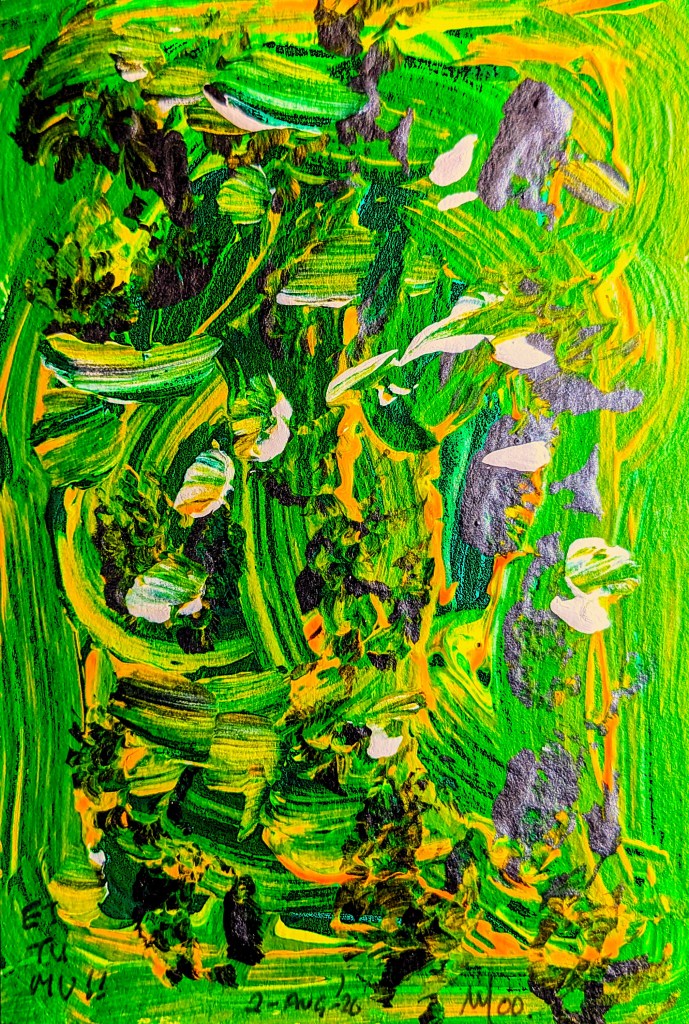
Until the arrival of Moo. “Hello,” he bellows. “Writing again? Have I got a painting for you. You thought the little ones were noisy… well, speak for your self. Here’s your painting, Et Tu, Mu. It comes from Julius Caesar, the play. And remember, when you and Don Ryan get together you’re just as noisy as the little ones. And I am too, when I’m with you. That’s why the painting’s called Et tu, Mu. Time to go.”
Out he went, thumping and clumping, and left me to the tap of the computer keys and the ticking of the grandfather clock.
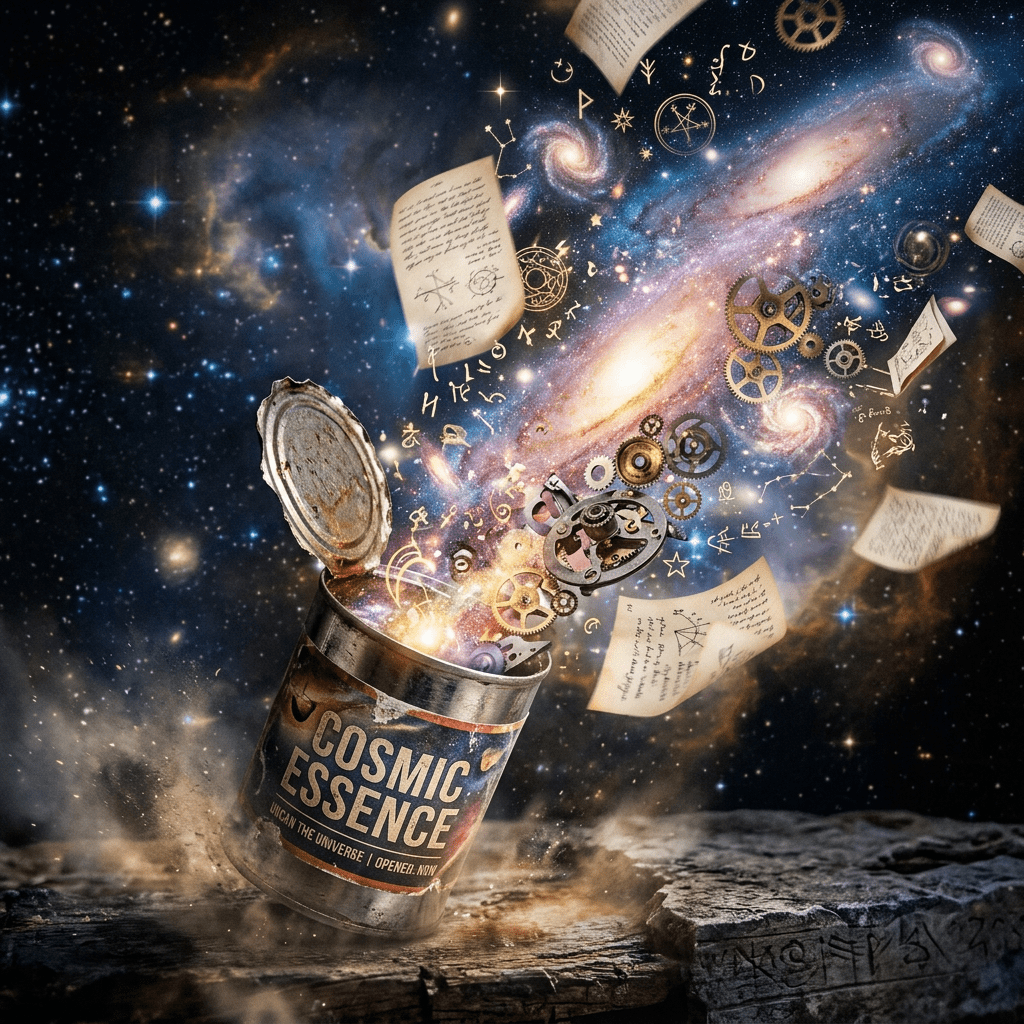
A weathered canister releases galaxies, gears, symbols, and handwritten notes into a star-filled universe.
Original Question –
Roger I have a question for you. Recently I purchased a book by Forrester- The African Queen. I enjoyed the movie years ago and thought I would like to read the story. The main actors were great. The book highlighted that it showed what it was like being a female during the war, (1) which when I look back on now is one of its main points.
My question or thought on this book is tied around the library system. When I lived in Fredericton I wanted to give a bunch of books to the library, their first question to me was, “How old are the books? I told her and she said anything over five years in not being accepted. (2)
I wondered about this and the fact that many books in school are being removed, (3) how can we tell how much we have progressed? (4)
I don’t like predjudice but it seems we are throwing out too much. (5) Any thoughts on this. I don’t mind some of the history being trashed (6) because for Canada the consentation is for Quebec and Ontario.
Roger’s Response
(1) It’s also about the role of the nun in society. How do ‘holy women’ function in a male society? It sets the questions but doesn’t really give the answers. It’s a long time since I saw the film. I don’t think I ever read the book – the themes might well change in print. They are present (some of them) in The Handmaid’s Tale.
(2) The library system seems to have rules and an etiquette all its own. When I donated books to the library, they accepted some for their collections, but set others up for sale on the book tables by the door. My guess is that certain books are ‘best sellers’ and will be read, others are ‘dust gatherers’ and won’t be. They want the former, not the latter. They also have specialized collections. If the books fit the specialized collections, great. If they don’t, then they hit the unwanted category and are moved on. This is particularly true of the UNB Library System.
(3) This is an entirely different question, and one with very deep roots. It deals, in part, with the question of control – quis custodiet ipsos custodies – who shall guard the guards, who shall program the programmers? By controlling what people read, you control their thoughts. One of the worst signs of this was the book burnings of the Spanish Inquisition (16th – 17th centuries). The Jews were expelled from Spain in 1492. (And the Arabs / Moors, in 1609). Prior to that, they were ‘processed’ by the Inquisition. The original Inquisition was Papal, and was aimed at instructing the priesthood in Rome. It was corrupted in Spain by the Spanish Inquisition, a sort of secret police, which worked rather like the Gestapo in WWII. One of their jobs was to ensure that people who had converted, stayed converted and didn’t revert to their old religion, even in secret. Another was to ensure that reading material, religious material, and cultural material, particularly after 1527 (Martin Luther and his 97 theses) when the Reformation started, were all in line with the accepted thoughts of the time. All books were sent to the Censor who vetted them and either approved them or asked for changes, if he (they were all men) saw the slightest sign of dissent or heresy. Don Quixote, Book One, Chapter Six (DQ,I,6), deals with the book burnings of DQ’s personal library. In certain of the States (down south) books are already being banned. One that touches us closely is the banning of Margaret Atwood’s The Handmaid’s Tale.
(4) “There is no earth, no heaven, no extended body, no magnitude, no place and that nonetheless I perceive these things and they seem good to me. And this is the most harrowing possibility of all, that our world is commanded by a deity who deceives humanity and we cannot avoid being misled for there may be systematic deception and then all is lost. And even the most reliable information is dubious, for we may be faced with an evil genius who is deceiving us and then there can be no reassurance in the foundations of our knowledge.” René Descartes (1635)
Descartes expresses this much better than I can. It is one of the major dangers of the age in which we live. How do we distinguish between reality and alternate realities? Which reality is the real reality? What is or isn’t fake news? How do we tell? Who do we believe, and why?
(5) Part of the problem is that ‘certain people’ – who don’t believe in science and who exploit people’s ignorance to their own advantage – are willing to destroy the foundations of our knowledge. Burn everything down. And start again. And the new starting point is to impose what they believe upon everybody around them. This is a huge and crucial question that threatens us, as individuals. It also threatens the foundations of our knowledge, as well as the very world in which we live – climate change vs denial of climate change – profits over people. Once one starts looking at the AI systems with their immense persuasive powers and their seemingly uncontrollable spread of Mis-information and Dis-information, then we start to realize how serious the problem is.
(6) Those who ignore history are doomed to repeat it – Santana (I think). However, we must, in certain circumstances, adjust our current beliefs to current realities. Immigration is a major issue – as is how we deal with people, like me, of different cultures and beliefs? Not everything written in the past suits our current world view. I have been looking at old Westerns – “The only good injun is a dead one” (John Wayne). Really? I know some wonderful people in our first nations communities and I have taught them and worked with them and been taught by them. “Shoot first and ask questions afterwards.” Really? I won’t comment further on that one… and there are so many others.
All of this comes down to the big question – freedom of information or the release of just enough information to persuade other people of what we believe and what we want them to believe. Power and Control. Knowledge is Power – Michael Foucault. Control that knowledge and you have power over the people. Noam Chomsky has written widely on this – and his books have been banned in the USA. Bertrand Russell too – The Meaning of Meaning, for example, and his establishing – along with A. J. Ayer – of the doctrine of logical positivism – the removal by means of mathematics of all the emotional content of words.
My friend, you have opened a can of worms.
Long may they wriggle.
Comment:
A series of questions that have recurred throughout the centuries. Well worth re-asking them and rethinking them. Times change and the answers often change with them. The image, incidentally, is AI generated, based on an examination of my written words.
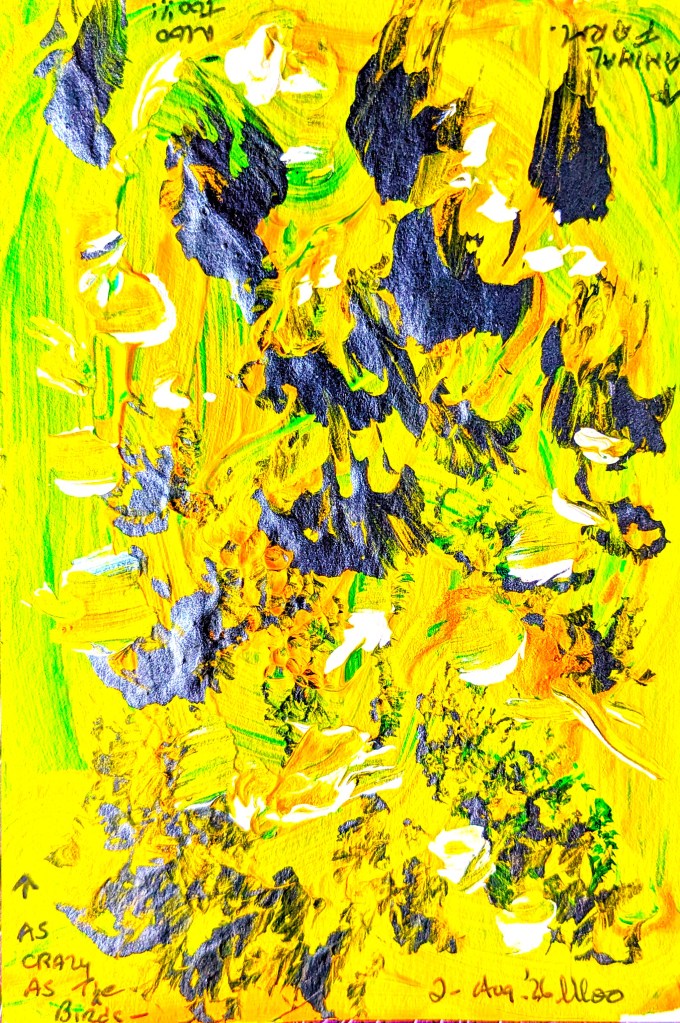
Bakhtin’s Carnival – the world turned upside down and inside out. And here it is. Moo has painted an upside down world. From the above angle, the world is full of birds and is “as crazy as the birds“. Lovely image. There they go, birds of a feather, flocking together, soaring, sinking, doing what birds do when they are as crazy as bat shit – and Moo told me, he nearly gave his painting that name – Crazy as Bat Shit.
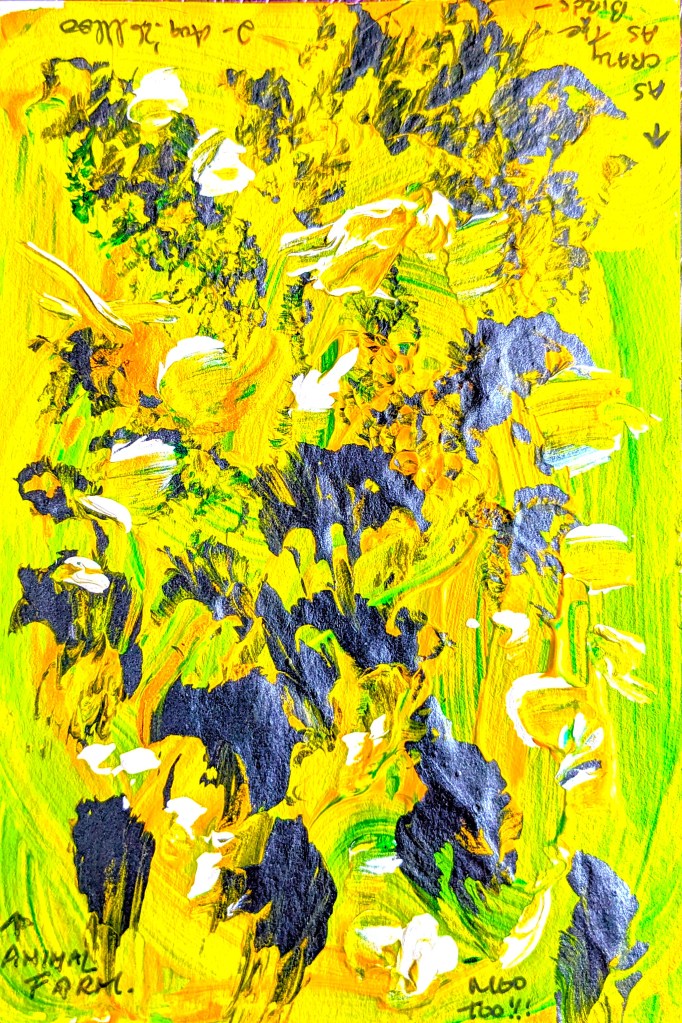
But hang on a moment – if the world is upside down, what happens when you turn Moo’s painting upside down? Let’s try it and see.
Would you believe it – the birds are no longer birds, they have turned into animals. From this point of view, we have Animal Farm. Moo thinks he can sell this painting for double the price now he has discovered it means something different the other way up. Now – what if …. Nope. Let’s leave it there. We are not going to turn it sideways, nor inside out. That’s asking too much of Moo and his painting skills.
But we have a tiny little lesson, and with no poem attached to it. Perspectivism – the same object seen from two different points of view by two different people can elicit different functions and different interpretations.
Think of the Barber’s Basin in Don Quixote. One group of people see it as a barber’s basin. A second group see it as Mambrino’s Helmet, missing a visor. Cervantes resolves the problem by adding yelmo to bacía to give a new word – a baciyelmo. A helmet that serves as a basin and vice-versa. Does such a combination exist in English? Whyever not! We can call it a bassinet, as in a pig-faced bassinet. That is to say, a helmet with a snout that ends in a bassin – well, we can forgive the -ss- if we are generous.
And now we come to the important part of our lesson. Most things can be changed from one meaning to another, if we change our position and our point of view. Birds can become animals. Animals can turn into birds. A good mood can be turned into a bad mood. A bad mood can be turned into a good one.
There is so much depression around us at the current time. “Turn that frown upside down” – and turn the world on its head and inside out. I bet you can do it if you really try. After all, Moo has shown you how and I assure you that Moo – and I know him well – is no genius. However, in spite of that, every so often he stumbles on a tiny truth, just like he has in this painting.
So – don’t get frightened and depressed by the black dog when he leaps out at you from the grandmother clock. Turn him from a dog into a bird and let him fly away into the blue, taking the black dog’s blues along with him. And remember – if Moo can do it, so can you. So “turn that frown upside down” and remake your world in the shape you would like it to be. And remember – if Moo can do it, so can you.
alive in the moment a momentary cloud crosses the sun face brings shade to table
soon page and tabletop ripple with light again
the pen’s shadow pushes across the page while the nib weaves its spider fine lines of well webbed words
meaningful mindful each letter a moment caught and held in time
Comments:
I caught myself forcing myself to write a poem – and it just wasn’t working. Meaningless words upon the page, each wound up, struggling like a little black fly in a spider web that promised only oblivion. Then I caught the one sentence that ends the above poem – each letter a moment caught in time. I had found what I was looking for. For the next half hour I played back and forth with a whole sequence of dibbles and dabbles that eventually led to what I have written above.
I showed it to Moo. “Tranquility,” he said. “I have just the painting for you.” Love at first sight – poet and painter, painting and poem, blissful in a true moment of blended tranquility and mindfulness. “Why, thank you, dear Moo,” I said and all our previous squibbling and squabbling was laid aside. We gave each other a big hug – I should add that we don’t often do that, as one or two of you out there might well know. But we did it today.
Meanwhile, I have received another set of fake invitations – oh, I would be so famous in the world of fakery if I gave away what little money I own to make myself truly famous – for my folly in believing the permanence of fakery. Why, only last week, I got an email mistaking me for my namesake and offering to help me publicize his most famous book – My Word is my Bond. The person involved was asking for a cool $250,00 for making the videos.
Oh dear. 007 is one thing. 006.5 is something else and someone else. Never mind – maybe one day someone real will call me and make me a genuine offer that I really can’t refuse. I probably wouldn’t believe that if it happened.
last night I saw stars never thought to see them again first time in years a riot of bright lights no dark spots floating no black holes barring vision’s edge
just layer upon layer star fields like buttercups littering the sky I had forgotten their names forgotten how many existed smiling frowning down immortalized in myth celebrated in song
daylight broke waves an ocean of sunshine untying dreams’ night-knots sharp black and white memories shifting to corkscrews of color
two refreshing rain drops four times a day a never-to-be-forgotten face seen once again in close up
Fundy fogs clearing mist un-threading between salt-laden pine roots gripping splitting fragile rocks
complicated emotions woven into a simple carpet bag of words
Commentary:
I wrote this some time ago, after a simple eye operation that scraped clean the new lenses that the doctor had placed in my eyes. Distorted vision – it happens in so many ways. Kennel blindness – at the doggy shows, the owners and breeders blind to the faults of their own dogs while eagle-eyed for the slightest fault in another owner’s woof! Cat shows the same. Incidentally, tell me if you can, why a cat show has a catalog, as does a dog show. But why shouldn’t a dog show have a dog-a-log? I wanted to print one foe them when I was working with the kennel club, but their own kennel blindness made them insist on a catalog for dogs.
Think of the joy and beauty of sight. Sunrise. A thunder storm, dark clouds building. The slash of rain. Those first flakes of winter snow. That snow snake hissing down the road before you whipped by the wind.
Now I am back with new glasses and new eye drops and the world has come back into focus yet again. My beloved is, as she always was, and as I will always remember her. Yet, with my new glasses, I see and sense the subtle changes that have taken place.
And words. That magic carpet of letters that turn an army of ants into a Jackpine sonnet or a song about the sixpence that vanished so long ago. Oral poetry, yes. You can listen to it. But the written word, going letter by letter onto the page – you need vision to see that.
Vision and Revision – we are not writers, we are re-writers. Indeed we are, but without vision, without sight, we would be lost, so lost. Unthinkable a world without words. Unthinkable that night sky without its stars. Ah, to feel the warmth of the sun – but alas not to be able to see sun and shadow, the butterfly upon the flower, the stork returning to its nest.
Sight, touch, taste, sound, smell – deprived of one sense, we are left with four – but oh what a chunk of world goes missing when we lose just one sense.
It is hard to shed the skin and skin once shed can never be worn again
Yesterday is gone today slips slowly by
Tomorrow always comes but never arrives
Who and what am I this child who thrives on sorrow and on a sadness that grinds bones to dust and soft silk ash
Tell me if you know what will arrive for this child tomorrow if and when it comes
Comment:
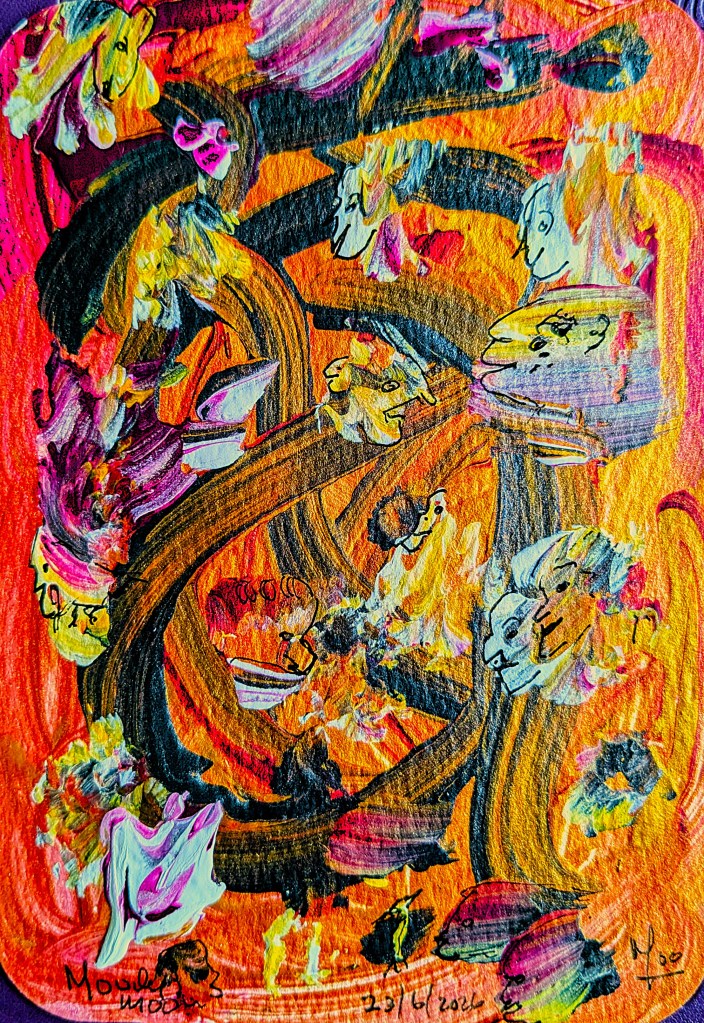
Moo is back painting and I am sure everybody is happy to hear that. Mind you, he’s a little bit on the Moo-dy side, if you know what I mean, as you can see from this painting. He calls it Moody Moo and he says it’s a Moo-d painting. He swears there’s a Moo Cow in it, but search as I have, I cannot see a Mrs. Moo. Let me know if you find one. Usual route – unless you have a drone of one sort or another. They have the road up leading into town and we had to wait a long time yesterday at the roadside while little men in yellow hats stood in front of the cars and wouldn’t let them move.
It was so bad, I put Pete Seeger on the disc player and turned the volume up full. “No pasarán, no pasarán, sang the Abraham Lincoln Brigade.” I thought it was rather funny. The person holding the placard that said STOP didn’t seem to be amused. I don’t if it was the volume. Maybe he spoke Spanish and knew all about the Spanish Civil War and how the Abraham Lincoln Brigade stopped Franco’s troops and wouldn’t let them pass! No pasarán, no pasarán – those yellow hatted road buccaneers certainly closed down the narrow straits that led to our house and they wouldn’t let anyone through. No pasarán, no pasarán.
Meanwhile, old Welsh logic – tomorrow never comes, because by the time it gets here, its today. “Good one,” says Moo, checking the way I have reproduced his painting. Oh yes, the original is for sale, Moo says – going cheap for a five figure sum. And that’s not counting the two zeros after the dot! I think Moo is really asking too much. OW! He just kicked me. Sorry, Moo. That’s a very fair price. Now he seems happy. But I don’t think you’ll get it. Now he seems sad – oh dear, just like I said – “Moody Moo”!
I’d better be careful, or he will be doing some Blue Moo paintings next, and he’ll be turning the air blue while he’s painting them. Meanwhile, speaking of AI – here’s the news that’s rolling round the rock at Island View. There’s a new book on the market. A limited Edition. Only 50 copies. Keep your eyes open. They will soon be a collector’s item. In fact, they already are. Go for it -Don Roger and Don Ryan. Oh yes. Moo did the cover painting for that one too. But he’s not selling it – he’s already given it away to another friend.
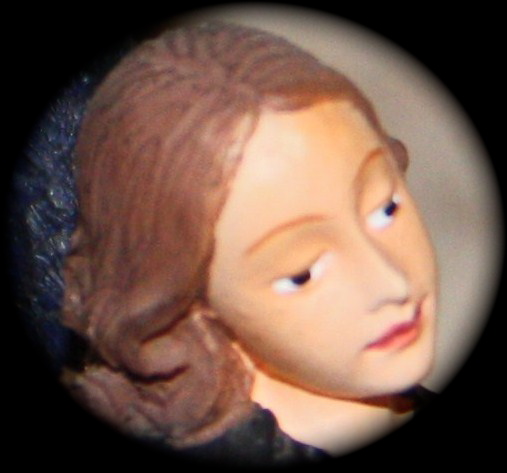
I first saw the Black Angel in Aldebarán’s cultural store in Ávila (2006). She sat there, in the shop window, along with several other angels, and I worshiped her from the distance of the street. Her image was taken from an original painting from Rogier van der Weyden (1399/1400-1464). This was turned into a 3-D image and then converted into the statue I saw in the shop window.
I brought the statue back to Island View, placed it on the shelf above the fireplace, where it still rests, and wrote several poems on the theme of Angels. I gathered them together in a chapbook entitled All About Angels that I self-published in Fredericton in 2009. The chapbook was dedicated to Clare’s great-aunt, D. E. Witcombe who departed this world on October 15, 2008.
All About Angels was also based on a book of a similar title, Sobre los Ángeles, written by Rafael Albertí, one of the poets of Spain’s Generation of 1927. I avoided the ambiguity of the Spanish title — Sobre (in Spanish) can mean Above or Beyond as well as About — by limiting my own title to All About Angels.
For Carl Jung, angels are the messengers sent to inform people of the state of their world. For me, they are also the wild creatures that inhabit the world around me and often take the form of birds and other spiritual creatures. They can be best seen in those moments of solitude when we are most open to the natural world around us. Then, and sometimes only then, we can hear the urgent messages they bring.
Black Angel
You cannot hide when the black angel comes and knocks on your door.
“Wait a minute,” you say, “While I change my clothes and comb my hair.”
But she is there before you, in the clothes closet, pulling your arm. You move to the bathroom to brush your teeth.
“Now,” says the angel. Your eyes mist over.
You know you are there, but you can no longer see your reflection in the mirror.
Angel Choir
(on seeing the Northern Lights at Ste. Luce-sur-mer)
listen to the choristers with their red and green voices light’s counterpoint flowering across this unexpected son et lumière we tremble with the sky fire’s crackle and roar
once upon another time twinned in our heavenly prisons we surely flew to those great heights and hovered in wonderment now our earthbound feet are rooted to the concrete if only our hearts could sprout new wings and soar upwards together
the moon’s phosphorescent wake swims shimmering before us the lighthouse’s fingers tingle up and down our spines our bodies flow fire and blood till we crave light and yet more light yet when the lights go out we are left in darkness
Croaking Angels
Their tunes are one note symphonies, croaks of joy moving their fellows to ecstasy, exhorting them to share the splendors of ditch life, in a springtime bonding that will loft them to the skies.
There’s an ancient magic in this calling: love and laughter, moonlight and water, all the joyous things one links with spring.
Moonlight swings its cheerful love lamp. New leaves and buds are also known to sing.
me crossing the bridge shaking sand from my sandals
a rare event Swansea Bay Station Cline Valley Line a train at the platform
the station master blows his whistle doors close slowly the train goes under the bridge
I stand in a cloud wrapped up half-blinded in huge puffs of smoke
filling my lungs assaulting nostrils and eyes with the sting of cinders the stench of burning coal
sting and stench and that short sharp whistle
they linger and cling unforgettable in my mind’s dark corner
Railway Bridge
2
walking away from Swansea sands
me crossing the bridge shaking sand from my sandals
a rare event Swansea Bay Station Cline Valley Line a train at the platform
the station master blows his whistle doors close slowly the train goes under the bridge
I stand in a cloud wrapped up half-blinded in huge puffs of smoke
filling my lungs assaulting nostrils and eyes with the sting of cinders the stench of burning coal
sting and stench they linger and cling unforgettable cobwebs in my mind’s dark corridors and never forget that short sharp whistle
Comment 1:
Me and my writing buddy also discussed linked poems. This is simply a chain in which each poem links back to another one. Yesterday, we wrote about Swansea Sands and how the poem was generated. Today we can look at the linking between that poem and this one, the old railway bridge that crossed the railway lines by Swansea Bay Station, and led back into Swansea, a town in those days, and the Civic Centre. Note, now, that each of those names could generate further links, further poems in the chain.
When we think of the great chain of being, we think of how all things are linked. From the Great Western Railway (GWR), to the Mumbles Railway, to the Cline Valley Branch line, and beyond. Each poem a railway station along the way. Main line, branch line, express train, goods train … links everywhere, and each link encapsulated in a memory of one kind or another. How could we not write poetry about such things?
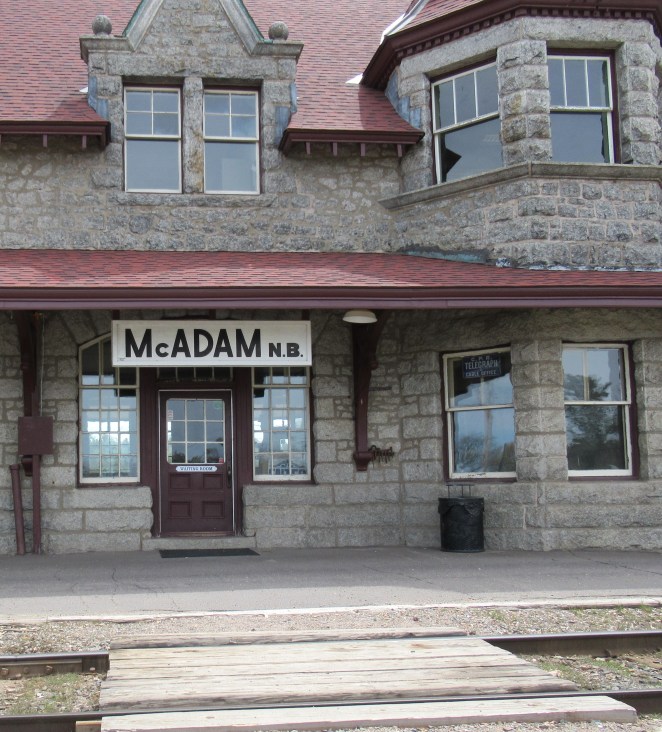
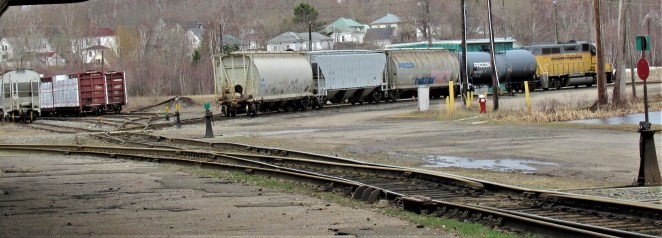
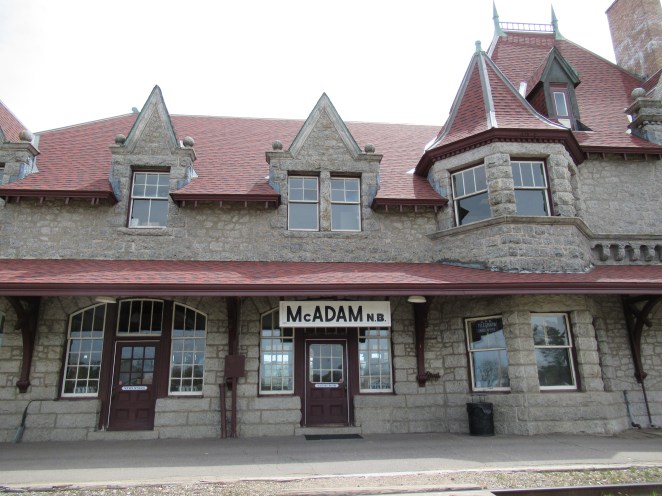
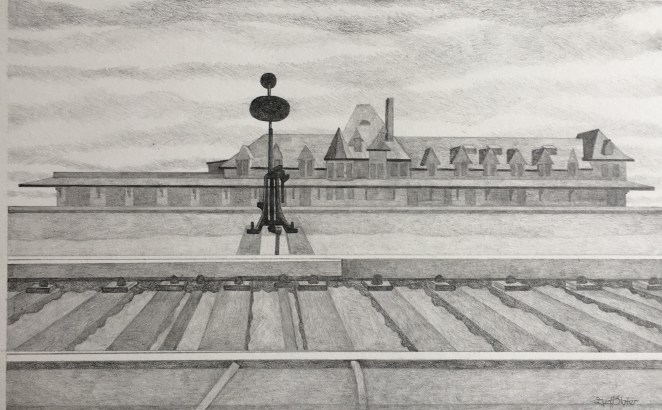
McAdam Railway Station, in New Brunswick, Canada. 60 trains a day used to stop here. Now the station is a landmark, a memory, a place where ghost trains run and shadowy figures run wild up and down the grass grown tracks where the sleepers sleep, their dreams undisturbed. I could write a book of poems about this station. Wait a second, I already have and Geoff Slater, my painting buddy, decorated it for me with his wonderful paintings and drawings. What more can I say? Each link in the chain, a potential poem. Each stop along the way, material enough for a painting, a poem, or a book.
Comment 2:
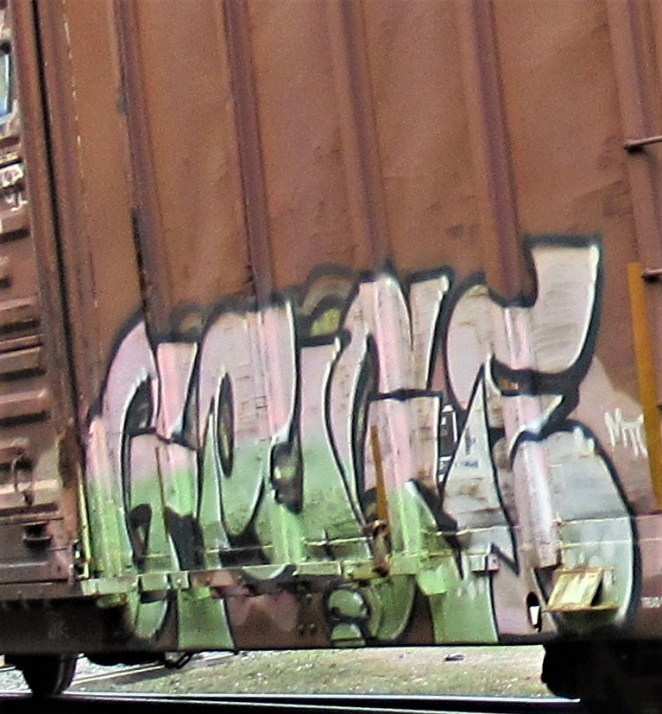
So, what happens when we change the photo? What if we add a branch line or two to the original poem? How does this affect our idea of creativity, poetic creativity? What happens when we add a different sketch from my painting buddy’s wonderful set of drawings? Oh-oh, that’s not my painting buddy – that’s a set of graffiti on a passing railway car. Sorry, painting buddy, please forgive me. But hey, wait a minute – de gustibus non est disputando – there is no arguing about taste. Somebody painted that box car and enjoyed doing it. Where does art begin? Where does it end? How formal can it be? How informal? How many railway stations do we stop at? I guess it depends on the length of the journey. But one thing I know, don’t get off the train until you reach your destination!
me crossing the bridge shaking sand from my sandals
a rare event Swansea Bay Station Cline Valley Line a train at the platform
the station master blows his whistle doors close slowly the train goes under the bridge
I stand in a cloud wrapped up half-blinded in huge puffs of smoke
filling my lungs assaulting nostrils and eyes with the sting of cinders the stench of burning coal
sting and stench and that short sharp whistle
they linger and cling unforgettable in my mind’s dark corners
Comment:
Me and my writing buddy also discussed linked poems. This is simply a chain in which each poem links back to another one. Yesterday, we wrote about Swansea Sands and how the poem was generated. Today we can look at the linking between that poem and this one, the old railway bridge that crossed the railway lines by Swansea Bay Station, and led back into Swansea, a town in those days, and the Civic Centre. Note, now, that each of those names could generate further links, further poems in the chain.
When we think of the great chain of being, we think of how all things are linked. From the Great Western Railway (GWR), to the Mumbles Railway, to the Cline Valley Branch line, and beyond. Each poem a railway station along the way. Main line, branch line, express train, goods train … links everywhere, and each link encapsulated in a memory of one kind or another. How could we not write poetry about such things?
McAdam Railway Station, in New Brunswick, Canada. 60 trains a day used to stop here. Now the station is a landmark, a memory, a place where ghost trains run and shadowy figures run wild up and down the grass grown tracks where the sleepers sleep, their dreams undisturbed. I could write a book of poems about this station. Wait a second, I already have and Geoff Slater, my painting buddy, decorated it for me with his wonderful paintings and drawings. What more can I say? Each link in the chain, a potential poem. Each stop along the way, material enough for a painting, a poem, or a book.
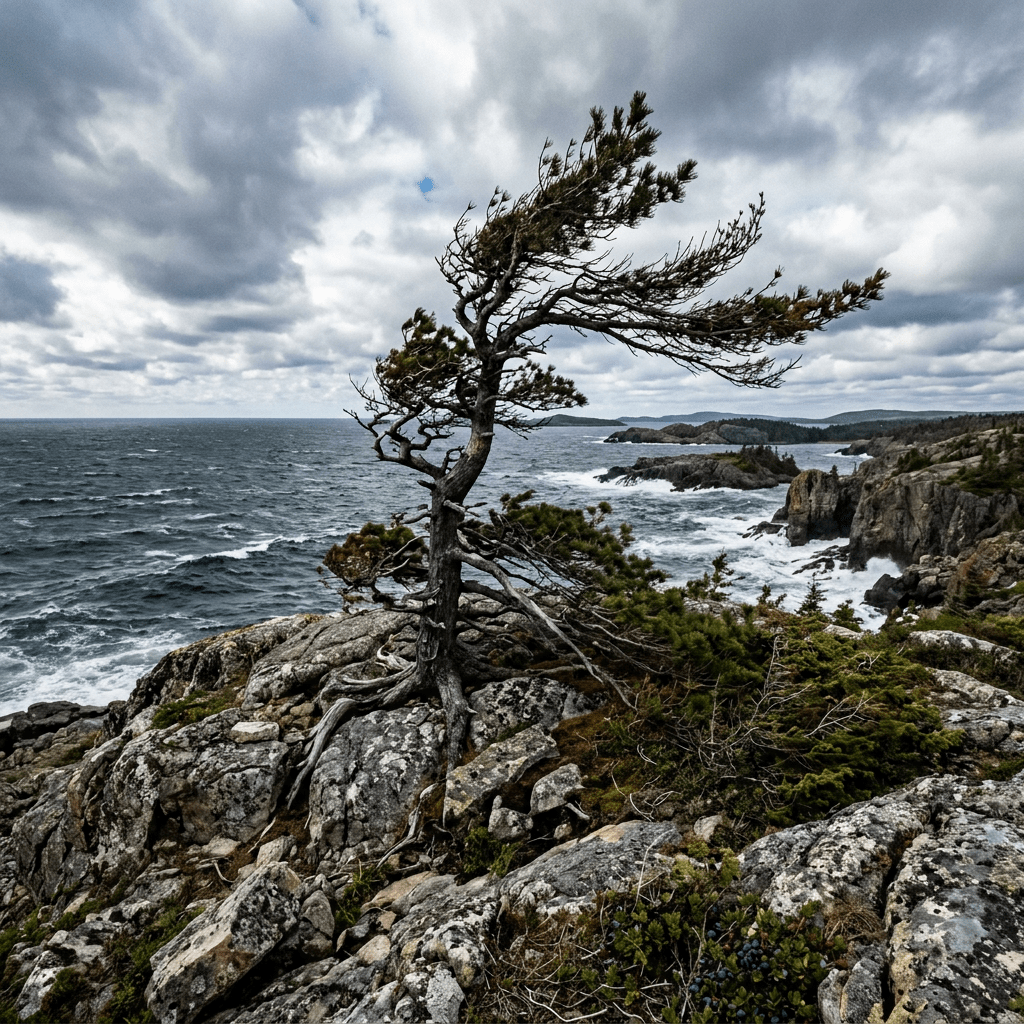
A lone, wind-shaped tree stands on rugged coastal rocks under a cloudy sky
Image generated not by Big Brother but by Little Brother who left the Frying Squad to become a painter and mind-reader
Waist Land
Jack Pine Sonnet
living in a waste land surrounded by books he writes in his journal things false and true in memory of the old days when the world seemed so new
a life built on sand slips through his fingers wouldn’t it be grand if the sand stays and lingers refusing to pass through the hour glass’ waist so time stops to flow
then he could say no leave me alone there’s more sand to fall I don’t want to go
Comment:
It’s a bit like a cliff-hanger, isn’t it? Hanging on by our fingertips and not daring to look at the depths down below. We know they are there, but look, there’s a tiny fossil in the fissure in the rock, so much older than us, we’ve got a long time to go to catch that up. And remember – 80 is not old, if you are a stone!
Treading air – great fun. Not as good as treading warm water in the local YMCA. Just a lovely sense of balance, floating there in the warmth, no weight on arthritic joints, and the world around us amniotic, as it was in the beginning. Ah, those original waters, we have all swum in them, the rich and the poor, the black and the white, and all shades in between. Even King Charles and the late Queen. And remember, they may speak of blue bloods, but all blood is red -and, if you cut us, do we not bleed.
Speaking of bleeding – blood-thinners – my favorite doctor’s latest joke. I cut my arm the other night, getting into bed. Didn’t even notice. Pillows and sheets soaked in blood when I woke up and my scalloped arm, stuck to the sheet, opened itself up and started to bleed again. Feels like seventeenth century Spain, the wounds of the dead man re-open and start to bleed when the assassin appears before him. Certain truth. Obviously 100% guilty.
And they tell me that in South Wales people are adding cooking oil to gasoline to make the petrol go further. Scotland Yard sent the Flying Squad to South Wales to sniff people’s exhaust pipes to see if they were cheating the tax man. I asked my friend – “Is this true?” “Ah, yes,” he said in his lovely Welsh lilt, “and we call them the Frying Squad!”


 rogermoorepoet