Railway Station 2

Railway Bridge

1

walking away
from Swansea sands

me crossing the bridge
shaking sand
from my sandals

a rare event
Swansea Bay Station
Cline Valley Line
a train at the platform

the station master
blows his whistle
doors close
slowly the train goes
under the bridge

I stand in a cloud
wrapped up
half-blinded
in huge puffs of smoke

filling my lungs
assaulting nostrils and eyes
with the sting of cinders
the stench of burning coal

sting and stench
and that short sharp whistle

they linger and cling
unforgettable
in my mind’s dark corner

Railway Bridge

2

walking away
from Swansea sands

me crossing the bridge
shaking sand
from my sandals

a rare event
Swansea Bay Station
Cline Valley Line
a train at the platform

the station master
blows his whistle
doors close
slowly the train goes
under the bridge

I stand in a cloud
wrapped up
half-blinded
in huge puffs of smoke

filling my lungs
assaulting nostrils and eyes
with the sting of cinders
the stench of burning coal

sting and stench
they linger and cling
unforgettable cobwebs
in my mind’s dark corridors
and never forget
that short sharp whistle


Comment 1:

Me and my writing buddy also discussed linked poems. This is simply a chain in which each poem links back to another one. Yesterday, we wrote about Swansea Sands and how the poem was generated. Today we can look at the linking between that poem and this one, the old railway bridge that crossed the railway lines by Swansea Bay Station, and led back into Swansea, a town in those days, and the Civic Centre. Note, now, that each of those names could generate further links, further poems in the chain.

When we think of the great chain of being, we think of how all things are linked. From the Great Western Railway (GWR), to the Mumbles Railway, to the Cline Valley Branch line, and beyond. Each poem a railway station along the way. Main line, branch line, express train, goods train … links everywhere, and each link encapsulated in a memory of one kind or another. How could we not write poetry about such things?

McAdam Railway Station, in New Brunswick, Canada. 60 trains a day used to stop here. Now the station is a landmark, a memory, a place where ghost trains run and shadowy figures run wild up and down the grass grown tracks where the sleepers sleep, their dreams undisturbed. I could write a book of poems about this station. Wait a second, I already have and Geoff Slater, my painting buddy, decorated it for me with his wonderful paintings and drawings. What more can I say? Each link in the chain, a potential poem. Each stop along the way, material enough for a painting, a poem, or a book.

Comment 2:

So, what happens when we change the photo? What if we add a branch line or two to the original poem? How does this affect our idea of creativity, poetic creativity? What happens when we add a different sketch from my painting buddy’s wonderful set of drawings? Oh-oh, that’s not my painting buddy – that’s a set of graffiti on a passing railway car. Sorry, painting buddy, please forgive me. But hey, wait a minute – de gustibus non est disputandothere is no arguing about taste. Somebody painted that box car and enjoyed doing it. Where does art begin? Where does it end? How formal can it be? How informal? How many railway stations do we stop at? I guess it depends on the length of the journey. But one thing I know, don’t get off the train until you reach your destination!

A Question for AI

A Question for AI

It is hard
to shed the skin
the skin once shed
can never
be worn again

Yesterday
is gone
today
slips slowly by

Tomorrow
always comes
but never arrives

Who and what am I
this child
who thrives on sorrow
and on a sadness

that grinds
those bones to dust
and soft silk ash

Tell me
if you know
what will arrive
for this child
tomorrow
if and when
it comes

Comment:

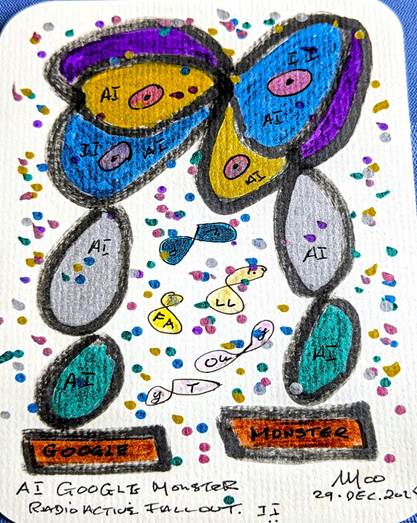
Moo is so happy when I don’t allow Ryan to persuade me to invite AI to paint my thoughts in pictures. “AI?” said Moo. “Have I got a painting for you!” And he showed me the AI Google Monster with its radio active fallout. “Nice,” I said. “I like the look and feel of that.” It looks like a two-eyed cricket bowling machine. It bowls Googlies out of the right eye and Chinamen out of the left one. Alas, we are no longer allowed to use the term Chinaman as it has been labelled ‘disrespectful’.

But what is a Googly? A Googly is an off-break bowled by a right-handed bowler with a leg break action. And a Chinaman is the reverse – a leg break delivered by a left arm bowler with an off-break action. Complicated? You bet it is. But AI and Google have demystified the mysteries of right and left arm wrist spin. Or have they?

It is one thing to know what they are – definition – but another to spot them as they leave the bowler’s hand, and yet another to play them as they whir through the air, then pitch and viciously spin. Of course, just to keep you up to date with Dennis Compton’s Three Card Trick, a top spinner, bowled with exactly the same action will come straight on and not turn at all.

It is hard to spot the spin when the ball is leaving the bowler’s hand, and the spin, once spun, can never be spun again! I am glad we sorted all that out. Oh sweet mysteries of the cricketer’s life. I once asked a top batsman how he spotted the difference between a leg- break, a googly and a top spinner. “I watch which way the stitches are moving when the ball leaves the bowler’s hand.” You need really good eye sight to do that. The Eggs Box, sorry, that’s the Two Ronnies, the X-Box will never do that for you.

But who is Dennis Compton and what is his three card trick? Good question. Dennis Compton, aka The Brylcream Boy, was one of England’s best ever batsman. You can look him up in the 1947 Wisden. Genuine paper pages, crackling as you turn them, much nicer than the metallic voice of AI. Compton was notorious for running out his partners with his three card trick – “Yes! No! Wait!” What do you mean, you don’t understand a word of what I am talking about? You’ve read Jabberwocky, haven’t you? Yes? No? Wait … if you haven’t read it you must do so. Immediately – but not if the slithy toves are gyring and gimbling in the wabe. Go Google it – and when you find it remember to sing “oh frabjous day, calloo, callay” as you chortle in your joy.

Past Glories Restored

Ryan and Don Roger

10

Past Glories Restored

            What is it about madmen like Don Quixote that they find it hard to live in the present and always want to see themselves restore past glories however impossible it is to do so? The search for the beauty and peacefulness of the past is always with us. Many seek the perfection of the Garden of Eden, but wise men know that Adam and Eve were expelled from the garden by an angel with a fiery sword, never to return.

            Jorge Manrique (1440-1479) begins his Coplas por la Muerte de su padre with the statement that “a nuestro parescer, cualquier tiempo passado fué mejor.” / It seems to us that any past time was better. Why do poets and madmen always look back to the past, all too often with a view to recreating that which can never be recreated?

            François Villon (1431 – 1463?) asks, in his famous refrain to La Ballade des Dames de Jadis – “Mais où sont les neiges d’antan!” / Where are last year’s snows! Indeed, the theme of ubi sunt / where is – where are is a constant throughout literature. And where is last year’s snow? Can you tell me? It certainly isn’t in our aquifer. I didn’t even use the snowblower last year. Tell me, where did the snow go? I live in Canada, and we didn’t see it. So where did it go?

            Marcel Proust (1871-1922) searched for those lost times in his novel À la recherche du temps perdu. This can be translated directly as In Search of Lost Time. It also occurs, more poetically as Remembrance of Things Past. Unfortunately, the word Remembrance rather cancels out the idea of Search, not to mention the twin ideas of recalling and re-establishing. However, in the case of the madman, Don Quixote, it can be argued that all those meanings are correct. But what exactly does Don Quixote want to restore?

            Above all, Don Quixote wishes to restore the lost age of knight errantry. He is besotted by the fantasy tales of these knights errant and believes that he can be one himself and restore their glory with the force of his arm alone.  In DQI, II/2, The knight addresses the ‘ladies of easy virtue’ at the inn in these terms: “I beg you, ladies, not to fly, nor to fear any outrage; for it ill fits or suits the order of chivalry which I profess to injure anyone, least of all maidens of such rank as your appearance proclaims you to be.’ His language, which was unintelligible to them, made them laugh more. So, knights errant protect women, especially damsels in trouble, and women of easy virtue. That is one of their most important tasks.

            In DQI, IV/4, our knight meets the boy, Andrés, who is being whipped by his master, the farmer. Don Quixote stops the thrashing and makes the man promise to pay the boy the wages that are owed him. The farmer promises to do so, but when Don Quixote leaves, he ties Andrés to a tree and whips him so soundly ‘that he laves him for dead.’ Protect the innocent, then, is another task, one at which Don Quixote fails miserably, as we will see later.

            In addition to restoring the high ideals of the ancient order of knights errant, Don Quixote also wishes to keep the words and deeds of the ancient romances / ballads alive, and this he does throughout the book. His constant quoting of passages and deeds from the books of chivalry, those that have driven him mad, serves to keep them alive. As we said earlier, you can burn the individual books, and destroy them, but you cannot destroy the ideas they contain. Don Quixote, in his constant and lively embodiment of those books serves to keep them, and their ideals and ideas, vibrant in the eyes and the minds of the readers.

            Cervantes, perhaps a wiser man than many, restructures the theme by rejecting it – no hay pájaros en los nidos de antaño / there are no birds in last year’s nests. However, as we shall see, it doesn’t stop Don Quixote the madman, from searching for the glories of past times and from fighting for them in an effort to restore them.

And don’t forget Guillaume Apollinaire (1880-1918), who perished in WWI – “Ni temps passés ni les amours reviennent / sous le Pont Mirabeau coule la Seine.” “Nor past times nor past loves return / beneath Mirabeau Bridge flows the Seine.”

Comment:

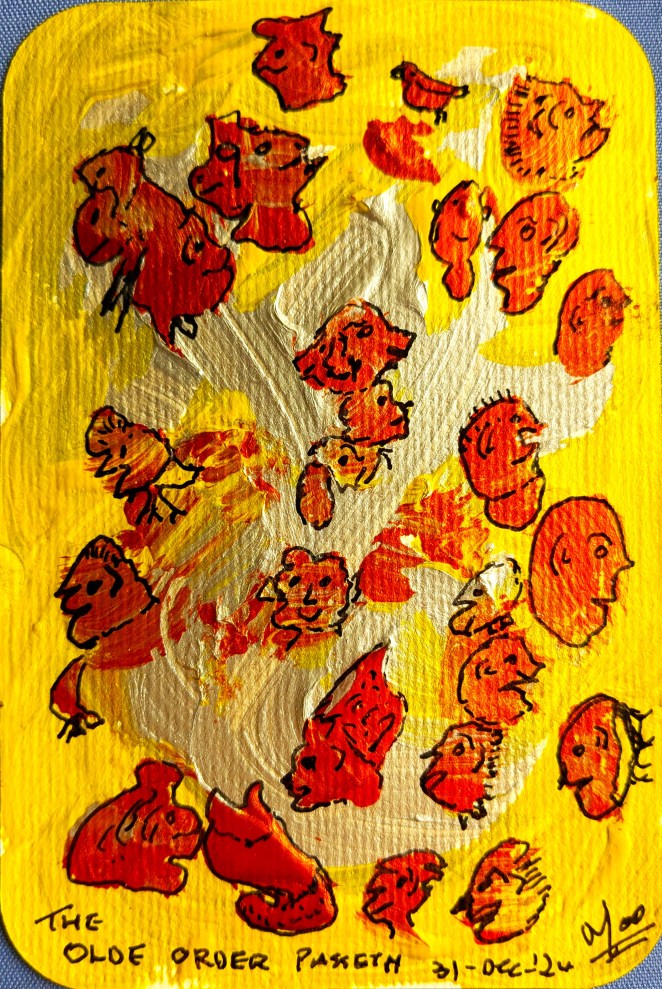
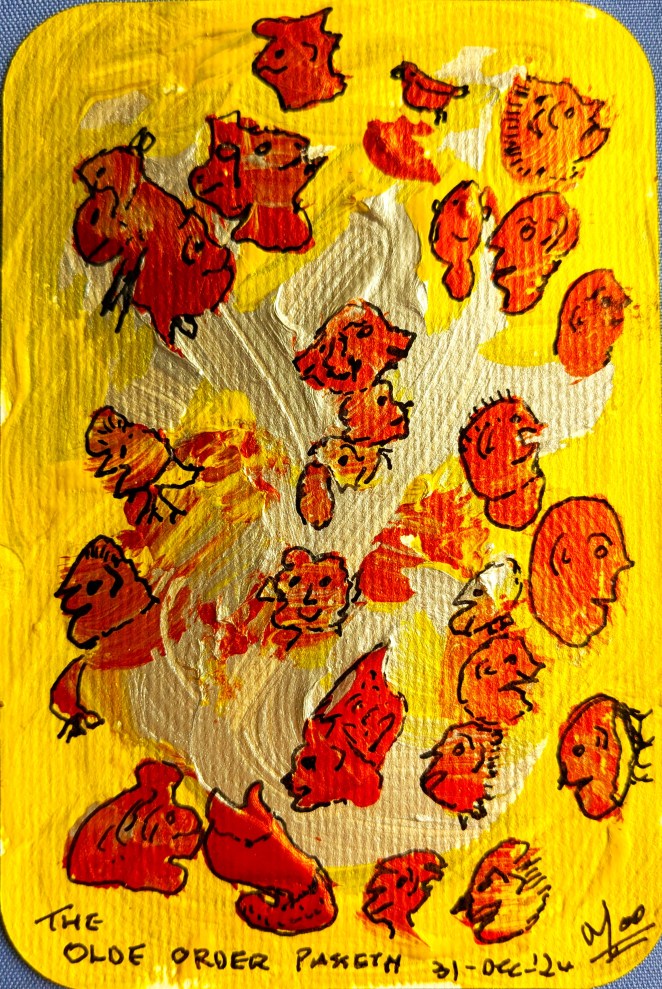
We don’t need a comment really except that The Olde Order Changeth Lest One Good Custom Should Corrupt the World. Interpret that as you will. And as Moo says to Ryan in the presence of Don Roger – “Hey, Ryan, look at all those changes in my painting.”

Rage, Rage 46 & 47

Rage, Rage
46

I fall into
the easy sleep of age,
pencil in hand,
notebook on knee.

Shadows grow longer
as my life grows shorter,
day by day.

Now it is so easy
to stumble and fall,
each slip a steep slope
down which I slide.

So difficult now
to regain my feet.

I must crawl to where
I can haul myself
first to my knees
and then stubbornly
upward until I can stand.

47

Now-a-nights
I fall easily into dreams
that all too often
turn into nightmares
that rise up from my past
to trouble my sleep.

I struggle and scream
and pinch myself awake,
only to find my cheeks
wet with tears and my mind
all shook up by the return
of childhood fears.

Freud and Jung pull the strings
of those mental puppets
that dance in my head.
Some nights I am afraid
of falling asleep,
for fear that I may never
get up from my bed.

Comments:

Coming to the end of Rage, Rage. When it is finished, that will also be the end of the trilogy – Clepsydra [Chronotopos I], Carved in Stone [Chronotopos II], and Rage, Rage [Chronotopos III]. I have written a fourth volume in the sequence – No Dominion [Chronotopos IV], but this is very personal and I will probably only share it with family members and the closest of friends. However, do not despair – I have an alternate fourth volume, but that is still being written. It us under wraps, and may well replace No Dominion. We shall see.

As for Freud and Jung, they certainly do pull the strings of those mental puppets that dance in my head. Moo says that there should be no strings attached. He has therefore drawn all those strange puppet like figures, a but like an Aunt Sally, really, but has left out the strings and the man / men / woman / women / people pulling them. An Aunt Sally or a lovely bunch of coconuts? Time well tell, if you ask it nicely.

Maybe one of my teddies will tell. They all romp around the room with me at night and I am sure they suspect much of what goes on in my dreams. Here they are – a selection of friendly teddy bears. Be very careful, though, they can be very grumpy, especially if you wake them up suddenly. They don’t like things that go BUMP in the night.

Rage, Rage 36 & 37

Rage, Rage
36

How many times
must I open these
Pandora’s Boxes
packed so lovingly
to give me the tests
I loathe?

Yesterday they gave me
a throw-away plastic potty,
and three wooden spatulas.

I also got
an air-dry sample card,
stamped and dated.

37

Today
a teenage apprentice
prompts me to reveal
my birthdate, then binds my arm
with a thick rubber thong.

She tells me to make a fist
and probes with blunt fingers,
searching in vain for a fresh vein
she can open to extract
and bottle a sample
of my precious blood.

I watch my body’s sap
pumping out
in irregular spurts,
driven by my heart,
that worn-out
flesh-and-blood machine.

Drip by febrile drip,
blood accumulates
and the teenager smiles
with youth’s perfections:
slim body, wit, and grace.

Now, my heart is once more
a time-bomb ticking
beneath her fingers.

Comment:

“Youth’s perfections: slim body, wit, and grace.” Those were the days, my friends, I thought would never end. Then I watched my weight rising, my body thickening, my hips and knees sticking. But I am still me – my own hair, my own teeth, my own limbs, creaky as they are.

I remember. back in the days, watching the TV series – $6 million dollar man.” remember him? Artificial everything and he could out run a car, out jump a kangaroo, outswim an otter, out fight the world’s greatest ever boxers, with one hand tied behind his back. Everything artificial. The willing suspension of disbelief.

Well, I called a couple of friends from my rugby playing days, and guess what? They were all in competition with the $6,000,000 man. An artificial hip… an artificial knee … an artificial shoulder. One of my friends, probably the best player of the lot, had a shoulder replacement, two hip replacements, and two knee replacements. Try going through a metal detector with that lot clanking like Don Quixote’s armor on a warm day.

And DQ was lucky. His magic balsam would heal a man, even if he had been chopped in half by a malignant giant with a sharp sword. Instructions to his squire – “if that happens to me, just join the two halves together as closely and as carefully as you can. Then sprinkle a few drops of the balsam on my body and watch how the two halves grow back together, almost instantly.”

Well, it doesn’t always work like that. I spent half an hour soaking my thumbs in hot water when I got them stuck together using some form of Crazy Glue or Gorilla Glue or Rhinoceros Glue or Elephant Glue or the like. Now there’s a magic balsam for you. However, don’t get into any hot water until the halves are well set and the flesh has grown afresh. Otherwise you might come apart in the bath!

PS Moo did not think this was an amusing piece. So he would only give me a very early cartoon of a ticking alarm clock – well, four of them. And each one set to go off at a slightly different time. Way to go Moo.

Rage, Rage 35

Rage, Rage
35

Now,
once a month, they stick
a needle in my arm
and check the levels
of my PSA, cholesterol,
and testosterone.

Is my blood pressure rising?
Is my cholesterol high?
Are my electrolytes
ticking slowly down?

The doctor keeps telling me
it’s a level playing field
but every week
he changes the rules
and twice a year
he moves the goal-posts.

What game is he playing?
A man in a black-and-white
zebra shirt holds a whistle
to his lips while another
throws a penalty flag.

It comes out of the tv set
and falls flapping at my feet.
Now I know for certain that
I’m living in the Red Zone
and I’m running out of time.

Comment:

Now, once a month, they stick a needle in me! Not always in the same place. But, I sometimes feel like a pin cushion. “The slings and arrows of outrageous fortune” have turned into the “probing instruments of innumerable doctors.” Try repeating those lines at speed and you will end up repeating the message, from lips to ear, like the battalions waiting to go over the top, used to do in the trenches of WWI.

Original message – “Send reinforcements, we’re going to advance.” Last message in sequence – “Send three and fourpence, we’re going to a dance.” Funny how times change. I am re-reading Don Quixote (yet again) and am bowled over by the length and complexity of the sentences. Then I realize how words, culture, times, and attitudes have changed. “Change and decay in all around we see…” – indeed we do.

How many people now know what ‘three and fourpence’ means? And how about LSD – and no, it’s not a psychedelic drug, it’s code for pounds, shillings, and pence. Well, for the original Latin terms for them anyway.

Oh the joys of AI – “The terms librasestercia (commonly sestertius), and denarius are the direct Roman ancestors of the British pre-decimal currency system (£sd), which was in use until 1971. The system was adopted from the Roman/Frankish model where a pound (libra) was divided into shillings (solidus) and pence (denarius).”

Oh the wonders of the British pre-decimal currency system (£sd). Four farthings = one penny; 12 pennies / pence = one shilling; 20 shillings = one pound; 21 shillings = one guinea. What fun we had adding and subtracting British coinage in those days, let alone multiplying and dividing for those wonderful state examinations.

Ah well, it’s all forgotten now, as are the jabs, the needles, and the tests. Anyone got a Wills’ Woodbine? Or a Player’s Navy Cut? And how about a Lucifer to light your fag? There weren’t any fags in my boarding school. Fagging was strictly forbidden. As was smoking. And drinking. And loads of other things that we did anyway.

Rage, Rage 10

Rage, Rage
10

My body’s house
has many rooms
and you, my love,
are present in them all.

I glimpse your shadow
in the mirror, and your breath
brushes my cheek
when I open the door.
Where have you gone?

I walk from room to room,
but when I seek,
I no longer find
and nothing opens
when I knock.

Afraid, sometimes,
to enter a room,
I am sure
you are in there.

I hear your footsteps.
Sometimes your voice
breaks the silence
when you whisper my name
in the same old way.

Comment:

Rage, Rage – and still I rage against the dying of the light and, like Dylan Thomas, ask the ageing of this world not to go gentle into that dark night. Yet, as my beloved and I age, we watch day’s shadows growing longer, and night stealing steadily along. What can we do?

Well, since the winter solstice, we can start counting the minutes as each day adds a minute or two and gifts some more light and strength to the sun. Sunrise today – 8:03 AM. Sunset today – 5:09 PM. That means 9 hours and 6 minutes of sunlight. Well, it would, if it weren’t cloudy, with a cold wind, and a dropping temperature. My guess is that it will get dark much before it ought to. And that’s not nice – no respect!

Of course, my beloved is a sun bunny and a Leo, and she perishes in these shortened days. I was born in them and they don’t affect me as badly as they do her. But I can still Rage, Rage, because there is so much to rage about – icy streets, the usual potholes, roads that hide ice beneath a thin covering of snow, some strange drivers who don’t seem to have bought winter tires. Oh yes, I love them. One came twisting and turning down the same side of the road as me only this morning. Luckily he hit the snow bank before he hit me. But, I ask you, what was he thinking?

So there’s Rage, and Rage Rage, and also Road Rage. Way to go! I think we should call a national rage day and all stay home for 24 hours, just to cool us all down for a bit. Oh dear, that might lead to cabin fever – and that would be an outRage.

Carved in Stone 61 & 62

Carved in Stone
61

Water through the water clock,
water off a duck’s back,
the waters of life,
continually flowing,
trapped in our children
and their children,
and the love we create
never lost, just circling,
like the hands of the clock,
like the planets and stars.

But who will wind up
the clockwork universe,
and tend the mechanism
that balances planets and stars?

What will happen
when the clockwork
finally runs down,
the last candle is snuffed,
and the water clock dries up?

62

Whoever, whatever remains
will be left to contemplate
Ozymandias with his two vast
and trunkless legs of stone,
standing in the desert.

“Look on my works,
ye mighty, and despair.”

Commentary:

“Look on my works, ye mighty, and despair.” Well, Moo does have a sense of humor after all. I thought he did. From Ozymandias to the meaning of “works” to the destiny of the work we did. What a journey. It goes from the joy of the children who build a snowman to the warm spring wind that melts him to the crows and the dog who do what crows and doggies do. Intertextuality – the links between verbal and visual and think about it – such strange things happens in Moo’s creative mind.

But what do we leave behind? Think about it. Only the wake of the ship in which we sail. The wake – that white trail we leave behind us, on the surface of the sea, slowly vanishing as we also vanish, pulling away into the unknown that always lies ahead. Moo is right – so many things disappear out of the frame of the painting. “There are no pockets in shrouds” said the preacher in the hospital where I took my father, so long ago for treatment.

And even if there were, how would you fit a snowman, several crows, a cardinal, and the rear end of a dog into the pocket? “Contemplate Ozymandias with his two vast and trunkless legs of stone, standing in the desert. Now contemplate the fate of the snowman. Now look on my works, ye mighty, and despair.”


Carved in Stone 43

Carved in Stone
43

Back home, in that little cul-de-sac,
the husbands are away,
working their night shifts,
while the wives are at home,
entertaining the truckers,
those long-distance drivers,
who park in that street and lodge there,
overnight, in the houses.

The children, boys and girls,
go out into the street,
climb into the trucks,
duck under the tarpaulins,
and, with all of us sworn to silence,
practice what their elders
are doing back home.

Commentary:
Monkey see, monkey do. And who knows what Monkey sees or does when the lights are turned out, darkness descends, and the honor of the blood cult takes control. Ask the animals, they will teach you. That was the motto of Bristol Zoo, where the Monkey Temple ruled, and Alfred the Gorilla and Rosie, the Elephant, were King and Queen of the beasts.

Knowledge – where does it come from? How do we attaint it? Is there a difference between knowledge, what is known, felt, and worked out for yourself, and education, when you obey orders and do what you are told to do (and how to do it). “We don’t need no education, we don’t need no thought control.” I have always loved Pink Floyd and The Wall. So many walls, so many barriers, so many things to break down in order to build them up again. Songs – Frank Sinatra – “I did it my way!” And who teaches what and to whom, underneath the tarpaulin when the lights are out? “Hey, teacher, leave those kids alone.”

And beware of anyone who tells you that “we teach you to think outside the box.” That person will only give you a slightly bigger box, of his or her own making, inside of which you will be forced to think.

Of course, there are other ways in which we can think about education. How about this one? Filling empty heads with knowledge. How many ways are there to do this? And what is the exact content of the jug from which the knowledge will flow? And how many sows’ ears does it take to make a silk purse? “Hey, teacher, leave those kids alone.” Giddy up, Neddy I’m on my hobby horse now.