For Yolande whose children left the same day as mine
the house’s silence speaks a dream language full of touch and tone and shared emotions that still reach out
floorboards creaking mimic the tip-toe dance of visitors now departed
the chair beside me at the breakfast table stands empty this morning
the armchair cushions in the tv room where they sat now sink beneath the weight of my hollow heart
Comment:
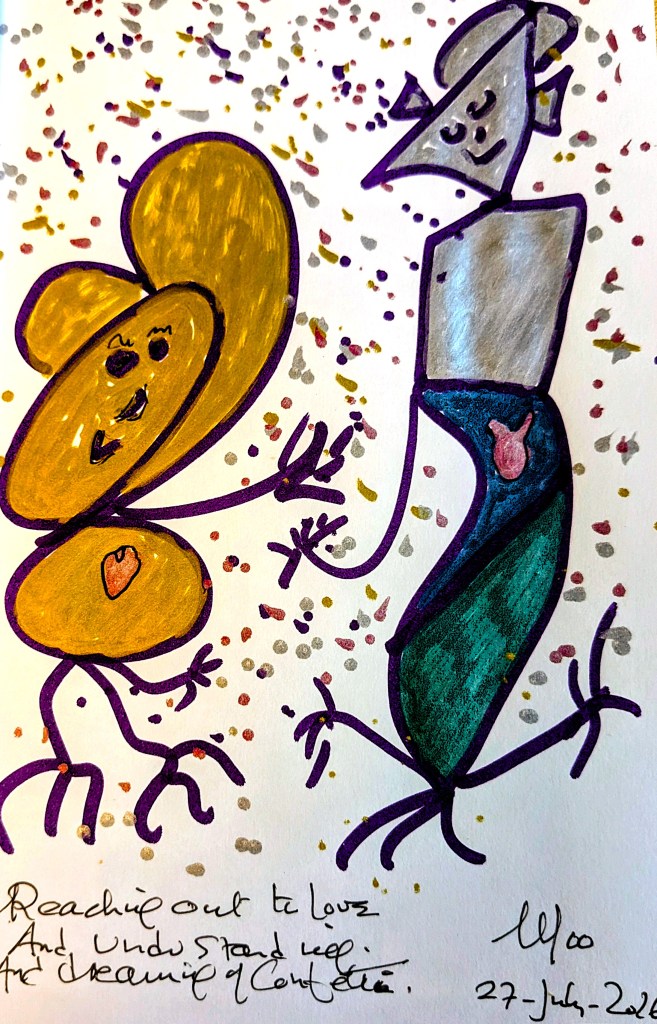
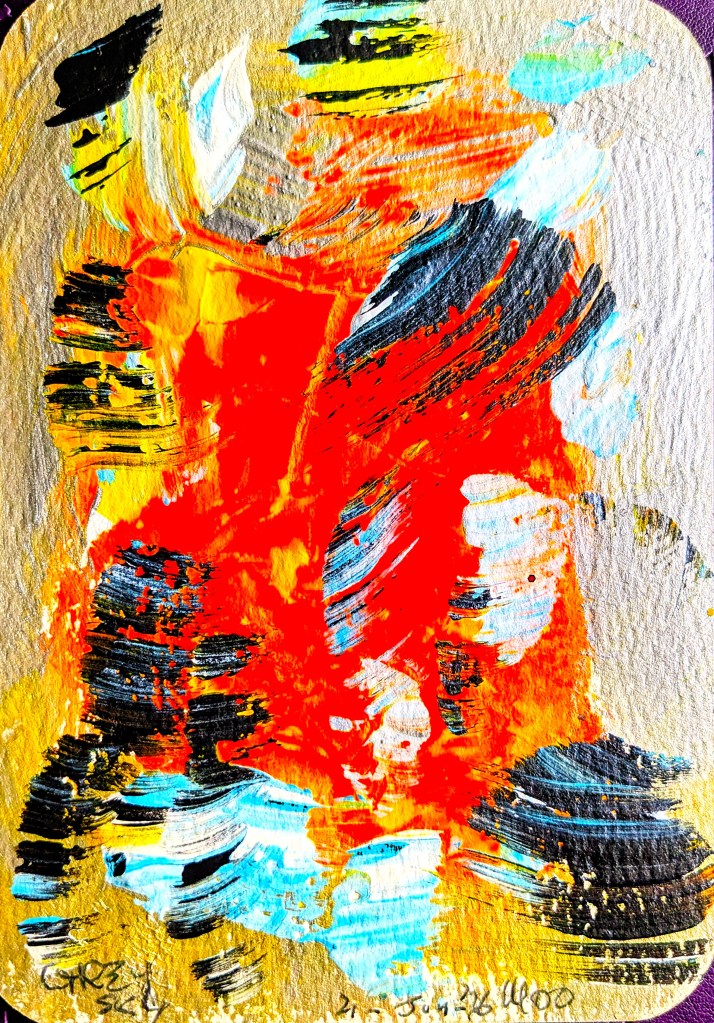
When Moo read this poem, he thought very carefully and, brow puckered, said “It’s not all bad. It’s not the dark night of the soul and I see Glimpses of blue sky. Here – this is the painting for that poem.” He gave me the one you see above, unsigned and unnamed. “I call it Glimpses of Blue Sky,” he told me.
Sometimes Moo can be very nice and sometimes he can be a pain in the you-know-what. I guess you’ve got one or two of those in your family too. Moody Blues, they are, who turn into Moody Moos, and act like sea-cows up at Skinner’s Pond, or else where on the Island. And no, that’s not the Island in Island View, not my Island View anyway, because here there are no Islands to be seen. We live on the far side from the river. The river – if this drought continues much longer, we end up with no river at all.
We used to get nine feet (three meters) of snow every winter. Two winters ago, I used my magic snow blower on three occasions. Last winter, I didn’t use it once. Jackie, my jovial black lab loved water. In the spring she could dive in the ditch and swim all the way around the block. Now the ditches run dry, the grass is gray rather than green, and the crab apples are about the size of raisins.
Global warming > climate change > climate crisis > climate disaster ….. you choose your own terminology, I don’t want to put words into your mouth, but don’t tell me that everything is business as usual and that there’s nothing to worry about.
A couple of our neighbors are worried about the aquifer we all share. They get dirty tap water. Wells are of varying depths. Several of the less deep drillings are showing sign of strain. And yes, the St. John River, the river that the local indigenous call the River of Plenty, is plenty empty right now and flowing very slow. The salmon disappeared a long time ago and now the waters are following them into oblivion.
Well, I suppose that is also a departure of sorts, a very worrying one for some of us. Moo can paint Glimpses of Blue Sky, but hard as I try, when I look at storm clouds building and the rain never falling, I find it difficult to see them.
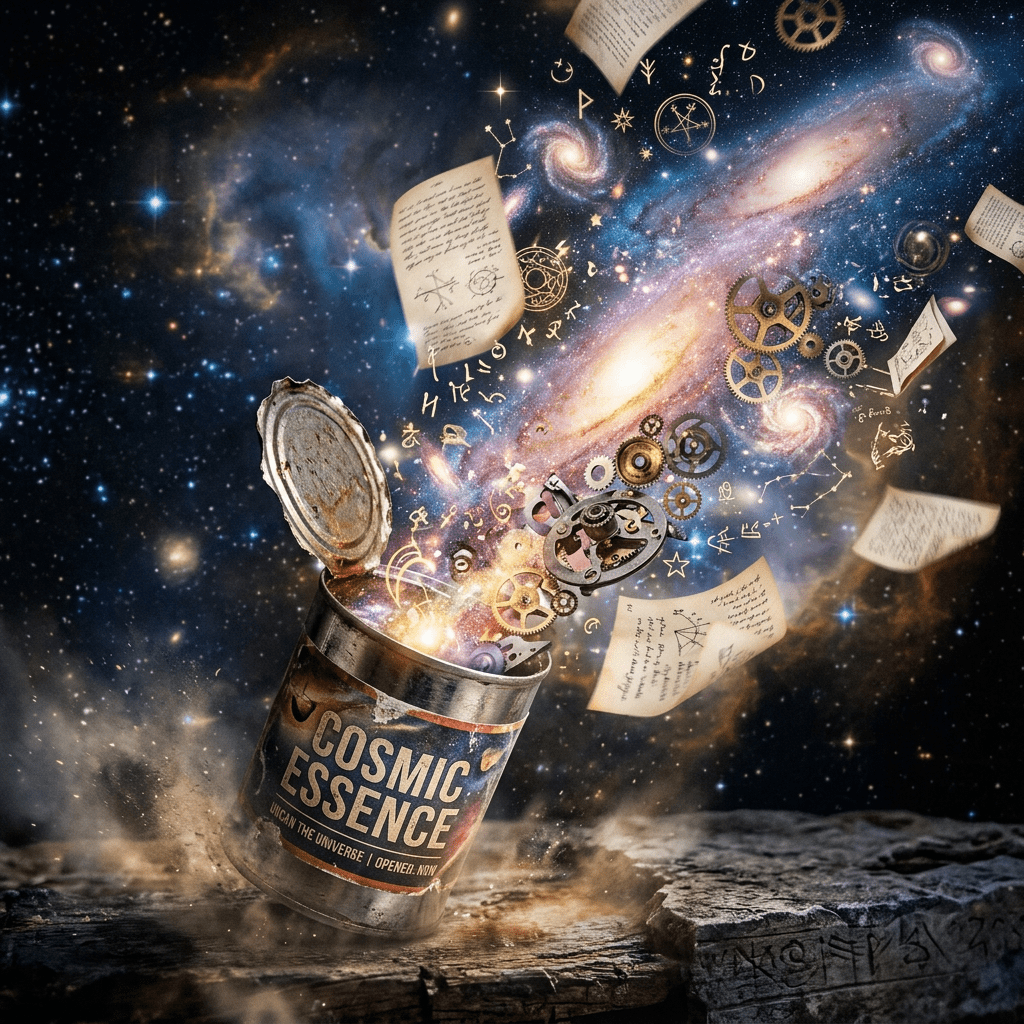
A weathered canister releases galaxies, gears, symbols, and handwritten notes into a star-filled universe.
Original Question –
Roger I have a question for you. Recently I purchased a book by Forrester- The African Queen. I enjoyed the movie years ago and thought I would like to read the story. The main actors were great. The book highlighted that it showed what it was like being a female during the war, (1) which when I look back on now is one of its main points.
My question or thought on this book is tied around the library system. When I lived in Fredericton I wanted to give a bunch of books to the library, their first question to me was, “How old are the books? I told her and she said anything over five years in not being accepted. (2)
I wondered about this and the fact that many books in school are being removed, (3) how can we tell how much we have progressed? (4)
I don’t like predjudice but it seems we are throwing out too much. (5) Any thoughts on this. I don’t mind some of the history being trashed (6) because for Canada the consentation is for Quebec and Ontario.
Roger’s Response
(1) It’s also about the role of the nun in society. How do ‘holy women’ function in a male society? It sets the questions but doesn’t really give the answers. It’s a long time since I saw the film. I don’t think I ever read the book – the themes might well change in print. They are present (some of them) in The Handmaid’s Tale.
(2) The library system seems to have rules and an etiquette all its own. When I donated books to the library, they accepted some for their collections, but set others up for sale on the book tables by the door. My guess is that certain books are ‘best sellers’ and will be read, others are ‘dust gatherers’ and won’t be. They want the former, not the latter. They also have specialized collections. If the books fit the specialized collections, great. If they don’t, then they hit the unwanted category and are moved on. This is particularly true of the UNB Library System.
(3) This is an entirely different question, and one with very deep roots. It deals, in part, with the question of control – quis custodiet ipsos custodies – who shall guard the guards, who shall program the programmers? By controlling what people read, you control their thoughts. One of the worst signs of this was the book burnings of the Spanish Inquisition (16th – 17th centuries). The Jews were expelled from Spain in 1492. (And the Arabs / Moors, in 1609). Prior to that, they were ‘processed’ by the Inquisition. The original Inquisition was Papal, and was aimed at instructing the priesthood in Rome. It was corrupted in Spain by the Spanish Inquisition, a sort of secret police, which worked rather like the Gestapo in WWII. One of their jobs was to ensure that people who had converted, stayed converted and didn’t revert to their old religion, even in secret. Another was to ensure that reading material, religious material, and cultural material, particularly after 1527 (Martin Luther and his 97 theses) when the Reformation started, were all in line with the accepted thoughts of the time. All books were sent to the Censor who vetted them and either approved them or asked for changes, if he (they were all men) saw the slightest sign of dissent or heresy. Don Quixote, Book One, Chapter Six (DQ,I,6), deals with the book burnings of DQ’s personal library. In certain of the States (down south) books are already being banned. One that touches us closely is the banning of Margaret Atwood’s The Handmaid’s Tale.
(4) “There is no earth, no heaven, no extended body, no magnitude, no place and that nonetheless I perceive these things and they seem good to me. And this is the most harrowing possibility of all, that our world is commanded by a deity who deceives humanity and we cannot avoid being misled for there may be systematic deception and then all is lost. And even the most reliable information is dubious, for we may be faced with an evil genius who is deceiving us and then there can be no reassurance in the foundations of our knowledge.” René Descartes (1635)
Descartes expresses this much better than I can. It is one of the major dangers of the age in which we live. How do we distinguish between reality and alternate realities? Which reality is the real reality? What is or isn’t fake news? How do we tell? Who do we believe, and why?
(5) Part of the problem is that ‘certain people’ – who don’t believe in science and who exploit people’s ignorance to their own advantage – are willing to destroy the foundations of our knowledge. Burn everything down. And start again. And the new starting point is to impose what they believe upon everybody around them. This is a huge and crucial question that threatens us, as individuals. It also threatens the foundations of our knowledge, as well as the very world in which we live – climate change vs denial of climate change – profits over people. Once one starts looking at the AI systems with their immense persuasive powers and their seemingly uncontrollable spread of Mis-information and Dis-information, then we start to realize how serious the problem is.
(6) Those who ignore history are doomed to repeat it – Santana (I think). However, we must, in certain circumstances, adjust our current beliefs to current realities. Immigration is a major issue – as is how we deal with people, like me, of different cultures and beliefs? Not everything written in the past suits our current world view. I have been looking at old Westerns – “The only good injun is a dead one” (John Wayne). Really? I know some wonderful people in our first nations communities and I have taught them and worked with them and been taught by them. “Shoot first and ask questions afterwards.” Really? I won’t comment further on that one… and there are so many others.
All of this comes down to the big question – freedom of information or the release of just enough information to persuade other people of what we believe and what we want them to believe. Power and Control. Knowledge is Power – Michael Foucault. Control that knowledge and you have power over the people. Noam Chomsky has written widely on this – and his books have been banned in the USA. Bertrand Russell too – The Meaning of Meaning, for example, and his establishing – along with A. J. Ayer – of the doctrine of logical positivism – the removal by means of mathematics of all the emotional content of words.
My friend, you have opened a can of worms.
Long may they wriggle.
Comment:
A series of questions that have recurred throughout the centuries. Well worth re-asking them and rethinking them. Times change and the answers often change with them. The image, incidentally, is AI generated, based on an examination of my written words.
A meaningless collection of notes swarms into my empty head swimming round and round like clustering tadpoles.
The ebb and flow of that mysterious music clumps on and on, tight in my mind and will not let me go.
Earwigs, some call them, those senseless repetitions, day after day, night after night, awake and asleep, old tv adverts, short clips of classical music or popular songs.
They are wheelbarrow songs, hedge clippings, dead flowers, crass grass, broken branches, weeds, repetitive memes of meaning, a syndrome of stuck songs destined for the garbage dump and ritual burning in the hell of an eternal turntable turning.
Comment:
Word magic from the Mikado – “My object all sublime I shall achieve in time, to make the punishment fit the crime” … And in this case I would tie the criminals who invented these ‘ballads, songs, and snatches’ to the stake, with earphones that endlessly repeated all the nonsense we hear day and night, so much of which sticks in the turntables of our brains turning round and round as we toss and turn in our beds at night. Just a case, I suppose, of hearing music while there’s no one there.
And how many earworms did you pluck out of that first paragraph? I can count six, maybe seven. Then, my mind may be very different from yours. Perhaps your mind isn’t in the outrageous Wilfred that mine is. Don’t get that joke, do you? And why should you? I guess you don’t remember Ray’s a Laugh, Round the Horne, Mr. Dimwitty, or Wilfred Pickles – and why should you.
Passent les jours et passent les semaines / ni temps passés ni les amours reviennent / sous le Pont Mirabeau coule la Seine– click on the link for the English version (my translation) and click on this linkfor a slightly improved revised version.
Yes, as Apollinaire says time flows on and by – or, after Heraclitus – you can never step in the same river twice. More important, perhaps, for those who worry about their past thoughts, words, and deeds – you can throw the stone into the pond, but you can’t control the ripples.
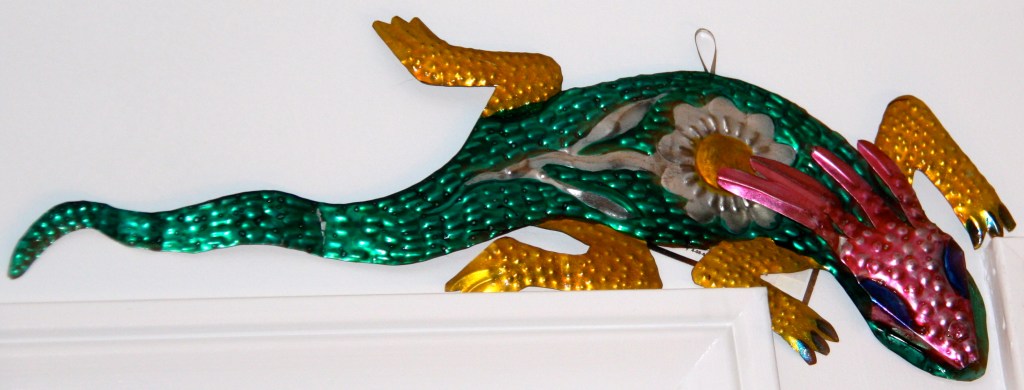
There are striations in my heart, so deep, a lizard could lie there, unseen, and wait for tomorrow’s sun.
Timeless, the worm at the apple’s core waiting for its world to end.
Seculae seculorum: the centuries rushing headlong. Matins: wide-eyed this owl hooting in the face of day.
Somewhere, I remember a table spread for two. Breakfast. An open door. “Where are you going, dear?”
Something bright has fled the world. The sun unfurls shadows. The blood whirls stars around the body. “It has gone.” she said. “The magic. I no longer tremble at your touch.”
The silver birch wades at dawn’s bright edge. Somewhere, tight lips, a blaze of anger, a challenge spat in the wind’s taut face.
High-pitched the rabbit’s grief in its silver snare. The midnight moon deep in a trance. If only I could kick away this death’s head, this sow’s bladder, this full moon drifting high in a cloudless sky.
Comment:
La poesía se explica sola. Si no, no se explica.
Pedro Salinas.
Poetry explains itself. If it doesn’t, it’s inexplicable.
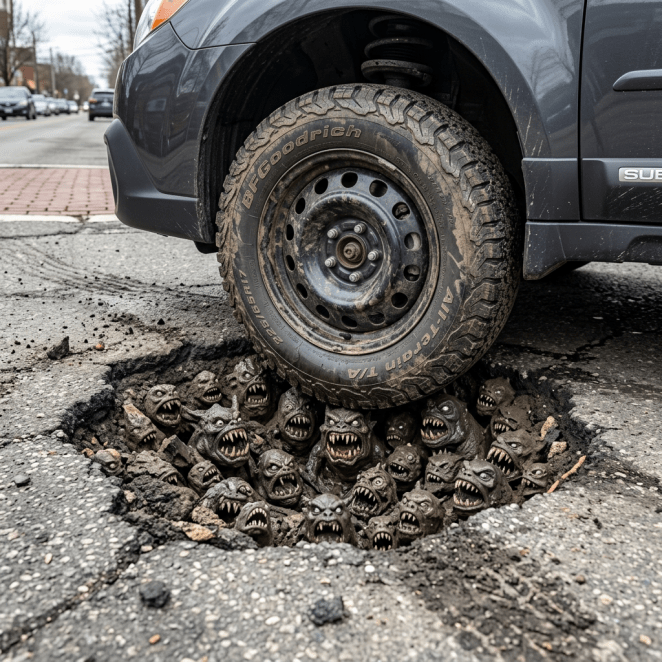
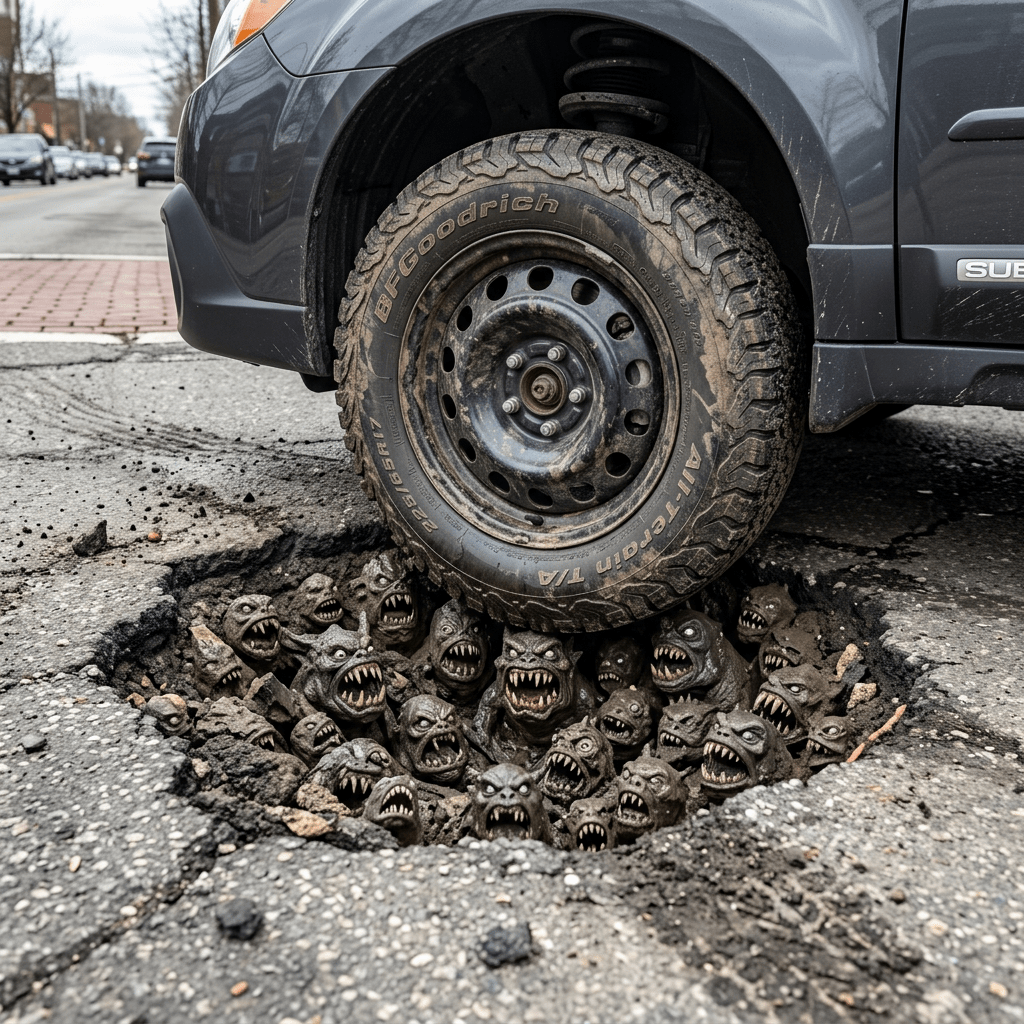
A car tire hovers above a pothole filled with snarling monster sculptures. Image AI generated.
Blood from Stones
The road ahead a bandage leaking grey blood from stones. The snow plow brutal, carelessly lifting scabbed edges until the gore overflows.
Spring always promises renewal, but freeze and thaw also open old wounds making them bleed.
A merry, mazy life we lead, threading the car’s needle through holes torn in the asphalt’s fabric.
Some holes are so large they have lives of their own, and names – Grand Canyon, Yawning Gap, Patty’s Peril, Big Bertha, each one well-known to neighbors.
Others are pornographic, their open orifices painted, laughing in scorn, dentated vaginas ready for anything.
Such decorated potholes are soon filled, their crude messages swiftly erased.
Comment:
Three flat tires in the last month and spring’s potholes still out there, waiting to trap me. Apparently, one neighborhood on the North Side of the river decided to decorate their potholes with pornographic drawings. These were swiftly filled and their messages totally erased. Alas, we on the South Side are not so daring. We don’t go out and paint our potholes. Personally, I wish we did. July – and many potholes are still there.
Not only that, the road into town is being repaired. Hooray! However, the tarmac was stripped off two weeks ago and has yet to be replaced. Boo! More than that, at the end of our street, just before the highway, one or two enormous potholes still gape. They lead directly to a dip that rises abruptly when it meets with the now stripped highway. A champion clunker that – a genuine tank-trap. I think at least two of my flat tires occurred after going over that one.
It reminds me of my grandfather’s stories about WWI and ‘going over the top’. Now, each time I approach it in the car, I call out loudly, “Look out, grandpa, here I come.” I call that particular pothole Grandpa’s Revenge. My own personal name. I don’t know what the neighbors call it. And I don’t know why grandpa is seeking revenge! But below the tires, the pothole awaits, gnashing its teeth.
Our world is spinning on its edge, placed on the perimeter of space, going who knows where.
Specks of dust, we float around and contemplate night’s wonders wondering what might happen.
Out there, in the vastness that surrounds us, worlds without end will never know we existed.
Bleak and blank our names, our deeds, our status, the monuments sometimes raised in our praise.
And what of our thoughts, those sparks of electricity that link us mind to mind?
Is each of our actions determined by a dance performed by circling planets that shape us?
Are we nothing more than a code of virtually meaningless dots and dashes?
Are we then pinballs bouncing between a million trillion strings of flashing lights?
What star god plays trivial games of snakes and ladders with our lives and names?
Commentary:
Moo’s painting is called Grey Sky with Bear Claws. He thinks it is a great companion to the poem. Actually, I rather think he likes to have his paintings published online without the necessity of lifting a finger to help. Oh dear – he heard that and just lifted his middle finger in my direction. “I am helping,” he said. “I also lift paint brushes. Remember that, you philistine.”
Philistine? Me? Now why would I be a Philistine? And what is a Philistine anyway? That’s where AI comes in. Thank you, Don Ryan. I wouldn’t know about AI without you. “And you wouldn’t know about painting without me,’ says Moo. “So tell me what a Philistine is,” I said to him. “Go look it up,” he scowled, wagging that finger in a menacing way. So I did.
AI to the rescue. A philistine is a person who is hostile, indifferent, or smugly oblivious to art, culture, and intellectual pursuits. The term typically describes someone whose interests are purely materialistic and practical, lacking any aesthetic refinement or appreciation for high culture.
Well, I don’t think that’s fair. Let’s see – hostile, indifferent, or smugly oblivious to art – no, that’s not me. I love Moo’s art, and he knows I do. I am not hostile to it at all, though I might be just a little teeny weeny bit hostile to him when I think he is lazy and doesn’t appreciate me. More – someone whose interests are purely materialistic and practical, lacking any aesthetic refinement or appreciation for high culture – no. I refuse to accept that. Purely materialistic? I give my poems away, free of charge, to my friends and anyone else who wants to read them. Moo isn’t materialistic either. He gives his paintings away to his friends. I know he does, because I have seen him do it. Come to think of it, I don’t think either of us is practical. We wouldn’t be living in Penury if we were.
Sorry. I won’t go any further. That’s all Isle of Wight Ferry, as they say in Hampshire. Well, I won’t call you a Philistine if you don’t know what they say in Hampshire. Okay – here goes. “What’s hot, black and smelly and comes steaming backwards out of Cowes?” Why, it’s the Isle of Wight Ferry, of course. Well, it was until they replaced it with a hovercraft. Now the joke [Cowes, the port / cows] doesn’t work any more. So, here’s a couple of questions at Philistine 100 level for you – (1) What have Margo and Reg got? If you don’t know, you’ll have to ask Stomping Tom Connors. And (2) what did Reggie give to Margo? Okay, okay. I give in. I’ll tell you.
Answers – (1) Margo’s got the Cargo and Reggie’s got the Rig. (2) A cowsy dungsy clock, of course. Made only in Canada. And you can check that one on AI too. And look up the song on YouTube while you are at it. Canada Day – July 1 – and Stomping Tom Connors is one of the best adverts for Canada. Go, check out his songs.
I see a face in the foliage. The Green Man of Wye stares out at me.
A light breeze moves his lips – what can he be saying? Sweat breaks on his brow – thin, drizzling rain.
Now I see other faces, all a myriad shades of green – young / old, male / female, sometimes somewhere in between.
They welcome this rain, fearing heat, as I do, parching them, making them thirst, and drying out the woods.
I sense their fear and I know how they fear that first spark of fire the worst.
Commentary
It has been a cold, damp spring and summer’s promised heat has not yet arrived. The result is a garden tinged with a thousand shades and hues of green. To many slight variations in color for my vocabulary to name them. Better by far this damp than last year’s raging heat that gave us the hottest summer ever with wild fires raging closer, ever closer.
They gave our subdivision a new name and placed us in a new area under new management. Early last year, before the heat really began, we received a booklet from our now community – What to do in case of forest fires. The first chapters provided some comfort – how to prepare three weeks ahead, one week ahead, three days ahead. But fear spreads s quickly as wild fires when we read – Evacuation – Three hours’ notice – Two hours’ notice – One hour’s notice.
It is amazing how little you can pack into one small car when you have only an hour in which to prepare and gather your things. Frightening. Very frightening. How much can you take? What must you leave behind? Which are your safe exits? Do you actually have an exit?
Dreams are important in Oaxacan mythology. Do we create them ourselves? Or do they come to us as celestial messages? Can they exist without us? Or do we form a symbiotic relationship each dependent on the other?
Eight Deer or Tiger Claw / Ocho Venado or Garra de Tigre is a Mixtec Hero; his name is composed of two parts: (1) day name (ie the name of the day on which he was born) Eight Deer and (2) nickname Tiger Claw. His symbol in the códices is a small circle with a comma like a tiger claw. Nuttall is the twentieth century editor of the Zouche Nuttall Codex in which Eight Deer’s history of conquest is recounted. Nine Wind / Nueve Viento is another Mixtec Hero and the founding father of the race, according to some códices.
Once I stole the nose from a sacred statue; today I watch it cross the square attached to a face.
Eight Deer walks past with a fanfare of conches: you can tell him by his donut with its little tail.
A shadow moves as zopilote wings his way across the square. I caught him once on a midnight bus; he begged me to fold his wings and let him sleep forever.
A gringa called Nuttall sells tins of watery soap. Her children fill my days with enchantments: bubbles born from a magic ring.
Eight Deer, eight years old, sets out on his conquests. Nine Wind births his people from a flint, or was it the magic tree in Apoala?
The voices in my head slip slowly into silence. Sometimes I think they have no need of me, these dreams that come at midnight, and knock at my window.
A car tire hovers above a pothole filled with snarling monster sculptures.
Big Sister replaced Big Brother and generously generated this image
“Watch out for that pot hole!” “Which one?” Snap, crackle, pop! “That one.”
Pot Holes
Jack Pine Sonnet
Welcome to Pot Hole time. It’s all yours and it’s all mine. Mine, possession, not land mine, though hitting one at speed will rattle your teeth, shake your spine, and leave you feeling far from divine.
Pot Holes, Pot Holes, everywhere, filled with water you can’t drink. They hide the depth of every hole with waters, dark as ink.
Spring’s freeze and thaw breed ever more Pot Holes than we had before. I think at night they stay out late, to fornicate, and celebrate.
A low spring sun in the driver’s eyes makes shadows shift and slide.
A mazy life full of chance drawing a labyrinthine thread through a maze of Pot Holes that we dread, the morning sun blinding our eyes so we cannot see the Pot Holes’ size nor how they move and dance.
Big Sister replaced Big Brother and generously generated this image
Comment:
This is wonderful fun. Moo has ceased to be jealous of Big Brother and Big Sister with their attempts to read my mind. And what a great job they do of it. All in the cause of the Pot Hole Dance Season. Have you seen the Pot Holes dance? You know, one minute there isn’t one and about and then a split second later – CLANK! The dreaded tire pressure light comes on. You turn it off. It comes back on. You turn it off. It comes back on.
You stop the car at the roadside, turn off the engine, get out, and check the tires. They look all right. You kick them or tap them with a stick. They all sound all right and they all sound the same. You get back into the car. You start the engine. All the lights come on. All the lights go off. Except one – the dreaded tire pressure light. Well, I can swear pretty well in about five languages. I turn the tire light off. Wonder of wonders, it goes away.
I am so happy. I turn on the radio. I clap my hands. And CLANK! I drive into another Pot Hole that appeared from nowhere and walked or danced or shimmied or slithered into the road right in front of your car. You guessed it – and the tire pressure light comes on!



 rogermoorepoet