Sun’s yellow duster arrived late this year gray cobwebs still clutter my mind
I try to brush them away with clumsy fingers but stubbornly they stick and cling and will not go
Spring came in with snow gales and icy rain
Warm winds will soon spring showers bring to revive cold clay and help things grow
Comment:
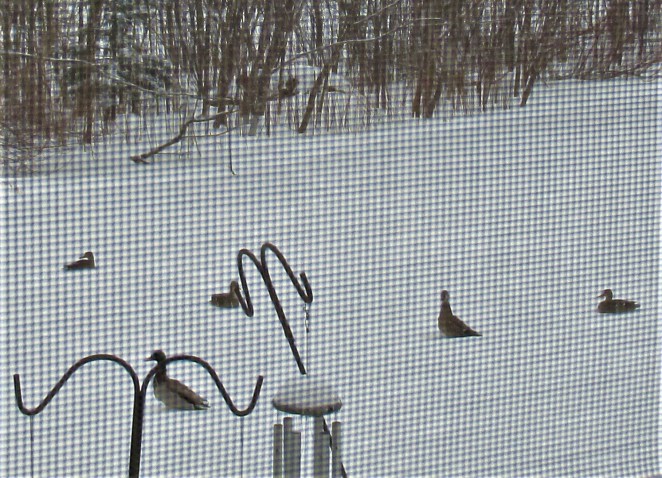
We have lived in this house for 37 years, but only once have I seen ducks land on the snow-covered lawn. Whatever were they thinking? Good question – do ducks think? They are living beings, so of course they do. But I am totally unaware of what they think nor am I able to understand the nature of their mental computations.
We share this world with so many creatures that we do not understand. I wonder sometimes if they understand us. Who knows? If we cannot speak their multiple languages, if we cannot enter their culture and their minds, if we see them as nothing but food and devour them as fast as we can, never thinking of them at all, save as more or less savoury items on our dinner plate — les meurtiers et les victimes, as Albert Camus wrote. Murderers and victims – and we are both. Murderers of our victims and victims ourselves to our unbounded greed.
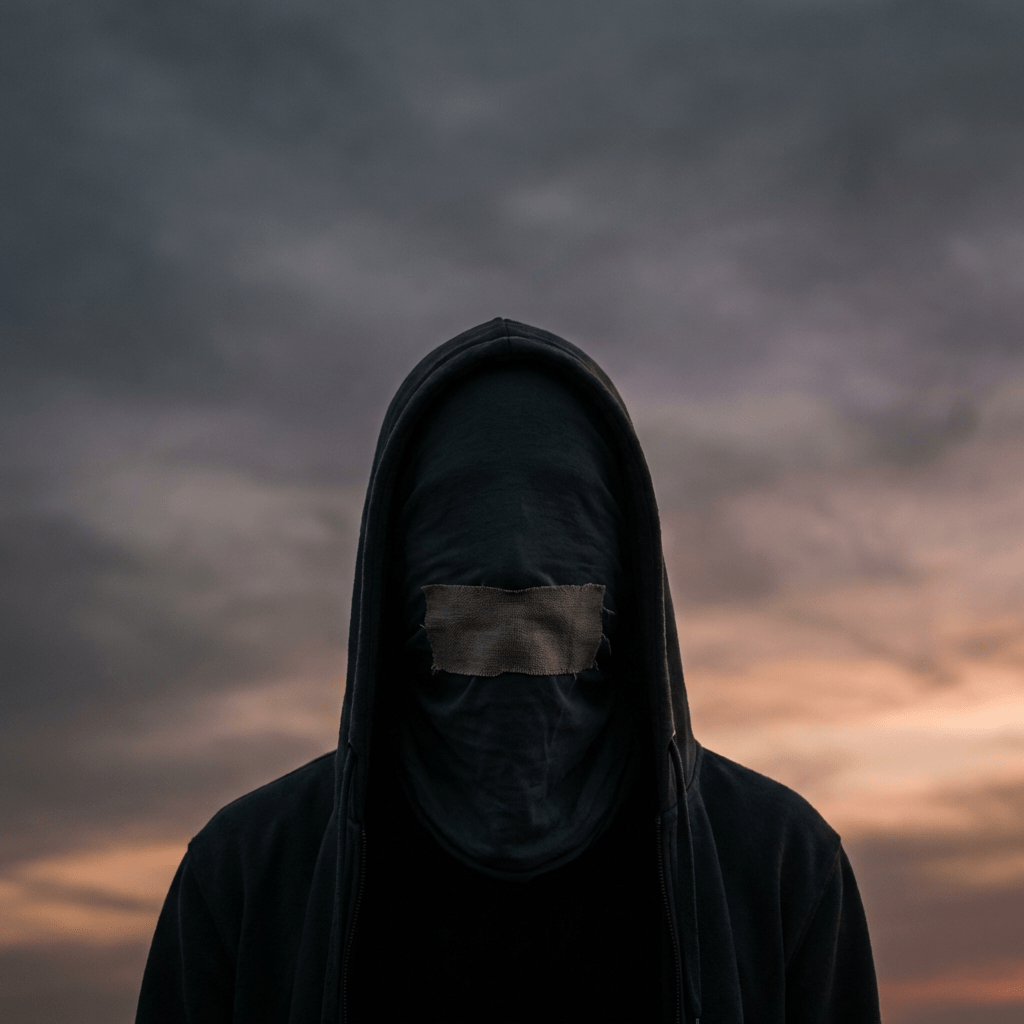
A hooded figure stands with a taped mouth in this powerful depiction of silenced expression.
Image generated by AI
Ryan and Don Roger
6
Censorship
Censorship plays an important part in many societies and can take multiple forms. The Spanish Inquisition, for example, along with book burning, played a powerful role in the printing industry. Every book had to be examined and approved by a member of the Inquisition. Political correctness is itself a form of censorship. It encourages people to think about what they say and how they are saying it. Many sorts of political correctness arise from the feminist movement that began to question the male domination of the English language. Actors and actresses became actors. In cricket, wicket-keepers, bowlers, and fielders passed the linguistic test, but batsmen and batswomen became batters. I sincerely hope that glove men, for wicket-keepers, do not turn into glove persons.
Nowadays, some people feel that the correction of language has gone too far and this has resulted in the anti-woke movement, as it is called. This rejects both the correction, and the hyper-correction, of what some people call imbalances in language, culture, and society. I will self-censor myself, rather than being censored by another person or persons, and refrain from what I personally feel about these ideas. Here, I merely point out that they exist.
Lazarillo de Tormes, for example, was heavily censored by the Spanish Inquisition. All anti-clerical references in the original edition, and there were many of them, were removed. The resultant volume, heavily redacted and much smaller, became known as Lazarillo Castigado / Lazarillo chastised.
To the best of my knowledge, the only piece removed from Don Quixote was the episode in which he made a rosary from the tail of his shirt, by tying ten small knots in it, and one large one. Since the shirt tail was used for many purposes, including wiping oneself, the censor thought this idea was indecent. Cervantes replaced the shirt tail with ten acorns and a chestnut in later editions.
He also managed to escape censure by placing all his questionable statements in the mouth of a mad man. Whenever an anti-clerical comment was made, readers (and listeners, for in those days, not everybody could read), chuckled at the enormity of the statement and rejoiced in the fact that only a madman could say such things.
Together with censorship comes correction. Thus Sancho, who is illiterate and can neither read nor write, is also unable to spell. In this fashion, he offers a series of incorrect pronunciations and phonetic equivalents that Don Quixote joyfully and carefully corrects. We see this in other characters too. In DQI, VII or 7, the devil named by the housekeeper, becomes ‘the sage Muñaton’ in the mouth of the niece. Don Quixote changes this to ‘Freston’. The housekeeper continues with ‘Freston’ or ‘Friton’ and adds “I know only that his name ended in ton.”
In our modern society, I see an enormous change taking place. Where I was educated by reading books, many books in my case, today’s younger generation teach themselves via AI and Chat. They watch videos. Watch TV. Text on cell phones. They listen to multiple podcasts. All this is audio-visual, little of it is written down. As a result, essays I received from my students were filled with phonetic spellings of words that they had heard, but not seen in written form. In addition, schools are no longer teaching cursive. My grand-daughter can print. She can neither read nor write joined letters. However, she can text faster with her two thumbs than I can with my index finger! The new generations have entered an electronic world that is totally alien to me.
Quis custodiet ipsos custodies? Who shall guard the guards? Who shall police the police? Who shall program the programmers? And with what shall they program them? A long time ago, the BBC in England banned Sesame Street because it was too simplistic. Today, Sesame Street equivalents rule. So, let us extend our questions – “Who shall censor the censors?”
Sometimes, it takes a madman to do it, in our case, a madman called Don Quixote! He, in his madness, encourages us, nay (or as Rocinante might say ‘neigh!’), he forces us to re-examine our links to language, to reality, to illusion. Reading his text, we learn to ask questions of the world around us. How many of our realities are illusions? How many of our illusions are corruptions of reality? How many times has Don Quixote been banned by figures in authority because of its attacks on authority?
Quis custodiet ipsos custodies? Who shall guard the guards? Who shall program the programmers? “Who shall censor the censors?” And who will protect us if we speak truth to authority, and authority doesn’t like the truths we offer? The author of Lazarillo remains anonymous. Cervantes distanced his words from himself and put them in the mouth of a madman. Other people have taken evasive action in other ways.
The alternative – stay silent and bleat with the sheep – “Four legs good! Two legs bad!” And when the Mastiffs with their spiked collars come for us, we can always, like the sheep, change our chant. “Four legs bad! Two legs good!” After all, all sheep are equal, even when some sheep are more equal than others, and all of us can imagine we are animals on George Orwell’s Animal Farm – and then we can say what we want and nobody will listen, nobody will pay attention, and nobody will understand. And remember, somebody, somewhere will want Animal Farm banned. And 1984.
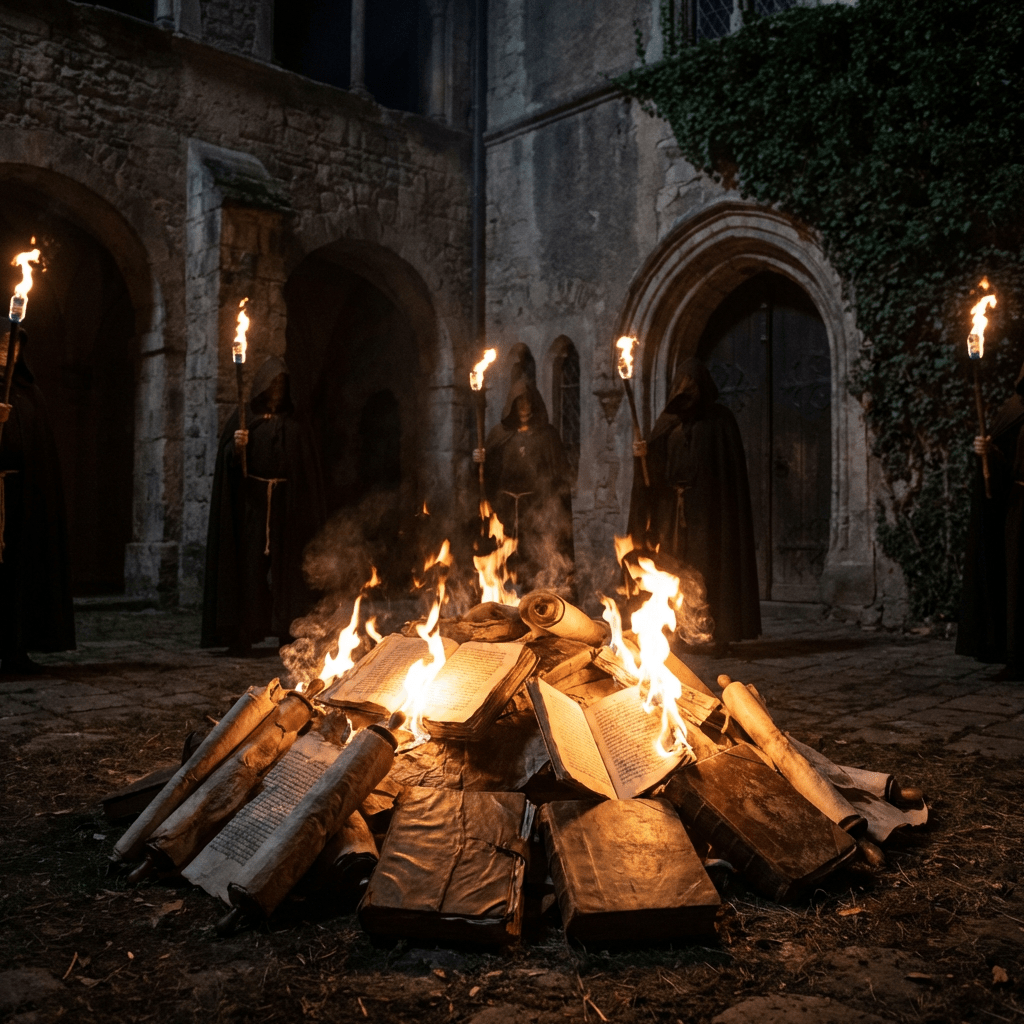
A group of cloaked figures stands in a dimly lit stone courtyard as they burn ancient scrolls and books in a large central fire.
Image generated by AI
Ryan and Don Roger
5
Book Burnings
In 1492, the Spanish Jews were given the choice of conversion to Catholicism or of being expelled from Spain. Many chose to leave. Those who converted, and remained, were kept under constant supervision. In an effort to stamp out their faith, their books were condemned to the flames by the Spanish Inquisition. A similar burning of the books in Don Quixote’s library occurs in DQI, 6. Is book burning effective? Some people think so. Other people aren’t so sure.
The Spanish conquest of Mexico, led by Hernán Cortés, concluded on August 13, 1521, when Spanish forces and their native Tlaxcalan allies captured the Aztec capital of Tenochtitlan and emperor Cuauhtémoc, marking the end of the Aztec Empire and the beginning of Spanish colonial rule. The country was then called New Spain.
Mexico is famous for its codices. These are fan-fold picture histories, drawn on vellum covered with gesso, of tribal conquests, social norms, tables of the gods, in fact a whole cultural and historical record of pre-Hispanic Mexico. The Zouche-Nuttal codex, for example, sets out the conquests of Ocho Venado / Eight Deer, nicknamed Garra de Tigre/ Tiger Claw, a Mixtec warrior, who lived between 1063 and 1115. Five of the Mixtec codices survive. Many, many more were burned. The cover of the Vindobonensis shows the burn marks where some daring person pulled the codex from the flames and saved it. Without such saved codices, we would have much less knowledge of pre-Hispanic Mexico.
Why is this anecdote important? Because prior to the invention of printing, in 1474, manuscripts were written by hand. Yes, some were copied, but many copies were single and unique. Burn the manuscript, destroy the knowledge it contains. Post 1474, with the printing of multiple copies of books, the individual book might be destroyed, but some books would survive from the printing sequence. Apply this to Don Quixote’s library and we note several things. First, Don Quixote’s copies are destroyed. Second, other copies of his books survive elsewhere. In addition, although Don Quixote’s books are burned the ideas in those books survive in the knight’s head and he lives by their rules. Those ideas are spread throughout the history of his adventures to everybody with whom he comes in contact. Conclusion – you can destroy the books. You cannot destroy the ideas that those books contained.
Ray Bradbury, in Farhenheit 451, describes the burning of books in his dystopian novel. 451F incidentally is the temperature at which paper burns. The books are burnt in Bradbury’s world, but the book people survive. The book people are those who memorize their books and are able to quote them from memory and pass them on orally to other people.
And people protect their books. How? By placing them in small rooms within their houses and walling up those rooms so that the books could not be found. This happens in DQI, VI – 6. Don Quixote awakes, goes to find his library, but it has disappeared. The housekeeper swears that a sage enchanter descended on a dragon and the library vanished in a puff of smoke. Don Quixote believes the metatheatrical lie and acts as if it were the truth. He then bemoans the fact that he is pursued by malignant sorcerers. These evil enchanters will pursue him throughout the novel whenever he wakes up from his illusions and is faced by reality. Clearly, the sage enchanters have robbed him of his moment of glory (illusion) and reduced him to sorry (the truth).
Curiously enough, a 16th Century walled-up library was found in a house in Barcarrota, Spain not so long ago. The books were hidden, probably from the Inquisition, so that their owner could escape prosecution. The discovery sheds light on how individuals hid literature from the Inquisition during the 16th century in Spain. It also illustrates how closely Cervantes followed the reality of his times when writing the Quixote.
You can destroy books. But it is very difficult to destroy the ideas they contain. In this fashion, although the burning of that one book ends the life of that particular volume, it rarely ends the life of the ideas contained within its covers. We might not recognize the names of the characters that Don Quixote quotes from his memory of those histories, but many of the people who encounter the knight during his adventures know them and remember them. Amadis of Gaul is never dead, not when his name lives on. The same is true of King Arthur and his Knights of the Round Table. King Arthur is said to fstill be alive and can be seen in the shape of a White Crow, bran gwen, in Welsh. And even Walt Disney knew, and profited from, the legend of the sword in the stone.
We will also see, as we continue our journey, that in the same way that tall oaks grow out of small acorns, large parts of later events found in the Quixote already have their seeds sown in these early chapters. Metatheatre, illusion and reality, authorship and censorship, truth and falsehood, waking events and dream sequences – and that is just the start.
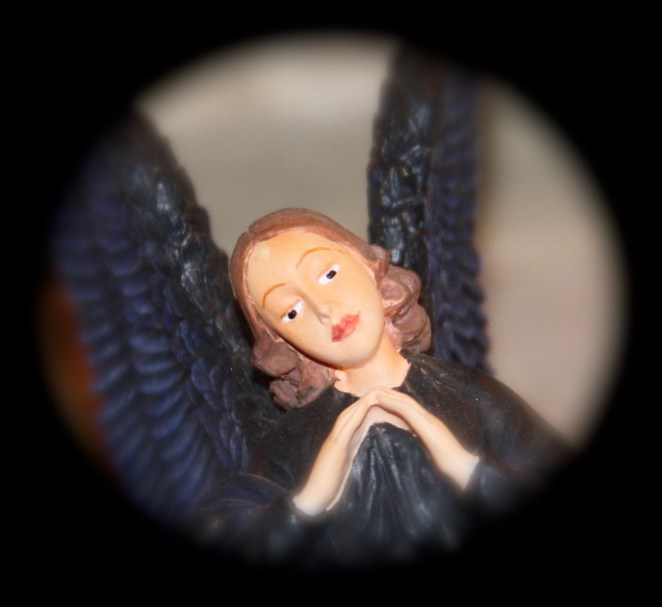
You cannot hide when the black angel comes and knocks on your door.
“Wait a minute,” you say, “While I change my clothes and comb my hair.”
But he is there before you, in the clothes closet, pulling your arm. You move to the bathroom to brush your teeth.
Now,” says the angel.
Your eyes mist over. You know you are there, but you can no longer see your reflection in the mirror.
Comment:
The last poem in the series and Rage, Rageagainst the dying of the light is over and done. Many of you will recognize the title from Dylan Thomas’s poem Do not go gentle into that dark night. I guess the theme itself has become part of the Welsh culture. And now we have exported it to New Brunswick, Canada, and perhaps beyond.
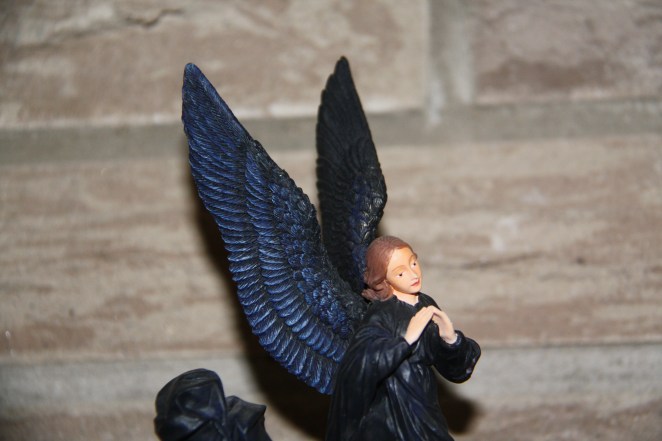
I bought The Black Angel, pictured above, in Avila, Spain. It is a plaster cast of one of the Angels in Roger Van der Leyden’s paintings, if I remember correctly. Here is the angel’s face in close up.
She or he brings a promise of rest and peace, a freedom from earthbound woes and sorrows. She stands on the shelf above the fireplace insert in our sitting room and brings blessings to the house. I look at her every time I light the fire. And she smiles down and blesses me. I think of her as a lady, but her peace and beauty outweigh any formal signs of sex.
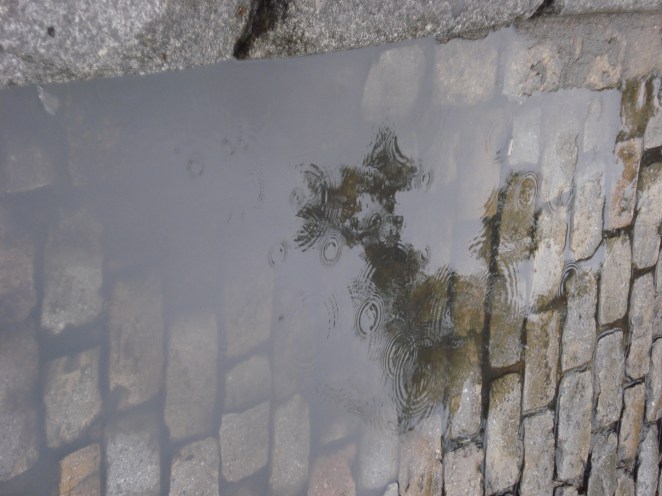
As for that reflection in the mirror, well, I don’t have one of me. But her is a photo to reflect upon:
Raining in Avila and puddles in the street. Now you see me, now you don’t. But I am there, holding the camera, and looking down at the water where —- rain has stopped play. The bails have been removed. Old Father Time has gone back to the Pavilion at Lord’s, and the cricket game is over for the day.
“What is this sound?” It is your own death sighing, groaning, growing while you wait for it to devour you.
“What is this feeling” It is the itch of your own skin wrinkling and shrinking, preparing to wrap you in the last clothes you’ll wear.
“What is this taste?” It is the taste of your life, bottled like summer wine once sweet tasting, now turning to vinegar.
“What is this smell?” It is waste and decay, the loss of all you knew and of all that knew you.
“That carriage outside?” It is the dark hearse come to carry you to your everlasting home.
Comment:
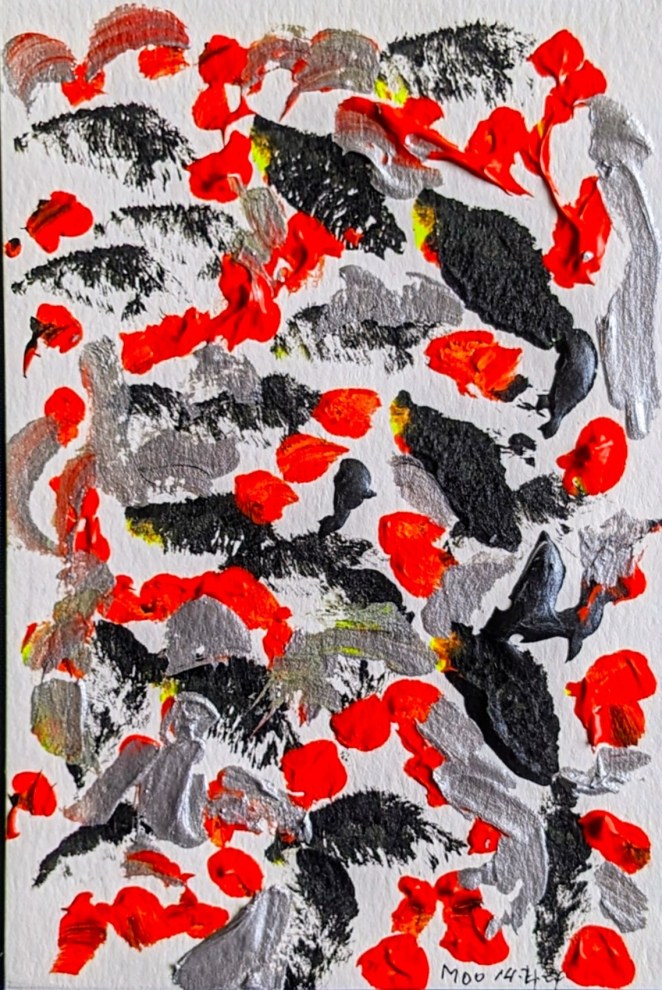
Moo thinks that his portrait of me is perfectly good for this poem. He told me not to rage, rage against the accuracy of the portrait, but he did tell me to rage, rage against the lack of paper. Où est le papier, indeed. As for the rest of it, he said it’s the same for everyone, so stop making a fuss about it. “You’ve got one last bottle of mescal on the shelf,” he told me. “I know. I’ve seen it. Just swig it down, worm and all, and you’ll have nothing to worry about.”
Oh dear. The worm in the bottle. They used to sell the gusanos in Oaxaca’s mescal street at a price of five for ten pesos. I used to buy a two litre coke bottle, filled with mescal from a barrel, and drop ten worms in it. They made yellow streaks as they descended through the liquid. Sweet dreams when you chewed on that lot – and an end to your worries. El brujo, the witch doctor, told me to stick a marijuana plant in the bottle of mescal and when the leaves turned white to rub the liquid into my arthritic knees. “Which doctor was that?” one of the tourists in my apartment block asked me. But I didn’t tell her. Nor did I do it. A waste of good mescal. And to think I now have one last half bottle left. And one little squirmy, crunchy, chewy worm.
Speaking of chewy, crunchy – I had never eaten chapulines, fried grasshoppers, until I went to Oaxaca. I didn’t like the look of them. At the first party I attended was confronted by the host who demanded I eat some. I told him they were taboo, against my religion. He shrugged. When he, and the other guests lost interest in my presence, I tried a couple. They were delicious. A real delicacy. I loved their crunchy little legs.
I guess one is always afraid of the unknown – the gusano in the mescal, the chapulines on the plate, that first plate of calamares en su tinta – squid in its own ink. I love bara lawr – Welsh laver bread – or Welsh caviar, as Richard Burton used to call it. I also know that people who have never eaten bara lawr won’t go near it – it looks like cow pats – but luckily doesn’t taste like them. Don’t ask me how I know. Some people get over their fear of the unknown, others don’t. I guess we’ll just have to wait and see what happens.
A silvery thatch bears witness to the winter of my withering.
My broken body hangs from the coat hanger of my shoulders, its worn-out sack knitted from skin, bonded with blood.
I walk with two canes, not just a sick man, but a stick man.
When I fall asleep, my enigmatic body haunts me with its death-rattle of drying bones.
Comment
Sometimes no comments are needed. However, when it comes down to it, I guess it’s worth saying that I am raging, raging against the dying of the light.
The dying of the light – in the evening, when the sun goes down, the house grows silent and cools around me. Some nights, when the news is bad or depressing, I feel we are entering another dark age. Luckily, spring is on its way, with summer not far behind. But what will spring and summer bring?
I fear the heat, the gathering of muttering trees, the ambush nature is setting up for humanity. We live among trees. Trees, all around the house. Trees, climbing the hills into the distance. I loved them when I came here first. The maples, the paper birches, the mountain ashes with their spring finery and the light green fuzz of forming leaves. Winter – the firs and pines dressed in their winter coats.
Last summer, fires broke out all over the province. The closest was a mere 30 kms down the road from us. We could smell the fire, see the smoke, and sense the discomfort of the proximity of possible outbreaks closer to home.
As I grow older, I become more fearful. Walking downstairs in the morning – cada pie mal puesto es una caída, cada caída es un precipico / each badly placed foot is a fall, each fall is down a precipice. Luis de Gongora. ( d. 1627). Alas, it’s that time of life, and it comes to anybody who, like me, has walked this far.
It’s the animals that I pity. The birds who move on and away and no longer stay with us. The deer who also have nowhere to go when their habitat is destroyed. The moose, the bears, the coyotes, the foxes, the jack rabbits and yes, they have all been visitors to our backyard.
Last summer, the local council circulated some ideas on how to prepare for immediate evacuation of our property- what to pack with a day’s notice, three hours’ warning, two hours’ warning, one hour’s warning. I hope it never comes to that. But now, I no longer know, and so I rage, rage, against the dying of the light.
I search for the key that will re-wind me, but I fail to find it.
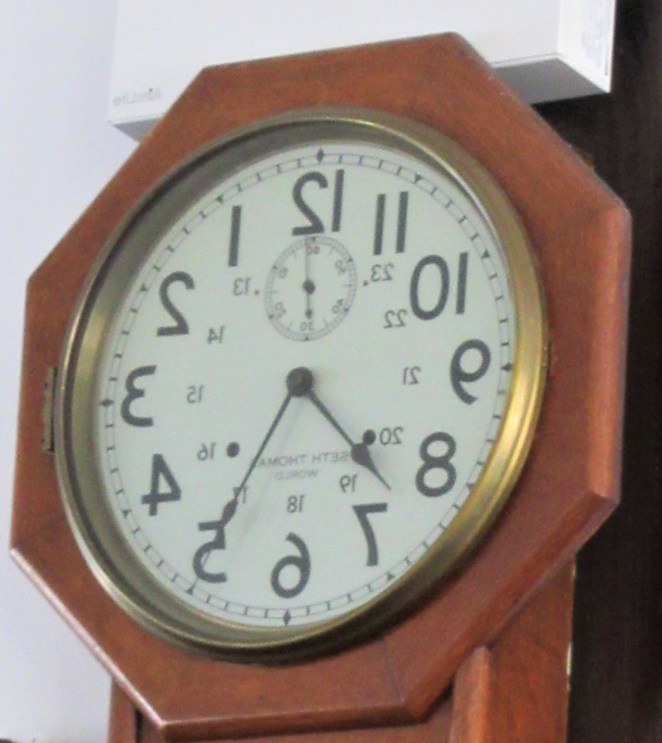
Who will winch up the pendulums on my grandfather clock, resetting it in spring and fall?
Who will watch time’s sharp black arrows as they point the path of moon change and the fleeting hours?
Each hour wounds, or so they say. Who will tend me when that last one kills?
Comment:
Omnia vulnerant, ultima necat. / Each one wounds, the last one kills. That’s how the Romans thought about the collection of hours that make up a day. An interesting way of putting it. In lapidarian fashion. Four words that are worth a whole book of philosophical thought.
What is this thing called time? Good question, and one which is being asked more and more. Clearly time does not flow evenly within the human mind, though it is remarkably regular on the clocks we have invented to mark time for us. And remember, there are many types of time – seasonal time – spring time, summer time, autumn time, winter time. Strange that autumn – or fall as I have now learned to call it – is the only one that doesn’t have the word time attached to it.
And what about time changes – spring forward, fall back – when we change our clocks in order to make the most of daylight hours. A tedious process for many of us. I see some provinces are rejecting those changes and sticking to the same time, all the year round, from season to season. Personally, I would prefer life without those time changes, as would many of my friends.
Celestial time also known as sidereal time – the time as showed by the planets as they seem to march around the earth in the terra-centric universe. Rephrased, the positions of the planets as the earth turns slowly round the sun in the helio-centric universe.
Then there is the personal time of individual experience. An hour watching football or rugby on the tv set passes much more quickly than an hour passed in the doctor’s waiting room or the dentist’s chair. Of course, an hour watching a five day cricket test can also be a slow process, unless England are playing Australia in the Ashes. As one friend of mine commented, a long time ago, “I thought those English cricketers were unfit. But I’ve never seen anyone go out to bat and come back to the pavilion so quickly. They must be super-fit.” Alas, their cricketing problem, as usual, was centered on the three cants – can’t bowl, can’t bat, can’t catch.
En fuga irrevocable huye la hora. La que el mejor cálculo cuenta en lectura y lección nos mejora.
Irrevocable is the hour’s flight. The one that counts the most in learning or reading improves us.
Francisco de Quevedo (1580-1645)
And remember – the hours fly by and your time is limited – spend it wisely and enjoy each and every day to the full limits of your abilities.
Terminal and terminus, they both mean nec plus ultra: the Pillars of Hercules, the end of the known world, and my own world’s end.
I throw my hands skywards in desperation: “Is anybody up there?” There’s no reply, and I see no ladder for angels to descend or ascend.
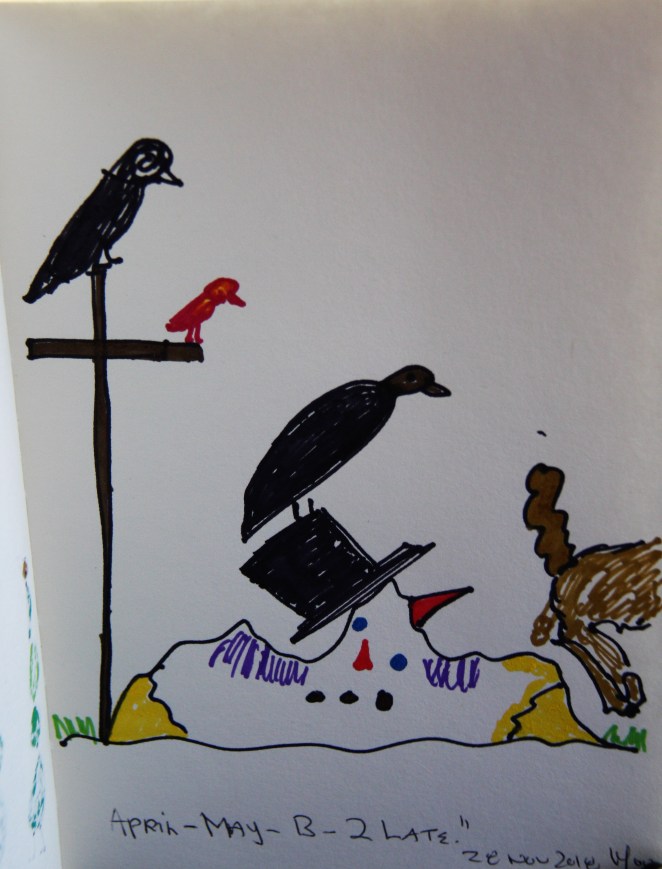
Only the crows, those black-winged monarchs destined to wear the survivor’s crown, cry out their anguish as they wait for the day when they’ll pick clean my unburied bones and rule this sickening world, an earthly paradise no more.
Comment:
When I said “I am looking for a picture of a crow,” Moo went wild. “Me,” he said. “I’ve got one.” And indeed he had. Here it is – two crows perched like vultures over the body of a fast melting snowman. Our current world in miniature – and don’t forget the yellow snow and the doggy doing a dump. “Moo,” I said, “That’s not nice.” “True to nature, though,” he replied. “You want reality – you got it.”
Reality – what a strange word. Who knows nowadays what is real? The barber’s basin in Don Quixote – is it a barber’s basin or is it Mambrino’s Helmet? Good question. Relativism – it depends on your point of view. U a barber’s basin – turn it upside down Ω and it’s a helmet. So how do we deal with an object that has two functions and can be seen both as one thing and then another?
Good question. Cervantes solves the problem in his own unique fashion – U – bacía / basin and Ω – yelmo / helmet. Put them together and you get the neologism [newly invented word] baciyelmo – a basin that serves as a helmet and a helmet that serves as a basin. Wonderful – if it weren’t for the snout, I’d swear that was the origin of the pig-faced bassinet.
Some days, I try to understand all this – but I throw my hands skywards in desperation: “Is anybody up there?” Another good question. I often ask myself that question but I despair of an answer.
My friend Francisco de Quevedo voiced the same question in a dream that came to me last night.
¡Ah de la vida! ¿Nadie me responde?
Life ahoy! Will nobody reply? Is anybody up there? Will someone reply?
Blas de Otero once made a similar utterance –
“I raise my hands in supplication – you cut them off at the wrist.”
Tell me, if you know, – what is this life if, full of care, we have no time to stand and stare. And look at those crows, standing there, staring, waiting … waiting for their turn to come. Patient, eternally patient. Just standing around. Waiting.
There is a stillness in the bee’s balm, a withering of early blossoms and still no bees: will they ever come back? The bee-keepers don’t seem to know as they scratch their heads and search dry colonies only to find dead and dusty hives, with cells devoid of the lust and life of their former inmates.
Each day we watch over the flowers, and hum as we wait for the bees to buzz: “will ye no come back again …”
This is the hospital’s forgetting place, the left-luggage office where, a human parcel wrapped in a blue gown, I wait to be claimed.
Tagged with a label on my wrist, I find myself alone with my fate.
53
All choice disappeared when I came here and surrendered myself to the system.
Now I lack free will and freedom of choice.
Yet I still dream of choosing my destination, and the ways and means of arriving there.
Comment:
A terminus – what an interesting word. Terminus a quo or terminus ad quem? Or just a railway terminus or a bus terminus where we sit and wait to change buses of trains? Or maybe just a terminus in terms of being terminal? Oh what a tangled web we weave when we first start to analyze our words in order to see exactly where we might go and where they might lead us.
And what a journey I was on when I first wrote that poem. Sitting in the waiting room, outside the radiation room, waiting for the lady who would wag her finger and point at the machine’s next victim. Would it be me? The man next to me? That woman over there? Many of us avoided each other’s eyes and just sat there stunned – and now you know the meaning, in context, of ojos de besugo – do you remember that from Rage, Rage, 48?. Others chatted. Some sat there quietly while their teeth chattered. Few of us knew each other, except from the hospice where we stayed if we weren’t day patients travelling in on a daily basis and rushing home afterwards.
Libre albedrío – free will. We can say so much about free will and determinism. But when we enter the system, it’s the system that rules. We have free will to enter – and they [the authorities] say we have free will to exit when we wish – but do we? Good question. A very good question. Once tagged, we are as free as the birds, as free as the salmon, as free as the whales – but within that freedom we are tracked, followed, taken in hand, advised, persuaded, manipulated … and whales have a whale of a time when they’re trapped up in fish netting …
Then there are the follow-ups. The appointments. The emails. The telephone calls. The check-ups. The blood tests. The MRIs. The X-rays. The Holter appointments. The various scans. Who is brave enough to get off the wagon or to open the aircraft’s door half way through its flight over the Atlantic and step out? Would you jump from the save-yourself-train – not at all like the gravy train – and think carefully – are you really saving yourself or are you getting yourself into hotter and deeper water? Come along then, let’s open the aircraft’s door and step out over the Atlantic. And tell me, what exactly are we stepping into?
Stop the world, I want to get off! Not so easy to do, my friends, not so easy to do. Not even when you think the terminus in which you are sitting is taking you to hell in a hand-basket. You start to stand up. And the little lady appears, smiles at you, crooks her finger, nods her head, and – as obedient as one of Pavlov’s well-trained puppy dogs – off you go, following in her footsteps.

 rogermoorepoet