Green Banks

Green Banks

An empty shell I am
the sea sound swishing
when you hold me to your ear

Pwll Ddu and pebbles
Swansea Sands
their fishnets glistening
with golden day stars

Brandy Cove
ever-changing after
winter’s storm surge

Fisherman’s Point
early evening
when dog-fish bark

Pyle Corner
cows in the lane
quick to kick
high the five barred gate
we climb
to avoid them

Rats
in the rubbish dump
grey bodies
scuttling claws

Green Banks at last
home of our summer
sky cloud castle dreams

Comment:

Have you ever held an empty sea-shell to your ear and heard the sea’s soft sighting sound? I used to collect them from the sands, hold them to my ear, and listen. The best shells left you with the sigh and sound of sea and waves moving with a magic that sounds eternally. These I would take home and listen to them in winter, or at boarding school, when I needed such beauty to keep me alive and sound in heart and mind.

Sure I was a dreamer. But oh what dreams and how they have followed me step by step, town by town, country by country. And now they gather here, in Island View, and let me know that within my mind the dream world of memory is immense but I can still capture it and hold it to my heart.

Funny how things come back to me.

1. Taste – and I there at Eynon’s in the Uplands, where I first tasted crempogau, Welsh pancakes. They changed into the Crêpes Suzettes I tried in Cassis-les-Calanques, all soaked in Grand Marnier.

2. Touch – damp wood beneath the hand takes me to boarding school where the walls sweated and the bannisters gleamed in foggy weather. There, in the Vale of Severn, damp mornings were the warm. I also remember the touch of hot air, breathed into my shirt, to keep me warm.

3. Smell – the scent of things burning, burnt porridge particularly, drifting down the drive, and driving through the tree mist and into my nostrils.

4. Sound – so many songs take me back to the places where I used to sing them. Sometimes they attached themselves to a family member, though I didn’t understand how or why those associations were made, not until much, much later.

5. Sight – put them all together and you can see those memories surging out of the mists in all five forms.

Have you tasted sea mist on your tongue? Have you touched the dampness of your jersey when you cycle down Painswick Hill in the mist? Have you caught the smell of wet wool, mist moistened, and clinging close? Have you heard the rustle in autumn when the November mists wrap themselves around ghostly trees and the dry leaves rattle like bones? Have you seen long dead mist warriors rise up from the ground at Badbury Rings or atop Maiden Castle, or on Cley Hill, or Westbury White Horse?

Time and tide wait for neither man nor woman. And memory’s mists do not wait either. they rush in, like angels, and foolish is the the man who refuses to meet them, eye to eye, tongue to tongue, nose to nose, finger to finger, ear to ear – in all their mystical mist-filled glory.
Enigma Variations

Enigma Variations

Our world is spinning on its edge, placed on
the perimeter of space, going who knows where.

Specks of dust, we float around and contemplate
night’s wonders wondering what might happen.

Out there, in the vastness that surrounds us,
worlds without end will never know we existed.

Bleak and blank our names, our deeds, our status,
the monuments sometimes raised in our praise.

And what of our thoughts, those sparks
of electricity that link us mind to mind?

Is each of our actions determined by a dance
performed by circling planets that shape us?

Are we nothing more than a code
of virtually meaningless dots and dashes?

Are we then pinballs bouncing between
a million trillion strings of flashing lights?

What star god plays trivial games of snakes
and ladders with our lives and names?

Commentary:

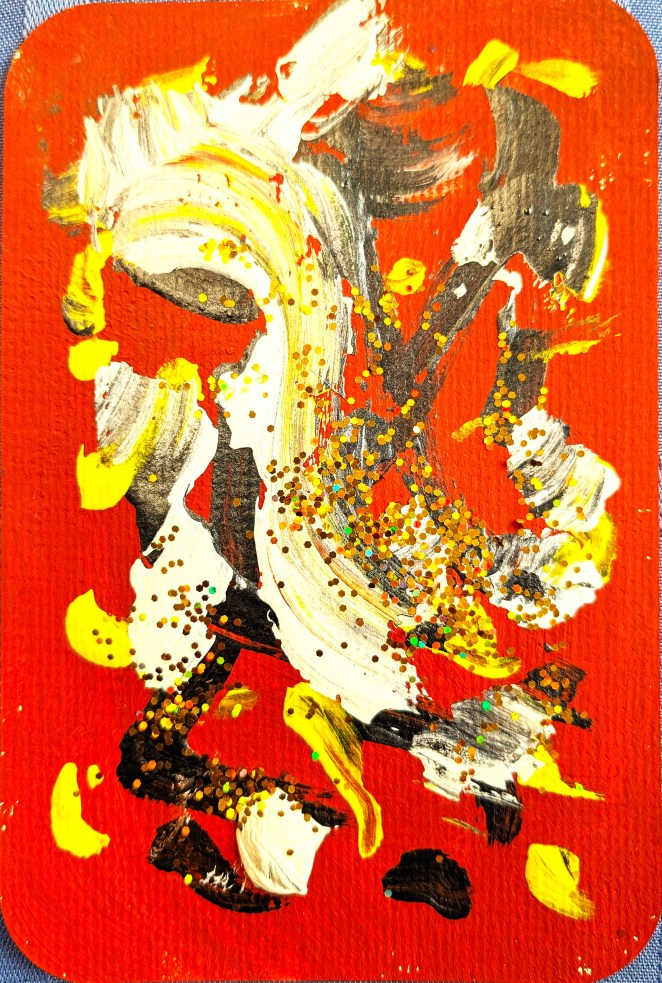
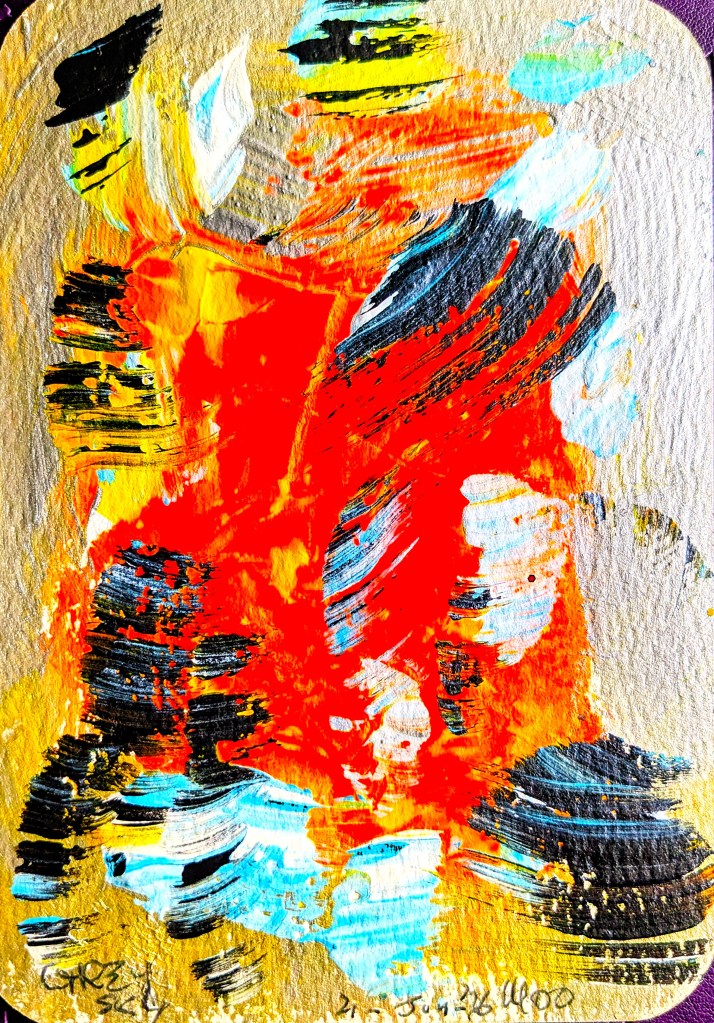
Moo’s painting is called Grey Sky with Bear Claws. He thinks it is a great companion to the poem. Actually, I rather think he likes to have his paintings published online without the necessity of lifting a finger to help. Oh dear – he heard that and just lifted his middle finger in my direction. “I am helping,” he said. “I also lift paint brushes. Remember that, you philistine.”

Philistine? Me? Now why would I be a Philistine? And what is a Philistine anyway? That’s where AI comes in. Thank you, Don Ryan. I wouldn’t know about AI without you. “And you wouldn’t know about painting without me,’ says Moo. “So tell me what a Philistine is,” I said to him. “Go look it up,” he scowled, wagging that finger in a menacing way. So I did.

AI to the rescue. A philistine is a person who is hostile, indifferent, or smugly oblivious to art, culture, and intellectual pursuits. The term typically describes someone whose interests are purely materialistic and practical, lacking any aesthetic refinement or appreciation for high culture.

Well, I don’t think that’s fair. Let’s see – hostile, indifferent, or smugly oblivious to art – no, that’s not me. I love Moo’s art, and he knows I do. I am not hostile to it at all, though I might be just a little teeny weeny bit hostile to him when I think he is lazy and doesn’t appreciate me. More – someone whose interests are purely materialistic and practical, lacking any aesthetic refinement or appreciation for high culture – no. I refuse to accept that. Purely materialistic? I give my poems away, free of charge, to my friends and anyone else who wants to read them. Moo isn’t materialistic either. He gives his paintings away to his friends. I know he does, because I have seen him do it. Come to think of it, I don’t think either of us is practical. We wouldn’t be living in Penury if we were.

Sorry. I won’t go any further. That’s all Isle of Wight Ferry, as they say in Hampshire. Well, I won’t call you a Philistine if you don’t know what they say in Hampshire. Okay – here goes. “What’s hot, black and smelly and comes steaming backwards out of Cowes?” Why, it’s the Isle of Wight Ferry, of course. Well, it was until they replaced it with a hovercraft. Now the joke [Cowes, the port / cows] doesn’t work any more. So, here’s a couple of questions at Philistine 100 level for you – (1) What have Margo and Reg got? If you don’t know, you’ll have to ask Stomping Tom Connors. And (2) what did Reggie give to Margo? Okay, okay. I give in. I’ll tell you.

Answers – (1) Margo’s got the Cargo and Reggie’s got the Rig. (2) A cowsy dungsy clock, of course. Made only in Canada. And you can check that one on AI too. And look up the song on YouTube while you are at it. Canada Day – July 1 – and Stomping Tom Connors is one of the best adverts for Canada. Go, check out his songs.

Bees

Bees

This year, we mark them by their absence.

There is a stillness in the bee’s balm,
a withering of early blossoms and still no bees:
will they ever come back? The bee-keepers
don’t seem to know as they scratch their heads
and search dry colonies only to find
dead and dusty hives, with cells devoid
of the lust and life of their former inmates.

Each day we watch over the flowers,
and hum as we wait for the bees to buzz:
“will ye no come back again …”

Rage, Rage 4

Rage, Rage
4

I walk from room to room,
startled by shadows,
and open doors,
search under the table,
look behind chairs.

Nothing. No one.
The house stands
still and empty,
but for the sadness,
the silent sadness,
that fills each room
with their remembered
presence.

Commentary:

Absence and presence. How many of us feel that something is there, walking beside us, or just behind us? How many feel that an empty room is not empty, but is filled with a presence, something we feel, half-recognize?

I have been in houses, invited for the night, where I would not sleep. Why? I do not know. But I felt a presence, a prescience, if you wish, that filled me with a desire to leave and not to stay.

What is it? Is it other memories, other lives, that impinge upon ours in this current time frame? I do not know. But I do know that there are houses and rooms in which I will not stay. I also know that there are others that throw open warm arms to welcome me.

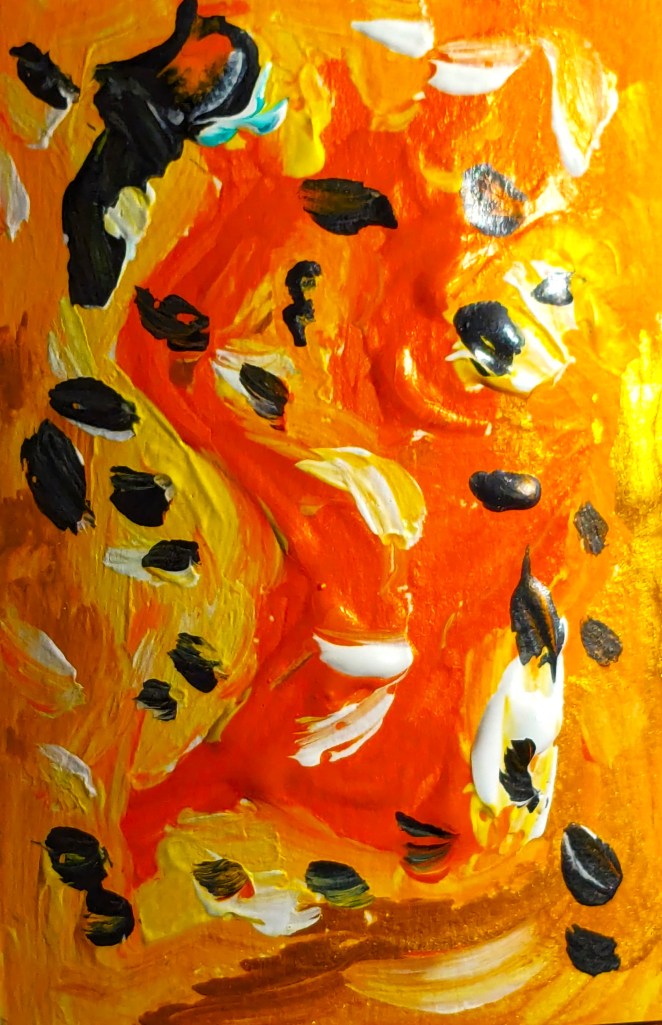
Look at Moo’s painting(s). How many of them welcome us in? Do some of them shut us out and make us shiver with a fear, not of the unknown, but of the hardly-remembered, that lies in wait to shake us out of this dream which is our present life?

Carved in Stone 67 & 68

Carved in Stone
67

At night, on the cool
sea-shore of my dreams,
the calls of shore-birds
at Ste. Luce-sur-Mer
are borne on the wind.

High-pitched, they are,
like the voices of children,
or of men and women,
in distress.

I walk on the sand
at low tide and a lone gull
flies past my head,
battering itself
against the wind’s cage
with outraged, sturdy wings.

68

Sunset.
Sea mists descend.
The church on the headland
steps in and out of darkness.

Shadows gather, persistent.
Gulls surround a lone heron.
It clacks its beak in anger
forcing the gulls to scatter.

These words are not my words.

They came to me in the speech
of birds hidden in the foliage,
or carried on a feathered plume
sprung from the osprey’s wing.

Some came from the click
of the crab’s claw as he dug
deeper into the sand
a refuge where he thought
he could live safely.

Commentary:

Sunset. Sea mists descend. The church on the headland steps in and out of darkness. And so do I. I seek clarity, but there is no clarity when the sea mist descends, just the blurred image and the clouded thought. The cloud of unknowing, one philosopher called it, many years ago, and it is still with us. Especially when the sunlight fades and we are left wandering in the mists of unknowing.

“Is it here, you ask, or over here?” Well, if you do not know, I cannot tell you. But I will ask you this, and think very carefully before you answer – does the answer come from outside of you, given by another, or does it come from the deep, sacred intimacy of your own soul? The answer to that question will tell you all you need to know, one way, or the other.

These words are not my words. They came to me in the speech of birds hidden in the foliage, or carried on a feathered plume sprung from the osprey’s wing. Some came from the click of the crab’s claw as he dug deeper into the sand a refuge where he thought he could live safely. Sunset. Sea mists descend. The church on the headland steps in and out of darkness.

Carved in Stone 61 & 62

Carved in Stone
61

Water through the water clock,
water off a duck’s back,
the waters of life,
continually flowing,
trapped in our children
and their children,
and the love we create
never lost, just circling,
like the hands of the clock,
like the planets and stars.

But who will wind up
the clockwork universe,
and tend the mechanism
that balances planets and stars?

What will happen
when the clockwork
finally runs down,
the last candle is snuffed,
and the water clock dries up?

62

Whoever, whatever remains
will be left to contemplate
Ozymandias with his two vast
and trunkless legs of stone,
standing in the desert.

“Look on my works,
ye mighty, and despair.”

Commentary:

“Look on my works, ye mighty, and despair.” Well, Moo does have a sense of humor after all. I thought he did. From Ozymandias to the meaning of “works” to the destiny of the work we did. What a journey. It goes from the joy of the children who build a snowman to the warm spring wind that melts him to the crows and the dog who do what crows and doggies do. Intertextuality – the links between verbal and visual and think about it – such strange things happens in Moo’s creative mind.

But what do we leave behind? Think about it. Only the wake of the ship in which we sail. The wake – that white trail we leave behind us, on the surface of the sea, slowly vanishing as we also vanish, pulling away into the unknown that always lies ahead. Moo is right – so many things disappear out of the frame of the painting. “There are no pockets in shrouds” said the preacher in the hospital where I took my father, so long ago for treatment.

And even if there were, how would you fit a snowman, several crows, a cardinal, and the rear end of a dog into the pocket? “Contemplate Ozymandias with his two vast and trunkless legs of stone, standing in the desert. Now contemplate the fate of the snowman. Now look on my works, ye mighty, and despair.”


Carved in Stone 58

Carved in Stone
58

Modern shamans
roam the pyramid’s flat top,
looking for its energy point,
not knowing that, seated,
peacefully in silence,
that power will seek them out.

The more they seek,
the less they find,
yet that power seeks me out,
because I no longer seek it.
Is that the secret of creativity?

Commentary:

A long time ago my judo instructor taught me the following –

“The more you strive,
you cannot grasp it,
the hand cannot hold it,
nor the mind exceed it.
When you no longer seek it,
it is with you.”

It was the same with the St. John Ambulance course that I took. The instructor told us that we might not remember now exactly what we were doing, but if the occasion arose, everything we were practicing now would appear before us and we would just do it, knowing exactly what to do. A rugby coach, I saw and met and solves several such injuries on the field of play. Something took me over and I did what I had to do.

I still don’t know how or why. But it is the same with creativity. “When you no longer seek it, it is with you.”

Just breathe deep and believe.


Dog Daze

Dog Daze

Memories deceive me with their half-remembered shows, shadow shapes shifting over the walls with a flick of the magician’s fingers. What magic lantern now slips its subtle slides across night’s screen? Desperate I lap at salt-licks of false hope that increase my thirst and drive me deeper into thick, black, tumultuous clouds. A pandemic storm lays waste to the days that dog my mind. Carnivorous canicular, hydropic, it drinks me dry, desiccates my dreams, gnaws me into nothingness. At night a black dog hounds me, sends my head spinning, makes me chase my own tail, round and round. It snaps at dreams, shadows, memories, anything that ghosts through my mind. Hunter home from the hill, I return to find my house empty, my body devastated, my future a foretold mess. Tarot Cards and Tea Leaves are lost in a Mad Hatter’s illusion of a dormouse in a teapot raking runes from an unkempt lawn.

Commentary:

Well, what a muddle. Images flying everywhere, in and out, like Von Richthofen’s flying circus of WWI fame. And look at that last line! Tarot Cards and Tea Leaves are lost in a Mad Hatter’s illusion of a dormouse in a teapot raking runes from an unkempt lawn. No wonder Moo said “Nein!” when I asked him if he had a painting to illustrate this one. In fact, he quoted Salvador Dalí at me: “There’s no difference between you and a madman, except that some days, you aren’t mad.” I guess this implies that some days I am.

“Ah well,” said Mrs. Thomas calling her son Arwel in for tea. Welsh joke. Many won’t get it. Arwel didn’t and he didn’t get his tea either. Never mind. Those things happened a long time ago when the world was so much younger, and, dare I say it, wiser! Actually, there’s nothing wrong with the world itself. The problem, as always, just like the old woman who lived in a shoe, it’s the madmen who inhabit the shoe that are the problem. And when the shoe’s sole needs a nail, who is going to come and glue it back together. Not me, said the red squirrel, laughing. And he always laughs. As soon as it gets cold he tucks into my garage and it’s a devil of a job to get him out again.

What’s worse, he insists on building nests in my car engine. That’s three times now. And it costs money to dig those nests out. Not to mention the mess. First time, I didn’t even know he was in there until the windscreen wiper on the driver’s side started to fail. Then the whole watering system broke down. I took it to the garage, and the garagemen said “I hope you’re getting rent money, you’ve got a tenant.” Anyway, he got rid of the squirrel and the nest. But the little blighter must have followed me home, because a few days later he was back in there again. He’s in there now. I can hear him chuckling as I type this.

Dog Daze, indeed. I wish I had my doggy back. Alas, as you can see from the photo, he crossed the rainbow bridge to his doggy paradise, leaving me to contend with a garage full of ham-fisted red squirrels. No wonder my head is spinning around and I am chasing my own tail, round and round. At least he’s single, that squirrel. I don’t know what I’d do if he got married. I know my maths ain’t no good (nor is my English), but where squirrels are concerned, I am pretty sure that 1 + 1 = 6 or more and a foretold mess.

Carved in Stone 53

Carved in Stone
53

Nor do I belong
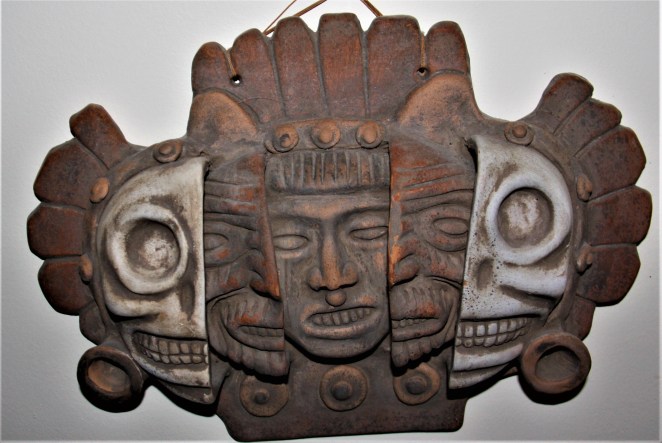
in the Aztec city of Tenochtitlán
with its cruel stone gods.

Built originally
in the middle of a great lake,
it defied all comers, and held
the mighty Cortés at bay.

Human sacrifices, night and day –
what is it that makes some people,
carve and shape the living flesh
of others, as if it were wood or stone?

Who could admire a culture,
based on human sacrifice,
death, blood flowing,
just to keep the sun in the sky,
red at its dawning,
westering in the evening
into a sea of blood.

Commentary:
“Man’s inhumanity to man.” Robbie Burns, if I remember correctly. Thus it was and thus it always will be. Man’s need for space, for room around him. The need to establish himself and his own tribe and oust the other. The need to target the other to prove the weakness of those who do not belong. So many ways to target, including humor and jokes, all pointed at the targeted individual.

“What’s the most dangerous job in Ireland?” – “Riding shotgun on the garbage truck. “The jokes never change, just the targets. For Ireland, substitute England, France, Canada, Wales, Scotland. For a country, substitute a town – Fredericton, Island View, Saint John, London, Cardiff, Dublin, Paris. Okay, so they are cities, not towns, but you know what I mean.

Let’s change the joke. “How do you get the [choose one or more] English, Irish, Scottish, French, Welsh, Germans, Italians, out of your front yard?” “Put your garbage cans in your back yard.” And so it goes on and on. Like old Father Thames, who just keeps rolling along, down to the deep blue sea.

Why, I ask myself, why, why, why, do we have to diminish someone else in order to appear strong ourselves? Is it just human nature? Is it the nature of some people? Do all people behave in the same way? If you have the answers, or any answer, the same instructions as usual, send it to me on the back of a postcard, by dog sled, via the North Pole. And if you’re feeling generous, put a $5 bill in the envelope. It will help me pay the lawyer’s bill for suggesting such outrageous nonsense.

Joy of Words

Joy of Words

If the words won’t come, don’t worry.
Sooner or later, they will arrive, driving
down in flurries. Think wind-driven leaves
or the soft white whisper of snaking snow.

There is a moment when all sounds cease
and you can be at one with your inner self,
there, where summer sunshine twinkles
and soft rains bring forth clarity and joy.

What are words anyway, but soap bubbles
emerging from an iron ring to rise in
child-hood’s skies, soaring, dying, around
the cloudy thrones of sun-kissed clouds.

We, their so-called creators, are left below,
building cotton-wool castles spun from air.

Commentary:
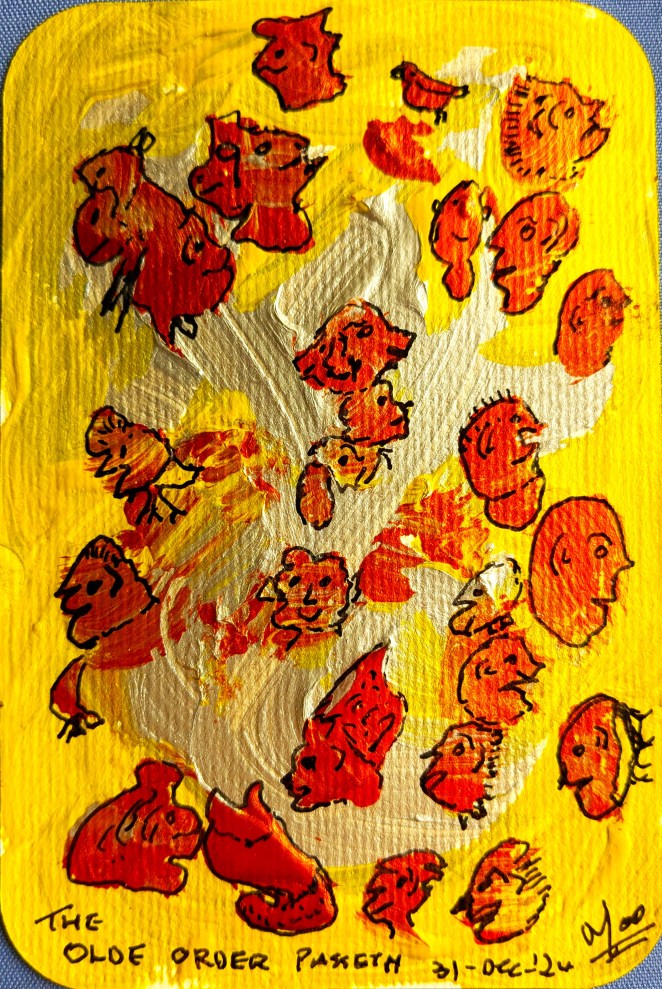
Moo suggested I use this painting of his to illustrate this poem. He called it originally The Olde Order Passeth, but the original phrase, from Tennyson’s Idylls of the King, should really be The Olde Order Changeth, lest one good custom should corrupt the world.

And yes, things do change. Here we have a fourteen line sonnet. Structure giving order to chaos. And words change, the world changes, our thoughts change, the weather changes. Hymns Ancient and Modern – Age and decay in all around I see, oh thou who changeth not, abide with me.

And what do we do when we meet with change? Weather – I change my clothes. There is no such thing as bad weather, only inadequate clothing. It used to be a useful saying, that one, but not any longer. When change changes into disaster, it is a very different kettle of fish. Thoughts change – mine just did. A useful phrase suddenly becomes an inadequate reaction to a changing situation. The world changes – sometimes for better, sometimes for worse, but how do we, each one of us, confront that change? How do we adapt to it?

I know far too many people who, like the ostrich, bury their heads in the sand and pretend that change is not all around us, that the world is the same as it always was. We humans are experts at adapting. We must adapt. But how do we adapt? Each one of us must answer that question in his or her own way. The alternative is to close our eyes, bury our heads, and pretend that nothing is happening.

Another alternative is to seek within for that moment when all sounds cease and you can be at one with your inner self, there, where summer sunshine twinkles and soft rains bring forth clarity and joy. Perhaps that is the world the ostrich discovers when he removes himself from this world and enters that other one beneath the sand. Who knows? Not even the ostrich, I would guess.