On Re-reading Quevedo’s Poetry

On Re-reading Quevedo’s Poetry

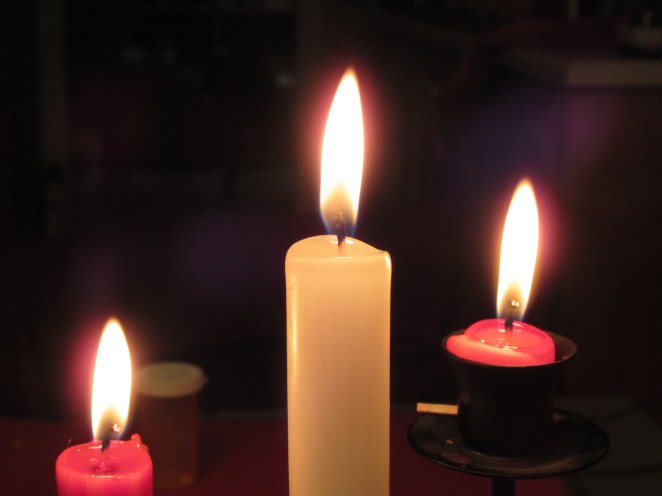
Was that where my life went,
a spent candle trailing dark studies
among the packed lines of your poems?

What about you, was your life gutted by that
same guttering candle by whose light you
scrawled your tight black spider rhymes?

Are they all meaningless, your insights
and my words? Few people now know who
you were and what you represented.

Am I, your scholar, a mere shadow
of your shadow struggling in the straggling
half-light of your existence?

Yet, I’m still intent on sharing light
and the word with a world that thinks
the two of us are out of date and absurd.

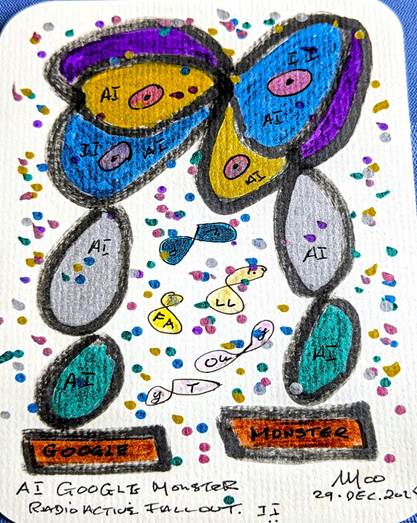
A Question for AI

A Question for AI

It is hard
to shed the skin
and skin once shed
can never
be worn again

Yesterday
is gone
today
slips slowly by

Tomorrow
always comes
but never arrives

Who and what am I
this child
who thrives on sorrow
and on a sadness
that grinds
bones to dust
and soft silk ash

Tell me
if you know
what will arrive
for this child
tomorrow
if and when
it comes

Comment:

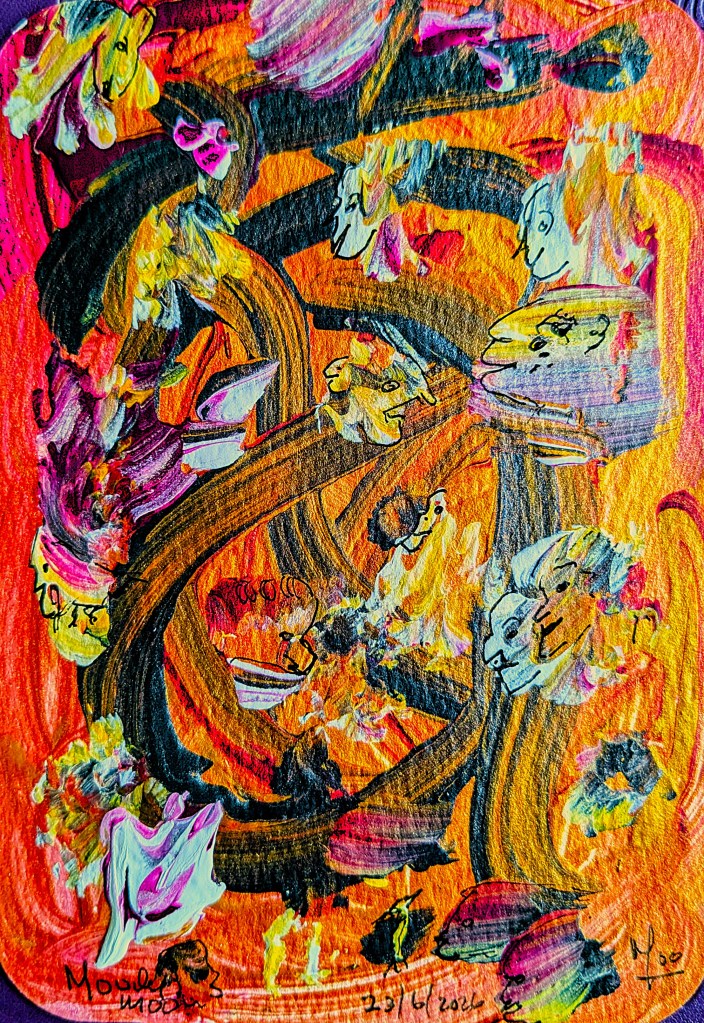
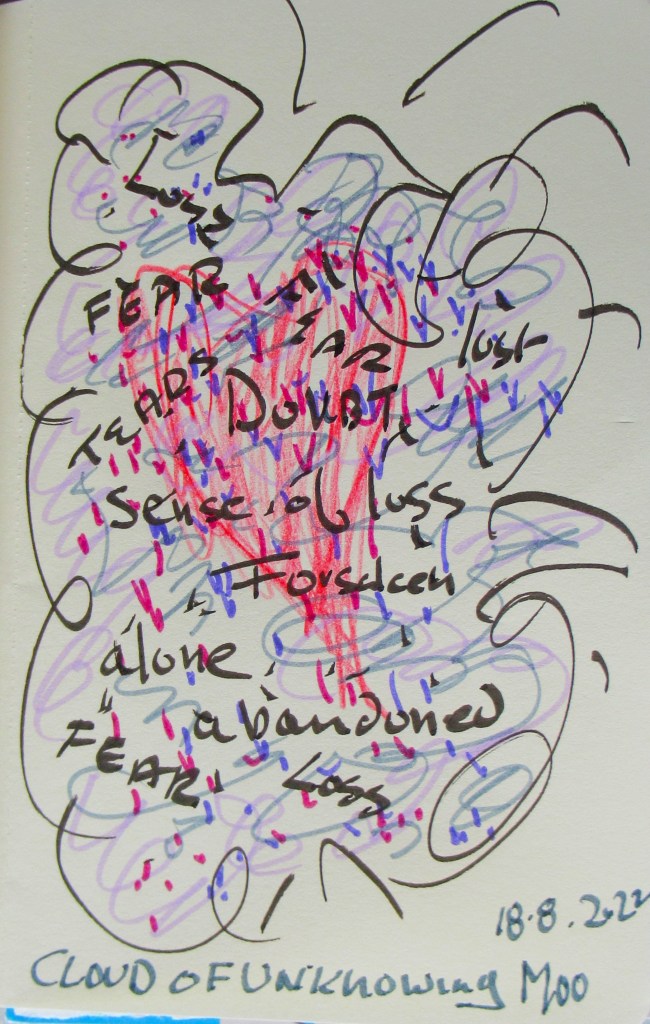
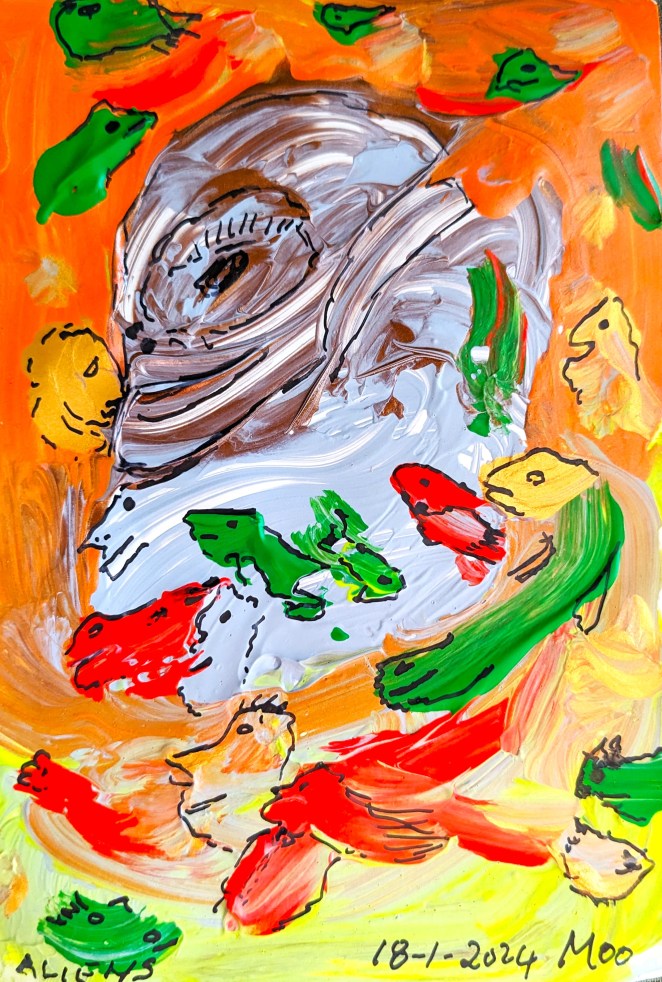
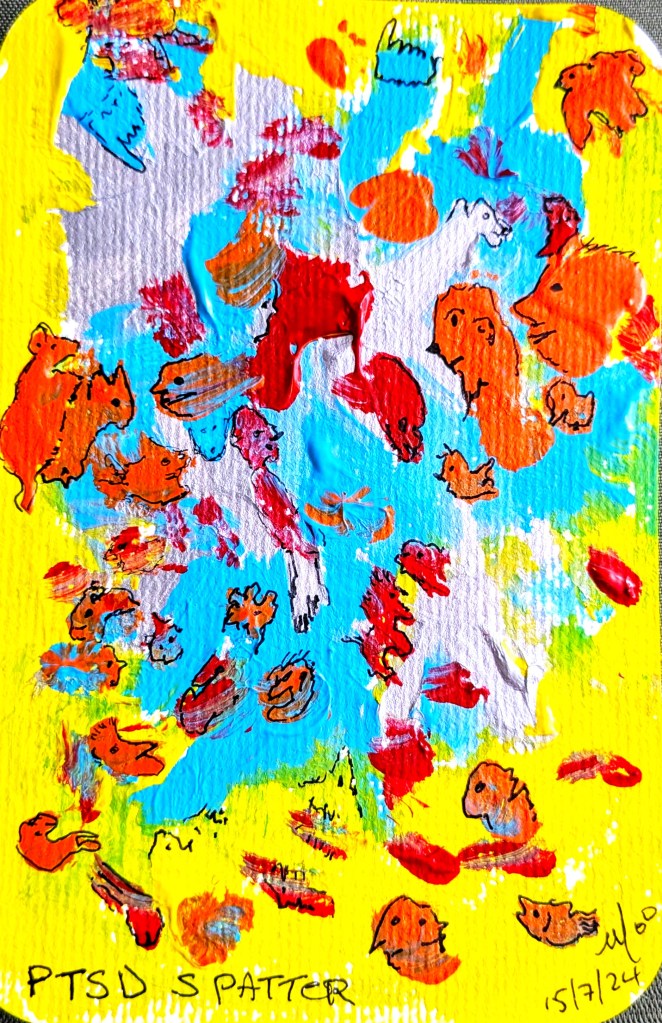
Moo is back painting and I am sure everybody is happy to hear that. Mind you, he’s a little bit on the Moo-dy side, if you know what I mean, as you can see from this painting. He calls it Moody Moo and he says it’s a Moo-d painting. He swears there’s a Moo Cow in it, but search as I have, I cannot see a Mrs. Moo. Let me know if you find one. Usual route – unless you have a drone of one sort or another. They have the road up leading into town and we had to wait a long time yesterday at the roadside while little men in yellow hats stood in front of the cars and wouldn’t let them move.

It was so bad, I put Pete Seeger on the disc player and turned the volume up full. “No pasarán, no pasarán, sang the Abraham Lincoln Brigade.” I thought it was rather funny. The person holding the placard that said STOP didn’t seem to be amused. I don’t if it was the volume. Maybe he spoke Spanish and knew all about the Spanish Civil War and how the Abraham Lincoln Brigade stopped Franco’s troops and wouldn’t let them pass! No pasarán, no pasarán – those yellow hatted road buccaneers certainly closed down the narrow straits that led to our house and they wouldn’t let anyone through. No pasarán, no pasarán.

Meanwhile, old Welsh logic – tomorrow never comes, because by the time it gets here, its today. “Good one,” says Moo, checking the way I have reproduced his painting. Oh yes, the original is for sale, Moo says – going cheap for a five figure sum. And that’s not counting the two zeros after the dot! I think Moo is really asking too much. OW! He just kicked me. Sorry, Moo. That’s a very fair price. Now he seems happy. But I don’t think you’ll get it. Now he seems sad – oh dear, just like I said – “Moody Moo”!

I’d better be careful, or he will be doing some Blue Moo paintings next, and he’ll be turning the air blue while he’s painting them. Meanwhile, speaking of AI – here’s the news that’s rolling round the rock at Island View. There’s a new book on the market. A limited Edition. Only 50 copies. Keep your eyes open. They will soon be a collector’s item. In fact, they already are. Go for it -Don Roger and Don Ryan. Oh yes. Moo did the cover painting for that one too. But he’s not selling it – he’s already given it away to another friend.

Obsidian’s Edge 2
An AI Analysis

Don Roger & Don Ryan

All About Angels

039.JPG

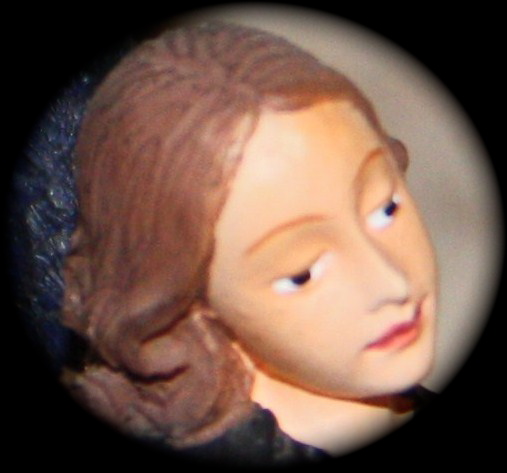
I first saw the Black Angel in Aldebarán’s cultural store in Ávila (2006). She sat there, in the shop window, along with several other angels, and I worshiped her from the distance of the street. Her image was taken from an original painting from Rogier van der Weyden (1399/1400-1464). This was turned into a 3-D image and then converted into the statue I saw in the shop window.

I brought the statue back to Island View, placed it on the shelf above the fireplace, where it still rests, and wrote several poems on the theme of Angels. I gathered them together in a chapbook entitled All About Angels that I self-published in Fredericton in 2009. The chapbook was dedicated to Clare’s great-aunt, D. E. Witcombe who departed this world on October 15, 2008.

All About Angels was also based on a book of a similar title, Sobre los Ángeles, written by Rafael Albertí, one of the poets of Spain’s Generation of 1927. I avoided the ambiguity of the Spanish title — Sobre (in Spanish) can mean Above or Beyond as well as About — by limiting my own title to All About Angels.

All About Angels
Paperback edition

All About Angels
Kindle Edition

For Carl Jung, angels are the messengers sent to inform people of the state of their world. For me, they are also the wild creatures that inhabit the world around me and often take the form of birds and other spiritual creatures. They can be best seen in those moments of solitude when we are most open to the natural world around us. Then, and sometimes only then, we can hear the urgent messages they bring.

Black Angel

You cannot hide
when the black angel comes
and knocks on your door.

“Wait a minute,” you say,
“While I change my clothes
and comb my hair.”

But she is there before you,
in the clothes closet,
pulling your arm.
You move to the bathroom
to brush your teeth.

“Now,” says the angel.
Your eyes mist over.

You know you are there,
but you can no longer see
your reflection in the mirror.

Angel Choir

(on seeing the Northern Lights at Ste. Luce-sur-mer)

listen to the choristers with their red and green voices
light’s counterpoint flowering across this unexpected son et lumière
we tremble with the sky fire’s crackle and roar

once upon another time twinned in our heavenly prisons
we surely flew to those great heights and hovered in wonderment
now our earthbound feet are rooted to the concrete
if only our hearts could sprout new wings and soar upwards together

the moon’s phosphorescent wake swims shimmering before us
the lighthouse’s fingers tingle up and down our spines
our bodies flow fire and blood till we crave light and yet more light
yet when the lights go out we are left in darkness

close up.jpg

 Croaking Angels

Their tunes are one note symphonies,
croaks of joy
moving their fellows to ecstasy,
exhorting them to share
the splendors of ditch life,
in a springtime bonding
that will loft them to the skies.

There’s an ancient magic in this calling:
love and laughter,
moonlight and water,
all the joyous things
one links with spring.

Moonlight swings its cheerful love lamp.
New leaves and buds are also known to sing.

Translation Theory

Ryan and Don Roger

15

Translation Theory
(revised 3 May 2026)

            In DQI, IX, Cervantes, in his role of first-person narrator, goes to the Alcana in Toledo, where he discovers an Arabic manuscript containing the adventures of Don Quixote. The first eight chapters of our novel contain no mention of a translator. Suddenly one appears. The narrator buys the manuscript, finds a translator, takes the translator to his house, and in six weeks receives a translation, from Arabic into Spanish, of the novel. Question – does the translation contain Chapters 1-8, already written by Cervantes, or not? Alas, we do not know. Is the translation accurate? We do not know that either, for the original Arabic manuscript is a literary illusion and does not exist.

            However, we do know that Cervantes writes that ‘reading a translation is like looking at the reverse side of a tapestry’. Speaking of the Italian poet, Boiardo, the priest, in DQI, 6, says “If I find him here speaking in any language but his own I shall show him no respect. But if he speaks his own tongue, I will wear him next to my heart.” The priest continues, “That is what happens with all authors who translate poetry into other languages. However much care they take, and however much skill they show, they can never make their translations as good as the original.”

            Of course, with no original for the Quixote, there can be no translation theory. So, let us try to construct one. In the course of my own work, I have studied various translations of Quevedo’s poem Miré los muros de la patria mía. I will use them to see how translations can function, and what happens when we look at the reverse side of the tapestry. First, Quevedo’s poem in the original Spanish. Then a direct, line by line translation of it, for those who do not read Spanish.

Miré los muros de la patria mía,
si un tiempo fuertes, ya desmoronados,
de la carrera de la edad cansados,
por quien caduca ya su valentía.

Salíme al campo, vi que el sol bebía
los arroyos del yelo desatados,
y del monte quejosos los ganados,
que con sus sombras hurtó su luz al día.

Entré en mi casa; vi que, amancillada,
de anciana habitación era despojos;
mi báculo más corvo y menos fuerte;

vencida de la edad sentí mi espada.
Y no hallé cosa en que poner los ojos
que no fuese recuerdo de la muerte.

            I looked at the walls of my fatherland, (line 1) if once strong, now crumbling, (line 2) from the passing of age tired, (line 3) which wears out their bravery. (line 4) I went out to the field, saw that the sun was drinking (line 5) the streams from the ice untied, (line 6) and of the hill complaining the herds, (line 7) whose shadows stole the light of day. (line 8) I entered my house; I saw that, stained, (line 9) of an ancient habitation it was the spoils; (line 10) my cane more curved and less strong; (line 11) conquered by age I sensed my sword. (line 12) And I didn’t find a thing on which to turn my eyes (line 13) that was not a reminder of death. (line 14).

            This very literal translation, with all its inaccuracies and its inability to express the hidden cultural depths of the original, is totally unpoetic and inadequate, compared to the genius of the original version. Other prose translations have been offered by J. M. Cohen and Elías Rivers, and they are much more accurate – and much better (!), than mine.

            Brave poetic translations, also at times somewhat distant from the original, have been published by Robert Lowell, David Gitlitz, and Griswald Morley / Charles Cobb revising the version of John Masefield. Alas, I do not have permission to replicate their versions. However, I called the translations ‘inadequate’, but they aren’t really they are just the best we can do. Robert Lowell, himself an outstanding poet, gave us much more than a translation. He gave us what I like to think of as a recreation, a new poem based upon the old original. Translations and re-creations, two very different kettles of fish! I offer you here two of my own efforts at recreating the poem!

1

I looked at the defenses of my native land:
empty silos, bombs and rockets melted down.
“Put your faith,” the TV said, “in diplomacy,
not in the metal walls of flying ships.” I went

outside. Cattle were lowing against the falling
temperature, tails to the wind. Steam
rose from their flanks, then was scattered
like an overnight dream of ghosts. Inside,

on the sink, a shrivelled tea bag, dried up stains;
my trusty coffee pot, rusty on the stove,
was chipped and raw at the rim. I took

my shot gun in my hand. Its crooked barrels
served me as a walking-stick. As I limped
around, my mother’s photo spoke to me of death.

2
I’ve got something to say, so here’s what I’ll do
I’ll write it out in rap with a rhythm just for you.
I once saw a town with a very small wall
that’s so fallen down it’s no wall at all.
It’s old and it’s rotten and it cannot last
like a runner on the track who’s run too fast
at the start of the race, and he’s run out of breath,
so he’s hit that wall, and he feels like death.
And there’s cattle lowing and the sun’s in the sky
but it’s winter time, so the sun’s not high,
and the shadows are long, and the wind’s getting cold,
and it’s all about a man who’s growing old.
He looks around his house and all he sees
are dead people’s faces and living memories.
He’s trapped on the ground floor, can’t climb stairs,
everything he touches he’ll leave to his heirs.
There’s a pain in his side, and he can’t catch his breath,
and all that he sees, reminds him of death!

            A rap sonnet (14 lines) containing nine pairs of rhymed couplets (18 lines)? The good Don Francisco de Quevedo will be turning in his grave and his still-warm ashes will once again be burning with love for Lisi and the joy of being alive, in one form or another, in spite of the River Styx, which the flame of his love could swim and not be lost forever.

            So, when looking at translation theory, what can we set down? First, it is very difficult to capture the full cultural meaning of the original because each word has an associative field that differs in each language. The associative field is the word itself, with all its secondary meanings and concepts. Mi espada / my sword is an excellent example. Quevedo, in spite of his infirmities, was a master swordsman. His sword remained unconquered, save by age itself. We no longer walk around with swords sheathed at our sides. The meaning, therefore, in all its sadness and profundity, cannot be captured by our translation skills. The words just do not have the weight.

            The grammatical structures, inversion of words, for example, cannot easily be reproduced in English translation.  Line 3 – from the passing of age tired – just doesn’t sound right. And yet, it is curiously accurate – but not English. Oh dear. Line 6 – the streams from the ice untied – Line 7 – of the hill complaining the herds – Line 10 – of an ancient habitation it was the spoils – no, sorry, these inversions just do not function in English.

            In addition, the rhythm and the syllable count of each line of the original is lost in translation. Whatever you say about it, the rhythm of my rap sonnet emphasizes the importance of beat and tempo. Great fun to read aloud, and when reading it to an audience, watch their faces and then their feet. I have actually seen some listeners tap-dancing during my reading! And the scowls of those who cannot believe the impertinence of a translator who translates into rap music the classical lines of a poetic genius. Finally, the rhyme scheme will almost always defeat the would-be translator who approaches it as a target, while never quite mastering the reproductive technique, other than approximation. The structure of Quevedo’s original rhyme scheme is 14 hendecasyllabic (eleven syllable) lines rhyming abba / abba / cde / cde.  This is all very difficult to reproduce in English with its eternal iambic pentameter. Therefore, we must be satisfied, like it or not, with the reverse side of the tapestry, as Cervantes calls it.

Lure of the Picaresque Novel

Ryan and Don Roger

12

Lure of the Picaresque Novel

            Let us begin by asking – what is the picaresque novel? According to Wikipedia, “the picaresque novel, is a genre of prose fiction that depicts the adventures of a roguish but appealing hero, usually of a low social class who lives by his wits in a corrupt society. Picaresque novels typically adopt the form of an episodic prose narrative with a realistic style.”

            Is Don Quixote a picaresque novel? It has been called a picaresque novel by English standards, but rarely, if ever, by Spanish ones. Yes, Don Quixote is prose fiction that relates the adventures of Don Quixote and Sancho Panza. However, while Sancho is of low social class, Quixote himself most certainly isn’t. He is a landowner, with an expensive library, and a solid education. He is literate, though Sancho is not. Does Don Quixote live by his wits? Good question. Some would say yes, he does. Others, including the first-person narrator in DQI, I/1, would say his brain was so decayed with his all-night readings that it had dried up and he had no wits left to lose. Is the society around him corrupt? This is a much more difficult question to answer.

            In an earlier discussion, The Golden Age, we saw that Don Quixote, in his speech to the goat herds, contrasted the idyllic golden age of the Edenic pastoral with the corruption of contemporary society. As we mentioned earlier, neither description is truly accurate. As for the society in which Don Quixote moves, he meets, in the course of the novel, more than 600 characters, many of them unforgettable, some of whom are good, and some bad. More, Cervantes’s description of Spanish society is so wide and it is painted in such depth that it is hard to generalize and call that society corrupt. In addition, while Don Quixote meets low class characters in his travellers, he also mingles with judges, high ranking churchmen, country gentlemen, and even dukes and duchesses. Case made, I would hope.

            One further point on the picaresque, while the peripatetic novel may be considered picaresque in English, it is not picaresque in Spanish unless it is narrated in the first-person singular. The first word in Quevedo’s Buscón is ‘Yo’ / ‘I’ – “Yo, señor soy de Segovia.” / “I, sir, am from Segovia.” Then Pablos goes on to tell his own life story. On the other hand, the first-person narrator at the beginning of Don Quixote tells the story of the knight. He does not tell his own story, even though elements of his personal life are included within the knight’s tale.

            That said, elements of the picaresque do occur in the Quixote. The most important sequence can be found in DQI, XXII / 22, The freeing of the galley slaves. In this chapter, Don Quixote and Sancho meet a chain gang of low-class criminals who are en route to the coast to serve penal sentences chained to the oars of the King’s galleys. When Sancho tells his master that these men are forced, against their will, to serve in the galleys, Don Quixote sees an opportunity to employ his knightly skills – “this is a case for the exercising of my profession, for the redressing of outrages and the succouring and relieving of the wretched.”

            Don Quixote then asks each criminal in turn about the crimes they have committed. Big problem – in the same way that the goat herds have not understood a word of Don Quixote’s learned language, the knight is unable to understand the thieves’ slang of the galley slaves. There follows a series of misinterpretations. The first slave fell in love, the second had been singing, the third was short of a small sum of money, the fourth paraded the streets in state and on horse back, and the fifth had been caught up in an intricate tangle of relationships. Don Quixote cannot comprehend any of this and interprets each word in its literal, dictionary meaning.

            He doesn’t understand that the man in love was in love with someone else’s belongings, the singer had ‘sung’, ie confessed under torture, the third didn’t have enough money to bribe the judge, the fourth had been whipped through the streets, guilty of procuring, and possibly witchcraft, and the fifth had been involved in irregular sexual adventures with a wide range of people, some related and others not. Poor Don Quixote is baffled by this language.

            The sixth prisoner, the famous Gines de Pasamonte, is a different kettle of fish, for he has, in true picaresque fashion, written his own life story with his own fingers. Translated – he has written his own picaresque novel with himself in the starring role. When Don Quixote asks if the book is good, Gines replies that “it is so good … that Lazarillo de Tormes will have to look out, and so will everything else in that style …” “Is it finished?” Don Quixote asks him. “How can it be … if my life isn’t?” is the reply.  

            So, that is the story of Don Quixote’s encounter with the picaresque. It is a style that Cervantes tended to avoid, preferring at this stage the Italianate, the pastoral, the romance, and his own invention of the novel as a reinvention of the epic poem that can be written in prose. The picaresque was certainly a temptation for Cervantes, for he leaned towards that style from time to time in Don Quixote, and also in a couple of his exemplary novels (1612), namely Rinconete y Cortadillo and El Coloquio delosPerros, among others. That said, Don Quixote is certainly not a picaresque novel, in the Spanish sense of the word.

The Golden Age

Ryan and Don Roger

11

The Golden Age

            Don Quixote begins his discourse on the Golden Age (DQI, XI/11) with these words: “Happy the age and happy the times on which the ancients bestowed the name of golden, not because gold, which in this iron age of ours is rated so highly, was attainable without labour in those fortunate times, but rather because the people of those days did not know those two words thine and mine. In that blessed age all things were held in common.”

            Several things of note. First, the length of the sentences. Remember we are reading about a society in which the majority of people were still illiterate, knowing neither how to read nor to write. Earlier, in the same chapter, when Don Quixote describes his role as a knight errant, we read that “The goatherds did not understand this gibberish about squires and knights errant, but just watched in silence …”

            Don Quixote goes on to describe the perfect pastoral life in the course of which nymphs and shepherds could go about their daily lives living in peace, love, and justice, and aways at one with the land. It is interesting to read about this idealistic and escapist pastoral myth that takes place in a land overflowing with milk and honey. Now compare it with the reality of the illiterate goatherds who slaughter and consume their own goats, devour dried, wrinkled acorns, and eat rock hard, age-old cheese.

Compare it too with the reality of the current age of iron, as described by Don Quixote who says “But now, in tis detestable age of ours, no maiden is safe even though she be hidden in the centre of another Cretan labyrinth; for even there, through some chink or through the air, by dint of its accursed persistence, the plague of love gets in and brings them to the ruin despite their seclusion.” Is Don Quixote’s description of this detestable age any more real than his description of the Golden Age? Whether it is or isn’t, Eon Quixote uses the contrast between the two worlds, past and present, for his own ends. I quote “Therefore, as times rolled on and wickedness increased, the order of knights errant was founded for their protection, to defend maidens, relieve widows, and succour the orphans and the needy.”

            We should also mention the illusion of the Don Quixote’s literary pastoral in which “all was peace then, all amity, and all concord” and the reality of the harsh life led by these real goatherds.

Reality and illusion is a common theme as we move from the Renaissance towards the Baroque. For those of us who follow Spanish Art, we have only to look at Velásquez’s paintings to understand the difference between the ugliness of the court dwarves and the beauty of the royalty they entertain. In his painting The Topers, for example, Velásquez shows the reality of the country folk. In Vulcan’s Forge he presents us with the workmen who labour around the furnace contrasting them with the god Apollo who addresses them from within a golden light.

            We will meet the pastoral myth on many occasions in Don Quixote I & II, for our adventurer meets with many suffering lovers who escape, or try to escape, their sufferings by fleeing to the countryside to live an idyllic life free from the stress of their supposed multiple love and relationship problems. The pastoral – escapist literary, it is, describing a perfect world that never existed. A suitable follow-up to Past Glories Restored #10 in this sequence of ours. Can such Edenic innocence ever be re-created in contemporary society, Don Quixote’s or our own? A leading question and one that readers must answer for themselves.

In Wales and in the Welsh language, we have a wonderful word to describe that longing for the Golden Age that is long past and unrecoverable. Hiraeth – a spiritual longing for a home that maybe never existed. Nostalgia for ancient places and times to which we can never return. It is the echo of the lost places of our soul’s past and our grief for them and their loss. It is in the wind, the rocks, the bays of the Gower coast, and the waves of the sea. It is nowhere and yet it is ubiquitous.

Past Glories Restored

Ryan and Don Roger

10

Past Glories Restored

            What is it about madmen like Don Quixote that they find it hard to live in the present and always want to see themselves restore past glories however impossible it is to do so? The search for the beauty and peacefulness of the past is always with us. Many seek the perfection of the Garden of Eden, but wise men know that Adam and Eve were expelled from the garden by an angel with a fiery sword, never to return.

            Jorge Manrique (1440-1479) begins his Coplas por la Muerte de su padre with the statement that “a nuestro parescer, cualquier tiempo passado fué mejor.” / It seems to us that any past time was better. Why do poets and madmen always look back to the past, all too often with a view to recreating that which can never be recreated?

            François Villon (1431 – 1463?) asks, in his famous refrain to La Ballade des Dames de Jadis – “Mais où sont les neiges d’antan!” / Where are last year’s snows! Indeed, the theme of ubi sunt / where is – where are is a constant throughout literature. And where is last year’s snow? Can you tell me? It certainly isn’t in our aquifer. I didn’t even use the snowblower last year. Tell me, where did the snow go? I live in Canada, and we didn’t see it. So where did it go?

            Marcel Proust (1871-1922) searched for those lost times in his novel À la recherche du temps perdu. This can be translated directly as In Search of Lost Time. It also occurs, more poetically as Remembrance of Things Past. Unfortunately, the word Remembrance rather cancels out the idea of Search, not to mention the twin ideas of recalling and re-establishing. However, in the case of the madman, Don Quixote, it can be argued that all those meanings are correct. But what exactly does Don Quixote want to restore?

            Above all, Don Quixote wishes to restore the lost age of knight errantry. He is besotted by the fantasy tales of these knights errant and believes that he can be one himself and restore their glory with the force of his arm alone.  In DQI, II/2, The knight addresses the ‘ladies of easy virtue’ at the inn in these terms: “I beg you, ladies, not to fly, nor to fear any outrage; for it ill fits or suits the order of chivalry which I profess to injure anyone, least of all maidens of such rank as your appearance proclaims you to be.’ His language, which was unintelligible to them, made them laugh more. So, knights errant protect women, especially damsels in trouble, and women of easy virtue. That is one of their most important tasks.

            In DQI, IV/4, our knight meets the boy, Andrés, who is being whipped by his master, the farmer. Don Quixote stops the thrashing and makes the man promise to pay the boy the wages that are owed him. The farmer promises to do so, but when Don Quixote leaves, he ties Andrés to a tree and whips him so soundly ‘that he laves him for dead.’ Protect the innocent, then, is another task, one at which Don Quixote fails miserably, as we will see later.

            In addition to restoring the high ideals of the ancient order of knights errant, Don Quixote also wishes to keep the words and deeds of the ancient romances / ballads alive, and this he does throughout the book. His constant quoting of passages and deeds from the books of chivalry, those that have driven him mad, serves to keep them alive. As we said earlier, you can burn the individual books, and destroy them, but you cannot destroy the ideas they contain. Don Quixote, in his constant and lively embodiment of those books serves to keep them, and their ideals and ideas, vibrant in the eyes and the minds of the readers.

            Cervantes, perhaps a wiser man than many, restructures the theme by rejecting it – no hay pájaros en los nidos de antaño / there are no birds in last year’s nests. However, as we shall see, it doesn’t stop Don Quixote the madman, from searching for the glories of past times and from fighting for them in an effort to restore them.

And don’t forget Guillaume Apollinaire (1880-1918), who perished in WWI – “Ni temps passés ni les amours reviennent / sous le Pont Mirabeau coule la Seine.” “Nor past times nor past loves return / beneath Mirabeau Bridge flows the Seine.”

Comment:

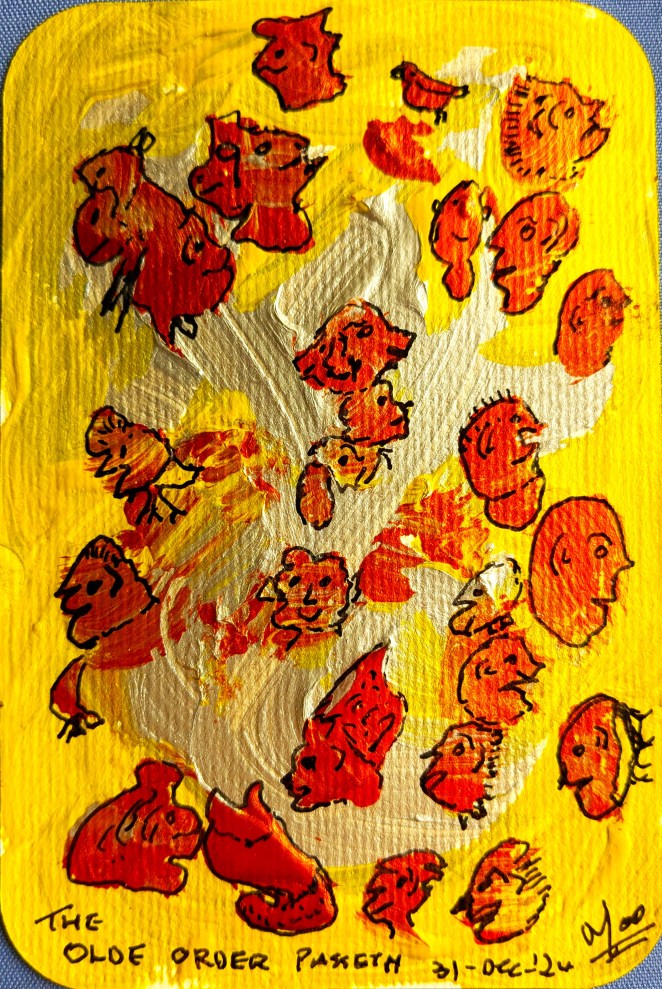
We don’t need a comment really except that The Olde Order Changeth Lest One Good Custom Should Corrupt the World. Interpret that as you will. And as Moo says to Ryan in the presence of Don Roger – “Hey, Ryan, look at all those changes in my painting.”

The Sowing of Acorns

Painting by Moo
PTSD Spatter
aka

The tangled web we weave
when first we practice to deceive

Ryan and Don Roger

9

The Sowing of Acorns

            Metatheatre can be defined as a play within a play. In DQI,7, the priest and the barber decide that one of the easiest ways to cure Don Quixote of his madness will be to wall up his library, so that he can find no trace of the room in which it was contained. They thought it might stop him from thinking about his books. Then they agreed to tell him that an enchanter had taken the books away, room and all.

            When Don Quixote asks the housekeeper about his books, she tells him that there is neither room nor books because the devil has taken them away. The niece joins in and corrects her saying that no, it wasn’t the devil. A sage enchanter descended one night in a cloud, dismounted from his dragon, went into the room, came out through the roof in a puff of smoke, and left no trace of room or books. He called himself Muñaton and said he had a grudge against the books’ owner. Don Quixote corrects her and tells her is must have been Freston. The housekeeper joined in with “Freston or Friton, but it ended in ton.”

            Cervantes has now planted several little acorns in the mind of the reader. Sooner or later, they will grow into large oak trees.

1. Metatheatre is based on a falsehood. The main character does not see the dramatic irony in the situation, but believes the lie that the other characters have spun for him. They write the play within a play, and Don Quixote becomes the actor in that play written specifically for him. This metatheatrical theme will recur throughout the novel and will become dominant in DQII.

2. The correction of speechMuñaton (housekeeper and niece) becomes Freston (DQ), becomes Freston (the housekeeper), and then Friton, or something ending in -ton. The correction of spoken language will play a much larger role later in the novel.

3. The role of the evil enchanter who dogs Don Quixote’s footsteps and robs him of his greatest triumphs. This will start in the very near future with the adventure of the windmills.

4. The intersection of illusion and reality. This is really important for several reasons. Cervantes, as author, causes his characters to reveal the truth behind any metatheatrical (or other) illusion that concerns Don Quixote. He does not wish to trade, like Lazarillo de Tormes in false miracle. Clearly, he has no wish to be, like Lazarillo, castigado.

The simplest conflict between illusion and reality occurs in the first sortie. Don Quixote sees an inn, a humble country inn. Totally deluded, he believes it is a castle. Nobody contradicts him. Inn – reality / castle / illusion – but nobody really points out the difference. The adventure of the windmills is similar. Don Quixote sees giants. Sancho Panza sees windmills. Now the conflict is supported by a sane and reliable witness aka his squire. When one of the characters reveals the illusion, the author does not need to step in and do so. Throughout part one of the novel (DQI), we will see Don Quixote reacting in different ways to the unmasking of the illusion in which he so strongly believed.  This situation, as we will see, will be presented in very different fashion in DQII. One fictional month between the two parts – but, in reality, ten years in which Cervantes thinks, plans, rewrites, and deepens his plots while polishing his skills.

So many little acorns. So many sown seeds. Hopefully, we will soon be able to watch them grow.

Hunt the Author

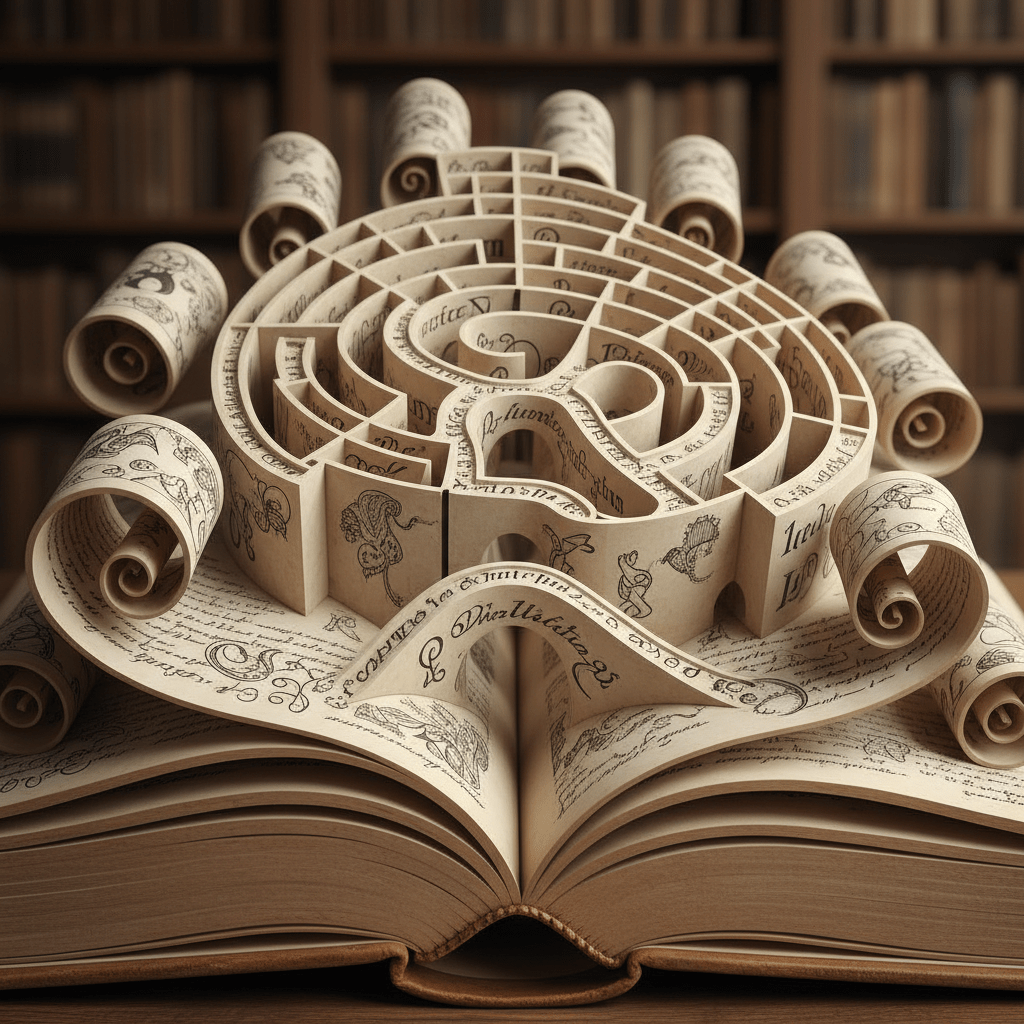
Open book with labyrinthine paper structure and calligraphy designs
A fascinating labyrinth constructed from the pages of an old book, showcasing delicate calligraphy and illustrations.

Image generated by AI

Ryan and Don Roger

7

Hunt the Author

            We have already seen what type of games can be played with numbers. Now we shall look at a different type of party game – hunt the thimble or the slipper turned into hunt the author. Where is the best place to hide a tree? In a forest. What is the best place in which to hide a book? In a library. What is the best place to hide a needle? In a haystack. What is the best place to hide an author? In a book, of course.

How does this affect our understanding of Don Quixote? Well, we are about to find out. But first we must ask the question, why would we want to hide an author in the first place? The answer to this is quite simple – to avoid punishment from the Spanish Inquisition, or any other authoritarian institution that wishes to ban books and punish authors for writing them. The best way to do this is to not put the author’s name on the book. Thus, Lazarillo de Tormes, said to be the first picaresque novel, was written by Anonymous. And when you check your history of literature, you will find that a great many books and poems have been written by that gentle person. Person, because being anonymous, we have no idea if he was a he or she was a she!

But who is the author of Don Quixote? Miguel de Cervantes, obviously. Who, then, is the narrator of the story? In the first sentence of the book, this first-person narrator reveals himself ‘in a village in la Mancha that I do not wish to name – de cuyo nombre no quiero acordarme / whose name I don’t want to remember – in the original Spanish. A little later, DQI, II / 2, in an effort to distance himself from the text, our first-person narrator states that ‘There are authors who say that the first adventure he met was that of the pass of Lapice. Others say it was the windmills. But what I have been able to discover of the matter and what I have found written in the annals of La Mancha …”

So, we have our first-person narrator, but he is not creating this story, not at all. We know from 4 – Stage to Page, that our narrator borrowed the idea for this first sortie from El Entremés de los Romances. Now he tells us that multiple authors have written about Don Quixote and his adventures and that there are some discrepancies about what was his first adventure. Our narrator also tells us that he has researched the matter and found his account in the annals of La Mancha. Interesting. Annals, multiple writers, and our narrator is a historian who has researched the matter. What do we find when we hunt the author? Not one author, but multiple authors and a reference to accounts of the matter contained in the annals of La Mancha. Once again, AI comes to my rescue – “Synonyms for annals include historical records, chronicles, archives, journals, and registers. These terms refer to chronological accounts or records of events, often in yearly order, documenting the history of a person, organization, or era.”

            Curiouser and curiouser! Historical records – chronicles – archives – journals – registers -documenting the history of a person – what price creativity? No single slipper, then, at this hunt the slipper party, but a multiplicity of slippers, just like the Easter Bunny lays a multiplicity of eggs at Easter and hides them round the house. So much for the needle in the haystack – some haystack this.

Censorship

Person in a black hoodie with face covered and mouth taped shut at sunset.
A hooded figure stands with a taped mouth in this powerful depiction of silenced expression.

Image generated by AI

Ryan and Don Roger

6

Censorship

            Censorship plays an important part in many societies and can take multiple forms. The Spanish Inquisition, for example, along with book burning, played a powerful role in the printing industry. Every book had to be examined and approved by a member of the Inquisition. Political correctness is itself a form of censorship. It encourages people to think about what they say and how they are saying it. Many sorts of political correctness arise from the feminist movement that began to question the male domination of the English language. Actors and actresses became actors. In cricket, wicket-keepers, bowlers, and fielders passed the linguistic test, but batsmen and batswomen became batters. I sincerely hope that glove men, for wicket-keepers, do not turn into glove persons.

            Nowadays, some people feel that the correction of language has gone too far and this has resulted in the anti-woke movement, as it is called. This rejects both the correction, and the hyper-correction, of what some people call imbalances in language, culture, and society. I will self-censor myself, rather than being censored by another person or persons, and refrain from what I personally feel about these ideas. Here, I merely point out that they exist.

            Lazarillo de Tormes, for example, was heavily censored by the Spanish Inquisition. All anti-clerical references in the original edition, and there were many of them, were removed. The resultant volume, heavily redacted and much smaller, became known as Lazarillo Castigado / Lazarillo chastised.

            To the best of my knowledge, the only piece removed from Don Quixote was the episode in which he made a rosary from the tail of his shirt, by tying ten small knots in it, and one large one. Since the shirt tail was used for many purposes, including wiping oneself, the censor thought this idea was indecent. Cervantes replaced the shirt tail with ten acorns and a chestnut in later editions.

He also managed to escape censure by placing all his questionable statements in the mouth of a mad man. Whenever an anti-clerical comment was made, readers (and listeners, for in those days, not everybody could read), chuckled at the enormity of the statement and rejoiced in the fact that only a madman could say such things.

            Together with censorship comes correction. Thus Sancho, who is illiterate and can neither read nor write, is also unable to spell. In this fashion, he offers a series of incorrect pronunciations and phonetic equivalents that Don Quixote joyfully and carefully corrects. We see this in other characters too. In DQI, VII or 7, the devil named by the housekeeper, becomes ‘the sage Muñaton’ in the mouth of the niece. Don Quixote changes this to ‘Freston’. The housekeeper continues with ‘Freston’ or ‘Friton’ and adds “I know only that his name ended in ton.”

            In our modern society, I see an enormous change taking place. Where I was educated by reading books, many books in my case, today’s younger generation teach themselves via AI and Chat. They watch videos. Watch TV. Text on cell phones. They listen to multiple podcasts. All this is audio-visual, little of it is written down. As a result, essays I received from my students were filled with phonetic spellings of words that they had heard, but not seen in written form. In addition, schools are no longer teaching cursive. My grand-daughter can print. She can neither read nor write joined letters. However, she can text faster with her two thumbs than I can with my index finger! The new generations have entered an electronic world that is totally alien to me.

            Quis custodiet ipsos custodies? Who shall guard the guards? Who shall police the police? Who shall program the programmers? And with what shall they program them? A long time ago, the BBC in England banned Sesame Street because it was too simplistic. Today, Sesame Street equivalents rule. So, let us extend our questions – “Who shall censor the censors?”

            Sometimes, it takes a madman to do it, in our case, a madman called Don Quixote! He, in his madness, encourages us, nay (or as Rocinante might say ‘neigh!’), he forces us to re-examine our links to language, to reality, to illusion. Reading his text, we learn to ask questions of the world around us. How many of our realities are illusions? How many of our illusions are corruptions of reality? How many times has Don Quixote been banned by figures in authority because of its attacks on authority?

            Quis custodiet ipsos custodies? Who shall guard the guards? Who shall program the programmers? “Who shall censor the censors?” And who will protect us if we speak truth to authority, and authority doesn’t like the truths we offer? The author of Lazarillo remains anonymous. Cervantes distanced his words from himself and put them in the mouth of a madman. Other people have taken evasive action in other ways.

The alternative – stay silent and bleat with the sheep – “Four legs good! Two legs bad!” And when the Mastiffs with their spiked collars come for us, we can always, like the sheep, change our chant. “Four legs bad! Two legs good!” After all, all sheep are equal, even when some sheep are more equal than others, and all of us can imagine we are animals on George Orwell’s Animal Farm – and then we can say what we want and nobody will listen, nobody will pay attention, and nobody will understand. And remember, somebody, somewhere will want Animal Farm banned. And 1984.