Lure of the Picaresque Novel

Ryan and Don Roger

12

Lure of the Picaresque Novel

            Let us begin by asking – what is the picaresque novel? According to Wikipedia, “the picaresque novel, is a genre of prose fiction that depicts the adventures of a roguish but appealing hero, usually of a low social class who lives by his wits in a corrupt society. Picaresque novels typically adopt the form of an episodic prose narrative with a realistic style.”

            Is Don Quixote a picaresque novel? It has been called a picaresque novel by English standards, but rarely, if ever, by Spanish ones. Yes, Don Quixote is prose fiction that relates the adventures of Don Quixote and Sancho Panza. However, while Sancho is of low social class, Quixote himself most certainly isn’t. He is a landowner, with an expensive library, and a solid education. He is literate, though Sancho is not. Does Don Quixote live by his wits? Good question. Some would say yes, he does. Others, including the first-person narrator in DQI, I/1, would say his brain was so decayed with his all-night readings that it had dried up and he had no wits left to lose. Is the society around him corrupt? This is a much more difficult question to answer.

            In an earlier discussion, The Golden Age, we saw that Don Quixote, in his speech to the goat herds, contrasted the idyllic golden age of the Edenic pastoral with the corruption of contemporary society. As we mentioned earlier, neither description is truly accurate. As for the society in which Don Quixote moves, he meets, in the course of the novel, more than 600 characters, many of them unforgettable, some of whom are good, and some bad. More, Cervantes’s description of Spanish society is so wide and it is painted in such depth that it is hard to generalize and call that society corrupt. In addition, while Don Quixote meets low class characters in his travellers, he also mingles with judges, high ranking churchmen, country gentlemen, and even dukes and duchesses. Case made, I would hope.

            One further point on the picaresque, while the peripatetic novel may be considered picaresque in English, it is not picaresque in Spanish unless it is narrated in the first-person singular. The first word in Quevedo’s Buscón is ‘Yo’ / ‘I’ – “Yo, señor soy de Segovia.” / “I, sir, am from Segovia.” Then Pablos goes on to tell his own life story. On the other hand, the first-person narrator at the beginning of Don Quixote tells the story of the knight. He does not tell his own story, even though elements of his personal life are included within the knight’s tale.

            That said, elements of the picaresque do occur in the Quixote. The most important sequence can be found in DQI, XXII / 22, The freeing of the galley slaves. In this chapter, Don Quixote and Sancho meet a chain gang of low-class criminals who are en route to the coast to serve penal sentences chained to the oars of the King’s galleys. When Sancho tells his master that these men are forced, against their will, to serve in the galleys, Don Quixote sees an opportunity to employ his knightly skills – “this is a case for the exercising of my profession, for the redressing of outrages and the succouring and relieving of the wretched.”

            Don Quixote then asks each criminal in turn about the crimes they have committed. Big problem – in the same way that the goat herds have not understood a word of Don Quixote’s learned language, the knight is unable to understand the thieves’ slang of the galley slaves. There follows a series of misinterpretations. The first slave fell in love, the second had been singing, the third was short of a small sum of money, the fourth paraded the streets in state and on horse back, and the fifth had been caught up in an intricate tangle of relationships. Don Quixote cannot comprehend any of this and interprets each word in its literal, dictionary meaning.

            He doesn’t understand that the man in love was in love with someone else’s belongings, the singer had ‘sung’, ie confessed under torture, the third didn’t have enough money to bribe the judge, the fourth had been whipped through the streets, guilty of procuring, and possibly witchcraft, and the fifth had been involved in irregular sexual adventures with a wide range of people, some related and others not. Poor Don Quixote is baffled by this language.

            The sixth prisoner, the famous Gines de Pasamonte, is a different kettle of fish, for he has, in true picaresque fashion, written his own life story with his own fingers. Translated – he has written his own picaresque novel with himself in the starring role. When Don Quixote asks if the book is good, Gines replies that “it is so good … that Lazarillo de Tormes will have to look out, and so will everything else in that style …” “Is it finished?” Don Quixote asks him. “How can it be … if my life isn’t?” is the reply.  

            So, that is the story of Don Quixote’s encounter with the picaresque. It is a style that Cervantes tended to avoid, preferring at this stage the Italianate, the pastoral, the romance, and his own invention of the novel as a reinvention of the epic poem that can be written in prose. The picaresque was certainly a temptation for Cervantes, for he leaned towards that style from time to time in Don Quixote, and also in a couple of his exemplary novels (1612), namely Rinconete y Cortadillo and El Coloquio delosPerros, among others. That said, Don Quixote is certainly not a picaresque novel, in the Spanish sense of the word.

Censorship

Person in a black hoodie with face covered and mouth taped shut at sunset.
A hooded figure stands with a taped mouth in this powerful depiction of silenced expression.

Image generated by AI

Ryan and Don Roger

6

Censorship

            Censorship plays an important part in many societies and can take multiple forms. The Spanish Inquisition, for example, along with book burning, played a powerful role in the printing industry. Every book had to be examined and approved by a member of the Inquisition. Political correctness is itself a form of censorship. It encourages people to think about what they say and how they are saying it. Many sorts of political correctness arise from the feminist movement that began to question the male domination of the English language. Actors and actresses became actors. In cricket, wicket-keepers, bowlers, and fielders passed the linguistic test, but batsmen and batswomen became batters. I sincerely hope that glove men, for wicket-keepers, do not turn into glove persons.

            Nowadays, some people feel that the correction of language has gone too far and this has resulted in the anti-woke movement, as it is called. This rejects both the correction, and the hyper-correction, of what some people call imbalances in language, culture, and society. I will self-censor myself, rather than being censored by another person or persons, and refrain from what I personally feel about these ideas. Here, I merely point out that they exist.

            Lazarillo de Tormes, for example, was heavily censored by the Spanish Inquisition. All anti-clerical references in the original edition, and there were many of them, were removed. The resultant volume, heavily redacted and much smaller, became known as Lazarillo Castigado / Lazarillo chastised.

            To the best of my knowledge, the only piece removed from Don Quixote was the episode in which he made a rosary from the tail of his shirt, by tying ten small knots in it, and one large one. Since the shirt tail was used for many purposes, including wiping oneself, the censor thought this idea was indecent. Cervantes replaced the shirt tail with ten acorns and a chestnut in later editions.

He also managed to escape censure by placing all his questionable statements in the mouth of a mad man. Whenever an anti-clerical comment was made, readers (and listeners, for in those days, not everybody could read), chuckled at the enormity of the statement and rejoiced in the fact that only a madman could say such things.

            Together with censorship comes correction. Thus Sancho, who is illiterate and can neither read nor write, is also unable to spell. In this fashion, he offers a series of incorrect pronunciations and phonetic equivalents that Don Quixote joyfully and carefully corrects. We see this in other characters too. In DQI, VII or 7, the devil named by the housekeeper, becomes ‘the sage Muñaton’ in the mouth of the niece. Don Quixote changes this to ‘Freston’. The housekeeper continues with ‘Freston’ or ‘Friton’ and adds “I know only that his name ended in ton.”

            In our modern society, I see an enormous change taking place. Where I was educated by reading books, many books in my case, today’s younger generation teach themselves via AI and Chat. They watch videos. Watch TV. Text on cell phones. They listen to multiple podcasts. All this is audio-visual, little of it is written down. As a result, essays I received from my students were filled with phonetic spellings of words that they had heard, but not seen in written form. In addition, schools are no longer teaching cursive. My grand-daughter can print. She can neither read nor write joined letters. However, she can text faster with her two thumbs than I can with my index finger! The new generations have entered an electronic world that is totally alien to me.

            Quis custodiet ipsos custodies? Who shall guard the guards? Who shall police the police? Who shall program the programmers? And with what shall they program them? A long time ago, the BBC in England banned Sesame Street because it was too simplistic. Today, Sesame Street equivalents rule. So, let us extend our questions – “Who shall censor the censors?”

            Sometimes, it takes a madman to do it, in our case, a madman called Don Quixote! He, in his madness, encourages us, nay (or as Rocinante might say ‘neigh!’), he forces us to re-examine our links to language, to reality, to illusion. Reading his text, we learn to ask questions of the world around us. How many of our realities are illusions? How many of our illusions are corruptions of reality? How many times has Don Quixote been banned by figures in authority because of its attacks on authority?

            Quis custodiet ipsos custodies? Who shall guard the guards? Who shall program the programmers? “Who shall censor the censors?” And who will protect us if we speak truth to authority, and authority doesn’t like the truths we offer? The author of Lazarillo remains anonymous. Cervantes distanced his words from himself and put them in the mouth of a madman. Other people have taken evasive action in other ways.

The alternative – stay silent and bleat with the sheep – “Four legs good! Two legs bad!” And when the Mastiffs with their spiked collars come for us, we can always, like the sheep, change our chant. “Four legs bad! Two legs good!” After all, all sheep are equal, even when some sheep are more equal than others, and all of us can imagine we are animals on George Orwell’s Animal Farm – and then we can say what we want and nobody will listen, nobody will pay attention, and nobody will understand. And remember, somebody, somewhere will want Animal Farm banned. And 1984.

The Numbers Game

Ryan and Don Roger

3

The Numbers Game

            The numbering of the chapters in Don Quixote is also interesting. While Part I and Part II often retain the Latin numbering, the chapters themselves can be found both with Latin Numbers and standard numbers.

            Latin numbers are based on six letters I, V, X, L, C, D and M. Each has its own value. I = 1, V = 5, X = 10, l = 50, C = 100, D = 500, M = 1000. Most have us have seen Roman numerals on clocks and we are familiar with the numbers from 1-12. I, II, III, IV (4, that is to say one before five), V, VI (6, that is to say one after five), VII, VIII, IX (9, that is to say one before ten), X, XI (11, that is to say one after ten), XII.

            This paradigm governs Latin numbers. XV = 15, XX = 20, XXX = 30, XL (ten before fifty) = 40, L = 50, LX (ten after fifty) = 60, LXX = 70, LXXX = 80, XC (ten before one hundred) = 90, C = 100, CX = 110. The date of my writing this MMXXVI (2026). You will have noticed similar numerical configurations on books and old movies.

            The ancient Celtic numbering system was based on the digits of hands and feet. Counting sheep, for example, or goats, shepherds and goatherds would count up to twenty on their toes and fingers. Then they would carve a notch in a piece of wood. To keep score was to score the notch.

            Something similar happens in Basque jai alai, the happy game.  The scorers score in groups of IIII which they then made into 5 with a line through the numbers IIII. Four groups of 5 made 20 and the 21st notch won the game. That scoring method may have changed, but it is certainly how I learned to score the game in the Basque country (Spain) back in the 1950’s. Curiously, modern French shows the vestigial remains of this – quatre-vingts. Welsh shows a somewhat similar diversity because the Welsh word for twenty is ugain – although it’s technically not the only one, with the alternative dau ddeg (literally two tens) becoming more and more common. A case of plus ça change, plus c’est la même chose.

            And we must never forget the old sterling system of the United Kingdom of Great Britain and Northern Island. £. S. D. aka pounds shillings and pence. 4 farthings = one penny, 12 pennies = one shilling, 20 shillings = one pound.

Our good friends on AI came to our aid with this one. I quote – The pre-decimal British currency system, known as £sd (librae, solidi, denarii), consisted of 12 pence in a shilling and 20 shillings in a pound (£), totaling 240 pence per pound. Used until Decimal Day on February 15, 1971, this system featured various denominations, including farthings, sixpences, florins, half-crowns, and crowns. What about a guinea you ask? Well. That was £1 and 1 shilling. Hence the auctioneer’s delight.

            “What am I bid”?       >         “£20.”             >          “Guineas!”

Our trusted friends on AI sum it up this way – “A guinea was a British gold coin minted between 1663 and 1814, officially valued at 21 shillings (£1.05 in decimal currency) from 1717 onwards. It was the first machine-struck gold coin in Britain, typically worth slightly more than one pound. While no longer in circulation, it is still used in horse racing and some luxury auctions to represent £1.05.”

Luxury auctions – I love that phrase. And here we must leave our luxurious description of, and adventures into, numbers in Don Quixote! Just look where the journey has led us. And remember, in the same way that Cervantes inserted short stories, both spoken and read, that digressed from the main narrative, we can also insert such mental rants and ramblings into our own narrative. And we shall continue to do.

Here’s one, for example. How do you count goats in Wales? Click on these links for two examples. Counting the Goats traditional and Counting the Goats modern. Of course, wrth gwrs, the simplest method of all is to count their legs and divide by four! Try doing that with Latin numerals!


What’s in a Name?

Ryan and Don Roger

2

What’s in a name?

            Don Quixote was first published in Spain in 1605. In 1609, Thomas Shelton translated it into English. By 1611 / 1612 the adjective quixotic, was already in use within English society. An AI search tells us that “In the 17th century, the term quixotic was used to describe a person who does not distinguish between reality and imagination. The etymology of the word began after the publication of Don Quixote in 1605.”

But what does quixotic mean exactly? Another AI search reveals that “Quixotism (adj. quixotic) is impracticality in pursuit of ideals, especially those ideals manifested by rash, lofty and romantic ideas or extravagantly chivalrous action. It also serves to describe an idealism without regard to practicality.”

            Why is this important? Quite simply because in English we say Don Quixote / Quick-sot, not Don Key-hoe-tay a bastardized version of the Spanish. Please note that the adjective, in English, is quixotic not “key-hoe-tay-ic” which is too chaotic to be practical. Note too that the French translators offer us Don Quichotte, while the Italians suggest Don Chisciotte. Both these languages conserve the original pronunciation – a voiceless postalveolar fricative /ʃ/, which is the same sound as the English “sh” in “ship”. This is clear evidence that the X of the original had a different pronunciation in the seventeenth century than it does today.

            My wonderful friends on AI confirm this as follows, and I quote:

In 17th-century Spain, the letter ‘X’ primarily represented a voiceless postalveolar fricative /ʃ/, which is the same sound as the English “sh” in “ship”. During this period, which coincided with the Spanish Golden Age and the “readjustment of the sibilants,” this sound underwent a transformation, shifting from the “sh” sound to the modern velar fricative /x/ (similar to the German ch in loch or the modern Spanish ‘j’). 

Here are the key details about the pronunciation of ‘X’ during that era:

Initial “Sh” Sound: Early in the 17th century (and before), words that are now spelled with ‘j’ or ‘g’ were spelled with ‘x’ and pronounced as “sh.” For example, Don Quixote was pronounced “Don Keesh-o-teh”.

The Sibilant Shift: During the 16th and 17th centuries, the sound /ʃ/ (written as ‘x’) and the voiced /ʒ/ (written as ‘j’) merged into a single voiceless sound /ʃ/. Later in the 17th century, this sound moved backward in the mouth, evolving into the modern velar /x/ (the modern ‘jota’).

And this is just the beginning and what’s in a name? For example, what is the real name of Sancho Panza? Is it Sancho Panza or Sancho Zancas [DQI,9]? How about his wife? Is it Juana Gutierrez or Mary Gutierrez [DQI, 7]? In the same chapter she is called Teresa Panza, the name that stays with her throughout the novel.

And what about Don Quixote himself? Is his real surname Quixada, Quesada, Quexana [DQI,1] or Alonso Quijano el Bueno [DQII,74]? Don Quixada de la Mancha aka Don Quesada de la Mancha aka Don Quexana de la Mancha – and we won’t mention the alternate names he takes – the Knight of the Sad Countenance or the Knight of the Lions!

Fascinating, eh? So, after all that, tell me – what’s in a name?

Riding Buddies – Reading Buddies

Ryan and Don Roger

1

Riding Buddies – Reading Buddies

            Don Quixote makes three sorties. The first is very brief, about five chapters. The second is much longer. And the third is 74 chapters in length. Each sortie is different. For now, I would like to take a brief glance the difference between Sortie 1 and Sortie 2.

            Sortie 1 – Don Quixote sets out on his own. He travels to an inn, has adventures there, gets knighted by the inn-keeper, albeit falsely, and after an unequal combat in which he is bruised and battered, he is brought back home by a neighbor.

            When the inn-keeper asks Don Quixote for payment, the knight replies that knights errant do not carry money with them, nor do they pay for their food and lodging. The inn-keeper recommends that Don Quixote find a squire to attend, one who can carry the money and the other things that a knight needs. Our knight takes this recommendation to heart.

            Sortie 2 – In this second sortie, Don Quixote has a companion. One of the main differences between the first and second sorties is that the knight now has a squire with whom he can talk. This dialog between knight and squire, master and servant, is key to the understanding of the novel.

            Their contrasting points of view, Don Quixote literate, a believer in reading, with a firm belief that all books of chivalry are true, contrasts immediately with the illiterate Sancho, his squire. Where Sancho sees reality – the windmills are windmills – Don Quixote sees illusion – the windmills are giants, waving their arms, and threatening to attack. This is a simplistic summary, but we will leave it there for now.

            Graham Green understood the nature of dialog when he penned his novel, Monsignor Quixote. In the film, available free of charge on YouTube, the Catholic Priest (now a Monsignor) and his friend, the Communist Mayor (now defeated in an election and unemployed) leave the little town in which they live, and set out on a journey of adventures, much in the same way that Monsignor Quixote’s namesake sets out in Cervantes’s novel.

They do not have a horse and a donkey. However, they do have Monsignor Quixote’s car, nicknamed, of course, Rocinante, in which to travel. The key to Green’s novel is the constant dialog between the mayor, knowledgeable in the ways of the world, and Monsignor Quixote, innocent of the world outside his church and full of illusions about the reality of that world. It is easy to think of them as riding buddies who converse.

            So, what is a reading buddy? Well, Don Quixote is a long book, over 1000 pages, with 127 chapters. Many readers set out in search of adventure, but do not keep reading. However, a wise reader will set out on that journey with a reading buddy, who will travel with him, step by step, chapter by chapter. Each will keep the other company, and one of the delights of the journey will be the constant conversation between the reading buddies.

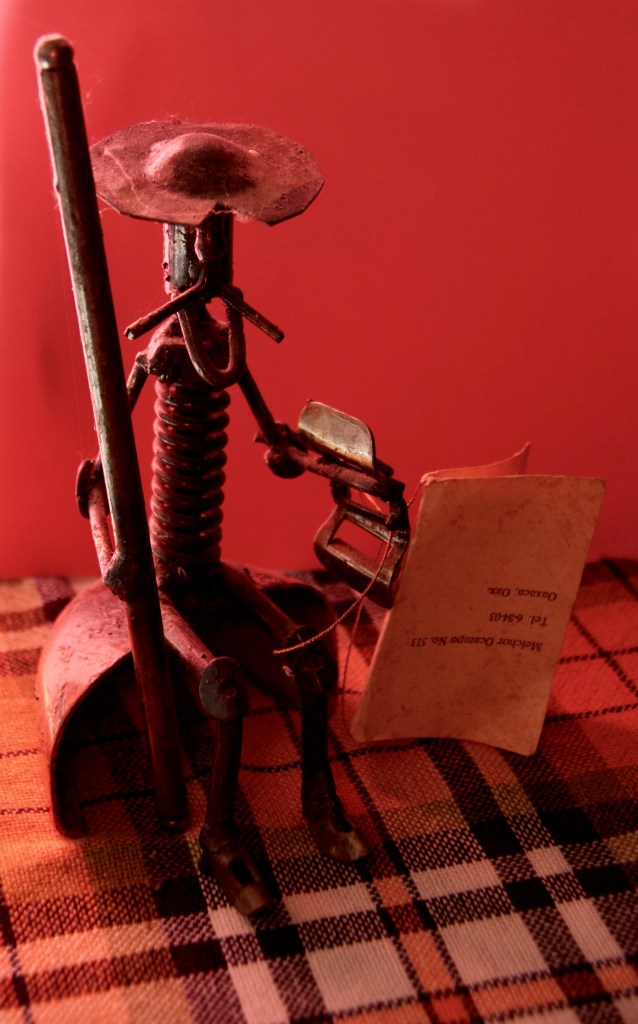
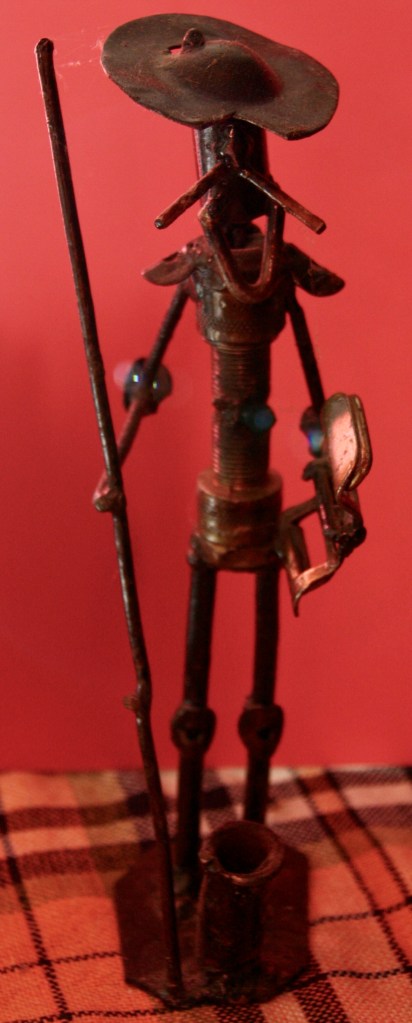
            I am Don Roger. My reading buddy is Ryan. I am short and stout. Ryan is tall and thin. We have reversed the Sancho / Quixote image, but we are both equally insatiable in our search for knowledge. The curious thing is that I have read Don Quixote 28 items, mainly in Spanish, but also in English and French. Ryan is reading it for the first time, but he is an expert in AI access and is helping me to understand the wily ways of that electronic world of short cuts. Of course, it helps you to sort the chaff from the grain when you know what you are looking for and just use AI to refresh your fading memory!

            I am full of the illusions of the academy. Ryan reads with a sharp mind, a keen wit, and no illusions at all. He sees only the reality of what is there. Together we have embarked on a journey that is in the process of opening our eyes to two different realities his and mine – Ryan’s and Don Roger’s. The conversations that we are having along the way, will be the subject of this little discourse on Cervantes’s novel.

Flowers

Flowers

“With freedom, flowers, books, and the moon, who could not be perfectly happy?” Oscar Wilde

Yesterday I bought my beloved some flowers. I searched among the bunches in the supermarket to find some that were not full blown but ready to spring from bud to blossom. I had the freedom to buy and with it the freedom that comes from having a little bit of money to spare for those frivolities that keep love alive at any age.

As for books, I read them and I write them, and sometimes they write me, and sometimes I can tell the difference, and some times I can’t. “What is this life, if full of greed we have no time to sit and read. Or when we lay awake at night, we don’t have time to think or write.”

Then there is the moon. “Please let the light that shines on me, shine on the one I love.” An old sea-farers’ song also sung by the beloved left behind on the home shore. There are few things as fascinating as a garden in the moonlight. Delightful too are night flowers blossoming beneath a full moon. “Boys and girls come out to play, the moon is shining as bright as day. Leave your pillows and leave your sheets and join your playfellows in the streets.”

So there you have a recipe for perfect happiness. Freedom from need, cash for frivolities and flowers, moonlight in which to serenade one’s beloved, and a book in which to record the recipe and keep it fresh in mind – add them one by one, stir them gently, plant them – and may perfect happiness blossom for you, too.

Dreamers

Dreamers

“Yes: I am a dreamer. For a dreamer is one who can only find his way by moonlight, and his punishment is that he sees the dawn before the rest of the world.” Oscar Wilde.

“The dreamers by day are dangerous people, for they are the ones who make their dreams come true.” T. E. Lawrence.

Two interesting and contrasting quotes on dreamers. They seem to contradict each other – but do they? How do we dream? What do we dream of when we dream? What does the word ‘dream’ really mean? How can it change, that meaning when a person announces in a sharp, sarcastic voice: “In your dreams.”? Were the Everly Brothers right when they sang their version of dream, dream, dream?

There is no right and wrong with dreams. Some dreams come at night. They rise from deep within our resting – restless minds, asking questions, answering questions, doubling down on what we did, or didn’t do. Some dreams are obsessive and occur again and again. These are individual to each sleeper and cannot be interpreted, en masse, by a dictionary of dreams. Other night dreams creep in through the bedroom window. These may not be our dreams – they may be the dreams of other people, come to disturb us as we sleep. These can be dangerous dreams, disturbing moments, and that’s why the indigenous have created dream-catchers that will snare those dreams and prevent them from entering.

Other dreams come by day. Day-dreaming is a rite of passage for many young children, trapped in boring school rooms with an ageing teacher droning on and on. “Knowledge is that which passes from my notes to your notes without going through anyone’s head.” I woke up enough from my day dream during that particular first-year lecture to note those words in my notebook. They were the only notes I took in that class and I day dreamed my way though a year of that man’s pseudo-lectures.

But the dreams we dream by day – yes, they can indeed be dangerous – because we can make them happen. One person dreams of being a doctor and, against all the odds, that person becomes one. Another visualizes – another form of day-dreaming – breaking a world record. And does so – such people fulfill their day-dream. Some, like Don Quixote, dream the impossible dream. These are fantasists whose dreams will never come true, for they are based on unrealities, and not founded on the essential truths of real life.

“Yes: I am a dreamer. For a dreamer is one who can only find his way by moonlight.” Much as I love this quote, I am disturbed by the adverb ‘only’. It is so limiting. Dreamers, as I have tried to show, can find their way by day as well. “His punishment is that he sees the dawn before the rest of the world.” This, too, I find enigmatic and disturbing. Why should dreamers be punished when they can also be rewarded? Why is seeing the dawn a punishment? Why is seeing the dawn before the rest of the world a sort of double punishment? And why does the dawn punish people? In order to answer that question, we must define the dawn! Maybe we’ll do that in another post.