Translation Theory

Ryan and Don Roger

15

Translation Theory
(revised 3 May 2026)

            In DQI, IX, Cervantes, in his role of first-person narrator, goes to the Alcana in Toledo, where he discovers an Arabic manuscript containing the adventures of Don Quixote. The first eight chapters of our novel contain no mention of a translator. Suddenly one appears. The narrator buys the manuscript, finds a translator, takes the translator to his house, and in six weeks receives a translation, from Arabic into Spanish, of the novel. Question – does the translation contain Chapters 1-8, already written by Cervantes, or not? Alas, we do not know. Is the translation accurate? We do not know that either, for the original Arabic manuscript is a literary illusion and does not exist.

            However, we do know that Cervantes writes that ‘reading a translation is like looking at the reverse side of a tapestry’. Speaking of the Italian poet, Boiardo, the priest, in DQI, 6, says “If I find him here speaking in any language but his own I shall show him no respect. But if he speaks his own tongue, I will wear him next to my heart.” The priest continues, “That is what happens with all authors who translate poetry into other languages. However much care they take, and however much skill they show, they can never make their translations as good as the original.”

            Of course, with no original for the Quixote, there can be no translation theory. So, let us try to construct one. In the course of my own work, I have studied various translations of Quevedo’s poem Miré los muros de la patria mía. I will use them to see how translations can function, and what happens when we look at the reverse side of the tapestry. First, Quevedo’s poem in the original Spanish. Then a direct, line by line translation of it, for those who do not read Spanish.

Miré los muros de la patria mía,
si un tiempo fuertes, ya desmoronados,
de la carrera de la edad cansados,
por quien caduca ya su valentía.

Salíme al campo, vi que el sol bebía
los arroyos del yelo desatados,
y del monte quejosos los ganados,
que con sus sombras hurtó su luz al día.

Entré en mi casa; vi que, amancillada,
de anciana habitación era despojos;
mi báculo más corvo y menos fuerte;

vencida de la edad sentí mi espada.
Y no hallé cosa en que poner los ojos
que no fuese recuerdo de la muerte.

            I looked at the walls of my fatherland, (line 1) if once strong, now crumbling, (line 2) from the passing of age tired, (line 3) which wears out their bravery. (line 4) I went out to the field, saw that the sun was drinking (line 5) the streams from the ice untied, (line 6) and of the hill complaining the herds, (line 7) whose shadows stole the light of day. (line 8) I entered my house; I saw that, stained, (line 9) of an ancient habitation it was the spoils; (line 10) my cane more curved and less strong; (line 11) conquered by age I sensed my sword. (line 12) And I didn’t find a thing on which to turn my eyes (line 13) that was not a reminder of death. (line 14).

            This very literal translation, with all its inaccuracies and its inability to express the hidden cultural depths of the original, is totally unpoetic and inadequate, compared to the genius of the original version. Other prose translations have been offered by J. M. Cohen and Elías Rivers, and they are much more accurate – and much better (!), than mine.

            Brave poetic translations, also at times somewhat distant from the original, have been published by Robert Lowell, David Gitlitz, and Griswald Morley / Charles Cobb revising the version of John Masefield. Alas, I do not have permission to replicate their versions. However, I called the translations ‘inadequate’, but they aren’t really they are just the best we can do. Robert Lowell, himself an outstanding poet, gave us much more than a translation. He gave us what I like to think of as a recreation, a new poem based upon the old original. Translations and re-creations, two very different kettles of fish! I offer you here two of my own efforts at recreating the poem!

1

I looked at the defenses of my native land:
empty silos, bombs and rockets melted down.
“Put your faith,” the TV said, “in diplomacy,
not in the metal walls of flying ships.” I went

outside. Cattle were lowing against the falling
temperature, tails to the wind. Steam
rose from their flanks, then was scattered
like an overnight dream of ghosts. Inside,

on the sink, a shrivelled tea bag, dried up stains;
my trusty coffee pot, rusty on the stove,
was chipped and raw at the rim. I took

my shot gun in my hand. Its crooked barrels
served me as a walking-stick. As I limped
around, my mother’s photo spoke to me of death.

2
I’ve got something to say, so here’s what I’ll do
I’ll write it out in rap with a rhythm just for you.
I once saw a town with a very small wall
that’s so fallen down it’s no wall at all.
It’s old and it’s rotten and it cannot last
like a runner on the track who’s run too fast
at the start of the race, and he’s run out of breath,
so he’s hit that wall, and he feels like death.
And there’s cattle lowing and the sun’s in the sky
but it’s winter time, so the sun’s not high,
and the shadows are long, and the wind’s getting cold,
and it’s all about a man who’s growing old.
He looks around his house and all he sees
are dead people’s faces and living memories.
He’s trapped on the ground floor, can’t climb stairs,
everything he touches he’ll leave to his heirs.
There’s a pain in his side, and he can’t catch his breath,
and all that he sees, reminds him of death!

            A rap sonnet (14 lines) containing nine pairs of rhymed couplets (18 lines)? The good Don Francisco de Quevedo will be turning in his grave and his still-warm ashes will once again be burning with love for Lisi and the joy of being alive, in one form or another, in spite of the River Styx, which the flame of his love could swim and not be lost forever.

            So, when looking at translation theory, what can we set down? First, it is very difficult to capture the full cultural meaning of the original because each word has an associative field that differs in each language. The associative field is the word itself, with all its secondary meanings and concepts. Mi espada / my sword is an excellent example. Quevedo, in spite of his infirmities, was a master swordsman. His sword remained unconquered, save by age itself. We no longer walk around with swords sheathed at our sides. The meaning, therefore, in all its sadness and profundity, cannot be captured by our translation skills. The words just do not have the weight.

            The grammatical structures, inversion of words, for example, cannot easily be reproduced in English translation.  Line 3 – from the passing of age tired – just doesn’t sound right. And yet, it is curiously accurate – but not English. Oh dear. Line 6 – the streams from the ice untied – Line 7 – of the hill complaining the herds – Line 10 – of an ancient habitation it was the spoils – no, sorry, these inversions just do not function in English.

            In addition, the rhythm and the syllable count of each line of the original is lost in translation. Whatever you say about it, the rhythm of my rap sonnet emphasizes the importance of beat and tempo. Great fun to read aloud, and when reading it to an audience, watch their faces and then their feet. I have actually seen some listeners tap-dancing during my reading! And the scowls of those who cannot believe the impertinence of a translator who translates into rap music the classical lines of a poetic genius. Finally, the rhyme scheme will almost always defeat the would-be translator who approaches it as a target, while never quite mastering the reproductive technique, other than approximation. The structure of Quevedo’s original rhyme scheme is 14 hendecasyllabic (eleven syllable) lines rhyming abba / abba / cde / cde.  This is all very difficult to reproduce in English with its eternal iambic pentameter. Therefore, we must be satisfied, like it or not, with the reverse side of the tapestry, as Cervantes calls it.
Silence

Silence

Pain stops at the edge of silence
and silence is the sound of sunlight
breaking against the walls of the room
in which I sit and listen, in silence,
waiting for the notes to begin again.

Silence, yes, yet my silence lies broken
by the renewed intrusion of the clock,
by the electric hum from lights and heating.

Ghostly noises break into my thoughts:
cheers from a distant tennis court,
those eternal advertisements
that invade my innermost being.

What triviality now shatters
the Messiaenic mood that wrapped me
for a moment in a many-colored cloak
woven from musical oblivion.

Time’s teeth start to gnaw again
and the grandfather clock
nibbles at my soul, extracting
its essence in a surge of sound,
tick-tock, tick-tock.

Westminster Chimes choke
life from the hour and ring
the tick-tock knell that files
my life away, second by second,
minute by minute, day by day.

Comment:

Silence is the fifth poem in the first sequence (Crystal Liturgy) of my poetry book Septets for the End of Time.

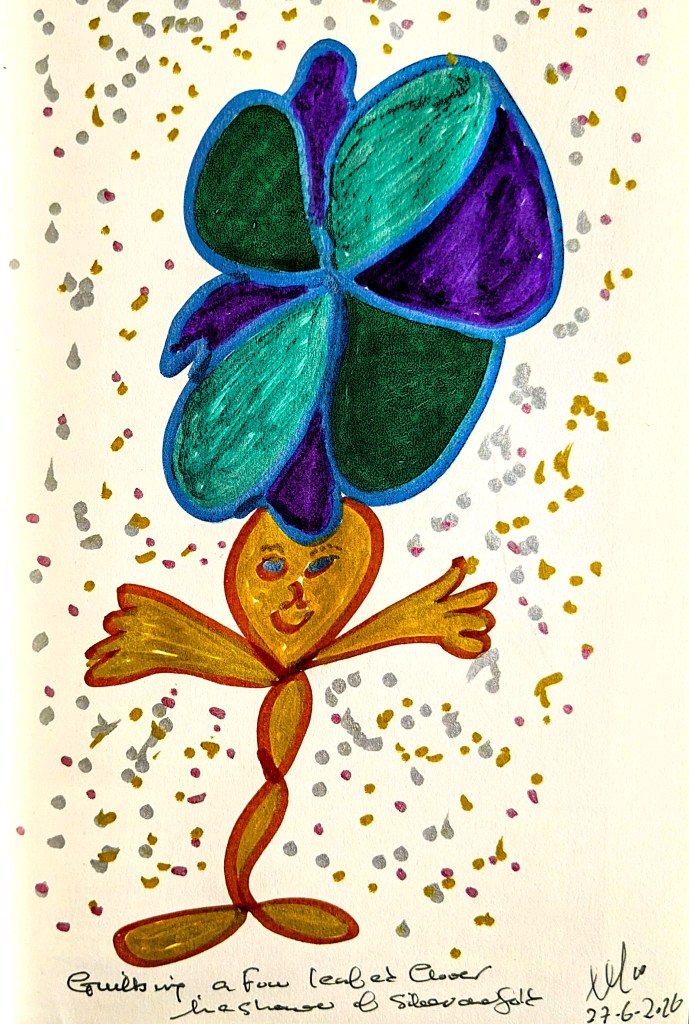
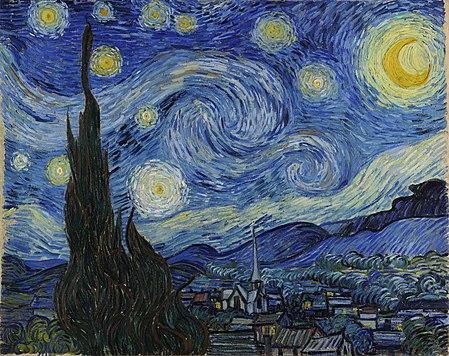
“So,” said Moo, “today I offer this painting where the title, Sound of Silence, fits well with the title of your poem. That said, I am not sure that the painting itself, qua painting, is as suitable as earlier pairings. De gustibus non est disputandum / there is no arguing about taste. I guess you either like something or you don’t.”

“It certainly isn’t in your usual style. In fact, it looks more like a colored pencil sketch than a painting. Where did you draw the title from?”

“Actually, it’s from one of your poems about Avila, in Spain, the city where, or so they say, you can hear the silence. You complained about all the noise that you found, especially the church bells, in that otherwise silent city.”

“Ah yes. I remember that poem. And I’ll never forget the sound of the bells echoing from wall to wall in those narrow, medieval streets. Bells from all the churches inside the walls of the city, tolling at exactly the same time, calling the faithful to prayer.”

“And that is one of the differences between us that I mentioned yesterday. My paintings, whatever they depict, are always silent. I have heard you read your poems out loud on Spotify and I have also heard other people reading them on your behalf, not always successfully. Poetry is designed not only to be read silently, but also to be read out loud, before an audience. Painting, on the other hand, is always silent. It does not speak, nor can it be heard. A painting is just there, in two dimensions, powerful, if you are lucky, weak and wobbly if the artist does not fulfill his task.”

“Interesting, dear Moo. And the images that I draw from Messiaen’s music are interesting too. For musical notes, without words, change into images within the listener’s mind, and then, when heard by the poet in me, become verbal images upon the page. Fascinating.”

“It is. Some time soo we must talk about intertextuality, the ways in which one artistic form or text can influence another. Hopefully, you’ll find a poem and I’ll find a painting that illustrate just that.”

30 things that make me happy!

Daily writing prompt
List 30 things that make you happy.

List 30 things that make you happy.

The first thirty dots I add to a dotty painting. As we all know, pointillisme drives one dotty. So, start counting each little dotty – when you get to thirty you can stoppy – and you’ll be as happy as a poppy. I do hope poppies are happy. I know poo-pees are. They wag their tales when they are hippy, happy, hoppy.

Oh yes, counting the ten toes on my feet when I have a double-trouble bubble bath. Then counting the ten toes on my grandson’s feet – that makes twenty. Then counting the toes on my other grandson’s feet. That makes thirty. Bubble, bubble, toil and trouble, hard to see those toes when the bubble baths bubble. Pinch each bubble, make them pop. When you get to thirty you can stop. Okay, okay, I hear you laugh – and that’s the joy of a bubble bath.

Black Paintings

Black Paintings
pinturas negras
Goya

Wrapped in his blanket of silence, the painter paints.
He pays no attention to the shrieks, screams, prayers,
curses, doesn’t even hear them. He sees their staring eyes
as the bull’s eyes at which anonymous soldiers, heads down,
backs to his easel, fire. He sees their mouths as black holes,
slashed across their faces. He sees the priest with his rosary,
but never hears the rattle of the beads or the firing squad’s guns
going off, filling the canvas with smoke, the square with blood.

Back home, in the Quinta del Sordo, his deaf man’s house,
he sits at the supper table, dwarfed by his painting of Saturn,
devouring one of his children. Beside him, old women,
hags themselves, suck soup silently from wooden spoons,
or fly soundless, black bats in the starless sky,
 on the back of goats or on their witches’ brooms.

The great, open wounds of his paintings speak to us
of his hushed suffering, of the calamitous world that spawned
such violence, plague, famine, and fear. Plundering armies,
guerrilla warfare in back street and alley, torture, pillage,
rape, and suffering, pits filled with the dead and dying,
famine walking the streets, and all of it inaudible,
the nightmares of a little child, seen, but never heard.
His paintings speak to us, and they allow us to reconstruct
in our imagination, the many things that the painter, deaf,
but never dumb, could never hear, yet reproduced
using his paintbrush and his taciturn palette as a tongue.

Click here for Roger’s reading.

“It is said that deafness is worse than blindness because you are isolated in an inner world of terrible silence.” John O’Donohue, Anam Cara, p. 71.

Movement

Movement

Not just the ups and downs, but the small things,
moving, that catch your eye – that butterfly
on the bees’ balm, wings folding, unfolding –
that deer at the wood’s edge, invisible when still,
then suddenly surging into empty space, tail raised,
up and away – that crow, blending into tree black,
then one quick flap, and launched into clear air –
that falcon, perched on the pole, frozen at first,
then taking a step forward, wings folded, dropping,
like a stone then a fast strike on an unsuspecting
robin – silence , pierced by the robin’s shrill shriek,
then silence and peace returned after violence.

Slow movement – the autumn leaves turning color,
a day at a time, almost invisible the change, until one day,
an autumn leaf becomes a whole forest, blushing into
its autumn finery – even slower, the fall’s stealthy approach,
and then, one day, the blue skies turn grey, rain falls,
the wind rises up, and the leaves go tumbling, here, there,
playing strip-jack-naked with limbs and branches.

Looking at my inner world, I feel, but do not see,
winter drawing near – its frosty footprints grip my bones,
snow and frost lie white upon my head, blood flows
thin and slow, seeps life and warmth away, day by day,
inexorable, yes, but also invisible, their still, small steps.

Click here for Roger’s reading.

Swings

Swings

They told me that one day
my feet would be up in the air,
and the next they would be stuck
on the ground.

A roundabout, they said,
a merry-go-round,
with all the fun of whatever fair
happens to be around that day.

Someone, not me, flicks a switch,
music plays, the carousel horses
move up and down, slowly at first,
then faster and faster as day, music,
and horses all gather pace.

There are no reins. If there were,
I would heave those horses
back to whatever reality I left.

But what is reality now?
These hot flashes that warm my flesh?
Those cold flushes that make me shiver,
then turn up the heat
until I am sweating again?

Shadows grow. I pull less strongly
on the swing boat’s ropes.
My journey slows. The showman
raises the bar beneath the wooden hull.
 
Wish it or not, my journey grinds
to its inevitable end.

Click here for Roger’s reading.

B & W

B & W

black words     white page

thoughts

floating in space

airs and graces

the world’s wind

blowing through

freshening     cleansing

cotton clouds     silky sky

that one word

waiting

to be spoken

that one thought

soon to be borne

out from the dark

a new existence

brightens

blinds with its light

Click here for Roger’s reading.


“If you look at a page of poetry, the slim words are couched in the empty whiteness of the page.” John O’Donohue, Anam Cara, p. 69.

The Appointment

The Appointment

“We have room tomorrow,” she said.
“But only between 7 and 9 am.
Shall I book you in for 8:15?”
“Sure,” I replied, not realizing
that I had forgotten to remember
the joys of rush hour traffic,
and the crush of crossing
the only bridge downtown.

I left home early only to find
chaos at the end of my road.
School busses, cars nose to tail,
trucks, cyclists, you name it,
it was all there, flowing, slow
but steady, with scarcely room
to insert a razor blade between
bumper and bumper. But that
was only the beginning.

The bridge downtown: it was
like threading a four wheeled camel
through the eye of a very small needle.
Crawlers, creepers, slugs and snails,
racing demons, speedsters, all of them
hustling, impatient, bustling, yielding
not an inch of space. My car became
a shuttle, weaving a thread of progress,
inch by inch, through the maze
that confronted and confounded.

I got to my journey’s end at last.
“You’re late,” said the girl at reception.
“You’ve missed your appointment.
Shall I book you in again?
Tomorrow at the same time?”

Click here for Roger’s reading.

Alien Nation

Alien Nation

I used to love the trees, the way
they stood there, patiently,
through all four seasons,
bending to the will
of weather and wind.

I planted many of them,
cultivated them,
watched them flourish,
treated them as siblings,
stood beneath their branches,
my back against a trunk,
their life force flowing
through me, renewing me,
as leaf-filtered sunlight
freckled hands and face
and danced in my heart.

Now, I fear them.
People have treated them
so badly, polluting water and air.
I fear their darkness,
their slow-burning anger,
their dryness, the ways
in which they gather,
shutting out the sunlight,
whispering dark secrets,
plotting to destroy us.

I fear the fire they have stored
in root and branch, a fire
that may one day come
to burn us out and leave
the land for their offspring.

Click here for Roger’s reading.

Good Friday

Good Friday

Crucifixion and Death

1

Now is the hour of his parting,
such sweet sorrow, they say,
but not on this day.
Yet we’ll meet again, sang Vera Lynn,
don’t know where, don’t know when.

There he lies, helpless, on the street.
Why is that man in blue
kneeling on his neck?
“I can’t breathe.”
Can’t anyone hear his cries?
Is there anybody out there listening?

Watchers stand round and watch.
Someone makes a video on a cell phone.

Who gifted him this gift,
this parting gift he never chose.
Everyone who follows him
and tries to walk in his shoes
knows he had no choice.
They know he didn’t choose.

2

Do you feel the baton stab into the guts?
The plastic shield’s edge slash into the face?
The knee come up, no ifs, no buts?

Eyes water from tear gas and pepper spray.
Thunder flashes crack and roll, deafening
ears, taking years from marchers’ lives.

Did you follow him through Jerusalem?
Did you walk in his footsteps, step by step?
There is a green hill far away, or so they say.

The cameras rolled as they cuffed him
to his pavement cross, men in blue smiled,
winked at each other, watched him fade.

His loss was not their family’s loss.
Just another loser tossed beneath the bus.
The watchers watched and nobody made a fuss.

They stood and stared and nobody cared
until cell phone videos hit the tv screens.
 Now it’s fake news, whatever that means.

The believers will believe what they’re told.
You can’t put a price on what he was losing,
on the many things that others have already lost.

3

Leg-irons and chains:
that’s what remains from his journey here.

Iron, cold iron, splintered, burning wood.
A death bed on the sidewalk
his last will and testament.

A flaming cross lifted him to the skies,
that cross burning before his eyes.

Before he goes, we must double-check:
whose is that knee upon his neck?

“Let me breathe, let me breathe.
Take away your knee.
Justice, why hast thou forsaken me?”

Commissioner, forgive them.
They didn’t know what they did,
when all around the dying man
men closed their eyes and ears,
buried their heads, and hid.

4

Good Friday in Island View:
a foot of snow fills the streets,
empties the churches.
The Easter Weekend lurches
towards its predestined end.

But how do you end
two thousand years of hurt,
four hundred years of persecution,
of cruelty and neglect?

How do you end
eight minutes and forty-six seconds,
with that black man lying there,
choking, a white man’s knee on his neck.

He died in the shade
of orders that were given and obeyed,
orders that should never have been made.