Translation Theory

Ryan and Don Roger

15

Translation Theory
(revised 3 May 2026)

            In DQI, IX, Cervantes, in his role of first-person narrator, goes to the Alcana in Toledo, where he discovers an Arabic manuscript containing the adventures of Don Quixote. The first eight chapters of our novel contain no mention of a translator. Suddenly one appears. The narrator buys the manuscript, finds a translator, takes the translator to his house, and in six weeks receives a translation, from Arabic into Spanish, of the novel. Question – does the translation contain Chapters 1-8, already written by Cervantes, or not? Alas, we do not know. Is the translation accurate? We do not know that either, for the original Arabic manuscript is a literary illusion and does not exist.

            However, we do know that Cervantes writes that ‘reading a translation is like looking at the reverse side of a tapestry’. Speaking of the Italian poet, Boiardo, the priest, in DQI, 6, says “If I find him here speaking in any language but his own I shall show him no respect. But if he speaks his own tongue, I will wear him next to my heart.” The priest continues, “That is what happens with all authors who translate poetry into other languages. However much care they take, and however much skill they show, they can never make their translations as good as the original.”

            Of course, with no original for the Quixote, there can be no translation theory. So, let us try to construct one. In the course of my own work, I have studied various translations of Quevedo’s poem Miré los muros de la patria mía. I will use them to see how translations can function, and what happens when we look at the reverse side of the tapestry. First, Quevedo’s poem in the original Spanish. Then a direct, line by line translation of it, for those who do not read Spanish.

Miré los muros de la patria mía,
si un tiempo fuertes, ya desmoronados,
de la carrera de la edad cansados,
por quien caduca ya su valentía.

Salíme al campo, vi que el sol bebía
los arroyos del yelo desatados,
y del monte quejosos los ganados,
que con sus sombras hurtó su luz al día.

Entré en mi casa; vi que, amancillada,
de anciana habitación era despojos;
mi báculo más corvo y menos fuerte;

vencida de la edad sentí mi espada.
Y no hallé cosa en que poner los ojos
que no fuese recuerdo de la muerte.

            I looked at the walls of my fatherland, (line 1) if once strong, now crumbling, (line 2) from the passing of age tired, (line 3) which wears out their bravery. (line 4) I went out to the field, saw that the sun was drinking (line 5) the streams from the ice untied, (line 6) and of the hill complaining the herds, (line 7) whose shadows stole the light of day. (line 8) I entered my house; I saw that, stained, (line 9) of an ancient habitation it was the spoils; (line 10) my cane more curved and less strong; (line 11) conquered by age I sensed my sword. (line 12) And I didn’t find a thing on which to turn my eyes (line 13) that was not a reminder of death. (line 14).

            This very literal translation, with all its inaccuracies and its inability to express the hidden cultural depths of the original, is totally unpoetic and inadequate, compared to the genius of the original version. Other prose translations have been offered by J. M. Cohen and Elías Rivers, and they are much more accurate – and much better (!), than mine.

            Brave poetic translations, also at times somewhat distant from the original, have been published by Robert Lowell, David Gitlitz, and Griswald Morley / Charles Cobb revising the version of John Masefield. Alas, I do not have permission to replicate their versions. However, I called the translations ‘inadequate’, but they aren’t really they are just the best we can do. Robert Lowell, himself an outstanding poet, gave us much more than a translation. He gave us what I like to think of as a recreation, a new poem based upon the old original. Translations and re-creations, two very different kettles of fish! I offer you here two of my own efforts at recreating the poem!

1

I looked at the defenses of my native land:
empty silos, bombs and rockets melted down.
“Put your faith,” the TV said, “in diplomacy,
not in the metal walls of flying ships.” I went

outside. Cattle were lowing against the falling
temperature, tails to the wind. Steam
rose from their flanks, then was scattered
like an overnight dream of ghosts. Inside,

on the sink, a shrivelled tea bag, dried up stains;
my trusty coffee pot, rusty on the stove,
was chipped and raw at the rim. I took

my shot gun in my hand. Its crooked barrels
served me as a walking-stick. As I limped
around, my mother’s photo spoke to me of death.

2
I’ve got something to say, so here’s what I’ll do
I’ll write it out in rap with a rhythm just for you.
I once saw a town with a very small wall
that’s so fallen down it’s no wall at all.
It’s old and it’s rotten and it cannot last
like a runner on the track who’s run too fast
at the start of the race, and he’s run out of breath,
so he’s hit that wall, and he feels like death.
And there’s cattle lowing and the sun’s in the sky
but it’s winter time, so the sun’s not high,
and the shadows are long, and the wind’s getting cold,
and it’s all about a man who’s growing old.
He looks around his house and all he sees
are dead people’s faces and living memories.
He’s trapped on the ground floor, can’t climb stairs,
everything he touches he’ll leave to his heirs.
There’s a pain in his side, and he can’t catch his breath,
and all that he sees, reminds him of death!

            A rap sonnet (14 lines) containing nine pairs of rhymed couplets (18 lines)? The good Don Francisco de Quevedo will be turning in his grave and his still-warm ashes will once again be burning with love for Lisi and the joy of being alive, in one form or another, in spite of the River Styx, which the flame of his love could swim and not be lost forever.

            So, when looking at translation theory, what can we set down? First, it is very difficult to capture the full cultural meaning of the original because each word has an associative field that differs in each language. The associative field is the word itself, with all its secondary meanings and concepts. Mi espada / my sword is an excellent example. Quevedo, in spite of his infirmities, was a master swordsman. His sword remained unconquered, save by age itself. We no longer walk around with swords sheathed at our sides. The meaning, therefore, in all its sadness and profundity, cannot be captured by our translation skills. The words just do not have the weight.

            The grammatical structures, inversion of words, for example, cannot easily be reproduced in English translation.  Line 3 – from the passing of age tired – just doesn’t sound right. And yet, it is curiously accurate – but not English. Oh dear. Line 6 – the streams from the ice untied – Line 7 – of the hill complaining the herds – Line 10 – of an ancient habitation it was the spoils – no, sorry, these inversions just do not function in English.

            In addition, the rhythm and the syllable count of each line of the original is lost in translation. Whatever you say about it, the rhythm of my rap sonnet emphasizes the importance of beat and tempo. Great fun to read aloud, and when reading it to an audience, watch their faces and then their feet. I have actually seen some listeners tap-dancing during my reading! And the scowls of those who cannot believe the impertinence of a translator who translates into rap music the classical lines of a poetic genius. Finally, the rhyme scheme will almost always defeat the would-be translator who approaches it as a target, while never quite mastering the reproductive technique, other than approximation. The structure of Quevedo’s original rhyme scheme is 14 hendecasyllabic (eleven syllable) lines rhyming abba / abba / cde / cde.  This is all very difficult to reproduce in English with its eternal iambic pentameter. Therefore, we must be satisfied, like it or not, with the reverse side of the tapestry, as Cervantes calls it.
Rage, Rage 55

Rage, Rage
55

I walk on thin ice
at the frayed edge
of my life.

I search for the key
that will re-wind me,
but I fail to find it.

Who will winch up
the pendulums on
my grandfather clock,
resetting it
in spring and fall?

Who will watch
time’s sharp black arrows
as they point the path
of moon change
and the fleeting hours?

Each hour wounds,
or so they say.
Who will tend me
when that last one kills?

Comment:

Omnia vulnerant, ultima necat. / Each one wounds, the last one kills. That’s how the Romans thought about the collection of hours that make up a day. An interesting way of putting it. In lapidarian fashion. Four words that are worth a whole book of philosophical thought.

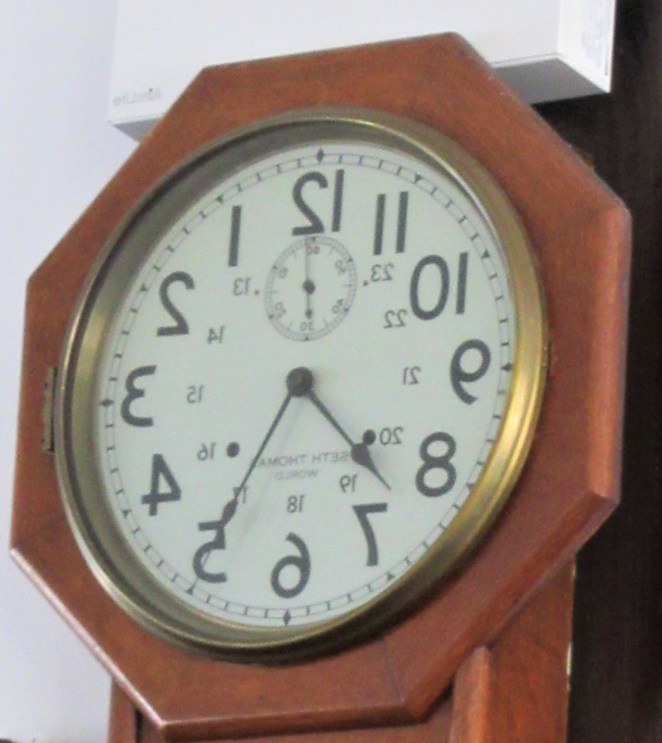
What is this thing called time? Good question, and one which is being asked more and more. Clearly time does not flow evenly within the human mind, though it is remarkably regular on the clocks we have invented to mark time for us. And remember, there are many types of time – seasonal time – spring time, summer time, autumn time, winter time. Strange that autumn – or fall as I have now learned to call it – is the only one that doesn’t have the word time attached to it.

And what about time changes – spring forward, fall back – when we change our clocks in order to make the most of daylight hours. A tedious process for many of us. I see some provinces are rejecting those changes and sticking to the same time, all the year round, from season to season. Personally, I would prefer life without those time changes, as would many of my friends.

Celestial time also known as sidereal time – the time as showed by the planets as they seem to march around the earth in the terra-centric universe. Rephrased, the positions of the planets as the earth turns slowly round the sun in the helio-centric universe.

Then there is the personal time of individual experience. An hour watching football or rugby on the tv set passes much more quickly than an hour passed in the doctor’s waiting room or the dentist’s chair. Of course, an hour watching a five day cricket test can also be a slow process, unless England are playing Australia in the Ashes. As one friend of mine commented, a long time ago, “I thought those English cricketers were unfit. But I’ve never seen anyone go out to bat and come back to the pavilion so quickly. They must be super-fit.” Alas, their cricketing problem, as usual, was centered on the three cants – can’t bowl, can’t bat, can’t catch.

En fuga irrevocable huye la hora.
La que el mejor cálculo cuenta
en lectura y lección nos mejora.

Irrevocable is the hour’s flight.
The one that counts the most
in learning or reading improves us.

Francisco de Quevedo
(1580-1645)

And remember – the hours fly by and your time is limited – spend it wisely and enjoy each and every day to the full limits of your abilities.

Rage, Rage 54

Rage, Rage
54

Terminal and terminus,
they both mean nec plus ultra:
the Pillars of Hercules,
the end of the known world,
and my own world’s end.

I throw my hands skywards
in desperation:
“Is anybody up there?”
There’s no reply,
and I see no ladder
for angels to descend
or ascend.

Only the crows,
those black-winged
monarchs
destined to wear
the survivor’s crown,
cry out their anguish
as they wait for the day
when they’ll pick clean
my unburied bones and
rule this sickening world,
an earthly paradise no more.

Comment:

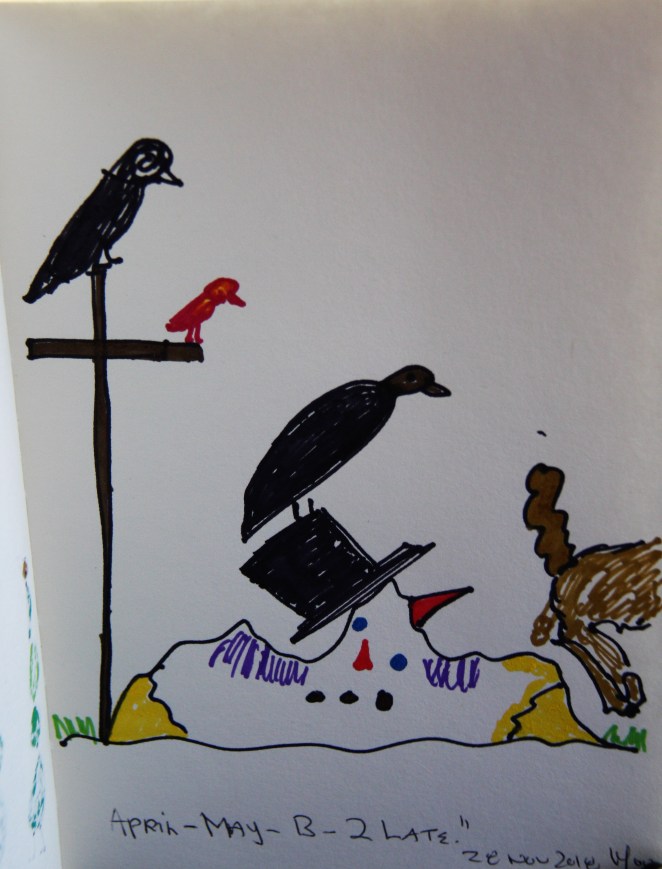
When I said “I am looking for a picture of a crow,” Moo went wild. “Me,” he said. “I’ve got one.” And indeed he had. Here it is – two crows perched like vultures over the body of a fast melting snowman. Our current world in miniature – and don’t forget the yellow snow and the doggy doing a dump. “Moo,” I said, “That’s not nice.” “True to nature, though,” he replied. “You want reality – you got it.”

Reality – what a strange word. Who knows nowadays what is real? The barber’s basin in Don Quixote – is it a barber’s basin or is it Mambrino’s Helmet? Good question. Relativism – it depends on your point of view. U a barber’s basin – turn it upside down Ω and it’s a helmet. So how do we deal with an object that has two functions and can be seen both as one thing and then another?

Good question. Cervantes solves the problem in his own unique fashion – U – bacía / basin and Ω – yelmo / helmet. Put them together and you get the neologism [newly invented word] baciyelmo – a basin that serves as a helmet and a helmet that serves as a basin. Wonderful – if it weren’t for the snout, I’d swear that was the origin of the pig-faced bassinet.

Some days, I try to understand all this – but I throw my hands skywards in desperation: “Is anybody up there?” Another good question. I often ask myself that question but I despair of an answer.

My friend Francisco de Quevedo voiced the same question in a dream that came to me last night.

¡Ah de la vida! ¿Nadie me responde?

Life ahoy! Will nobody reply?
Is anybody up there?
Will someone reply?

Blas de Otero once made a similar utterance –

“I raise my hands in supplication
– you cut them off at the wrist.”

Tell me, if you know, – what is this life if, full of care, we have no time to stand and stare. And look at those crows, standing there, staring, waiting … waiting for their turn to come. Patient, eternally patient. Just standing around. Waiting.

Rage, Rage 43

Rage, Rage
43

The truth,
unwelcome as it is,
is that the day I was born
I took my first steps
on the path to death,
my own death.

Death –
an inescapable law
that tells me that
body and spirit
will be forced apart.

My flesh will wither
and perish,
and the person
that the world and I
know as me
will no longer be able
to hold together.

Commentary:

“The day I was born I took my first steps on the path to death.” An echo of a line from Francisco de Quevedo, of course.

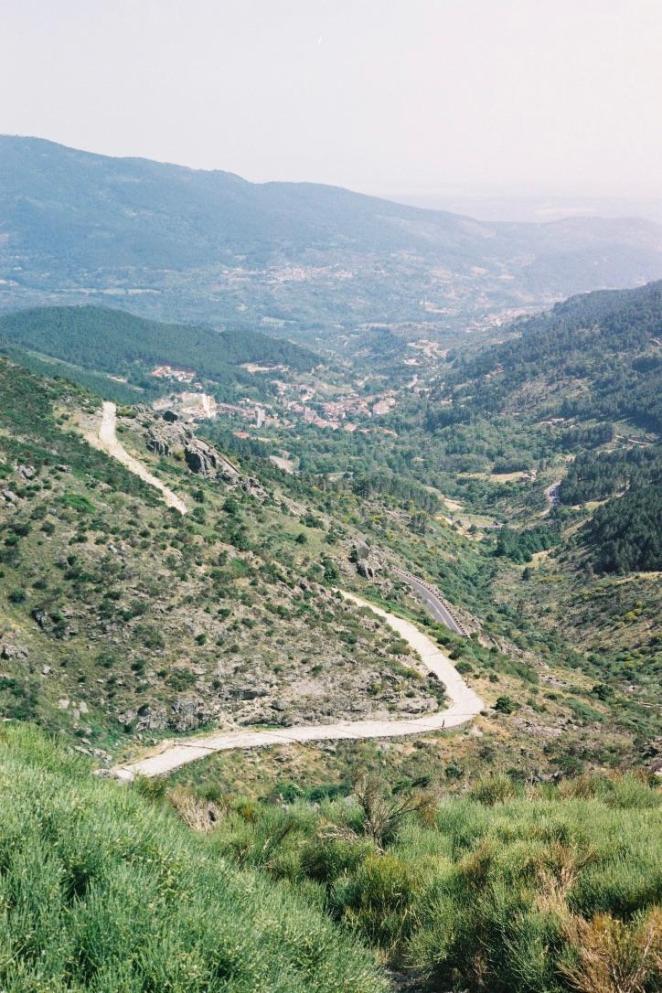
And the photo above? It is the old Roman road that ascends the Puerto del Pico in the Province of Avila. Hard to believe it was laid down nearly 2,000 years ago and still carries the transhumance cattle and sheep from the valleys in winter to the hills in summer. It is also a part of the Camino de la Plata, the silver road that brought precious metals from Spanish America to Madrid after the discovery and conquest of the Incan Empire.

The treasures of the Empire – what joy. Yet what weight around the neck of the Spanish nation. Wealth so abundant, spending so rife, money-lenders always lending, filling in the gaps between the arrival of the treasure convoys from the Colonies. And yet that borrowing became a millstone around the borrowers’ necks. So much money borrowed that there came a moment when each convoy only served to pay off the loan debt of the last set of borrowings.

The cattle and sheep struggle to climb to those heights. Yet it is not difficult to imagine how much easier it was to walk downhill, beside the creaking wagons that held the gold and silver to pay off the monarch’s debts, en route to the king and his court.

Think also of the squeals of anguish heard when the treasure fleet did not arrive. Captured by the English pirates, or hurricane battered and lost in the Caribbean or closer to home. This meant even more borrowing on the back of earlier borrowing and always the cost of living and the lending rates rising higher and higher.

Butterflies

Butterflies
Miguel de Unamuno

… butterflies … temporal forms … fluttering …
existing for one sweet day … they perch … spread
their wings … fan us with their beauty … flourish …
catch our attention … then caught by a gust
tear their wings on a thorn … and perish … blink
your eye and they are gone … yet reborn … they
cluster and gather in dusty ditches …
congregate on bees’ balm … smother Black-Eyed
Susan and Cape Daisy … shimmer in shade …
butterflies by day … fireflies by night …
terrestrial stars floating in their forest
firmament … dark tamarack … black oak … bird’s
eye maple … silver birch … impermanence
surrounds us … dances beneath stars … sings with
robins … echoes the owl’s haunting cry …
eternity held briefly in our hands …
then escaping like water or sand … black
words on white paper capturing nothing …
… my dialog … my time … my place … butterflies …

Note: “La poesía da permanencia a las formas temporales del ser / Poetry gives permanence to the temporal forms of the self.” Miguel de Unamuno (1864-1936)

The temporal forms of the self – and so much today is unsettled, changing, insubstantial. I have often wondered how one makes time stop. Is it even possible to do so? Time and tide wait for no man. And why should they? Fray Luis de León – “Con paso silencioso, el cielo vueltas dando, las horas del vivir le va hurtando.” / With silent step, the ever-turning sky, steals away life’s hours. Or Fancisco de Quevedo – “Que sin saber ni cómo, ni adónde, la edad y la salud se hayan huído. Falta la vida, asiste lo vivido, y no hay calamidad que no me ronde.” Without me knowing how or where, age and health have fled. Life is lacking, past life flew by, and there isn’t a calamity that doesn’t hound me.

Ars longa, vis brevis – art endures, life flies by. My translations are freer than usual today, but I too feel like being creative in my own language. So, if we can’t slow time down, what can we do? We can create – poems, paintings, photos. We can read – and translate from one language to another. We can, like butterflies, perch on flowers and enjoy our brief days in the sun. Mindfulness – we can make the most of each moment by living it thoroughly and well. Carpe diem – we can seize each moment of every day and live it to its full measure. And, above all, we can write and read poetry – because, as Unamuno says – Poetry gives permanence to the temporal forms of the self.

On Loneliness

Loneliness

58 What relationships have a positive impact on you?

I think one of my poems answers this question best. I write “one of my poems” but it is really my ‘free’ translation of one of Francisco de Quevedo’s sonnets – Retirado en la paz de estos desiertos. I have changed the poem slightly, but I am sure Don Francisco (1580-1645) will excuse Don Roger’s impoverished effort (2023).

On Loneliness
29 December 2023

Resting in the peace of these small rooms,
with few, but welcome books together,
I live in conversation with my friends,
and listen with my eyes to loving words.

Not always understood, but always there,
they influence and question my affairs,
and with contrasting points of view,
they wake me up, and make me more aware.

The wisdom of these absent friends,
some distant from me just because they’re dead,
lives on and on, thanks to the printed word.

Life flits away, the past can’t be retained.
each hour, once past, is lost and gone,
but with such friends, I’m never left alone.

And there are so many of those literary friends. I still read Rudyard Kipling and I have just finished Kim, Captains Courageous, Stalky and Co., Puck of Pook’s Hill, and Rewards and Fairies. I read these first when I was nine or ten years old, and I return to them regularly. Other friends include Garcilaso de la Vega, Fray Luis de León, St. John of the Cross, Quevedo, Góngora, Calderón, Miguel de Unamuno, Antonio Machado, various members of the Generation of 1898, the majority of the poets from the Generation of 1927… and these are just my Spanish literary friends. I have French friends, English friends, Anglo-Welsh friends, Canadian friends, Mexican friends, and, in translation, many, many more. My relationship with each of these friends has had an impact upon me.

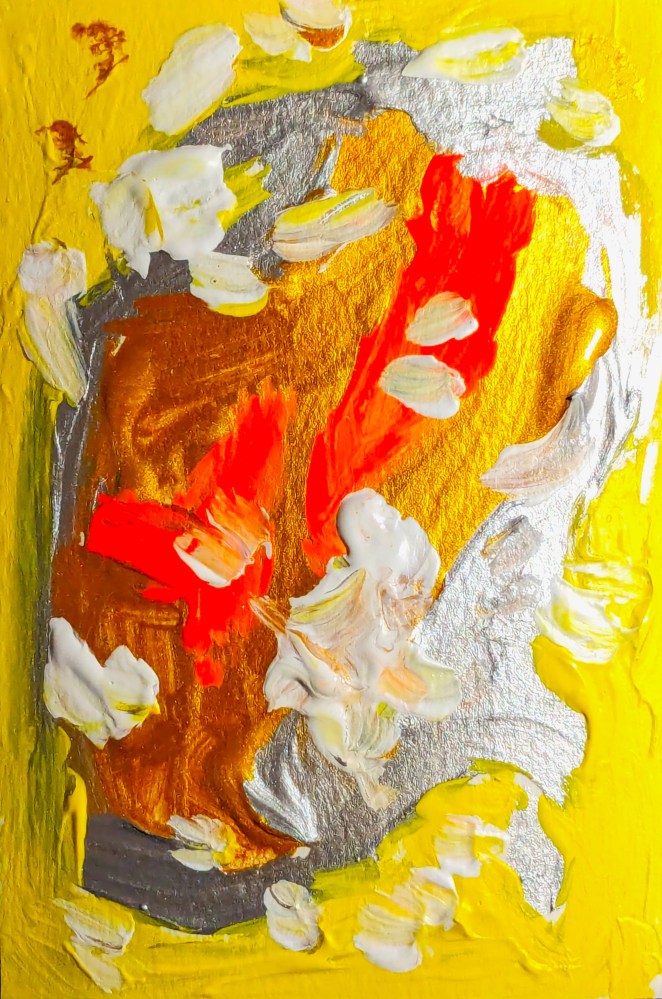
A recent painting, by my friend Moo, is called Fiat Lux – Let There Be Light. It is reminiscent of Dylan Thomas’s poem, Light breaks where no light shines. Intertextuality – Quevedo drew inspiration from the Stoics. I drew inspiration from Quevedo. Moo drew inspiration from Dylan Thomas. The nature of creativity, and its continuing links throughout the ages, shines clearly through these wonderful associations. Long may they continue, and may others enjoy them and be influenced by them as much as I have.

Comment:
The funny thing is that I do not remember writing this blog prompt, nor do I remember having translated Quevedo’s poem into English. I wonder how many other forget-me-nots there are out there. Or, to be more precise, in my books and in my notes. A treasure trove – that’s my guess. Borges wrote of Quevedo that he was more a library than an author, and I am beginning to think that way about my self. A strange world, this, one in which the creator abandons, and then forgets, his creations. Perhaps we should change the image – not so much a library as an orphanage, and so many lost and abandoned orphans wandering around The Little World of Don Rogelio.