Distancing and Narrative Layers

Winding dirt path through misty forested mountains with conifer trees
A winding dirt path stretches through mist-covered forested mountains at dawn.

Image generated by AI

Ryan and Don Roger

8

Distancing and Narrative Layers

            In DQI, VIII/8, the author suspends the narration, leaving Don Quixote and the Basque with their swords in the air, frozen in time. The cliff-hanger, as it is often called, is not unknown in literary fiction, and yes, most normal human beings will want to know how this battle ends. However, read on – “But the unfortunate thing is that the author of this history left the battle in suspense at this critical point, with the excuse that he could find no more records of Don Quixote’s exploits than those recorded here.” Enter the second author – “It is true that the second author of this work would not believe that such a curious history could have been consigned to oblivion …” Would you believe it? We now have two authors a first one and a second one. So, would the real author stand up please?”

            Before he does, we have another little diversion. DQI, I-VIII/8 is only the first part of Don Quixote. We read at the beginning of DQI, IX/9 that “In the first part of this history, we left the valiant Basque and the famous Don Quixote with naked swords aloft …” So, logically, DQI now has two parts – DQI, Part One and DQI Part Two. Clearly, we are dealing with a novel that is writing itself, constructing itself, and changing itself as it creates, re-creates, and rethinks itself. More, “our delightful history stopped short and remained mutilated, our author [singular] failing to inform us where to find the missing part. This caused me great annoyance.” Fascinating. Please tell me, if you know, who is this me? It is a me who cannot understand the lack of a conclusion to the story he is reading. Indeed, he must now go seeking the sage who wrote this story, for all of these stories – historical records – chronicles – archives – journals – registers now forgotten – must have had a sage enchanter who recorded them.

            And this is how that sage was found. The first-person narrator “I” visited the Alcana in Toledo. There he bought a parchment book written in Arabic. He finds a translator who, on reading the book, starts to laugh at the mention of Lady Dulcinea, “the gest hand at salting pork in La Mancha.” This parchment becomes these books, and at the beginning he found the following: “History of Don Quixote de la Mancha, written by Cide Hamete Benengeli, Arabic historian.” The first-person narrator then took the Arabic translator to his own house and there, in less than six weeks, he translated the history from Arabic into Spanish.

            The Ariadne’s thread that will lead us through this labyrinth goes like this. Cervantes (author), becomes Cervantes (first-person narrator), becomes Cervantes (commentator), who offers us the translator’s version, of the History of Don Quixote that was originally written in Arabic. Clearly a series of barriers between the author and his creation have been built. Everything is now deniable. And doubly so, since “if any objection can be made against the truth of this history, it can only be that its narrator was an Arab – men of that nation being ready liars.” And note that both Cide Hamete and the translator are Arabs – a double dose of distancing to protect our noble author from the long arm of the Inquisition.  

Book Burnings

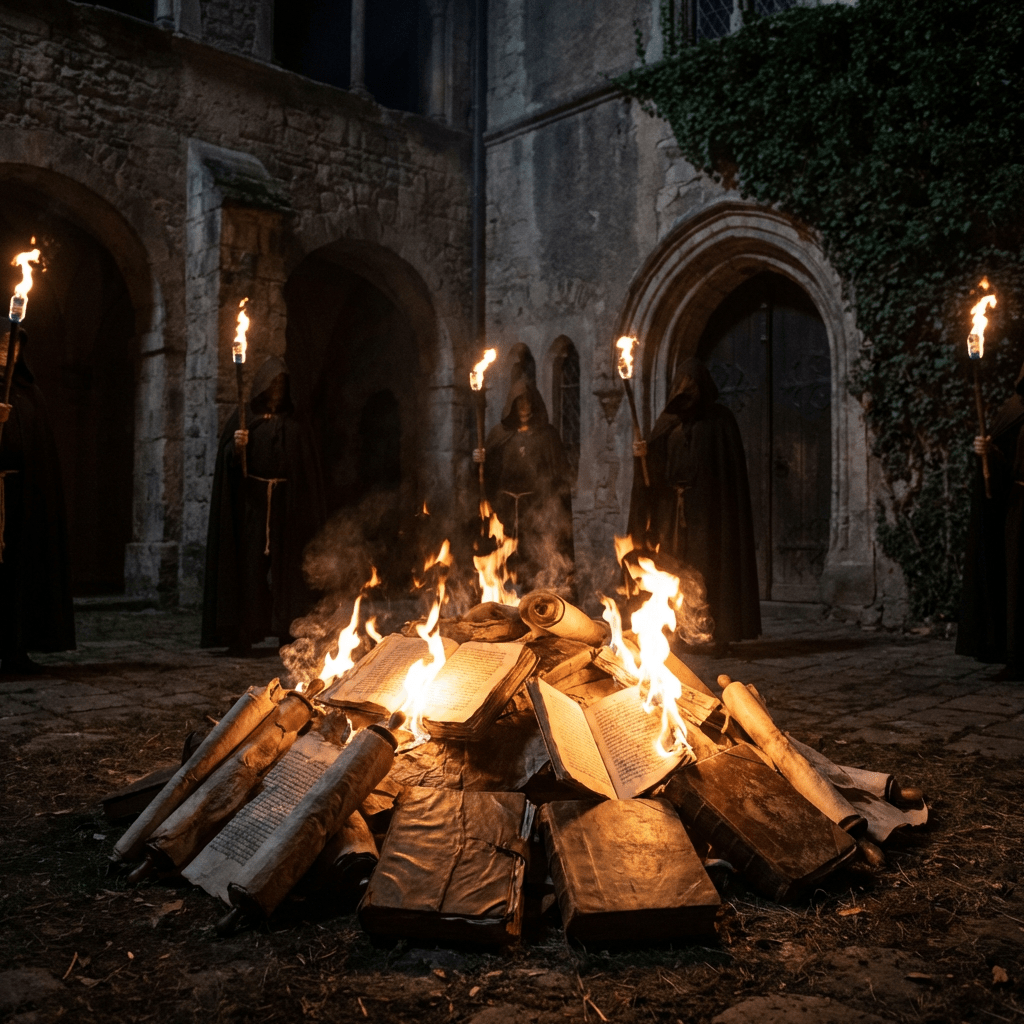
Hooded figures holding torches surround a bonfire of burning books and scrolls.
A group of cloaked figures stands in a dimly lit stone courtyard as they burn ancient scrolls and books in a large central fire.

Image generated by AI


Ryan and Don Roger


5

Book Burnings

            In 1492, the Spanish Jews were given the choice of conversion to Catholicism or of being expelled from Spain. Many chose to leave. Those who converted, and remained, were kept under constant supervision. In an effort to stamp out their faith, their books were condemned to the flames by the Spanish Inquisition. A similar burning of the books in Don Quixote’s library occurs in DQI, 6. Is book burning effective? Some people think so. Other people aren’t so sure.

            The Spanish conquest of Mexico, led by Hernán Cortés, concluded on August 13, 1521, when Spanish forces and their native Tlaxcalan allies captured the Aztec capital of Tenochtitlan and emperor Cuauhtémoc, marking the end of the Aztec Empire and the beginning of Spanish colonial rule. The country was then called New Spain. 

Mexico is famous for its codices. These are fan-fold picture histories, drawn on vellum covered with gesso, of tribal conquests, social norms, tables of the gods, in fact a whole cultural and historical record of pre-Hispanic Mexico. The Zouche-Nuttal codex, for example, sets out the conquests of Ocho Venado / Eight Deer, nicknamed Garra de Tigre / Tiger Claw, a Mixtec warrior, who lived between 1063 and 1115. Five of the Mixtec codices survive. Many, many more were burned. The cover of the Vindobonensis shows the burn marks where some daring person pulled the codex from the flames and saved it. Without such saved codices, we would have much less knowledge of pre-Hispanic Mexico.

            Why is this anecdote important? Because prior to the invention of printing, in 1474, manuscripts were written by hand. Yes, some were copied, but many copies were single and unique. Burn the manuscript, destroy the knowledge it contains. Post 1474, with the printing of multiple copies of books, the individual book might be destroyed, but some books would survive from the printing sequence. Apply this to Don Quixote’s library and we note several things. First, Don Quixote’s copies are destroyed. Second, other copies of his books survive elsewhere. In addition, although Don Quixote’s books are burned the ideas in those books survive in the knight’s head and he lives by their rules. Those ideas are spread throughout the history of his adventures to everybody with whom he comes in contact. Conclusion – you can destroy the books. You cannot destroy the ideas that those books contained.

            Ray Bradbury, in Farhenheit 451, describes the burning of books in his dystopian novel. 451F incidentally is the temperature at which paper burns. The books are burnt in Bradbury’s world, but the book people survive. The book people are those who memorize their books and are able to quote them from memory and pass them on orally to other people.

            And people protect their books. How? By placing them in small rooms within their houses and walling up those rooms so that the books could not be found. This happens in DQI, VI – 6. Don Quixote awakes, goes to find his library, but it has disappeared. The housekeeper swears that a sage enchanter descended on a dragon and the library vanished in a puff of smoke. Don Quixote believes the metatheatrical lie and acts as if it were the truth. He then bemoans the fact that he is pursued by malignant sorcerers. These evil enchanters will pursue him throughout the novel whenever he wakes up from his illusions and is faced by reality. Clearly, the sage enchanters have robbed him of his moment of glory (illusion) and reduced him to sorry (the truth).

            Curiously enough, a 16th Century walled-up library was found in a house in Barcarrota, Spain not so long ago. The books were hidden, probably from the Inquisition, so that their owner could escape prosecution. The discovery sheds light on how individuals hid literature from the Inquisition during the 16th century in Spain. It also illustrates how closely Cervantes followed the reality of his times when writing the Quixote.

            You can destroy books. But it is very difficult to destroy the ideas they contain. In this fashion, although the burning of that one book ends the life of that particular volume, it rarely ends the life of the ideas contained within its covers. We might not recognize the names of the characters that Don Quixote quotes from his memory of those histories, but many of the people who encounter the knight during his adventures know them and remember them. Amadis of Gaul is never dead, not when his name lives on. The same is true of King Arthur and his Knights of the Round Table. King Arthur is said to fstill be alive and can be seen in the shape of a White Crow, bran gwen, in Welsh. And even Walt Disney knew, and profited from, the legend of the sword in the stone.

We will also see, as we continue our journey, that in the same way that tall oaks grow out of small acorns, large parts of later events found in the Quixote already have their seeds sown in these early chapters. Metatheatre, illusion and reality, authorship and censorship, truth and falsehood, waking events and dream sequences – and that is just the start.

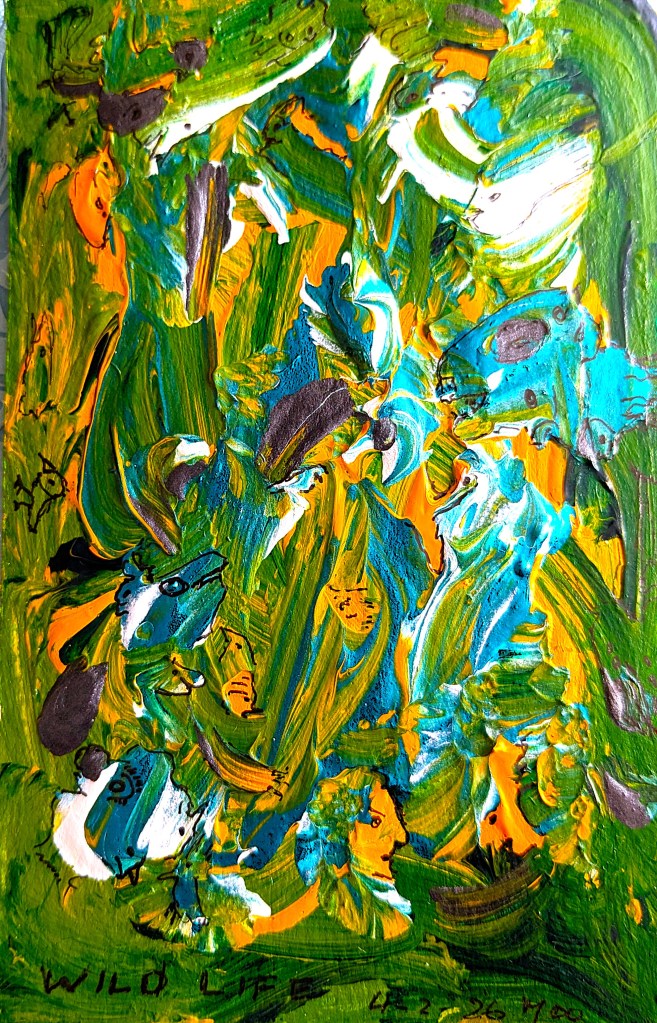
Wild Life

Wild Life

I see green grass
Small ponds
Winding roads
Patches of sorrow

Turquoise blues 
Hills to climb
Softness
Strength 

Flowers blooming
A small animal
Covered in feathers 

An eye
Keeping watch
Purity of white

Ekphrastic Poem
©
Yolande Essiembre

Comment:

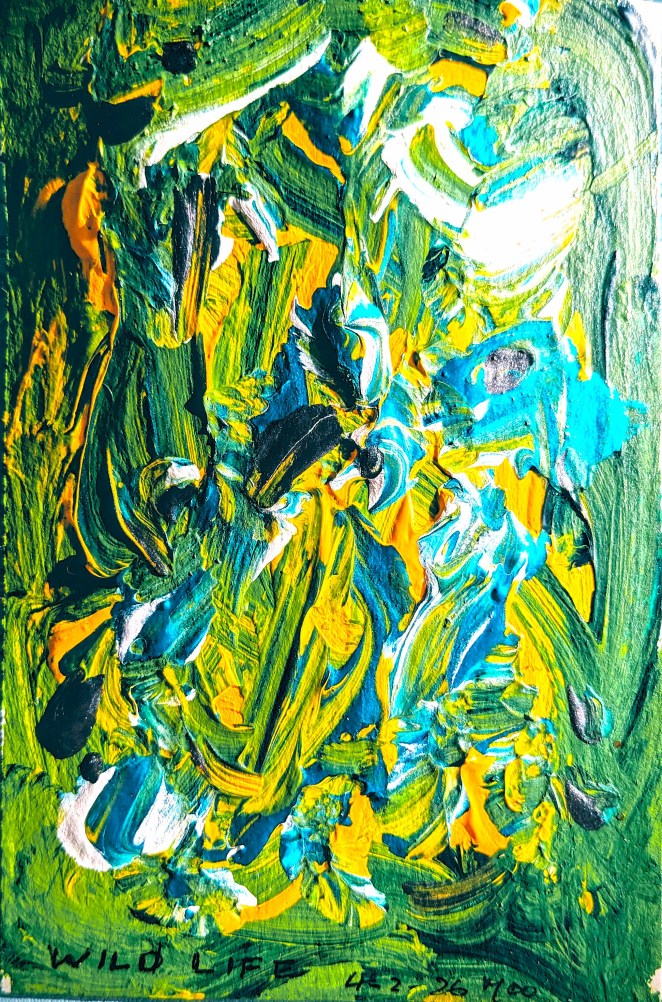
My good friend Yolande Essiembre sent me her Ekphrastic poem after viewing this morning’s painting by Moo. Wild Life II is a better representation of the colours of the original. However, Moo added in some (what he calls!) helpful touches – the black shapes that reinforce the suggestions of the original. Yolande wrote her poem based on Version I – but with the stronger colors of version II. Magic oh what a tangled web we weave when first we practice to deceive. And all artists weave their webs of deceit. As Cervantes says – Tanto la mentira es mejor, cuanto más parece verdadera. / The closer it approaches the truth, the better the lie.

Imitatioimitation – one of the bedrocks of classical rhetoric. “Imitation is the best form of flattery”. Flattery, yes, but what we find, in art above all, is that there exists only one original. However good the copy, the flattery – the imitation, if you prefer – it is never as good as the original. The original of this painting exists in one time and one place. The two deceptions are not the original. In fact, Wild Life I no longer exists because Moo has repainted it. It has turned into Wild Life II.

So many questions – which version do you prefer – I or II? De gustibus non est disputandum. There is no arguing about taste. Which is the better version? Well, each viewer must choose. But remember, each version is a deception, and each deception is a lie. And there is only one original. Oh what a tangled web we weave.

But we can, I hope, agree on one thing – Yolande’s verbal version (which I publish here with her permission) is verbally picture perfect. It is how she sees the painting. It is what the painting means to her.

Thank you so much Yolande. Moo and I hope to publish your words and visions more often. With your permission. we will do so.


Clepsydra 41 & 42

41

… fire flares on the water
     rivers and lakes blaze
          that sound is a monster
               a dragon descending
                    breathing fire

so swift so powerful
     come sudden
          from nowhere
              yet another disaster
                   with its ravenous roar         

the dragon refuses to move on
     until sated
          but who could satisfy
               that monster
                    destroy its will
                         defeat its power

will Lac Megantic
     ever be the same
          after all these years
               of grief and tears

will fading memories
     be all that remain …


42

… a stillness between words
    tranquil movements
         the world suspended in space
               soundless the night
                    drenched in silent light

 Aurora Borealis
     draws gaudy curtains
          across the night sky

I can hear my heart beat
    as time softly sifts

a celestial hour glass
     this sky filled
          with unimaginable light
               breaking coloured waves

lit up
     with mysterious flowers
          so graceful
               when decked out
                    in light

 the moon returns
     turns into a mirror

          its silver boat
               suspended in space

silent its light
     enlightening
          the heart’s dusky craters

dawn’s silent glory
     will be here soon
          pointing the silent path
               to even more light …

Commentary:

Ten years or so since the disaster at Lake Megantic. I am sure it affected everyone who followed the news, saw the pictures, and bore witness to the power of conflagration. Moo offered me his painting called Burning Birbi. A Birbi is a Koala Bear in one of the Aboriginal Languages. When the fires hit New South Wales, the Eucalyptus Trees started to fire. When in danger, the Birbi climbs the eucalyptus trees, higher and higher, followed, of course, by the fire. A fate inescapable. Just like the Megantic Disaster. Word has it that it could, and should, have been prevented. I cannot (will not) comment on that here. I will just stress the fear that we all have, those of us who live in a drought stricken province (New Brunswick) surrounded by trees.

The closest wildfire to us, in Island View, was about 31 kilometres away. The closest trees are about 30 feet away from the house. Much too close for comfort. Curtains of flame and smoke, rising up to stain the skies. And the smell of burning also inescapable. Stay indoors, I say. Shut the windows. And hope that nothing comes your way!

Fire, controlled, brings heat, warmth, light. The Northern Lights bring spectacular light flooding down from the skies, not rising up. You can almost hear the sky crackling as the light curtains shift and shimmer and dance their way across the horizon. Fire and Fire Light – beautiful when we can control them, but oh-so-destructive when they flame and flare, out of control.

Do not despair. Just remember we need each other, all of us, each one of us. Together we can overcome most things. Isolated and alone, like the lone koala at the top of his tree, it is much, much more difficult to survive. Select your friends carefully. Maintain contact with them. And be there for each other in times of need, for, as we say in Wales – “a friend in need, is a friend in deed.”

Clepsydra 39 & 40

39

… all too soon I too shall move on
     leaving behind me
          fading memories and cloud shadows


yet I recall
     standing beneath the cathedral’s
          great rose window
               on a sunny day
                    my body dressed
                         in a harlequin suit
                              of glistening lights 

in such splendour
     mortal things like words
          cease to flow

I held my breath
     shocked by an enormous presence
          that filled me then
               as it does now
                    with the knowledge
                         that nothing happens in vain …

40


… illumination
     I must find it for myself
  were another to tell me
      where it dwells
            its light would be untrue

only I can strike the match
     ignite the flame
          and trap its warmth
              in my body’s bone cage

when it flowers within me
     I’ll need no candle
          not even in the darkest mine

in Alma, I have seen
     the tide lower
          Fundy fishing boats
               down into the mud

like those boats
     I lack the power
          to resist both time and tide …

Commentary:

I asked Moo for a painting of boats from Fundy, preferably from Alma, lying on their sides at low tide. “Let me see what I am meant to be illustrating,” he said. He read the above excerpt from Clepsydra and told me “You’re navel gazing again. I thought I told you not to do that. Now, have I got a painting for you.” I didn’t dare refuse to post it – he’s had a bad couple of days and it has sharpened his sense of humor – so it’s here it is. Moo calls is – now don’t laugh – Naval Gazing.

“Nothing happens in vain.” So maybe I was predestined to ask Moo for a painting he didn’t have and to end up with one that tickled his fancy. Now that set off a light bulb in my skull. Mr. Dimwitty came to his sense – I have been navel gazing. Naughty, naughty. How many of you remember Mr. Dimwitty, the not too bright schoolmaster on BBC radio? Hold up your hands, and I’ll count them.

Meanwhile, things happen to Moo and me, and like the boats on the Fundy, we lack the power to resist both time and tide. And that’s why we help each other, carry each other along. “We few, we few, we band of brothers.” That was Shakespeare. Nowadays we have to say “we band of siblings.” It pays to be inclusive. Speaking of bands, I saw a man walking down Main Street yesterday, blowing a rubber trumpet. I asked him what he was doing and he told me that he was looking for a rubber band. Joy to the world and help spread the joy. If you don’t like joy, spread Marmite. And if you don’t like Marmite I am sure you’ll love Vegemite. Ma might, but Pa won’t. That’s why it’s not called Pa-mite.

Raven

Raven

When Raven flies through his trap door in the sky, a light bulb clicks off in my head and I fall into darkness. Is there some safety net before oblivion? Raven’s claws scar crow’s feet on a fingernail moon. His bleak black beak widens the hole in my head and the Easter egg of my skull shows thin blue cracks. Outside my window, the river moves backwards and forwards with the tide. Raven shrugs at cancerous creatures, promising nothing. He soars into clear skies in search of his private exit and extinguishes sun, moon, and stars, plunging our world into blackness. The light on the point picks out a heron, mobbed by a clacking ring of gulls. The sea mist wraps the real world tight in its cloak. Now sea and lighthouse, heron and gulls, are distant things of memory. Raven, shoulders hunched, stands like a stone, an anthracite block hacked out from the coal seam in my mind, hand carved from feathers and my forefathers’ blood.

Commentary:

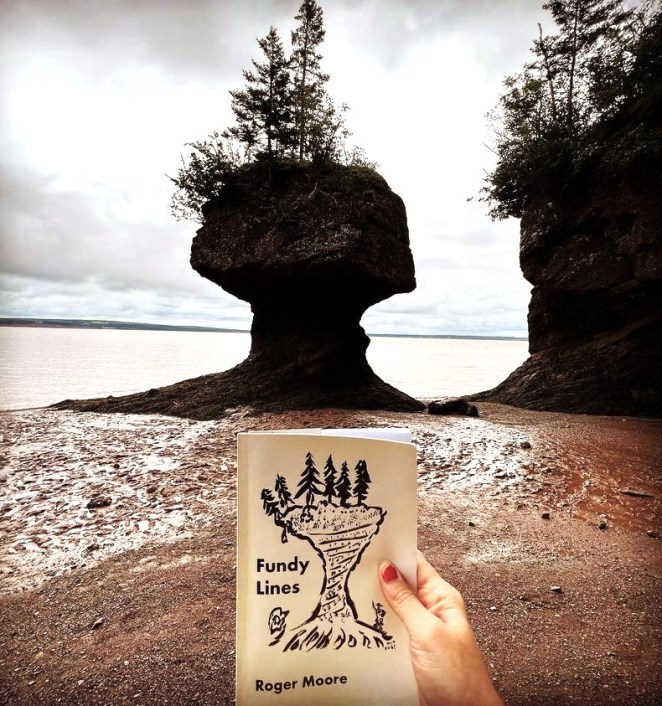
I had forgotten all about this poem in prose. It comes from Fundy Lines, if I remember correctly. Photo credit (below) to one of my former students, an excellent poet herself, who took the trouble to locate the correct rock and then take a photo of book and rock together.


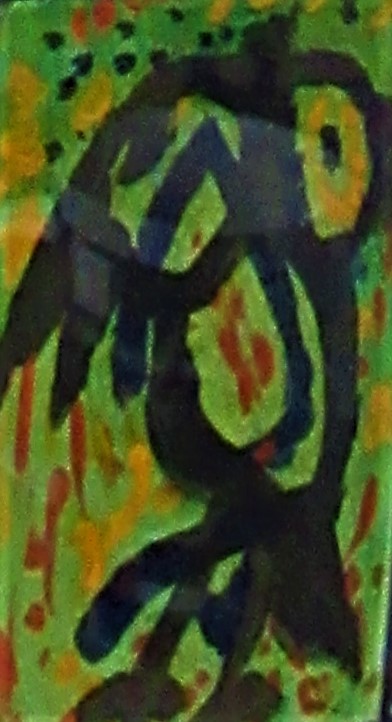
Moo thought his painting of a dark shape that looks a little bit like a bird of ill-omen would be just what this prose poem needed. Maybe he’s right. I trust him with his choice of paintings. Well, most of the time anyway. He can be a bit ‘off’ from time to time, but mostly we form a good team, especially where Surrealism is concerned.

I guess Raven formed part of my Surreal sequences. I really do enjoy Surrealism. The mixing of metaphors, for example, the unexpected meeting of a sewing machine with a carving knife and an umbrella on an operating table. And look what Raven’s up to. He discovers a trap door in the sky. Well, that would be very useful, if we had wings and could fly. Then he turns off the light bulb in my head. I didn’t even know I had one in there. I guess Raven, like coyote and zopilote is a bit of a Trickster. Next he changes into a woodpecker and widens the hole in my skull. Poor old me – avian trepanning – no wonder I have problems! My head becomes an Easter Egg and has cracks in it giving birth to what? Some mad ideas, I guess, pecking their way out into the wonderful world in which Moo and I live in perfect harmony with my beloved and our cat. And look at all those Welsh mining memories – lignite, house coal, steam coal, anthracite, jet – and remember, when the coal comes from the Rhondda down the Merthyr – Taff Vale line, I’ll be there.

It will be a long way from Canada to Taff’s Well. Maybe Raven will be kind and fly me there, through his Island View trap door that has direct access to the trap door just above Castell Coch, the Fairy Castle of my childhood. That would be faster, and easier, than my old two-wheeler Raleigh bicycle with it’s Sturmey-Archer three gear click on the handlebars. I bet Raven can fly faster than I can pedal. And if I could have pedaled as fast as Raven flies, downhill and uphill, I would have been King of the Mountains and an all time winner of the Tour de France. Now that would have been surrealistically surreal, seeing me as a cereal winner, with my snap, crackle, and pop! Not that my dad would have been happy. He never was happy with anything I did!

Dog Days

Dog Daze

1

A dry storm lays waste the days that dog my mind.
Carnivorous canicular, hydropic, it drinks me dry,
desiccates my dreams, gnaws me into nothingness.

At night a black dog hounds me, sends my head spinning,
makes me chase my own tail, round and round. It snaps at
dreams, shadows, memories that ghost through my mind.

Tarot Cards and Tea Leaves are lost in a Mad Hatter’s
dream of a dormouse in a teapot on an unkempt table.
Hunter home from the hill, I awake to find my house
empty, my body devastated, my future a foretold mess.

Desperate I lap at salt-licks of false hope but
they only increase my thirst and drive me deeper
into thick, black, tumultuous clouds. Dry lightning.
The drought continues and no raindrops fall.

Dog Daze
2

The drought continues and no raindrops fall.
Desperate I lap at salt-licks of false hope but
they only increase my thirst and drive me deeper
into thick, black, tumultuous clouds. Dry lightning.

Tarot Cards and Tea Leaves are lost in a Mad Hatter’s
dream of a dormouse in a teapot on an unkempt table.
Hunter home from the hill, I awake to find my house
empty, my body devastated, my future a foretold mess.

At night a black dog hounds me, sends my head spinning,
makes me chase my own tail, round and round. It snaps at
dreams, shadows, memories that ghost through my mind.

A heat wave lays waste the hopes that dog my days.
Carnivorous canicular, hydropic, it drinks me dry,
desiccates my dreams, gnaws me into nothingness.

Dog Daze
3

The drought continues. No raindrops fall.
No fresh water. None at all.

Dark clouds gather in the sky.
No rain falls. The ground is dry.

Grass all burned. No more hay.
How much livestock will they slay?

No rain comes, but a flash of light
sets the woods and fields alight.

Home from the fields, some farmers confess
their future is an unpredictable mess.

Desperate farmers are losing hope.
Out in the barns, they keep some rope.

The roof beams are sturdy and built high.
One little jump and problems good-bye.

Commentary:

Dog Daze 1 is a reverse sonnet. Instead of being structured 4-4-3-3 it moves in reverse 3-3-4-4. What fun to pretend to be Milton Acorn, and to turn my sonnet upside down. It should rhyme, but I abandoned rhyme in favor of metaphor a long time ago. Was I right to do so? What, if anything, catches you unawares in Dog Daze 1? Does it work for you? What would happen if we turned it upside down? You be the judge.

Dog Daze 2 is more or less the same sonnet returned to its normal stanzaic shape 4-4-3-3. In what ways has the poem now changed? Clearly there is a structural difference. Obviously some of the lines and images have changed. Is the poem stronger? Weaker? Does each one affect you in a different fashion? Do you prefer one version to the other?

Mission Impossible – How many more adaptations can we make to this poem and how would each one affect the poem and the reader’s reception of it? For example – Dog Daze 3 sees our sonnet turned into a poem composed of seven rhyming couplets. Couplets are easy to rhyme. But do they simplify the thoughts too much? Is the poem now too dark? Can you lighten the mood? How? Your mission, should you decide to accept it, is to rewrite the poem in seven non-rhyming couplets. That will make a change from the Daily Sudoku and the Cross-word puzzle. If you do take up the challenge, let me see what you do! And remember, you can make it personal to you, your life, and your garden.

Time Flies

Time Flies

… bends like a boomerang,
flies too rapidly away,
limps back to the hand.

Endless this shuffle of unmarked
days dropping off the calendar.

Hands stop on the clock.
The pendulum swings:
time and tide stand still,
do not move.

The print in my grandma’s house:
seemingly moving seas,
sails swelled out,
the ship stays firm in its frame.

‘As idle as a painted ship
upon a painted ocean.’

Our garden fills
with brightly colored birds
and red and grey squirrels.

Light and dark
switch back and forth
each day
a twin of the day before.

The TV screen hangs out
the daily washing.
Tired, worn out shadow,
their faces boring us
with shallow wit
and hand-me-down wisdom.

Time:
an albatross around the neck,
an emu, an ostrich, a dodo,
an overweight bumble bee,
too clumsy, too heavy to fly.

“Time flies?”
“You can’t.
They fly too fast.”

Commentary:

My friend Moo told me he was ‘all shook up’ when I read him this poem. I don’t think Moo’s too smart. He thought All Shook Up was written by the Rolling Stones when they went out moss gathering during the Fredericton Harvest Festival, but I said no, it was definitely written by Buddy Holly on an off-day when he was playing cricket. It wasn’t okay in those days to play croquet.

The last three lines come from an examination question in the General Paper, “S” Level, as it used to be. “Punctuate this sentence – time flies you can’t they fly too fast” – of course, they should have said, “in exactly the same way we want you to. Corrections and alternative versions will not be accepted.” What did they think I was? A mind-reader? I wasn’t. I was a teenager having a field day in the national examinations. I would love to have been a fly on the wall when they marked my paper.

In the biology exam, they gave each one of us a Brussel Sprout and asked us to draw it and tell us as much as we could about it. Of course, I ate mine, and I said it tasted a little bit dry and needed some salt. Then I drew a mess of potage, all yellow and green with chewed up squiggles, and added “That’s what the sprout probably looks like right now.” I failed that exam too. Didn’t even get a part mark for ingenuity, though the science teacher said I could have a glow of satisfaction. Very useful after lights out in a boarding school, I can tell you.

I can’t remember if Moo went to that school with me or not. I don’t think he did. I think he drifted into my life a little bit later. He wasn’t a painter at that stage, just a half-starved philosopher doomed to live in a garret. Of course, once he started painting houses, he made money. It’s amazing how many people will pay you for painting their houses. Of course, that was before they invented plastic siding.

About now you realize that I live in a strange world all of my own and a lot of people live in it with me. You, too, if you enjoyed reading this. Long may the ‘strange world of me, you, and Moo’ continue. I’d send you a penny for your thoughts, but they have gone out of circulation. I can’t even sing you a song of sixpence these days either. Silver sixpences have walked the dodo path too.

This Vessel in which I Sail

This Vessel in which I Sail

Trapped in this fragile vessel, with the pandemic
a passenger waiting to board, I drift from port to port,
looking for a haven, safe, to have and to hold me.

No harbour will let me dock. “No room at this inn,”
they say. “No haven here.” They wave me away.

Now I have no destination. Aimless, I float and every
where I go the message is: “No vacancy: no room at all.”

Unwanted, abandoned, I wander with wind and waves,
my only friends seals, porpoises, and whales.
I walk the whale road, leaving a frail, white wake behind.

This vessel has become a gulag now, a prison
camp where I exist just to survive. Each hour of each day
endless, boundless, like this shadowy, haunted sea.

Today there is no motion, no goal. What is there to achieve
but survival? Each day’s journey is sufficient unto itself.

Commentary:

Moo’s cartoon, Naval Gazing, dates from 2015. That year I spent eight weeks in Moncton at the Georges Dumont, gazing at my navel while waiting for my anti-cancer radiation treatment. Naval gazing / navel gazing, indeed. Good one, guys. You make a great pairing.

The poem dates from 2020 when Covid stalked the streets and we wore masks when we were not confined to our houses. I thought of the tour ships, wandering the seas, with the disease on board, and no port wanting them. It was a strange time.

Golden Oldies, then, both poem and painting. There are signs, small at present, but still visible, that such days are on their way back. We must each ask the question – What is there to achieve but survival? Hopefully we will come up with a similar answer – Each day’s journey is sufficient unto itself. Journey well and journey safely, my friends.

What would your life be like without music?

Daily writing prompt
What would your life be like without music?

What would your life be like without music?

Very quiet.

I consulted Moo, my favorite artist, on this one and he said that the above answer was much too brief and slightly cynical.
“Look,” he said to me, “this is today’s painting. It’s called Walking on Air.”
“Walking on air?” I queried.
“Yup,” he replied – “I hear music, but there’s no one there.” Then he told me to listen quietly to his painting. And I did. But nothing happened.
“I can’t hear a thing,” I told him.
“How many people do you see inside the painting?” he asked.
“About four,” I replied. “A girl with long red hair, a little girl with a little curl, right in the middle of her forehead, an old man, all hunched up, running away from something, and someone on the left hand-side, at the bottom, but I’m not sure what they’re doing.”
“Idiot,” he said to me. “Open your mind, not just your eyes. Look again. Now what do you see?”
“The same people, and there may be a couple more. How many people do you see, Moo?” “None. That’s why I hear music, because there’s no one there.”
“You’re having me on, aren’t you? You’re pulling my leg? You’re taking the…”
“Easy now,” he grinned maliciously, ” you don’t want your next word to be taken and used in evidence against you, do you? Now, look out of the window. What do you see?”
“I see blossoms…”
“But the trees are bare,” he smiled. “Do you toss and turn in your bed at night?”
“I do. And I’ve gone and lost my appetite.”
“I bet those stars shining in the skies last night, will be shining in your eyes tonight.”
“My golly, Moo, I think they might be. You know, you are a genius.”
“I am indeed. But I usually travel incognito. And listen…”
“Wow. I hear someone singing softly, and the voice is coming from the painting… but…”
“I know. There’s no one there.”

How quiet would my life be without music? As quiet as it would be without art, poetry, a sense of humor, friends who laugh with me, not at me, and people like you, who read this, and don’t think that I am totally insane. Oh yes, and if there was no music in my life, there would be no Great Starts to the Day, and no Poems for the End of Time.