Black Dog
The black dog leaps out
of the grandmother clock
and lands on my back.
His paws grip my shoulders,
then rake down my spine.
I try to shake him off,
but he growls, bares his teeth,
and won’t let go.
I love that clock,
its Westminster chimes,
the Roman numerals
standing guard
over the pointed arrows
of the hands as they march
round and round.
But I hate the hound
that makes its kennel
in the clock, leaps out,
snaps at me, bites and claws,
and grinds me
down into the ground.
Comment:
The Black Dog was Winston Churchill’s name for the depression that came over him, and overcame him, from time to time. It used to attack me when I was a young boy living in Swansea. My grandfather would point at the clock and say “He’s in there. He’s coming for you. I can see him. It’s the black dog.” Well, that used to drive me crazy and whatever it was that set me off became twice as bad when the black dog arrived. Alas, now I am entering into my dotage and my second childhood, the black dog has re-appeared to trouble my waking hours. I guess it’s the mood swings. Happy one moment, miserable the next. The good dog appears. The black dog drives it away. Then the good dog reappears and all is well again.
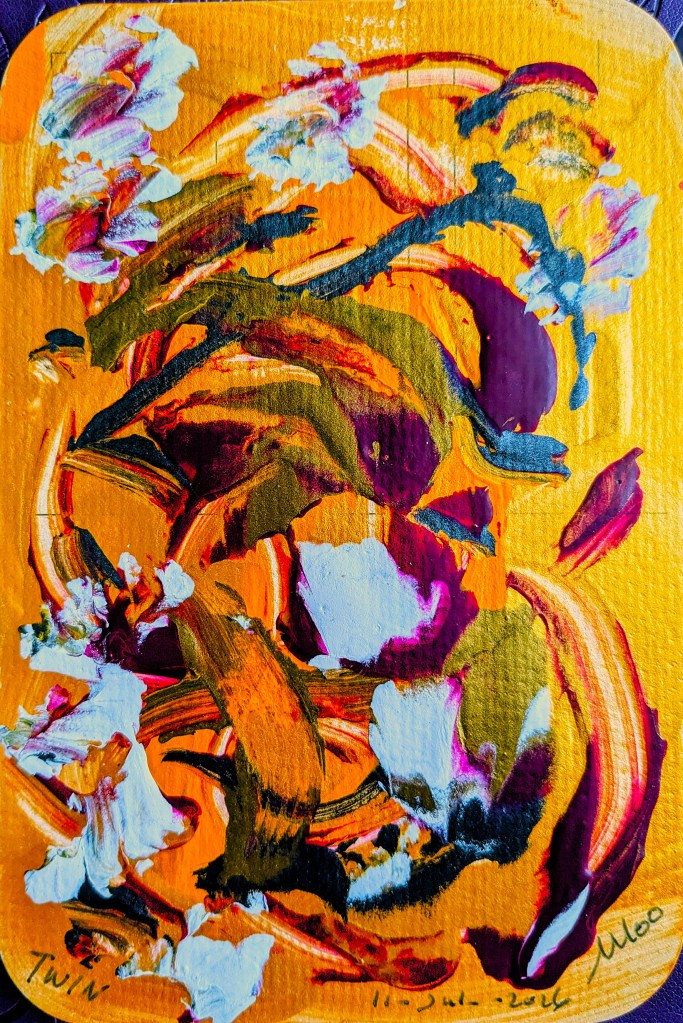
Moo understands me and my patterns very well. In fact he painted two paintings for me – Twin – the one above and Niwt – the one below. You can see evidence of the good dog and the black dog in each of them. But which is which?
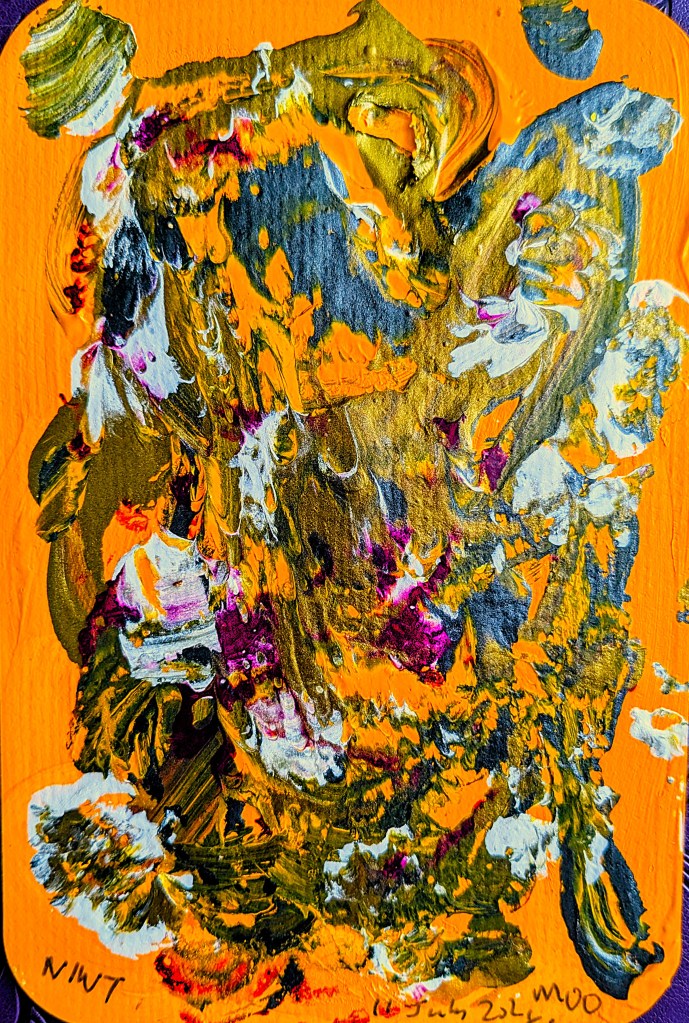
I’ll leave you to guess which is the good dog and which the bad one. Really and truly, they are two sides of the same coin – heads and tails so to speak. Moo tells me you can think of the paintings as a mirror image, one of the other.
It’s like mood swings – either my mind or my body flips the coin and one of the two dogs jumps out visit me. Luckily, after a bit, the good one chases the bad one away, so it’s all swings and roundabouts and all the fun of the fair. Until I fall off the Ferris Wheel or see my own shadow while riding on the Ghost Train.
Twin, of course, is Niwt backwards. Or is it the other way round. Dylan Thomas, my favorite Welsh poet, set the standard for word reversal. After all, the town of Llareggub is bugger all backwards. What fun we can have when we twist our words, double up on our language, reverse words and their meanings, and generally weave the tangled webs of linguistic double-talk. Oh the mystery of missed and mixed up meanings. But are meanings meaningful or meaningless? Now that is the question. And when you have answered it for meanings, start thinking about double-meanings and their twins – or should that be quadruplets?


