Questions

Questions

Jackpine Sonnet

each time you see a shooting star
a child is born or an angel falls
swarms of them in certain seasons
when our planet sails through
the meteor belt and rocks burn up
as they fall to earth through air and fire

written in the stars they say
and everyday I read my horoscope
to see what lies in stall
or rather what fate will me befall

warmth and love perhaps yet what
do cold unconscious planets know
about this life that people lead below

Eros Agape Philia
Jupiter Mercury Venus Mars
who knows what ancient
Greek and Roman gods
still play at being gods
among so many drifting
shifting shooting stars

Comment:

So, Moo is back to painting, at long last. Last night he painted two paintings to celebrate his return to a lovely clean, neat, washed, rearranged workshop desk that a certain KTJ tidied up for him. He was so happy. I could see him bouncing up and down on tip-toe, trying not to fall over with excitement. He even got to wash his brushes and ensure that all the remaining ones were solid and good.

“Back again,” he sighed. And that’s exactly what he painted. Of course, in the course of time some of his paints have dried up and a brush or two needed careful separation, fine squirrel hairs from dried paint. But with a little elbow grease and a lot of luck everything came together.

This time, I had poem that fitted Moo’s painting. It explores the idea that everything can be found in the heavens. Fray Luis de León phrases it this way –

Es más que un breve punto
este bajo y torpe suelo comparado
con aquel gran transunto
donde vive mejorado
todo lo que es, lo que será, lo que ha pasado?

Is it more than a brief speck
this low and clumsy earth compared
with that huge universe
where lives in betterment
everything that is, will be, and was?

Well, what a load of questions and all based on 16th Century Spanish Neo-Platonism. Yet old as the system of star reading is, people still read their daily horoscopes. Well, some people do. I guess they think that in the same way that the moon rules the tides and pulls them this way and that way, then the moon and stars rule our bodies – we are, after all, 95% water – and pull us this way and that way.

But hold on a moment. Nature or nurture. And what about free will – libre albedrío? Are we ruled by the stars? Or do we have free will to do as we want in this little world of ours? Good questions. What we do know is that certain people think they can do whatever they want, with no repercussions or consequences whatsoever, while others understand that certain societal norms and rules are there for a purpose. Oh dear – the eternal question. If the stars and planets know what we will do and when we will do it, can we speak of free will or are our lives pre-determined!

I guess Moo’s painting is more than a Who’s Who Zoo and more a who did what and with which and to whom zoo combined with when and why did they do it. “Alas, if thy mother knew it, sadly, sadly would she rue it.” And now’s the time to De La Rue it – so get out those playing cards, shuffle them carefully, read your fortune, and let’s see what is going to happen, and how, and when. Or you could read tea leaves, Viking Runes, or the lines on the palm of your hand. Speaking of which – question – what is the first sign of madness? – answer – hairs on the palm of your hand. Question – what is the second sign of madness? – answer – looking for them. – and you did, go on, admit it, you took a little peek, didn’t you. I know you did – it was written in the stars, and in the Tarot pack, and … and … and …. did you find one?
Anywhere

Anywhere
Jackpine Sonnet

I knew you the first day
I saw you. I knew your heart
before you could open it up
and let me in. I knew your soul
before you allowed me
to touch its beauty’s depth.

Did I know you from another
life? I just don’t know. I only
know that I knew who you were
and what you meant to me.

Once I saw you, how could I let
you go? I reached across the bridge
that spans the ages and saw you
as you always were, clad in white,
shining like the Milky Way
across a universe of falling stars
and you the only one I wanted
to catch, put in my pocket,
 and keep safe in my heart.

Comment:

“Know thy self!” So easy to say, but not so easy to do. Sometimes it is easier to know others, to see them clearly, than it is to know ourselves. As Robbie Burns once wrote – “Oh would some power the giftie gie us / to see ourselves as others see us.” The mirror of the self, alas, is a fairground mirror, snatched from the hall of mirrors, and it is a distorting mirror that turns us into different shapes and sizes.

And what about the ways in which people change? Miguel de Cervantes wrote that “the most difficult role in the play is that of the fool, for he who would play the fool must never be one.” How many of us wear a mask, play the fool, and it is only the joker’s bells that are heard, the fool’s mask that is seen?

And we can change in so many ways. Heraclitus – “we can never walk in the same river twice.” Why not? Because we change and the waters of the river change and everything is in fluctuation and nothing stays the same, not even for one day. Nostra vita brevis est … and it is subject to change.

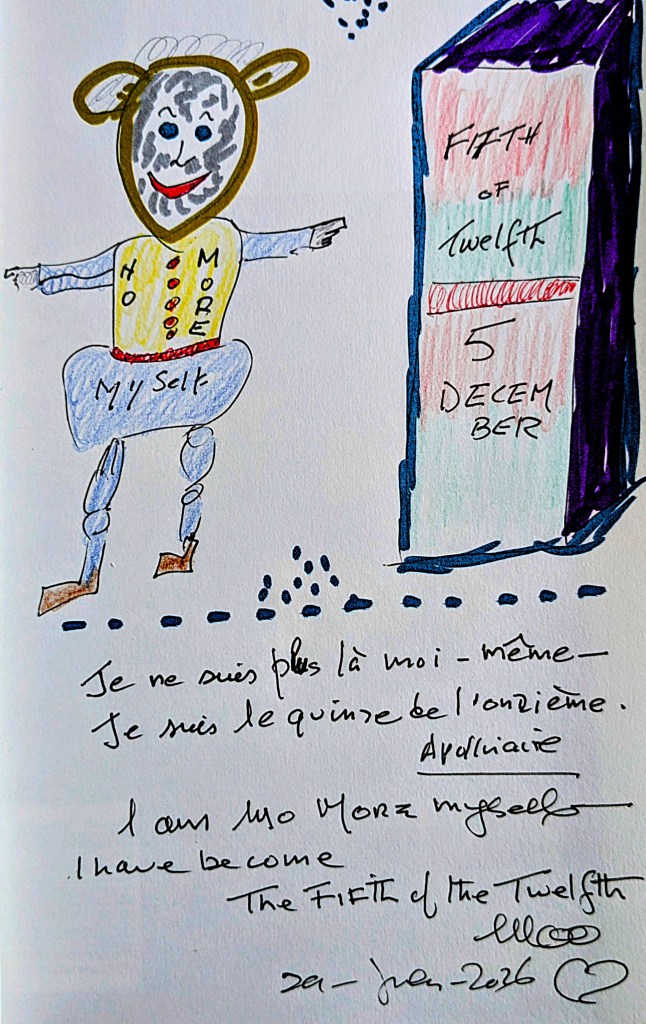
How do we change? Let me count the ways – but, like petals on a daisy or seeds on a dandelion, the changes are almost impossible to count. Guillaume Apollinaire also wrote about change. “Je ne suis plus là moi-mème, je suis le quinze de l’onzième.” / “I am no more myself. I have become the fifth of the twelfth.” How often do people say – “I am a human being. I am not just a number.” Yet numbers are what we turn into. Statistics. Figures in columns. Dates in note books. Telephone numbers. Number plates on cars.

Oh the joys of time. Today’s heroes so soon turn into tomorrow’s forgotten people. Seeds on a dandelion, petals on a daisy, ants beneath the traveler’s feet … change is everywhere. And one day, even you, might look in that mirror and no longer recognize yourself. So – know yourself – yes – but always prepare for change.

Windmill

Windmill
Jackpine Sonnet

When the scales fell from my eyes
I stood on them and wondered
what I weighed on the time’s great scales.

Miniscule. A featherweight.
A dandelion seed blown on the wind
that whirls the world through space.

Spiritus mundi – the great world spirit
inflating my lungs, each breath
a glimpse of the infinite
combining in my body and soul.

The sails of a windmill, my arms,
and the wind turning them,
dashing me down into the dust,
then raising me rejoicing to the skies.

Comment:

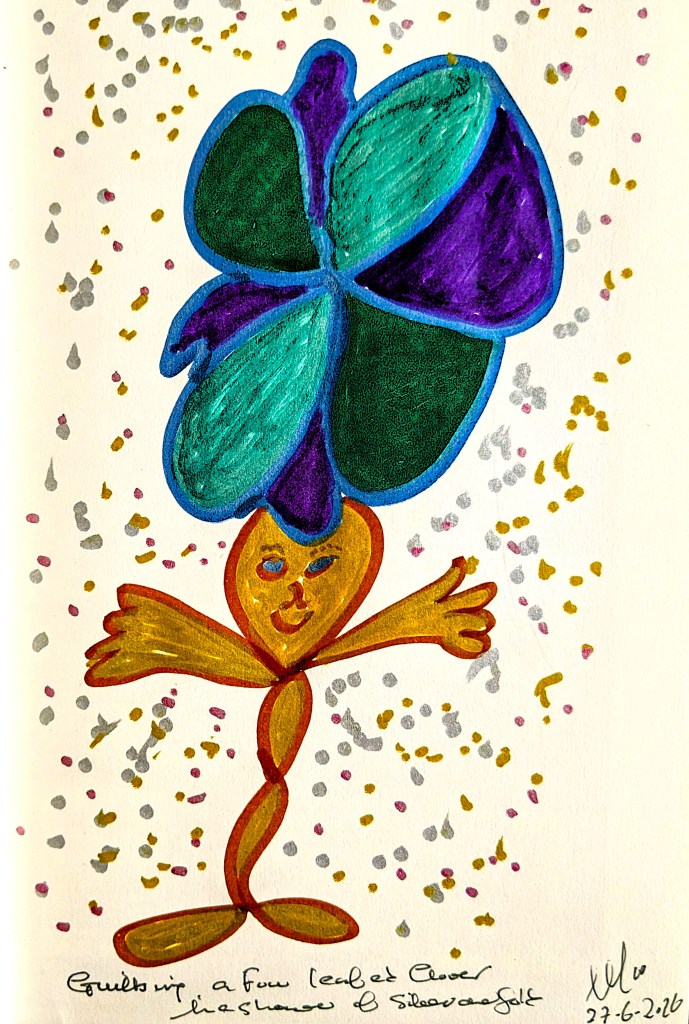
Moo said I needed cheering up, so he painted me a happy painting. “I know it’s not a windmill,” he told me, “but you can pretend it is. The leaves of the clover even look like they might be a windmill, and look, it’s got arms as well.”

“Thank you, Moo,” I said. My poem is a happy poem and it proves that the Black Dog of yesterday had been banished today, not by a happy dog, but by a four leafed clover standing beneath a shower of solver and gold.”

Intertextuality – texts speaking to texts. I wonder how many texts you can spot in this poem. I can count five, at least, and there are probably more. Milton Acorn, Miguel de Cervantes, Northop Frye, the Bible (not y Beibl Cymreig, unfortunately), Edmond Rostand. That’s quite the handful. Well, four fingers and a thumb, at least. Now all you have to do is spot the original sources which, blended, give my poem a saucy sauce of sorts. So, grab your AI and play hide and seek and see what you can find drawn from the dark recesses of my mind. Don’t give in too easily, now.

Mood swings – mood changes – Moody Me – Moody Moo – I’ll bet that you are Moody Too. Good mood, bad mood, who’s to say? We’ll leave that for another day!

Night Thoughts

Night Thoughts
Jackpine Sonnet

Alive, the house,
with creaks and groans,
doors, windows, floorboards,
all in the minor key,
soft and low.

Walls give forth a series
of squeaks akin to mouse songs
mouthed at midnight.

Who’s there? Was that
a footstep on the stair?
Nobody replies.

I wonder sometimes what sounds
my guardian angel makes
as he does his rounds.

Sometimes in the cool of the night
I think I sense the passing of his wings,
among those other things.

Comment:


Well, what can I say? Moo took one look at this poem of mine and said “Poor thing. You are in a Tiz- Was. Have I got the cartoon for you.”
“What’s a Tiz-woz?” I asked him.
“This painting is. And so are your Night Thoughts. You’d do far better to go to sleep and stop thinking, especially if you’re going to think such things as these. What’s happened to Blueberry? I thought you had persuaded him to look after the Night Bumps.”
“He got rid of those a long time ago. Anyway, these aren’t Night Bumps, they’re Night Thoughts.” “Well, if Blueberry isn’t up to the task, you’d better ask Roseberry to do it. Either that or you get yourself another cat. Or a great big dog.”
“I’ve always got Teddy.”
“You mean you sleep with three teddy bears?”
“Of course I do. You’ve never hear of a three bear night? This is Canada. It gets cold at night in the winter.”
“Idiot. You’ve got central heating.”
“Sometimes the power fails.”
“Then you need to buy Three Dogs. That will give you a Three Dog Night. One in each arm and one to keep your tootsies warm.”
“You’re not being very helpful, Moo.”
“I’m not meant to be helpful. I am a painter and I use my paintings to stir people up and make them think. If I wanted to help people, I’d be a Social Worker.”
“I can’t imagine you as a Social Worker. An Anti-Social Worker maybe.”
“Okay. That’s enough. Do you want to use this cartoon or not?”
“I do.”
“Then do so. And now I am going back to work. I don’t do day thoughts or night thoughts. I just paint.”
“And draw cartoons.”
“That too! That’s why I am a Moo.””

Striations

Striations

Striations

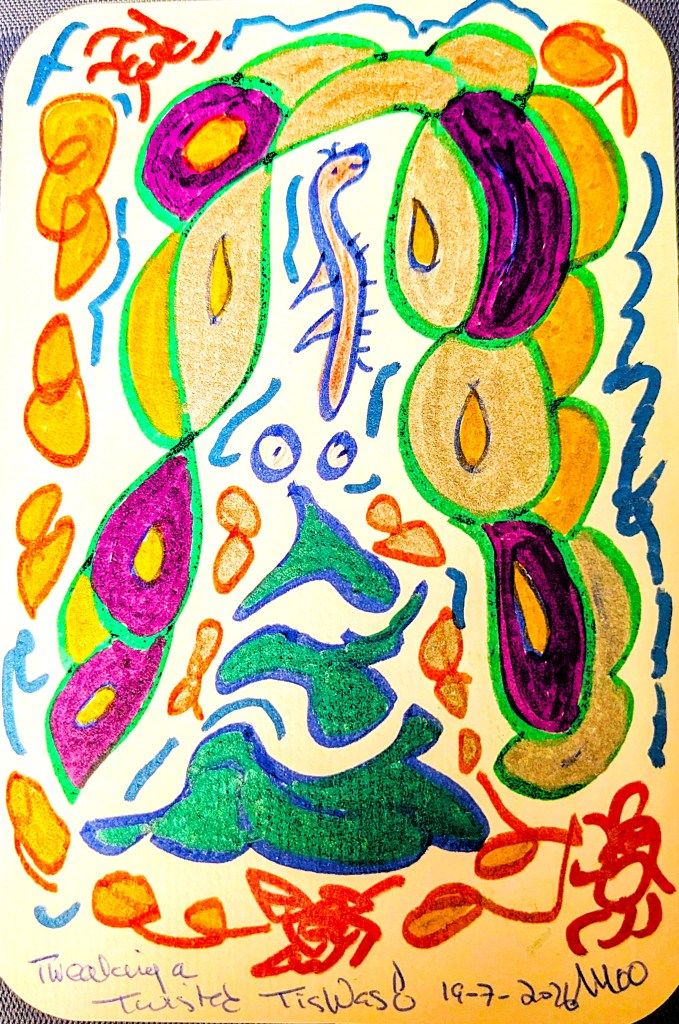
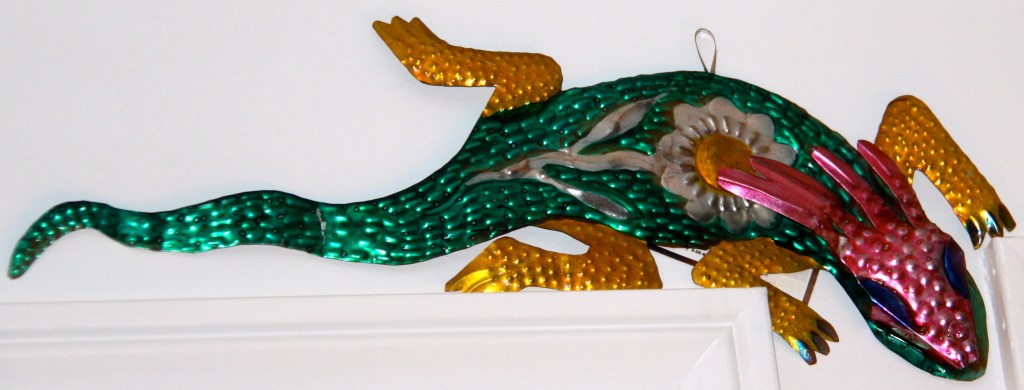
There are striations in my heart,
so deep, a lizard could lie there,
unseen, and wait for tomorrow’s sun.

Timeless,
the worm at the apple’s core
waiting for its world to end. 

Seculae seculorum:
the centuries rushing headlong.
Matins: wide-eyed this owl
hooting in the face of day.

Somewhere, I remember
a table spread for two.
Breakfast. An open door.
“Where are you going, dear?”

Something bright has fled the world.
The sun unfurls shadows.
The blood whirls stars around the body.
“It has gone.” she said. “The magic.
I no longer tremble at your touch.”

The silver birch wades at dawn’s bright edge.
Somewhere, tight lips, a blaze of anger,
a challenge spat in the wind’s taut face.

High-pitched the rabbit’s grief in its silver snare.
The midnight moon deep in a trance.
If only I could kick away this death’s head,
this sow’s bladder, this full moon
drifting high in a cloudless sky.

Comment:

La poesía se explica sola. Si no, no se explica.

Pedro Salinas.

Poetry explains itself. If it doesn’t, it’s inexplicable.

Tomorrow’s Words

Tomorrow’s Words


belong to another day
another experience
a different thought set

tomorrow’s words
new leaves
drifting from the tree
bright-faced
kites on a wind
we have yet to know

mini-kites they fly
and our eyes
cling on to them
while we stand
tethered
here below

itinerant drifters
they will not stay
they just fly away
notes on a wind
words of a song

tomorrow’s words
tomorrow’s song
yet to be sung

Comment

Some time ago, Moo painted this painting – Ephemera he calls it. He wrote a series of thoughts – in poetic form – then covered them over with paint. “Everything,” he told me, “is transient. Ephemeral. The poems you write. The paintings I paint. All ephemeral.” “What does ephemeral mean?” I asked him. He gave me his Bad Hair Day Moo Grunt – “Go look it up,” he told me. So I did.

Ephemeral means lasting for only a very short time, fleeting or transitory. Derived from the Greek word ephēmeros—which literally translates to “lasting only a day”—it is often used to describe things like a beautiful sunset, a brief childhood emotion, or a flitting dream that fades in the morning light. The true essence of the word highlights the fragile, impermanent nature of life, trends, and experiences, serving as a poetic reminder to appreciate moments while they happen. Thank you AI and Wikipedia and anyone else involved. Alas, some citations are as ephemeral as words.

Moo’s painting links with several themes from antiquity. Carpe diem – seize the day. Make the best use of the time you have, for time flits by in the twinkling of an eye. Ubi sunt – the central theme of time past – ubi sunt qui ante nos in mundo fuere – where are they who lived in this world before us -. This is an age old question that returns via Gaudeamus igitur – a song still sung in some European universities at graduation time. It also occurs in Villon – Mais où sont les neiges d’antan? Where are last year’s snows. This is the version sung by Georges Brassens.

While the past slips rapidly away, like scenery viewed in the rear view mirror of a rapidly advancing car, the future is always before us. Yet, in many ways it is as ephemeral as the past and soon fades into that rearview mirror as we drive along our chosen paths. The words of yesterday have gone. The words of tomorrow have not yet arrived. We can only cling to the words that we speak and hear now. Catch them if you can. Savour them. They won’t last long.

Frustration

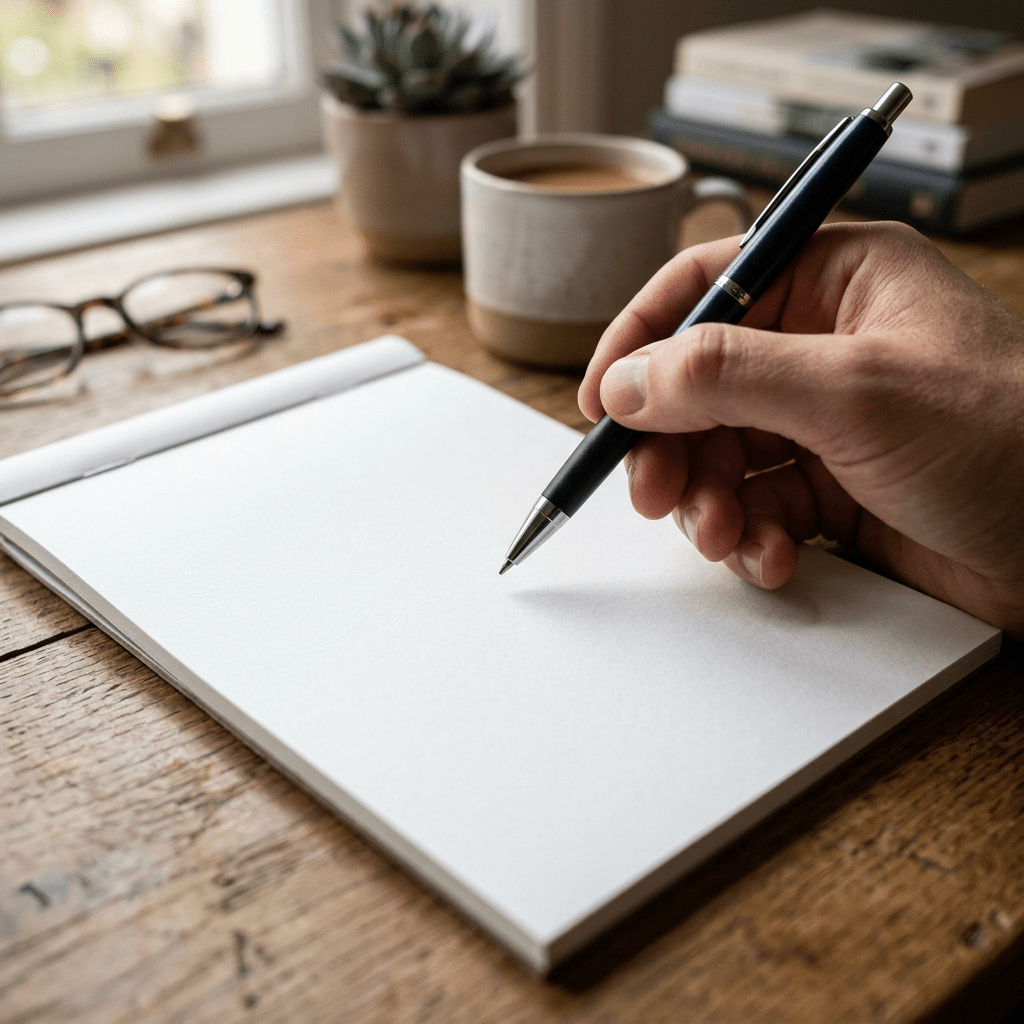
Hand holding pen above blank notepad with coffee cup and glasses on wooden table
A hand holds a pen poised to write on a blank notepad next to a coffee cup
AI generated

Frustration
A Jackpine Sonnet

Hand hovering pen poised
a black shadow hangs over
the blank page threatening
to erase any ink marks
that may emerge

Eyes and mind blank
no butterfly kiss delicate
in its touch of nib to page
a black cloud of nothingness
damns creativity at its source

Who can prise the worm
out from the chrysalis
gift wings to the pupa
change it from slug or snail
into that glorious moment
when sunshine’s beauty
stutters into fluttering flight

Comment:

The top photo, AI generated, was based on the wording of the poem. The bottom one was a Moo choice from his pre-painting selections when he claimed to be a photographer. I like both, but for different reasons.

The first one emphasizes the fear of the blank page, the blank canvas, the blank mind, the overnight snowfall that is awaiting its first foot or hoof print, its first instant of inspiration, its first splash of paint, its first letter or word. And yet, according to many with whom I have spoken, artistic creativity is one per cent inspiration and ninety-nine per cent perspiration. So, why hesitate? Get on with it. Make those first marks. Take that first step. And remember, even the longest journey begins with the first step.

The second photo expresses the duality of creativity. At the front end of the butterfly, its poised, fragile beauty. At the rear end, the fearsome face it assumes if approached in the wrong way from the wrong direction. Front end – the moment of creation. Rear end – the fear of that first step and the consequent sense of frustration.

So – at the moment of creating, we must consider several things – the fear of failure. But the only way to never fail is to never try. Each failure, however bad, is not a crime, it is a stepping stone on the way to ultimate success. The fear of the first step – this ties in with the fear of failure. Will we slip on the first damp stepping stone across the stream? How long will we permit our selves to search for a safer passage? Is there really a bridge around the bend, a bridge that will stop us from getting our toes wet? And what’s wrong with wet toes anyway?

When we dip our toes in the sea, we feel the cold of the water. When we take the plunge, dive in head first, we feel the full force of the ocean. And that ocean is the creative energy that yes, can sweep us away, can carry us up, can pull us down. Is that what we are afraid of, being overwhelmed by the creative powers within us? Of losing the meagre control we hold over our lives? I truly believe that in many cases it is just that element of being swept away by our own unleashed creativity that fills us fear. But if we never take that first step we’ll never know who or what we are, nor will we understand what we are afraid of, nor will we be able to conquer that fear and accept our creativity for what it is.

Outsider

Outsider

Outside their window
nose pressed to the pane
always an outsider

Cold rain turned
to sleet then snow
dark outside
inside fairy lights
the fire’s warm glow

I never cried
I accepted sleet and snow
just stood outside
watching the fire
the sparkling tree
gifts at the foot
children playing

I turned for home
my cold empty house
no lights no fire
just me all alone
my parents out partying
me left on my own

Comment:

Poor Moo – he’s been having a bad time. Winston Churchill’s Black Dog of Depression leapt out of the grandmother clock on the wall in the kitchen, draped itself round his shoulders, and wouldn’t let go. Well, that’s what he told me, anyway. Personally, I think he was silly enough as to check his pension plan on the stock exchange – bad idea. That descending red arrow is worse than the Black Dog and equally as likely to drag one down, down, down. Is there a rock bottom? Who knows. What I do know, from my own hard-won experience, is when it’s darkest and all seems lost, that’s when the you know dawn will soon come and the light will break through.

In 17th Century Spanish Mysticism, this is known as the dark night of the soul. Stick with it. Do not despair. That dark night leads to what the Mystics call the Via Iluminativa – the path of light that leads you back upwards, into your normal self and your daily life of sunshine and happiness.

Anyway, in a cri de coeur – a cry from the heart – Moo showed me this painting and asked me to write a poem, just for him, so that he could wallow in his sorrow for a little bit longer then pull himself out of the Slough of Despond. Bunyan – Pilgrim’s Progress – don’t tell me you haven’t read that? You’ll be on Santa’s Naughty List if you haven’t. Anyway, I offered him a hand to pull him out, but he said “No, not a hand. I want a poem.” And here it is. Moo on the outside, looking in. As you can see, he’s wearing Blue. So he’s a Blue Moo. Good job he isn’t from Kentucky – “Blue Moo of Kentucky, keep on shining.” If he was, he might never recover!

This poem is also dedicated to my good friends Ginger and Michael. They live in the Sunshine State and are never left out in the cold. Now, if they lived in Nova Scotia, they might become true blue Blue Nosers. As for me, I am just a reborn New Brunswick Herring Choker. And I think one of those two might be as well.

My Beloved

Pond covered with blooming pink and white water lilies reflecting sunrise and a small arched bridge
A serene garden pond with blooming water lilies under a soft sunrise sky
Image AI generated
based on poem

My Beloved

In my dream garden,
the early sun floats petals
across a lily pond.
Framed among lilies,
my beloved’s face drifts
through a watery space.

So sweet, her embodiment:
she lies languid among the lilies,
beside herself in bloom after bloom,
each flower gigantic in its frame
beneath a wooden footbridge.

I envision her as she was,
this lily who will toil not, nor spin,
 and who sighs with the morning breeze
 that ripples her smiling countenance
into a thousand fragments.

She lies cushioned amid the lily pads,
a work of wonder in liquid impressions
fluid in this fragmented light.

Comment:

I guess Moo will be pretty upset when he sees this AI generated painting of a lily pond. He offered me a couple of lovely paintings today, but they had no lilies in them, so I said “Thanks, but no thanks.” Oh dear. I hope I haven’t sparked another feud. I did ask him if he had some lilies, but he shook his head – “Sadly, no.” he said. “I don’t paint them. I’m Moo, not Moo-net.”

Speaking of Monet – a student once asked me what was the definition of Baroque. He picked a bad day. I was in joyful mood. “Baroque is when you’re out of Monet,” I told him. Dead silence. So I tried to explain. Baroque / Broke — Monet / Monnaie / Money. Then he let out a long, low whistle. “Is that why they pay you the big bucks?” he asked me. Well, I didn’t really get big bucks. But at least I had tenure – the monkeys rhymes it with manure in the Monkey Temple. I guess we’ll stay well clear of that one. Ain’t no lilies in that old temple pond.

“What’s yellow and deadly?” “I don’t know,” says Moo. “Shark infested custard,” I tell him. “Why don’t you try painting that. You could add some false teeth and a few streaks of strawberry jam.” O

“Okay,” said Moo. “You asked for it. What’s black and blue and lies face down in the gutter?” “I don’t know,” I replied. “Please enlighten me.” “You, if you keep telling jokes like that,” he pulled a paint brush out of his pocket and shook it in my direction. Very threatening.

“I’ll tell you a better one,” I said, smiling, “here – what’s got four legs, sits in a kennel, wags its tail, and barks?” He looked at me for a few seconds then said hesitantly, “A dog?” “Oh dear, sorry,” I frowned at him, “it’s an old joke. You must have heard it before.”

No Man’s Island

No Man’s Island

It’s so easy to lose
our true selves
or to be carried along
by the flow of another’s
rhetoric because we
no longer possess
(or never had)
that inner conviction
that makes us different.

That’s why we must join hands
and link together:
a chain of bridged
and ferried islands
to insulate us
against our loneliness.

Comment:

I first published this in 2017 with the title Islands – I have changed the title, very slightly, to move closer to John Donne’s No Man is an Island. What I have noticed more and more recently is how we tend to isolate ourselves. Birds of a feather flock together – true – and nowhere truer than in this bloated Soccer World Cup with its 48 teams to be expanded next time, 2030, to 64 teams, unless we have 64 teams in 2028, because this circus demands to be offered more frequently so it can make even more money … or is so that more teams can compete in the final stages. Remember – the finals are meant to be the ultimate challenge – the best 32 teams in the world – until Quatar (2022) 42 teams and now USA (2026) 48 teams.

Il gruppo della morte – remember that? It’s when three top teams were drawn together in a group of four – and one of them was doomed not to get out. Didn’t happen this time. No gruppo della morte this time – 24 top teams all got through, and the next eight third best place finishes. There were some very one-sided games. And there were many games in which one team parked the bus – all ten players inside their own penalty area and no way to get through. This led to some very negative defensive football. And don’t forget that terrible off-side law – no portion, not a hair or a fingernail of the attacking player could be seen on the – bow your heads in submission – Video Assisted Referee’s screen. And how far back do you go when searching for that minor infringement that will disallow whatever happened to whomsoever it happened to?

Before the days of the electronic spy in the sky, the rules of rugby were fairly straightforward. “The referee is the sole judge of fact and of law.” In addition, in those days, the advantage needed to be immediate. No five minute wait while the players bang away at the goal line from the one yard until an infringement takes place, the attacking team fails to score, and we all go back to the original infringement. And no five minute wait while all the moves leading up to the try are checked and double checked so that there are no imperfections. For those without memories – check the Barbarians versus New Zealand in Cardiff, way back when, in 1972 or 73. Look at those high and dangerous tackles leading up to that wonderful Gareth Edwards try. Guess what? That try would never have taken place with a VAR check for dangerous play.

Writing these words, I feel myself to be isolated. A man with a memory who has been left out in the cold by a world that has moved on and left him behind – with all his beautiful memories. “See that house?” My grandfather asked me, when I was an avid collector of autographs. “Knock on the door and ask for the autograph of the man who lives there.” I did. He was old. He was asleep. Leave the book. He’ll sign it when he wakes up. And he did. I have the book here in the house and the autograph standing in isolated glory in the middle of a page. W. J. Bancroft – aka Billy Bancroft. “Who’s he?” you ask. Well, just go and look him up. You may be surprised at what you find down memory’s lane where my grandfather and I wandered hand in hand all those many years ago.

As for Moo’s painting, he calls it Craters with Creatures. But I call it In search of times past. Look closely. You can see many of them within the picture’s frame and they are all searching for something they have lost and would desperately love to cling on to.