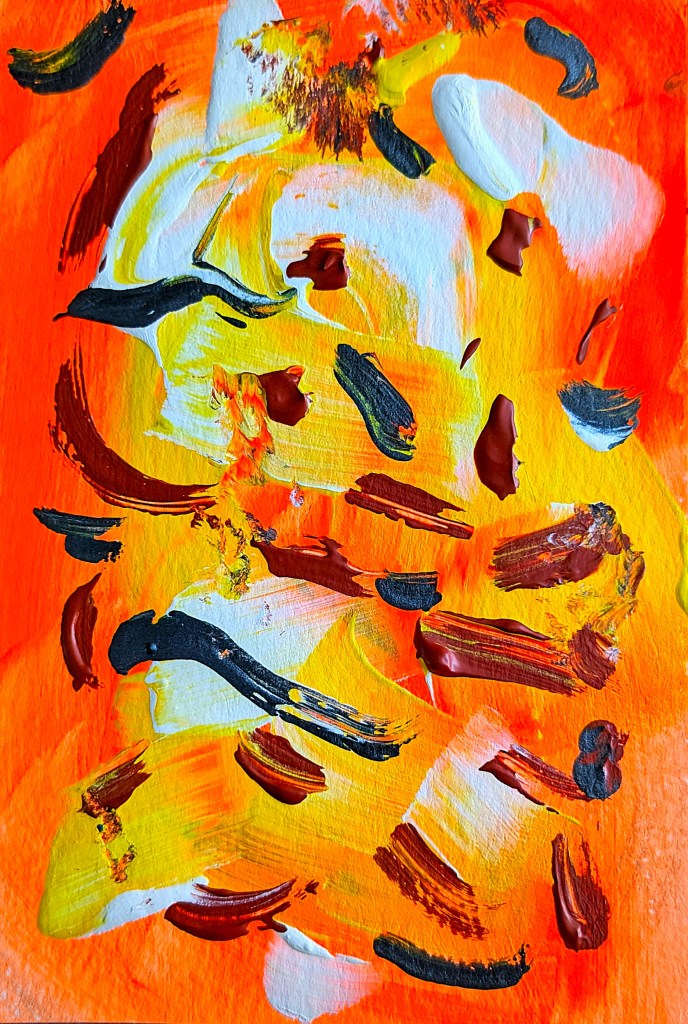
Avalanche
A single stone
starts the avalanche
The boy in the kitchen
bare legs held to the fire
‘this is what hell will be like’
The cupboard under the stairs
cold dark locked from the outside
an oubliette
the young boy left there
forgotten
Running upstairs
to safety beneath the bed
hands grasping at legs
and ankles
pulling him back down
for appropriate punishment
The belt the stick
the little red brush that cleans
the fireplace
with its foretaste of hell
beating battering
an avalanche of blows
the boy buried beneath them
Commentary:
Another unsigned painting by Moo. He told me that he calls this one Orange-U-Happy. Well, it is a happy painting, until you read the poem that goes with it and discover that all the stones of the avalanche are floating around in Moo’s painting, including a nice selection of sticks.
“Sticks and stones will break my bones, but names will never hurt me.” But names do hurt. Names can be cast like stones, and the thrown stone, like the spoken word, can never be recalled. Liar. Cheat. Thief. Little Lord Fauntleroy. Bite the hand that feeds you. Are you laughing at me? I’ll teach you a lesson you’ll never forget. I’ll shake you until your teeth rattle.
Stones can be thrown into ponds. When they are, the ripples reach out, spread further, spread far and wide. Thrown words can enter the soul, ripple through the blood, and they can lodge in heart and brain, forever memories that never fade and never fly away. Heart stones, they are, that strike at the stroke of midnight and leave the victim suffering, gasping for air.
So many silent memories, buried deep, only to rise and parade around in dreams at night, revenants come to haunt and hunt, sharp words made even sharper than flint or obsidian to cut and fracture, and splinter, and slowly, slowly wear down the prey. Words – the jaws that bite, the claws that snatch. Think twice before you throw, speak, wound, injure …. then think again, bite your tongue, stay your hand, drop the stone, think rather of the hand of friendship, of comfort, the feathered wing of the guardian angel that consoles and brings succor.
Succour (or succor in American English) means assistance or support given to someone experiencing grief or hardship. It is a formal, often literary term used to describe help that offers actual relief or comfort to people in difficult situations, such as disaster victims or those struggling emotionally – Wikipedia.
And remember – many words have double meanings – spare – to forbear: deciding not to hurt, destroy, or punish, such as “sparing the life” of a captive or sparing the the rod. Spoil – to indulge: to treat someone, such as a child or pet, with pampering. It can also mean treating oneself to a luxury or relaxing day.
So, what does spare the rod and spoil the child mean? Clearly it is a phrase with a double meaning. Choose which one you will. But remember – “Let us pray” is a better prayer than “Let us prey“.

