Ryan and Don Roger
10
Past Glories Restored
What is it about madmen like Don Quixote that they find it hard to live in the present and always want to see themselves restore past glories however impossible it is to do so? The search for the beauty and peacefulness of the past is always with us. Many seek the perfection of the Garden of Eden, but wise men know that Adam and Eve were expelled from the garden by an angel with a fiery sword, never to return.
Jorge Manrique (1440-1479) begins his Coplas por la Muerte de su padre with the statement that “a nuestro parescer, cualquier tiempo passado fué mejor.” / It seems to us that any past time was better. Why do poets and madmen always look back to the past, all too often with a view to recreating that which can never be recreated?
François Villon (1431 – 1463?) asks, in his famous refrain to La Ballade des Dames de Jadis – “Mais où sont les neiges d’antan!” / Where are last year’s snows! Indeed, the theme of ubi sunt / where is – where are is a constant throughout literature. And where is last year’s snow? Can you tell me? It certainly isn’t in our aquifer. I didn’t even use the snowblower last year. Tell me, where did the snow go? I live in Canada, and we didn’t see it. So where did it go?
Marcel Proust (1871-1922) searched for those lost times in his novel À la recherche du temps perdu. This can be translated directly as In Search of Lost Time. It also occurs, more poetically as Remembrance of Things Past. Unfortunately, the word Remembrance rather cancels out the idea of Search, not to mention the twin ideas of recalling and re-establishing. However, in the case of the madman, Don Quixote, it can be argued that all those meanings are correct. But what exactly does Don Quixote want to restore?
Above all, Don Quixote wishes to restore the lost age of knight errantry. He is besotted by the fantasy tales of these knights errant and believes that he can be one himself and restore their glory with the force of his arm alone. In DQI, II/2, The knight addresses the ‘ladies of easy virtue’ at the inn in these terms: “I beg you, ladies, not to fly, nor to fear any outrage; for it ill fits or suits the order of chivalry which I profess to injure anyone, least of all maidens of such rank as your appearance proclaims you to be.’ His language, which was unintelligible to them, made them laugh more. So, knights errant protect women, especially damsels in trouble, and women of easy virtue. That is one of their most important tasks.
In DQI, IV/4, our knight meets the boy, Andrés, who is being whipped by his master, the farmer. Don Quixote stops the thrashing and makes the man promise to pay the boy the wages that are owed him. The farmer promises to do so, but when Don Quixote leaves, he ties Andrés to a tree and whips him so soundly ‘that he laves him for dead.’ Protect the innocent, then, is another task, one at which Don Quixote fails miserably, as we will see later.
In addition to restoring the high ideals of the ancient order of knights errant, Don Quixote also wishes to keep the words and deeds of the ancient romances / ballads alive, and this he does throughout the book. His constant quoting of passages and deeds from the books of chivalry, those that have driven him mad, serves to keep them alive. As we said earlier, you can burn the individual books, and destroy them, but you cannot destroy the ideas they contain. Don Quixote, in his constant and lively embodiment of those books serves to keep them, and their ideals and ideas, vibrant in the eyes and the minds of the readers.
Cervantes, perhaps a wiser man than many, restructures the theme by rejecting it – no hay pájaros en los nidos de antaño / there are no birds in last year’s nests. However, as we shall see, it doesn’t stop Don Quixote the madman, from searching for the glories of past times and from fighting for them in an effort to restore them.
And don’t forget Guillaume Apollinaire (1880-1918), who perished in WWI – “Ni temps passés ni les amours reviennent / sous le Pont Mirabeau coule la Seine.” “Nor past times nor past loves return / beneath Mirabeau Bridge flows the Seine.”
Comment:
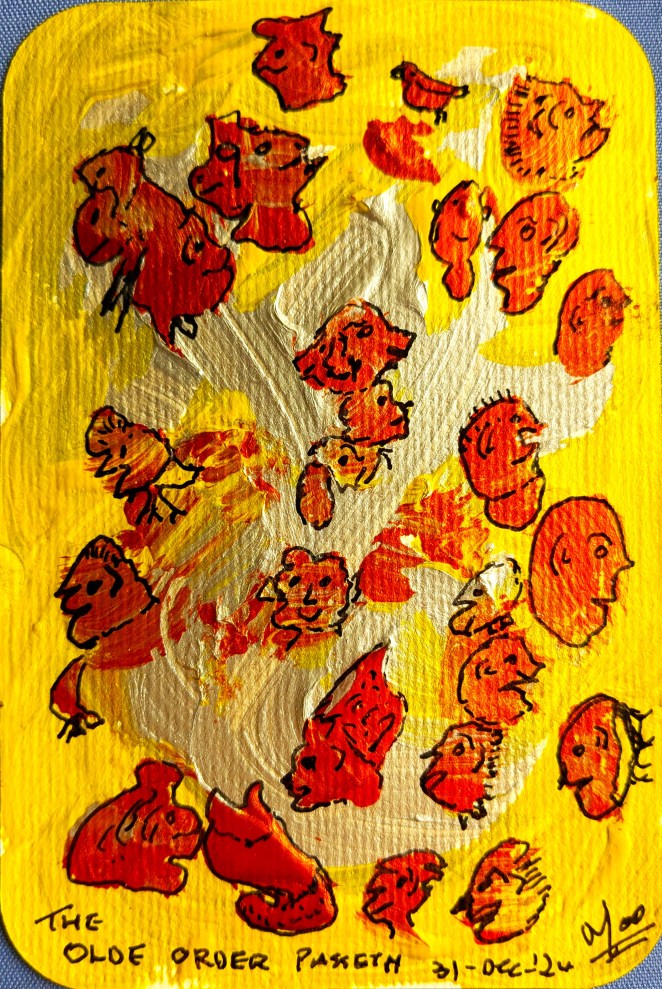
We don’t need a comment really except that The Olde Order Changeth Lest One Good Custom Should Corrupt the World. Interpret that as you will. And as Moo says to Ryan in the presence of Don Roger – “Hey, Ryan, look at all those changes in my painting.”
 rogermoorepoet