Black Dog

Black Dog

The black dog leaps out
of the grandmother clock
and lands on my back.

His paws grip my shoulders,
then rake down my spine.

I try to shake him off,
but he growls, bares his teeth,
and won’t let go.

I love that clock,
its Westminster chimes,
the Roman numerals
standing guard
over the pointed arrows
of the hands as they march
round and round.

But I hate the hound
that makes its kennel
in the clock, leaps out,
snaps at me, bites and claws,
and grinds me
down into the ground.

Comment:

The Black Dog was Winston Churchill’s name for the depression that came over him, and overcame him, from time to time. It used to attack me when I was a young boy living in Swansea. My grandfather would point at the clock and say “He’s in there. He’s coming for you. I can see him. It’s the black dog.” Well, that used to drive me crazy and whatever it was that set me off became twice as bad when the black dog arrived. Alas, now I am entering into my dotage and my second childhood, the black dog has re-appeared to trouble my waking hours. I guess it’s the mood swings. Happy one moment, miserable the next. The good dog appears. The black dog drives it away. Then the good dog reappears and all is well again.

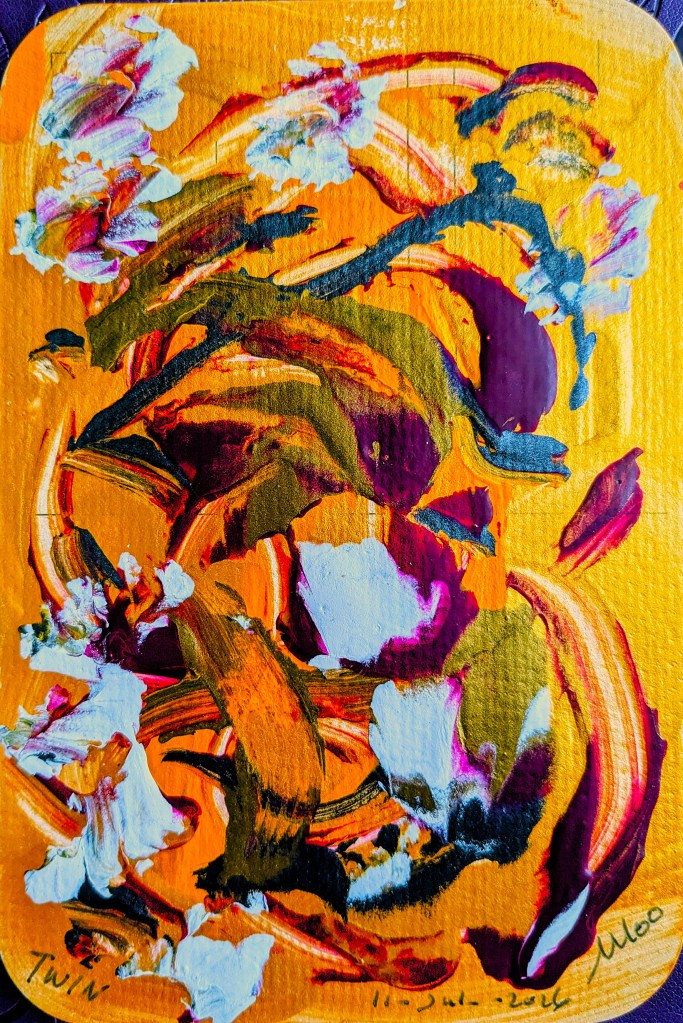
Moo understands me and my patterns very well. In fact he painted two paintings for me – Twin – the one above and Niwt – the one below. You can see evidence of the good dog and the black dog in each of them. But which is which?
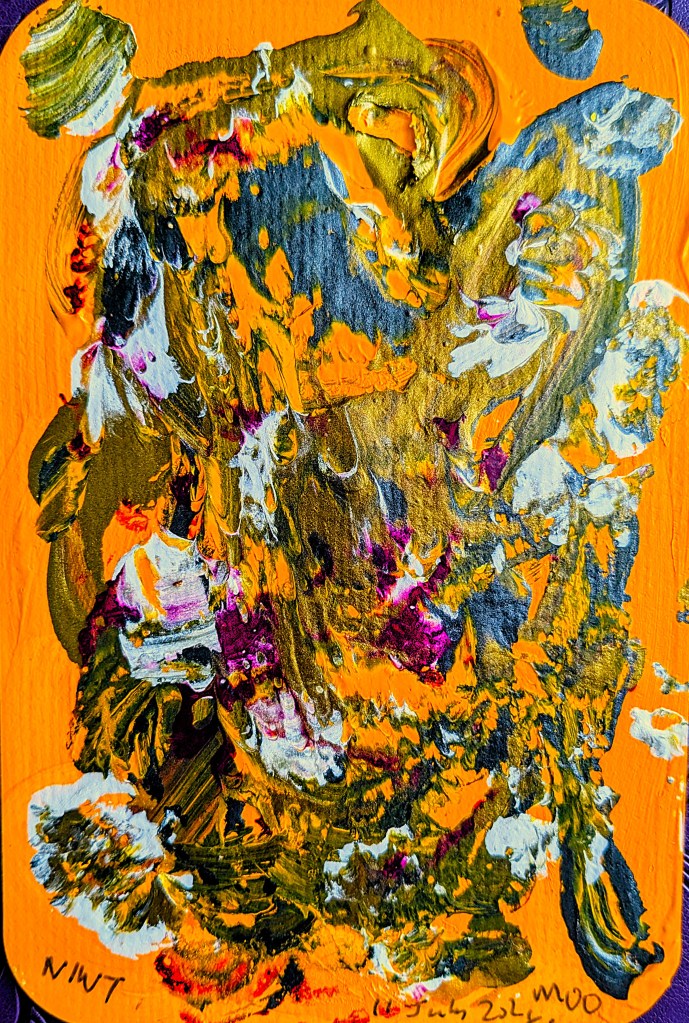
I’ll leave you to guess which is the good dog and which the bad one. Really and truly, they are two sides of the same coin – heads and tails so to speak. Moo tells me you can think of the paintings as a mirror image, one of the other.

It’s like mood swings – either my mind or my body flips the coin and one of the two dogs jumps out visit me. Luckily, after a bit, the good one chases the bad one away, so it’s all swings and roundabouts and all the fun of the fair. Until I fall off the Ferris Wheel or see my own shadow while riding on the Ghost Train.

Twin, of course, is Niwt backwards. Or is it the other way round. Dylan Thomas, my favorite Welsh poet, set the standard for word reversal. After all, the town of Llareggub is bugger all backwards. What fun we can have when we twist our words, double up on our language, reverse words and their meanings, and generally weave the tangled webs of linguistic double-talk. Oh the mystery of missed and mixed up meanings. But are meanings meaningful or meaningless? Now that is the question. And when you have answered it for meanings, start thinking about double-meanings and their twins – or should that be quadruplets?


Tomorrow’s Words

Tomorrow’s Words


belong to another day
another experience
a different thought set

tomorrow’s words
new leaves
drifting from the tree
bright-faced
kites on a wind
we have yet to know

mini-kites they fly
and our eyes
cling on to them
while we stand
tethered
here below

itinerant drifters
they will not stay
they just fly away
notes on a wind
words of a song

tomorrow’s words
tomorrow’s song
yet to be sung

Comment

Some time ago, Moo painted this painting – Ephemera he calls it. He wrote a series of thoughts – in poetic form – then covered them over with paint. “Everything,” he told me, “is transient. Ephemeral. The poems you write. The paintings I paint. All ephemeral.” “What does ephemeral mean?” I asked him. He gave me his Bad Hair Day Moo Grunt – “Go look it up,” he told me. So I did.

Ephemeral means lasting for only a very short time, fleeting or transitory. Derived from the Greek word ephēmeros—which literally translates to “lasting only a day”—it is often used to describe things like a beautiful sunset, a brief childhood emotion, or a flitting dream that fades in the morning light. The true essence of the word highlights the fragile, impermanent nature of life, trends, and experiences, serving as a poetic reminder to appreciate moments while they happen. Thank you AI and Wikipedia and anyone else involved. Alas, some citations are as ephemeral as words.

Moo’s painting links with several themes from antiquity. Carpe diem – seize the day. Make the best use of the time you have, for time flits by in the twinkling of an eye. Ubi sunt – the central theme of time past – ubi sunt qui ante nos in mundo fuere – where are they who lived in this world before us -. This is an age old question that returns via Gaudeamus igitur – a song still sung in some European universities at graduation time. It also occurs in Villon – Mais où sont les neiges d’antan? Where are last year’s snows. This is the version sung by Georges Brassens.

While the past slips rapidly away, like scenery viewed in the rear view mirror of a rapidly advancing car, the future is always before us. Yet, in many ways it is as ephemeral as the past and soon fades into that rearview mirror as we drive along our chosen paths. The words of yesterday have gone. The words of tomorrow have not yet arrived. We can only cling to the words that we speak and hear now. Catch them if you can. Savour them. They won’t last long.

Frustration

Hand holding pen above blank notepad with coffee cup and glasses on wooden table
A hand holds a pen poised to write on a blank notepad next to a coffee cup
AI generated

Frustration
A Jackpine Sonnet

Hand hovering pen poised
a black shadow hangs over
the blank page threatening
to erase any ink marks
that may emerge

Eyes and mind blank
no butterfly kiss delicate
in its touch of nib to page
a black cloud of nothingness
damns creativity at its source

Who can prise the worm
out from the chrysalis
gift wings to the pupa
change it from slug or snail
into that glorious moment
when sunshine’s beauty
stutters into fluttering flight

Comment:

The top photo, AI generated, was based on the wording of the poem. The bottom one was a Moo choice from his pre-painting selections when he claimed to be a photographer. I like both, but for different reasons.

The first one emphasizes the fear of the blank page, the blank canvas, the blank mind, the overnight snowfall that is awaiting its first foot or hoof print, its first instant of inspiration, its first splash of paint, its first letter or word. And yet, according to many with whom I have spoken, artistic creativity is one per cent inspiration and ninety-nine per cent perspiration. So, why hesitate? Get on with it. Make those first marks. Take that first step. And remember, even the longest journey begins with the first step.

The second photo expresses the duality of creativity. At the front end of the butterfly, its poised, fragile beauty. At the rear end, the fearsome face it assumes if approached in the wrong way from the wrong direction. Front end – the moment of creation. Rear end – the fear of that first step and the consequent sense of frustration.

So – at the moment of creating, we must consider several things – the fear of failure. But the only way to never fail is to never try. Each failure, however bad, is not a crime, it is a stepping stone on the way to ultimate success. The fear of the first step – this ties in with the fear of failure. Will we slip on the first damp stepping stone across the stream? How long will we permit our selves to search for a safer passage? Is there really a bridge around the bend, a bridge that will stop us from getting our toes wet? And what’s wrong with wet toes anyway?

When we dip our toes in the sea, we feel the cold of the water. When we take the plunge, dive in head first, we feel the full force of the ocean. And that ocean is the creative energy that yes, can sweep us away, can carry us up, can pull us down. Is that what we are afraid of, being overwhelmed by the creative powers within us? Of losing the meagre control we hold over our lives? I truly believe that in many cases it is just that element of being swept away by our own unleashed creativity that fills us fear. But if we never take that first step we’ll never know who or what we are, nor will we understand what we are afraid of, nor will we be able to conquer that fear and accept our creativity for what it is.

My Beloved

Pond covered with blooming pink and white water lilies reflecting sunrise and a small arched bridge
A serene garden pond with blooming water lilies under a soft sunrise sky
Image AI generated
based on poem

My Beloved

In my dream garden,
the early sun floats petals
across a lily pond.
Framed among lilies,
my beloved’s face drifts
through a watery space.

So sweet, her embodiment:
she lies languid among the lilies,
beside herself in bloom after bloom,
each flower gigantic in its frame
beneath a wooden footbridge.

I envision her as she was,
this lily who will toil not, nor spin,
 and who sighs with the morning breeze
 that ripples her smiling countenance
into a thousand fragments.

She lies cushioned amid the lily pads,
a work of wonder in liquid impressions
fluid in this fragmented light.

Comment:

I guess Moo will be pretty upset when he sees this AI generated painting of a lily pond. He offered me a couple of lovely paintings today, but they had no lilies in them, so I said “Thanks, but no thanks.” Oh dear. I hope I haven’t sparked another feud. I did ask him if he had some lilies, but he shook his head – “Sadly, no.” he said. “I don’t paint them. I’m Moo, not Moo-net.”

Speaking of Monet – a student once asked me what was the definition of Baroque. He picked a bad day. I was in joyful mood. “Baroque is when you’re out of Monet,” I told him. Dead silence. So I tried to explain. Baroque / Broke — Monet / Monnaie / Money. Then he let out a long, low whistle. “Is that why they pay you the big bucks?” he asked me. Well, I didn’t really get big bucks. But at least I had tenure – the monkeys rhymes it with manure in the Monkey Temple. I guess we’ll stay well clear of that one. Ain’t no lilies in that old temple pond.

“What’s yellow and deadly?” “I don’t know,” says Moo. “Shark infested custard,” I tell him. “Why don’t you try painting that. You could add some false teeth and a few streaks of strawberry jam.” O

“Okay,” said Moo. “You asked for it. What’s black and blue and lies face down in the gutter?” “I don’t know,” I replied. “Please enlighten me.” “You, if you keep telling jokes like that,” he pulled a paint brush out of his pocket and shook it in my direction. Very threatening.

“I’ll tell you a better one,” I said, smiling, “here – what’s got four legs, sits in a kennel, wags its tail, and barks?” He looked at me for a few seconds then said hesitantly, “A dog?” “Oh dear, sorry,” I frowned at him, “it’s an old joke. You must have heard it before.”

Green Banks

Green Banks

An empty shell I am
the sea sound swishing
when you hold me to your ear

Pwll Ddu and pebbles
Swansea Sands
their fishnets glistening
with golden day stars

Brandy Cove
ever-changing after
winter’s storm surge

Fisherman’s Point
early evening
when dog-fish bark

Pyle Corner
cows in the lane
quick to kick
high the five barred gate
we climb
to avoid them

Rats
in the rubbish dump
grey bodies
scuttling claws

Green Banks at last
home of our summer
sky cloud castle dreams

Comment:

Have you ever held an empty sea-shell to your ear and heard the sea’s soft sighting sound? I used to collect them from the sands, hold them to my ear, and listen. The best shells left you with the sigh and sound of sea and waves moving with a magic that sounds eternally. These I would take home and listen to them in winter, or at boarding school, when I needed such beauty to keep me alive and sound in heart and mind.

Sure I was a dreamer. But oh what dreams and how they have followed me step by step, town by town, country by country. And now they gather here, in Island View, and let me know that within my mind the dream world of memory is immense but I can still capture it and hold it to my heart.

Funny how things come back to me.

1. Taste – and I there at Eynon’s in the Uplands, where I first tasted crempogau, Welsh pancakes. They changed into the Crêpes Suzettes I tried in Cassis-les-Calanques, all soaked in Grand Marnier.

2. Touch – damp wood beneath the hand takes me to boarding school where the walls sweated and the bannisters gleamed in foggy weather. There, in the Vale of Severn, damp mornings were the warm. I also remember the touch of hot air, breathed into my shirt, to keep me warm.

3. Smell – the scent of things burning, burnt porridge particularly, drifting down the drive, and driving through the tree mist and into my nostrils.

4. Sound – so many songs take me back to the places where I used to sing them. Sometimes they attached themselves to a family member, though I didn’t understand how or why those associations were made, not until much, much later.

5. Sight – put them all together and you can see those memories surging out of the mists in all five forms.

Have you tasted sea mist on your tongue? Have you touched the dampness of your jersey when you cycle down Painswick Hill in the mist? Have you caught the smell of wet wool, mist moistened, and clinging close? Have you heard the rustle in autumn when the November mists wrap themselves around ghostly trees and the dry leaves rattle like bones? Have you seen long dead mist warriors rise up from the ground at Badbury Rings or atop Maiden Castle, or on Cley Hill, or Westbury White Horse?

Time and tide wait for neither man nor woman. And memory’s mists do not wait either. they rush in, like angels, and foolish is the the man who refuses to meet them, eye to eye, tongue to tongue, nose to nose, finger to finger, ear to ear – in all their mystical mist-filled glory.

No Man’s Island

No Man’s Island

It’s so easy to lose
our true selves
or to be carried along
by the flow of another’s
rhetoric because we
no longer possess
(or never had)
that inner conviction
that makes us different.

That’s why we must join hands
and link together:
a chain of bridged
and ferried islands
to insulate us
against our loneliness.

Comment:

I first published this in 2017 with the title Islands – I have changed the title, very slightly, to move closer to John Donne’s No Man is an Island. What I have noticed more and more recently is how we tend to isolate ourselves. Birds of a feather flock together – true – and nowhere truer than in this bloated Soccer World Cup with its 48 teams to be expanded next time, 2030, to 64 teams, unless we have 64 teams in 2028, because this circus demands to be offered more frequently so it can make even more money … or is so that more teams can compete in the final stages. Remember – the finals are meant to be the ultimate challenge – the best 32 teams in the world – until Quatar (2022) 42 teams and now USA (2026) 48 teams.

Il gruppo della morte – remember that? It’s when three top teams were drawn together in a group of four – and one of them was doomed not to get out. Didn’t happen this time. No gruppo della morte this time – 24 top teams all got through, and the next eight third best place finishes. There were some very one-sided games. And there were many games in which one team parked the bus – all ten players inside their own penalty area and no way to get through. This led to some very negative defensive football. And don’t forget that terrible off-side law – no portion, not a hair or a fingernail of the attacking player could be seen on the – bow your heads in submission – Video Assisted Referee’s screen. And how far back do you go when searching for that minor infringement that will disallow whatever happened to whomsoever it happened to?

Before the days of the electronic spy in the sky, the rules of rugby were fairly straightforward. “The referee is the sole judge of fact and of law.” In addition, in those days, the advantage needed to be immediate. No five minute wait while the players bang away at the goal line from the one yard until an infringement takes place, the attacking team fails to score, and we all go back to the original infringement. And no five minute wait while all the moves leading up to the try are checked and double checked so that there are no imperfections. For those without memories – check the Barbarians versus New Zealand in Cardiff, way back when, in 1972 or 73. Look at those high and dangerous tackles leading up to that wonderful Gareth Edwards try. Guess what? That try would never have taken place with a VAR check for dangerous play.

Writing these words, I feel myself to be isolated. A man with a memory who has been left out in the cold by a world that has moved on and left him behind – with all his beautiful memories. “See that house?” My grandfather asked me, when I was an avid collector of autographs. “Knock on the door and ask for the autograph of the man who lives there.” I did. He was old. He was asleep. Leave the book. He’ll sign it when he wakes up. And he did. I have the book here in the house and the autograph standing in isolated glory in the middle of a page. W. J. Bancroft – aka Billy Bancroft. “Who’s he?” you ask. Well, just go and look him up. You may be surprised at what you find down memory’s lane where my grandfather and I wandered hand in hand all those many years ago.

As for Moo’s painting, he calls it Craters with Creatures. But I call it In search of times past. Look closely. You can see many of them within the picture’s frame and they are all searching for something they have lost and would desperately love to cling on to.

Enigma Variations

Enigma Variations

Our world is spinning on its edge, placed on
the perimeter of space, going who knows where.

Specks of dust, we float around and contemplate
night’s wonders wondering what might happen.

Out there, in the vastness that surrounds us,
worlds without end will never know we existed.

Bleak and blank our names, our deeds, our status,
the monuments sometimes raised in our praise.

And what of our thoughts, those sparks
of electricity that link us mind to mind?

Is each of our actions determined by a dance
performed by circling planets that shape us?

Are we nothing more than a code
of virtually meaningless dots and dashes?

Are we then pinballs bouncing between
a million trillion strings of flashing lights?

What star god plays trivial games of snakes
and ladders with our lives and names?

Commentary:

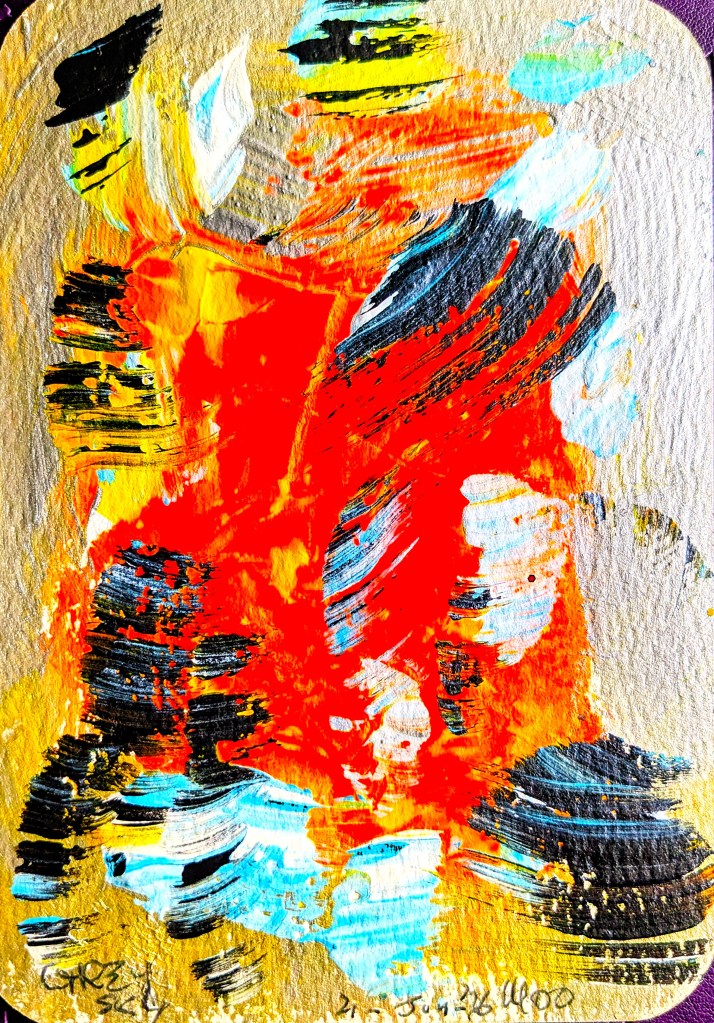
Moo’s painting is called Grey Sky with Bear Claws. He thinks it is a great companion to the poem. Actually, I rather think he likes to have his paintings published online without the necessity of lifting a finger to help. Oh dear – he heard that and just lifted his middle finger in my direction. “I am helping,” he said. “I also lift paint brushes. Remember that, you philistine.”

Philistine? Me? Now why would I be a Philistine? And what is a Philistine anyway? That’s where AI comes in. Thank you, Don Ryan. I wouldn’t know about AI without you. “And you wouldn’t know about painting without me,’ says Moo. “So tell me what a Philistine is,” I said to him. “Go look it up,” he scowled, wagging that finger in a menacing way. So I did.

AI to the rescue. A philistine is a person who is hostile, indifferent, or smugly oblivious to art, culture, and intellectual pursuits. The term typically describes someone whose interests are purely materialistic and practical, lacking any aesthetic refinement or appreciation for high culture.

Well, I don’t think that’s fair. Let’s see – hostile, indifferent, or smugly oblivious to art – no, that’s not me. I love Moo’s art, and he knows I do. I am not hostile to it at all, though I might be just a little teeny weeny bit hostile to him when I think he is lazy and doesn’t appreciate me. More – someone whose interests are purely materialistic and practical, lacking any aesthetic refinement or appreciation for high culture – no. I refuse to accept that. Purely materialistic? I give my poems away, free of charge, to my friends and anyone else who wants to read them. Moo isn’t materialistic either. He gives his paintings away to his friends. I know he does, because I have seen him do it. Come to think of it, I don’t think either of us is practical. We wouldn’t be living in Penury if we were.

Sorry. I won’t go any further. That’s all Isle of Wight Ferry, as they say in Hampshire. Well, I won’t call you a Philistine if you don’t know what they say in Hampshire. Okay – here goes. “What’s hot, black and smelly and comes steaming backwards out of Cowes?” Why, it’s the Isle of Wight Ferry, of course. Well, it was until they replaced it with a hovercraft. Now the joke [Cowes, the port / cows] doesn’t work any more. So, here’s a couple of questions at Philistine 100 level for you – (1) What have Margo and Reg got? If you don’t know, you’ll have to ask Stomping Tom Connors. And (2) what did Reggie give to Margo? Okay, okay. I give in. I’ll tell you.

Answers – (1) Margo’s got the Cargo and Reggie’s got the Rig. (2) A cowsy dungsy clock, of course. Made only in Canada. And you can check that one on AI too. And look up the song on YouTube while you are at it. Canada Day – July 1 – and Stomping Tom Connors is one of the best adverts for Canada. Go, check out his songs.

Railway Station 2

Railway Bridge

1

walking away
from Swansea sands

me crossing the bridge
shaking sand
from my sandals

a rare event
Swansea Bay Station
Cline Valley Line
a train at the platform

the station master
blows his whistle
doors close
slowly the train goes
under the bridge

I stand in a cloud
wrapped up
half-blinded
in huge puffs of smoke

filling my lungs
assaulting nostrils and eyes
with the sting of cinders
the stench of burning coal

sting and stench
and that short sharp whistle

they linger and cling
unforgettable
in my mind’s dark corner

Railway Bridge

2

walking away
from Swansea sands

me crossing the bridge
shaking sand
from my sandals

a rare event
Swansea Bay Station
Cline Valley Line
a train at the platform

the station master
blows his whistle
doors close
slowly the train goes
under the bridge

I stand in a cloud
wrapped up
half-blinded
in huge puffs of smoke

filling my lungs
assaulting nostrils and eyes
with the sting of cinders
the stench of burning coal

sting and stench
they linger and cling
unforgettable cobwebs
in my mind’s dark corridors
and never forget
that short sharp whistle


Comment 1:

Me and my writing buddy also discussed linked poems. This is simply a chain in which each poem links back to another one. Yesterday, we wrote about Swansea Sands and how the poem was generated. Today we can look at the linking between that poem and this one, the old railway bridge that crossed the railway lines by Swansea Bay Station, and led back into Swansea, a town in those days, and the Civic Centre. Note, now, that each of those names could generate further links, further poems in the chain.

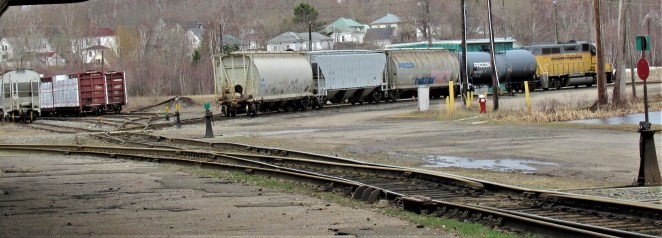
When we think of the great chain of being, we think of how all things are linked. From the Great Western Railway (GWR), to the Mumbles Railway, to the Cline Valley Branch line, and beyond. Each poem a railway station along the way. Main line, branch line, express train, goods train … links everywhere, and each link encapsulated in a memory of one kind or another. How could we not write poetry about such things?

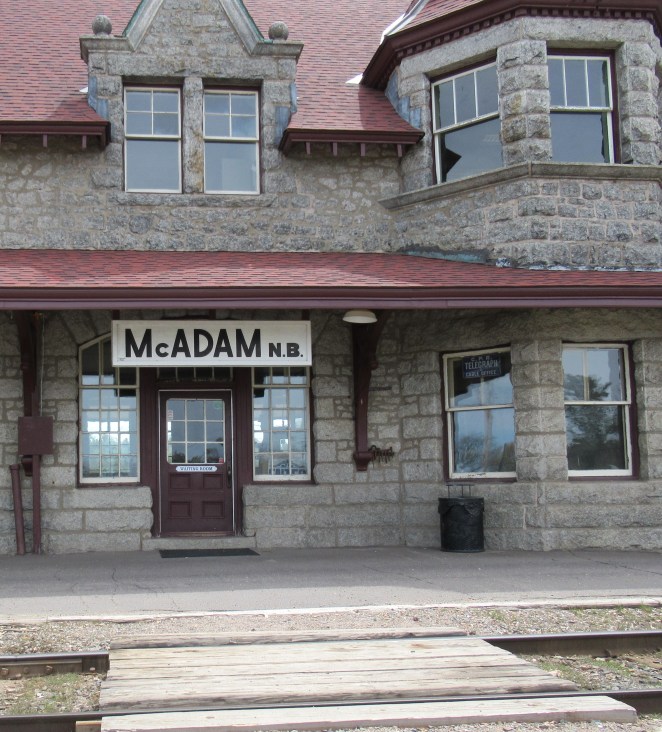
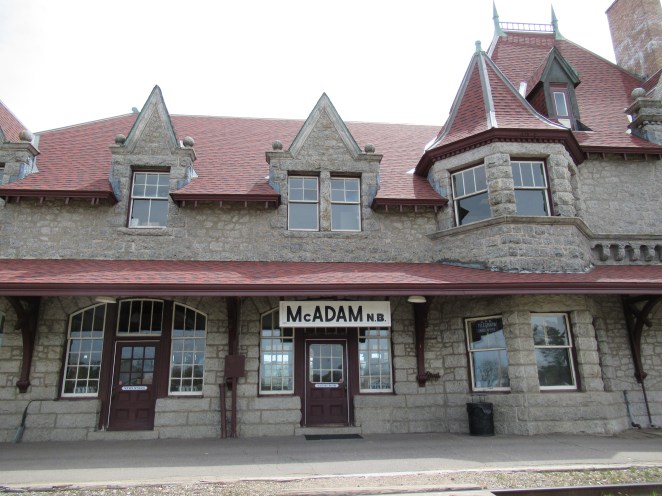
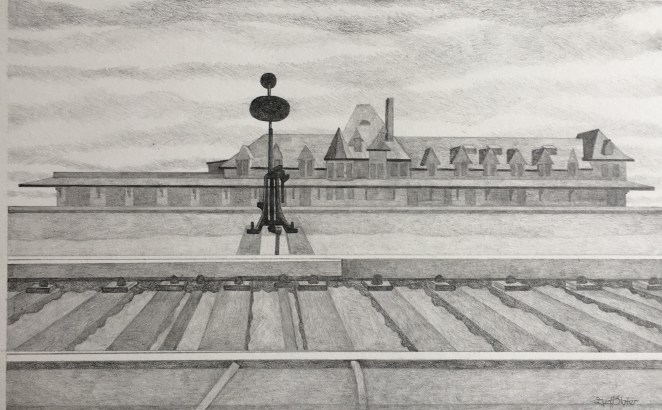
McAdam Railway Station, in New Brunswick, Canada. 60 trains a day used to stop here. Now the station is a landmark, a memory, a place where ghost trains run and shadowy figures run wild up and down the grass grown tracks where the sleepers sleep, their dreams undisturbed. I could write a book of poems about this station. Wait a second, I already have and Geoff Slater, my painting buddy, decorated it for me with his wonderful paintings and drawings. What more can I say? Each link in the chain, a potential poem. Each stop along the way, material enough for a painting, a poem, or a book.

Comment 2:

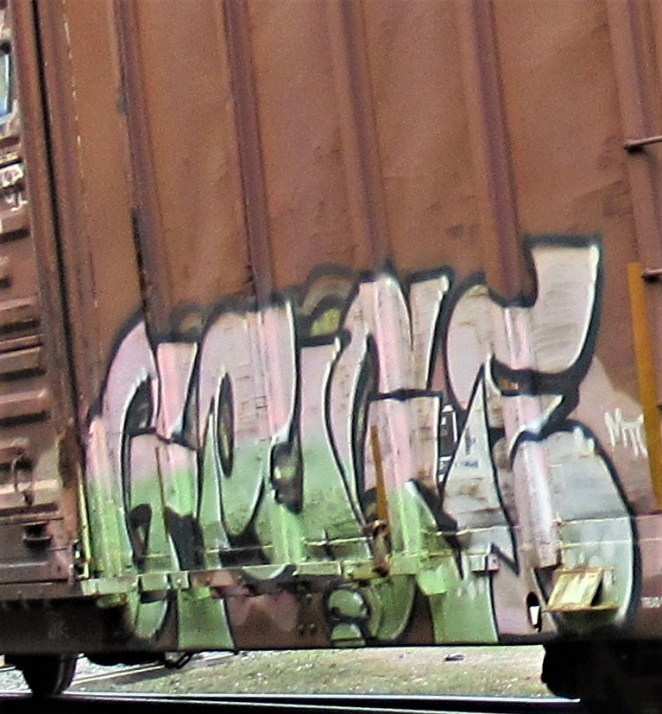
So, what happens when we change the photo? What if we add a branch line or two to the original poem? How does this affect our idea of creativity, poetic creativity? What happens when we add a different sketch from my painting buddy’s wonderful set of drawings? Oh-oh, that’s not my painting buddy – that’s a set of graffiti on a passing railway car. Sorry, painting buddy, please forgive me. But hey, wait a minute – de gustibus non est disputandothere is no arguing about taste. Somebody painted that box car and enjoyed doing it. Where does art begin? Where does it end? How formal can it be? How informal? How many railway stations do we stop at? I guess it depends on the length of the journey. But one thing I know, don’t get off the train until you reach your destination!

Railway Bridge

Railway Bridge

walking away
from Swansea sands

me crossing the bridge
shaking sand
from my sandals

a rare event
Swansea Bay Station
Cline Valley Line
a train at the platform

the station master
blows his whistle
doors close
slowly the train goes
under the bridge

I stand in a cloud
wrapped up
half-blinded
in huge puffs of smoke

filling my lungs
assaulting nostrils and eyes
with the sting of cinders
the stench of burning coal

sting and stench
and that short sharp whistle

they linger and cling
unforgettable
in my mind’s dark corners

Comment:

Me and my writing buddy also discussed linked poems. This is simply a chain in which each poem links back to another one. Yesterday, we wrote about Swansea Sands and how the poem was generated. Today we can look at the linking between that poem and this one, the old railway bridge that crossed the railway lines by Swansea Bay Station, and led back into Swansea, a town in those days, and the Civic Centre. Note, now, that each of those names could generate further links, further poems in the chain.

When we think of the great chain of being, we think of how all things are linked. From the Great Western Railway (GWR), to the Mumbles Railway, to the Cline Valley Branch line, and beyond. Each poem a railway station along the way. Main line, branch line, express train, goods train … links everywhere, and each link encapsulated in a memory of one kind or another. How could we not write poetry about such things?

McAdam Railway Station, in New Brunswick, Canada. 60 trains a day used to stop here. Now the station is a landmark, a memory, a place where ghost trains run and shadowy figures run wild up and down the grass grown tracks where the sleepers sleep, their dreams undisturbed. I could write a book of poems about this station. Wait a second, I already have and Geoff Slater, my painting buddy, decorated it for me with his wonderful paintings and drawings. What more can I say? Each link in the chain, a potential poem. Each stop along the way, material enough for a painting, a poem, or a book.

Swansea Sands

Swansea Sands

walking home
over the railway bridge

sand in my hair
sand in my socks

sand in my sandals
sand like sandpaper
sanding me down

tides rise and fall
sea gulls call
the bay so big
and me so small
as tiny as a tiny
grain of sand

Comment:

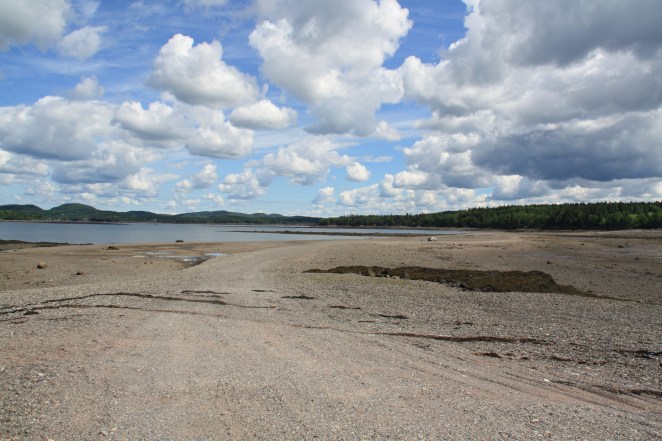
Not Swansea Sands at all, sorry. But a sandy beach all the same, here on the southern shores of New Brunswick, down by St. Andrews. The theme of the poem comes from Blake’s ‘to see the world in a grain of sand’. It might not be Swansea Sands, but there’s a great deal of sand down on the southern shores of NB. I worked on this poem with one of my writing buddies, who visits me regularly. We shared an impromptu creative writing session over the kitchen table in Island View a couple of days ago. Alas, as you probably know, there are no islands in Island View, and there’s not a grain of sea sand in sight. So we improvised.

We started with a central idea – a grain of sand – and from there we talked about how to generate a poem, from scratch so to speak, in three steps.

(1) The first draft.

Write as it comes to you – just write. Just bounce from word to word, line to line, like a supercharged, literate budgie. Take about 3-4 minutes for this. Then read it aloud to partner / writing buddy, checking on sound and rhythm.

(2) Second draft.

– Eliminate words and ideas that do not fit the central image. Remove anything loose or unclear. Then read it aloud to partner / writing buddy, concentrating on sound and rhythm.

(3) Third draft.

Polish and finalize the poem. Sometimes a fourth draft is needed, but in this case we settled with the third draft. At this stage, pay careful attention to the poem’s ending (closure is always difficult). Reorder, add, and polish, as necessary. Then read it aloud to partner / writing buddy, checking on sound and rhythm.

From the initial image – to see the world in a grain of sand – I generated two poems. My partner / writing buddy generated a short story that would fit into their current sequence of childhood memories. Other ideas for further poems also came through.

Conclusions;

  1. Make your poems alive, make them personal, make them an experience! 
  2. Remember rhythm. And never forget the necessity of a live reading or series of readings in which you can feel and hear the words.
  3. An alterative to a live reading with a partner / writing buddy is to record your own voice. The recordings can then be sent to friends who can comment on them.