Hunt the Author

Open book with labyrinthine paper structure and calligraphy designs
A fascinating labyrinth constructed from the pages of an old book, showcasing delicate calligraphy and illustrations.

Image generated by AI

Ryan and Don Roger

7

Hunt the Author

            We have already seen what type of games can be played with numbers. Now we shall look at a different type of party game – hunt the thimble or the slipper turned into hunt the author. Where is the best place to hide a tree? In a forest. What is the best place in which to hide a book? In a library. What is the best place to hide a needle? In a haystack. What is the best place to hide an author? In a book, of course.

How does this affect our understanding of Don Quixote? Well, we are about to find out. But first we must ask the question, why would we want to hide an author in the first place? The answer to this is quite simple – to avoid punishment from the Spanish Inquisition, or any other authoritarian institution that wishes to ban books and punish authors for writing them. The best way to do this is to not put the author’s name on the book. Thus, Lazarillo de Tormes, said to be the first picaresque novel, was written by Anonymous. And when you check your history of literature, you will find that a great many books and poems have been written by that gentle person. Person, because being anonymous, we have no idea if he was a he or she was a she!

But who is the author of Don Quixote? Miguel de Cervantes, obviously. Who, then, is the narrator of the story? In the first sentence of the book, this first-person narrator reveals himself ‘in a village in la Mancha that I do not wish to name – de cuyo nombre no quiero acordarme / whose name I don’t want to remember – in the original Spanish. A little later, DQI, II / 2, in an effort to distance himself from the text, our first-person narrator states that ‘There are authors who say that the first adventure he met was that of the pass of Lapice. Others say it was the windmills. But what I have been able to discover of the matter and what I have found written in the annals of La Mancha …”

So, we have our first-person narrator, but he is not creating this story, not at all. We know from 4 – Stage to Page, that our narrator borrowed the idea for this first sortie from El Entremés de los Romances. Now he tells us that multiple authors have written about Don Quixote and his adventures and that there are some discrepancies about what was his first adventure. Our narrator also tells us that he has researched the matter and found his account in the annals of La Mancha. Interesting. Annals, multiple writers, and our narrator is a historian who has researched the matter. What do we find when we hunt the author? Not one author, but multiple authors and a reference to accounts of the matter contained in the annals of La Mancha. Once again, AI comes to my rescue – “Synonyms for annals include historical records, chronicles, archives, journals, and registers. These terms refer to chronological accounts or records of events, often in yearly order, documenting the history of a person, organization, or era.”

            Curiouser and curiouser! Historical records – chronicles – archives – journals – registers -documenting the history of a person – what price creativity? No single slipper, then, at this hunt the slipper party, but a multiplicity of slippers, just like the Easter Bunny lays a multiplicity of eggs at Easter and hides them round the house. So much for the needle in the haystack – some haystack this.

Censorship

Person in a black hoodie with face covered and mouth taped shut at sunset.
A hooded figure stands with a taped mouth in this powerful depiction of silenced expression.

Image generated by AI

Ryan and Don Roger

6

Censorship

            Censorship plays an important part in many societies and can take multiple forms. The Spanish Inquisition, for example, along with book burning, played a powerful role in the printing industry. Every book had to be examined and approved by a member of the Inquisition. Political correctness is itself a form of censorship. It encourages people to think about what they say and how they are saying it. Many sorts of political correctness arise from the feminist movement that began to question the male domination of the English language. Actors and actresses became actors. In cricket, wicket-keepers, bowlers, and fielders passed the linguistic test, but batsmen and batswomen became batters. I sincerely hope that glove men, for wicket-keepers, do not turn into glove persons.

            Nowadays, some people feel that the correction of language has gone too far and this has resulted in the anti-woke movement, as it is called. This rejects both the correction, and the hyper-correction, of what some people call imbalances in language, culture, and society. I will self-censor myself, rather than being censored by another person or persons, and refrain from what I personally feel about these ideas. Here, I merely point out that they exist.

            Lazarillo de Tormes, for example, was heavily censored by the Spanish Inquisition. All anti-clerical references in the original edition, and there were many of them, were removed. The resultant volume, heavily redacted and much smaller, became known as Lazarillo Castigado / Lazarillo chastised.

            To the best of my knowledge, the only piece removed from Don Quixote was the episode in which he made a rosary from the tail of his shirt, by tying ten small knots in it, and one large one. Since the shirt tail was used for many purposes, including wiping oneself, the censor thought this idea was indecent. Cervantes replaced the shirt tail with ten acorns and a chestnut in later editions.

He also managed to escape censure by placing all his questionable statements in the mouth of a mad man. Whenever an anti-clerical comment was made, readers (and listeners, for in those days, not everybody could read), chuckled at the enormity of the statement and rejoiced in the fact that only a madman could say such things.

            Together with censorship comes correction. Thus Sancho, who is illiterate and can neither read nor write, is also unable to spell. In this fashion, he offers a series of incorrect pronunciations and phonetic equivalents that Don Quixote joyfully and carefully corrects. We see this in other characters too. In DQI, VII or 7, the devil named by the housekeeper, becomes ‘the sage Muñaton’ in the mouth of the niece. Don Quixote changes this to ‘Freston’. The housekeeper continues with ‘Freston’ or ‘Friton’ and adds “I know only that his name ended in ton.”

            In our modern society, I see an enormous change taking place. Where I was educated by reading books, many books in my case, today’s younger generation teach themselves via AI and Chat. They watch videos. Watch TV. Text on cell phones. They listen to multiple podcasts. All this is audio-visual, little of it is written down. As a result, essays I received from my students were filled with phonetic spellings of words that they had heard, but not seen in written form. In addition, schools are no longer teaching cursive. My grand-daughter can print. She can neither read nor write joined letters. However, she can text faster with her two thumbs than I can with my index finger! The new generations have entered an electronic world that is totally alien to me.

            Quis custodiet ipsos custodies? Who shall guard the guards? Who shall police the police? Who shall program the programmers? And with what shall they program them? A long time ago, the BBC in England banned Sesame Street because it was too simplistic. Today, Sesame Street equivalents rule. So, let us extend our questions – “Who shall censor the censors?”

            Sometimes, it takes a madman to do it, in our case, a madman called Don Quixote! He, in his madness, encourages us, nay (or as Rocinante might say ‘neigh!’), he forces us to re-examine our links to language, to reality, to illusion. Reading his text, we learn to ask questions of the world around us. How many of our realities are illusions? How many of our illusions are corruptions of reality? How many times has Don Quixote been banned by figures in authority because of its attacks on authority?

            Quis custodiet ipsos custodies? Who shall guard the guards? Who shall program the programmers? “Who shall censor the censors?” And who will protect us if we speak truth to authority, and authority doesn’t like the truths we offer? The author of Lazarillo remains anonymous. Cervantes distanced his words from himself and put them in the mouth of a madman. Other people have taken evasive action in other ways.

The alternative – stay silent and bleat with the sheep – “Four legs good! Two legs bad!” And when the Mastiffs with their spiked collars come for us, we can always, like the sheep, change our chant. “Four legs bad! Two legs good!” After all, all sheep are equal, even when some sheep are more equal than others, and all of us can imagine we are animals on George Orwell’s Animal Farm – and then we can say what we want and nobody will listen, nobody will pay attention, and nobody will understand. And remember, somebody, somewhere will want Animal Farm banned. And 1984.

Book Burnings

Hooded figures holding torches surround a bonfire of burning books and scrolls.
A group of cloaked figures stands in a dimly lit stone courtyard as they burn ancient scrolls and books in a large central fire.

Image generated by AI


Ryan and Don Roger


5

Book Burnings

            In 1492, the Spanish Jews were given the choice of conversion to Catholicism or of being expelled from Spain. Many chose to leave. Those who converted, and remained, were kept under constant supervision. In an effort to stamp out their faith, their books were condemned to the flames by the Spanish Inquisition. A similar burning of the books in Don Quixote’s library occurs in DQI, 6. Is book burning effective? Some people think so. Other people aren’t so sure.

            The Spanish conquest of Mexico, led by Hernán Cortés, concluded on August 13, 1521, when Spanish forces and their native Tlaxcalan allies captured the Aztec capital of Tenochtitlan and emperor Cuauhtémoc, marking the end of the Aztec Empire and the beginning of Spanish colonial rule. The country was then called New Spain. 

Mexico is famous for its codices. These are fan-fold picture histories, drawn on vellum covered with gesso, of tribal conquests, social norms, tables of the gods, in fact a whole cultural and historical record of pre-Hispanic Mexico. The Zouche-Nuttal codex, for example, sets out the conquests of Ocho Venado / Eight Deer, nicknamed Garra de Tigre / Tiger Claw, a Mixtec warrior, who lived between 1063 and 1115. Five of the Mixtec codices survive. Many, many more were burned. The cover of the Vindobonensis shows the burn marks where some daring person pulled the codex from the flames and saved it. Without such saved codices, we would have much less knowledge of pre-Hispanic Mexico.

            Why is this anecdote important? Because prior to the invention of printing, in 1474, manuscripts were written by hand. Yes, some were copied, but many copies were single and unique. Burn the manuscript, destroy the knowledge it contains. Post 1474, with the printing of multiple copies of books, the individual book might be destroyed, but some books would survive from the printing sequence. Apply this to Don Quixote’s library and we note several things. First, Don Quixote’s copies are destroyed. Second, other copies of his books survive elsewhere. In addition, although Don Quixote’s books are burned the ideas in those books survive in the knight’s head and he lives by their rules. Those ideas are spread throughout the history of his adventures to everybody with whom he comes in contact. Conclusion – you can destroy the books. You cannot destroy the ideas that those books contained.

            Ray Bradbury, in Farhenheit 451, describes the burning of books in his dystopian novel. 451F incidentally is the temperature at which paper burns. The books are burnt in Bradbury’s world, but the book people survive. The book people are those who memorize their books and are able to quote them from memory and pass them on orally to other people.

            And people protect their books. How? By placing them in small rooms within their houses and walling up those rooms so that the books could not be found. This happens in DQI, VI – 6. Don Quixote awakes, goes to find his library, but it has disappeared. The housekeeper swears that a sage enchanter descended on a dragon and the library vanished in a puff of smoke. Don Quixote believes the metatheatrical lie and acts as if it were the truth. He then bemoans the fact that he is pursued by malignant sorcerers. These evil enchanters will pursue him throughout the novel whenever he wakes up from his illusions and is faced by reality. Clearly, the sage enchanters have robbed him of his moment of glory (illusion) and reduced him to sorry (the truth).

            Curiously enough, a 16th Century walled-up library was found in a house in Barcarrota, Spain not so long ago. The books were hidden, probably from the Inquisition, so that their owner could escape prosecution. The discovery sheds light on how individuals hid literature from the Inquisition during the 16th century in Spain. It also illustrates how closely Cervantes followed the reality of his times when writing the Quixote.

            You can destroy books. But it is very difficult to destroy the ideas they contain. In this fashion, although the burning of that one book ends the life of that particular volume, it rarely ends the life of the ideas contained within its covers. We might not recognize the names of the characters that Don Quixote quotes from his memory of those histories, but many of the people who encounter the knight during his adventures know them and remember them. Amadis of Gaul is never dead, not when his name lives on. The same is true of King Arthur and his Knights of the Round Table. King Arthur is said to fstill be alive and can be seen in the shape of a White Crow, bran gwen, in Welsh. And even Walt Disney knew, and profited from, the legend of the sword in the stone.

We will also see, as we continue our journey, that in the same way that tall oaks grow out of small acorns, large parts of later events found in the Quixote already have their seeds sown in these early chapters. Metatheatre, illusion and reality, authorship and censorship, truth and falsehood, waking events and dream sequences – and that is just the start.

The Numbers Game

Ryan and Don Roger

3

The Numbers Game

            The numbering of the chapters in Don Quixote is also interesting. While Part I and Part II often retain the Latin numbering, the chapters themselves can be found both with Latin Numbers and standard numbers.

            Latin numbers are based on six letters I, V, X, L, C, D and M. Each has its own value. I = 1, V = 5, X = 10, l = 50, C = 100, D = 500, M = 1000. Most have us have seen Roman numerals on clocks and we are familiar with the numbers from 1-12. I, II, III, IV (4, that is to say one before five), V, VI (6, that is to say one after five), VII, VIII, IX (9, that is to say one before ten), X, XI (11, that is to say one after ten), XII.

            This paradigm governs Latin numbers. XV = 15, XX = 20, XXX = 30, XL (ten before fifty) = 40, L = 50, LX (ten after fifty) = 60, LXX = 70, LXXX = 80, XC (ten before one hundred) = 90, C = 100, CX = 110. The date of my writing this MMXXVI (2026). You will have noticed similar numerical configurations on books and old movies.

            The ancient Celtic numbering system was based on the digits of hands and feet. Counting sheep, for example, or goats, shepherds and goatherds would count up to twenty on their toes and fingers. Then they would carve a notch in a piece of wood. To keep score was to score the notch.

            Something similar happens in Basque jai alai, the happy game.  The scorers score in groups of IIII which they then made into 5 with a line through the numbers IIII. Four groups of 5 made 20 and the 21st notch won the game. That scoring method may have changed, but it is certainly how I learned to score the game in the Basque country (Spain) back in the 1950’s. Curiously, modern French shows the vestigial remains of this – quatre-vingts. Welsh shows a somewhat similar diversity because the Welsh word for twenty is ugain – although it’s technically not the only one, with the alternative dau ddeg (literally two tens) becoming more and more common. A case of plus ça change, plus c’est la même chose.

            And we must never forget the old sterling system of the United Kingdom of Great Britain and Northern Island. £. S. D. aka pounds shillings and pence. 4 farthings = one penny, 12 pennies = one shilling, 20 shillings = one pound.

Our good friends on AI came to our aid with this one. I quote – The pre-decimal British currency system, known as £sd (librae, solidi, denarii), consisted of 12 pence in a shilling and 20 shillings in a pound (£), totaling 240 pence per pound. Used until Decimal Day on February 15, 1971, this system featured various denominations, including farthings, sixpences, florins, half-crowns, and crowns. What about a guinea you ask? Well. That was £1 and 1 shilling. Hence the auctioneer’s delight.

            “What am I bid”?       >         “£20.”             >          “Guineas!”

Our trusted friends on AI sum it up this way – “A guinea was a British gold coin minted between 1663 and 1814, officially valued at 21 shillings (£1.05 in decimal currency) from 1717 onwards. It was the first machine-struck gold coin in Britain, typically worth slightly more than one pound. While no longer in circulation, it is still used in horse racing and some luxury auctions to represent £1.05.”

Luxury auctions – I love that phrase. And here we must leave our luxurious description of, and adventures into, numbers in Don Quixote! Just look where the journey has led us. And remember, in the same way that Cervantes inserted short stories, both spoken and read, that digressed from the main narrative, we can also insert such mental rants and ramblings into our own narrative. And we shall continue to do.

Here’s one, for example. How do you count goats in Wales? Click on these links for two examples. Counting the Goats traditional and Counting the Goats modern. Of course, wrth gwrs, the simplest method of all is to count their legs and divide by four! Try doing that with Latin numerals!


Riding Buddies – Reading Buddies

Ryan and Don Roger

1

Riding Buddies – Reading Buddies

            Don Quixote makes three sorties. The first is very brief, about five chapters. The second is much longer. And the third is 74 chapters in length. Each sortie is different. For now, I would like to take a brief glance the difference between Sortie 1 and Sortie 2.

            Sortie 1 – Don Quixote sets out on his own. He travels to an inn, has adventures there, gets knighted by the inn-keeper, albeit falsely, and after an unequal combat in which he is bruised and battered, he is brought back home by a neighbor.

            When the inn-keeper asks Don Quixote for payment, the knight replies that knights errant do not carry money with them, nor do they pay for their food and lodging. The inn-keeper recommends that Don Quixote find a squire to attend, one who can carry the money and the other things that a knight needs. Our knight takes this recommendation to heart.

            Sortie 2 – In this second sortie, Don Quixote has a companion. One of the main differences between the first and second sorties is that the knight now has a squire with whom he can talk. This dialog between knight and squire, master and servant, is key to the understanding of the novel.

            Their contrasting points of view, Don Quixote literate, a believer in reading, with a firm belief that all books of chivalry are true, contrasts immediately with the illiterate Sancho, his squire. Where Sancho sees reality – the windmills are windmills – Don Quixote sees illusion – the windmills are giants, waving their arms, and threatening to attack. This is a simplistic summary, but we will leave it there for now.

            Graham Green understood the nature of dialog when he penned his novel, Monsignor Quixote. In the film, available free of charge on YouTube, the Catholic Priest (now a Monsignor) and his friend, the Communist Mayor (now defeated in an election and unemployed) leave the little town in which they live, and set out on a journey of adventures, much in the same way that Monsignor Quixote’s namesake sets out in Cervantes’s novel.

They do not have a horse and a donkey. However, they do have Monsignor Quixote’s car, nicknamed, of course, Rocinante, in which to travel. The key to Green’s novel is the constant dialog between the mayor, knowledgeable in the ways of the world, and Monsignor Quixote, innocent of the world outside his church and full of illusions about the reality of that world. It is easy to think of them as riding buddies who converse.

            So, what is a reading buddy? Well, Don Quixote is a long book, over 1000 pages, with 127 chapters. Many readers set out in search of adventure, but do not keep reading. However, a wise reader will set out on that journey with a reading buddy, who will travel with him, step by step, chapter by chapter. Each will keep the other company, and one of the delights of the journey will be the constant conversation between the reading buddies.

            I am Don Roger. My reading buddy is Ryan. I am short and stout. Ryan is tall and thin. We have reversed the Sancho / Quixote image, but we are both equally insatiable in our search for knowledge. The curious thing is that I have read Don Quixote 28 items, mainly in Spanish, but also in English and French. Ryan is reading it for the first time, but he is an expert in AI access and is helping me to understand the wily ways of that electronic world of short cuts. Of course, it helps you to sort the chaff from the grain when you know what you are looking for and just use AI to refresh your fading memory!

            I am full of the illusions of the academy. Ryan reads with a sharp mind, a keen wit, and no illusions at all. He sees only the reality of what is there. Together we have embarked on a journey that is in the process of opening our eyes to two different realities his and mine – Ryan’s and Don Roger’s. The conversations that we are having along the way, will be the subject of this little discourse on Cervantes’s novel.

Rage, Rage 2 & 3


Rage, Rage
2

These problems start the day
you realize you are alone.
Your beloved goes away,
for a holiday,
to be with your daughter
and grandchild.

Now the house and the cat
are yours, and yours alone.
No problem you say and
everyone believes you.

You jumped in the car,
drove daughter, and child,
holidays done,
to the airport.

Your beloved went with them,
her holiday about to begin.
And that’s when it all began.

3

When I come back home
from leaving them at the airport,
the front door stands open.

I thought I had closed it
when we left.
I tip-toe in and call out
“Is anybody there?”

Echo answers me –
‘… there, there, there …”

Commentary:

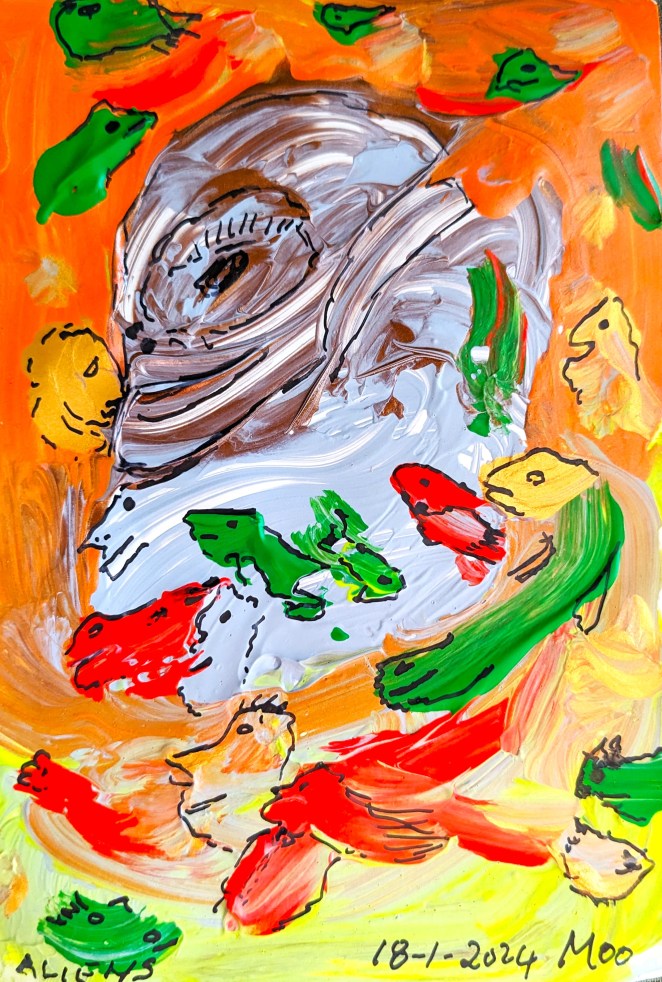
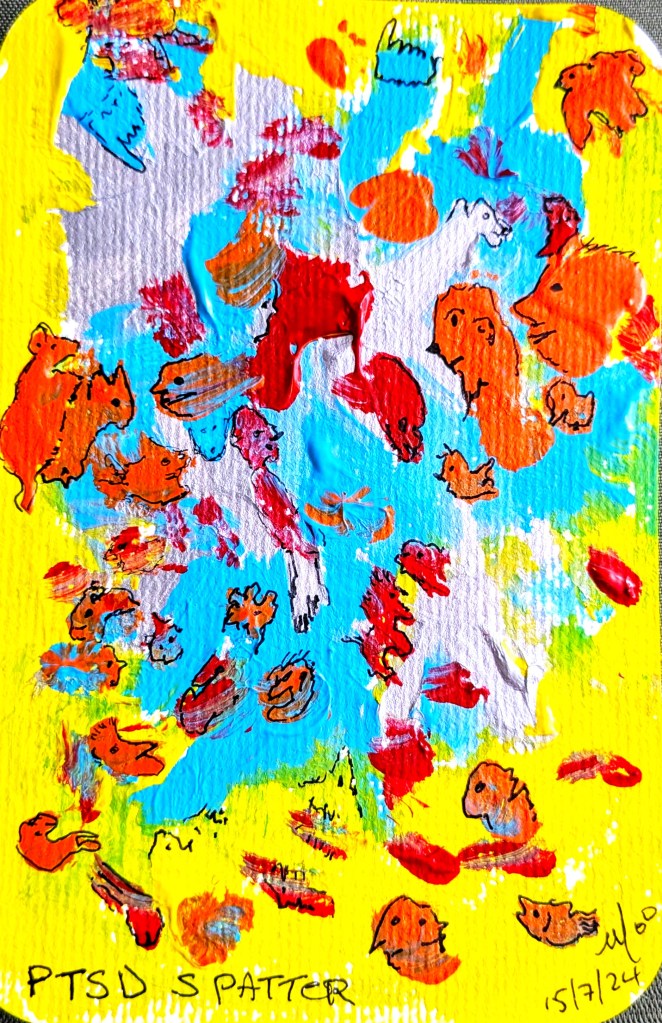
Raymond Guy LeBlanc, one of my favorite Acadian poets, published his poetry book, Cri de Terre, in 1972. My painter friend Moo, who also likes Acadian poetry, borrowed the title and changed it slightly when he painted this painting – Cri de Coeur. Earth Cry / Heart Cry.
What is all creativity, visual of verbal, but a cry from the land or a cry from the heart? Sometimes it is more than a cry – it becomes a clarion call, a shout out, a calling out.

So many of us are born with creativity in our hearts. So few of us carry that creativity, be it verbal or visual, into the adult world, a world that all too often grinds us down and sifts us out. We become grey people in grey clothing sitting behind grey desks beneath artificial lighting, doing grey jobs that slowly turn us into nine to five (or longer) dusts.

Moo has promised me a series of red paintings for this sequence. We shall see how he does. Red for anger, red for age, a red flag for danger, a red rag to wave at the raging bull of life, to provoke it, then bring it under control.

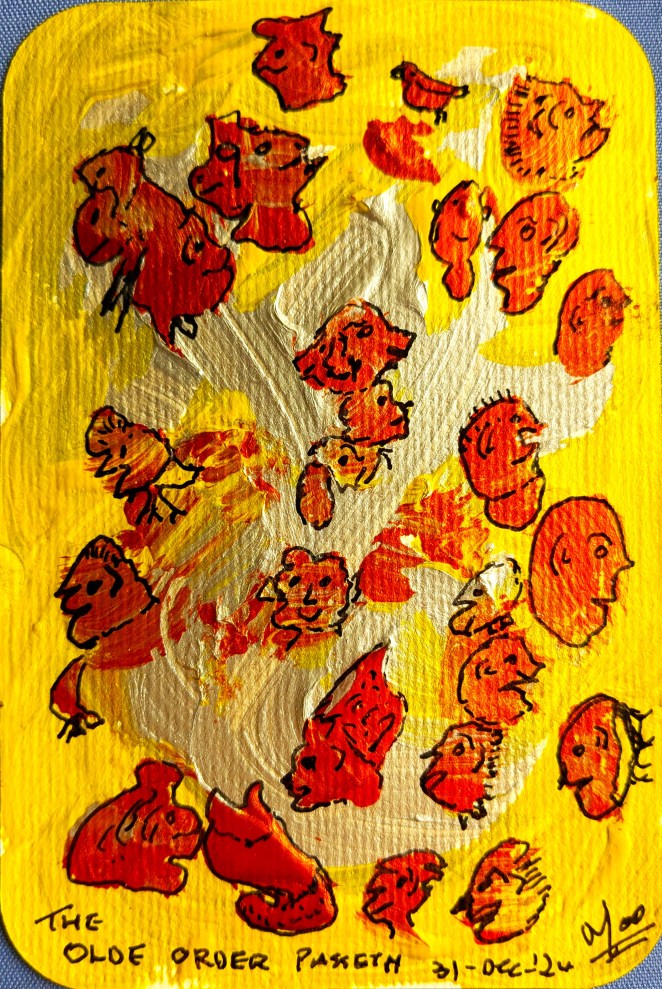
Nadolig Llawen – Welsh for Have a Joyous Festive Season. You can add other languages, as you wish. But above all remember Pedro Calderon de la Barca’s words – “Life is a dream and dreams are nothing but dreams.” One day, we shall all wake up. Artists and dreamers, grey ghosts and people of straw and dust.


Carved in Stone 16 & 17

16

The Bulls of Guisando,
pre-historic, unweighable,
the bearers of Roman graffiti,
itself two thousand years old.

Were they carved as boundary markers,
or designed to designate pastures,
for horses, pigs, sheep, and bulls,
all grazing in their stone dreams?

Celtic, pre-Roman,
they speak to my Welsh blood,
and to the Irish soul
that will always be a part of me.

I place my hand
on the dimpled granite hide
and feel time coursing
beneath the stone skin.

Granite ships,
islands in a sea of time,
I sense a heart beating,
something surviving
within the stone.

17

We are powerful people,
we creative artists,
we carvers of stone,
we dreamers,
whether we dream
by day or by night.

Those of us
who dream by day,
often see our day-dreams
come true.

Commentary:

“Those of us who dream by day, often see our day-dreams come true.” Lawrence of Arabia – The Seven Pillars of Wisdom. You recognized the quote of course, wrth gwrs. Intertextuality, the weaving of words through text after text in different combinations according to our time and space. Some of us think we are original, but there are only so many plots to a play, 24 or so, if I remember my Aristotle correctly, and I have changed the number, just to test you. Oh ye of too much faith!

We think we are original, but, as Picasso said, the painters of the cave paintings, all those many years ago, created everything we artists could ever dream of. We all borrow in one way or another and originality is merely a disguised form of borrowing. The faces change, the actors change, the medium changes, the times change, but otherwise, everything else is the same. Sad, really, that we should claim originality (and fresh water) for all that water that has passed under so many bridges.

Welsh blood and Irish soul – not even original, but shared by so many in my family. Add an English education, studies and residence in Spain, France, Mexico, Canada, and the USA, and what do you have? An intellectual mongrel, that does not know its own mother, like so many other mongrels, and that shakes its coat only to shed so many multi-cultural and multi-lingual fleas.

And remember – “Great fleas have lesser fleas upon their backs to bit them, and lesser fleas have smaller fleas, and so ad infinitum.” Intertextuality – they were only playing leap-frog and one jumped over and another jumped over someone else’s back.

On Loneliness

Loneliness

58 What relationships have a positive impact on you?

I think one of my poems answers this question best. I write “one of my poems” but it is really my ‘free’ translation of one of Francisco de Quevedo’s sonnets – Retirado en la paz de estos desiertos. I have changed the poem slightly, but I am sure Don Francisco (1580-1645) will excuse Don Roger’s impoverished effort (2023).

On Loneliness
29 December 2023

Resting in the peace of these small rooms,
with few, but welcome books together,
I live in conversation with my friends,
and listen with my eyes to loving words.

Not always understood, but always there,
they influence and question my affairs,
and with contrasting points of view,
they wake me up, and make me more aware.

The wisdom of these absent friends,
some distant from me just because they’re dead,
lives on and on, thanks to the printed word.

Life flits away, the past can’t be retained.
each hour, once past, is lost and gone,
but with such friends, I’m never left alone.

And there are so many of those literary friends. I still read Rudyard Kipling and I have just finished Kim, Captains Courageous, Stalky and Co., Puck of Pook’s Hill, and Rewards and Fairies. I read these first when I was nine or ten years old, and I return to them regularly. Other friends include Garcilaso de la Vega, Fray Luis de León, St. John of the Cross, Quevedo, Góngora, Calderón, Miguel de Unamuno, Antonio Machado, various members of the Generation of 1898, the majority of the poets from the Generation of 1927… and these are just my Spanish literary friends. I have French friends, English friends, Anglo-Welsh friends, Canadian friends, Mexican friends, and, in translation, many, many more. My relationship with each of these friends has had an impact upon me.

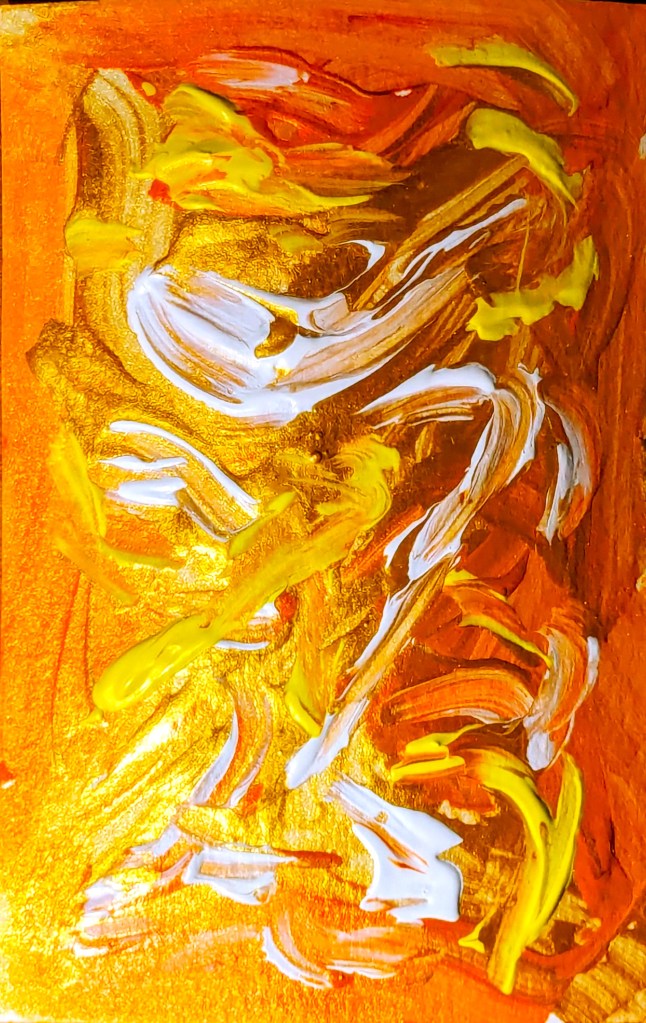
A recent painting, by my friend Moo, is called Fiat Lux – Let There Be Light. It is reminiscent of Dylan Thomas’s poem, Light breaks where no light shines. Intertextuality – Quevedo drew inspiration from the Stoics. I drew inspiration from Quevedo. Moo drew inspiration from Dylan Thomas. The nature of creativity, and its continuing links throughout the ages, shines clearly through these wonderful associations. Long may they continue, and may others enjoy them and be influenced by them as much as I have.

Comment:
The funny thing is that I do not remember writing this blog prompt, nor do I remember having translated Quevedo’s poem into English. I wonder how many other forget-me-nots there are out there. Or, to be more precise, in my books and in my notes. A treasure trove – that’s my guess. Borges wrote of Quevedo that he was more a library than an author, and I am beginning to think that way about my self. A strange world, this, one in which the creator abandons, and then forgets, his creations. Perhaps we should change the image – not so much a library as an orphanage, and so many lost and abandoned orphans wandering around The Little World of Don Rogelio.

The Book of Everything

Discourse Analysis
and
The Meaning of Meaning

Words have dictionary definitions that allow us to agree on what they mean. In this fashion, when I say ‘my grandmother’, you automatically know that I am referring either to the mother of my mother (maternal grandmother) or the mother of my father (paternal grandmother). This is the dictionary meaning of the word ‘grandmother’.

But words have lives of their own, and their meaning changes when used by individuals. You, the reader, never knew my grandmothers. You never will. They both passed away a long time ago. I loved them both, but for very different reasons, and to me they were as different as different can be.

This means that when you, the reader of these words, reach the word ‘grandmother’, the faces you see, the emotions you feel, the memories conjured up by that word are totally different from mine. Same word, same dictionary definition, different personal memories, experiences, relationships. In addition, the role that our grandmother(s) played in our lives will be very different too. That role may vary from culture to culture, from language to language, and from the social structure of the changing society in which we live.

For example, when I first went to Santander, Spain, I visited a family who lived in a large, detached house that contained three generations of the family – grandmother and siblings, father and mother, grandchildren, and an assortment of aunts and uncles. No need for babysitters in that household. Everybody had a vested interest in the development of the young ones and the older ones received tender, loving care, twenty-four hours a day, every day of the week.

I lived from time to time in the same town as my own grandparents. I saw them regularly, but rarely on a daily basis. When my parents sent me to my first boarding school, age six (if I remember correctly), I lost contact with my family. My paternal grandfather died when I was away at school. My maternal grandmother died while I was away at school. My paternal grandmother died when I was living in Spain. My maternal grandfather died when I was living in Canada. Alas, after those early years, I scarcely knew them. My experience, then, was so different from that of other people.

When I moved to Canada, the Atlantic Ocean separated me from my parents. My daughter, born in Canada, grew up with no close knowledge of her grandparents. The word ‘grandmother’ did not mean the same to her as it did to the grandchildren in Santander, or to me. How could it? All those miles between the families, and visits limited to a couple of weeks every other year at best. Although the dictionary meaning is always the same, what a difference in the emotional meanings for each person using that word.

Discourse Analysis, the way I use it, builds not on the dictionary meanings of words, but on their emotional and personal resonance. I take the standard, dictionary meaning of words, twist it, look for meanings at different levels, and then build an alternative narrative on that changed meaning. I have great fun doing so.

Part of that verbal fun comes from my childhood. I listened to Radio Shows like The Goon Show and Beyond Our Ken. Giles’ Cartoons gave my names like Chalky White, the skeletal school teacher, or Mr. Dimwitty, a rather dense teacher in another school. These shows also twisted the meaning of words and drew their humor from such multiple meanings. The Goon Show – “Min, did you put the cat out?” “No, Henry, was it on fire?” Or on an escaped convict – “He fell into a wheelbarrow of cement and showed every sign of becoming a hardened criminal.” Or from Beyond Our Ken – “My ear was ringing. I picked it up and answered it. ‘Ken here, who am I speaking to?’ ‘Larry Choo.’ ‘Ah, Choo.’ ‘Bless you, Ken.’ Verbal scenes like these – it’s hard to get visual pictures from listening to the radio – remain engraved in my memory banks. More than engrained, they become part of the verbal system from within which I write.

This system includes Direct Discourse, Indirect Discourse, and the Twisted Discourse of an Inventive Mind that still wishes to create. It also comes from Francico de Quevedo’s Conceptismo, from Ramón del Valle-Inclán’s esperpento, and from certain aspects of Albert Camus’s Theory of the Absurd, all blended with the poetry of Jacques Prévert and the songs of Georges Brassens. This from the latter – “Tout le monde viendra me voir pendu, sauf les aveugles, bien entendu.” Everyone will come to see me hanged, except the blind of course.

This is not always easy humor, nor is it a comfortable way to see the world. But it is a traditional one with a long literary history. The title of my book goes back to Francisco de Quevedo, of course, who, in 1631, in Madrid, published El libro de todas las cosas y otras muchas más / The book of everything and a lot more things as well. Don Roger turns to his good friend Don Francisco whenever he needs a helping hand.

The pieces themselves were first published on my blog rogermoorepoet.com. They have been revised, and I have added some more pieces in a similar vein. Tolle, lege – Take and read.  Above all, enjoy this world of mine, with its subtle and not so subtle humor, its sly digs at many of our follies, and its many forms of creativity.

The Book of Everything
and
a little bit extra

Click on the title to purchase this book.

Silence

Silence

Pain stops at the edge of silence
and silence is the sound of sunlight
breaking against the walls of the room
in which I sit and listen, in silence,
waiting for the notes to begin again.

Silence, yes, yet my silence lies broken
by the renewed intrusion of the clock,
by the electric hum from lights and heating.

Ghostly noises break into my thoughts:
cheers from a distant tennis court,
those eternal advertisements
that invade my innermost being.

What triviality now shatters
the Messiaenic mood that wrapped me
for a moment in a many-colored cloak
woven from musical oblivion.

Time’s teeth start to gnaw again
and the grandfather clock
nibbles at my soul, extracting
its essence in a surge of sound,
tick-tock, tick-tock.

Westminster Chimes choke
life from the hour and ring
the tick-tock knell that files
my life away, second by second,
minute by minute, day by day.

Comment:

Silence is the fifth poem in the first sequence (Crystal Liturgy) of my poetry book Septets for the End of Time.

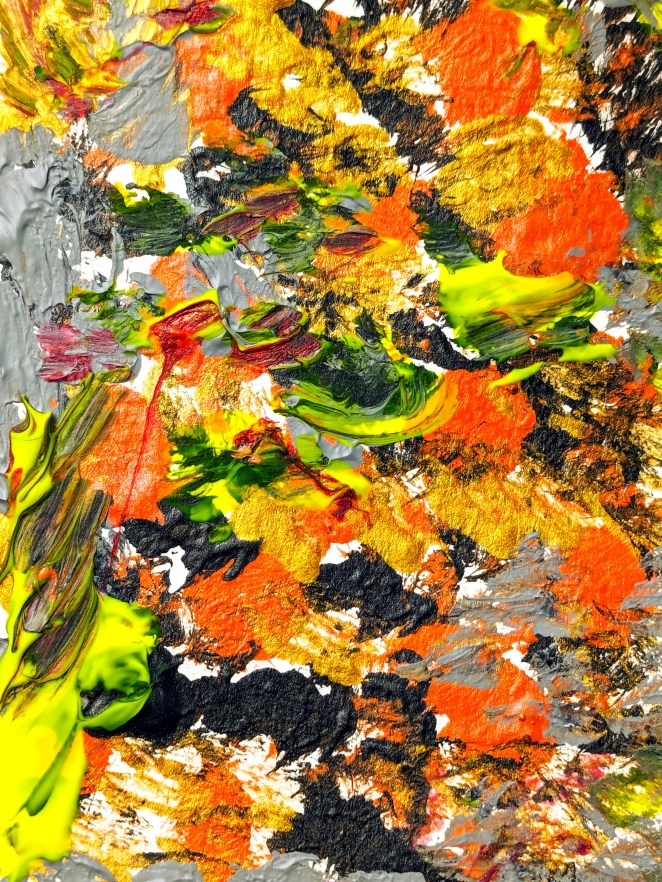
“So,” said Moo, “today I offer this painting where the title, Sound of Silence, fits well with the title of your poem. That said, I am not sure that the painting itself, qua painting, is as suitable as earlier pairings. De gustibus non est disputandum / there is no arguing about taste. I guess you either like something or you don’t.”

“It certainly isn’t in your usual style. In fact, it looks more like a colored pencil sketch than a painting. Where did you draw the title from?”

“Actually, it’s from one of your poems about Avila, in Spain, the city where, or so they say, you can hear the silence. You complained about all the noise that you found, especially the church bells, in that otherwise silent city.”

“Ah yes. I remember that poem. And I’ll never forget the sound of the bells echoing from wall to wall in those narrow, medieval streets. Bells from all the churches inside the walls of the city, tolling at exactly the same time, calling the faithful to prayer.”

“And that is one of the differences between us that I mentioned yesterday. My paintings, whatever they depict, are always silent. I have heard you read your poems out loud on Spotify and I have also heard other people reading them on your behalf, not always successfully. Poetry is designed not only to be read silently, but also to be read out loud, before an audience. Painting, on the other hand, is always silent. It does not speak, nor can it be heard. A painting is just there, in two dimensions, powerful, if you are lucky, weak and wobbly if the artist does not fulfill his task.”

“Interesting, dear Moo. And the images that I draw from Messiaen’s music are interesting too. For musical notes, without words, change into images within the listener’s mind, and then, when heard by the poet in me, become verbal images upon the page. Fascinating.”

“It is. Some time soo we must talk about intertextuality, the ways in which one artistic form or text can influence another. Hopefully, you’ll find a poem and I’ll find a painting that illustrate just that.”