Tomorrow’s Words

Tomorrow’s Words


belong to another day
another experience
a different thought set

tomorrow’s words
new leaves
drifting from the tree
bright-faced
kites on a wind
we have yet to know

mini-kites they fly
and our eyes
cling on to them
while we stand
tethered
here below

itinerant drifters
they will not stay
they just fly away
notes on a wind
words of a song

tomorrow’s words
tomorrow’s song
yet to be sung

Comment

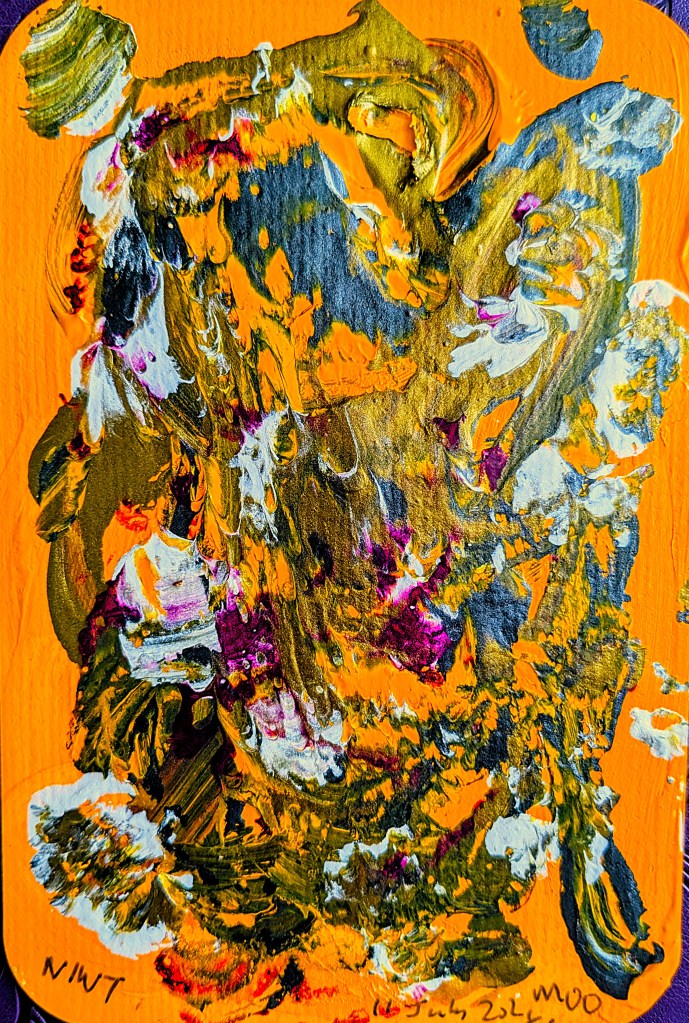
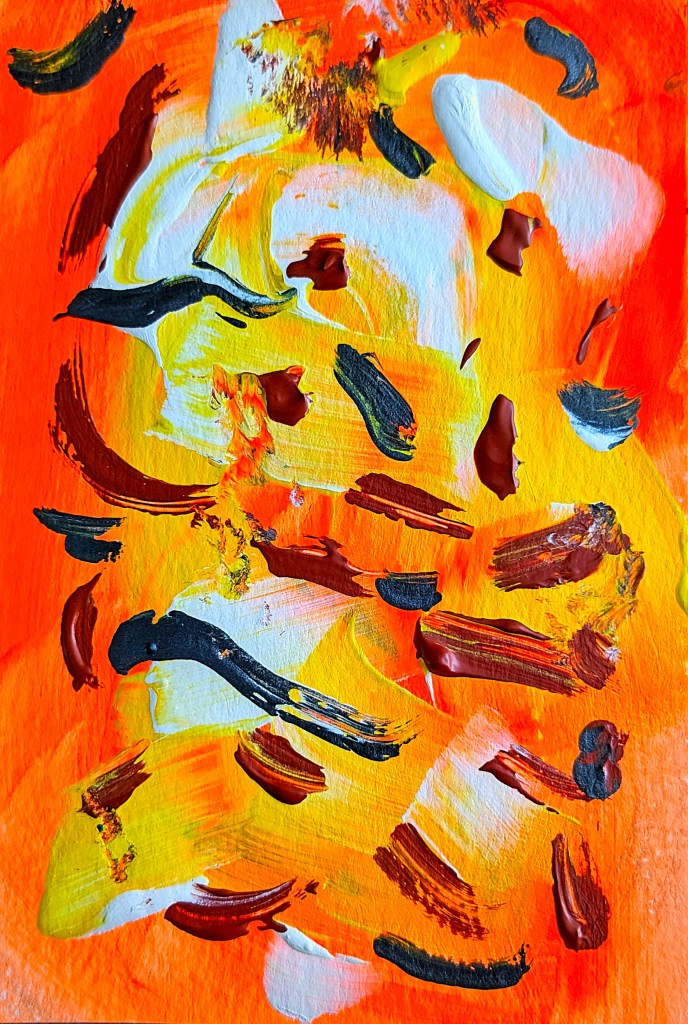
Some time ago, Moo painted this painting – Ephemera he calls it. He wrote a series of thoughts – in poetic form – then covered them over with paint. “Everything,” he told me, “is transient. Ephemeral. The poems you write. The paintings I paint. All ephemeral.” “What does ephemeral mean?” I asked him. He gave me his Bad Hair Day Moo Grunt – “Go look it up,” he told me. So I did.

Ephemeral means lasting for only a very short time, fleeting or transitory. Derived from the Greek word ephēmeros—which literally translates to “lasting only a day”—it is often used to describe things like a beautiful sunset, a brief childhood emotion, or a flitting dream that fades in the morning light. The true essence of the word highlights the fragile, impermanent nature of life, trends, and experiences, serving as a poetic reminder to appreciate moments while they happen. Thank you AI and Wikipedia and anyone else involved. Alas, some citations are as ephemeral as words.

Moo’s painting links with several themes from antiquity. Carpe diem – seize the day. Make the best use of the time you have, for time flits by in the twinkling of an eye. Ubi sunt – the central theme of time past – ubi sunt qui ante nos in mundo fuere – where are they who lived in this world before us -. This is an age old question that returns via Gaudeamus igitur – a song still sung in some European universities at graduation time. It also occurs in Villon – Mais où sont les neiges d’antan? Where are last year’s snows. This is the version sung by Georges Brassens.

While the past slips rapidly away, like scenery viewed in the rear view mirror of a rapidly advancing car, the future is always before us. Yet, in many ways it is as ephemeral as the past and soon fades into that rearview mirror as we drive along our chosen paths. The words of yesterday have gone. The words of tomorrow have not yet arrived. We can only cling to the words that we speak and hear now. Catch them if you can. Savour them. They won’t last long.
Frustration

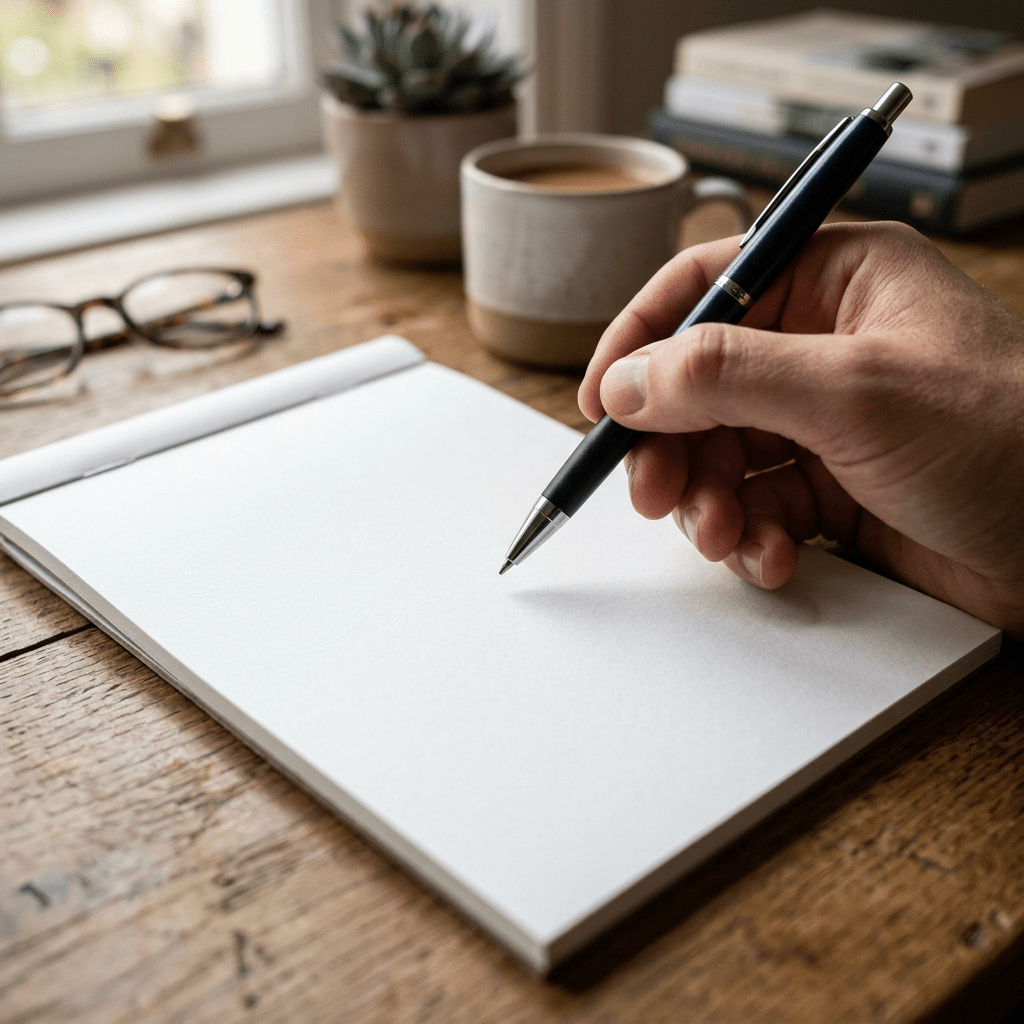
Hand holding pen above blank notepad with coffee cup and glasses on wooden table
A hand holds a pen poised to write on a blank notepad next to a coffee cup
AI generated

Frustration
A Jackpine Sonnet

Hand hovering pen poised
a black shadow hangs over
the blank page threatening
to erase any ink marks
that may emerge

Eyes and mind blank
no butterfly kiss delicate
in its touch of nib to page
a black cloud of nothingness
damns creativity at its source

Who can prise the worm
out from the chrysalis
gift wings to the pupa
change it from slug or snail
into that glorious moment
when sunshine’s beauty
stutters into fluttering flight

Comment:

The top photo, AI generated, was based on the wording of the poem. The bottom one was a Moo choice from his pre-painting selections when he claimed to be a photographer. I like both, but for different reasons.

The first one emphasizes the fear of the blank page, the blank canvas, the blank mind, the overnight snowfall that is awaiting its first foot or hoof print, its first instant of inspiration, its first splash of paint, its first letter or word. And yet, according to many with whom I have spoken, artistic creativity is one per cent inspiration and ninety-nine per cent perspiration. So, why hesitate? Get on with it. Make those first marks. Take that first step. And remember, even the longest journey begins with the first step.

The second photo expresses the duality of creativity. At the front end of the butterfly, its poised, fragile beauty. At the rear end, the fearsome face it assumes if approached in the wrong way from the wrong direction. Front end – the moment of creation. Rear end – the fear of that first step and the consequent sense of frustration.

So – at the moment of creating, we must consider several things – the fear of failure. But the only way to never fail is to never try. Each failure, however bad, is not a crime, it is a stepping stone on the way to ultimate success. The fear of the first step – this ties in with the fear of failure. Will we slip on the first damp stepping stone across the stream? How long will we permit our selves to search for a safer passage? Is there really a bridge around the bend, a bridge that will stop us from getting our toes wet? And what’s wrong with wet toes anyway?

When we dip our toes in the sea, we feel the cold of the water. When we take the plunge, dive in head first, we feel the full force of the ocean. And that ocean is the creative energy that yes, can sweep us away, can carry us up, can pull us down. Is that what we are afraid of, being overwhelmed by the creative powers within us? Of losing the meagre control we hold over our lives? I truly believe that in many cases it is just that element of being swept away by our own unleashed creativity that fills us fear. But if we never take that first step we’ll never know who or what we are, nor will we understand what we are afraid of, nor will we be able to conquer that fear and accept our creativity for what it is.

Green Banks

Green Banks

An empty shell I am
the sea sound swishing
when you hold me to your ear

Pwll Ddu and pebbles
Swansea Sands
their fishnets glistening
with golden day stars

Brandy Cove
ever-changing after
winter’s storm surge

Fisherman’s Point
early evening
when dog-fish bark

Pyle Corner
cows in the lane
quick to kick
high the five barred gate
we climb
to avoid them

Rats
in the rubbish dump
grey bodies
scuttling claws

Green Banks at last
home of our summer
sky cloud castle dreams

Comment:

Have you ever held an empty sea-shell to your ear and heard the sea’s soft sighting sound? I used to collect them from the sands, hold them to my ear, and listen. The best shells left you with the sigh and sound of sea and waves moving with a magic that sounds eternally. These I would take home and listen to them in winter, or at boarding school, when I needed such beauty to keep me alive and sound in heart and mind.

Sure I was a dreamer. But oh what dreams and how they have followed me step by step, town by town, country by country. And now they gather here, in Island View, and let me know that within my mind the dream world of memory is immense but I can still capture it and hold it to my heart.

Funny how things come back to me.

1. Taste – and I there at Eynon’s in the Uplands, where I first tasted crempogau, Welsh pancakes. They changed into the Crêpes Suzettes I tried in Cassis-les-Calanques, all soaked in Grand Marnier.

2. Touch – damp wood beneath the hand takes me to boarding school where the walls sweated and the bannisters gleamed in foggy weather. There, in the Vale of Severn, damp mornings were the warm. I also remember the touch of hot air, breathed into my shirt, to keep me warm.

3. Smell – the scent of things burning, burnt porridge particularly, drifting down the drive, and driving through the tree mist and into my nostrils.

4. Sound – so many songs take me back to the places where I used to sing them. Sometimes they attached themselves to a family member, though I didn’t understand how or why those associations were made, not until much, much later.

5. Sight – put them all together and you can see those memories surging out of the mists in all five forms.

Have you tasted sea mist on your tongue? Have you touched the dampness of your jersey when you cycle down Painswick Hill in the mist? Have you caught the smell of wet wool, mist moistened, and clinging close? Have you heard the rustle in autumn when the November mists wrap themselves around ghostly trees and the dry leaves rattle like bones? Have you seen long dead mist warriors rise up from the ground at Badbury Rings or atop Maiden Castle, or on Cley Hill, or Westbury White Horse?

Time and tide wait for neither man nor woman. And memory’s mists do not wait either. they rush in, like angels, and foolish is the the man who refuses to meet them, eye to eye, tongue to tongue, nose to nose, finger to finger, ear to ear – in all their mystical mist-filled glory.

No Man’s Island

No Man’s Island

It’s so easy to lose
our true selves
or to be carried along
by the flow of another’s
rhetoric because we
no longer possess
(or never had)
that inner conviction
that makes us different.

That’s why we must join hands
and link together:
a chain of bridged
and ferried islands
to insulate us
against our loneliness.

Comment:

I first published this in 2017 with the title Islands – I have changed the title, very slightly, to move closer to John Donne’s No Man is an Island. What I have noticed more and more recently is how we tend to isolate ourselves. Birds of a feather flock together – true – and nowhere truer than in this bloated Soccer World Cup with its 48 teams to be expanded next time, 2030, to 64 teams, unless we have 64 teams in 2028, because this circus demands to be offered more frequently so it can make even more money … or is so that more teams can compete in the final stages. Remember – the finals are meant to be the ultimate challenge – the best 32 teams in the world – until Quatar (2022) 42 teams and now USA (2026) 48 teams.

Il gruppo della morte – remember that? It’s when three top teams were drawn together in a group of four – and one of them was doomed not to get out. Didn’t happen this time. No gruppo della morte this time – 24 top teams all got through, and the next eight third best place finishes. There were some very one-sided games. And there were many games in which one team parked the bus – all ten players inside their own penalty area and no way to get through. This led to some very negative defensive football. And don’t forget that terrible off-side law – no portion, not a hair or a fingernail of the attacking player could be seen on the – bow your heads in submission – Video Assisted Referee’s screen. And how far back do you go when searching for that minor infringement that will disallow whatever happened to whomsoever it happened to?

Before the days of the electronic spy in the sky, the rules of rugby were fairly straightforward. “The referee is the sole judge of fact and of law.” In addition, in those days, the advantage needed to be immediate. No five minute wait while the players bang away at the goal line from the one yard until an infringement takes place, the attacking team fails to score, and we all go back to the original infringement. And no five minute wait while all the moves leading up to the try are checked and double checked so that there are no imperfections. For those without memories – check the Barbarians versus New Zealand in Cardiff, way back when, in 1972 or 73. Look at those high and dangerous tackles leading up to that wonderful Gareth Edwards try. Guess what? That try would never have taken place with a VAR check for dangerous play.

Writing these words, I feel myself to be isolated. A man with a memory who has been left out in the cold by a world that has moved on and left him behind – with all his beautiful memories. “See that house?” My grandfather asked me, when I was an avid collector of autographs. “Knock on the door and ask for the autograph of the man who lives there.” I did. He was old. He was asleep. Leave the book. He’ll sign it when he wakes up. And he did. I have the book here in the house and the autograph standing in isolated glory in the middle of a page. W. J. Bancroft – aka Billy Bancroft. “Who’s he?” you ask. Well, just go and look him up. You may be surprised at what you find down memory’s lane where my grandfather and I wandered hand in hand all those many years ago.

As for Moo’s painting, he calls it Craters with Creatures. But I call it In search of times past. Look closely. You can see many of them within the picture’s frame and they are all searching for something they have lost and would desperately love to cling on to.

Decision Time

Decision Time

When down means up
and up has nowhere to go
save for the desert sand
barren and bare shifting
through helpless fingers
or the hour glass waste
with two trunkless stones
propping up the sundial’s
wrinkled face and time’s sneer
of command its wilderness
voice always a choice
between thinking and feeling
for yourself or believing
frozen words dropped
from winter’s snowflakes
to melt in the toothless mouth
of a new day another decision
the future laid out ahead
and you with no map
no GPS nothing to get you
to the last place you want to go

Comment:

Some strange touches of surrealism in this little poem that weaves its way through an intertextual maze recognizable, I hope, to many of those who read this blog and follow these comments on a regular basis. Travelers from far-off lands tinkle their echoes through the lines.

How many of you have read the South Wales Echo or listened to the paperboy, almost always an old man, chant his late afternoon song outside Cardiff Market or Down by what used to be Howell’s, not so long ago, when my world was so much younger and I too lived in a far-off land before I became a traveler. What sort of traveler, you ask. Why, a traveler in time and space, of course. Listen. Can you hear him? “Echo. South Wales Echo.” As regular as clockwork.

But in Swansea, everything was different. There it was the South Wales Evening Post, chanted by a paper boy turned old man who sang out – “Po-ost, Po-ost, Evening Po-ost, South Wales Evening Po-ost!” That double or extended vowel was a signature tune that brought on the evening and the turning on of the old gas lights that used to light up the streets.

Living in Santander, Spain, the street calls were totally different. There it was the lottery man, usually blind, who stood on the street corners crying out “Para hoy! Tengo para Hoy!” Today’s lottery. I have tickets for today’s lottery. So many lotteries in Spain. So much fun. In the laundry at the bottom of Perines, where I used to lodge, if your laundry ticket number matched the winning lottery number of the Ciegos – the Blind People’s Lottery, then you could claim a free wash that day.

So many memories. The past fading slowly away. The future coming ever closer. I look out of my window, and what do I see? Well, there’s always a bird in a tree, but today the clouds are building, playing piggy-back, and climbing on top of each other, reaching higher and higher into the sky and, sooner or later, there will be rain. Blessed, comforting rain. The gardens are dry. The aquifers are low, and yes, we need that rain. Para hoy – today – please!

And then maybe the desert will bloom again. The woods will flourish and, guess what KTJ saw in the woods the other day? You can’t guess? Well, I’ll tell you what KTJ told me – “I saw a partridge, then an owl, then two bear cubs, and the mother cub, followed by a third cub, and then a mother moose with a wobble-legged baby moose trailing behind …” If you ever see a mother bear with cubs – oh-oh, decision time, remember to make the right decision – don’t get between the cubs and the mother. Or you might end up as the Teddy Bears’ Picnic. And you wouldn’t want that!

And each time you meet a wild animal, you make a decision. To stop or not to stop. To take a picture or not to take a picture. To shoot or not to shoot – with a gun this time [nasty!] not with a camera [nice]. And remember, Santa’s got a list and he remembers who is naughty and who is nice. So think twice before you make that decision – you wouldn’t want to end up on the wrong list at Christmas Time, would you.

Blood from Stones

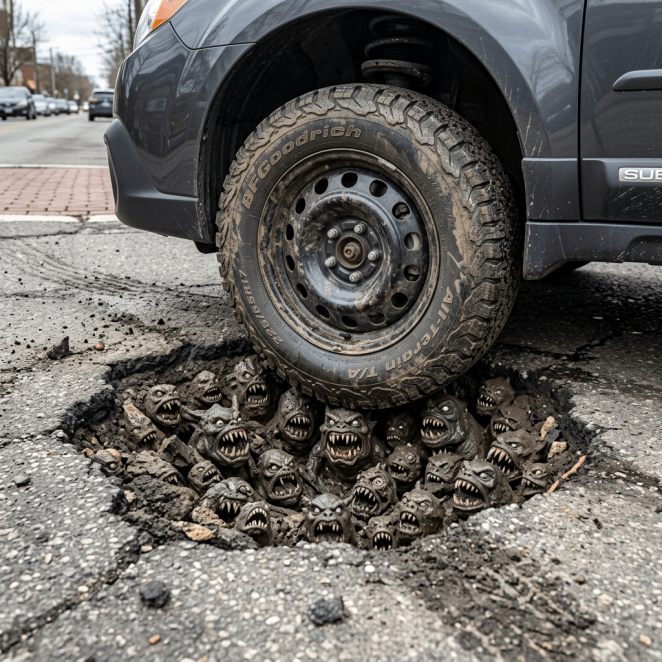
Car tire over a pothole containing small monster figurines with aggressive faces
A car tire hovers above a pothole filled with snarling monster sculptures.
Image AI generated.

Blood from Stones

The road ahead a bandage
leaking grey blood from stones.
The snow plow brutal,
carelessly lifting scabbed edges
until the gore overflows.

Spring always promises renewal,
but freeze and thaw also open
old wounds making them bleed.

A merry, mazy life we lead,
threading the car’s needle through
holes torn in the asphalt’s fabric.

Some holes are so large they have
lives of their own, and names –
Grand Canyon, Yawning Gap,
Patty’s Peril, Big Bertha, each one
well-known to neighbors.

Others are pornographic,
their open orifices painted,
laughing in scorn, dentated
vaginas ready for anything.

Such decorated potholes
 are soon filled, their crude
messages swiftly erased.

Comment:

Three flat tires in the last month and spring’s potholes still out there, waiting to trap me. Apparently, one neighborhood on the North Side of the river decided to decorate their potholes with pornographic drawings. These were swiftly filled and their messages totally erased. Alas, we on the South Side are not so daring. We don’t go out and paint our potholes. Personally, I wish we did. July – and many potholes are still there.

Not only that, the road into town is being repaired. Hooray! However, the tarmac was stripped off two weeks ago and has yet to be replaced. Boo! More than that, at the end of our street, just before the highway, one or two enormous potholes still gape. They lead directly to a dip that rises abruptly when it meets with the now stripped highway. A champion clunker that – a genuine tank-trap. I think at least two of my flat tires occurred after going over that one.

It reminds me of my grandfather’s stories about WWI and ‘going over the top’. Now, each time I approach it in the car, I call out loudly, “Look out, grandpa, here I come.” I call that particular pothole Grandpa’s Revenge. My own personal name. I don’t know what the neighbors call it. And I don’t know why grandpa is seeking revenge! But below the tires, the pothole awaits, gnashing its teeth.

Enigma Variations

Enigma Variations

Our world is spinning on its edge, placed on
the perimeter of space, going who knows where.

Specks of dust, we float around and contemplate
night’s wonders wondering what might happen.

Out there, in the vastness that surrounds us,
worlds without end will never know we existed.

Bleak and blank our names, our deeds, our status,
the monuments sometimes raised in our praise.

And what of our thoughts, those sparks
of electricity that link us mind to mind?

Is each of our actions determined by a dance
performed by circling planets that shape us?

Are we nothing more than a code
of virtually meaningless dots and dashes?

Are we then pinballs bouncing between
a million trillion strings of flashing lights?

What star god plays trivial games of snakes
and ladders with our lives and names?

Commentary:

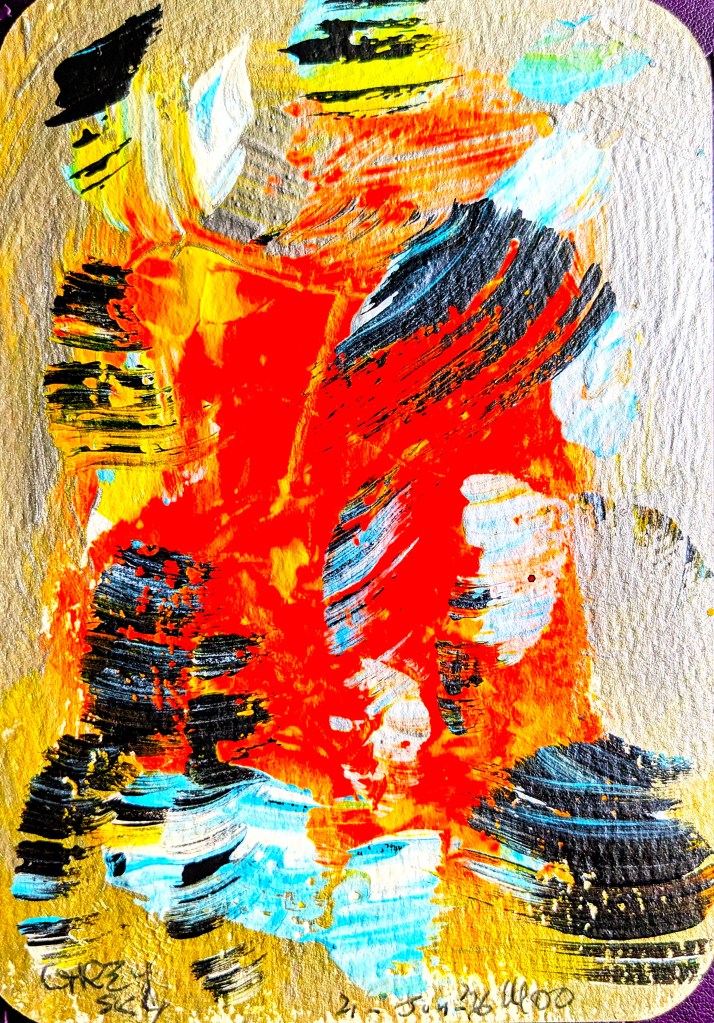
Moo’s painting is called Grey Sky with Bear Claws. He thinks it is a great companion to the poem. Actually, I rather think he likes to have his paintings published online without the necessity of lifting a finger to help. Oh dear – he heard that and just lifted his middle finger in my direction. “I am helping,” he said. “I also lift paint brushes. Remember that, you philistine.”

Philistine? Me? Now why would I be a Philistine? And what is a Philistine anyway? That’s where AI comes in. Thank you, Don Ryan. I wouldn’t know about AI without you. “And you wouldn’t know about painting without me,’ says Moo. “So tell me what a Philistine is,” I said to him. “Go look it up,” he scowled, wagging that finger in a menacing way. So I did.

AI to the rescue. A philistine is a person who is hostile, indifferent, or smugly oblivious to art, culture, and intellectual pursuits. The term typically describes someone whose interests are purely materialistic and practical, lacking any aesthetic refinement or appreciation for high culture.

Well, I don’t think that’s fair. Let’s see – hostile, indifferent, or smugly oblivious to art – no, that’s not me. I love Moo’s art, and he knows I do. I am not hostile to it at all, though I might be just a little teeny weeny bit hostile to him when I think he is lazy and doesn’t appreciate me. More – someone whose interests are purely materialistic and practical, lacking any aesthetic refinement or appreciation for high culture – no. I refuse to accept that. Purely materialistic? I give my poems away, free of charge, to my friends and anyone else who wants to read them. Moo isn’t materialistic either. He gives his paintings away to his friends. I know he does, because I have seen him do it. Come to think of it, I don’t think either of us is practical. We wouldn’t be living in Penury if we were.

Sorry. I won’t go any further. That’s all Isle of Wight Ferry, as they say in Hampshire. Well, I won’t call you a Philistine if you don’t know what they say in Hampshire. Okay – here goes. “What’s hot, black and smelly and comes steaming backwards out of Cowes?” Why, it’s the Isle of Wight Ferry, of course. Well, it was until they replaced it with a hovercraft. Now the joke [Cowes, the port / cows] doesn’t work any more. So, here’s a couple of questions at Philistine 100 level for you – (1) What have Margo and Reg got? If you don’t know, you’ll have to ask Stomping Tom Connors. And (2) what did Reggie give to Margo? Okay, okay. I give in. I’ll tell you.

Answers – (1) Margo’s got the Cargo and Reggie’s got the Rig. (2) A cowsy dungsy clock, of course. Made only in Canada. And you can check that one on AI too. And look up the song on YouTube while you are at it. Canada Day – July 1 – and Stomping Tom Connors is one of the best adverts for Canada. Go, check out his songs.

On Re-reading Quevedo’s Poetry

On Re-reading Quevedo’s Poetry

Was that where my life went,
a spent candle trailing dark studies
among the packed lines of your poems?

What about you, was your life gutted by that
same guttering candle by whose light you
scrawled your tight black spider rhymes?

Are they all meaningless, your insights
and my words? Few people now know who
you were and what you represented.

Am I, your scholar, a mere shadow
of your shadow struggling in the straggling
half-light of your existence?

Yet, I’m still intent on sharing light
and the word with a world that thinks
the two of us are out of date and absurd.

Avalanche

Avalanche

A single stone
starts the avalanche

The boy in the kitchen
bare legs held to the fire
‘this is what hell will be like’

The cupboard under the stairs
cold dark locked from the outside
an oubliette
the young boy left there
forgotten

Running upstairs
to safety beneath the bed
hands grasping at legs
and ankles
pulling him back down
for appropriate punishment

The belt the stick
the little red brush that cleans
the fireplace
with its foretaste of hell
beating battering
an avalanche of blows
the boy buried beneath them

Commentary:

Another unsigned painting by Moo. He told me that he calls this one Orange-U-Happy. Well, it is a happy painting, until you read the poem that goes with it and discover that all the stones of the avalanche are floating around in Moo’s painting, including a nice selection of sticks.

“Sticks and stones will break my bones, but names will never hurt me.” But names do hurt. Names can be cast like stones, and the thrown stone, like the spoken word, can never be recalled. Liar. Cheat. Thief. Little Lord Fauntleroy. Bite the hand that feeds you. Are you laughing at me? I’ll teach you a lesson you’ll never forget. I’ll shake you until your teeth rattle.

Stones can be thrown into ponds. When they are, the ripples reach out, spread further, spread far and wide. Thrown words can enter the soul, ripple through the blood, and they can lodge in heart and brain, forever memories that never fade and never fly away. Heart stones, they are, that strike at the stroke of midnight and leave the victim suffering, gasping for air.

So many silent memories, buried deep, only to rise and parade around in dreams at night, revenants come to haunt and hunt, sharp words made even sharper than flint or obsidian to cut and fracture, and splinter, and slowly, slowly wear down the prey. Words – the jaws that bite, the claws that snatch. Think twice before you throw, speak, wound, injure …. then think again, bite your tongue, stay your hand, drop the stone, think rather of the hand of friendship, of comfort, the feathered wing of the guardian angel that consoles and brings succor.

Succour (or succor in American English) means assistance or support given to someone experiencing grief or hardship. It is a formal, often literary term used to describe help that offers actual relief or comfort to people in difficult situations, such as disaster victims or those struggling emotionally – Wikipedia.

And remember – many words have double meanings – spare – to forbear: deciding not to hurt, destroy, or punish, such as “sparing the life” of a captive or sparing the the rod. Spoil – to indulge: to treat someone, such as a child or pet, with pampering. It can also mean treating oneself to a luxury or relaxing day.

So, what does spare the rod and spoil the child mean? Clearly it is a phrase with a double meaning. Choose which one you will. But remember – “Let us pray” is a better prayer than “Let us prey“.

Rag Doll

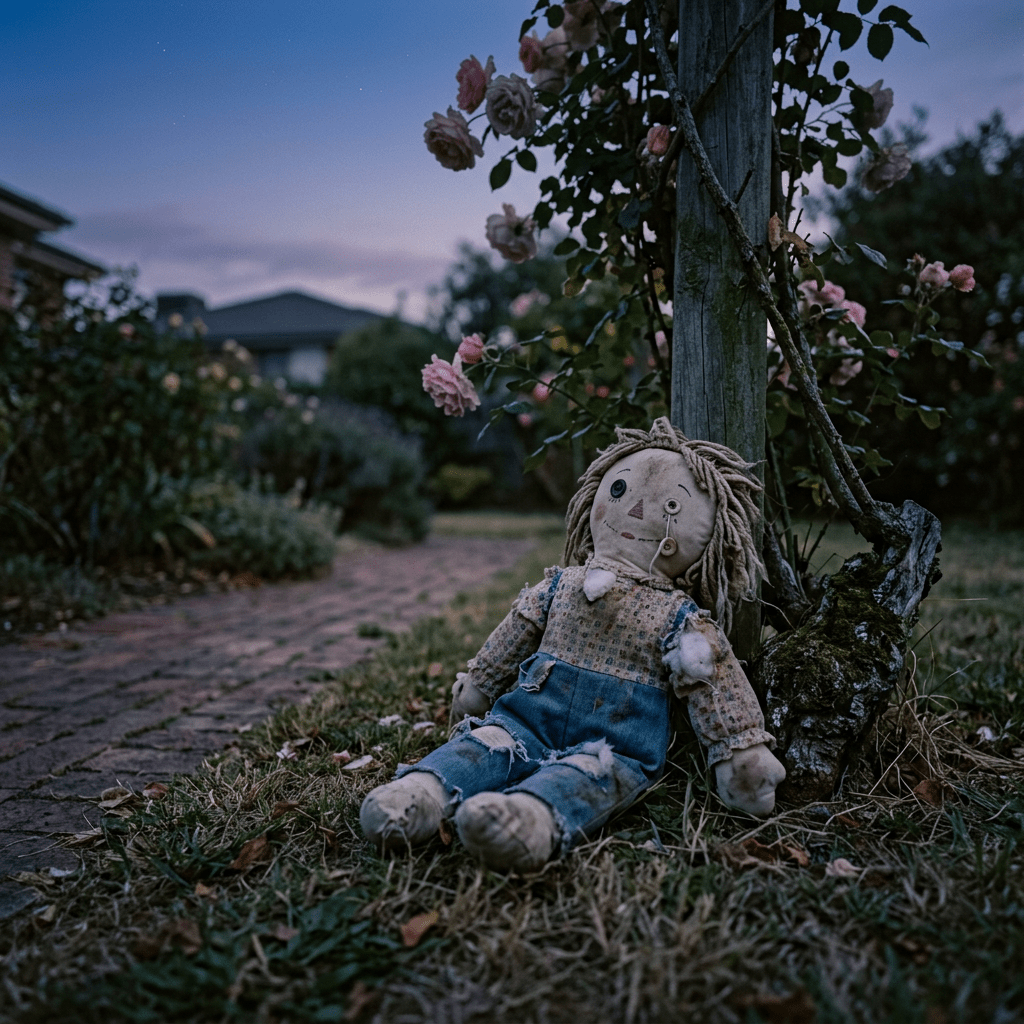
A rag doll with button eyes and a patched outfit sitting against a wooden post near pink rose bushes in a garden at dusk.
A well-loved rag doll leans against a wooden post surrounded by blooming roses at twilight.

Big Brother read my mind
and painted the picture

Rag Doll

Jack Pine Sonnet

They fought over her
whenever they met
each one holding her
by a leg or an arm

An eternal tug of war
a terrestrial dog fight
with no truce called
and neither giving in

One day they went
a step too far and tore
the doll in two neither happy
with an arm and a leg each

as for the rag doll
torn apart in fury
she was discarded
thrown in the garbage

when nobody was looking
one child returned
rescued the rag doll
sewed her back together
and filled her with love

Comment:

Tragic, really, and really tragic. A reversed Judgement of Solomon in so many ways. An Allegory applicable to so many situations in this tiny, overcrowded world of ours. Every night, on the television, we can watch hour after hour of shows like this – minus the last stanza. Some endings can never be happy.

One night, for the fun of it, I counted all the deaths, shooting and murders on selected shows over a three or four hour period. I saw over 150 violent deaths. What sort of legacy are we leaving our children, our grandchildren. And what will their children learn in their turn? Food for thought to be taken three times a day while avoiding exposure to reality – or is this the alternative reality to which we will all be exposed?