Book Burnings

Hooded figures holding torches surround a bonfire of burning books and scrolls.
A group of cloaked figures stands in a dimly lit stone courtyard as they burn ancient scrolls and books in a large central fire.

Image generated by AI


Ryan and Don Roger


5

Book Burnings

            In 1492, the Spanish Jews were given the choice of conversion to Catholicism or of being expelled from Spain. Many chose to leave. Those who converted, and remained, were kept under constant supervision. In an effort to stamp out their faith, their books were condemned to the flames by the Spanish Inquisition. A similar burning of the books in Don Quixote’s library occurs in DQI, 6. Is book burning effective? Some people think so. Other people aren’t so sure.

            The Spanish conquest of Mexico, led by Hernán Cortés, concluded on August 13, 1521, when Spanish forces and their native Tlaxcalan allies captured the Aztec capital of Tenochtitlan and emperor Cuauhtémoc, marking the end of the Aztec Empire and the beginning of Spanish colonial rule. The country was then called New Spain. 

Mexico is famous for its codices. These are fan-fold picture histories, drawn on vellum covered with gesso, of tribal conquests, social norms, tables of the gods, in fact a whole cultural and historical record of pre-Hispanic Mexico. The Zouche-Nuttal codex, for example, sets out the conquests of Ocho Venado / Eight Deer, nicknamed Garra de Tigre / Tiger Claw, a Mixtec warrior, who lived between 1063 and 1115. Five of the Mixtec codices survive. Many, many more were burned. The cover of the Vindobonensis shows the burn marks where some daring person pulled the codex from the flames and saved it. Without such saved codices, we would have much less knowledge of pre-Hispanic Mexico.

            Why is this anecdote important? Because prior to the invention of printing, in 1474, manuscripts were written by hand. Yes, some were copied, but many copies were single and unique. Burn the manuscript, destroy the knowledge it contains. Post 1474, with the printing of multiple copies of books, the individual book might be destroyed, but some books would survive from the printing sequence. Apply this to Don Quixote’s library and we note several things. First, Don Quixote’s copies are destroyed. Second, other copies of his books survive elsewhere. In addition, although Don Quixote’s books are burned the ideas in those books survive in the knight’s head and he lives by their rules. Those ideas are spread throughout the history of his adventures to everybody with whom he comes in contact. Conclusion – you can destroy the books. You cannot destroy the ideas that those books contained.

            Ray Bradbury, in Farhenheit 451, describes the burning of books in his dystopian novel. 451F incidentally is the temperature at which paper burns. The books are burnt in Bradbury’s world, but the book people survive. The book people are those who memorize their books and are able to quote them from memory and pass them on orally to other people.

            And people protect their books. How? By placing them in small rooms within their houses and walling up those rooms so that the books could not be found. This happens in DQI, VI – 6. Don Quixote awakes, goes to find his library, but it has disappeared. The housekeeper swears that a sage enchanter descended on a dragon and the library vanished in a puff of smoke. Don Quixote believes the metatheatrical lie and acts as if it were the truth. He then bemoans the fact that he is pursued by malignant sorcerers. These evil enchanters will pursue him throughout the novel whenever he wakes up from his illusions and is faced by reality. Clearly, the sage enchanters have robbed him of his moment of glory (illusion) and reduced him to sorry (the truth).

            Curiously enough, a 16th Century walled-up library was found in a house in Barcarrota, Spain not so long ago. The books were hidden, probably from the Inquisition, so that their owner could escape prosecution. The discovery sheds light on how individuals hid literature from the Inquisition during the 16th century in Spain. It also illustrates how closely Cervantes followed the reality of his times when writing the Quixote.

            You can destroy books. But it is very difficult to destroy the ideas they contain. In this fashion, although the burning of that one book ends the life of that particular volume, it rarely ends the life of the ideas contained within its covers. We might not recognize the names of the characters that Don Quixote quotes from his memory of those histories, but many of the people who encounter the knight during his adventures know them and remember them. Amadis of Gaul is never dead, not when his name lives on. The same is true of King Arthur and his Knights of the Round Table. King Arthur is said to fstill be alive and can be seen in the shape of a White Crow, bran gwen, in Welsh. And even Walt Disney knew, and profited from, the legend of the sword in the stone.

We will also see, as we continue our journey, that in the same way that tall oaks grow out of small acorns, large parts of later events found in the Quixote already have their seeds sown in these early chapters. Metatheatre, illusion and reality, authorship and censorship, truth and falsehood, waking events and dream sequences – and that is just the start.

From Stage to Page

An unrolled parchment scroll showing a sunset windmill sketch on a wooden desk with a quill and inkwell.
A beautifully detailed scroll depicting windmills at sunset rests on a classic wooden desk alongside traditional writing tools.

Image generated by AI.

Ryan and Don Roger

4

Stage to Page

            So many questions – so much to say. Let us begin by stating that Cervantes is one of the most original novelists the world has known. Then we can continue by stating that, in spite of that, like Jean-Baptiste Poquelin, aka Molière, he is not above borrowing his material from other writers. When Molière was asked where he found sources for his plays, he replied “Je les prends où je les trouve.” Cervantes might well have said the same thing.

            The source of the first sortie of Don Quixote is a short play, an entremés, called El Entremés de los Romances. These short, entertaining pieces were often installed between acts of a longer pay to keep the audience amused during the breaks. In this particular one, an old man thinks he is a knight and travels forth quoting the old border ballads and ballads of chivalry as if they were historical truth. Mind you, some of them were, or pretty close to it, especially those that carried news of the reconquest, but not all of them were true by a long way. The old man goes too far with his chivalry, gets a beating, and comes back home, draped over his horse which is led by a neighbor. Sound familiar?

            In classical rhetoric, imitation – imitatio in Latin – was the highest compliment one could pay to another author as it meant he was worth imitating. Today, imitation is considered more a scourge to be avoided, although if you follow the crime and spy shows on TV you will know that the same, or very similar, incidents recur again and again, played out in different stories by different actors.

            So, Cervantes starts out by imitating an older stage play and turning it from a play into a short story. This is creativity, beyond imitation, in itself. In this theory, the first story is in fact a short story, meant originally to stand on its own. This is not my theory, incidentally, I have borrowed it from my own teacher, Geoffrey L. Stagg, the man who introduced me to the scientific study of the Quixote. Stagg took as his evidence the first edition of the book in which he discovered an anomaly. The last sentence of Chapter Five ends in a comma (in the original, and certainly not in my translation by J. M. Cohen. I first read this book in 1965 – 61 years later, it is held together by glue and Scotch tape, a bit like Don Quixote’s helmet and armour!). To continue, the first word of Chapter Six begins with a lower-case letter, as if that word were joined to the last in the previous chapter. The heading of Chapter Six also runs smoothly into that first word as if they were joined. This suggested that in fact the two chapters had been united in a single story and had later been separated as the idea of turning the story into a novel dawned on the author.

            But who is the author of Don Quixote? Miguel de Cervantes, obviously. But who is the narrator of the story? In the first sentence, this first person narrator states ‘a village in la Mancha that I do not wish to name – de cuyo nombre no quiero acordarme in the original Spanish. AI helps us out here. I quote – “Miguel de Cervantes was likely imprisoned in Argamasilla de Alba (specifically in the Cueva de Medrano) around the turn of the 17th century due to disputes arising from his work as a tax collector, or potentially a local dispute with a nobleman. This confinement, stemming from financial irregularities or local drama, is traditionally believed to be where he began writing Don Quixote.”

No wonder Cervantes, the initial narrator, does not wish to name that particular town. A little later, in an effort to embrace the readers and draw them into the text, the narrator uses the first-person plural- our text, followed by we make take itwe do not depart.

We will return to the narrative structure of the novel on many occasions. For the moment, we will leave the matter there. In narrative structure, the real Cervantes is the author. Cervantes, named or unnamed, is the narrator and becomes a part of the narration. I should add that the 1605 version of Don Quixote contains many short stories, that have nothing, or very little to do, with Don Quixote himself. We will return to these intercalated novels, as they are called, when we meet them later in the text.

What’s in a Name?

Ryan and Don Roger

2

What’s in a name?

            Don Quixote was first published in Spain in 1605. In 1609, Thomas Shelton translated it into English. By 1611 / 1612 the adjective quixotic, was already in use within English society. An AI search tells us that “In the 17th century, the term quixotic was used to describe a person who does not distinguish between reality and imagination. The etymology of the word began after the publication of Don Quixote in 1605.”

But what does quixotic mean exactly? Another AI search reveals that “Quixotism (adj. quixotic) is impracticality in pursuit of ideals, especially those ideals manifested by rash, lofty and romantic ideas or extravagantly chivalrous action. It also serves to describe an idealism without regard to practicality.”

            Why is this important? Quite simply because in English we say Don Quixote / Quick-sot, not Don Key-hoe-tay a bastardized version of the Spanish. Please note that the adjective, in English, is quixotic not “key-hoe-tay-ic” which is too chaotic to be practical. Note too that the French translators offer us Don Quichotte, while the Italians suggest Don Chisciotte. Both these languages conserve the original pronunciation – a voiceless postalveolar fricative /ʃ/, which is the same sound as the English “sh” in “ship”. This is clear evidence that the X of the original had a different pronunciation in the seventeenth century than it does today.

            My wonderful friends on AI confirm this as follows, and I quote:

In 17th-century Spain, the letter ‘X’ primarily represented a voiceless postalveolar fricative /ʃ/, which is the same sound as the English “sh” in “ship”. During this period, which coincided with the Spanish Golden Age and the “readjustment of the sibilants,” this sound underwent a transformation, shifting from the “sh” sound to the modern velar fricative /x/ (similar to the German ch in loch or the modern Spanish ‘j’). 

Here are the key details about the pronunciation of ‘X’ during that era:

Initial “Sh” Sound: Early in the 17th century (and before), words that are now spelled with ‘j’ or ‘g’ were spelled with ‘x’ and pronounced as “sh.” For example, Don Quixote was pronounced “Don Keesh-o-teh”.

The Sibilant Shift: During the 16th and 17th centuries, the sound /ʃ/ (written as ‘x’) and the voiced /ʒ/ (written as ‘j’) merged into a single voiceless sound /ʃ/. Later in the 17th century, this sound moved backward in the mouth, evolving into the modern velar /x/ (the modern ‘jota’).

And this is just the beginning and what’s in a name? For example, what is the real name of Sancho Panza? Is it Sancho Panza or Sancho Zancas [DQI,9]? How about his wife? Is it Juana Gutierrez or Mary Gutierrez [DQI, 7]? In the same chapter she is called Teresa Panza, the name that stays with her throughout the novel.

And what about Don Quixote himself? Is his real surname Quixada, Quesada, Quexana [DQI,1] or Alonso Quijano el Bueno [DQII,74]? Don Quixada de la Mancha aka Don Quesada de la Mancha aka Don Quexana de la Mancha – and we won’t mention the alternate names he takes – the Knight of the Sad Countenance or the Knight of the Lions!

Fascinating, eh? So, after all that, tell me – what’s in a name?

Riding Buddies – Reading Buddies

Ryan and Don Roger

1

Riding Buddies – Reading Buddies

            Don Quixote makes three sorties. The first is very brief, about five chapters. The second is much longer. And the third is 74 chapters in length. Each sortie is different. For now, I would like to take a brief glance the difference between Sortie 1 and Sortie 2.

            Sortie 1 – Don Quixote sets out on his own. He travels to an inn, has adventures there, gets knighted by the inn-keeper, albeit falsely, and after an unequal combat in which he is bruised and battered, he is brought back home by a neighbor.

            When the inn-keeper asks Don Quixote for payment, the knight replies that knights errant do not carry money with them, nor do they pay for their food and lodging. The inn-keeper recommends that Don Quixote find a squire to attend, one who can carry the money and the other things that a knight needs. Our knight takes this recommendation to heart.

            Sortie 2 – In this second sortie, Don Quixote has a companion. One of the main differences between the first and second sorties is that the knight now has a squire with whom he can talk. This dialog between knight and squire, master and servant, is key to the understanding of the novel.

            Their contrasting points of view, Don Quixote literate, a believer in reading, with a firm belief that all books of chivalry are true, contrasts immediately with the illiterate Sancho, his squire. Where Sancho sees reality – the windmills are windmills – Don Quixote sees illusion – the windmills are giants, waving their arms, and threatening to attack. This is a simplistic summary, but we will leave it there for now.

            Graham Green understood the nature of dialog when he penned his novel, Monsignor Quixote. In the film, available free of charge on YouTube, the Catholic Priest (now a Monsignor) and his friend, the Communist Mayor (now defeated in an election and unemployed) leave the little town in which they live, and set out on a journey of adventures, much in the same way that Monsignor Quixote’s namesake sets out in Cervantes’s novel.

They do not have a horse and a donkey. However, they do have Monsignor Quixote’s car, nicknamed, of course, Rocinante, in which to travel. The key to Green’s novel is the constant dialog between the mayor, knowledgeable in the ways of the world, and Monsignor Quixote, innocent of the world outside his church and full of illusions about the reality of that world. It is easy to think of them as riding buddies who converse.

            So, what is a reading buddy? Well, Don Quixote is a long book, over 1000 pages, with 127 chapters. Many readers set out in search of adventure, but do not keep reading. However, a wise reader will set out on that journey with a reading buddy, who will travel with him, step by step, chapter by chapter. Each will keep the other company, and one of the delights of the journey will be the constant conversation between the reading buddies.

            I am Don Roger. My reading buddy is Ryan. I am short and stout. Ryan is tall and thin. We have reversed the Sancho / Quixote image, but we are both equally insatiable in our search for knowledge. The curious thing is that I have read Don Quixote 28 items, mainly in Spanish, but also in English and French. Ryan is reading it for the first time, but he is an expert in AI access and is helping me to understand the wily ways of that electronic world of short cuts. Of course, it helps you to sort the chaff from the grain when you know what you are looking for and just use AI to refresh your fading memory!

            I am full of the illusions of the academy. Ryan reads with a sharp mind, a keen wit, and no illusions at all. He sees only the reality of what is there. Together we have embarked on a journey that is in the process of opening our eyes to two different realities his and mine – Ryan’s and Don Roger’s. The conversations that we are having along the way, will be the subject of this little discourse on Cervantes’s novel.

Rage, Rage 58

Rage, Rage
58

“What is this sound?”
It is your own death sighing,
groaning, growing
while you wait for it
to devour you.

“What is this feeling”
It is the itch of your own skin
wrinkling and shrinking,
preparing to wrap you
in the last clothes you’ll wear.

“What is this taste?”
It is the taste of your life,
bottled like summer wine
once sweet tasting,
now turning to vinegar.

“What is this smell?”
It is waste and decay,
the loss of all you knew
and of all that knew you.

“That carriage outside?”
It is the dark hearse
come to carry you
to your everlasting home.

Comment:

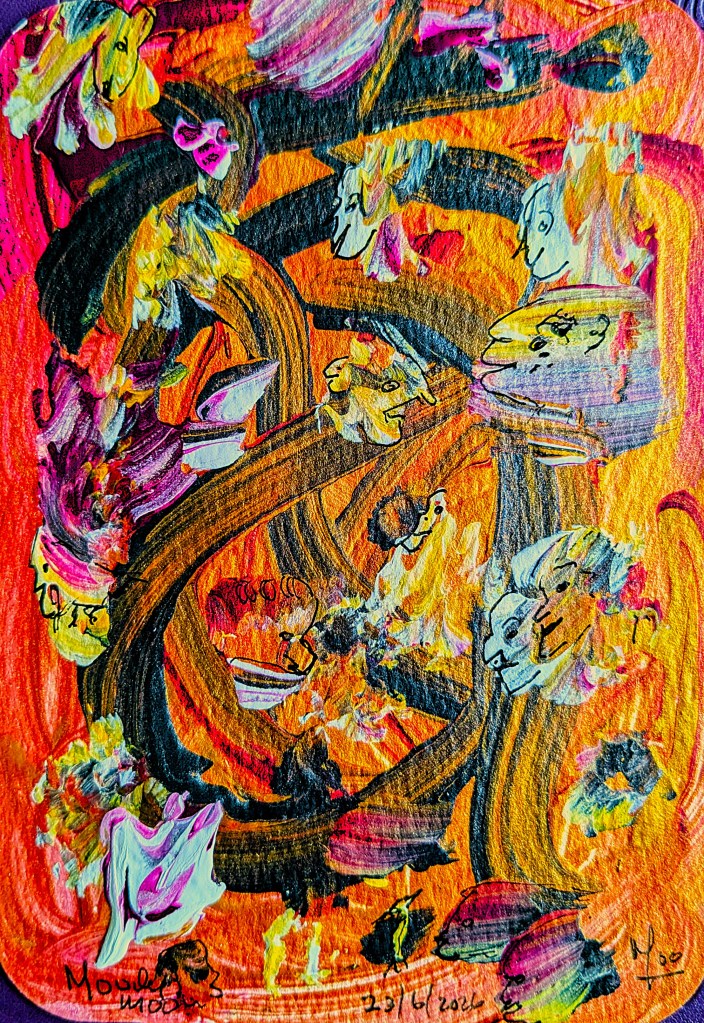
Moo thinks that his portrait of me is perfectly good for this poem. He told me not to rage, rage against the accuracy of the portrait, but he did tell me to rage, rage against the lack of paper. Où est le papier, indeed. As for the rest of it, he said it’s the same for everyone, so stop making a fuss about it. “You’ve got one last bottle of mescal on the shelf,” he told me. “I know. I’ve seen it. Just swig it down, worm and all, and you’ll have nothing to worry about.”

Oh dear. The worm in the bottle. They used to sell the gusanos in Oaxaca’s mescal street at a price of five for ten pesos. I used to buy a two litre coke bottle, filled with mescal from a barrel, and drop ten worms in it. They made yellow streaks as they descended through the liquid. Sweet dreams when you chewed on that lot – and an end to your worries. El brujo, the witch doctor, told me to stick a marijuana plant in the bottle of mescal and when the leaves turned white to rub the liquid into my arthritic knees. “Which doctor was that?” one of the tourists in my apartment block asked me. But I didn’t tell her. Nor did I do it. A waste of good mescal. And to think I now have one last half bottle left. And one little squirmy, crunchy, chewy worm.

Speaking of chewy, crunchy – I had never eaten chapulines, fried grasshoppers, until I went to Oaxaca. I didn’t like the look of them. At the first party I attended was confronted by the host who demanded I eat some. I told him they were taboo, against my religion. He shrugged. When he, and the other guests lost interest in my presence, I tried a couple. They were delicious. A real delicacy. I loved their crunchy little legs.

I guess one is always afraid of the unknown – the gusano in the mescal, the chapulines on the plate, that first plate of calamares en su tinta – squid in its own ink. I love bara lawr – Welsh laver bread – or Welsh caviar, as Richard Burton used to call it. I also know that people who have never eaten bara lawr won’t go near it – it looks like cow pats – but luckily doesn’t taste like them. Don’t ask me how I know. Some people get over their fear of the unknown, others don’t. I guess we’ll just have to wait and see what happens.

Rage, Rage 57

Rage, Rage
57

Time’s oxen
have plowed their furrows
in my face.

A silvery thatch
bears witness
to the winter
of my withering.

My broken body
hangs from the coat hanger
of my shoulders,
its worn-out sack
knitted from skin,
bonded with blood.

I walk with two canes,
not just a sick man,
but a stick man.

When I fall asleep,
my enigmatic body
haunts me with
its death-rattle
of drying bones.

Comment

Sometimes no comments are needed. However, when it comes down to it, I guess it’s worth saying that I am raging, raging against the dying of the light.

The dying of the light – in the evening, when the sun goes down, the house grows silent and cools around me. Some nights, when the news is bad or depressing, I feel we are entering another dark age. Luckily, spring is on its way, with summer not far behind. But what will spring and summer bring?

I fear the heat, the gathering of muttering trees, the ambush nature is setting up for humanity. We live among trees. Trees, all around the house. Trees, climbing the hills into the distance. I loved them when I came here first. The maples, the paper birches, the mountain ashes with their spring finery and the light green fuzz of forming leaves. Winter – the firs and pines dressed in their winter coats.

Last summer, fires broke out all over the province. The closest was a mere 30 kms down the road from us. We could smell the fire, see the smoke, and sense the discomfort of the proximity of possible outbreaks closer to home.

As I grow older, I become more fearful. Walking downstairs in the morning – cada pie mal puesto es una caída, cada caída es un precipico / each badly placed foot is a fall, each fall is down a precipice. Luis de Gongora. ( d. 1627). Alas, it’s that time of life, and it comes to anybody who, like me, has walked this far.

It’s the animals that I pity. The birds who move on and away and no longer stay with us. The deer who also have nowhere to go when their habitat is destroyed. The moose, the bears, the coyotes, the foxes, the jack rabbits and yes, they have all been visitors to our backyard.

Last summer, the local council circulated some ideas on how to prepare for immediate evacuation of our property- what to pack with a day’s notice, three hours’ warning, two hours’ warning, one hour’s warning. I hope it never comes to that. But now, I no longer know, and so I rage, rage, against the dying of the light.

Rage, Rage 54

Rage, Rage
54

Terminal and terminus,
they both mean nec plus ultra:
the Pillars of Hercules,
the end of the known world,
and my own world’s end.

I throw my hands skywards
in desperation:
“Is anybody up there?”
There’s no reply,
and I see no ladder
for angels to descend
or ascend.

Only the crows,
those black-winged
monarchs
destined to wear
the survivor’s crown,
cry out their anguish
as they wait for the day
when they’ll pick clean
my unburied bones and
rule this sickening world,
an earthly paradise no more.

Comment:

When I said “I am looking for a picture of a crow,” Moo went wild. “Me,” he said. “I’ve got one.” And indeed he had. Here it is – two crows perched like vultures over the body of a fast melting snowman. Our current world in miniature – and don’t forget the yellow snow and the doggy doing a dump. “Moo,” I said, “That’s not nice.” “True to nature, though,” he replied. “You want reality – you got it.”

Reality – what a strange word. Who knows nowadays what is real? The barber’s basin in Don Quixote – is it a barber’s basin or is it Mambrino’s Helmet? Good question. Relativism – it depends on your point of view. U a barber’s basin – turn it upside down Ω and it’s a helmet. So how do we deal with an object that has two functions and can be seen both as one thing and then another?

Good question. Cervantes solves the problem in his own unique fashion – U – bacía / basin and Ω – yelmo / helmet. Put them together and you get the neologism [newly invented word] baciyelmo – a basin that serves as a helmet and a helmet that serves as a basin. Wonderful – if it weren’t for the snout, I’d swear that was the origin of the pig-faced bassinet.

Some days, I try to understand all this – but I throw my hands skywards in desperation: “Is anybody up there?” Another good question. I often ask myself that question but I despair of an answer.

My friend Francisco de Quevedo voiced the same question in a dream that came to me last night.

¡Ah de la vida! ¿Nadie me responde?

Life ahoy! Will nobody reply?
Is anybody up there?
Will someone reply?

Blas de Otero once made a similar utterance –

“I raise my hands in supplication
– you cut them off at the wrist.”

Tell me, if you know, – what is this life if, full of care, we have no time to stand and stare. And look at those crows, standing there, staring, waiting … waiting for their turn to come. Patient, eternally patient. Just standing around. Waiting.

Bees

Bees

This year, we mark them by their absence.

There is a stillness in the bee’s balm,
a withering of early blossoms and still no bees:
will they ever come back? The bee-keepers
don’t seem to know as they scratch their heads
and search dry colonies only to find
dead and dusty hives, with cells devoid
of the lust and life of their former inmates.

Each day we watch over the flowers,
and hum as we wait for the bees to buzz:
“will ye no come back again …”

Rage, Rage 52 & 53

Rage, Rage
52

A terminus, this waiting
room in which I sit.

This is the hospital’s
forgetting place,
the left-luggage office
where, a human parcel
wrapped in a blue gown,
I wait to be claimed.

Tagged with a label
on my wrist, I find myself
alone with my fate.

53

All choice disappeared
when I came here
and surrendered myself
to the system.

Now I lack free will
and freedom of choice.

Yet I still dream of choosing
my destination, and the ways
and means of arriving there.

Comment:

A terminus – what an interesting word. Terminus a quo or terminus ad quem? Or just a railway terminus or a bus terminus where we sit and wait to change buses of trains? Or maybe just a terminus in terms of being terminal? Oh what a tangled web we weave when we first start to analyze our words in order to see exactly where we might go and where they might lead us.

And what a journey I was on when I first wrote that poem. Sitting in the waiting room, outside the radiation room, waiting for the lady who would wag her finger and point at the machine’s next victim. Would it be me? The man next to me? That woman over there? Many of us avoided each other’s eyes and just sat there stunned – and now you know the meaning, in context, of ojos de besugo – do you remember that from Rage, Rage, 48?. Others chatted. Some sat there quietly while their teeth chattered. Few of us knew each other, except from the hospice where we stayed if we weren’t day patients travelling in on a daily basis and rushing home afterwards.

Libre albedrío – free will. We can say so much about free will and determinism. But when we enter the system, it’s the system that rules. We have free will to enter – and they [the authorities] say we have free will to exit when we wish – but do we? Good question. A very good question. Once tagged, we are as free as the birds, as free as the salmon, as free as the whales – but within that freedom we are tracked, followed, taken in hand, advised, persuaded, manipulated … and whales have a whale of a time when they’re trapped up in fish netting …

Then there are the follow-ups. The appointments. The emails. The telephone calls. The check-ups. The blood tests. The MRIs. The X-rays. The Holter appointments. The various scans. Who is brave enough to get off the wagon or to open the aircraft’s door half way through its flight over the Atlantic and step out? Would you jump from the save-yourself-train – not at all like the gravy train – and think carefully – are you really saving yourself or are you getting yourself into hotter and deeper water? Come along then, let’s open the aircraft’s door and step out over the Atlantic. And tell me, what exactly are we stepping into?

Stop the world, I want to get off! Not so easy to do, my friends, not so easy to do. Not even when you think the terminus in which you are sitting is taking you to hell in a hand-basket. You start to stand up. And the little lady appears, smiles at you, crooks her finger, nods her head, and – as obedient as one of Pavlov’s well-trained puppy dogs – off you go, following in her footsteps.