The Numbers Game

Ryan and Don Roger

3

The Numbers Game

            The numbering of the chapters in Don Quixote is also interesting. While Part I and Part II often retain the Latin numbering, the chapters themselves can be found both with Latin Numbers and standard numbers.

            Latin numbers are based on six letters I, V, X, L, C, D and M. Each has its own value. I = 1, V = 5, X = 10, l = 50, C = 100, D = 500, M = 1000. Most have us have seen Roman numerals on clocks and we are familiar with the numbers from 1-12. I, II, III, IV (4, that is to say one before five), V, VI (6, that is to say one after five), VII, VIII, IX (9, that is to say one before ten), X, XI (11, that is to say one after ten), XII.

            This paradigm governs Latin numbers. XV = 15, XX = 20, XXX = 30, XL (ten before fifty) = 40, L = 50, LX (ten after fifty) = 60, LXX = 70, LXXX = 80, XC (ten before one hundred) = 90, C = 100, CX = 110. The date of my writing this MMXXVI (2026). You will have noticed similar numerical configurations on books and old movies.

            The ancient Celtic numbering system was based on the digits of hands and feet. Counting sheep, for example, or goats, shepherds and goatherds would count up to twenty on their toes and fingers. Then they would carve a notch in a piece of wood. To keep score was to score the notch.

            Something similar happens in Basque jai alai, the happy game.  The scorers score in groups of IIII which they then made into 5 with a line through the numbers IIII. Four groups of 5 made 20 and the 21st notch won the game. That scoring method may have changed, but it is certainly how I learned to score the game in the Basque country (Spain) back in the 1950’s. Curiously, modern French shows the vestigial remains of this – quatre-vingts. Welsh shows a somewhat similar diversity because the Welsh word for twenty is ugain – although it’s technically not the only one, with the alternative dau ddeg (literally two tens) becoming more and more common. A case of plus ça change, plus c’est la même chose.

            And we must never forget the old sterling system of the United Kingdom of Great Britain and Northern Island. £. S. D. aka pounds shillings and pence. 4 farthings = one penny, 12 pennies = one shilling, 20 shillings = one pound.

Our good friends on AI came to our aid with this one. I quote – The pre-decimal British currency system, known as £sd (librae, solidi, denarii), consisted of 12 pence in a shilling and 20 shillings in a pound (£), totaling 240 pence per pound. Used until Decimal Day on February 15, 1971, this system featured various denominations, including farthings, sixpences, florins, half-crowns, and crowns. What about a guinea you ask? Well. That was £1 and 1 shilling. Hence the auctioneer’s delight.

            “What am I bid”?       >         “£20.”             >          “Guineas!”

Our trusted friends on AI sum it up this way – “A guinea was a British gold coin minted between 1663 and 1814, officially valued at 21 shillings (£1.05 in decimal currency) from 1717 onwards. It was the first machine-struck gold coin in Britain, typically worth slightly more than one pound. While no longer in circulation, it is still used in horse racing and some luxury auctions to represent £1.05.”

Luxury auctions – I love that phrase. And here we must leave our luxurious description of, and adventures into, numbers in Don Quixote! Just look where the journey has led us. And remember, in the same way that Cervantes inserted short stories, both spoken and read, that digressed from the main narrative, we can also insert such mental rants and ramblings into our own narrative. And we shall continue to do.

Here’s one, for example. How do you count goats in Wales? Click on these links for two examples. Counting the Goats traditional and Counting the Goats modern. Of course, wrth gwrs, the simplest method of all is to count their legs and divide by four! Try doing that with Latin numerals!
           

What’s in a Name?

Ryan and Don Roger

2

What’s in a name?

            Don Quixote was first published in Spain in 1605. In 1609, Thomas Shelton translated it into English. By 1611 / 1612 the adjective quixotic, was already in use within English society. An AI search tells us that “In the 17th century, the term quixotic was used to describe a person who does not distinguish between reality and imagination. The etymology of the word began after the publication of Don Quixote in 1605.”

But what does quixotic mean exactly? Another AI search reveals that “Quixotism (adj. quixotic) is impracticality in pursuit of ideals, especially those ideals manifested by rash, lofty and romantic ideas or extravagantly chivalrous action. It also serves to describe an idealism without regard to practicality.”

            Why is this important? Quite simply because in English we say Don Quixote / Quick-sot, not Don Key-hoe-tay a bastardized version of the Spanish. Please note that the adjective, in English, is quixotic not “key-hoe-tay-ic” which is too chaotic to be practical. Note too that the French translators offer us Don Quichotte, while the Italians suggest Don Chisciotte. Both these languages conserve the original pronunciation – a voiceless postalveolar fricative /ʃ/, which is the same sound as the English “sh” in “ship”. This is clear evidence that the X of the original had a different pronunciation in the seventeenth century than it does today.

            My wonderful friends on AI confirm this as follows, and I quote:

In 17th-century Spain, the letter ‘X’ primarily represented a voiceless postalveolar fricative /ʃ/, which is the same sound as the English “sh” in “ship”. During this period, which coincided with the Spanish Golden Age and the “readjustment of the sibilants,” this sound underwent a transformation, shifting from the “sh” sound to the modern velar fricative /x/ (similar to the German ch in loch or the modern Spanish ‘j’). 

Here are the key details about the pronunciation of ‘X’ during that era:

Initial “Sh” Sound: Early in the 17th century (and before), words that are now spelled with ‘j’ or ‘g’ were spelled with ‘x’ and pronounced as “sh.” For example, Don Quixote was pronounced “Don Keesh-o-teh”.

The Sibilant Shift: During the 16th and 17th centuries, the sound /ʃ/ (written as ‘x’) and the voiced /ʒ/ (written as ‘j’) merged into a single voiceless sound /ʃ/. Later in the 17th century, this sound moved backward in the mouth, evolving into the modern velar /x/ (the modern ‘jota’).

And this is just the beginning and what’s in a name? For example, what is the real name of Sancho Panza? Is it Sancho Panza or Sancho Zancas [DQI,9]? How about his wife? Is it Juana Gutierrez or Mary Gutierrez [DQI, 7]? In the same chapter she is called Teresa Panza, the name that stays with her throughout the novel.

And what about Don Quixote himself? Is his real surname Quixada, Quesada, Quexana [DQI,1] or Alonso Quijano el Bueno [DQII,74]? Don Quixada de la Mancha aka Don Quesada de la Mancha aka Don Quexana de la Mancha – and we won’t mention the alternate names he takes – the Knight of the Sad Countenance or the Knight of the Lions!

Fascinating, eh? So, after all that, tell me – what’s in a name?

Riding Buddies – Reading Buddies

Ryan and Don Roger

1

Riding Buddies – Reading Buddies

            Don Quixote makes three sorties. The first is very brief, about five chapters. The second is much longer. And the third is 74 chapters in length. Each sortie is different. For now, I would like to take a brief glance the difference between Sortie 1 and Sortie 2.

            Sortie 1 – Don Quixote sets out on his own. He travels to an inn, has adventures there, gets knighted by the inn-keeper, albeit falsely, and after an unequal combat in which he is bruised and battered, he is brought back home by a neighbor.

            When the inn-keeper asks Don Quixote for payment, the knight replies that knights errant do not carry money with them, nor do they pay for their food and lodging. The inn-keeper recommends that Don Quixote find a squire to attend, one who can carry the money and the other things that a knight needs. Our knight takes this recommendation to heart.

            Sortie 2 – In this second sortie, Don Quixote has a companion. One of the main differences between the first and second sorties is that the knight now has a squire with whom he can talk. This dialog between knight and squire, master and servant, is key to the understanding of the novel.

            Their contrasting points of view, Don Quixote literate, a believer in reading, with a firm belief that all books of chivalry are true, contrasts immediately with the illiterate Sancho, his squire. Where Sancho sees reality – the windmills are windmills – Don Quixote sees illusion – the windmills are giants, waving their arms, and threatening to attack. This is a simplistic summary, but we will leave it there for now.

            Graham Green understood the nature of dialog when he penned his novel, Monsignor Quixote. In the film, available free of charge on YouTube, the Catholic Priest (now a Monsignor) and his friend, the Communist Mayor (now defeated in an election and unemployed) leave the little town in which they live, and set out on a journey of adventures, much in the same way that Monsignor Quixote’s namesake sets out in Cervantes’s novel.

They do not have a horse and a donkey. However, they do have Monsignor Quixote’s car, nicknamed, of course, Rocinante, in which to travel. The key to Green’s novel is the constant dialog between the mayor, knowledgeable in the ways of the world, and Monsignor Quixote, innocent of the world outside his church and full of illusions about the reality of that world. It is easy to think of them as riding buddies who converse.

            So, what is a reading buddy? Well, Don Quixote is a long book, over 1000 pages, with 127 chapters. Many readers set out in search of adventure, but do not keep reading. However, a wise reader will set out on that journey with a reading buddy, who will travel with him, step by step, chapter by chapter. Each will keep the other company, and one of the delights of the journey will be the constant conversation between the reading buddies.

            I am Don Roger. My reading buddy is Ryan. I am short and stout. Ryan is tall and thin. We have reversed the Sancho / Quixote image, but we are both equally insatiable in our search for knowledge. The curious thing is that I have read Don Quixote 28 items, mainly in Spanish, but also in English and French. Ryan is reading it for the first time, but he is an expert in AI access and is helping me to understand the wily ways of that electronic world of short cuts. Of course, it helps you to sort the chaff from the grain when you know what you are looking for and just use AI to refresh your fading memory!

            I am full of the illusions of the academy. Ryan reads with a sharp mind, a keen wit, and no illusions at all. He sees only the reality of what is there. Together we have embarked on a journey that is in the process of opening our eyes to two different realities his and mine – Ryan’s and Don Roger’s. The conversations that we are having along the way, will be the subject of this little discourse on Cervantes’s novel.

Rage, Rage 43

Rage, Rage
43

The truth,
unwelcome as it is,
is that the day I was born
I took my first steps
on the path to death,
my own death.

Death –
an inescapable law
that tells me that
body and spirit
will be forced apart.

My flesh will wither
and perish,
and the person
that the world and I
know as me
will no longer be able
to hold together.

Commentary:

“The day I was born I took my first steps on the path to death.” An echo of a line from Francisco de Quevedo, of course.

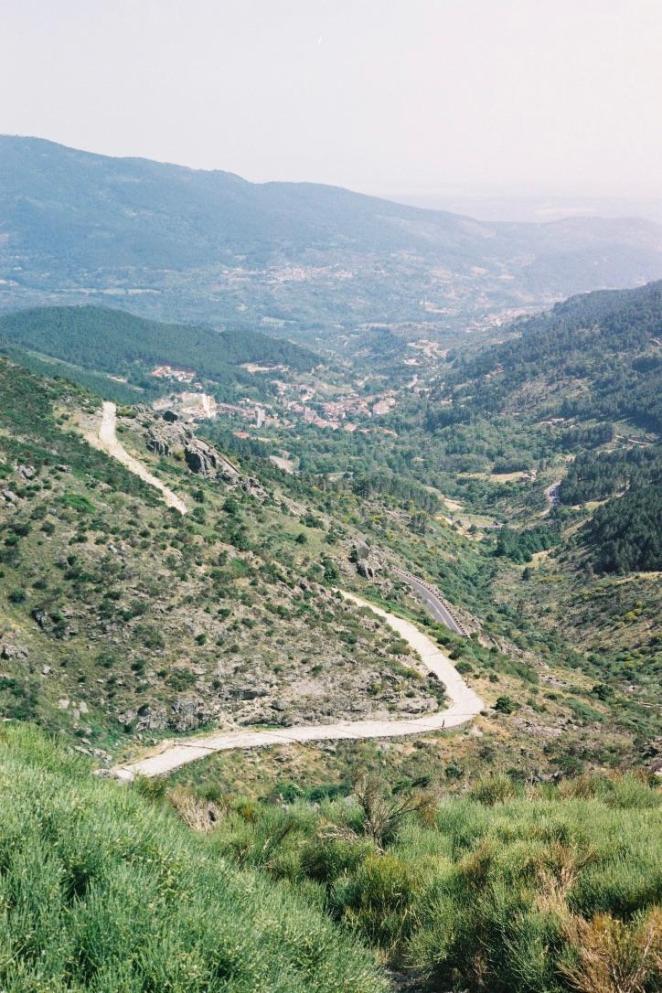
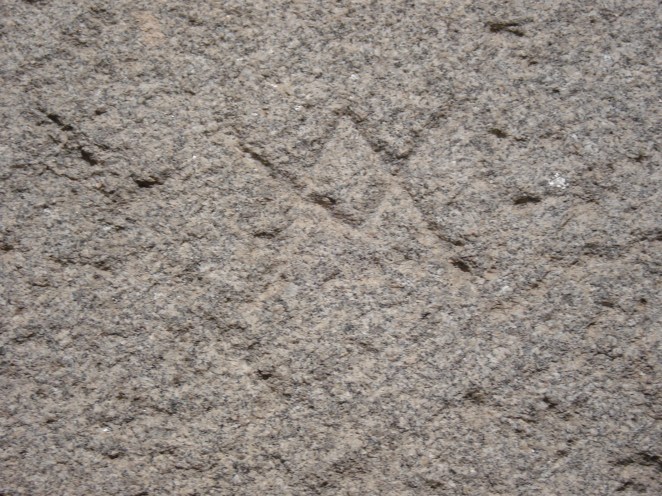
And the photo above? It is the old Roman road that ascends the Puerto del Pico in the Province of Avila. Hard to believe it was laid down nearly 2,000 years ago and still carries the transhumance cattle and sheep from the valleys in winter to the hills in summer. It is also a part of the Camino de la Plata, the silver road that brought precious metals from Spanish America to Madrid after the discovery and conquest of the Incan Empire.

The treasures of the Empire – what joy. Yet what weight around the neck of the Spanish nation. Wealth so abundant, spending so rife, money-lenders always lending, filling in the gaps between the arrival of the treasure convoys from the Colonies. And yet that borrowing became a millstone around the borrowers’ necks. So much money borrowed that there came a moment when each convoy only served to pay off the loan debt of the last set of borrowings.

The cattle and sheep struggle to climb to those heights. Yet it is not difficult to imagine how much easier it was to walk downhill, beside the creaking wagons that held the gold and silver to pay off the monarch’s debts, en route to the king and his court.

Think also of the squeals of anguish heard when the treasure fleet did not arrive. Captured by the English pirates, or hurricane battered and lost in the Caribbean or closer to home. This meant even more borrowing on the back of earlier borrowing and always the cost of living and the lending rates rising higher and higher.

Rage, Rage 35

Rage, Rage
35

Now,
once a month, they stick
a needle in my arm
and check the levels
of my PSA, cholesterol,
and testosterone.

Is my blood pressure rising?
Is my cholesterol high?
Are my electrolytes
ticking slowly down?

The doctor keeps telling me
it’s a level playing field
but every week
he changes the rules
and twice a year
he moves the goal-posts.

What game is he playing?
A man in a black-and-white
zebra shirt holds a whistle
to his lips while another
throws a penalty flag.

It comes out of the tv set
and falls flapping at my feet.
Now I know for certain that
I’m living in the Red Zone
and I’m running out of time.

Comment:

Now, once a month, they stick a needle in me! Not always in the same place. But, I sometimes feel like a pin cushion. “The slings and arrows of outrageous fortune” have turned into the “probing instruments of innumerable doctors.” Try repeating those lines at speed and you will end up repeating the message, from lips to ear, like the battalions waiting to go over the top, used to do in the trenches of WWI.

Original message – “Send reinforcements, we’re going to advance.” Last message in sequence – “Send three and fourpence, we’re going to a dance.” Funny how times change. I am re-reading Don Quixote (yet again) and am bowled over by the length and complexity of the sentences. Then I realize how words, culture, times, and attitudes have changed. “Change and decay in all around we see…” – indeed we do.

How many people now know what ‘three and fourpence’ means? And how about LSD – and no, it’s not a psychedelic drug, it’s code for pounds, shillings, and pence. Well, for the original Latin terms for them anyway.

Oh the joys of AI – “The terms libra, sestercia (commonly sestertius), and denarius are the direct Roman ancestors of the British pre-decimal currency system (£sd), which was in use until 1971. The system was adopted from the Roman/Frankish model where a pound (libra) was divided into shillings (solidus) and pence (denarius).”

Oh the wonders of the British pre-decimal currency system (£sd). Four farthings = one penny; 12 pennies / pence = one shilling; 20 shillings = one pound; 21 shillings = one guinea. What fun we had adding and subtracting British coinage in those days, let alone multiplying and dividing for those wonderful state examinations.

Ah well, it’s all forgotten now, as are the jabs, the needles, and the tests. Anyone got a Wills’ Woodbine? Or a Player’s Navy Cut? And how about a Lucifer to light your fag? There weren’t any fags in my boarding school. Fagging was strictly forbidden. As was smoking. And drinking. And loads of other things that we did anyway.

Carved in Stone 48 & 49

Carved in Stone

48

Moats. Everywhere.
Defensive, offensive,
and the mote
in the other’s eye
much more offensive
than the beam in your own.

49

Caerphilly Castle –
the largest water defenses
in the United Kingdom,
but unable to compete
with the changing times.

Cromwell’s cannons came,
destroyed the towers,
broke down the walls.

His army bridged the moat,
destroyed every one inside that castle
with fire and sword.

Only the desecrated towers,
vast, legless trunks of stone,
eyeless, toothless,
remain as a reminder.

Carved in Stone 45

Carved in Stone

45

No candles burned at that altar.
A single match, let alone
a candle flame,
would spell the end,
if gas leaked from the seam.

Only the canaries,
confined in their cages,
sang songs.

Doomed,
like the blind pit ponies,
never to see the light of day,
they lived out their lives
down there.

So many died underground,
unable to get out,
buried alive,
before they were even dead.

Commentary:

“Only the canaries, confined in their cages, sang songs.” Yet the miners often sang, in their own cages, as they were lowered down from pit-head to seam. It wasn’t the songs that worried them, it was the silence. The men could rarely smell the gas, but when the canary stopped singing and toppled from its perch, then the men knew that bad news hounded their heels. As for the pit ponies, how did one get them out? Some of those mines, had been dug 5,000 feet deep and two or three miles out to sea. A pit pony should never be confused with a sea horse, and as for the white horses that surge in the waves in so many paintings, well, pit ponies need to be laundered before they can compete.

“Good-bye old friend.” I remember the photo from WWI of the dying horse, surrounded by crying men. The suffering of the animals is what men feared and pitied most. The animals are innocent. They do not ask to be sent underground, nor to be sent to war. They have no choice, poor things. So sad, when a dear, four-footed friend dies, so far away from the light of the sun. As for the men, there were no “safe rooms”, those reinforced rooms filled with food and water, not in the early days, anyway. A camaraderie, yes, but not many people went down to the mines willingly. Rita MacNeil summed it all up in her wonderful song that begins ‘It’s a working man I am.” – How many people, if they ever saw the sun, would ever go back underground again.”

Carved in Stone 44

Carved in Stone
44

The old man, withered,
last house on the left,
leaning on his garden wall,
coughing, spitting up
coal dust and blood.

He’s not old, when you get close,
just grown old, underground,
where emphysema
and pneumoconiosis
devour men and boys.

He spits on the side walk.
Mining souvenirs,
Max Boyce calls them,
and they appear
every time the young man,
turned suddenly old,
starts to cough.

He can’t walk far,
wearing carpet slippers,
soft and furry,
just leans on the wall.

He fell, or was pushed,
into the trap at an early age,
when the coal seams
had grown so thin,
that only a small boy
could kneel before
the coal black altar
of the underground god
and, with a pick and shovel,
he learned to carve and shape
the long, slow death
contained in those seams.

Commentary

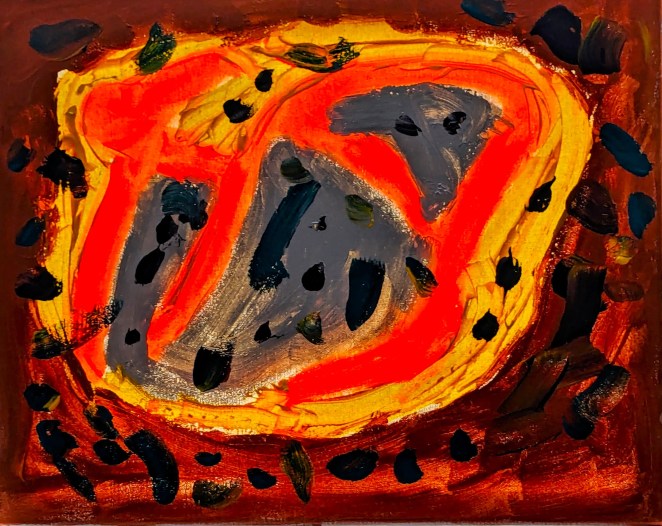
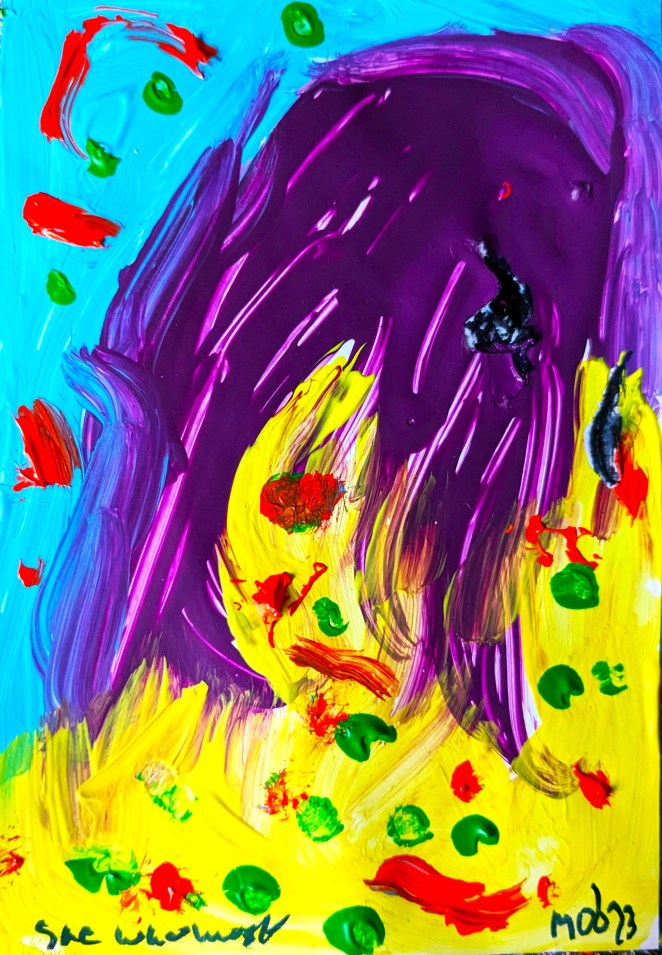
Moo’s painting, Coal Face, adorns the front cover of Carved in Stone, Chronotopos II. Coal Face is not the denigration of Black Face, white men pretending to be black by dyeing their faces, although they have some similarities. In Welsh Mining, the coal face is where the men used to dig when, with their shovel and their pick and their little lamp and wick, they knelt to dig out the coal. Knelt, because there was no standing room, deep down underground. Then, when the seams grew thinner, and the men could no longer reach them, the young boys were sent underground.

A day underground left men and boys with coal dust seamed into their bodies, especially their hands and their faces. Hence the triple meaning of black face – where the coal is dug, what men and boys looked like after a day’s work, and the blackening of their faces by white men, for the fun of it.

Faces are one thing, coal dust in the lungs is another. The result – emphysema and pneumoconiosis devour men and boys. Black lung, some call it. “And every time he coughs, he gets a mining souvenir” – a black spot coughed up on the sidewalk – Max Boyce.

Child labor, minimum wage, living wage, work that kills, slowly and silently, – what can I say? Forgive me, for I can say no more.

Memories

Memories

All that remains of you: memories
and these swift-flowing rivers of blood
embodied within my flesh and skin.

A lifeless kite, each word I write,
too heavy to rise. Each sentence,
a wasted movement of lips and tongue.

And you, a black and white snap-shot,
of blooded washing hanging on the barbed
wire fence we grew each day between us.

Today, sunlight streams through stained
glass windows of the house you no longer
inhabit. Dust rises from artificial flowers.

Your poinsettia’s dry silk leaves, now mine,
brush a taut, barren kiss against my face.
I dream of the drowned lying cold on a beach.

Fresh memories pound through my head.
Waves on a rocky shoreline. Each word
a grating grind of shingle and sharp stones.

Commentary:

Moo calls it going Bodmin but the idea comes from Doc Martin and Porthwen. People lose their minds, their directions, and end up ‘going Bodmin’. This means they wander about, lost, on the Bodwin Moor and can’t find their way home. As we age, it happens to many of us. Not only do we go Bodmin, but our memories betray us. Sometimes we remember what we did as children, but forget what we did a few moments ago.

WWI – my grandfather told me all about it. “We’ll hang out our washing on the Siegfried Line, have you any dirty washing mother dear?” Or worse, “If you want to find the Sargent, I know where he is, he’s hanging on the old barbed wire.” Unbroken wire, covered by enemy machine guns, we who die like cattle – such bitter memories. And the French, walking to the front, baaing like lambs being led to the slaughter, decimated, one in ten (10%) being shot for cowardice or insubordination. “If you want the whole battalion, I know where they are, they’re hanging on the old barbed wire.”

And now you must think of the barriers, the fences, that we grow between us, day after day, as we grow old, and older. Artificial flowers, houses we no longer inhabit, dust motes floating in the air through rooms well-remembered, but no longer open to us. “Each word, each memory, a grating grind of shingle and sharp stones.”

Look at them, those lost people, those forgotten faces. You may even recognize one or two of them. Listen – well-remembered voices, bugles calling from sad shires, and every night, a drawing down of blinds.

Inquisitor

Inquisitor
Sun and Moon

He told me to read,
and plucked my left eye from its orbit.
He slashed the glowing globe of the other.
Knowledge leaked out, loose threads dangled.
He told me to speak and I squeezed dry dust
to spout a diet of Catechism and Confession.

He emptied my mind of poetry and history.
He destroyed the myths of my people.
He filled me with fantasies from a far-off land.
I live in a desert where people die of thirst,
yet he talked to me of a man who walked on water.

On all sides, as stubborn as stucco,
the prison walls listened and learned.
I counted the years with feeble scratches:
one, five, two, three.

For an hour each day the sun shone on my face,
for an hour at night the moon kept me company.
Broken worlds lay shattered inside me.
Dust gathered in my people’s ancient dictionary.

My heart was like a spring sowing
withering in my chest
It longed for the witch doctor’s magic,
for the healing slash of wind and rain.

The Inquisitor told me to write down our history:
I wrote … how his church … had come … to save us.

Commentary:

No wonder the little girl in Moo’s painting looks so sad. She must have read this poem and understood how the exercise of power and authority, be it religious or secular, can effect those upon whom it is exercised. Times change, but so many things remain the same. The pendulum swings, and it moves from chaos to order and back again. The meaning of meaning – how we define chaos and how we define order define who we are.

Birds of a feather flock together. Manners maketh the man. Wonderful sayings. But fine words do not necessarily make for fine men or women at that. Serpents and senators, both can speak with forked tongues. It is up to us to apply discourse analysis and distinguish between what they say and what they actually mean. As my friend Jean-Paul Sartre once said – “L’homme n’est rien d’autre que ce qu’il fait.” A man is nothing more than what he does. His deeds reveal his true inner self – and remember – the plumage doesn’t necessarily make the bird.