The Golden Age

Ryan and Don Roger

11

The Golden Age

            Don Quixote begins his discourse on the Golden Age (DQI, XI/11) with these words: “Happy the age and happy the times on which the ancients bestowed the name of golden, not because gold, which in this iron age of ours is rated so highly, was attainable without labour in those fortunate times, but rather because the people of those days did not know those two words thine and mine. In that blessed age all things were held in common.”

            Several things of note. First, the length of the sentences. Remember we are reading about a society in which the majority of people were still illiterate, knowing neither how to read nor to write. Earlier, in the same chapter, when Don Quixote describes his role as a knight errant, we read that “The goatherds did not understand this gibberish about squires and knights errant, but just watched in silence …”

            Don Quixote goes on to describe the perfect pastoral life in the course of which nymphs and shepherds could go about their daily lives living in peace, love, and justice, and aways at one with the land. It is interesting to read about this idealistic and escapist pastoral myth that takes place in a land overflowing with milk and honey. Now compare it with the reality of the illiterate goatherds who slaughter and consume their own goats, devour dried, wrinkled acorns, and eat rock hard, age-old cheese.

Compare it too with the reality of the current age of iron, as described by Don Quixote who says “But now, in tis detestable age of ours, no maiden is safe even though she be hidden in the centre of another Cretan labyrinth; for even there, through some chink or through the air, by dint of its accursed persistence, the plague of love gets in and brings them to the ruin despite their seclusion.” Is Don Quixote’s description of this detestable age any more real than his description of the Golden Age? Whether it is or isn’t, Eon Quixote uses the contrast between the two worlds, past and present, for his own ends. I quote “Therefore, as times rolled on and wickedness increased, the order of knights errant was founded for their protection, to defend maidens, relieve widows, and succour the orphans and the needy.”

            We should also mention the illusion of the Don Quixote’s literary pastoral in which “all was peace then, all amity, and all concord” and the reality of the harsh life led by these real goatherds.

Reality and illusion is a common theme as we move from the Renaissance towards the Baroque. For those of us who follow Spanish Art, we have only to look at Velásquez’s paintings to understand the difference between the ugliness of the court dwarves and the beauty of the royalty they entertain. In his painting The Topers, for example, Velásquez shows the reality of the country folk. In Vulcan’s Forge he presents us with the workmen who labour around the furnace contrasting them with the god Apollo who addresses them from within a golden light.

            We will meet the pastoral myth on many occasions in Don Quixote I & II, for our adventurer meets with many suffering lovers who escape, or try to escape, their sufferings by fleeing to the countryside to live an idyllic life free from the stress of their supposed multiple love and relationship problems. The pastoral – escapist literary, it is, describing a perfect world that never existed. A suitable follow-up to Past Glories Restored #10 in this sequence of ours. Can such Edenic innocence ever be re-created in contemporary society, Don Quixote’s or our own? A leading question and one that readers must answer for themselves.

In Wales and in the Welsh language, we have a wonderful word to describe that longing for the Golden Age that is long past and unrecoverable. Hiraeth – a spiritual longing for a home that maybe never existed. Nostalgia for ancient places and times to which we can never return. It is the echo of the lost places of our soul’s past and our grief for them and their loss. It is in the wind, the rocks, the bays of the Gower coast, and the waves of the sea. It is nowhere and yet it is ubiquitous.

Past Glories Restored

Ryan and Don Roger

10

Past Glories Restored

            What is it about madmen like Don Quixote that they find it hard to live in the present and always want to see themselves restore past glories however impossible it is to do so? The search for the beauty and peacefulness of the past is always with us. Many seek the perfection of the Garden of Eden, but wise men know that Adam and Eve were expelled from the garden by an angel with a fiery sword, never to return.

            Jorge Manrique (1440-1479) begins his Coplas por la Muerte de su padre with the statement that “a nuestro parescer, cualquier tiempo passado fué mejor.” / It seems to us that any past time was better. Why do poets and madmen always look back to the past, all too often with a view to recreating that which can never be recreated?

            François Villon (1431 – 1463?) asks, in his famous refrain to La Ballade des Dames de Jadis – “Mais où sont les neiges d’antan!” / Where are last year’s snows! Indeed, the theme of ubi sunt / where is – where are is a constant throughout literature. And where is last year’s snow? Can you tell me? It certainly isn’t in our aquifer. I didn’t even use the snowblower last year. Tell me, where did the snow go? I live in Canada, and we didn’t see it. So where did it go?

            Marcel Proust (1871-1922) searched for those lost times in his novel À la recherche du temps perdu. This can be translated directly as In Search of Lost Time. It also occurs, more poetically as Remembrance of Things Past. Unfortunately, the word Remembrance rather cancels out the idea of Search, not to mention the twin ideas of recalling and re-establishing. However, in the case of the madman, Don Quixote, it can be argued that all those meanings are correct. But what exactly does Don Quixote want to restore?

            Above all, Don Quixote wishes to restore the lost age of knight errantry. He is besotted by the fantasy tales of these knights errant and believes that he can be one himself and restore their glory with the force of his arm alone.  In DQI, II/2, The knight addresses the ‘ladies of easy virtue’ at the inn in these terms: “I beg you, ladies, not to fly, nor to fear any outrage; for it ill fits or suits the order of chivalry which I profess to injure anyone, least of all maidens of such rank as your appearance proclaims you to be.’ His language, which was unintelligible to them, made them laugh more. So, knights errant protect women, especially damsels in trouble, and women of easy virtue. That is one of their most important tasks.

            In DQI, IV/4, our knight meets the boy, Andrés, who is being whipped by his master, the farmer. Don Quixote stops the thrashing and makes the man promise to pay the boy the wages that are owed him. The farmer promises to do so, but when Don Quixote leaves, he ties Andrés to a tree and whips him so soundly ‘that he laves him for dead.’ Protect the innocent, then, is another task, one at which Don Quixote fails miserably, as we will see later.

            In addition to restoring the high ideals of the ancient order of knights errant, Don Quixote also wishes to keep the words and deeds of the ancient romances / ballads alive, and this he does throughout the book. His constant quoting of passages and deeds from the books of chivalry, those that have driven him mad, serves to keep them alive. As we said earlier, you can burn the individual books, and destroy them, but you cannot destroy the ideas they contain. Don Quixote, in his constant and lively embodiment of those books serves to keep them, and their ideals and ideas, vibrant in the eyes and the minds of the readers.

            Cervantes, perhaps a wiser man than many, restructures the theme by rejecting it – no hay pájaros en los nidos de antaño / there are no birds in last year’s nests. However, as we shall see, it doesn’t stop Don Quixote the madman, from searching for the glories of past times and from fighting for them in an effort to restore them.

And don’t forget Guillaume Apollinaire (1880-1918), who perished in WWI – “Ni temps passés ni les amours reviennent / sous le Pont Mirabeau coule la Seine.” “Nor past times nor past loves return / beneath Mirabeau Bridge flows the Seine.”

Comment:

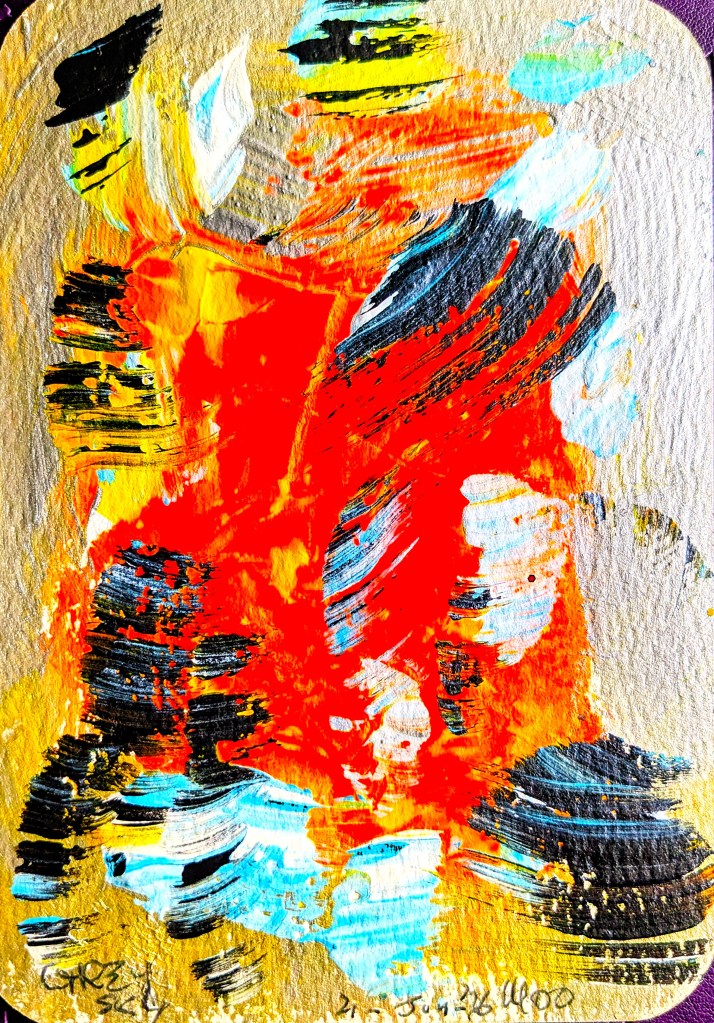
We don’t need a comment really except that The Olde Order Changeth Lest One Good Custom Should Corrupt the World. Interpret that as you will. And as Moo says to Ryan in the presence of Don Roger – “Hey, Ryan, look at all those changes in my painting.”

House of Dreams 5 & 6

House of Dreams

5

A leaf lies down
in a broken
corner
and fills me
with a sudden
silence.

I revise
our scrimshaw history
carving fresh tales
on the ivory
of new found bones.

6

A vixen
hunts for my remains.

She digs deep
at midnight
unearthing
the decaying teeth
you buried with
my borrowed
head.

Comment:

None of this makes sense. Why should it? Don’t ask me to explain it to you. Who am I to tell you what to think and what to do? You are not in elementary school now. Teacher is not leaning over you, teaching you how to shape letters with a pen, telling you to color in red, or yellow, or orange.

Learning – tell me what have you learned? Have you learned to think for yourself? Have you learned that life is mysterious, joyful, sad? Do you not know it can also be incredibly dangerous? Fear not the thunder. Rejoice in the rain and snow. Open your eyes to the world around you and be joyous wherever you go.

Meditation

I am the gatherer of words,
the weaver of wooly clouds.

I am the sheep dog
who shepherds the flock
in and out of the field.

I am the corgi
who snaps at the heels
of cows and pigs,
too small to be noticed.

I am the butterfly
turned into an eagle
who soars into the sky
and gazes on the sun
with an open eye.

Tell me,
my friend,
what and who
are you?

House of Dreams 3 & 4

House of Dreams
3 & 4

3

The light fails
fast, I hold up
shorn stumps
of flowers
for the night
wind to heal.

The pale magnolia
bleeds into summer:
white petals
melting on the lawn
like snow.

Sparrow sings
an afterlife
built of spring
branches.

4

Pressed between
the pages of my dream:
a lingering scent –
the death of last
year’s delphiniums –
the tall tree
toppled in the yard –
a crab apple flower-

a shard of grass
as brittle
as a bitter tongue
at winter’s
beginning.

Comment:

“La poesía se explica sola, si no, no se explica.” Pedro Salinas. Poetry explains itself. If it doesn’t, it can’t be explained.

This quote suggests that the poem is a self-contained entity that must be accepted and understood on its own terms. This is particularly true when metaphor rules and feelings and meaning are contained within the poem’s enunciation. In addition, the musicality of words can never be ignored. The rhythm they bear within them speaks for itself.

Show don’t tell – easy advice, but what exactly does it mean? So many people say so many different things. A cliché is always the simplest form of criticism.

“I don’t understand your poem,” Moo tells me.
“Neither do I,” I reply, “and I wrote it.”

“I don’t understand your painting,” I tell Moo.
“Neither do I,” Moo replies. “And I painted it.”

Words of wisdom.

Breathe deep.
Look and listen.
Don’t think.
Feel.

Hear the smell of color.
Touch the emanating light.
Taste the dry leaves crackling.

See the words shaping,
carving themselves
deep into your dream.

Rage, Rage 55

Rage, Rage
55

I walk on thin ice
at the frayed edge
of my life.

I search for the key
that will re-wind me,
but I fail to find it.

Who will winch up
the pendulums on
my grandfather clock,
resetting it
in spring and fall?

Who will watch
time’s sharp black arrows
as they point the path
of moon change
and the fleeting hours?

Each hour wounds,
or so they say.
Who will tend me
when that last one kills?

Comment:

Omnia vulnerant, ultima necat. / Each one wounds, the last one kills. That’s how the Romans thought about the collection of hours that make up a day. An interesting way of putting it. In lapidarian fashion. Four words that are worth a whole book of philosophical thought.

What is this thing called time? Good question, and one which is being asked more and more. Clearly time does not flow evenly within the human mind, though it is remarkably regular on the clocks we have invented to mark time for us. And remember, there are many types of time – seasonal time – spring time, summer time, autumn time, winter time. Strange that autumn – or fall as I have now learned to call it – is the only one that doesn’t have the word time attached to it.

And what about time changes – spring forward, fall back – when we change our clocks in order to make the most of daylight hours. A tedious process for many of us. I see some provinces are rejecting those changes and sticking to the same time, all the year round, from season to season. Personally, I would prefer life without those time changes, as would many of my friends.

Celestial time also known as sidereal time – the time as showed by the planets as they seem to march around the earth in the terra-centric universe. Rephrased, the positions of the planets as the earth turns slowly round the sun in the helio-centric universe.

Then there is the personal time of individual experience. An hour watching football or rugby on the tv set passes much more quickly than an hour passed in the doctor’s waiting room or the dentist’s chair. Of course, an hour watching a five day cricket test can also be a slow process, unless England are playing Australia in the Ashes. As one friend of mine commented, a long time ago, “I thought those English cricketers were unfit. But I’ve never seen anyone go out to bat and come back to the pavilion so quickly. They must be super-fit.” Alas, their cricketing problem, as usual, was centered on the three cants – can’t bowl, can’t bat, can’t catch.

En fuga irrevocable huye la hora.
La que el mejor cálculo cuenta
en lectura y lección nos mejora.

Irrevocable is the hour’s flight.
The one that counts the most
in learning or reading improves us.

Francisco de Quevedo
(1580-1645)

And remember – the hours fly by and your time is limited – spend it wisely and enjoy each and every day to the full limits of your abilities.

Rage, Rage 54

Rage, Rage
54

Terminal and terminus,
they both mean nec plus ultra:
the Pillars of Hercules,
the end of the known world,
and my own world’s end.

I throw my hands skywards
in desperation:
“Is anybody up there?”
There’s no reply,
and I see no ladder
for angels to descend
or ascend.

Only the crows,
those black-winged
monarchs
destined to wear
the survivor’s crown,
cry out their anguish
as they wait for the day
when they’ll pick clean
my unburied bones and
rule this sickening world,
an earthly paradise no more.

Comment:

When I said “I am looking for a picture of a crow,” Moo went wild. “Me,” he said. “I’ve got one.” And indeed he had. Here it is – two crows perched like vultures over the body of a fast melting snowman. Our current world in miniature – and don’t forget the yellow snow and the doggy doing a dump. “Moo,” I said, “That’s not nice.” “True to nature, though,” he replied. “You want reality – you got it.”

Reality – what a strange word. Who knows nowadays what is real? The barber’s basin in Don Quixote – is it a barber’s basin or is it Mambrino’s Helmet? Good question. Relativism – it depends on your point of view. U a barber’s basin – turn it upside down Ω and it’s a helmet. So how do we deal with an object that has two functions and can be seen both as one thing and then another?

Good question. Cervantes solves the problem in his own unique fashion – U – bacía / basin and Ω – yelmo / helmet. Put them together and you get the neologism [newly invented word] baciyelmo – a basin that serves as a helmet and a helmet that serves as a basin. Wonderful – if it weren’t for the snout, I’d swear that was the origin of the pig-faced bassinet.

Some days, I try to understand all this – but I throw my hands skywards in desperation: “Is anybody up there?” Another good question. I often ask myself that question but I despair of an answer.

My friend Francisco de Quevedo voiced the same question in a dream that came to me last night.

¡Ah de la vida! ¿Nadie me responde?

Life ahoy! Will nobody reply?
Is anybody up there?
Will someone reply?

Blas de Otero once made a similar utterance –

“I raise my hands in supplication
– you cut them off at the wrist.”

Tell me, if you know, – what is this life if, full of care, we have no time to stand and stare. And look at those crows, standing there, staring, waiting … waiting for their turn to come. Patient, eternally patient. Just standing around. Waiting.

Rage, Rage 52 & 53

Rage, Rage
52

A terminus, this waiting
room in which I sit.

This is the hospital’s
forgetting place,
the left-luggage office
where, a human parcel
wrapped in a blue gown,
I wait to be claimed.

Tagged with a label
on my wrist, I find myself
alone with my fate.

53

All choice disappeared
when I came here
and surrendered myself
to the system.

Now I lack free will
and freedom of choice.

Yet I still dream of choosing
my destination, and the ways
and means of arriving there.

Comment:

A terminus – what an interesting word. Terminus a quo or terminus ad quem? Or just a railway terminus or a bus terminus where we sit and wait to change buses of trains? Or maybe just a terminus in terms of being terminal? Oh what a tangled web we weave when we first start to analyze our words in order to see exactly where we might go and where they might lead us.

And what a journey I was on when I first wrote that poem. Sitting in the waiting room, outside the radiation room, waiting for the lady who would wag her finger and point at the machine’s next victim. Would it be me? The man next to me? That woman over there? Many of us avoided each other’s eyes and just sat there stunned – and now you know the meaning, in context, of ojos de besugo – do you remember that from Rage, Rage, 48?. Others chatted. Some sat there quietly while their teeth chattered. Few of us knew each other, except from the hospice where we stayed if we weren’t day patients travelling in on a daily basis and rushing home afterwards.

Libre albedrío – free will. We can say so much about free will and determinism. But when we enter the system, it’s the system that rules. We have free will to enter – and they [the authorities] say we have free will to exit when we wish – but do we? Good question. A very good question. Once tagged, we are as free as the birds, as free as the salmon, as free as the whales – but within that freedom we are tracked, followed, taken in hand, advised, persuaded, manipulated … and whales have a whale of a time when they’re trapped up in fish netting …

Then there are the follow-ups. The appointments. The emails. The telephone calls. The check-ups. The blood tests. The MRIs. The X-rays. The Holter appointments. The various scans. Who is brave enough to get off the wagon or to open the aircraft’s door half way through its flight over the Atlantic and step out? Would you jump from the save-yourself-train – not at all like the gravy train – and think carefully – are you really saving yourself or are you getting yourself into hotter and deeper water? Come along then, let’s open the aircraft’s door and step out over the Atlantic. And tell me, what exactly are we stepping into?

Stop the world, I want to get off! Not so easy to do, my friends, not so easy to do. Not even when you think the terminus in which you are sitting is taking you to hell in a hand-basket. You start to stand up. And the little lady appears, smiles at you, crooks her finger, nods her head, and – as obedient as one of Pavlov’s well-trained puppy dogs – off you go, following in her footsteps.

Rage, Rage 48


Rage, Rage
48

I carry memories
and scars like a snail
wears its shell
and I leave behind me
a slither of silver words.

I’m a broken gramophone,
needle stuck in a groove
repeating the same verses
again and again.
This repetition
drives me insane.

My thoughts just drift.
My body is a ship
in the doldrums,
no wind to fill its sails.

I pick up my paint brush
and paint myself –
lonely and blue
as idle as a long-lost lamb,
alone with nothing to do.

Comment:

The alienation of an alien nation – and I wonder if they really are here, those aliens. So many strange happenings in my life. The silver slither of words drags me through so many lost moments in time. Fray Luis de León, I spoke to him last night, asked me the question – “Es más que un breve punto / este bajo y torpe suelo comparado / con aquel gran transunto / do vive mejorado / todo lo que es, lo que será, lo que ha pasado?”

It’s a lovely verse in Spanish, but not so easy to translate into English. Let’s try – first, word for word – “Is it more than a small dot this low and stupid soil compared with that great sky world where now lives improved all that is, all that will be, and all that has happened?”

A comment on the translation – first, the length of the sentence and the way in which it is complicated by inversions and ideas expressed in words which have little direct translation. Then there is the expression – 1. a small dot – un breve punto – a short moment in time. 2. low and stupid soil – este bajo y torpe suelo – clumsy earth below. That clarifies, a little the meaning. 3. that great sky world – aquel gran transunto – that great sky above. 4. where – do [short for donde – to keep the syllable count] – where – 5. lives improved – vive mejorado – lives a better life.

Here goes: “Is this clumsy earth below more than a short moment in time compared with that great sky above where now lives a better life all that is, all that will be, and all that has happened?” Not great, but we can live with it.

As Miguel de Cervantes said “To read in translation is to look at the reverse side of a tapestry.” So, to imagine the real side of the tapestry we need to count our syllables – they don’t match. We need to measure the length of our lines. They don’t match. We need to sharpen our metaphors and images – they don’t really match. And, last but not least, we have to imagine the Platonic, Terra-Centric universe in which the sun moves around the earth and the earth is the centre of all life.

I should add the cultural association of words. In every language, each word has an “associative field of cultural meanings”. Those “associative fields” differ from language to language. So, even getting the verbal meaning correct means that you do not necessarily get the cultural associations right. In fact, it’s almost impossible to do so. It’s a fascinating world and one which I have explored in various academic articles.

I would like to take cultural meanings a step further. In Don Quixote, II, 11 – I quote from J. M. Cohen’s Penguin translation of 1950 (rpt 1961) – Don Quixote says to Sancho ” … if I remember rightly, you said that she [Dulcinea] had eyes like pearls, and eyes like pearls suit a sea-bream better than a lady” (p. 533). I will leave aside, for now, Sancho’s comic mixing of the Petrarchan metaphors and concentrate on the single word sea-bream. To compare someone’s eyes to those of a sea-bream is comical in English. However, the word has several associative fields in Spanish which are worthy of deeper study. Secondary meanings of a sea-bream – besugo – include 1. a mild insult, as in no seas besugo / don’t be a fool / an idiot / stupid. 2. Diálogo de besugos – two people talking and neither one listening to the other. 3. Ojos de besugo – a blank or dazed expression. Quite simply, the translation besugo > sea-bream functions at the literal level, but by no means at the cultural level of the associative fields.

Alas, some days I’m a broken gramophone, needle stuck in a groove, repeating the same things again and again. Maybe one day I will get them right. And maybe I won’t. Better minds than mine have struggled with translating Spanish (poetry) into English (poetry), and most have failed. Many, dismally. We won’t mention names. Sometimes the best translations are not translations at all, but poems that recreate the original in the target language. I am quite happy with my translation of the meaning of Fray Luis de León’s poem – but how sad would be any attempt to transfer the verse form from Spanish to English? Five lines of seven and eleven syllables each – wow! Go for it. But remember – fools rush in where angels fear to tread.

Never mind. Maybe tonight I’ll have another little chat with Fray Luis de León and Miguel de Cervantes, Quevedo too, if I am lucky. Maybe their English will be good enough to give me a few hints. I’ll let you know later if any one of them does come to visit.

Rage, Rage 46 & 47

Rage, Rage
46

I fall into
the easy sleep of age,
pencil in hand,
notebook on knee.

Shadows grow longer
as my life grows shorter,
day by day.

Now it is so easy
to stumble and fall,
each slip a steep slope
down which I slide.

So difficult now
to regain my feet.

I must crawl to where
I can haul myself
first to my knees
and then stubbornly
upward until I can stand.

47

Now-a-nights
I fall easily into dreams
that all too often
turn into nightmares
that rise up from my past
to trouble my sleep.

I struggle and scream
and pinch myself awake,
only to find my cheeks
wet with tears and my mind
all shook up by the return
of childhood fears.

Freud and Jung pull the strings
of those mental puppets
that dance in my head.
Some nights I am afraid
of falling asleep,
for fear that I may never
get up from my bed.

Comments:

Coming to the end of Rage, Rage. When it is finished, that will also be the end of the trilogy – Clepsydra [Chronotopos I], Carved in Stone [Chronotopos II], and Rage, Rage [Chronotopos III]. I have written a fourth volume in the sequence – No Dominion [Chronotopos IV], but this is very personal and I will probably only share it with family members and the closest of friends. However, do not despair – I have an alternate fourth volume, but that is still being written. It us under wraps, and may well replace No Dominion. We shall see.

As for Freud and Jung, they certainly do pull the strings of those mental puppets that dance in my head. Moo says that there should be no strings attached. He has therefore drawn all those strange puppet like figures, a but like an Aunt Sally, really, but has left out the strings and the man / men / woman / women / people pulling them. An Aunt Sally or a lovely bunch of coconuts? Time well tell, if you ask it nicely.

Maybe one of my teddies will tell. They all romp around the room with me at night and I am sure they suspect much of what goes on in my dreams. Here they are – a selection of friendly teddy bears. Be very careful, though, they can be very grumpy, especially if you wake them up suddenly. They don’t like things that go BUMP in the night.

Rage, Rage 44 & 45

Rage, Rage
44

But all is not lost.
Highlights of the day:
waking to birdsong,
making it safely to the bathroom,
shaving without cutting my face.

I step high to get into the shower
and wash my body
without dropping the soap.

I emerge
without slipping or falling
thanks to the safety rails
Extra-Mural
inserted in the walls.

I stand on the bath mat
and dry with my towel
those parts of the body
that are now
so difficult to reach,
especially between
my far-off toes.

45

I pull my shirt over
still-wet, sticky patches,
damp from the shower,
and negotiate each trouser leg
without catching
my toe nails in a fold.

I tug at the pulleys
of the machine
that helps my socks
to glide onto my feet.

I force those swollen feet
into undersize shoes
and hobble
to the top of the stairs.

Banister in one hand,
cane in the other,
I lurch down them,
descending with caution
one step at a time.

Comment:

I lurch down the stairs, descending with caution, one step at a time. Indeed I do. That whole process of getting up, washing, dressing, going down stairs, takes me a good half hour, sometimes more. I do things in order, one after another, each step the same every day. That way, I remember everything and forget nothing. Easier said than done! I often forget something, or do something out of order, and then I get muddled and I stand there befuddled. Muddled and befuddled. Not a good way to start the day.

Moo sometimes visits and watches me as I struggle with my clothes. He has been known to help, especially when my back is still wet and my shirt won’t go on, or my feet get stuck in my pants or my socks. Usually, though, he’s very good. He sits or stands there quietly, just watching. I think some of his paintings come from some of my struggles. I know the titles do. When I am muddled and befuddled he says I am all shook up. he says that’s where the painting comes from. I’m not so sure about that. I think he has a secret liking for Elvis Presley.

Funny going back over those old songs from the fifties and sixties. Long gone are the days when boarding school boys stuck their chewing gum on their bedposts overnight. I remember when we used to dare each other to sing ‘does your chewing gum lose its flavor’ in the school chapel during the morning service. I remember once having a bet with a friend how many Hallelujahs there were in the Hallelujah chorus. We dared each other to sing the number we chose. His number was higher than mine, and I remember his voice, singing out a lone solo Hallelujah and shattering the deafening silence of the packed school chapel.

And those limericks – “There was a young boy in the choir, whose voice rose up higher and higher. One Saturday night it rose right out of sight and we found it next day on the spire.” And that might be the only non-filthy Limerick that this old man can remember. Oh dear – all those songs we sang on the school bus!