Trees in bud sudden their break out fresh today a red fuzz here catkins over there
Fairy lights in the Mountain Ash goldfinches a mountaineer this downy woodpecker scaling the heights a star on top of the tree
Green the grass in places brown in others from last year’s drought
New Brunswick violets our provincial flowers a patchwork of blue
Dark green the early hollyhock leaves pushing stubbornly up and through to greet the sky
Commentary:
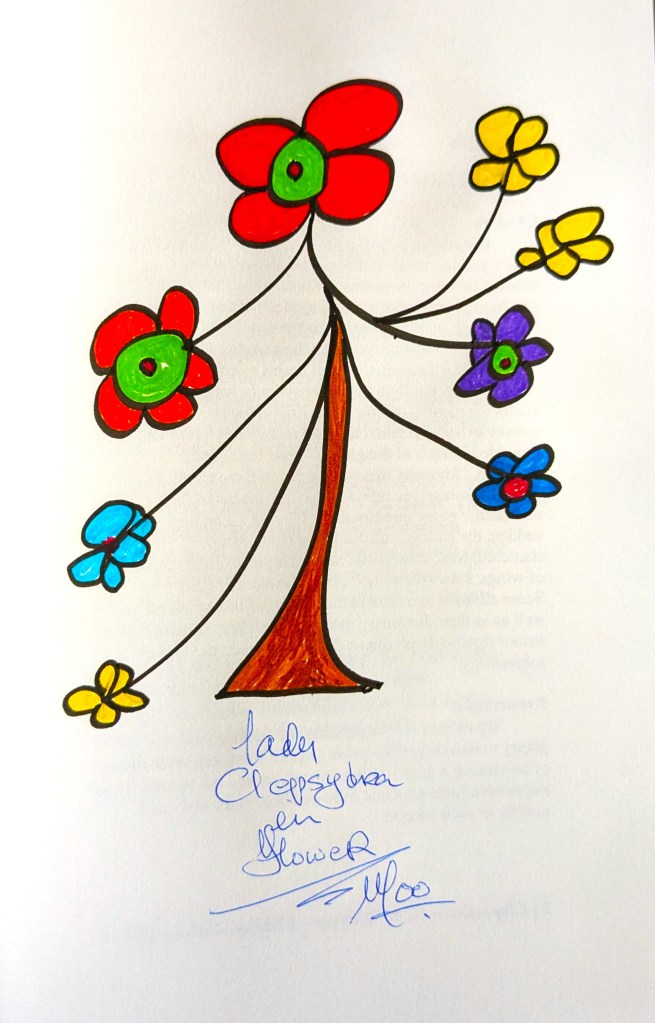
Mysterious indeed it is – to plant a clepsydra and watch it grow. Will it, won’t it? Does it suit the climate zone? Will it flower? Have you ever seen a flowering Clepsydra? Moo has. He draws and paints them all the time. But can he make them grow in my garden? We’ll have to wait to find out. He can certainly paint them.
But why does he call them mysterious? When I printed Clepsydra in my chapbook series, I mis-counted the pages and ended up with one blank page. “Mine!” said Moo. And he grabbed his colored pens and pencils and set to work drawing Clepsydras. That was his Mysterious Clepsydra Plant. Down below he has painted a Lady Clepsydra in Flower. Will the ones he says he planted in my garden be yellow, red, or multi-colored? Who knows? I most certainly don’t. And I am pretty sure Moo doesn’t have a clue about the plant life he uses to brighten my pages and plant in my flower beds.
Do you know what a Clepsydra is? Let’s ask Big Brother to draw us one. Hey, Big Bro – paint us a Clepsydra. A voice emerges from nowhere – “Say pretty please and I’ll think about it.” “Pretty please.” The metalic voice vanishes and a sign appears – Thinking!
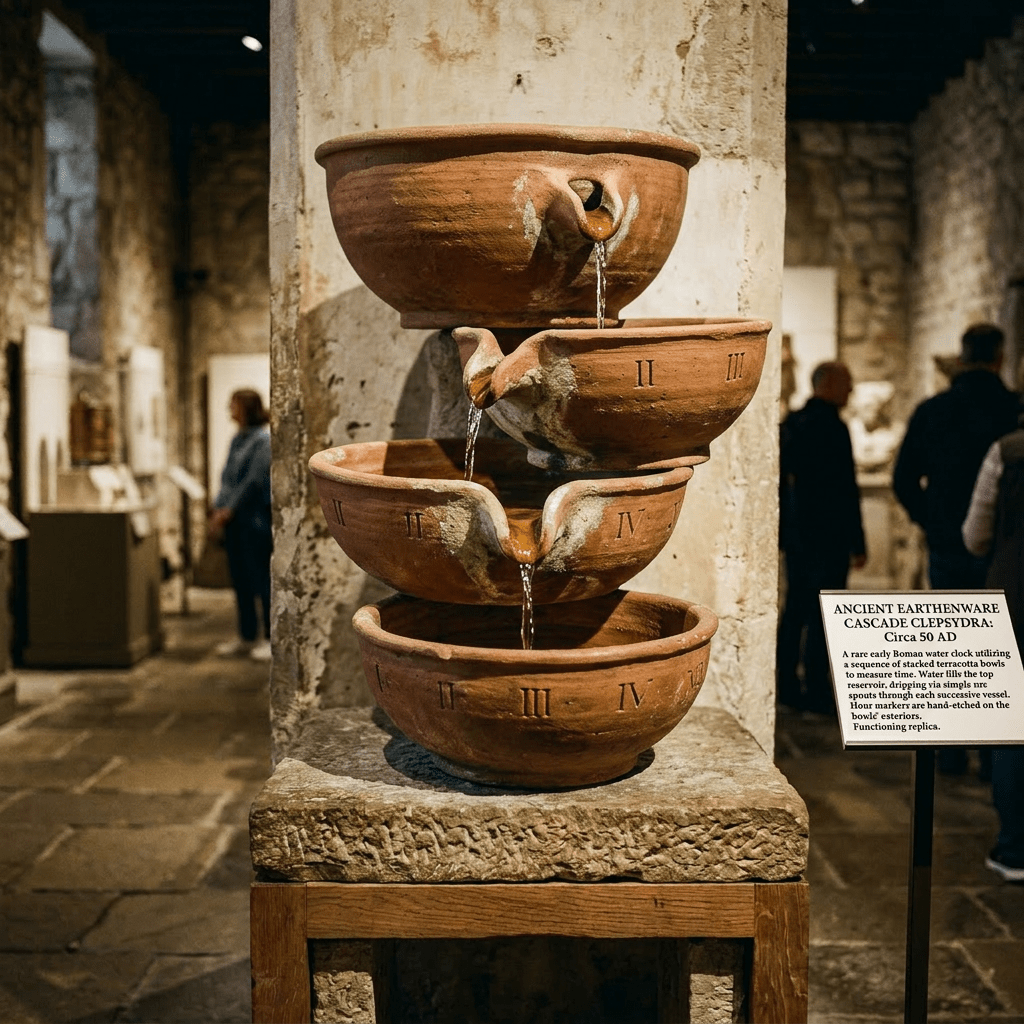
A functioning replica of a Roman water clock circa 50 AD / CE – a clepsydra – displayed in a museum
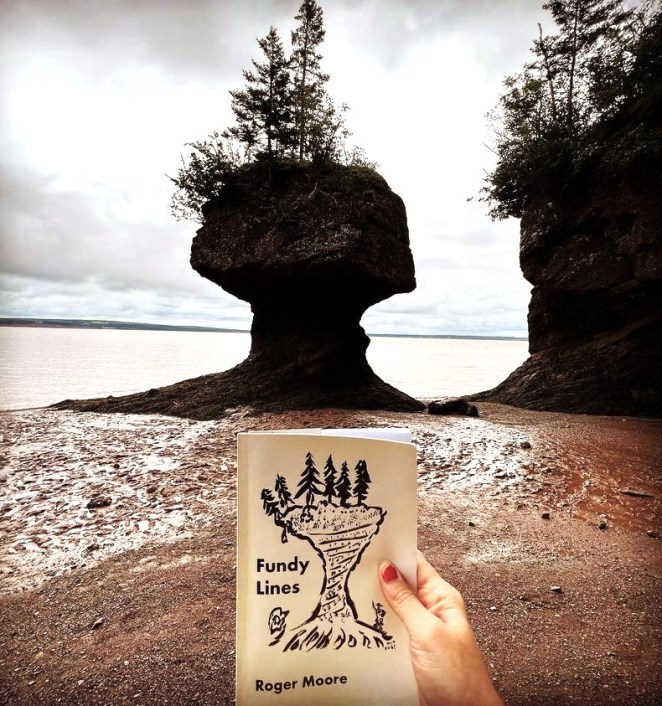
CE – Common Error – well I never. I guess poor Mistaken Moo made a common error and thought a Clepsydra was a flower. Time flows like a flowers, but it never flows back. If you see Moo, don’t tell him about this. He won’t be happy to know he can’t tell a flower from a set of flower pots. And what the heck would he paint if he went to Flower Pot Rocks? Oh no!!!! Well I never did. I blame Moo entirely. Shame on Moo! He’s fooled me again!
A hooded figure stands with a taped mouth in this powerful depiction of silenced expression.
Image generated by AI
Ryan and Don Roger
6
Censorship
Censorship plays an important part in many societies and can take multiple forms. The Spanish Inquisition, for example, along with book burning, played a powerful role in the printing industry. Every book had to be examined and approved by a member of the Inquisition. Political correctness is itself a form of censorship. It encourages people to think about what they say and how they are saying it. Many sorts of political correctness arise from the feminist movement that began to question the male domination of the English language. Actors and actresses became actors. In cricket, wicket-keepers, bowlers, and fielders passed the linguistic test, but batsmen and batswomen became batters. I sincerely hope that glove men, for wicket-keepers, do not turn into glove persons.
Nowadays, some people feel that the correction of language has gone too far and this has resulted in the anti-woke movement, as it is called. This rejects both the correction, and the hyper-correction, of what some people call imbalances in language, culture, and society. I will self-censor myself, rather than being censored by another person or persons, and refrain from what I personally feel about these ideas. Here, I merely point out that they exist.
Lazarillo de Tormes, for example, was heavily censored by the Spanish Inquisition. All anti-clerical references in the original edition, and there were many of them, were removed. The resultant volume, heavily redacted and much smaller, became known as Lazarillo Castigado / Lazarillo chastised.
To the best of my knowledge, the only piece removed from Don Quixote was the episode in which he made a rosary from the tail of his shirt, by tying ten small knots in it, and one large one. Since the shirt tail was used for many purposes, including wiping oneself, the censor thought this idea was indecent. Cervantes replaced the shirt tail with ten acorns and a chestnut in later editions.
He also managed to escape censure by placing all his questionable statements in the mouth of a mad man. Whenever an anti-clerical comment was made, readers (and listeners, for in those days, not everybody could read), chuckled at the enormity of the statement and rejoiced in the fact that only a madman could say such things.
Together with censorship comes correction. Thus Sancho, who is illiterate and can neither read nor write, is also unable to spell. In this fashion, he offers a series of incorrect pronunciations and phonetic equivalents that Don Quixote joyfully and carefully corrects. We see this in other characters too. In DQI, VII or 7, the devil named by the housekeeper, becomes ‘the sage Muñaton’ in the mouth of the niece. Don Quixote changes this to ‘Freston’. The housekeeper continues with ‘Freston’ or ‘Friton’ and adds “I know only that his name ended in ton.”
In our modern society, I see an enormous change taking place. Where I was educated by reading books, many books in my case, today’s younger generation teach themselves via AI and Chat. They watch videos. Watch TV. Text on cell phones. They listen to multiple podcasts. All this is audio-visual, little of it is written down. As a result, essays I received from my students were filled with phonetic spellings of words that they had heard, but not seen in written form. In addition, schools are no longer teaching cursive. My grand-daughter can print. She can neither read nor write joined letters. However, she can text faster with her two thumbs than I can with my index finger! The new generations have entered an electronic world that is totally alien to me.
Quis custodiet ipsos custodies? Who shall guard the guards? Who shall police the police? Who shall program the programmers? And with what shall they program them? A long time ago, the BBC in England banned Sesame Street because it was too simplistic. Today, Sesame Street equivalents rule. So, let us extend our questions – “Who shall censor the censors?”
Sometimes, it takes a madman to do it, in our case, a madman called Don Quixote! He, in his madness, encourages us, nay (or as Rocinante might say ‘neigh!’), he forces us to re-examine our links to language, to reality, to illusion. Reading his text, we learn to ask questions of the world around us. How many of our realities are illusions? How many of our illusions are corruptions of reality? How many times has Don Quixote been banned by figures in authority because of its attacks on authority?
Quis custodiet ipsos custodies? Who shall guard the guards? Who shall program the programmers? “Who shall censor the censors?” And who will protect us if we speak truth to authority, and authority doesn’t like the truths we offer? The author of Lazarillo remains anonymous. Cervantes distanced his words from himself and put them in the mouth of a madman. Other people have taken evasive action in other ways.
The alternative – stay silent and bleat with the sheep – “Four legs good! Two legs bad!” And when the Mastiffs with their spiked collars come for us, we can always, like the sheep, change our chant. “Four legs bad! Two legs good!” After all, all sheep are equal, even when some sheep are more equal than others, and all of us can imagine we are animals on George Orwell’s Animal Farm – and then we can say what we want and nobody will listen, nobody will pay attention, and nobody will understand. And remember, somebody, somewhere will want Animal Farm banned. And 1984.
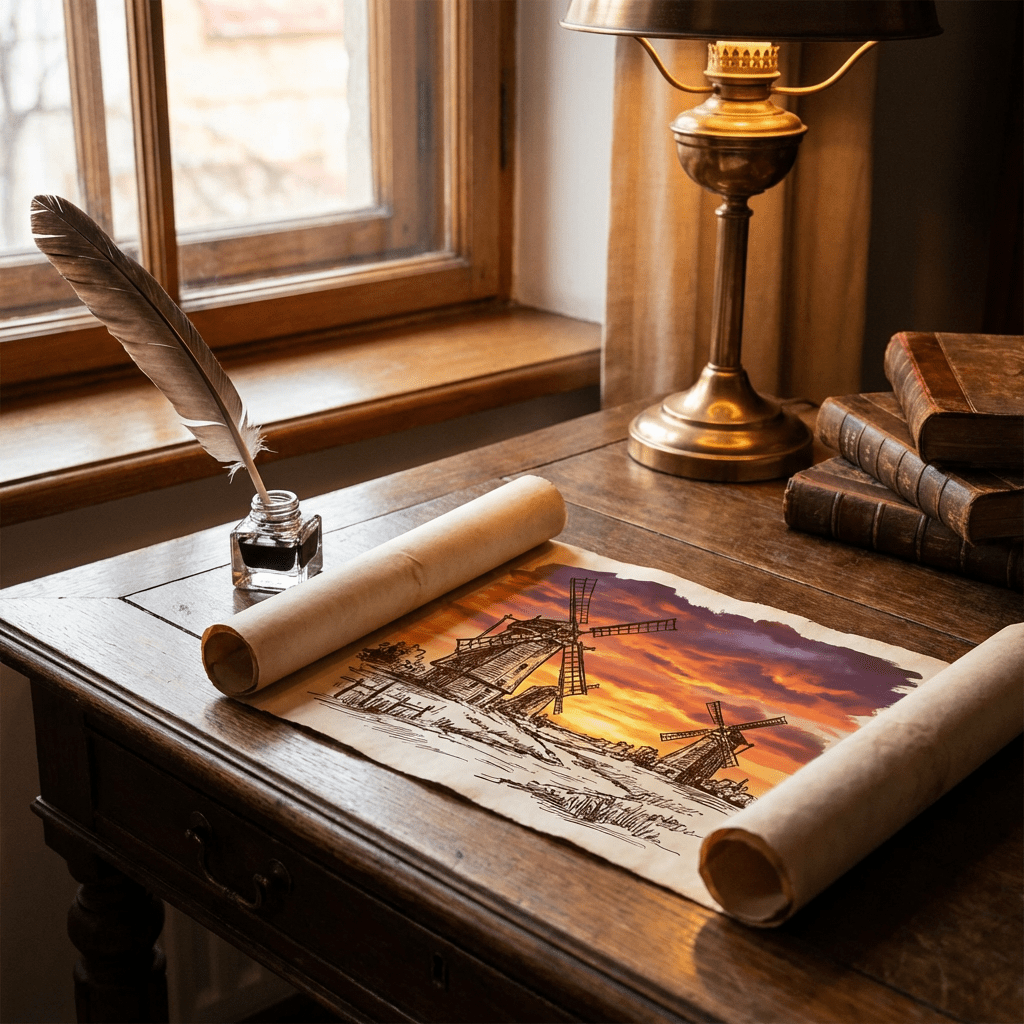
A beautifully detailed scroll depicting windmills at sunset rests on a classic wooden desk alongside traditional writing tools.
Image generated by AI.
Ryan and Don Roger
4
Stage to Page
So many questions – so much to say. Let us begin by stating that Cervantes is one of the most original novelists the world has known. Then we can continue by stating that, in spite of that, like Jean-Baptiste Poquelin, aka Molière, he is not above borrowing his material from other writers. When Molière was asked where he found sources for his plays, he replied “Je les prends où je les trouve.” Cervantes might well have said the same thing.
The source of the first sortie of Don Quixote is a short play, an entremés, called El Entremés de los Romances. These short, entertaining pieces were often installed between acts of a longer pay to keep the audience amused during the breaks. In this particular one, an old man thinks he is a knight and travels forth quoting the old border ballads and ballads of chivalry as if they were historical truth. Mind you, some of them were, or pretty close to it, especially those that carried news of the reconquest, but not all of them were true by a long way. The old man goes too far with his chivalry, gets a beating, and comes back home, draped over his horse which is led by a neighbor. Sound familiar?
In classical rhetoric, imitation – imitatio in Latin – was the highest compliment one could pay to another author as it meant he was worth imitating. Today, imitation is considered more a scourge to be avoided, although if you follow the crime and spy shows on TV you will know that the same, or very similar, incidents recur again and again, played out in different stories by different actors.
So, Cervantes starts out by imitating an older stage play and turning it from a play into a short story. This is creativity, beyond imitation, in itself. In this theory, the first story is in fact a short story, meant originally to stand on its own. This is not my theory, incidentally, I have borrowed it from my own teacher, Geoffrey L. Stagg, the man who introduced me to the scientific study of the Quixote. Stagg took as his evidence the first edition of the book in which he discovered an anomaly. The last sentence of Chapter Five ends in a comma (in the original, and certainly not in my translation by J. M. Cohen. I first read this book in 1965 – 61 years later, it is held together by glue and Scotch tape, a bit like Don Quixote’s helmet and armour!). To continue, the first word of Chapter Six begins with a lower-case letter, as if that word were joined to the last in the previous chapter. The heading of Chapter Six also runs smoothly into that first word as if they were joined. This suggested that in fact the two chapters had been united in a single story and had later been separated as the idea of turning the story into a novel dawned on the author.
But who is the author of Don Quixote? Miguel de Cervantes, obviously. But who is the narrator of the story? In the first sentence, this first person narrator states ‘a village in la Mancha that I do not wish to name – de cuyo nombre no quiero acordarme in the original Spanish. AI helps us out here. I quote – “Miguel de Cervantes was likely imprisoned in Argamasilla de Alba (specifically in the Cueva de Medrano) around the turn of the 17th century due to disputes arising from his work as a tax collector, or potentially a local dispute with a nobleman. This confinement, stemming from financial irregularities or local drama, is traditionally believed to be where he began writing Don Quixote.”
No wonder Cervantes, the initial narrator, does not wish to name that particular town. A little later, in an effort to embrace the readers and draw them into the text, the narrator uses the first-person plural- our text, followed by we make take it … we do not depart.
We will return to the narrative structure of the novel on many occasions. For the moment, we will leave the matter there. In narrative structure, the real Cervantes is the author. Cervantes, named or unnamed, is the narrator and becomes a part of the narration. I should add that the 1605 version of Don Quixote contains many short stories, that have nothing, or very little to do, with Don Quixote himself. We will return to these intercalated novels, as they are called, when we meet them later in the text.
But all is not lost. Highlights of the day: waking to birdsong, making it safely to the bathroom, shaving without cutting my face.
I step high to get into the shower and wash my body without dropping the soap.
I emerge without slipping or falling thanks to the safety rails Extra-Mural inserted in the walls.
I stand on the bath mat and dry with my towel those parts of the body that are now so difficult to reach, especially between my far-off toes.
45
I pull my shirt over still-wet, sticky patches, damp from the shower, and negotiate each trouser leg without catching my toe nails in a fold.
I tug at the pulleys of the machine that helps my socks to glide onto my feet.
I force those swollen feet into undersize shoes and hobble to the top of the stairs.
Banister in one hand, cane in the other, I lurch down them, descending with caution one step at a time.
Comment:
I lurch down the stairs, descending with caution, one step at a time. Indeed I do. That whole process of getting up, washing, dressing, going down stairs, takes me a good half hour, sometimes more. I do things in order, one after another, each step the same every day. That way, I remember everything and forget nothing. Easier said than done! I often forget something, or do something out of order, and then I get muddled and I stand there befuddled. Muddled and befuddled. Not a good way to start the day.
Moo sometimes visits and watches me as I struggle with my clothes. He has been known to help, especially when my back is still wet and my shirt won’t go on, or my feet get stuck in my pants or my socks. Usually, though, he’s very good. He sits or stands there quietly, just watching. I think some of his paintings come from some of my struggles. I know the titles do. When I am muddled and befuddled he says I am all shook up. he says that’s where the painting comes from. I’m not so sure about that. I think he has a secret liking for Elvis Presley.
Funny going back over those old songs from the fifties and sixties. Long gone are the days when boarding school boys stuck their chewing gum on their bedposts overnight. I remember when we used to dare each other to sing ‘does your chewing gum lose its flavor’ in the school chapel during the morning service. I remember once having a bet with a friend how many Hallelujahs there were in the Hallelujah chorus. We dared each other to sing the number we chose. His number was higher than mine, and I remember his voice, singing out a lone solo Hallelujah and shattering the deafening silence of the packed school chapel.
And those limericks – “There was a young boy in the choir, whose voice rose up higher and higher. One Saturday night it rose right out of sight and we found it next day on the spire.” And that might be the only non-filthy Limerick that this old man can remember. Oh dear – all those songs we sang on the school bus!
The truth, unwelcome as it is, is that the day I was born I took my first steps on the path to death, my own death.
Death – an inescapable law that tells me that body and spirit will be forced apart.
My flesh will wither and perish, and the person that the world and I know as me will no longer be able to hold together.
Commentary:
“The day I was born I took my first steps on the path to death.” An echo of a line from Francisco de Quevedo, of course.
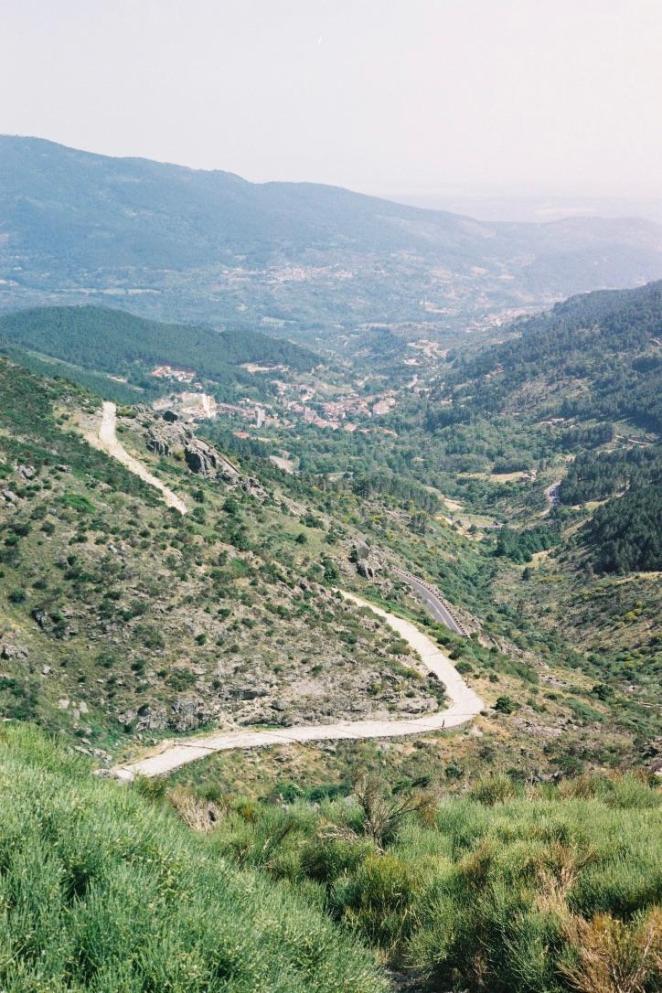
And the photo above? It is the old Roman road that ascends the Puerto del Pico in the Province of Avila. Hard to believe it was laid down nearly 2,000 years ago and still carries the transhumance cattle and sheep from the valleys in winter to the hills in summer. It is also a part of the Camino de la Plata, the silver road that brought precious metals from Spanish America to Madrid after the discovery and conquest of the Incan Empire.
The treasures of the Empire – what joy. Yet what weight around the neck of the Spanish nation. Wealth so abundant, spending so rife, money-lenders always lending, filling in the gaps between the arrival of the treasure convoys from the Colonies. And yet that borrowing became a millstone around the borrowers’ necks. So much money borrowed that there came a moment when each convoy only served to pay off the loan debt of the last set of borrowings.
The cattle and sheep struggle to climb to those heights. Yet it is not difficult to imagine how much easier it was to walk downhill, beside the creaking wagons that held the gold and silver to pay off the monarch’s debts, en route to the king and his court.
Think also of the squeals of anguish heard when the treasure fleet did not arrive. Captured by the English pirates, or hurricane battered and lost in the Caribbean or closer to home. This meant even more borrowing on the back of earlier borrowing and always the cost of living and the lending rates rising higher and higher.
Now, my heart is once more a time-bomb ticking beneath her fingers.
I dream of walking tall, with her by my side, in the youthful paradise of a distant, long-promised land.
My tom-tom heart, softening clay, putty beneath her fingers, thumps out a hoodoo voodoo beat on its drum.
Victor Sylvester, and his orchestra, Sundays on BBC radio, announces his signature rhythm – slow, slow, quick, quick, slow – my mind waltzes to the music plucked from my heart strings.
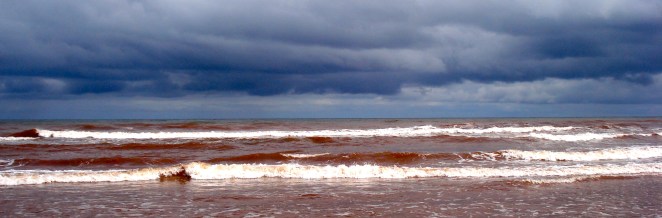
Wild winds blow in from the shore buffeting my heart, breaking it apart. Blown open, in spite of my dreams, my secret is not a secret anymore.
Comment:
Absent without leave, I have chased the dreams of rugby and cricket and abandoned my poetry until another today. And here I am, a week after St. David’s Day, still dreaming, still raging, still recalling so many things.
Wild winds blow in from the shore buffeting my heart, breaking it apart. You can see, in the photo above, the wind tugging at the waves. A lurid sky fills with heavy clouds and oncoming rain. My heart is out there somewhere, wave-washed, blown open by the simple beauty of wind and sea.
How many now recall Victor Sylvester on BBC Radio on a Sunday afternoon? Or the Billy Cotton Band Show? That was our Sunday afternoon entertainment long before we had TV. You can’t imagine it, can you? A world without TV. So many things fade away from far too many people.
Who now will talk of my Voce and my Larwood, long ago? How many saw Hammond at his best, with his imperial cover drive? Ken Jones? Cliff Jones? JJ and JPR? Lloyd and Bleddyn? Old visions, buffet my heart, breaking it apart. Frank Worrall in Swansea at St. Helen’s. Everton De Courcy Weekes at Bristol, in the County Ground. I have the photos. I have the memories. And I have a broken heart when I remember things, some personal, some not, that so few people do.
It exists only in my head, and on the page, but perhaps, one day, you too will see the things I have seen.
Yet the world I describe is as unreal as the words from which it is woven.
73
Heraclitus once wrote we can never bathe in the same river twice.
This is the Catch 22 faced by all poets, to remember, and to try to recreate.
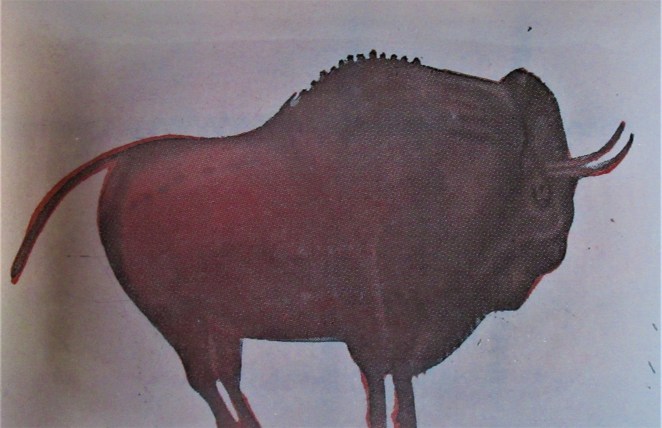
Shadow hands on cave walls, colored pictographs on gesso, hieroglyphics on papyrus, ink on paper, raw words, and in the end, everything reduced to these three little letters carved in stone –
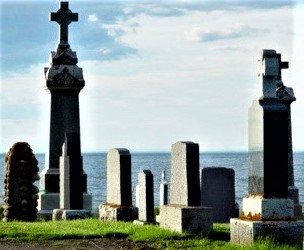
RIP
Commentary:
If you have read this far, we have walked a long journey together – 73 verses that comment on life and the meaning of life. Hard reading in places, easy in others. I trust you have enjoyed the journey and found some stops and resting points along the way in which to contemplate the ways in which the threads of your own life intermingle with mine.
Throughout this journey, I have tried to use a four step process. (1) Verbal – the poems themselves. (2) Visual – photos that intertwine with the verbal. (3) A Commentary – that goes beyond the verbal and visual and opens up the ideas a little more. (4) A Dialog between myself – the poet – and Moo – the visual artist who has so frequently loaned me his paintings when he thinks they illustrate my words.
It’s been a topsy-turvy journey through what Bakhtin calls a world of carnival, where little is at it seems, and the world is turned upside down. That said, we have a clear choice – to slide down the downside of this life, or to scale the upside, to contemplate, with joy and happiness, the world from those heady heights.
Blessings. Pax amorque. And thank you for travelling with me.
Wales is whales (with an aitch) to my daughter who has only been there once on holiday, very young, to see her grandparents, a grim old man and a wrinkled woman. They wrapped her in a shawl and hugged her till she cried herself to sleep suffocating in a straitjacket of warm Welsh wool. So how do I explain the sheep? They are everywhere, I say, on lawns and in gardens. I once knew a man whose every prize tulip was devoured by a sheep, a single sheep who sneaked into the garden the day he left the gate ajar. They get everywhere, I say, everywhere. Why, I remember five sheep riding in a truck on the coal train leering like tourists travelling God knows where bleating fiercely as they went by. In Wales, I say, sheep are magic. When you travel to London on the train, just before you leave Wales at Severn Tunnel Junction, you must lean out of the carriage window and say “Good morning, Mister Sheep!” And if that sheep looks up, your every wish will be granted. And look at that poster on the wall: a hillside of white on green, and every sheep as still as a stone, and each white stone a roche moutonnée.
Commentary:
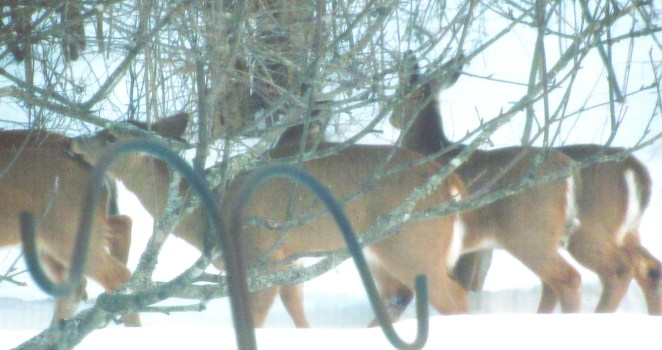
Sheep in Wales and deer in Canada. And here is a little group wandering around in our garden. So how do I explain the deer? They are everywhere, I say, on lawns and in gardens. I once knew a man whose every green leafed plant was devoured by a herd of deer, who sneaked into the garden the day he left the gate ajar. They get everywhere, I say, everywhere. And everybody loves them, because the heart beats a little faster when you see them walk by.
Here, in the abyss, where song-birds pluck their notes and send them, feather-light, floating through the air, here, you’ll find no vale of tears, no fears of shadow-hawks, for all blackness is abandoned in the interests of sunlight and song.
Here, the crystal liturgy surges, upwards from the rejoicing heart, ever upwards, into the realms of light, where color and sound alike brim over with the joy that, yes, brings release to head and heart.
Here, seven-stringed rainbows reign, the everlasting harp is tuned and plucked, and an eternity of music cements the foundations of earth and sky.
Here, the master musician conducts his celestial choir, their voices rising, higher and higher, until they reach the highest sphere, and song and voice inspire, then expire, passing from our eyes and ears into unbounded realms of light.
Here, the seven trumpets will sound their furious dance, a dance that will announce the end of this singer, the end of his song, but never the end of song itself.
Commentary:
Crystal Liturgy is the first poem in the poetry sequence Septets for the End of Time. I will start placing these poems here and you can follow the sequence as it evolves. It consists of 56 poems – seven septets and a coda.
A Note for Readers
Olivier Messiaen is one of my favorite composers. I purchased his Quatuor pour la fin du temps / Quartet for the End of Time in Rimouski, PQ, in 1982 while driving around the Gaspé Peninsula. I was fascinated both by the music and by the words that headed each section. I should note that I have always enjoyed ekphrasis, the verbal description of visual works of art. With Messiaen, I tried to recreate not only the thoughts and images generated in me by his music, but the spaces and repetitions that come from light and dark sounds and birdsong caught in the intervals between notes. This was a new sphere of experimental writing for me and while composing I played first the Quatuor pour la fins du temps / Quartet for the End of Time, then Éclairs sur l’au-delà/ Lightning above the Beyond, and finally Petites esquisses d’oiseaux / Little Sketches of Birds. What I tried to capture came from within my own mind, but the metaphors and images were inspired by listening to Messiaen’s music.
Winter’s chill lingers well into spring. I buy daffodils to encourage the sun to return and shine in the kitchen. Tight-clenched fists their buds, they sit on the table and I wait for them to open.
For ten long days the daffodils endured, bringing to vase and breakfast- table stored up sunshine and the silky softness of their golden gift.
Their scent grew stronger as they gathered strength from the sugar we placed in their water, but now they have withered and their day is done.
Dry and shriveled they stand paper- thin and brown, crisp to the touch. They hang their heads as their time runs out and death weighs them down.
Commentary:
A sad poem, really, for a wet, damp, dark, chilly day that begs for some light and warmth. And what warmth and light daffodils bring. Not to mention their delicate scent that lingers long in the nostril, faint, but intoxicating. For ten long days the daffodils endured. This was a joy in itself. Sometimes cut flowers wither so quickly. But ten days … wow! And they do indeed bring to vase and breakfast-table stored up sunshine and the silky softness of their golden gift.
Their scent grew stronger as they gathered strength from the sugar we placed in their water. Indeed it did. And the sugar itself enhanced their ability to linger on. A little Somerset trick that, all the way from Zummer Zet where the cider apples grow. And no, you can’t have real cider without real cider apples from real cider apple trees. But never forget Sally the Sozzled Sow – she got into the storage shed and drank about five gallons of the stuff. It was all over the newspapers. She got loose and knocked the milk churns over and rolled them in the clover. The corn was half cut at the time, and so was she.
Dry and shriveled they stand paper-thin and brown, crisp to the touch. So sad when this starts to happen. Then one day, they just fade away. And then they hang their heads as their time runs out and death weighs them down. Sad, really, as I said at the start – but we must never forget the joy and light and happiness they bring us when they are in their prime.






 rogermoorepoet