Clepsydra 30

30

… but before all that
     did I emerge slowly
          from the grain
               of a granite heart
                    as a sculpture
                         emerges from stone

I broke out of a silent world
     left the flesh-and-blood house
          where my mother lodged me
               abandoned that amniotic silence
                    broken only
                         by my mother’s heartbeat

my own heart
     responded to that rhythm
          until I materialized
               and slipped into
                    this waiting world

only to be held at the hips
     trapped
          a climber in a cave
               half out
                    yet not able to break
                         completely free

and me
     visited all my life
          by the nightmare
               of that pincer grip
                    until the doctor
                         forceps in hand
                              pincered me
                                   and drew me forth
white meat
     from a reluctant lobster’s claw
          silent
               dangling upside down
                    a special lobster
                         blue at the bottom
                              red at the top
                                   breathless
                                        motionless

until that first slap
     broke the silence
          and wailing
                I came into
                     that waiting world …

Commentary:

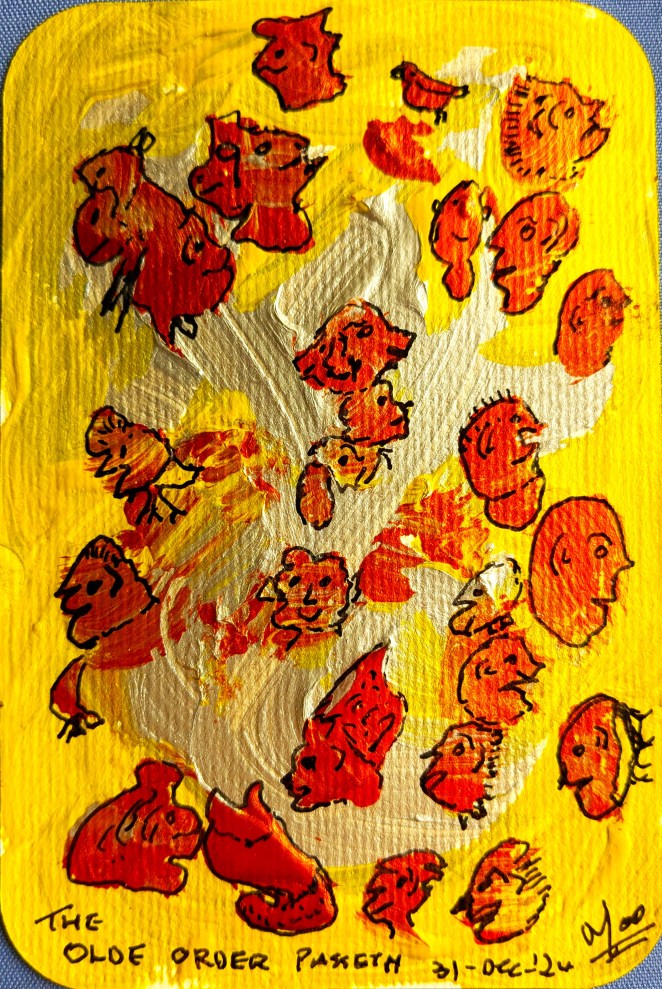
Nice painting, Moo. I like that. Its original title is Walking on Air, and I guess that’s what it might have felt like, dangling up side down, held by my feet, trying to walk on my hands, and look at all those suggestive colours. Colors / colours – English or Canadian? Does it matter? Red is still red and a rose by any other name would smell as sweet.

“Vanity of vanities, all is vanity.” Ecclesiastes, if I am not mistaken. “Great knowledge brings great grief; for in much wisdom is much grief, and he who increases knowledge increases sorrow.” So, we live and we learn, but what do we learn? Only the wisdom of all the wise people who walked this way before us. “In my beginning is my end …” – T. S. Eliot – “and in my end is my beginning.” In blood we begin our days, and in blood will we end them, just as the day begins with the spilling of the sun’s blood and ends in an evening of glory. Except when it’s cloudy, and then, of course, we have to guess what’s happening.

Guess-work – we guess how it began and we guess how it will end. And there’s the Clepsydra for you – drop after drop of water and people gathering knowledge, only to know how little they know, for, as Erich von Richthofen said, in the Medieval Course at the University of Toronto, a long time ago, in the 60’sixties of the last century which was also in the last millennium – “The more I know, the more I realize how much I don’t know.”

Clepsydra 28 & 29

28

… diagnosed
     with a terminal illness
          called life
               I know it will end
                    in death

I have seen many
     pass that way
          two-legged humans
               four-legged friends
                    and none have come back

I recall
     holding the dog’s shaved paw
          while the vet slipped
               that last redeeming needle
                    into the exposed vein

the dog’s eyes
     pleaded for release
          her tongue licked my hand
               oh so trusting
                    even at that
                         for me
                              so bitter end

and did the poor dog know
     what was coming
          did she live her life
               as I have led mine
                    waiting for that last word
                         to be spoken
                              the last order given …

29

… two of us
     me and my death
          walking side by side
               everywhere
                    sharing the same bed
                         sleeping between
                              the same sheets

I wonder if
     we dream
          the same dreams

my death
     how would I greet him
          when he came
               as executioner
                    not friend

I re-create him as a man
     or as a dark angel
          with all-comforting wings

is he open-eyed,
          while I am blindfolded
               not knowing the way
                    afraid of falling

this death
     is it cruelty
          or merely love               

the path is ahead is new
     and totally unknown …

Commentary:

Many of the images in these two pieces are exercises in intertextual examples, Stanza 29 in particular, drawn from the Neo-Stoicism of Francisco de Quevedo (1580-1645). His advice, set out in poem after poem, is to embrace death before it comes. Prepare for it, mentally, and be aware that it is the natural end of life. As Dylan Thomas also writes, “Every morning when I wake, oh Lord this little prayer I make, that thou wilt keep thy watchful eye on all poor creatures born to die.” The Dunvant Male Voice Choir gives us this version of it. Remember to turn your sound on! I like this version, not just for the music, but also for the views over one of my favorite childhood beaches, Rhossili and the Worm’s Head, not far from my home in Gower.

As I grow older and creakier, as my ailments accumulate, one by one, so I realize that indeed I have been “diagnosed with a terminal illness called life.” It’s funny to think of life as a terminal ailment. “Take two Tylenol and when you wake up tomorrow morning you’ll be feeling much better.” And yes, like every sane person “I know it [this terminal ailment] will end in death.” So, don’t be sad. Carpe Diem – seize each day and enjoy every one of them to the best of your ability. Remember the inscription on the Roman Sundial – horas non numero nisi serenas – I count only the happy hours. Whatever you do, have no regrets. If you do have some, make your peace with them now – or as soon as you possibly can. And, when the call comes, go willingly. Step with pride and joy onto that new and unknown path that will lead you to an eternity of joy, acceptance, and love.
                   

Cage of Flame

Cage of Flame

Now you are a river
flowing silver beneath the moon.
High tide in the salt marsh:
 your body fills with shadow and light.
 I dip my hands in dappled water.

Twin gulls, they float down stream,
then perch on an ice-floe
of half-remembered dreams.

Eagle with a broken wing,
why am I trapped in this cage of flame?
When I turn my feathers to the sun,
my back is striped
with the black and white
of a convict’s bars.

Awake, I lie anchored
by what pale visions
fluttering on the horizon?

White moths wing their snow
storm through the night.
A feathered shadow ghosts
fingers towards my face.
Butterflies stutter
against a shuttered window.

A candle flickers in the darkness
and maps in runes
the ruins of my heart. Eye of the peacock,
can you touch what I see
when my eyelids close for the night?

The black rock of the midnight sun
rolled up the sky.
Last night, the planet quivered
beneath my body
and I felt each footfall
a transient god.

When will I be released
from my daily bondage?

Commentary:

Moo reminded me that this poem also existed as a prose poem. here it is in prose layout. Think about it and let me know which version you prefer. Is one easier to read than the other? Do the rhythms come through more strongly in one version? Meanwhile, since he hasn’t painted a cage of flame, nor a river flowing silver, he suggested that if I really felt like the poem suggested I might feel like, then All Shook Up – with its warm, colorful flame images, might be just the poem to fit the crime. Better, he said than playing billiards on a cloth untrue, with a twisted cue, and elliptical billiard balls.

I wonder how many people recognize that little tip of the hat to the past glories of English Comic Opera? Since Canada post is on rotating strike – talk about twisted cues and elliptical billiard balls – then send your answers by highly trained snails (snail mail) or dog sled via whatever route still has enough snow for the huskies to haul on. Meanwhile, Ottawa has declared that the Maritime provinces are continuing with their suffering a buffering from lack of rain and severe drought. I do long for that river flowing silver, not to mention high tide in the salt marsh. We need water badly. And the sooner the better. Aquifers, rivers, wells, they all need filling.

Ah, the majestic game of cricket – and how I long for that summer test match curse – Rain Stopped Play. Or as the BBC commentator said on the radio one day – I heard him – “play has been stopped because of piddles on the putch – oh, sorry, I mean puddles on the pitch.” I wonder what Mr. Hugh Jarce would have thought of that. I know he always loved that old cricketing Chestnut – ‘The bowler’s Holding, the batsman’s Willey.” Unlike much wanted rain, it didn’t stop the match, but the commentators who perpetrated that jest laughed so much, the commentary stopped for nearly five minutes. Oh, the things one remembers as one gets old. Now, where did I put my glasses? I wonder if my beloved knows.

Cage of Flame

Now you are a river flowing silver beneath the moon. High tide in the salt marsh: your body fills with shadow and light. I dip my hands in dappled water. Twin gulls, they float down stream, then perch on an ice-floe of half-remembered dreams. Eagle with a broken wing, why am I trapped in this cage of flame? When I turn my feathers to the sun, my back is striped with the black and white of a convict’s bars. Awake, I lie anchored by what pale visions fluttering on the horizon? White moths wing their snow storm through the night. A feathered shadow ghosts fingers towards my face. Butterflies stutter against a shuttered window. A candle flickers in the darkness and map in runes the ruins of my heart. Eye of the peacock, can you touch what I see when my eyelids close for the night? The black rock of the midnight sun rolled up the sky. Last night, the planet quivered beneath my body and I felt each footfall of a transient god. When will I be released from my daily bondage?

Tell us about a time when you felt out of place!

Tell us about a time when you felt out of place!

I think it would be much easier to tell you about a time when I felt as if I was in my proper place. There were so few of them. As for the original question – Tell us about a time when you felt out of place – I think that a time should be replaced by the many times. Learning languages has always been more of a pain than a pleasure, for me, anyway. In the Basque Country, Northern Spain, at first with my parents, and then on my own. Sitting at the table or standing in the kitchen, listening to people chattering away in Spanish some days, in Basque, on other occasions. I was reduced to interpreting looks, smiles, scowls, meaningless sounds … how could I have felt that I was in my proper place? Etiquette – I knew nothing about their etiquette. Culture – I knew nothing about their culture and they knew even less about mine. I lived in a world where waves of sound battered at my body and I stood there, a rock on a seemingly deserted linguistic beach, being gradually worn down by the endless waves and the eroding tides. How could I have felt anything but ‘out of place’?

The same thing happened when I became immersed in French culture. I spent some time in the South of France, in an area where Provencal was still spoken. Between the two languages and the differing accents, I was lost, lost, lost.

Something similar happened when I came to Canada. Here, it wasn’t the language that baffled me, but the culture. I remember trying to learn to skate. My cousin played Junior “B” hockey and volunteered to teach me. Well, I learned very slowly (a) to keep my balance and (b) to move forwards very slowly. However, I couldn’t skate back wards and I couldn’t stop. In spite of that, I decided to try and play hockey. The park close to where I lived in Toronto had a frozen area where the little kids played shinny. I asked if I could join in. After three falls and a total inability to stick handle in any known fashion, they stuck me in goal. I used the goalie’s stick to try and stand up. After the third or fourth goal, one five or six year old whisked up to me, stopped in a sideways shower of ice, and said “Sir, please sir, you’re allowed to use the stick to stop the puck, you know.” I retired from ice hockey soon after that, and from skating. I did learn to cross-country ski, though. I also earned the name Wapiti (white-tailed deer) long before I saw one or knew what it meant.

And that is all just scratching the surface. I could say more, so much more. But I’ll control myself.

Clepsydra 16-17

Clepsydra 16 & 17
Click on the following link for the previous stanzas
Clepsydra 14 & 15

16

… would this be the beginning
     or the end

men and women
     on the street
          hands out
               fingers splayed
                    panhandling

their eyes
     black holes in empty faces
          not brain dead
               just drained of hope
                    brains deadened
                         by blow after blow

loaf after loaf crisping
     blackening in life’s oven
          fit only for preacher crows
               flitting from tree to tree

descending on garbage day
     to feast on desperate souls
          marooned kerbside
               for garbagemen to find …

17

… no soul allowed
     to weigh more than forty pounds
          each one swaddled
               in a plastic garbage bag
                    that serves
                         as a winding sheet

dust to dust
     to grey-faced ashes
          wound up by brawny arms
               swung flung skywards
                    into the truck

then ferried away
     to that place where crows
          and hunch-backed vultures
               gulls and humped eagles
                    wait for merciless ferries,

they cross into the shadow lands
     who was the one who found me
          who untied the ties that bind
               freed me from my cell
                    the shell of myself
                         and set me free …

Commentary:

Poetry explains itself.
If it doesn’t, it’s inexplicable.

What aspects of your cultural heritage are you most proud of or interested in?

What aspects of your cultural heritage are you most proud of or interested in?

Right now, I am quite interested in (re-) learning the Welsh Language. Although I was born in Wales, I was never allowed to speak Welsh at home and my parents sent me to schools in which Welsh was never seen nor heard, let alone taught. That didn’t stop me from hearing out on the streets, reading it on the street signs, or visiting places whose names were only available in Welsh, or an Anglicized form of Welsh.

I am no longer an assiduous student of languages, but I get a Welsh Word a day by e-mail, and each word comes with an explanation of meaning and extended meanings. I also receive the words’ pronunciation and its phonetic changes (something peculiar to Welsh – they come in written form and can be quite complicated). Useful sentences are added – not long, but 3-4 seconds, repeatable ad infinitum, by reliable Welsh speakers, who often offer the variant pronunciations not only of North and South Wales but of other regions as well.

A great deal of linguistic and cultural history is wrapped up in language and the origins of the word are analyzed – sometimes going back to Indo-European, proto-Welsh, Medieval forms, and modern changes to the language. Emphasis is also placed on the survival of Welsh and its preservation, in written form, in Y Beibl Cymraeg, The Bible in Welsh. This fixed the language and helped enormously in its preservation.

I am also interested in Welsh Songs and Hymns. I already know most of the tunes having sung them in English during my childhood. Now I am learning them in Welsh and am currently working on the words to Calon Lan, one of my favorite hymn tunes. So, there you are. A new start at a very advanced age. A return to the past and an investment in the unknown future!

Monkey Turns Down Promotion

Monkey Turns Down Promotion

“I hereby appoint you head of the asylum.”

The young office monkey with the plastic stethoscope
was dressed neatly in a white sheet.

“Dr. Freud, I presume?”
Monkey held out his hand
but his witticism was lost in a flood of water
flowing from the flush and over the floor.

Monkey stood there, paddling in piddle.
Inmates with crowded heads and vacant faces,
fools grinning at a universe of folly,
paddled beside him. He wiped
a sick one’s drool from his sleeve.

The office boy spat on his hands,
slicked down his hair, and placed
his stethoscope on monkey’s heaving chest.

“You have no pulse.”
“How do you know I have no pulse?
Surely, you cannot hear my heart
for you have a banana stuck in your ear.”

“Speak up!” said the doctor,
“I cannot hear you:
I have a banana stuck in my ear.”

Then monkey felt fear.

Daylight diminished
and waters closed over his head.
He spurned the proffered paw,
the life belt thrown
by the offer of a new position.

Exit monkey left,
pursued by a chorus:
“Run, monkey, run!”

Commentary:

A Golden Oldie from Monkey Temple (2010). I came across it by accident as I thumbed through some older books – wow, fifteen years ago that came out. A Golden Oldie indeed. I had forgotten all about Monkey Temple. However, the last couple of days I have watched New Zealand vs Canada and England vs France (Women’s Rugby World Cup). Both semi-finals took place at Ashton gate, Bristol. That’s when I started thinking about Bristol and Bristol Zoo.

We had family in Bristol (Westbury-on-Trym) and from an early age we visited Bristol Zoo. One of my favorite places was the old ruined Monkey Temple, full of monkeys that impressed me with their antics. A small, walled zoo, it was full of innovations and I remember well Alfred the Gorilla and Rosie the Elephant. I loved the rides on Rosie’s back. The camels too offered lifts to young children and the elephants took apples from my hand with their long trunks. I also remember the bear pit, and loved watching the brown bear climb to the top of his pole and catch food thrown to him by the visitors.

I think everybody’s greatest thrill came with feeding time for the seals. What a racket when the attendant appeared with his / her pail of fish and he/she threw them to the waiting seals. Almost as thrilling was the penguin house with its aquarium and glass windows. Animals that seemed so clumsy, waddling on land, turn into sea-angels when they dived and we could meet them, face to face, so to speak, almost in their own environment.

My love of zoos reached out and I recall the zoo in Madrid, established when Columbus returned from his voyages with species of animals hitherto unknown. And who could forget Copo de Nieve, the albino gorilla in Barcelona zoo.

Alas, my zoo day’s are over. But the world is wonderful. Today, two deer entered our front yard, lunched on the fallen crab apples, and went to sleep underneath the trees outside our window. Joy to the world and the world brings me joy -sunrise and sunset, colored clouds, the deer in my yard, a fox passing through. However, I must admit I am not impressed by the little red squirrel that nests under the hood of my car and gnaws my cables. Nor by the porcupine who loves the salt in my garage doors and nibbles at the door frame every chance it gets. The love of nature – red in tooth and claw – I guess we have to enjoy the good and put up with the bad. Life’s like that. “Ask the animals, they will teach you.” Bristol Zoo motto.

Fear

Fear

Now is the time of fear:
ice on the morning step,
a child’s slide on the sidewalk,
a parking space too narrow
for me to get out of the car.

Sometimes the shopping cart
lurches beneath my weight
and I clutch at thin air:
each fall a precipice.

An emptiness in the gut,
a tightening of the elastic band
clamped around chest and heart,
a chill through the bowels
in the washroom’s dark:

 a long night that threatens.

Commentary:

Things happen, from time to time, and seem inevitable. With the coming of fall and the threat of frost comes the fear of ice. All year round, the fear of wet and slippery floors walks beside me. I am very careful about how and where I place my canes.

Shopping brings the fear that someone will park so close to me that I cannot get back into the car. Shopping carts can be treacherous. In one shop, their light-weight carts always seem ready to tip up or lurch over. The tell-tale leap in my chest reminds me that yes, this can and does happen. I am ultra careful in that particular shop.

Oh yes, and don’t forget the diuretics that upset the tummy and leave one struggling for time, and space, and the right place. Such things arrive so suddenly. They make the night seem dark and long.

Funny how the same thoughts change shape when published in prose, rather than poetry. The narrative is the same, but the emotional impact can be so different. Góngora wrote about such moments, a long time ago, in the early seventeenth century. “Cada pie mal puesto es una caída, cada caída es un precipicio. / Each false step means a fall, every fall is down a precipice.” The fear of falling is inherent to those of us who age. It is interesting that precipicio (Spanish) ends in -ice, precip-ice (English). How many readers note such seemingly minor coincidences?

Accident or deliberate? Who knows when the shopping cart or the cane slips out beneath us and we stumble as the ground comes suddenly rushing up, with us on the way down.

On reste ici

On reste ici

The double meaning
troubles my brain,
tugs heart strings,
sings a violin strain
or strums a throbbing
double-bass tightly
enclosed in my chest.

Rest, reste: here
we will remain and rest.
I like the sound of it.

Outside my window,
the mountain ash weeps
red autumn tears.
Robins flock, grow tipsy
feasting on its berries.
Ici on reste.

You and I, now,
and here we will remain
until, at last, in peace,
we will rest.

Commentary:

I live in a functionally bilingual province in a legally bilingual country. Yet I am consistently told that poems should contain only one language and should not wander between two (or more) of them.

This always reminds of the old joke – “I know what CBC Radio means, but what do the initials EC mean in ici [EC] Radio Canada?” This draws attention to one of my pet hates – the translators who translate for our politicians as they transfer their thoughts from one language to another. Suddenly, without warning, the husky-voiced male prime minister starts speaking French and his deep voice immediately changes into the high-pitched feminine interpreter’s alto. Most disconcerting. I flick back and forth between channels to catch those politicians in both languages. Alas, they rarely deliver the same message in both languages as the nuances and emotions change. Listen carefully and you’ll see (or hear) what I mean.

And so it is with poetry. I love the play on English – rest (to rest or to stay) and French rester (to stay or remain). Why shouldn’t I use that type of play in my poetry? It lends infinite shades of meaning and emotion to the verse. Ah well, the jury’s out. But don’t put foreign words (NB in Canada, French is NOT a foreign language) in your poems. You won’t get published and you won’t win any competitions, even if you do explain what the words mean. And remember, T. S. Eliot didn’t translate the foreign words he used in his Four Quartets. And he wasn’t a bad poet!

Things


Things

I fumble in my mind for things
long lost in an upper attic.
I can no longer read the words
I wrote. What does this mean?

At night I dream of things
beyond my reach. My fingers
clutch but cannot clasp
those clouds that clutter.

Who, oh who, the owl cries,
can free the mice that nibble
through my mind and set me
gnawing at my own soul?

Once upon a time, a long
time ago, I thought I saw light
at the end of the tunnel.
I travelled on a ghost train.

The light I saw was a gaslight
ghosting my mind with fictional
fantasies of an illusive kingdom
that would never be mine.

Elusive, these memories of things
that never were, but might have been.
Will o’ the wisps dancing shadows
on the salt-marsh of my unknown life.

Commentary:
Memory loss. I guess it happens to all of us at one time or another. One of my long-lost friends visited yesterday and between us we could hardly put two consecutive memories together. Every other sentence was punctuated with a pause – ‘Now, when did that happen?’ ‘What was his name? I can’t remember now.’ ‘Me neither.’

I am not particularly worried by such happenings. I am a poet and a story-teller. Sometimes, I forget the truth – so what? – I just go ahead and reinvent it, tickling it here, sticking a spot of paint there, adding a word or two, or a magic moment. I often remind myself of Oscar Wilde when he created a magic moment of verbal ingenuity – “I wish I had said that, Oscar.” “You will, Roger, you will.”

Best of all, even in those moments when personal memories fail me, literary magic returns. I think of Dylan Thomas and his words spring to my mind – ‘time has ticked a heaven round the stars’. Wonderful. Or Francisco de Quevedo ‘soy un fué, y un será, y un es cansado.’ / ‘Tired I was, tired I am, tired I always will be.’ My own translation from the summer of 1963 when José Manuel Blecua introduced me to the poem, or rather Blecua introduced the poem to me, in that summer’s courses of the UIMP.

So, according to this theory, even when you feel lost, you are never really lost, because there are an enormous number of people living inside your head, who who will step out from the shadows, when needed, and give your memory a little boost. But don’t get too carried away. Think too of José María Valverde and his poetic premonition: ‘Pobres poetas de hoy, destinados a ser polvo seco de tesis doctoral.’ / ‘Poor poets of today, destined to be the dry dust of doctoral theses.’ (My translation).

Dust to dust and ashes to ashes – ‘Serán ceniza, pero tendrá sentido. Polvo serán, pero polvo enamorado.’ Quevedo, of course. But you didn’t need me to tell you that. You might need me to help you with the translation, though – ‘Ashes they’ll be, but ashes with feeling. They will be dust, but dust that burns with love.’ (My translation, with a little bit of exaggeration [sorry, don Francisco!] just at the end.)