Rage, Rage 34

Rage, Rage
34

A squiggle of spaghetti
or twisted noodles,
that’s what my brain
has become.

My second-hand mind
is a hand-me-down,
an antipersonnel bomb
from another place
and a distant time.

Blind, in so many ways,
with nowhere I want to go,
my soon-to-end days
lie humped on my shoulders,
weighing me down
as I limp along.

Comment:

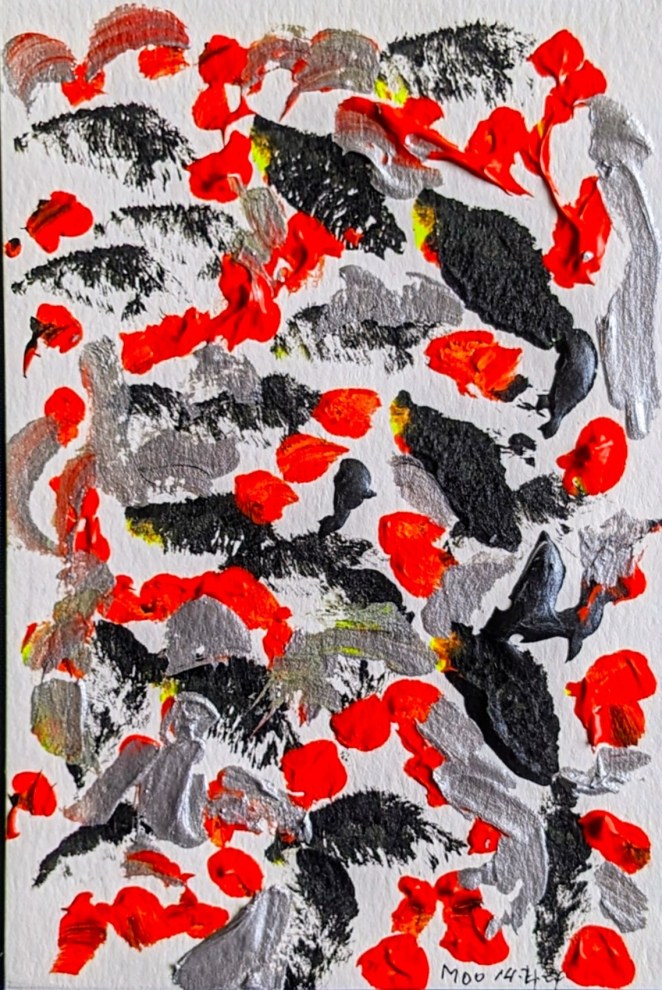
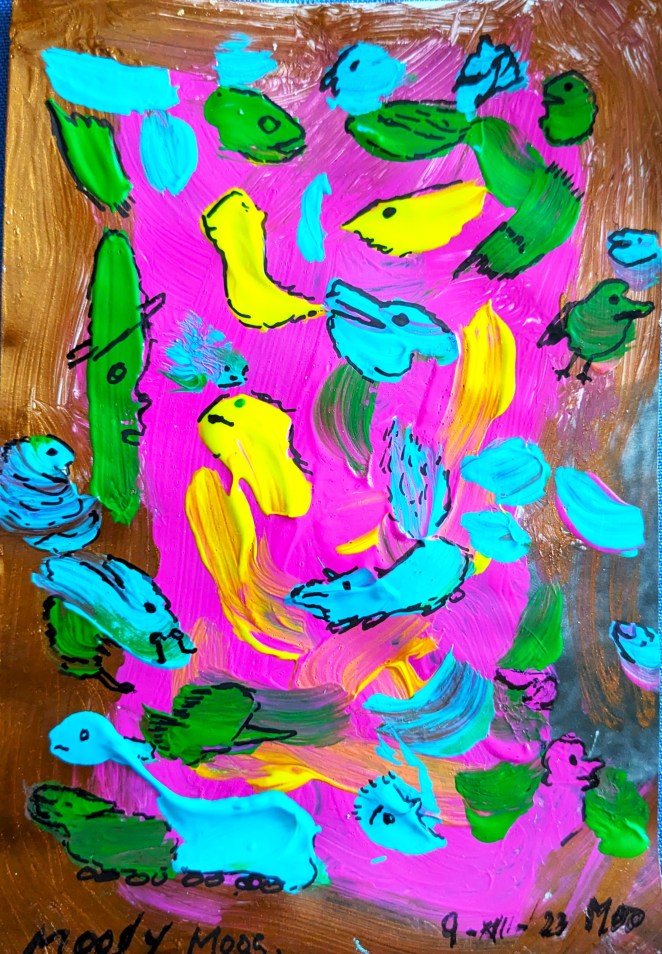
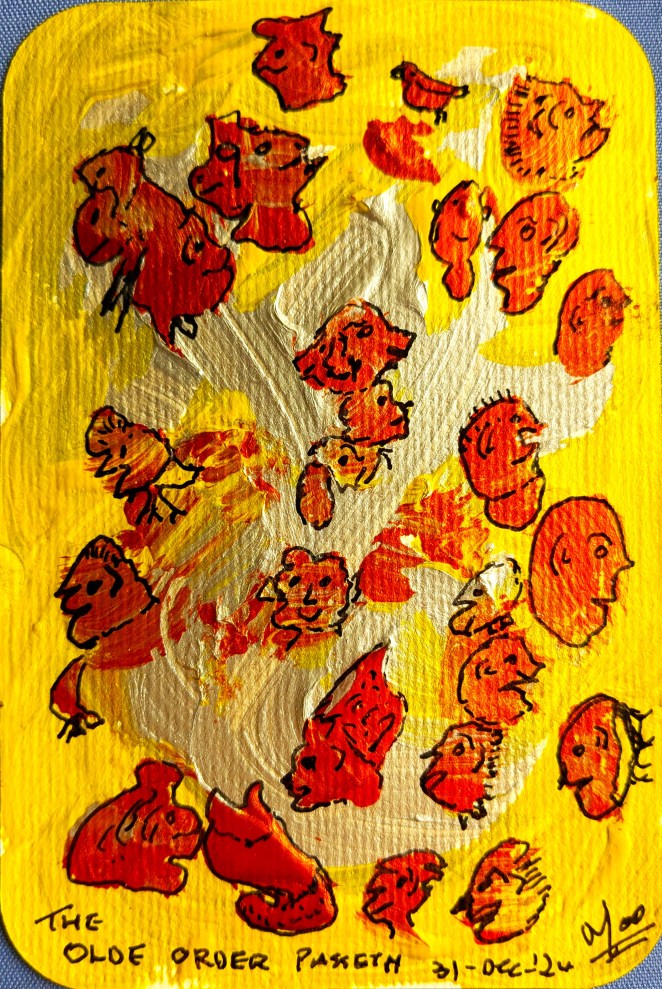
You can blame my friend Moo for the painting. “That’s my view of your brain,” he told me. “A squiggle of spaghetti or twisted noodles.” I think his painting looks like what my Beloved, courtesy of Corrie Street (as was), calls a Spag Bowl. Funny how easy it is to become muddled and confused as we age. Did I shut the back door? Double-check. Yes, I did. And you can multiply that to the power of N (or DR – for don’t remember!). And what about those windmills that wave their arms in my mind? Will that be cash or “Charge!”

Re-reading the Quixote, side by side with a very good friend, I forget some of the ideas that I once had. I try to read my penciled marginal notes. What fun! First, I can hardly read them. Second, I can hardly understand them. And third, I have to reinvent what they might possibly have told me. All good fun. But sometimes, at the end of a session, my mind feels like the bodies of Don Quixote, Sancho, and Rocinante, after their meeting with the Yanguesans – battered, bruised, and beaten! Why, can someone kindly tell me, did Cervantes treat his two main characters to such frequent and brutal assaults?

Ah well, Friday today, and Friday is fish – not Spag Bowl. Are scallops fish? Not when they are sliced off your body with a razor-sharp sword. But then, I doubt if Quixote’s sword was razor sharp. It was probably vencida de la edad – conquered by age – just like he was. Conquered? No, not yet. Happily, I just limp along, however slowly. Ah yes, I forgot. I need a name for my Nexus. Maybe I’ll call it Rocinante, like DQ’s horse.

Rage, Rage 32 & 33

Rage, Rage
32


I miss
the swish and roar
of my incoming,
outgoing breath.

I miss
those Full Moon fingers
tinkling the tides
of my inner being,
making me strive
to keep myself alive.

My body’s house,
devoid of gnomes,
wolves, and pipes,
lies vacant and silent.

The full moon’s
rampant skull
empties the sky of stars
and fills my mind
with cratered shadows.

33

Strange creatures hide in the mist
that overcomes my brain.
I see the sudden flash
of sharp, lusting midnight teeth,

My heart turns into
a time bomb ticking
its irregular beat
in the cavity of my chest.

Am I a victim, then,
as Camus suggests,
or just another assassin?

A suicide bomber, perhaps,
with explosives strapped
inside my rib-cage
rather than round my chest
in a hidden vest?

Tick-a-tock
and tickety-tick-tock,
I can hear and feel
the arrhythmic clock
alarming me
as it arms itself in my chest.”Tick-a-tock
and tickety-tick-tock,
I can hear and feel
the arrhythmic clock
alarming me
as it arms itself in my chest.”

Comment:

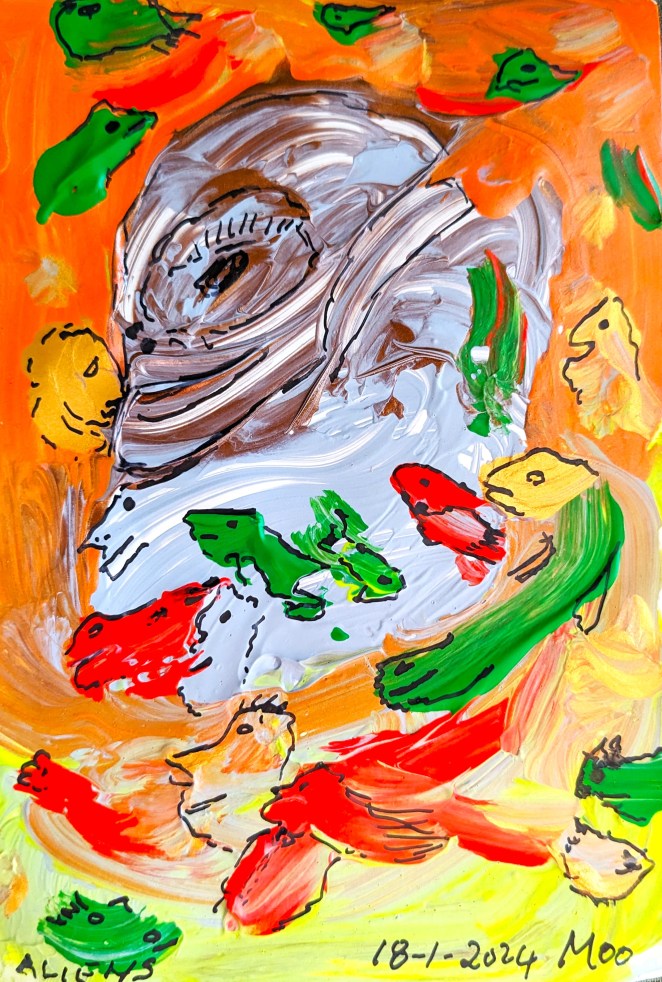
So, Moo has just come back from wherever he’s been and wherever it was, he’s not telling me. However, he does say that I look All Shook Up. And he’s humming Elvis Presley songs at me. And the above painting is his suggestion for me for today. “Thank you, Moo. And welcome back.” He nods at me. “Good to see you two,” he says. “You spelt that wrong,” I tell him. “I didn’t,” he says. “We all know you’re a split personality and I am saying that I am pleased to see both halves of you again.” Oh, dear, you can never win with Moo. He always paints a different angle or comes round in a wiggling circle. “Ha!” he says. “At least I don’t paint myself into corners.”

Am I a victim, then, as Camus suggests, or just another assassin? Interesting suggestion. We are either murderers or victims. But I haven’t murdered anyone, that I am aware of. And I don’t feel myself to be a victim. So what is my dear friend Albert on about? Alas, he isn’t around to ask. I just have to read his books and see myself left wondering.

I guess it was all different in Paris, in the 1940, during the Nazi occupation. Anyone can talk a good game, but what do you do when the Gestapo knock on your door at 2:00 am? Good question. Existence precedes essence. We live. We survive. That’s Jean-Paul Sartre. And so is this – “L’homme n’est rien d’autre que ce qu’il fait.” Man is no more than what he does. So there you have it. It’s never what you say you might do, or how you relate things in respect – it’s all about what you are doing right now. So – ask yourself that vital question – “What am I actually doing?” The answer you give will tell you a lot of things about yourself – if you are honest in what you say.

Rage, Rage 30 & 31

Rage, Rage
30

A pack of miniature wolves
infiltrated the midnight forest
flourishing in my other lung.

When the pibroch played,
they pointed their noses
at the spot where the full moon
would have been, if
I had invited her in.

They mingled their howls
with the bagpipes’ caterwaul
and I lay awake all night
with my heart beating
arrhythmic suspicions
on its blood red drum.

The drum played,
the pibroch wailed,
the wolves howled,
my body lay scarred by
an absence of sleep
and the presence of moonlight
that drove stars from the sky
and filled the room with shadows
and shifting shapes.

31

The full moon drew up water,
imposed high tides,
drew the wolves
by their drawstrings
out of my chest.

The piper paid his rent,
packed up his pipes,
took a sip of his whisky,
Bell’s – ‘a drop before ye go,’
and marched away,
leaving me alone.

Now silence rules my lungs.
Five deer stand silent
in the woods beneath my window.
I watch them watch the piper
pipe himself away.

It’s all over now,
the cough, the splutter,
the aches and pains
that told me I was alive.

I miss
the swish and roar
of my incoming,
outgoing breath.

Comment:

The piper marched away, leaving me alone. That’s the funny thing about pain, especially in our old age. It lets us know that yes, we are still alive. I know we are better off without it, but when it is there, it is better than the emptiness that will follow when we slip into the dark night that awaits us. Or perhaps it will be the golden dawn of another age. Many people tell us many things, but I don’t know how many people really and truly know. As I get older, I speculate more and more.

I once asked my grandfather if he was worried about dying. He looked at me for a long time. Then he said, “Well, one thing’s for certain. I know I am going to die. I’ll die if I worry about it and I’ll die if I don’t worry about it. So why worry about it?” He was a wonderful man with a wonderful attitude about so many things. But then he had survived the trenches in WWI and there weren’t many things he hadn’t seen. He rarely talked about it, but when he did, he told the most wonderful stories. And he sang all the old WWI songs too. A one man entertainment act for the small boy that would climb up onto his lap and say “Grandpa, tell me a story….” and he would begin “Once upon a time…” and that was the start of the magic.

And it’s the magic that we need. The magic that is so often missing in this age of information overload. “What is this life if, full of care, we have no time to stand and stare.” Nor do we have any time to crawl into grandpa’s lap and seek those magic words – the words that start the willing suspension of disbelief – “once upon a time, a long time ago …” And, with a wave of the magic wand we are transported into a wonderland of dream and magic.

Book Burnings

Book Burning

A sharp-edged double sword,
this down-sizing,
this clearing out of odds and ends.

Library shelves emptying.
books disappearing, one by one.

So many memories
trapped between each page,
covers, dust-bound now,
dust to dust and books to ashes.

Sorrowful, not sweet, each parting,
multiple losses, characters
never to be met again,
except in dreams.

Heroes, thinkers, philosophers, poets,
their life work condemned to conflagration.

Alpha: such love at their beginnings.
Omega: such despair,
with Guy Fawkes celebrations
the means to their ends.

Word-fires:
the means of forging
those book worlds that surrounded us.

Bonfires:
the means to end them.

Steadfast, the book-fires,
flames fast devouring

all but an occasional volume
snatched by burning fingers,
from the flames.

Comment:

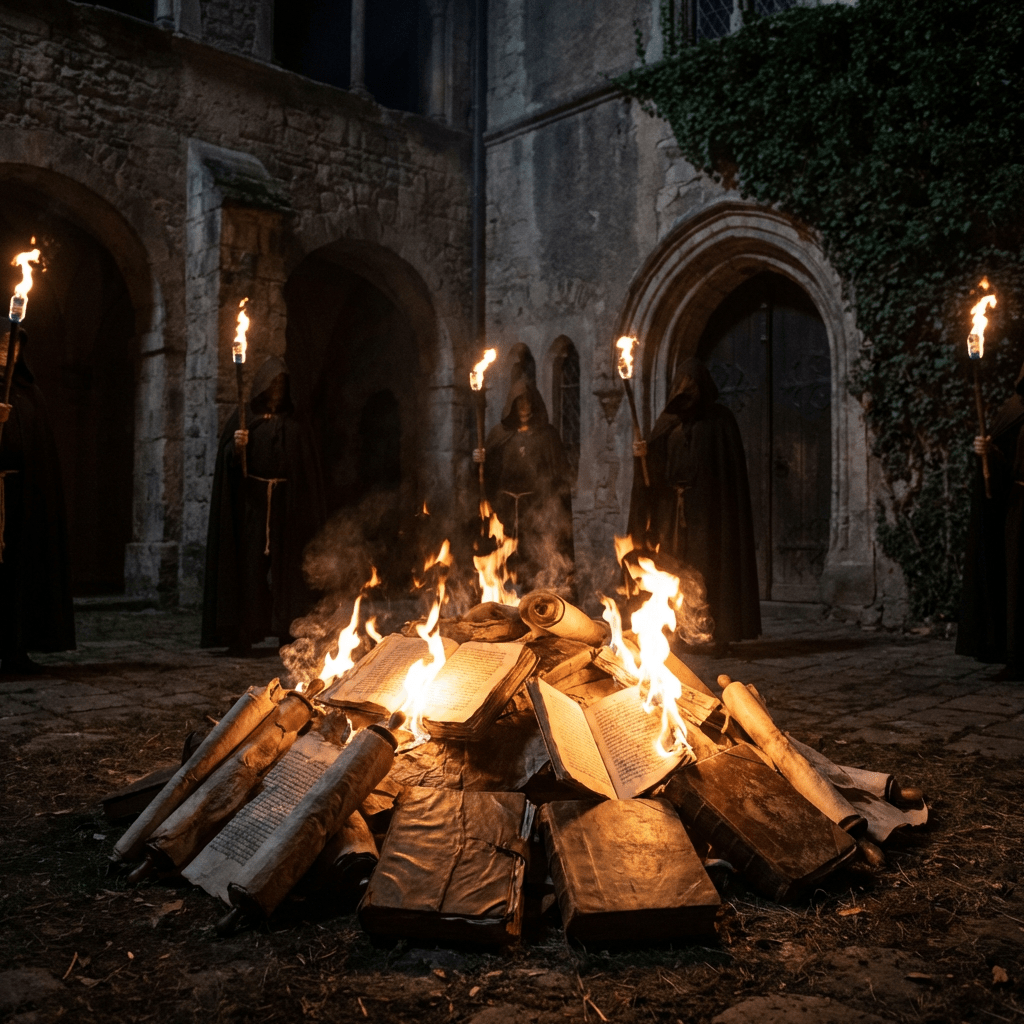
Funny things, book burnings. Why would anyone burn anything as innocent as a book? Good question. Yet people do. And people always have.

I think back to Don Quixote I, 6 and the Scrutiny of the Library. The Priest and the Barber go through the mad knight’s library and one by one examine the books of chivalry and either spare them, or cast them into the flames. This, in itself is a parody of some of the judicial actions of the Spanish Inquisition. In particular, any book that they considered to be unsafe or heretical went into the flames. Our Spanish Knight, of course, went mad through reading too many books of chivalry – and his brain dried up so that he totally lost all reason.

It is very interesting to read which books were spared and why. Equally interesting to find that many were burned on aesthetic grounds – they were not well written, or they were boring. Fascinating.

Fascinating too the book burnings that took place in Mexico during the Conquest of that country by the Spanish Conquistadores. Many pre-Columbian codices were burned. Priceless treasures and histories lost forever. Some, I think the Vindobonensis, still bear the marks of the flames when they were pulled from the fire in an effort to save them.

Moo tells me that my books will never be burned. And I am thankful for that. I asked why they wouldn’t be and he replied that nobody reads them anyway! Not such a comforting thought. So, in an effort to keep me happy and to preserve my books from the flames, another of my friends laid them out on the beach at Holt’s Point, New Brunswick. They certainly won’t burn when the tide comes in.

More important, I see that junk from Canadian Beaches, dated about 1960, has just arrived on the shores of the European continent, sixty plus years later. So – a floating book, a message, perhaps, in a time-bottle, destined to achieve immortality and live for ever. What a comforting thought for those of us who believe in the time and the tide that wait for no man! But they both might wait for his books.

Rage, Rage 26

Rage, Rage
26

In my dreams, I track 
the sails of drifting ships,
white moths fluttering
before the wind.

I think I have caught them
in overnight traps,
but they fly each morning
in dawn’s unforgiving light.

I give chase
with pen and paper,
fine butterfly nets
with which to catch
and tame wild thoughts.

I grasp at things
just beyond my fingertips.

I wake up each morning
unaware of where
I have traveled
in my dreams.

Comment:

White moths fluttering before the wind – my dreams at night. How do I trap them, catch them, squeeze them between my fingers, hold them, pin them to the show case of memory? I remember in Oaxaca – the young boys, trapping the moths. Huge, gigantic butterflies, moths, as large as birds. They severed their wings, and sold them to the passing tourists. Such beauty, such colour.

I heard an angry buzzing, looked down, and saw flightless bodies, wings clipped, rowing their stumps of bunt oars, skidding sideways across the gutters, and dreaming painfully of the stars.

Rage, Rage 8 & 9

Rage, Rage
8

A late summer storm
lays waste to the doggy daze
that clouds my mind.

Carnivorous canicular,
hydropic, it drains my soul,
desiccates my dreams,
gnaws me into nothingness.

Tonight, the old black hound
will dog me,
sending my head spinning.

It will force me
to chase my own tail,
round and round
in ever-decreasing circles.

It will devour my future,
leaving past failures
to ghost through my mind.

9

Where now are the hands
that raise me up,
that rescue me
from dark depression,
that haul me out
from life’s whirlpool,
that forestall
the jaws that bite,
that save me
from the claws
that snatch?

Where are the hands
that move the pieces
on the chess board
of my days and nights,
that prepare my breakfast,
that bake my birthday cake
and count the candles
that they place and light?

What will I do
without them
now they are gone?

Commentary:

Gnawed into nothingness – the umbra nihili of the medieval mystics, the shadow of nothingness that sometimes falls upon us, threatening our peace of mind. An AI search offers – Umbra Nihili (Latin for “Shadow of Nothingness”) refers to a concept of cosmic loneliness or existential void famously cited by Meister Eckhart. A great many of my friends have recently discovered this umbra nihili. I am not sure why. I guess it varies for each one of us. Mal de todos, consuelo de tontos / that everyone suffers consoles only fools, the Spaniards say. What can we do at such times? Reach out, help when we can, count only the happy hours, as the inscription on the Roman sundial tells us – horas non numero nisi serenas.

Many have walked this way before. But that should not be a consolation in itself. Rather, it should be an acknowledgement that there is an exit to the maze, a key to unlock misery’s door, a thread to lead us out of the labyrinth. We must just acknowledge that fact and search for the exit, the key, the thread, that will prove to be our personal salvation, and hopefully the salvation of other fellow sufferers as well.

Rage, Rage 7

Rage, Rage
7

Blood of my blood,
my daughter’s daughter,
time is not on our side.
 
I sometimes wonder
if I’ll survive,
if you and I
will ever meet again.

When we talk online
I see you trying
to understand, to hold
my image in your mind,
to figure out this shadow
that moves and talks
on the computer screen.

Words, born from old Welsh
melodies, bring poetry
to my heart, place music
on my lips.

But they fall short,
and fail to satisfy
my need to reach out
and hold you.

In spite of that I still survive
and live in hopes to see you
in our realities of flesh and blood.

Commentary:

When I first came to Canada, such a long time ago, I communicated with home by means of air mail letters written on special air mail paper that came in very thin, foldable envelopes. Very rarely I communicated by means of very expensive telephone calls of a limited three minute duration. How times have changed. Now via Skype (as was), Team (as is), Messenger, FaceTime, and other means, we can have unlimited face to face conversations, free of charge, with people on the other side of the world. And yet, face to face and screen to screen, there is still something missing. The cat senses it. She stares at the screen and sniffs – then she bristles and hisses. She fails to understand a known voice that has sound and movement but no smell.

And yet, what we now have is so much better than what we had before. Communication is so much easier. We have generated a generation that works in the audio-visual world, not in my preferred world of written verbalization. How we have changed. I can do so many things, in my head, that the younger generation cannot do, even with pen or pencil and paper. However, when my computer fails me, or my cell phone acts up, it is to that younger generation I go, because they dominate this new world in which we live.

I gave one of my academic articles to a friend the other week. “I can’t read this,” he said. “Tell me, what’s it all about?” I started to explain. “Hold on,” he said. He asked his AI program to read my article and generate, in words a 14 year old could understand, the main contents of my not-so-easy-to-read academic writing and thinking. About thirty seconds later, the analyzed contents appeared on the screen before him. I threw my mind back to when Coles Notes were forbidden. “Anybody caught using Coles Notes will be given an automatic F.” Then I looked at my own article, analyzed perfectly, and set out in the very way I had planned it, albeit with a simplified vocabulary – and the longer words explained in a sort of appendix. Quite simply, I was blown away.

Then my mind went back to my childhood in Wales. No running water, no electricity, no indoor toilets, no telephones, no television, a radio with limited stations and programming … imagine what we have come from – imagine where we are going. My only questions – will we control it or will it control us? And you know what it is. The clarion call goes out across the centuries. – Quis custodiet ipsos custodies? Who shall guard the guards? Who shall police the police? Who shall program the programmers? Each generation must find its own answers to those questions. And the sooner you do it, the better because it’s not going to be my problem for much longer!

Rage, Rage 5 & 6

Rage, Rage
5

Empty now the house,
clean the floors
where she scattered her toys,
polished the grubby tables,
where her small hands
splattered food,
wanted and unwanted.

Empty the bathroom,
the tub where she took
her daily bath,
dry the towels she dampened,
wrinkled the toothpaste tubes
she happily emptied.

Empty too
this heart of mine
wherein she built her nest.

Like a wild bird, she has flown,
joined the end of summer migration,
yet I still possess a part of her
within my emptiness.

6

I remember how she stood
at the window, excited,
gazing at the birds.

“Finch,” I pointed.
“Goldfinch. Grosbeak.”

Her hands plucked at the air,
not a feather fell,
she caught nothing.

“Yellow, she cried, “yellow,”
jumping up and down with joy.

Her nose, all wet and runny,
left damp, sticky smudges
on the cold window-pane.

I see the greasy smears
that remain where her nostrils
pressed against the pane.

Still the glass stays unwashed
and now that shadow stands
between me and the sun.

Commentary:

Empty house, empty nest. How many homes have just enjoyed the festive spirit, rejoicing in the company of family and friends. Alas, the holiday is almost done. In many houses, the taxis have left for the airport, the cars have driven away, the rooms that were filled with warmth, joy, and laughter are cold and empty. Only the shadows remain. The echo of voices that are now silent.

The old remain, as they were before the festive invasion, old and lonely. The young have flown back and away to their usual lives, their schools, their jobs. I sit before my screen and type these words. My beloved sits in another room and watches TV. When the adverts come on, the volume increases and the same tedious voices mouth their joyless messages. My nest may be empty, but I do not have an empty head. And I don’t want it swamped by the commercial acumen of the tv set.

My head contains many rooms and many of those rooms are filled with memories that will, as Albert Camus said, last me a lifetime. One summer afternoon, examined in its intensity, will last forever, or for as long as the viewer lasts. Alas, I mourn for those who age, who suffer from Alzheimer’s and the like, and whose heads are empty. What do they think, what do they feel, what twilight memories flicker through the empty nests of their ageing brains? I hope and pray I never know.

Rage, Rage 2 & 3


Rage, Rage
2

These problems start the day
you realize you are alone.
Your beloved goes away,
for a holiday,
to be with your daughter
and grandchild.

Now the house and the cat
are yours, and yours alone.
No problem you say and
everyone believes you.

You jumped in the car,
drove daughter, and child,
holidays done,
to the airport.

Your beloved went with them,
her holiday about to begin.
And that’s when it all began.

3

When I come back home
from leaving them at the airport,
the front door stands open.

I thought I had closed it
when we left.
I tip-toe in and call out
“Is anybody there?”

Echo answers me –
‘… there, there, there …”

Commentary:

Raymond Guy LeBlanc, one of my favorite Acadian poets, published his poetry book, Cri de Terre, in 1972. My painter friend Moo, who also likes Acadian poetry, borrowed the title and changed it slightly when he painted this painting – Cri de Coeur. Earth Cry / Heart Cry.
What is all creativity, visual of verbal, but a cry from the land or a cry from the heart? Sometimes it is more than a cry – it becomes a clarion call, a shout out, a calling out.

So many of us are born with creativity in our hearts. So few of us carry that creativity, be it verbal or visual, into the adult world, a world that all too often grinds us down and sifts us out. We become grey people in grey clothing sitting behind grey desks beneath artificial lighting, doing grey jobs that slowly turn us into nine to five (or longer) dusts.

Moo has promised me a series of red paintings for this sequence. We shall see how he does. Red for anger, red for age, a red flag for danger, a red rag to wave at the raging bull of life, to provoke it, then bring it under control.

Nadolig Llawen – Welsh for Have a Joyous Festive Season. You can add other languages, as you wish. But above all remember Pedro Calderon de la Barca’s words – “Life is a dream and dreams are nothing but dreams.” One day, we shall all wake up. Artists and dreamers, grey ghosts and people of straw and dust.


Rage, Rage 1

Rage, Rage
1

Old age creeps up on you,
slowly, ambushes you,
catches you unawares.

At first, you don’t believe
that it’s real.
You ignore the signs,
pretend they aren’t there.

Then comes a knock on the door.
There, did you hear it?
Around you your body’s house
slumbers in comfort.

You lose your footing,
but you do not fall.
Your book drops to the floor,
you bend down and pick it up.

Everything is as it always was.
Or is it? One of your friends
slips and falls down the stairs.

You descend the stairs
with more care than usual.
No, you don’t need a cane.
Nor special shoes and socks.

You convince yourself that
all is well. And so it is,
for a little while longer.

Commentary:

Rage, Rage
against the dying of the light

Dylan Thomas’s famous poem celebrates the passing of his father. “Do not go gentle into that good night, / old age should burn and rave at close of day. Rage, rage against the dying of the light.”

I am no Dylan Thomas, although I am still a Swansea boy at heart and, as my paternal grandfather used to sing while at the fighting front during WWI – “and still I live in hopes to see Swansea Town once more.”

Alas, I never will see Swansea Town, save in my dreams, for Swansea Town is no longer a town. It is now Swansea City and no, I will not be leaving Island View again, not even to return to Wales, the land of my fathers. But I can and do age, and ageing is a strange and very personal experience. These pages contain the thoughts that occur to me, in my solitude, as I come to terms with my diminishing existence.

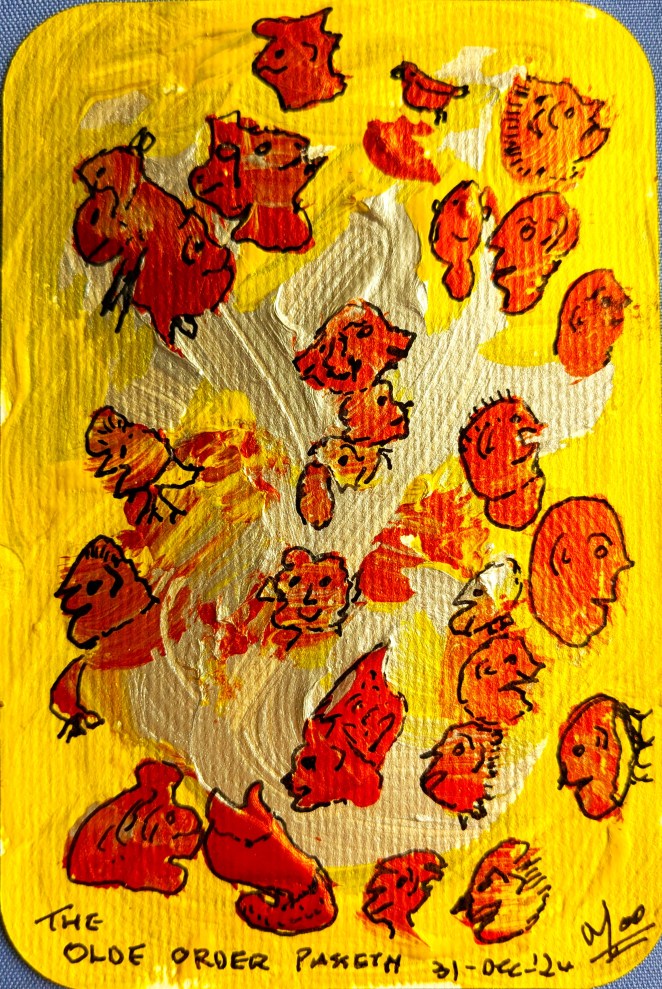
Moo has been very silently recently. But when he saw this poem he climbed out of the woodwork where he had been hiding like a silent spider and he said “Roger, have I got just the painting for you.” The painting is also called Rage, Rage – make of that what you will.