Bullfight

Los Toros de Guisando

Bullfight

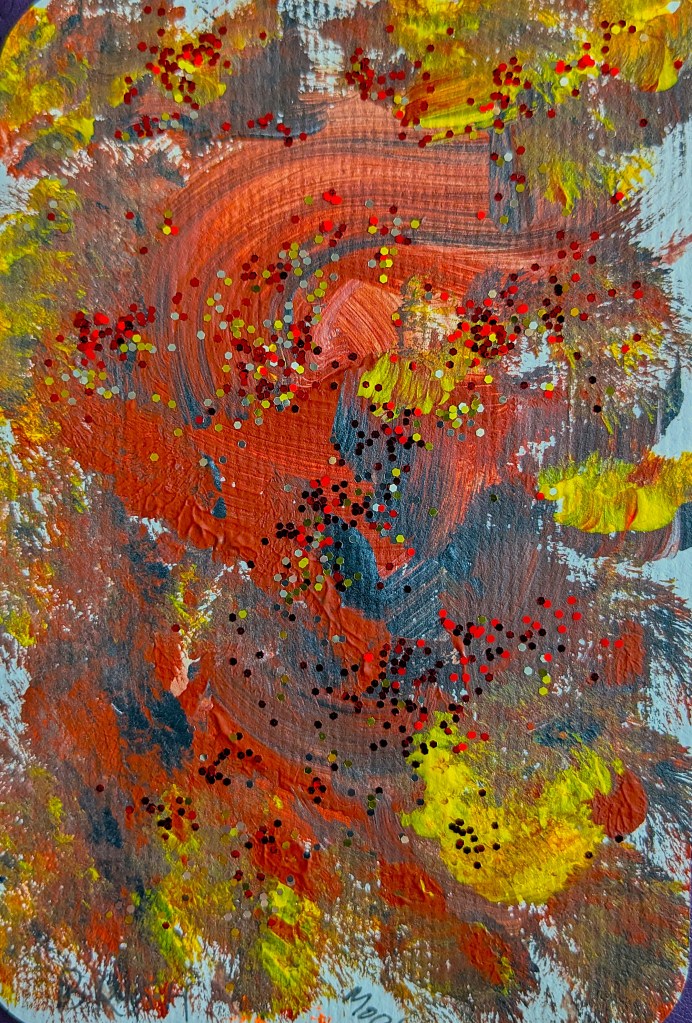
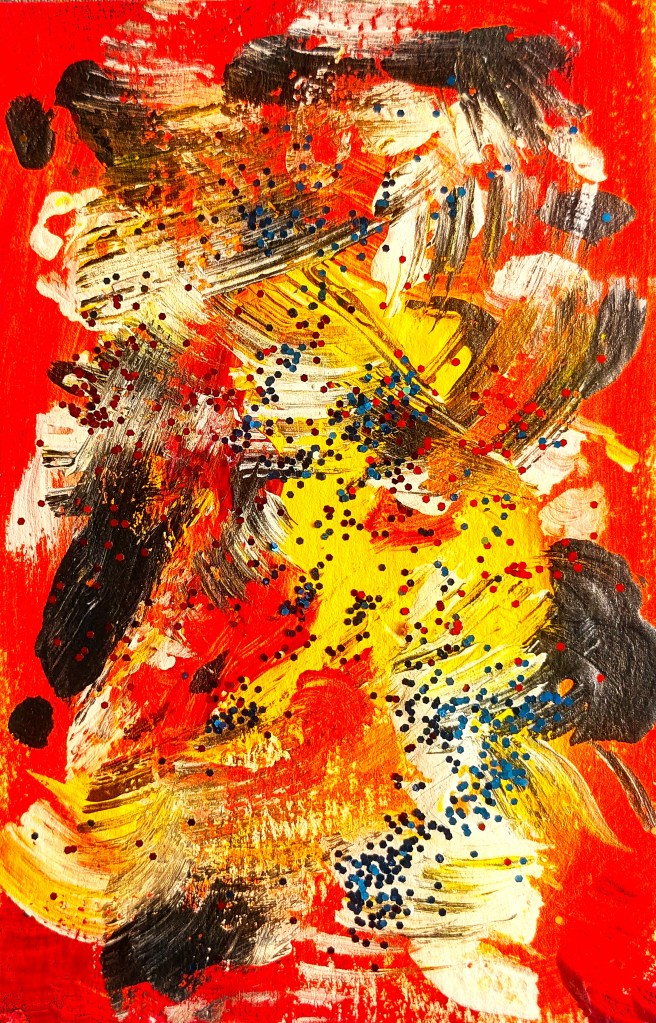
… at the beginning of the end, when more things have gone than are with us and the summer’s sun withers the grass and wrinkles our faces baking us bright red – como un cangrejo te has puesto, hijo mío, en el sol de Somo, como un cangrejo – and — pulpo en un garaje — you grasp at the new words, the new colors, the new delights, your tongue trapped clumsily in your mouth like a red rag doll and the midnight bull charging the spectators who gather and olé, au lait … as the drunken bullfighter climbs the bull and kills the post. The red cape flutters in our memories and to the slaughterhouse we go where the open body hangs loose like a flag and the red meat of him held out for all to see and some to share … and this is his body and this is his blood, sacrificed in a circle of golden sand for our drunken amusement … for whatever I did, I never visited those bull fights when I was sober … at five thirty, they began, and at 3 o’clock we would gather in the city center and slowly wend our way from bar to bar, up the Calle de Burgos, past the street where you lived and upwards, ever upwards, towards the bull ring at the top of the hill, from bar to bar, I say, and the bota, the wine-skin filled and re-filled with that dark red fluid that will set us all baying for the bull’s blood, or the matador’s blood, it doesn’t matter whose blood, as long as someone bleeds and the bull is butchered, torn from this life by a man on horseback, armed with a lance, and he thrusts the heavy blade between the shoulders of the bull, the blood first dripping red, then gushing, a small stream over the rock of the bull’s shoulder, and down the bull’s front legs, to slither on the sand, and the bull still ready to charge the horse, and the bull’s head steadily dropping as the muscles in the back and neck are gashed and torn and there’s no hell like this gaping wound between the bull’s shoulders and the blood flowing freely and vanishing into the sand, the golden sand, once pristine, stained now with blood, and soon to be further blemished with feces and urine, and the picador, his job done, walks his blind-folded, armored horse out of the ring, and the bull, un-armored, un-enamored of the process which turns his torment into a spectacle staged for our drunken delight, as we pass the bota round, and the blood red wine travels from hand to hand, and we squirt the bull’s blood squarely between our lips and it dashes against tongue and teeth and we swallow the body’s sacrifice hook, line, and sinker, as the banderillero runs in, harpoons in hand, waving his banderillas and plunging their arrowed barbs into the gaping wound that flowers on the bull’s back, and the bull stands there, twitching, wriggling, saliva and drool slipping down, sliding stickily into the sand, as the matador doffs his hat, takes his vorpal sword in hand and treads the light fantastique in his laced-up dancing pumps, his waltzing matilda feet so swift, so sure, eluding the lumbering rush of the charging bull, the load of bull, that tumbles down the railway track towards him as he stands there, the matador, poised like a ballerina, as stiff and as steady as a lamp-post around which the bull circles like a drunken man, staggering a bit, but still bemused by the red flag tied to a stick which waves before his eyes and goads him onwards, ever onwards, in his plunge towards a brilliant death, as he pauses, feet together, and the matador makes his move, one, step, then two, and the bull lurching forward to impale himself on three or four feet of curved, immaculate steel, and the matador immaculate in his reception of the bull – and what is happening? What will happen next? Sometimes, the sword pierces the spinal cord and death is instantaneous. Sometimes, the sword pierces the heart, and death is more or less swift, but certainly certain. And sometimes the sword pinches against the bone and flies from the matador’s hand, and the matador must bend, and pick it up, and try, try again, the red rag below the bull’s nose, the bull drawn forward, yet again, to impale himself, yet again, on the sharp end of the sword, and this time, the sword goes in, but the wound is in the lungs and the peones, the pawns, the workers, the drones, the little men who help, turn the bull round and round in ever tighter circles so the sword will open and even larger wound, sever the main arteries perhaps, and the bull, blood spurting through nose and mouth, lurches now, then falls to his knees, and lies there, bleeding, and the matador chooses the descabello, that little sharp sword with the razor blade at the end and he tries to sever the spinal cord, there at the back of the neck, and sometimes he does, and sometimes he doesn’t, and if he can’t then it’s the little men again in their colorful parrot suits all gleaming with sequins and stars and they carry a sharp little instrument, with a pointed end, la puntilla, that short, double-edged, stabbing knife which is plunged into the occipito-atlantal space to sever the medulla oblongata in the evernazione method of mercy killing,  and the puntilla is plunged again and again into the bull’s neck at this atlanto-occipital joint, until it severs the medulla oblongata, and when it is severed, in this glorious neck stab, then finally the bull drops dead, and the show must go on and on, and on, and the horses come in, black funeral horses with bright feathers on their heads and they loop a rope around the bull’s horns and away he goes, trailing blood, and urine, and shit, all across the sand and other little men appear to sweep the sands clean, and my neighbor who wears a large walrus moustache stained red now and purple with the wine that he has splashed about, shakes the wine skin and finds it as not as full as it was, so he sheds a bitter tear, and since the death was slow, the crowd all whistle and boo the matador and his merry men, but when the death is swift and quick then the crowd is aroused and they wave white hankies at the presidential box and the president awards the matador an ear, a salty, smelly, sticky ear which the peones cut off the bull before he is towed away, and then the matador throws the ear in the direction of his current sweet heart, the fairest lady in the crowd although she be as brown as the beauties baking daily on the summer sand where the sea horses dance and there are no bulls, and no bull shit, and no maids with mops, just the scouring sea, and sometimes the president gives away two ears, or two ears and the tail, dos orejas y el rabo, though this I have seldom seen, and what does the bull care that he dies bravely and well, for now he is dead he hasn’t a care in the world, and the butchers in the butcher’s shop are carving him away, carving him to the skeletal nothingness of skin and bone that awaits us all, the nothingness of this more or less glorious death, with our tails cut off and our ears hacked away to be pickled or smoked or otherwise kept in the fridge as the butcher’s trophy … and who now will walk stone cold sober into that magic circle of sun and shade and stand there, unbowed, before the might of the untamed beast, the untamed bestiality that drives us wild as it wanders through our nightmare cities and our wildest dreams … and now the crowd call ¡música, música! and the band strikes up and martial music plays as the bullfighter and his troupe march gaily round the ring, their trophies held high for all to see before they are thrown to the ravening crowd who bay like the dogs they are as they taste fresh, bloodied meat …

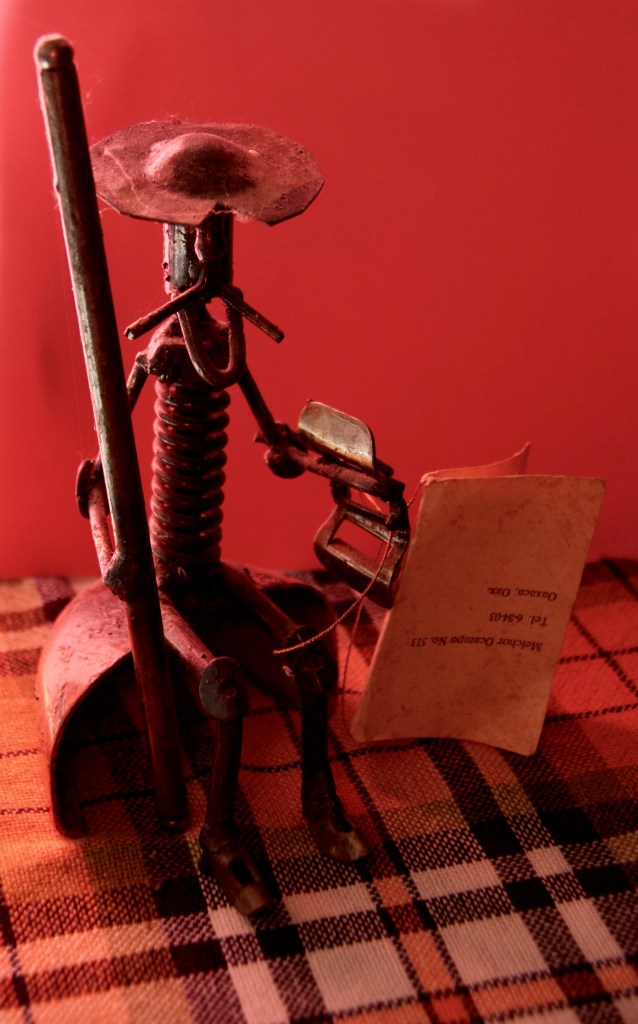
Contemporary stone bull

Mi verraco de Avila
gracias a Juanra

Book Burnings

Hooded figures holding torches surround a bonfire of burning books and scrolls.
A group of cloaked figures stands in a dimly lit stone courtyard as they burn ancient scrolls and books in a large central fire.

Image generated by AI


Ryan and Don Roger


5

Book Burnings

            In 1492, the Spanish Jews were given the choice of conversion to Catholicism or of being expelled from Spain. Many chose to leave. Those who converted, and remained, were kept under constant supervision. In an effort to stamp out their faith, their books were condemned to the flames by the Spanish Inquisition. A similar burning of the books in Don Quixote’s library occurs in DQI, 6. Is book burning effective? Some people think so. Other people aren’t so sure.

            The Spanish conquest of Mexico, led by Hernán Cortés, concluded on August 13, 1521, when Spanish forces and their native Tlaxcalan allies captured the Aztec capital of Tenochtitlan and emperor Cuauhtémoc, marking the end of the Aztec Empire and the beginning of Spanish colonial rule. The country was then called New Spain. 

Mexico is famous for its codices. These are fan-fold picture histories, drawn on vellum covered with gesso, of tribal conquests, social norms, tables of the gods, in fact a whole cultural and historical record of pre-Hispanic Mexico. The Zouche-Nuttal codex, for example, sets out the conquests of Ocho Venado / Eight Deer, nicknamed Garra de Tigre / Tiger Claw, a Mixtec warrior, who lived between 1063 and 1115. Five of the Mixtec codices survive. Many, many more were burned. The cover of the Vindobonensis shows the burn marks where some daring person pulled the codex from the flames and saved it. Without such saved codices, we would have much less knowledge of pre-Hispanic Mexico.

            Why is this anecdote important? Because prior to the invention of printing, in 1474, manuscripts were written by hand. Yes, some were copied, but many copies were single and unique. Burn the manuscript, destroy the knowledge it contains. Post 1474, with the printing of multiple copies of books, the individual book might be destroyed, but some books would survive from the printing sequence. Apply this to Don Quixote’s library and we note several things. First, Don Quixote’s copies are destroyed. Second, other copies of his books survive elsewhere. In addition, although Don Quixote’s books are burned the ideas in those books survive in the knight’s head and he lives by their rules. Those ideas are spread throughout the history of his adventures to everybody with whom he comes in contact. Conclusion – you can destroy the books. You cannot destroy the ideas that those books contained.

            Ray Bradbury, in Farhenheit 451, describes the burning of books in his dystopian novel. 451F incidentally is the temperature at which paper burns. The books are burnt in Bradbury’s world, but the book people survive. The book people are those who memorize their books and are able to quote them from memory and pass them on orally to other people.

            And people protect their books. How? By placing them in small rooms within their houses and walling up those rooms so that the books could not be found. This happens in DQI, VI – 6. Don Quixote awakes, goes to find his library, but it has disappeared. The housekeeper swears that a sage enchanter descended on a dragon and the library vanished in a puff of smoke. Don Quixote believes the metatheatrical lie and acts as if it were the truth. He then bemoans the fact that he is pursued by malignant sorcerers. These evil enchanters will pursue him throughout the novel whenever he wakes up from his illusions and is faced by reality. Clearly, the sage enchanters have robbed him of his moment of glory (illusion) and reduced him to sorry (the truth).

            Curiously enough, a 16th Century walled-up library was found in a house in Barcarrota, Spain not so long ago. The books were hidden, probably from the Inquisition, so that their owner could escape prosecution. The discovery sheds light on how individuals hid literature from the Inquisition during the 16th century in Spain. It also illustrates how closely Cervantes followed the reality of his times when writing the Quixote.

            You can destroy books. But it is very difficult to destroy the ideas they contain. In this fashion, although the burning of that one book ends the life of that particular volume, it rarely ends the life of the ideas contained within its covers. We might not recognize the names of the characters that Don Quixote quotes from his memory of those histories, but many of the people who encounter the knight during his adventures know them and remember them. Amadis of Gaul is never dead, not when his name lives on. The same is true of King Arthur and his Knights of the Round Table. King Arthur is said to fstill be alive and can be seen in the shape of a White Crow, bran gwen, in Welsh. And even Walt Disney knew, and profited from, the legend of the sword in the stone.

We will also see, as we continue our journey, that in the same way that tall oaks grow out of small acorns, large parts of later events found in the Quixote already have their seeds sown in these early chapters. Metatheatre, illusion and reality, authorship and censorship, truth and falsehood, waking events and dream sequences – and that is just the start.

The Numbers Game

Ryan and Don Roger

3

The Numbers Game

            The numbering of the chapters in Don Quixote is also interesting. While Part I and Part II often retain the Latin numbering, the chapters themselves can be found both with Latin Numbers and standard numbers.

            Latin numbers are based on six letters I, V, X, L, C, D and M. Each has its own value. I = 1, V = 5, X = 10, l = 50, C = 100, D = 500, M = 1000. Most have us have seen Roman numerals on clocks and we are familiar with the numbers from 1-12. I, II, III, IV (4, that is to say one before five), V, VI (6, that is to say one after five), VII, VIII, IX (9, that is to say one before ten), X, XI (11, that is to say one after ten), XII.

            This paradigm governs Latin numbers. XV = 15, XX = 20, XXX = 30, XL (ten before fifty) = 40, L = 50, LX (ten after fifty) = 60, LXX = 70, LXXX = 80, XC (ten before one hundred) = 90, C = 100, CX = 110. The date of my writing this MMXXVI (2026). You will have noticed similar numerical configurations on books and old movies.

            The ancient Celtic numbering system was based on the digits of hands and feet. Counting sheep, for example, or goats, shepherds and goatherds would count up to twenty on their toes and fingers. Then they would carve a notch in a piece of wood. To keep score was to score the notch.

            Something similar happens in Basque jai alai, the happy game.  The scorers score in groups of IIII which they then made into 5 with a line through the numbers IIII. Four groups of 5 made 20 and the 21st notch won the game. That scoring method may have changed, but it is certainly how I learned to score the game in the Basque country (Spain) back in the 1950’s. Curiously, modern French shows the vestigial remains of this – quatre-vingts. Welsh shows a somewhat similar diversity because the Welsh word for twenty is ugain – although it’s technically not the only one, with the alternative dau ddeg (literally two tens) becoming more and more common. A case of plus ça change, plus c’est la même chose.

            And we must never forget the old sterling system of the United Kingdom of Great Britain and Northern Island. £. S. D. aka pounds shillings and pence. 4 farthings = one penny, 12 pennies = one shilling, 20 shillings = one pound.

Our good friends on AI came to our aid with this one. I quote – The pre-decimal British currency system, known as £sd (librae, solidi, denarii), consisted of 12 pence in a shilling and 20 shillings in a pound (£), totaling 240 pence per pound. Used until Decimal Day on February 15, 1971, this system featured various denominations, including farthings, sixpences, florins, half-crowns, and crowns. What about a guinea you ask? Well. That was £1 and 1 shilling. Hence the auctioneer’s delight.

            “What am I bid”?       >         “£20.”             >          “Guineas!”

Our trusted friends on AI sum it up this way – “A guinea was a British gold coin minted between 1663 and 1814, officially valued at 21 shillings (£1.05 in decimal currency) from 1717 onwards. It was the first machine-struck gold coin in Britain, typically worth slightly more than one pound. While no longer in circulation, it is still used in horse racing and some luxury auctions to represent £1.05.”

Luxury auctions – I love that phrase. And here we must leave our luxurious description of, and adventures into, numbers in Don Quixote! Just look where the journey has led us. And remember, in the same way that Cervantes inserted short stories, both spoken and read, that digressed from the main narrative, we can also insert such mental rants and ramblings into our own narrative. And we shall continue to do.

Here’s one, for example. How do you count goats in Wales? Click on these links for two examples. Counting the Goats traditional and Counting the Goats modern. Of course, wrth gwrs, the simplest method of all is to count their legs and divide by four! Try doing that with Latin numerals!


Rage, Rage 58

Rage, Rage
58

“What is this sound?”
It is your own death sighing,
groaning, growing
while you wait for it
to devour you.

“What is this feeling”
It is the itch of your own skin
wrinkling and shrinking,
preparing to wrap you
in the last clothes you’ll wear.

“What is this taste?”
It is the taste of your life,
bottled like summer wine
once sweet tasting,
now turning to vinegar.

“What is this smell?”
It is waste and decay,
the loss of all you knew
and of all that knew you.

“That carriage outside?”
It is the dark hearse
come to carry you
to your everlasting home.

Comment:

Moo thinks that his portrait of me is perfectly good for this poem. He told me not to rage, rage against the accuracy of the portrait, but he did tell me to rage, rage against the lack of paper. Où est le papier, indeed. As for the rest of it, he said it’s the same for everyone, so stop making a fuss about it. “You’ve got one last bottle of mescal on the shelf,” he told me. “I know. I’ve seen it. Just swig it down, worm and all, and you’ll have nothing to worry about.”

Oh dear. The worm in the bottle. They used to sell the gusanos in Oaxaca’s mescal street at a price of five for ten pesos. I used to buy a two litre coke bottle, filled with mescal from a barrel, and drop ten worms in it. They made yellow streaks as they descended through the liquid. Sweet dreams when you chewed on that lot – and an end to your worries. El brujo, the witch doctor, told me to stick a marijuana plant in the bottle of mescal and when the leaves turned white to rub the liquid into my arthritic knees. “Which doctor was that?” one of the tourists in my apartment block asked me. But I didn’t tell her. Nor did I do it. A waste of good mescal. And to think I now have one last half bottle left. And one little squirmy, crunchy, chewy worm.

Speaking of chewy, crunchy – I had never eaten chapulines, fried grasshoppers, until I went to Oaxaca. I didn’t like the look of them. At the first party I attended was confronted by the host who demanded I eat some. I told him they were taboo, against my religion. He shrugged. When he, and the other guests lost interest in my presence, I tried a couple. They were delicious. A real delicacy. I loved their crunchy little legs.

I guess one is always afraid of the unknown – the gusano in the mescal, the chapulines on the plate, that first plate of calamares en su tinta – squid in its own ink. I love bara lawr – Welsh laver bread – or Welsh caviar, as Richard Burton used to call it. I also know that people who have never eaten bara lawr won’t go near it – it looks like cow pats – but luckily doesn’t taste like them. Don’t ask me how I know. Some people get over their fear of the unknown, others don’t. I guess we’ll just have to wait and see what happens.

Rage, Rage 57

Rage, Rage
57

Time’s oxen
have plowed their furrows
in my face.

A silvery thatch
bears witness
to the winter
of my withering.

My broken body
hangs from the coat hanger
of my shoulders,
its worn-out sack
knitted from skin,
bonded with blood.

I walk with two canes,
not just a sick man,
but a stick man.

When I fall asleep,
my enigmatic body
haunts me with
its death-rattle
of drying bones.

Comment

Sometimes no comments are needed. However, when it comes down to it, I guess it’s worth saying that I am raging, raging against the dying of the light.

The dying of the light – in the evening, when the sun goes down, the house grows silent and cools around me. Some nights, when the news is bad or depressing, I feel we are entering another dark age. Luckily, spring is on its way, with summer not far behind. But what will spring and summer bring?

I fear the heat, the gathering of muttering trees, the ambush nature is setting up for humanity. We live among trees. Trees, all around the house. Trees, climbing the hills into the distance. I loved them when I came here first. The maples, the paper birches, the mountain ashes with their spring finery and the light green fuzz of forming leaves. Winter – the firs and pines dressed in their winter coats.

Last summer, fires broke out all over the province. The closest was a mere 30 kms down the road from us. We could smell the fire, see the smoke, and sense the discomfort of the proximity of possible outbreaks closer to home.

As I grow older, I become more fearful. Walking downstairs in the morning – cada pie mal puesto es una caída, cada caída es un precipico / each badly placed foot is a fall, each fall is down a precipice. Luis de Gongora. ( d. 1627). Alas, it’s that time of life, and it comes to anybody who, like me, has walked this far.

It’s the animals that I pity. The birds who move on and away and no longer stay with us. The deer who also have nowhere to go when their habitat is destroyed. The moose, the bears, the coyotes, the foxes, the jack rabbits and yes, they have all been visitors to our backyard.

Last summer, the local council circulated some ideas on how to prepare for immediate evacuation of our property- what to pack with a day’s notice, three hours’ warning, two hours’ warning, one hour’s warning. I hope it never comes to that. But now, I no longer know, and so I rage, rage, against the dying of the light.

Rage, Rage 52 & 53

Rage, Rage
52

A terminus, this waiting
room in which I sit.

This is the hospital’s
forgetting place,
the left-luggage office
where, a human parcel
wrapped in a blue gown,
I wait to be claimed.

Tagged with a label
on my wrist, I find myself
alone with my fate.

53

All choice disappeared
when I came here
and surrendered myself
to the system.

Now I lack free will
and freedom of choice.

Yet I still dream of choosing
my destination, and the ways
and means of arriving there.

Comment:

A terminus – what an interesting word. Terminus a quo or terminus ad quem? Or just a railway terminus or a bus terminus where we sit and wait to change buses of trains? Or maybe just a terminus in terms of being terminal? Oh what a tangled web we weave when we first start to analyze our words in order to see exactly where we might go and where they might lead us.

And what a journey I was on when I first wrote that poem. Sitting in the waiting room, outside the radiation room, waiting for the lady who would wag her finger and point at the machine’s next victim. Would it be me? The man next to me? That woman over there? Many of us avoided each other’s eyes and just sat there stunned – and now you know the meaning, in context, of ojos de besugo – do you remember that from Rage, Rage, 48?. Others chatted. Some sat there quietly while their teeth chattered. Few of us knew each other, except from the hospice where we stayed if we weren’t day patients travelling in on a daily basis and rushing home afterwards.

Libre albedrío – free will. We can say so much about free will and determinism. But when we enter the system, it’s the system that rules. We have free will to enter – and they [the authorities] say we have free will to exit when we wish – but do we? Good question. A very good question. Once tagged, we are as free as the birds, as free as the salmon, as free as the whales – but within that freedom we are tracked, followed, taken in hand, advised, persuaded, manipulated … and whales have a whale of a time when they’re trapped up in fish netting …

Then there are the follow-ups. The appointments. The emails. The telephone calls. The check-ups. The blood tests. The MRIs. The X-rays. The Holter appointments. The various scans. Who is brave enough to get off the wagon or to open the aircraft’s door half way through its flight over the Atlantic and step out? Would you jump from the save-yourself-train – not at all like the gravy train – and think carefully – are you really saving yourself or are you getting yourself into hotter and deeper water? Come along then, let’s open the aircraft’s door and step out over the Atlantic. And tell me, what exactly are we stepping into?

Stop the world, I want to get off! Not so easy to do, my friends, not so easy to do. Not even when you think the terminus in which you are sitting is taking you to hell in a hand-basket. You start to stand up. And the little lady appears, smiles at you, crooks her finger, nods her head, and – as obedient as one of Pavlov’s well-trained puppy dogs – off you go, following in her footsteps.

Rage, Rage 49 & 50

Rage, Rage
49

Waiting in the doctor’s office,
I hear two old women
gossiping about friends
and family, the intimate
details all laid out
to fester in my fertile mind.

Never will I be able
to put faces to those girls
with breast cancer,
to the women
weighed down
with diabetes,
to the old men
with their strokes
and heart attacks.

50

“Just one of those things,”
one of them whispers,
“my husband gone
leaving me alone
with the grandkids.”

“Is it four years? Or five?
I remember his name,
but I forget his face.”

“And our fourteen-year-old,
her belly already swelling …”

“You’ll cope somehow …”

Silence wraps its scarf
around their flapping mouths.
I think of all my own lost loves,
buried before their proper time.

Lives and worlds end …
new ones begin.

Comments:

Lives and worlds end … new ones begin. How true it is. The olde order changeth lest one good custom should corrupt the world. Tennyson, I believe, from Idylls of the King. King Arthur and his knights of the round table. Each of them rode into that dark night, some quickly, some more slowly, but all were lost, as so many things are lost.

That was also the heading of the departures section of my old school magazine. At the end of the year, pupils left the school, many graduating, never to return, and the old order did indeed change. The fourth formers moved up to the fifth, the fifth to Transitus, then to the sixth, and finally, the scholarship students arrived in Ichabod. Ichabod, Ichabod, the glory that used to be. I look at old school photos and I wonder what became of so many of my childhood friends. The website for my old school also contains an obituary section. I consult it, every so often, to see who else has passed on. Fewer names than I would expect. Not everybody keeps in touch. I am in contact with few old boys from school, but nobody from my undergraduate university. Ships passing in the night, all of us. Our conversations lost in the mists of time.

The old order changes and the language changes with it too. When I was visiting Spain regularly, my first stop, every year, would be the local barber’s shop. I just sat there and listened while I waited to get my haircut, Spanish style. I listened for the new buzz words, the names that now floated around, the latest jokes, the ideas that were currently in fashion. Change is everywhere.

Covid changed the Spanish language, gave it a whole new set of terms that I do not recognize. The same thing happens with English, French, any language. French is not the same in Moncton, New Brunswick, as it is in Shediac. And the Acadian Peninsula is slightly different. As is the language of Grand Falls, and that of Little Falls, aka Edmundston, the capital of the Republic of Madawaska. The language also changes close to the border of Quebec where Joual can be heard. Same thing along the St. Lawrence river and out from Matane to Mont Albert and beyond. Small changes, sea changes, enormous varieties of change.

I often wonder what is happening in Wales both to Welsh itself and to the English language as it is spoken there. English in Swansea / Abertawe was never the English of Llanelli, nor was it the English of the Rhondda Valleys. How could it be? And Cardiff / Caer Dydd was always different. As was Newport / Cas Newydd. I haven’t been back there since 1988. 38 years of change – friends gone, family gone, nobody left. I couldn’t bear to stay in a hotel in a town where once I lived in my family’s homes.

How does one end a rant like this? In silence, of course. For silence wraps its silken around flapping mouths. I think of all my own lost friends and loves, buried so long ago, many before their proper time.

Rage, Rage 48


Rage, Rage
48

I carry memories
and scars like a snail
wears its shell
and I leave behind me
a slither of silver words.

I’m a broken gramophone,
needle stuck in a groove
repeating the same verses
again and again.
This repetition
drives me insane.

My thoughts just drift.
My body is a ship
in the doldrums,
no wind to fill its sails.

I pick up my paint brush
and paint myself –
lonely and blue
as idle as a long-lost lamb,
alone with nothing to do.

Comment:

The alienation of an alien nation – and I wonder if they really are here, those aliens. So many strange happenings in my life. The silver slither of words drags me through so many lost moments in time. Fray Luis de León, I spoke to him last night, asked me the question – “Es más que un breve punto / este bajo y torpe suelo comparado / con aquel gran transunto / do vive mejorado / todo lo que es, lo que será, lo que ha pasado?”

It’s a lovely verse in Spanish, but not so easy to translate into English. Let’s try – first, word for word – “Is it more than a small dot this low and stupid soil compared with that great sky world where now lives improved all that is, all that will be, and all that has happened?”

A comment on the translation – first, the length of the sentence and the way in which it is complicated by inversions and ideas expressed in words which have little direct translation. Then there is the expression – 1. a small dot – un breve punto – a short moment in time. 2. low and stupid soil – este bajo y torpe suelo – clumsy earth below. That clarifies, a little the meaning. 3. that great sky world – aquel gran transunto – that great sky above. 4. where – do [short for donde – to keep the syllable count] – where – 5. lives improved – vive mejorado – lives a better life.

Here goes: “Is this clumsy earth below more than a short moment in time compared with that great sky above where now lives a better life all that is, all that will be, and all that has happened?” Not great, but we can live with it.

As Miguel de Cervantes said “To read in translation is to look at the reverse side of a tapestry.” So, to imagine the real side of the tapestry we need to count our syllables – they don’t match. We need to measure the length of our lines. They don’t match. We need to sharpen our metaphors and images – they don’t really match. And, last but not least, we have to imagine the Platonic, Terra-Centric universe in which the sun moves around the earth and the earth is the centre of all life.

I should add the cultural association of words. In every language, each word has an “associative field of cultural meanings”. Those “associative fields” differ from language to language. So, even getting the verbal meaning correct means that you do not necessarily get the cultural associations right. In fact, it’s almost impossible to do so. It’s a fascinating world and one which I have explored in various academic articles.

I would like to take cultural meanings a step further. In Don Quixote, II, 11 – I quote from J. M. Cohen’s Penguin translation of 1950 (rpt 1961) – Don Quixote says to Sancho ” … if I remember rightly, you said that she [Dulcinea] had eyes like pearls, and eyes like pearls suit a sea-bream better than a lady” (p. 533). I will leave aside, for now, Sancho’s comic mixing of the Petrarchan metaphors and concentrate on the single word sea-bream. To compare someone’s eyes to those of a sea-bream is comical in English. However, the word has several associative fields in Spanish which are worthy of deeper study. Secondary meanings of a sea-bream – besugo – include 1. a mild insult, as in no seas besugo / don’t be a fool / an idiot / stupid. 2. Diálogo de besugos – two people talking and neither one listening to the other. 3. Ojos de besugo – a blank or dazed expression. Quite simply, the translation besugo > sea-bream functions at the literal level, but by no means at the cultural level of the associative fields.

Alas, some days I’m a broken gramophone, needle stuck in a groove, repeating the same things again and again. Maybe one day I will get them right. And maybe I won’t. Better minds than mine have struggled with translating Spanish (poetry) into English (poetry), and most have failed. Many, dismally. We won’t mention names. Sometimes the best translations are not translations at all, but poems that recreate the original in the target language. I am quite happy with my translation of the meaning of Fray Luis de León’s poem – but how sad would be any attempt to transfer the verse form from Spanish to English? Five lines of seven and eleven syllables each – wow! Go for it. But remember – fools rush in where angels fear to tread.

Never mind. Maybe tonight I’ll have another little chat with Fray Luis de León and Miguel de Cervantes, Quevedo too, if I am lucky. Maybe their English will be good enough to give me a few hints. I’ll let you know later if any one of them does come to visit.

Rage, Rage 46 & 47

Rage, Rage
46

I fall into
the easy sleep of age,
pencil in hand,
notebook on knee.

Shadows grow longer
as my life grows shorter,
day by day.

Now it is so easy
to stumble and fall,
each slip a steep slope
down which I slide.

So difficult now
to regain my feet.

I must crawl to where
I can haul myself
first to my knees
and then stubbornly
upward until I can stand.

47

Now-a-nights
I fall easily into dreams
that all too often
turn into nightmares
that rise up from my past
to trouble my sleep.

I struggle and scream
and pinch myself awake,
only to find my cheeks
wet with tears and my mind
all shook up by the return
of childhood fears.

Freud and Jung pull the strings
of those mental puppets
that dance in my head.
Some nights I am afraid
of falling asleep,
for fear that I may never
get up from my bed.

Comments:

Coming to the end of Rage, Rage. When it is finished, that will also be the end of the trilogy – Clepsydra [Chronotopos I], Carved in Stone [Chronotopos II], and Rage, Rage [Chronotopos III]. I have written a fourth volume in the sequence – No Dominion [Chronotopos IV], but this is very personal and I will probably only share it with family members and the closest of friends. However, do not despair – I have an alternate fourth volume, but that is still being written. It us under wraps, and may well replace No Dominion. We shall see.

As for Freud and Jung, they certainly do pull the strings of those mental puppets that dance in my head. Moo says that there should be no strings attached. He has therefore drawn all those strange puppet like figures, a but like an Aunt Sally, really, but has left out the strings and the man / men / woman / women / people pulling them. An Aunt Sally or a lovely bunch of coconuts? Time well tell, if you ask it nicely.

Maybe one of my teddies will tell. They all romp around the room with me at night and I am sure they suspect much of what goes on in my dreams. Here they are – a selection of friendly teddy bears. Be very careful, though, they can be very grumpy, especially if you wake them up suddenly. They don’t like things that go BUMP in the night.

Rage, Rage 41 & 42

Rage, Rage
41

Mortal,
this open wound
clinging, crablike,
to my sleeve.

A sudden surge,
this burgeoning urge
to end it all and sever
life’s thread.

How many times
must I jump,
eyes closed, through
hospital hoops?

Blood thinners,
my veins so
delicately untied,
my life blood
leaking meekly out,
dribbling from
my fingertips,
drip by feeble
drip.

42

Nothing left now
but this pain in my heart.

It makes me think
about growing old,
that unstoppable process
of the body’s slow,
inevitable breakdown
from everything
to nothing.

I should go to the doctor,
but what can she,
will she do?
She can’t stop the hands
on my body-clock
and lop ten, fifteen,
or twenty years
away from my life.

Nor can her pills,
lotions, potions
gift me in the same way
as the long-sought
Fountain of Youth.

Comment:

I should go to the doctor, but what can she, will she do? She can’t stop the hands on my body-clock and lop ten, fifteen, or twenty years away from my life. Nor can her pills, lotions, potions gift me in the same way as the long-sought, never discovered, Fountain of Youth.

Ah yes, my dear old body clock. Clocks went back last Sunday. My body clock still hasn’t quite caught up with the tick-tock clock with its Westminster Chimes and Nursery Rhymes. I have talked to quite a few people recently who have said the same thing. And it isn’t just the ageing and the aged – even young people, just out of their teens, feel the effects of the seasonal time change.

Apparently, the Insurance Companies notice a larger number of fender-benders, and worse, during the first few days after Old Father Time springs forward or leaps back. So why do we change the clocks and why does my body clock not immediately match the tick-tock clock? Good questions.

Maybe Salvador Dalí got it right. Time is Surreal. It is a clock folding itself over a tree branch or sliding over a waterfall, bent in two, with all its numbers abut to fly off. Moo says that his friend, Salvador Dalí, is jealous of Moo’s lovely painting, shown above. Moo says Dalí said he’d wished he’d painted it. I think that Moo, like all painters, has a little je ne sais pas quoi of the word magician about him. His words are as warped as his art. Who could even envy somebody who painted a clock like that.

I suspect Moo would not be able to ace his cognitive test if he actually drew something like that in answer to the prompt – “draw what time it is”. In fact, last time Moo was asked to do just that, this is what he drew – 10:42 AM. I don’t know about you, but I think Moo is a little bit strange. That doesn’t stp me liking him and using his paintings though.