Rage, Rage 32 & 33

Rage, Rage
32


I miss
the swish and roar
of my incoming,
outgoing breath.

I miss
those Full Moon fingers
tinkling the tides
of my inner being,
making me strive
to keep myself alive.

My body’s house,
devoid of gnomes,
wolves, and pipes,
lies vacant and silent.

The full moon’s
rampant skull
empties the sky of stars
and fills my mind
with cratered shadows.

33

Strange creatures hide in the mist
that overcomes my brain.
I see the sudden flash
of sharp, lusting midnight teeth,

My heart turns into
a time bomb ticking
its irregular beat
in the cavity of my chest.

Am I a victim, then,
as Camus suggests,
or just another assassin?

A suicide bomber, perhaps,
with explosives strapped
inside my rib-cage
rather than round my chest
in a hidden vest?

Tick-a-tock
and tickety-tick-tock,
I can hear and feel
the arrhythmic clock
alarming me
as it arms itself in my chest.”Tick-a-tock
and tickety-tick-tock,
I can hear and feel
the arrhythmic clock
alarming me
as it arms itself in my chest.”

Comment:

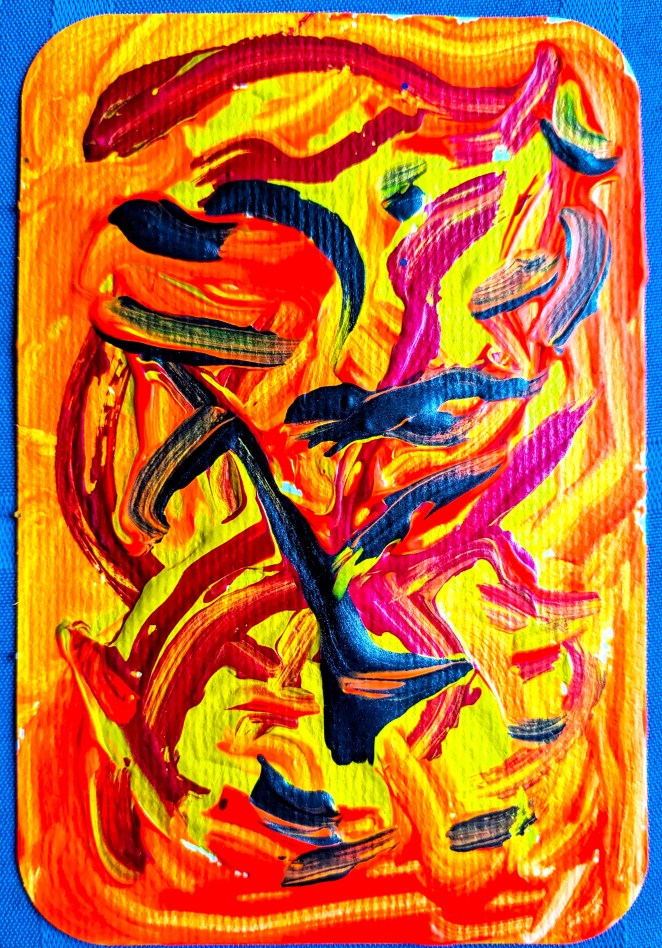
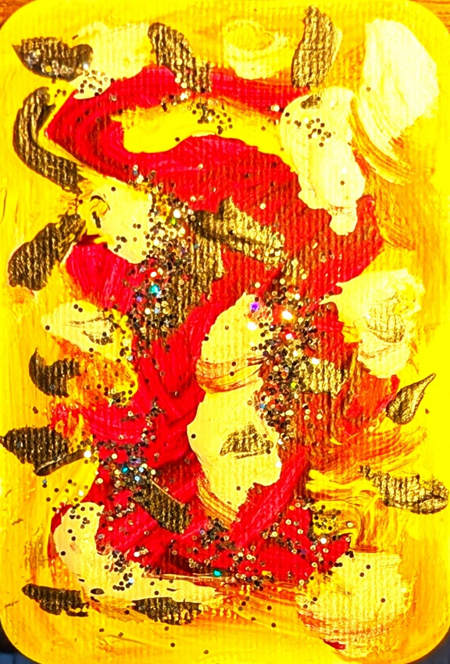
So, Moo has just come back from wherever he’s been and wherever it was, he’s not telling me. However, he does say that I look All Shook Up. And he’s humming Elvis Presley songs at me. And the above painting is his suggestion for me for today. “Thank you, Moo. And welcome back.” He nods at me. “Good to see you two,” he says. “You spelt that wrong,” I tell him. “I didn’t,” he says. “We all know you’re a split personality and I am saying that I am pleased to see both halves of you again.” Oh, dear, you can never win with Moo. He always paints a different angle or comes round in a wiggling circle. “Ha!” he says. “At least I don’t paint myself into corners.”

Am I a victim, then, as Camus suggests, or just another assassin? Interesting suggestion. We are either murderers or victims. But I haven’t murdered anyone, that I am aware of. And I don’t feel myself to be a victim. So what is my dear friend Albert on about? Alas, he isn’t around to ask. I just have to read his books and see myself left wondering.

I guess it was all different in Paris, in the 1940, during the Nazi occupation. Anyone can talk a good game, but what do you do when the Gestapo knock on your door at 2:00 am? Good question. Existence precedes essence. We live. We survive. That’s Jean-Paul Sartre. And so is this – “L’homme n’est rien d’autre que ce qu’il fait.” Man is no more than what he does. So there you have it. It’s never what you say you might do, or how you relate things in respect – it’s all about what you are doing right now. So – ask yourself that vital question – “What am I actually doing?” The answer you give will tell you a lot of things about yourself – if you are honest in what you say.
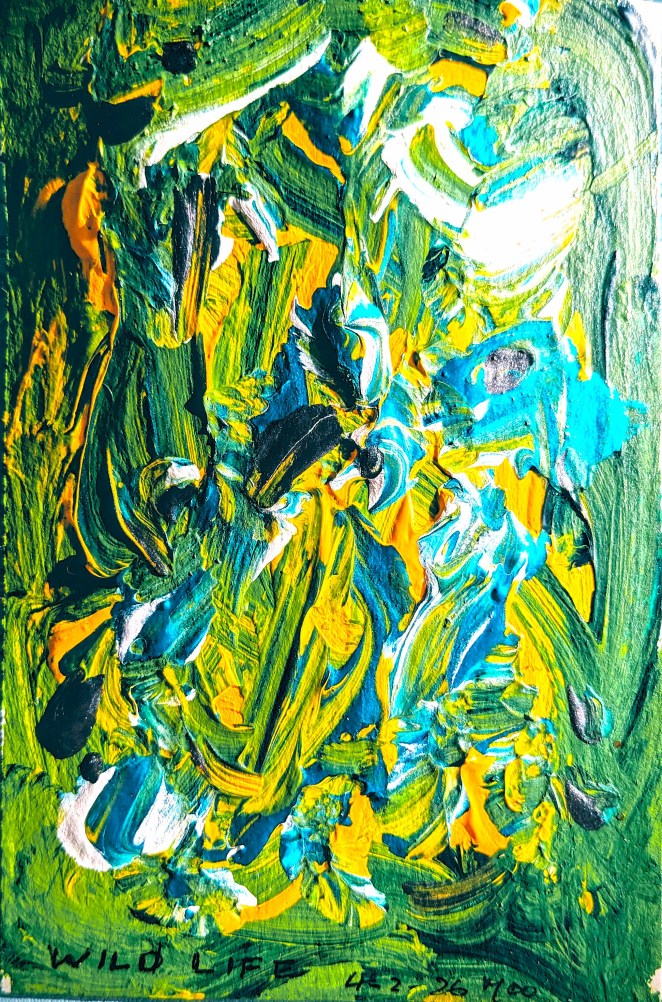
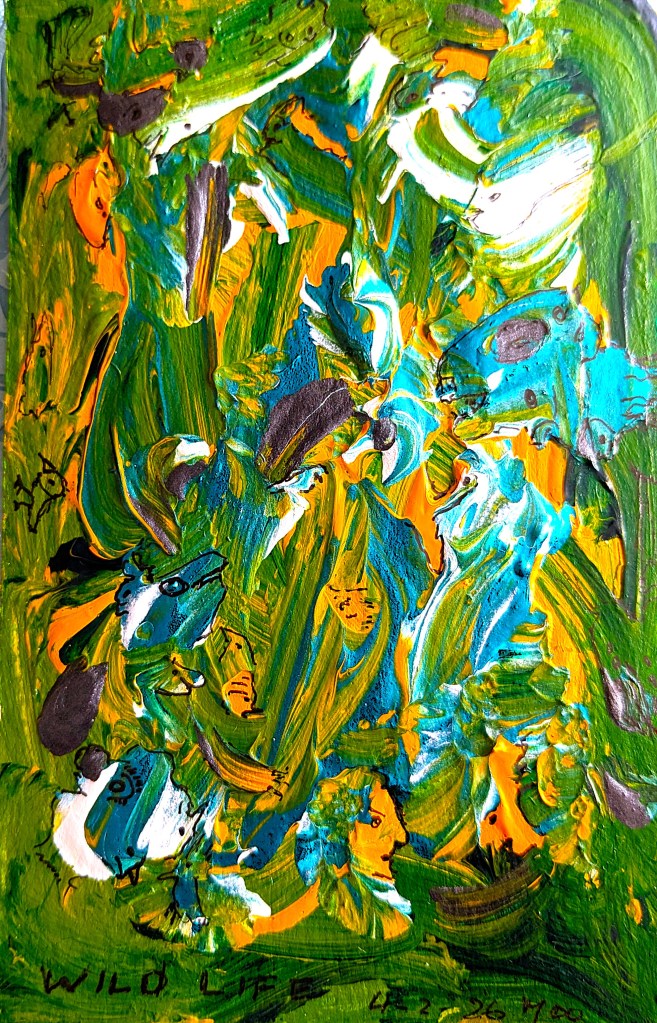
Wild Life

Wild Life

I see green grass
Small ponds
Winding roads
Patches of sorrow

Turquoise blues 
Hills to climb
Softness
Strength 

Flowers blooming
A small animal
Covered in feathers 

An eye
Keeping watch
Purity of white

Ekphrastic Poem
©
Yolande Essiembre

Comment:

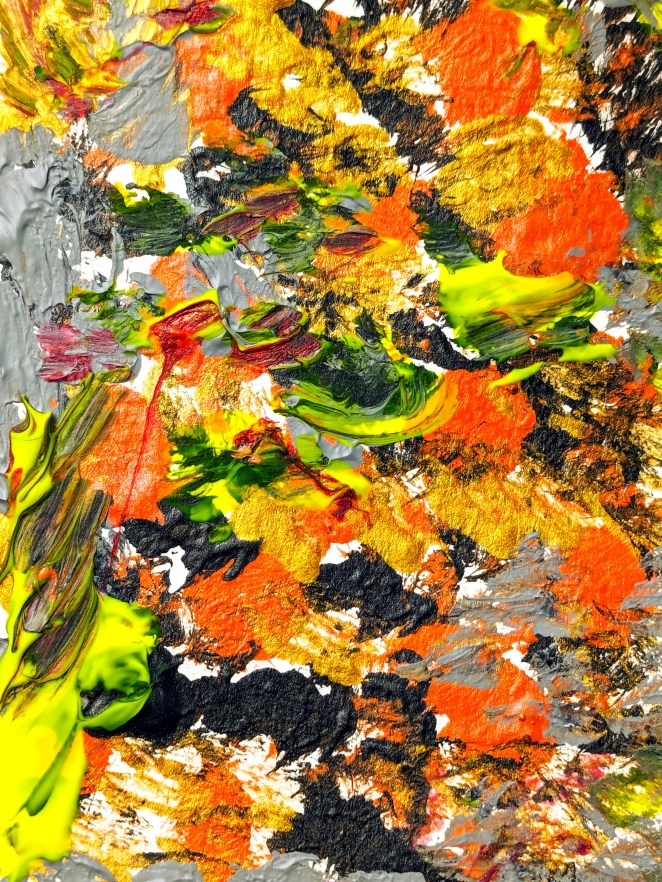
My good friend Yolande Essiembre sent me her Ekphrastic poem after viewing this morning’s painting by Moo. Wild Life II is a better representation of the colours of the original. However, Moo added in some (what he calls!) helpful touches – the black shapes that reinforce the suggestions of the original. Yolande wrote her poem based on Version I – but with the stronger colors of version II. Magic oh what a tangled web we weave when first we practice to deceive. And all artists weave their webs of deceit. As Cervantes says – Tanto la mentira es mejor, cuanto más parece verdadera. / The closer it approaches the truth, the better the lie.

Imitatioimitation – one of the bedrocks of classical rhetoric. “Imitation is the best form of flattery”. Flattery, yes, but what we find, in art above all, is that there exists only one original. However good the copy, the flattery – the imitation, if you prefer – it is never as good as the original. The original of this painting exists in one time and one place. The two deceptions are not the original. In fact, Wild Life I no longer exists because Moo has repainted it. It has turned into Wild Life II.

So many questions – which version do you prefer – I or II? De gustibus non est disputandum. There is no arguing about taste. Which is the better version? Well, each viewer must choose. But remember, each version is a deception, and each deception is a lie. And there is only one original. Oh what a tangled web we weave.

But we can, I hope, agree on one thing – Yolande’s verbal version (which I publish here with her permission) is verbally picture perfect. It is how she sees the painting. It is what the painting means to her.

Thank you so much Yolande. Moo and I hope to publish your words and visions more often. With your permission. we will do so.


Rage, Rage 8 & 9

Rage, Rage
8

A late summer storm
lays waste to the doggy daze
that clouds my mind.

Carnivorous canicular,
hydropic, it drains my soul,
desiccates my dreams,
gnaws me into nothingness.

Tonight, the old black hound
will dog me,
sending my head spinning.

It will force me
to chase my own tail,
round and round
in ever-decreasing circles.

It will devour my future,
leaving past failures
to ghost through my mind.

9

Where now are the hands
that raise me up,
that rescue me
from dark depression,
that haul me out
from life’s whirlpool,
that forestall
the jaws that bite,
that save me
from the claws
that snatch?

Where are the hands
that move the pieces
on the chess board
of my days and nights,
that prepare my breakfast,
that bake my birthday cake
and count the candles
that they place and light?

What will I do
without them
now they are gone?

Commentary:

Gnawed into nothingness – the umbra nihili of the medieval mystics, the shadow of nothingness that sometimes falls upon us, threatening our peace of mind. An AI search offers – Umbra Nihili (Latin for “Shadow of Nothingness”) refers to a concept of cosmic loneliness or existential void famously cited by Meister Eckhart. A great many of my friends have recently discovered this umbra nihili. I am not sure why. I guess it varies for each one of us. Mal de todos, consuelo de tontos / that everyone suffers consoles only fools, the Spaniards say. What can we do at such times? Reach out, help when we can, count only the happy hours, as the inscription on the Roman sundial tells us – horas non numero nisi serenas.

Many have walked this way before. But that should not be a consolation in itself. Rather, it should be an acknowledgement that there is an exit to the maze, a key to unlock misery’s door, a thread to lead us out of the labyrinth. We must just acknowledge that fact and search for the exit, the key, the thread, that will prove to be our personal salvation, and hopefully the salvation of other fellow sufferers as well.

Rage, Rage 7

Rage, Rage
7

Blood of my blood,
my daughter’s daughter,
time is not on our side.
 
I sometimes wonder
if I’ll survive,
if you and I
will ever meet again.

When we talk online
I see you trying
to understand, to hold
my image in your mind,
to figure out this shadow
that moves and talks
on the computer screen.

Words, born from old Welsh
melodies, bring poetry
to my heart, place music
on my lips.

But they fall short,
and fail to satisfy
my need to reach out
and hold you.

In spite of that I still survive
and live in hopes to see you
in our realities of flesh and blood.

Commentary:

When I first came to Canada, such a long time ago, I communicated with home by means of air mail letters written on special air mail paper that came in very thin, foldable envelopes. Very rarely I communicated by means of very expensive telephone calls of a limited three minute duration. How times have changed. Now via Skype (as was), Team (as is), Messenger, FaceTime, and other means, we can have unlimited face to face conversations, free of charge, with people on the other side of the world. And yet, face to face and screen to screen, there is still something missing. The cat senses it. She stares at the screen and sniffs – then she bristles and hisses. She fails to understand a known voice that has sound and movement but no smell.

And yet, what we now have is so much better than what we had before. Communication is so much easier. We have generated a generation that works in the audio-visual world, not in my preferred world of written verbalization. How we have changed. I can do so many things, in my head, that the younger generation cannot do, even with pen or pencil and paper. However, when my computer fails me, or my cell phone acts up, it is to that younger generation I go, because they dominate this new world in which we live.

I gave one of my academic articles to a friend the other week. “I can’t read this,” he said. “Tell me, what’s it all about?” I started to explain. “Hold on,” he said. He asked his AI program to read my article and generate, in words a 14 year old could understand, the main contents of my not-so-easy-to-read academic writing and thinking. About thirty seconds later, the analyzed contents appeared on the screen before him. I threw my mind back to when Coles Notes were forbidden. “Anybody caught using Coles Notes will be given an automatic F.” Then I looked at my own article, analyzed perfectly, and set out in the very way I had planned it, albeit with a simplified vocabulary – and the longer words explained in a sort of appendix. Quite simply, I was blown away.

Then my mind went back to my childhood in Wales. No running water, no electricity, no indoor toilets, no telephones, no television, a radio with limited stations and programming … imagine what we have come from – imagine where we are going. My only questions – will we control it or will it control us? And you know what it is. The clarion call goes out across the centuries. – Quis custodiet ipsos custodies? Who shall guard the guards? Who shall police the police? Who shall program the programmers? Each generation must find its own answers to those questions. And the sooner you do it, the better because it’s not going to be my problem for much longer!

Rage, Rage 2 & 3


Rage, Rage
2

These problems start the day
you realize you are alone.
Your beloved goes away,
for a holiday,
to be with your daughter
and grandchild.

Now the house and the cat
are yours, and yours alone.
No problem you say and
everyone believes you.

You jumped in the car,
drove daughter, and child,
holidays done,
to the airport.

Your beloved went with them,
her holiday about to begin.
And that’s when it all began.

3

When I come back home
from leaving them at the airport,
the front door stands open.

I thought I had closed it
when we left.
I tip-toe in and call out
“Is anybody there?”

Echo answers me –
‘… there, there, there …”

Commentary:

Raymond Guy LeBlanc, one of my favorite Acadian poets, published his poetry book, Cri de Terre, in 1972. My painter friend Moo, who also likes Acadian poetry, borrowed the title and changed it slightly when he painted this painting – Cri de Coeur. Earth Cry / Heart Cry.
What is all creativity, visual of verbal, but a cry from the land or a cry from the heart? Sometimes it is more than a cry – it becomes a clarion call, a shout out, a calling out.

So many of us are born with creativity in our hearts. So few of us carry that creativity, be it verbal or visual, into the adult world, a world that all too often grinds us down and sifts us out. We become grey people in grey clothing sitting behind grey desks beneath artificial lighting, doing grey jobs that slowly turn us into nine to five (or longer) dusts.

Moo has promised me a series of red paintings for this sequence. We shall see how he does. Red for anger, red for age, a red flag for danger, a red rag to wave at the raging bull of life, to provoke it, then bring it under control.

Nadolig Llawen – Welsh for Have a Joyous Festive Season. You can add other languages, as you wish. But above all remember Pedro Calderon de la Barca’s words – “Life is a dream and dreams are nothing but dreams.” One day, we shall all wake up. Artists and dreamers, grey ghosts and people of straw and dust.


Carved in Stone 70 & 71

Carved in Stone
70

Where can I survive
in this harsh world
where poetry and ideas
struggle to be free,
a world in which
the great literary myths
have been destroyed?

Where mass media rules,
sensationalizes, lies,
falsifies the power and glory
of words, now used
not to delight and educate,
but to manipulate.

A treacherous world
in which an evil genius rules
and constantly misleads us.

71

An Age, not of Enlightenment,
but of Endarkenment,
this is not the world
in which I want to live.

My chosen world
is that quiet corner,
outside El Rincón
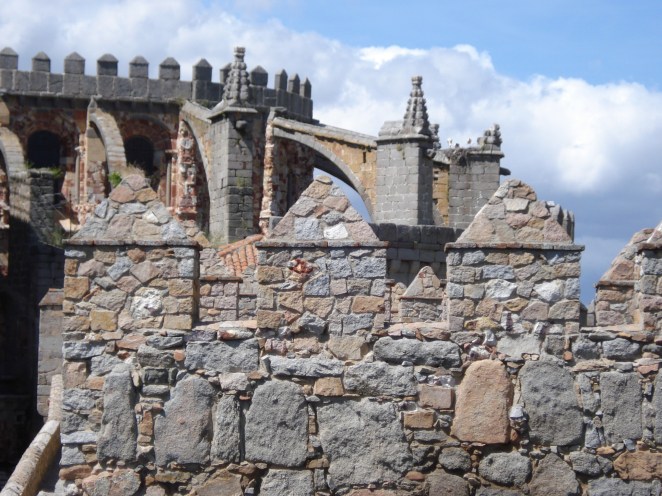
in the Plaza Zurraquín,
by the Mercado Chico,
in Ávila, Spain,
where leaves and confetti
dance to the wind’s tune.

A world of mystery and dream,
personal perhaps,
but well known to
all of those dreamers
who have the eyes to see
and the heart to stand still
and listen.

Commentary:

“There is no earth, no heaven, no extended body, no magnitude, no place and that nonetheless I perceive these things and they seem good to me. And this is the most harrowing possibility of all, that our world is commanded by a deity who deceives humanity and we cannot avoid being misled for there may be systematic deception and then all is lost. And even the most reliable information is dubious, for we may be faced with an evil genius who is deceiving us and then there can be no reassurance in the foundations of our knowledge.” René Descartes (1596-1650).

Cervantes wrote about such times in Don Quixote. Do we see what others see? What is truth and what is fiction? How do we approach and understand authority? What do we believe and why do we believe? Are they windmills or giants, wineskins or warriors, a flock of sheep or an invading army? “Only believe, and thou shalt see” – but what do we believe and why do we believe. “The fault, dear Brutus, lies in ourselves, not in the stars, that we are underlings,” Shakespeare, from one of his many plays.

Carved in Stone 43

Carved in Stone
43

Back home, in that little cul-de-sac,
the husbands are away,
working their night shifts,
while the wives are at home,
entertaining the truckers,
those long-distance drivers,
who park in that street and lodge there,
overnight, in the houses.

The children, boys and girls,
go out into the street,
climb into the trucks,
duck under the tarpaulins,
and, with all of us sworn to silence,
practice what their elders
are doing back home.

Commentary:
Monkey see, monkey do. And who knows what Monkey sees or does when the lights are turned out, darkness descends, and the honor of the blood cult takes control. Ask the animals, they will teach you. That was the motto of Bristol Zoo, where the Monkey Temple ruled, and Alfred the Gorilla and Rosie, the Elephant, were King and Queen of the beasts.

Knowledge – where does it come from? How do we attaint it? Is there a difference between knowledge, what is known, felt, and worked out for yourself, and education, when you obey orders and do what you are told to do (and how to do it). “We don’t need no education, we don’t need no thought control.” I have always loved Pink Floyd and The Wall. So many walls, so many barriers, so many things to break down in order to build them up again. Songs – Frank Sinatra – “I did it my way!” And who teaches what and to whom, underneath the tarpaulin when the lights are out? “Hey, teacher, leave those kids alone.”

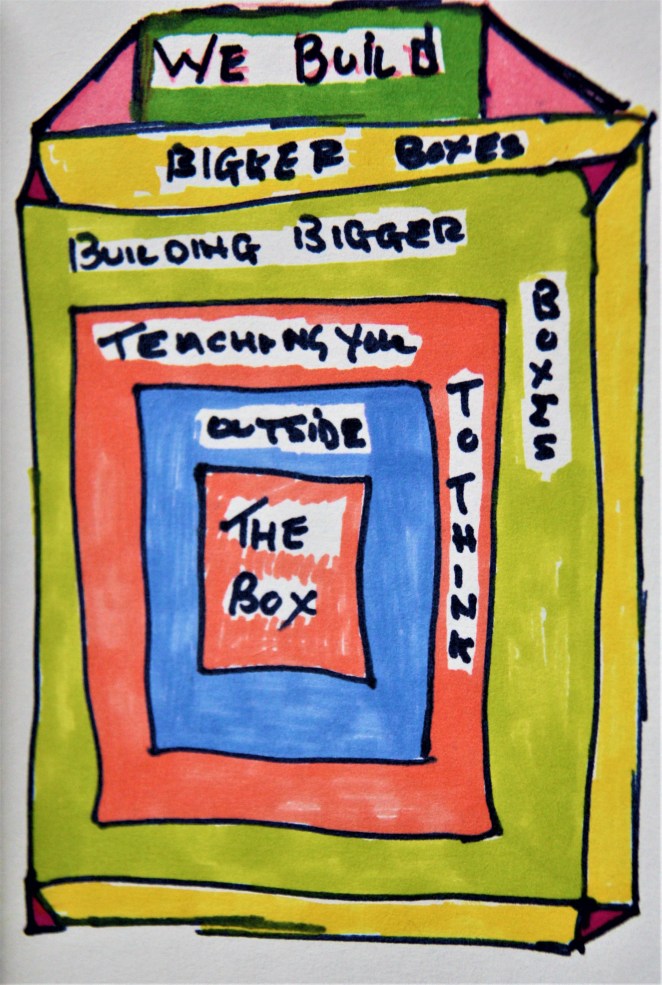
And beware of anyone who tells you that “we teach you to think outside the box.” That person will only give you a slightly bigger box, of his or her own making, inside of which you will be forced to think.

Of course, there are other ways in which we can think about education. How about this one? Filling empty heads with knowledge. How many ways are there to do this? And what is the exact content of the jug from which the knowledge will flow? And how many sows’ ears does it take to make a silk purse? “Hey, teacher, leave those kids alone.” Giddy up, Neddy I’m on my hobby horse now.

Joy of Words

Joy of Words

If the words won’t come, don’t worry.
Sooner or later, they will arrive, driving
down in flurries. Think wind-driven leaves
or the soft white whisper of snaking snow.

There is a moment when all sounds cease
and you can be at one with your inner self,
there, where summer sunshine twinkles
and soft rains bring forth clarity and joy.

What are words anyway, but soap bubbles
emerging from an iron ring to rise in
child-hood’s skies, soaring, dying, around
the cloudy thrones of sun-kissed clouds.

We, their so-called creators, are left below,
building cotton-wool castles spun from air.

Commentary:
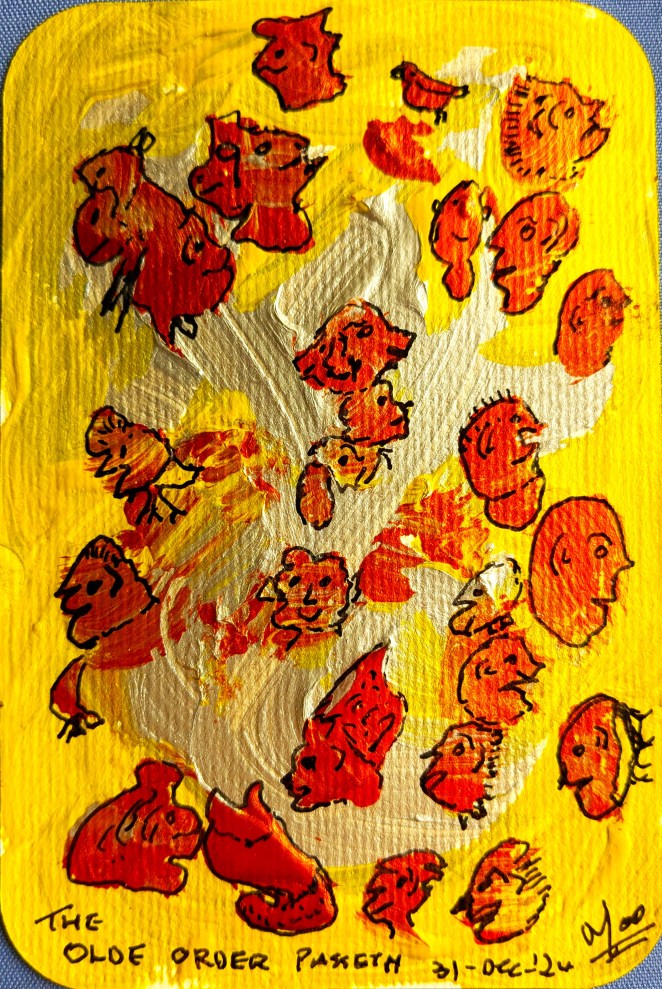
Moo suggested I use this painting of his to illustrate this poem. He called it originally The Olde Order Passeth, but the original phrase, from Tennyson’s Idylls of the King, should really be The Olde Order Changeth, lest one good custom should corrupt the world.

And yes, things do change. Here we have a fourteen line sonnet. Structure giving order to chaos. And words change, the world changes, our thoughts change, the weather changes. Hymns Ancient and Modern – Age and decay in all around I see, oh thou who changeth not, abide with me.

And what do we do when we meet with change? Weather – I change my clothes. There is no such thing as bad weather, only inadequate clothing. It used to be a useful saying, that one, but not any longer. When change changes into disaster, it is a very different kettle of fish. Thoughts change – mine just did. A useful phrase suddenly becomes an inadequate reaction to a changing situation. The world changes – sometimes for better, sometimes for worse, but how do we, each one of us, confront that change? How do we adapt to it?

I know far too many people who, like the ostrich, bury their heads in the sand and pretend that change is not all around us, that the world is the same as it always was. We humans are experts at adapting. We must adapt. But how do we adapt? Each one of us must answer that question in his or her own way. The alternative is to close our eyes, bury our heads, and pretend that nothing is happening.

Another alternative is to seek within for that moment when all sounds cease and you can be at one with your inner self, there, where summer sunshine twinkles and soft rains bring forth clarity and joy. Perhaps that is the world the ostrich discovers when he removes himself from this world and enters that other one beneath the sand. Who knows? Not even the ostrich, I would guess.

Carved in Stone 27

The philosopher in search of his stone.

Carved in Stone

27

Miguel de Cervantes –
I read and re-read his words,
envious of his ability to reach out
with language that thrills me still.

I see him as a total entity,
while I see myself in pieces,
broken, unable to express
the simplest thoughts.

As I age, I sense the water
slipping from the water-clock,
the candles burning lower.

I still cannot make the mark
I want to make, for they are beyond me,
those marvelous word-worlds.

My words are mortal, his are immortal.
Mine just ink stains on a humble page,
his cast in print, but crafted to last forever.

As I bear witness to those powers,
so much greater than mine,
my eyes fill with tears.

Commentary:

They are beyond me, those marvelous word-worlds. Indeed they are. But I do not seek to create ‘a marvelous word-world’. I am happy with ‘ink stains on a humble page’. I seek to reach out and find those one or two people who accept me for what I am and find their own selves in a small corner of the tiny gardens I discover or create. Not a world, then, but a tiny corner of my own world, described, and offered to those who have eyes to see and ears to hear and hearts and minds to feel and understand.

And what is this infatuation with the poem itself? I no longer write individual poems, I write sequences of linked poems, a set of poetic narratives, if you need to find a label for what I am trying to do. Cervantes once wrote “La épica también puede escribirse en prosa.” / Epic poetry can also be written in prose. What happens if we reverse that statement and say – “A narrative sequence can also be written in poetry.” Interesting, eh?

And what is this desire to leave something, some trace of us, behind? I cannot answer that question. The answer will vary for each one of us, and for each fall wall flower perishing against the garden wall. I look at the homeless, pushing their grocery carts, head down. Their existence is as important as mine. Their desire to survive, for another day, another week, another season – and winter is coming one – is more powerful than any poet’s desire to leave a work – a magnum opus – to celebrate their lives.

And yes, my words are mortal, as I am mortal, as Miguel de Cervantes and all the great writers were mortal. Patrick Lane once told me that if poets leave one poem behind them that is remembered, they have done well. Even the greatest poets, and you can check this in the anthologies over the ages, rarely leave more than ten or a dozen memorable poems. As for me, I am happy to say that I have never had a poem included in an anthology. Not to my knowledge anyway.

And what does Magnum Opus actually mean? I leave you with the quote from Wikipedia set out above. Click on it, and find yet another way to distract, deflect, and change the direction of our lives! Given that road, who would ever want to walk it to its end?

Carved in Stone 13

13

What is life?
Is it just an illusion,
as Calderón tells us,
and nothing but a dream?

And what is time?
Does it bend, as Dalí shows us
when his surreal clock breaks into pieces,
time and numbers flying off
as it explodes over a waterfall?

Another clock folds –
a pancake draped
over the bough of a tree.
 
Time – a water clock,
a marked candle,
a grandfather clock,
with Roman numerals,
and time marching,
round and round,
erasing the past,
establishing a future
that will itself
soon be erased.

And what am I
but a moment on time’s clock,
a drop in the clepsydra,
a striation on a flickering candle,
a piece of roughly polished sea-glass
perched on a lonely beach?

Commentary:

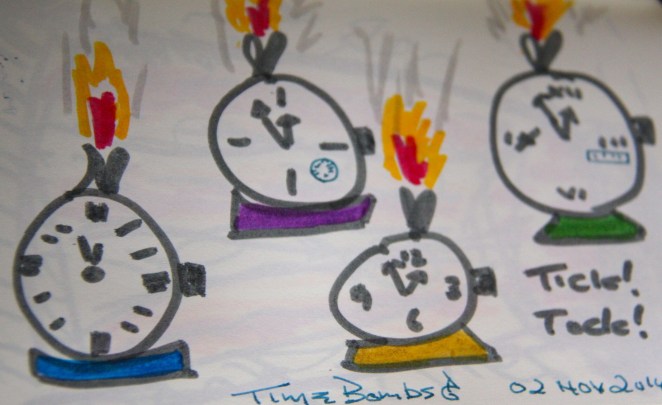
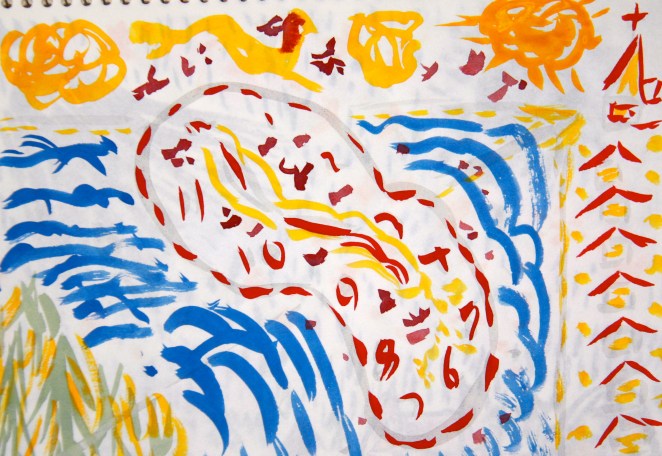
Well, Moo has done me proud this time. Two early paintings, both depicting aspects of time, as conceived by Moo. In the first, time is seen as a tick-tock time bomb, or rather a set of tick-tock time-bombs. In the second, in imitation of Salvador Dali (Moo always set his sights high!), a clock going over a water fall and the hours flying off the clock face as time bends. So, tell me if you can, what is time?

Perhaps more important, what is life? Is it a dream, an illusion? And if it is a dream, what happens when we wake up? I know what happens when I wake up – I get up and go pee. Is that to be my final reality? By extension, is life our only reality? Or is our life a series of lives, as some religions would persuade us? And if a cat has nine lives, how many lives do we have? Can they be numbered? Or, like innumerable onions, do we peel away layer after layer? And if so, what is in the centre of the onion when we finally get down that far?

And why do some people write center while others write centre? Is life an illusion, a play? If so does it take place in a theatre or a theater? Or is really a sort of metatheatre or metatheater, life in rings, like the onion, lay after lay, layer after layer? Oh dear, this is all much too complicated. I’ll ask Moo to paint me a painting of life and we’ll see what he comes up with. He’s a bit lazy at the moment and his paint brush has the bends and refuses to cooperate. It’s probably made of cat bristles, and is untrainable and almost impossible to train, let alone to herd. Never mind. We’ll abandon all this for now and give the cat the task of training Moo to paint another painting.