Autumn Leaves

Autumn Leaves

I used to run,
jump, and catch them
in mid-air,
one, two, three
in each hand.

Now
I stand and wait
for them to fall
and land, perhaps,
on my clothes
or catch in my hair

…

the Leprechaun luck
of my Irish heritage,
so long-denied,
with its pot of golden leaves
waiting for me
at summer’s cast-off
rainbow’s end.

Commentary:

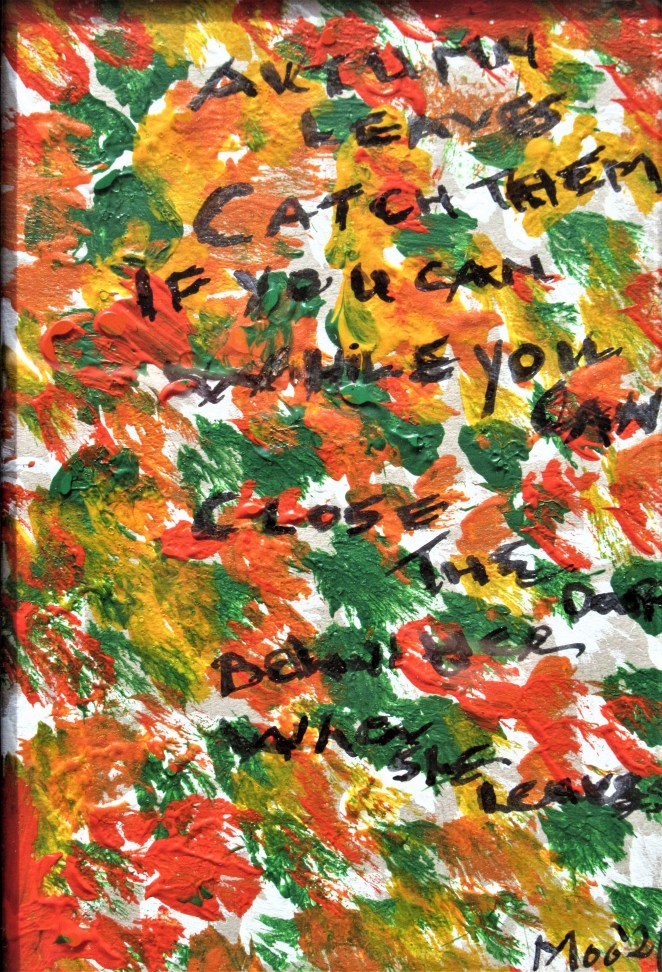
Autumn Leaves, but where does it go to. Good question. Moo asked me that the other day. I just had to tell him that I didn’t know. However, he did offer me the perfect painting for the fall and the changing leaves. Fall Folly Age. I never realized that he could play with words like he plays with paint. Anyway, I know that last winter he painted a picture of little white dots with wings. “What are they?” I asked him. “Snow flies,” he replied. “You know, when the snow flies …” “When the snow flies do what?” “I don’t know.” Moo and I live in a mysterious world, as you have probably come to realize.

Any way, the combination of fall foliage and fall folly age is quite a good one and it shows the folly of ageing and trying to chase down falling leaves when gadding about in the garden with two sticks, one in each hand. Of course, in case you don’t like that painting, and I hope you do like it, because I do, then here’s another one for you.

The text reads – “Autumn leaves – catch them if you can – while you can -and close the door behind her – when she leaves.” Oh witty Moo. Painting and occasional poetry too.

Dog Days

Dog Daze

1

A dry storm lays waste the days that dog my mind.
Carnivorous canicular, hydropic, it drinks me dry,
desiccates my dreams, gnaws me into nothingness.

At night a black dog hounds me, sends my head spinning,
makes me chase my own tail, round and round. It snaps at
dreams, shadows, memories that ghost through my mind.

Tarot Cards and Tea Leaves are lost in a Mad Hatter’s
dream of a dormouse in a teapot on an unkempt table.
Hunter home from the hill, I awake to find my house
empty, my body devastated, my future a foretold mess.

Desperate I lap at salt-licks of false hope but
they only increase my thirst and drive me deeper
into thick, black, tumultuous clouds. Dry lightning.
The drought continues and no raindrops fall.

Dog Daze
2

The drought continues and no raindrops fall.
Desperate I lap at salt-licks of false hope but
they only increase my thirst and drive me deeper
into thick, black, tumultuous clouds. Dry lightning.

Tarot Cards and Tea Leaves are lost in a Mad Hatter’s
dream of a dormouse in a teapot on an unkempt table.
Hunter home from the hill, I awake to find my house
empty, my body devastated, my future a foretold mess.

At night a black dog hounds me, sends my head spinning,
makes me chase my own tail, round and round. It snaps at
dreams, shadows, memories that ghost through my mind.

A heat wave lays waste the hopes that dog my days.
Carnivorous canicular, hydropic, it drinks me dry,
desiccates my dreams, gnaws me into nothingness.

Dog Daze
3

The drought continues. No raindrops fall.
No fresh water. None at all.

Dark clouds gather in the sky.
No rain falls. The ground is dry.

Grass all burned. No more hay.
How much livestock will they slay?

No rain comes, but a flash of light
sets the woods and fields alight.

Home from the fields, some farmers confess
their future is an unpredictable mess.

Desperate farmers are losing hope.
Out in the barns, they keep some rope.

The roof beams are sturdy and built high.
One little jump and problems good-bye.

Commentary:

Dog Daze 1 is a reverse sonnet. Instead of being structured 4-4-3-3 it moves in reverse 3-3-4-4. What fun to pretend to be Milton Acorn, and to turn my sonnet upside down. It should rhyme, but I abandoned rhyme in favor of metaphor a long time ago. Was I right to do so? What, if anything, catches you unawares in Dog Daze 1? Does it work for you? What would happen if we turned it upside down? You be the judge.

Dog Daze 2 is more or less the same sonnet returned to its normal stanzaic shape 4-4-3-3. In what ways has the poem now changed? Clearly there is a structural difference. Obviously some of the lines and images have changed. Is the poem stronger? Weaker? Does each one affect you in a different fashion? Do you prefer one version to the other?

Mission Impossible – How many more adaptations can we make to this poem and how would each one affect the poem and the reader’s reception of it? For example – Dog Daze 3 sees our sonnet turned into a poem composed of seven rhyming couplets. Couplets are easy to rhyme. But do they simplify the thoughts too much? Is the poem now too dark? Can you lighten the mood? How? Your mission, should you decide to accept it, is to rewrite the poem in seven non-rhyming couplets. That will make a change from the Daily Sudoku and the Cross-word puzzle. If you do take up the challenge, let me see what you do! And remember, you can make it personal to you, your life, and your garden.

On reste ici

On reste ici

The double meaning
troubles my brain,
tugs heart strings,
sings a violin strain
or strums a throbbing
double-bass tightly
enclosed in my chest.

Rest, reste: here
we will remain and rest.
I like the sound of it.

Outside my window,
the mountain ash weeps
red autumn tears.
Robins flock, grow tipsy
feasting on its berries.
Ici on reste.

You and I, now,
and here we will remain
until, at last, in peace,
we will rest.

Commentary:

I live in a functionally bilingual province in a legally bilingual country. Yet I am consistently told that poems should contain only one language and should not wander between two (or more) of them.

This always reminds of the old joke – “I know what CBC Radio means, but what do the initials EC mean in ici [EC] Radio Canada?” This draws attention to one of my pet hates – the translators who translate for our politicians as they transfer their thoughts from one language to another. Suddenly, without warning, the husky-voiced male prime minister starts speaking French and his deep voice immediately changes into the high-pitched feminine interpreter’s alto. Most disconcerting. I flick back and forth between channels to catch those politicians in both languages. Alas, they rarely deliver the same message in both languages as the nuances and emotions change. Listen carefully and you’ll see (or hear) what I mean.

And so it is with poetry. I love the play on English – rest (to rest or to stay) and French rester (to stay or remain). Why shouldn’t I use that type of play in my poetry? It lends infinite shades of meaning and emotion to the verse. Ah well, the jury’s out. But don’t put foreign words (NB in Canada, French is NOT a foreign language) in your poems. You won’t get published and you won’t win any competitions, even if you do explain what the words mean. And remember, T. S. Eliot didn’t translate the foreign words he used in his Four Quartets. And he wasn’t a bad poet!

Sweet Dreams

Sweet Dreams

Amnesia survives in these amniotic waters,
moving in time to the water pump’s heart beat.
I close my eyes and dream. Nothing is the same.

Do I drift dreamily or dreamily drift?
The bath-tub’s rose-petals bring memories –
primroses, bluebells, cowslips, daffodils dancing

beneath the trees in Blackweir Gardens,
or beside Roath Lake, where I biked
on gravel paths so many years ago.

Photos float before me, pictures of moments
I alone recall. Spring in Paris, the trees
breaking into bud along the Champs-Élysées.

Santander in summer, walking the Piquío
as it slumbers beneath the jacarandas.
One winter in Wales, up in Snowdonia,

I ran down a valley between high hills,
on a freezing night, with only the stars
to keep me company, so cold, I nearly froze.

Autumn at the Peace Park in Mactaquac,
with leaves reflected in the head pond.
Or the Beaver Pond with its fall orgy

of gaudily painted trees, leaves drifting down
on this first chill wind, to settle like tiny,
colorful birds in my beloved’s hair.

I remember the look in her eyes when
I caught a falling leaf and put it in
her pocket, telling her to save it,
like a falling star, for a rainy day.

Clepsydra 12 & 13 – Pilgrim in this barren land …

Clepsydra 12 & 13 –
Pilgrim in this barren land …

12

… pilgrim in this barren land
     lost in my wanderings
          the wander-lust still tugging at me

in my back-pack
               dusty with memories
                    photos that only I have seen
                         sepia
                              spotted in places

only I know names and faces
     recall relationships
          a mystery to me, an outsider,
               such images haunt me
                    move me in ways
                         I do not understand

the irregular heart-beat
     of my life walks inside me
          down new corridors of time
               fresh music
                    strums my heart-strings

a heart
     a bridge a time too far
          lost I wander the woods
               searching for things
                    I know I must find
                         my lost self among them …


13

… but to find myself
     I must first lose myself,
          not in a barren land
               nor in the inner depths
                    of my suffering mind
                         nor the deeper depths
                              of another’s body

am I nothing more
     than an offering on the altar
          where nothing alters more
               than this interchange
                    eye to eye
                         mind to mind
                              body to body

will the I ever transform
     into the power of us
          together
               both of us

and are we much more
     than one plus one
          with three or four or more
               conjured from the word
                    that was from the beginning

or is all of this
     nothing more than
          the woven magic of pillow-talk …

If you were going to open up a shop, what would you sell?

1. If you were going to open up a shop, what would you sell?

That is a very hard question to answer. I think of all the material things that everyone else can think of, but I do not want to sell commonplace things – antique furniture, paintings, books, stamps, groceries – I could go on and on, but I will resist the temptation to do so.

When I lived in Santander, Spain, the local wines were sometimes called ‘sol embotellado’ / bottled sunshine. I wouldn’t want to open a wine shop, but I would love to bottle the essence of a warm sunny summer day and – why should I sell it? I wouldn’t. I would give it away, free of charge, to all the needy people, inner city boys and girls, the impoverished, those who live in the streets and sleep in doorways or under bridges at night. Oh, the joy and happiness that would come when they opened their bottle of summer sunshine and felt the warm fresh air gather around them so they could breathe it in.

But why stop there? I would also give away ‘essence of butterflies’, that special feeling that comes on the colored wings of a butterfly and combines with the joy of flowers and the gift of taking flight. How special that would be. But sell it? It is much too valuable to sell. Put a dollar, Euro, yen, rupee, or sterling price upon it, and all its powers would vanish, like fairy dreams fading away.

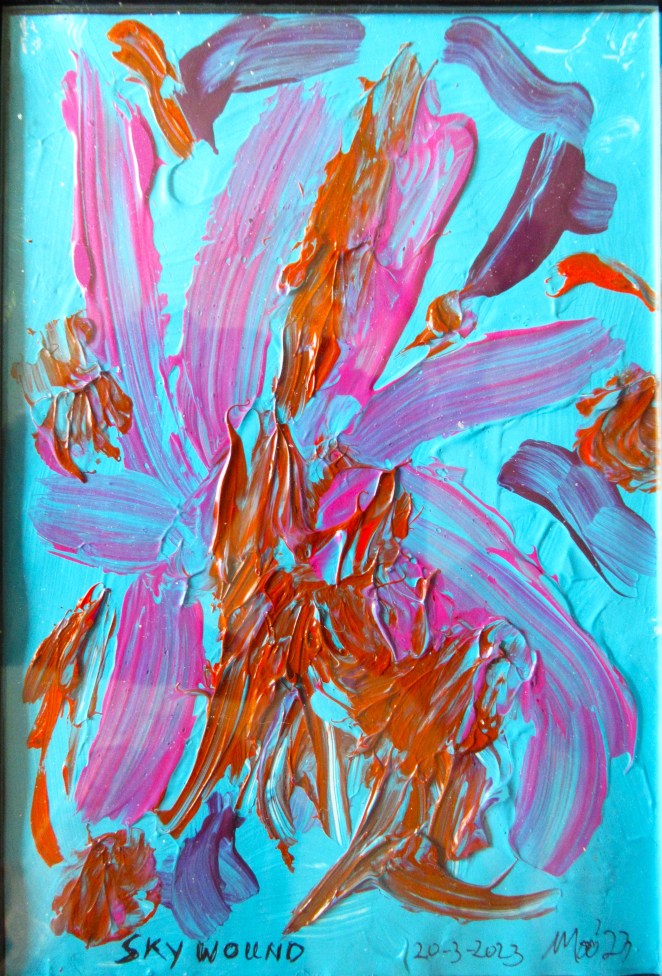
Among other things, I would also like to offer the gift of the joy of words. Colors, in the imagination of Blake, were ‘sky wounds’. What joy to take a normal word, add a second word to it and create a new verbal image – ‘sky wounds’. And what happens when the sky is wounded, you ask. Well, the wound opens, the blood pours out and ‘le soleil se couche dans son sang qui se fige’ – ‘the sun sets in its own congealing blood’. Baudelaire, if I remember correctly, from Les Fleurs du Mal. What beauty in those new images. What joy in remembering and recreating them. I would bottle such gifts and give them away in my shop.

Fairy dreams – yes, I would offer them as well to those who needed them. And not the sort that fade away, but those fairy dreams that suspend us in the wondrous beauty of their ethereal light. And I would bottle hope, and self-belief, and the power to change oneself from what one is to what one is destined to be. And I would add essence of self-knowledge and powder of Davey Lamp light that would enable the seekers to seek in the darkest corners of their souls and find that elusive inner self, and bring it out from the darkness. And I would stock fragrant filaments of firefly that would also allow my customers to enlighten that darkest of nights, the dark night of the soul. And a map of hidden foot paths that would allow the wanderer to wander and never get lost.

How about an elixir of happiness and joy? A quintessence of rainbows, perhaps? Or a magic lantern that would shine out from heart and eyes and enlighten the soul friends of those lucky souls who were able to locate and enter my shop of conditioners, vital vitamins, and soul magic for all those lost and lonely people. And there, that mirror on the wall – look in it, gaze deep into your own eyes, and maybe, just maybe, you will find my shop.

And “What will your shop be called?”, you ask. Look into your heart and you may find the answer engraved therein. It will be called The Gift Shop of Hope Restored. I look forward to welcoming you when you open the door and step in.

Comment
1. The number at the beginning of this post, refers to its position in The Book of Everything. In that book, I have included 100 blog prompts (The Book of Everything) and 11 more (and a little bit extra) to give a total of 111 responses to prompts. Each one is a little bit crazy, just as this one is. But what fun to read, and write, and think slightly differently.

On Loneliness

Loneliness

58 What relationships have a positive impact on you?

I think one of my poems answers this question best. I write “one of my poems” but it is really my ‘free’ translation of one of Francisco de Quevedo’s sonnets – Retirado en la paz de estos desiertos. I have changed the poem slightly, but I am sure Don Francisco (1580-1645) will excuse Don Roger’s impoverished effort (2023).

On Loneliness
29 December 2023

Resting in the peace of these small rooms,
with few, but welcome books together,
I live in conversation with my friends,
and listen with my eyes to loving words.

Not always understood, but always there,
they influence and question my affairs,
and with contrasting points of view,
they wake me up, and make me more aware.

The wisdom of these absent friends,
some distant from me just because they’re dead,
lives on and on, thanks to the printed word.

Life flits away, the past can’t be retained.
each hour, once past, is lost and gone,
but with such friends, I’m never left alone.

And there are so many of those literary friends. I still read Rudyard Kipling and I have just finished Kim, Captains Courageous, Stalky and Co., Puck of Pook’s Hill, and Rewards and Fairies. I read these first when I was nine or ten years old, and I return to them regularly. Other friends include Garcilaso de la Vega, Fray Luis de León, St. John of the Cross, Quevedo, Góngora, Calderón, Miguel de Unamuno, Antonio Machado, various members of the Generation of 1898, the majority of the poets from the Generation of 1927… and these are just my Spanish literary friends. I have French friends, English friends, Anglo-Welsh friends, Canadian friends, Mexican friends, and, in translation, many, many more. My relationship with each of these friends has had an impact upon me.

A recent painting, by my friend Moo, is called Fiat Lux – Let There Be Light. It is reminiscent of Dylan Thomas’s poem, Light breaks where no light shines. Intertextuality – Quevedo drew inspiration from the Stoics. I drew inspiration from Quevedo. Moo drew inspiration from Dylan Thomas. The nature of creativity, and its continuing links throughout the ages, shines clearly through these wonderful associations. Long may they continue, and may others enjoy them and be influenced by them as much as I have.

Comment:
The funny thing is that I do not remember writing this blog prompt, nor do I remember having translated Quevedo’s poem into English. I wonder how many other forget-me-nots there are out there. Or, to be more precise, in my books and in my notes. A treasure trove – that’s my guess. Borges wrote of Quevedo that he was more a library than an author, and I am beginning to think that way about my self. A strange world, this, one in which the creator abandons, and then forgets, his creations. Perhaps we should change the image – not so much a library as an orphanage, and so many lost and abandoned orphans wandering around The Little World of Don Rogelio.

The Book of Everything

Discourse Analysis
and
The Meaning of Meaning

Words have dictionary definitions that allow us to agree on what they mean. In this fashion, when I say ‘my grandmother’, you automatically know that I am referring either to the mother of my mother (maternal grandmother) or the mother of my father (paternal grandmother). This is the dictionary meaning of the word ‘grandmother’.

But words have lives of their own, and their meaning changes when used by individuals. You, the reader, never knew my grandmothers. You never will. They both passed away a long time ago. I loved them both, but for very different reasons, and to me they were as different as different can be.

This means that when you, the reader of these words, reach the word ‘grandmother’, the faces you see, the emotions you feel, the memories conjured up by that word are totally different from mine. Same word, same dictionary definition, different personal memories, experiences, relationships. In addition, the role that our grandmother(s) played in our lives will be very different too. That role may vary from culture to culture, from language to language, and from the social structure of the changing society in which we live.

For example, when I first went to Santander, Spain, I visited a family who lived in a large, detached house that contained three generations of the family – grandmother and siblings, father and mother, grandchildren, and an assortment of aunts and uncles. No need for babysitters in that household. Everybody had a vested interest in the development of the young ones and the older ones received tender, loving care, twenty-four hours a day, every day of the week.

I lived from time to time in the same town as my own grandparents. I saw them regularly, but rarely on a daily basis. When my parents sent me to my first boarding school, age six (if I remember correctly), I lost contact with my family. My paternal grandfather died when I was away at school. My maternal grandmother died while I was away at school. My paternal grandmother died when I was living in Spain. My maternal grandfather died when I was living in Canada. Alas, after those early years, I scarcely knew them. My experience, then, was so different from that of other people.

When I moved to Canada, the Atlantic Ocean separated me from my parents. My daughter, born in Canada, grew up with no close knowledge of her grandparents. The word ‘grandmother’ did not mean the same to her as it did to the grandchildren in Santander, or to me. How could it? All those miles between the families, and visits limited to a couple of weeks every other year at best. Although the dictionary meaning is always the same, what a difference in the emotional meanings for each person using that word.

Discourse Analysis, the way I use it, builds not on the dictionary meanings of words, but on their emotional and personal resonance. I take the standard, dictionary meaning of words, twist it, look for meanings at different levels, and then build an alternative narrative on that changed meaning. I have great fun doing so.

Part of that verbal fun comes from my childhood. I listened to Radio Shows like The Goon Show and Beyond Our Ken. Giles’ Cartoons gave my names like Chalky White, the skeletal school teacher, or Mr. Dimwitty, a rather dense teacher in another school. These shows also twisted the meaning of words and drew their humor from such multiple meanings. The Goon Show – “Min, did you put the cat out?” “No, Henry, was it on fire?” Or on an escaped convict – “He fell into a wheelbarrow of cement and showed every sign of becoming a hardened criminal.” Or from Beyond Our Ken – “My ear was ringing. I picked it up and answered it. ‘Ken here, who am I speaking to?’ ‘Larry Choo.’ ‘Ah, Choo.’ ‘Bless you, Ken.’ Verbal scenes like these – it’s hard to get visual pictures from listening to the radio – remain engraved in my memory banks. More than engrained, they become part of the verbal system from within which I write.

This system includes Direct Discourse, Indirect Discourse, and the Twisted Discourse of an Inventive Mind that still wishes to create. It also comes from Francico de Quevedo’s Conceptismo, from Ramón del Valle-Inclán’s esperpento, and from certain aspects of Albert Camus’s Theory of the Absurd, all blended with the poetry of Jacques Prévert and the songs of Georges Brassens. This from the latter – “Tout le monde viendra me voir pendu, sauf les aveugles, bien entendu.” Everyone will come to see me hanged, except the blind of course.

This is not always easy humor, nor is it a comfortable way to see the world. But it is a traditional one with a long literary history. The title of my book goes back to Francisco de Quevedo, of course, who, in 1631, in Madrid, published El libro de todas las cosas y otras muchas más / The book of everything and a lot more things as well. Don Roger turns to his good friend Don Francisco whenever he needs a helping hand.

The pieces themselves were first published on my blog rogermoorepoet.com. They have been revised, and I have added some more pieces in a similar vein. Tolle, lege – Take and read.  Above all, enjoy this world of mine, with its subtle and not so subtle humor, its sly digs at many of our follies, and its many forms of creativity.

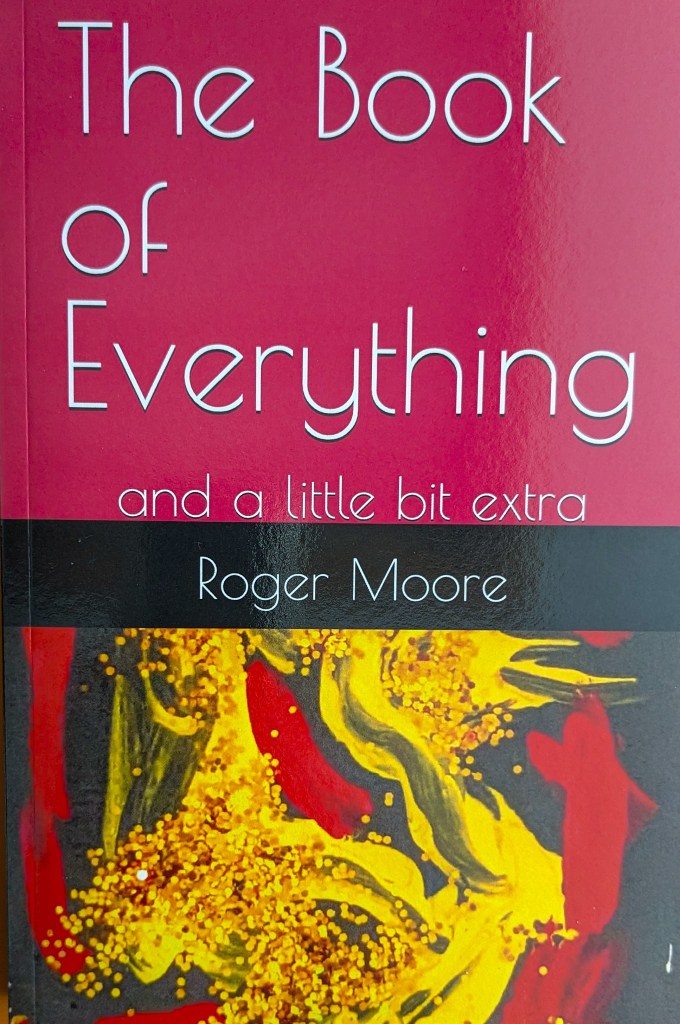
The Book of Everything
and
a little bit extra

Click on the title to purchase this book.
Clepsydra

Clepsydra

WFNB 2025 BAILEY PRIZE: 3rd Place
Citation

Clepsydra relates a process of identity loss, as time’s passing removes the people closest to the eroding narrator. Its consistent form – the manuscript is one long poem made up of 48 sections of varying length, each of which begins and ends with an ellipsis – provides a framework in which the narrator strives to describe how their sense of self drains away, drop by drop, the way the liquid in a clepsydra (a water clock) marks the passing of time. Amazingly, the poems convey existential dread through remarkably vivid and grounded images of things like “seals basking in sunshine, / knowing themselves, being themselves, / thinking themselves safe, / kings and queens of their seal-dom, / never questioning” (19) and “…an osprey, sudden, the swoop, / turned into a stoop, water shattered, total immersion, then emerging, / lusty thrust of wings, claws clasping, / prey imprisoned” (20). Sense slides in and around the sounds of the words as well as in their dictionary meanings. In Clepsydra the author rigorously plumbs a difficult subject: the loss of subjectivity.

Exhortation

Thank you for the privilege of reading your poetry manuscript, Clepsydra. I was quite taken with all of its virtues: a meaningful concept, carried out in an impressive form which is followed both rigorously and nimbly in each section.

Introduction

     The National Museum of Wales, in Cardiff, had a working Clepsydra that fascinated me. School children could enter free, and every week day, during the school holidays, I would visit the museum and also the Clepsydra.

     I have built the structure of the Clepsydra into the verses of this book. The words flow down, from left to right, just like the waters of the Clepsydra. Sometimes they overflow the line, and sometimes they hold back, just a little. This visual construction fortifies the idea of the ebb and flow of time, water, and memories.

     I first met the poetic image of the Clepsydra in the poetry of Antonio Machado – No temas. Tú no verás caer la última gota que en la clepsidra tiembla. / Never fear. You will not see the fall of the last waterdrop that trembles in the clepsydra. I have, for better or for worse, repeated this theme throughout the poetic dialog.

     I would like to thank the judge, the poet Kathy Mac, for her comments and her excellent suggestions. I have followed most of them in this revision of the original manuscript. My thanks go to all who have read Clepsydra at one time or another.

Clepsydra

1

… time, and my own place
     not this dry museum
          filled with dust

its ghosts, running rampant,
     raging silent
          over ancient artefacts

the clepsydra dreaming
     time like its liquid
          slipping
               through clay fingers
 
runnels of water
     ebbing flowing
          continually running down

earthen-throated
     its hour glass structure
         
each terracotta bowl
     lower than the one before
   
a mini-cataract
      a constant waterfall
            second by second
                    time dwindling away…

Silence

Silence

Pain stops at the edge of silence
and silence is the sound of sunlight
breaking against the walls of the room
in which I sit and listen, in silence,
waiting for the notes to begin again.

Silence, yes, yet my silence lies broken
by the renewed intrusion of the clock,
by the electric hum from lights and heating.

Ghostly noises break into my thoughts:
cheers from a distant tennis court,
those eternal advertisements
that invade my innermost being.

What triviality now shatters
the Messiaenic mood that wrapped me
for a moment in a many-colored cloak
woven from musical oblivion.

Time’s teeth start to gnaw again
and the grandfather clock
nibbles at my soul, extracting
its essence in a surge of sound,
tick-tock, tick-tock.

Westminster Chimes choke
life from the hour and ring
the tick-tock knell that files
my life away, second by second,
minute by minute, day by day.

Comment:

Silence is the fifth poem in the first sequence (Crystal Liturgy) of my poetry book Septets for the End of Time.

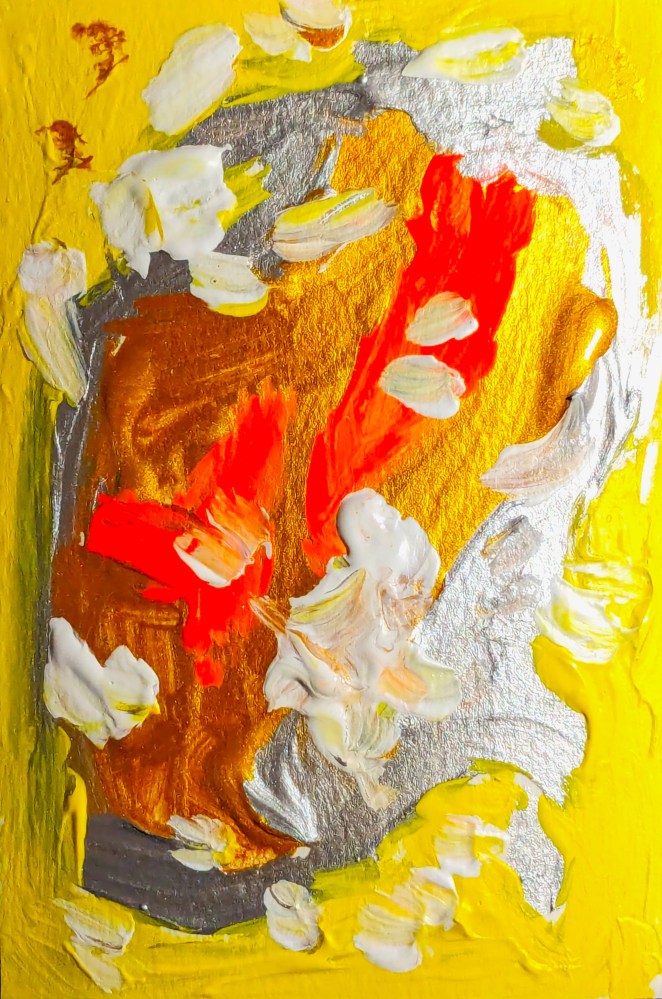
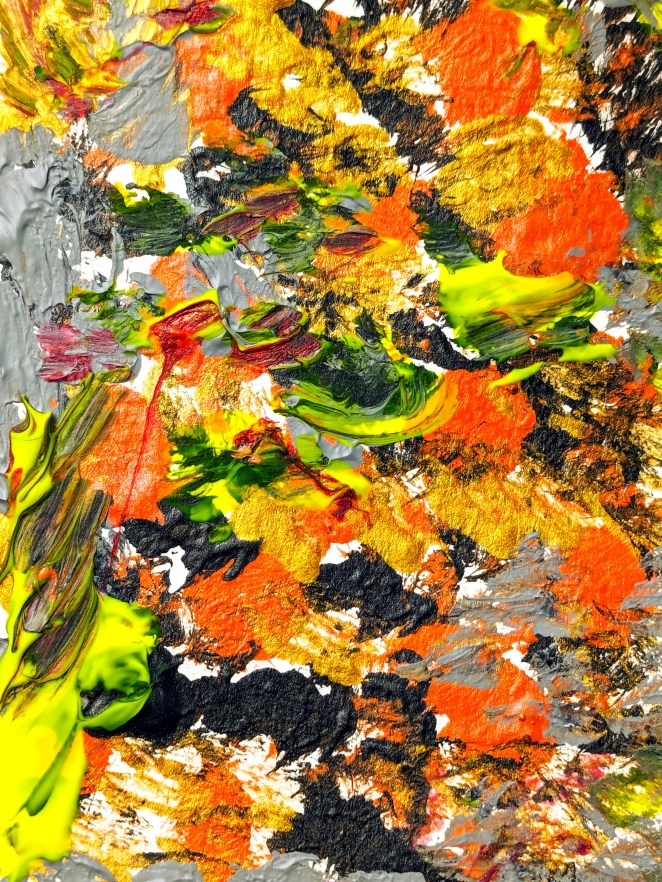
“So,” said Moo, “today I offer this painting where the title, Sound of Silence, fits well with the title of your poem. That said, I am not sure that the painting itself, qua painting, is as suitable as earlier pairings. De gustibus non est disputandum / there is no arguing about taste. I guess you either like something or you don’t.”

“It certainly isn’t in your usual style. In fact, it looks more like a colored pencil sketch than a painting. Where did you draw the title from?”

“Actually, it’s from one of your poems about Avila, in Spain, the city where, or so they say, you can hear the silence. You complained about all the noise that you found, especially the church bells, in that otherwise silent city.”

“Ah yes. I remember that poem. And I’ll never forget the sound of the bells echoing from wall to wall in those narrow, medieval streets. Bells from all the churches inside the walls of the city, tolling at exactly the same time, calling the faithful to prayer.”

“And that is one of the differences between us that I mentioned yesterday. My paintings, whatever they depict, are always silent. I have heard you read your poems out loud on Spotify and I have also heard other people reading them on your behalf, not always successfully. Poetry is designed not only to be read silently, but also to be read out loud, before an audience. Painting, on the other hand, is always silent. It does not speak, nor can it be heard. A painting is just there, in two dimensions, powerful, if you are lucky, weak and wobbly if the artist does not fulfill his task.”

“Interesting, dear Moo. And the images that I draw from Messiaen’s music are interesting too. For musical notes, without words, change into images within the listener’s mind, and then, when heard by the poet in me, become verbal images upon the page. Fascinating.”

“It is. Some time soo we must talk about intertextuality, the ways in which one artistic form or text can influence another. Hopefully, you’ll find a poem and I’ll find a painting that illustrate just that.”