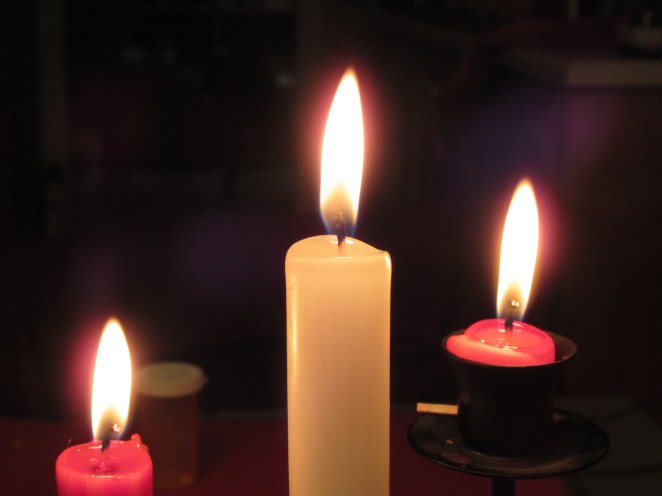
Cage of Flame

Cage of Flame

Now you are a river
flowing silver beneath the moon.
High tide in the salt marsh:
 your body fills with shadow and light.
 I dip my hands in dappled water.

Twin gulls, they float down stream,
then perch on an ice-floe
of half-remembered dreams.

Eagle with a broken wing,
why am I trapped in this cage of flame?
When I turn my feathers to the sun,
my back is striped
with the black and white
of a convict’s bars.

Awake, I lie anchored
by what pale visions
fluttering on the horizon?

White moths wing their snow
storm through the night.
A feathered shadow ghosts
fingers towards my face.
Butterflies stutter
against a shuttered window.

A candle flickers in the darkness
and maps in runes
the ruins of my heart. Eye of the peacock,
can you touch what I see
when my eyelids close for the night?

The black rock of the midnight sun
rolled up the sky.
Last night, the planet quivered
beneath my body
and I felt each footfall
a transient god.

When will I be released
from my daily bondage?

Commentary:

Moo reminded me that this poem also existed as a prose poem. here it is in prose layout. Think about it and let me know which version you prefer. Is one easier to read than the other? Do the rhythms come through more strongly in one version? Meanwhile, since he hasn’t painted a cage of flame, nor a river flowing silver, he suggested that if I really felt like the poem suggested I might feel like, then All Shook Up – with its warm, colorful flame images, might be just the poem to fit the crime. Better, he said than playing billiards on a cloth untrue, with a twisted cue, and elliptical billiard balls.

I wonder how many people recognize that little tip of the hat to the past glories of English Comic Opera? Since Canada post is on rotating strike – talk about twisted cues and elliptical billiard balls – then send your answers by highly trained snails (snail mail) or dog sled via whatever route still has enough snow for the huskies to haul on. Meanwhile, Ottawa has declared that the Maritime provinces are continuing with their suffering a buffering from lack of rain and severe drought. I do long for that river flowing silver, not to mention high tide in the salt marsh. We need water badly. And the sooner the better. Aquifers, rivers, wells, they all need filling.

Ah, the majestic game of cricket – and how I long for that summer test match curse – Rain Stopped Play. Or as the BBC commentator said on the radio one day – I heard him – “play has been stopped because of piddles on the putch – oh, sorry, I mean puddles on the pitch.” I wonder what Mr. Hugh Jarce would have thought of that. I know he always loved that old cricketing Chestnut – ‘The bowler’s Holding, the batsman’s Willey.” Unlike much wanted rain, it didn’t stop the match, but the commentators who perpetrated that jest laughed so much, the commentary stopped for nearly five minutes. Oh, the things one remembers as one gets old. Now, where did I put my glasses? I wonder if my beloved knows.

Cage of Flame

Now you are a river flowing silver beneath the moon. High tide in the salt marsh: your body fills with shadow and light. I dip my hands in dappled water. Twin gulls, they float down stream, then perch on an ice-floe of half-remembered dreams. Eagle with a broken wing, why am I trapped in this cage of flame? When I turn my feathers to the sun, my back is striped with the black and white of a convict’s bars. Awake, I lie anchored by what pale visions fluttering on the horizon? White moths wing their snow storm through the night. A feathered shadow ghosts fingers towards my face. Butterflies stutter against a shuttered window. A candle flickers in the darkness and map in runes the ruins of my heart. Eye of the peacock, can you touch what I see when my eyelids close for the night? The black rock of the midnight sun rolled up the sky. Last night, the planet quivered beneath my body and I felt each footfall of a transient god. When will I be released from my daily bondage?
Monologue

Monologue

“They broke our walls,” Mono whispered, “stone by stone.
A new church they built on the land they stole from us.
Red was its roof from a thunderstorm of blood.
The white bones of their lightning scattered us like hail.

They ripped out our tongues and commanded us to sing.
Carved mouths were ours, stuffed with grass.
Stone music forced its way through our broken teeth.

Few live who can read the melodies of our silence.
We wait for some wise man to measure our dance steps.

Pisando huevos: we walk on tiptoe across
these stepping stones of time.

Commentary:

Mono means monkey (in Spanish). Hence, monologue means monkey speaking to himself. Cute, eh? Monkey is one of the day signs in the Mixtec Codices. Lots of double meanings and rabbit holes down which the ardent reader can descend. Dig deep, my friend. Pisando huevos – literal meaning – ‘walking on eggs’ – meaning walking very carefully, on tip-toe, step by step.

Who said poetry was simple? You want it simple, there are so many simplifying factors out there. I want you to think. To think for yourself. To understand complicated language with multiple meanings. You want simplicity? Go watch a TV ad – Tide’s in, Dirt’s out. Omo adds bright, bright, brightness. The Esso sign means happy motoring. Don’ forget the Fruit Gums, mum – (said as the little boy throws a brick out of the window and it hits his mother on the head).

I’d say “wake up and smell the coffee.” But if wake means woke, I’m not the sort of bloke that accepts the meaning of wake or woke! Hereward the Wake. Robin Hood the Bloke in the Hood who Awoke- and I don’t mean the flower / flower, nor the Lincoln Green of the Lincoln Continental.

So what do I mean? I don’t know. Coded words are meaningless unless you have the meaning to the code. What code? The miscued code. And the meaningless lack of meaning in meaningless. Just like my friend who’s just been screwed, blued, and tattooed – and totally rude. Or was it scrod?

Inquisitor

Inquisitor
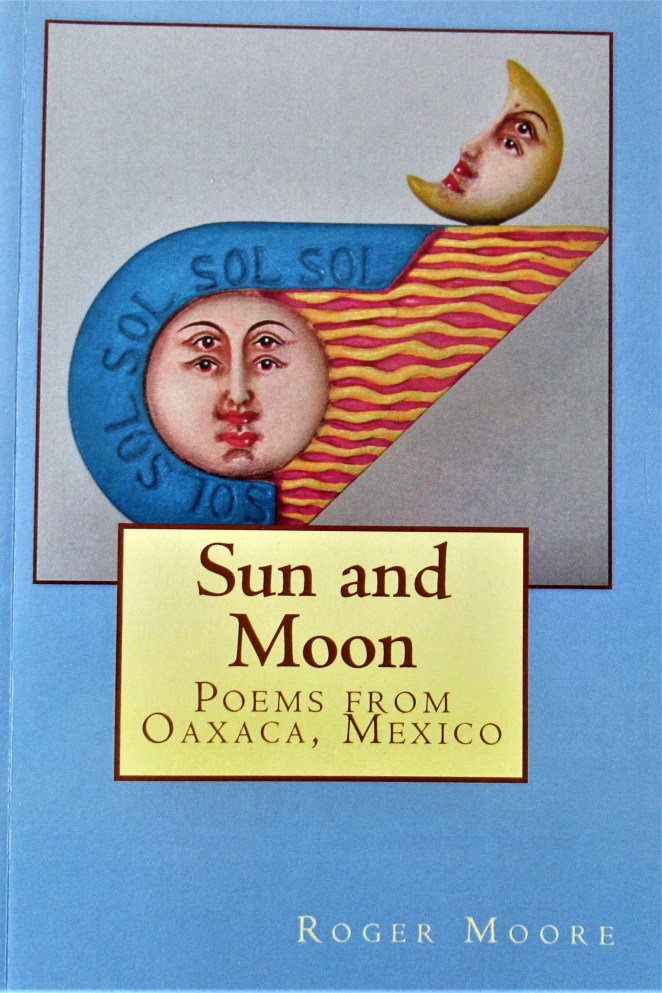
Sun and Moon

He told me to read,
and plucked my left eye from its orbit.
He slashed the glowing globe of the other.
Knowledge leaked out, loose threads dangled.
He told me to speak and I squeezed dry dust
to spout a diet of Catechism and Confession.

He emptied my mind of poetry and history.
He destroyed the myths of my people.
He filled me with fantasies from a far-off land.
I live in a desert where people die of thirst,
yet he talked to me of a man who walked on water.

On all sides, as stubborn as stucco,
the prison walls listened and learned.
I counted the years with feeble scratches:
one, five, two, three.

For an hour each day the sun shone on my face,
for an hour at night the moon kept me company.
Broken worlds lay shattered inside me.
Dust gathered in my people’s ancient dictionary.

My heart was like a spring sowing
withering in my chest
It longed for the witch doctor’s magic,
for the healing slash of wind and rain.

The Inquisitor told me to write down our history:
I wrote … how his church … had come … to save us.

Commentary:

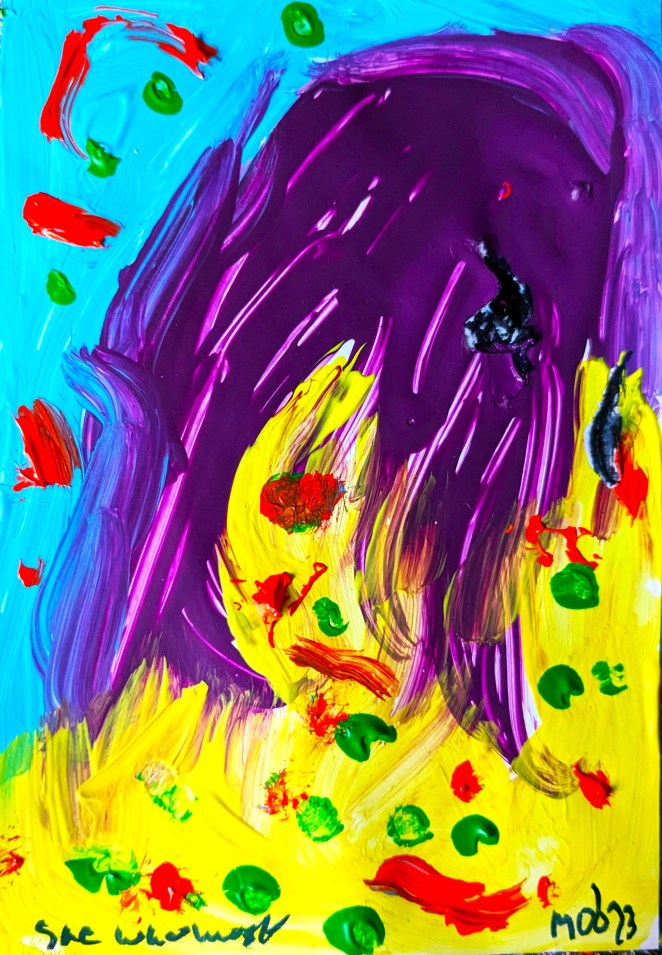
No wonder the little girl in Moo’s painting looks so sad. She must have read this poem and understood how the exercise of power and authority, be it religious or secular, can effect those upon whom it is exercised. Times change, but so many things remain the same. The pendulum swings, and it moves from chaos to order and back again. The meaning of meaning – how we define chaos and how we define order define who we are.

Birds of a feather flock together. Manners maketh the man. Wonderful sayings. But fine words do not necessarily make for fine men or women at that. Serpents and senators, both can speak with forked tongues. It is up to us to apply discourse analysis and distinguish between what they say and what they actually mean. As my friend Jean-Paul Sartre once said – “L’homme n’est rien d’autre que ce qu’il fait.” A man is nothing more than what he does. His deeds reveal his true inner self – and remember – the plumage doesn’t necessarily make the bird.

The Screws

The Screws

There is no science to sciatica,
just a series of sensations
most of them involving pain.

I don’t know how or when it comes,
but one day, it knocks on your door
and makes you clutch back and buttock.

It’s like a hawk at the bird feeder,
flown in from nowhere to shriek
and shred, unawares, one small bird.

Was it the flannel I dropped yesterday
when showering?  I stooped to pick it up,
lunged forward and, was that it?

The pain came later. It kept me awake
all night, my worst nightmare.
No comfort anywhere. An endless

wriggling and every movement a knife
blade stabbing at my buttock and groping
its slow, painful way down my leg.

The screws, my grandfather called it,
a metal screw screwed into his leg,
leaving him limp and limping.

I googled it today, sciatica, and they
suggested an ice pad for twenty minutes,
repeated twenty minutes later.

“Yes,” I muttered, “yes” and found
in the fridge the ice pack we used
to use in our Coleman’s cooler.

My beloved helped me undo my pants.
“This,” she said, “will be icing on the cake.”
“No,” I said, “it will be icing on the ache.”

Tomorrow, I will call the pyro-quack-tor.
She will bend me to her will, straighten
my back, cure the pain, set me right again,
provided she doesn’t read this post
and will permit me to enter her domain.

Commentary:

Moo doesn’t paint pain, even though it occasionally emerges in his paintings. This painting of his is called Grey Day and I guess a Grey Day is rather like a Blue, Blue Day, something to be avoided, because you feel like running away. And that’s the problem with “The Screws” – it’s hard to face the pain when it’s behind you, unless you are a contortionist and can twist and twirl and see yourself in the mirror. I suppose another solution is to have eyes in the back of your head, but not everyone is that gifted.

As for the pyro-quack-tor, my apologies, Chiropractor, mine is excellent. I limp into her office, crawl onto the medical bed, and then, thirty minutes later, I hop off it like a man reborn, and skip down the corridor, waving my sticks and grinning as if I were a Gorilla in heat. Oh dear, not the sort of condition in which one should drive the zoo bus!

As for my joke – “This,” she said, “will be icing on the cake.” “No,” I said, “it will be icing on the ache!” This takes me back to my old school days – Aix-les-Bains / Aches and Pains. I remember one of my school friends going to Baden-Baden for his summer holiday. A double-barreled name, wow, very foreign. He asked me where I had been and I replied “Cardiff-Cardiff – this is Cardiff.” They used the English version back in those days, not the Welsh one – “Caer Dydd – Caer Dydd.” Doesn’t sound quite the same in Welsh. And how about Cas Newydd – Cas Newydd [Newport] or Pen y Bont – Pen y Bont [Bridgend]. And let’s not get into Llanfair.p.g – Lanfair.p.g – [Llanfairpwllgwyngyllgogerychwyrndrobwllllantysiliogogogoch – Llanfairpwllgwyngyllgogerychwyrndrobwllllantysiliogogogoch].

Try saying that one twice in quick succession. You’ll be sitting in the railway station a long time, just waiting to find out where you are. That, of course, is if trains still run to Llanfair p. g. “Gentlemen will please refrain from …. ” and if you can finish that little ditty off, in public, you have more courage than I do! Besides which, my voice broke long ago, and I haven’t mended it yet!

Clepsydra 23 & 24

23

… gulls on the wharf-side roof
     fishing boats
          returning to port
               white wakes trailing,
                    pointing to where they’ve been

where have I been
     all my life         

where is the wake
     that tracked me to and from
          so many unimportant places

so often have I waited
     for that moment of reunion
          port station airport

birds leaving nest
     only to return
          then leave again
               are not more faithful

sweet brevity of life
     a stone memorial
          on the harbour wall
               raised to all
                    who went to sea
                         and never returned
                              dying in the waves’ embrace …

24

… a watery grave
     no church no candles
          just cold waters sliding shut
               as down to the depths they go
                    

sinking from level to level
     never to rise again
          not till seas run dry
               burnt up by the sun’s candle

even then they’ll walk no more
          with their beloveds
               hand in hand
                    on diminishing land
                         or sea-licked sand …

Commentary:

“Birds leaving nest, only to return, then leave again, are not more faithful.” A lovely photo, from Avila, of storks, bouncing on their nests, waiting for the wind to lift them up aloft. I thought of using sea side photo from PEI, but this image caught my eye, and my words. A verbal – visual link. Not easy to spot, but there, in the sky above them, a parent waits. As soon as one chick takes flight, the watching parent will drop, fly under the fledgling’s wings, and tutor the young bird in the art of soaring and flying. I have spent many a happy hour, just sitting there, watching them.

And here’s the photo from PEI. An osprey, returning to the nest, after a fishing expedition. One hopes for such moments. Then, suddenly, one day, the magic happens, and verbal and visual joining hands in a single moment of magic. And listen to that baby bird, beak open, shrieking, waiting for the parent to arrive. I can still hear the screeching, although we are in the age of silent, but colorful, pictures.

In the picture below, the Grande Réunion – you can see the White Geese gathered at Bic. They return every year, so beautiful. The first time I saw them, I thought they were a drift of late snow. Then they rose from the field, and flew up, into the air. I have often seen snow falling but that was the first time I saw snow actually rising, after it had settled. A memorable moment.

Moments of magic, as I said, and each of them linked – verbal to visual. Silent dialogs with my time and my place, now shared with whoever has ears to hear and eyes to see and an imagination to reconstruct the alternate realities.

Books

Books
… they fornicate at night
double in size and numbers
fall off the shelves
copulate in piles on the floor

… origami
I guess it’s what books do
when they wrap themselves
in their own pages
and enfold their stories
mingling their tales

… synaesthesia
the critics call it
that mixing of senses
taste with touch
and the lingering
smell of fresh print
tingling in the nostrils

… intertextuality
books talking to books
they start off with one word
and cling to each other …

… and you know
what happens next …

Commentary:

No comment!

Clepsydra 22

22

… winds kiss words from lips
      sand creaks
           squeaks underfoot
                    creeps between dry toes

the sand cleanses
     purges
          brings closure
               each magnificent moment
                    lighting a candle

is this beach an altar
     under the rocks’
         shadow church
              it doesn’t matter

mindfulness
     holding each memory
          each piece of colored glass

wave after wave
     climbing ashore
          washing footprints
               memories away
                    closing
                         door after door …

Commentary:

“Wave after wave climbing ashore, washing footprints, memories away, closing door after door.” Everything turns out in black-and-white – here a crow, there a seagull. What does each say to each, when they meet upon the beach? Silence and stillness. No sound of wind or wave, no sign of the tide rising or falling, and what do the birds say to each other, when they meet like this? Two solitudes, mine and thine, and somehow the silence must be broken, or in our separate solitudes we will remain. What if I open my solitude and show it to you? Will you then open yours and spread it willingly before me? Or will you turn away, crow spurning seagull and there’s no going back.

And did my feet, in ancient time, walk upon the beach in Santander? Did they wander over the cliffs at Cabo Mayor? What did I say to the sands in Swansea Bay when, sitting on the steps by the railway station, I dusted the sand from between my toes, placed socks upon my feet, and did up my sandals? Private places, private memories, private conversations live on in the privacy of my head.

A dozen heads, all crowded onto the computer screen, zoomed in so they can be together for an hour or two, repeating their memories to each other – how much did they really share? How much can we know, your life of mine, my life of yours? At what point do those twin railway lines meet at the edge of time? Or are they doomed to a parallel universe where mind and mind, rail and rail, neither meet nor understand? Tell me, if you can, what the crow thought of the gull when they met, that morning on the sand.

Gone out

Gone out

“She has lived.
Now she has gone out.”

And all too soon
I too will go out
and people
will be able to say
he has gone out.

Or not.
Maybe there’ll just be
a silence.
Few people know me.
Even fewer care about me,
know who I really am
what I’ve actually done.

What have I done?
Nothing, really.
Nothing at all.

But I have struck a match or two,
lit some candles,
and allowed them to shine
in the darkness …

…

and soon, I too,
like those candles,
will go out.

Commentary:
The opening quote, changed and adapted, is from Rudyard Kipling’s novel Kim. I was reading it a few days ago, by candlelight, as we had a brief, and totally unexpected power outage because some idiot ran into a power pole on the highway below us and cut off our power.

Reading by candlelight is so inspirational. It brings back memories of my childhood in Wales, summer evenings in the bungalow, no power, no running water, reading by lamplight or candle light. The candle’s scent, the flicker of shadowy thoughts across the page, each word held for a moment or two in a magic, shimmering glow. I recall also the candles on the high altar, lit for midnight mass, and the church all a-sparkle with shimmering light, incense, and flowers.

Power outage – I often think they should be called power out[r]ages. Then I think of the war zones, rife with suffering, where power outages are only one of the many outrages from which people are suffering. “Man’s inhumanity to man.” Robbie Burns, I believe. I regret calling that driver who took out the power pole an idiot. Shame on me. I found out later that he was a human being, suffering, just like me, from the attributes of ageing. A heart attack took him and his leaden foot, dead on the accelerator, sped him into the power pole.

DOA – dead on arrival at the power pole, and at the hospital. “He has lived. Now he has gone out,” snuffed out like the candles I blew out when the power was finally restored. It’s so easy to relight a candle, so hard to relight the beauty of a lost human life.


Clepsydra 21

Clepsydra 21

… she left me
          at the lighthouse
               rising tide
                    beach diminishing

and grew smaller
     as she walked away

I search the sand for sea-gems
     sand-dollars
          cerulean sea-glass
               rarest of all the reds

ground down
     polished
          sanded to perfection

so many worlds
     in a grain of sand
          their words going unspoken
               carried away by the sea-wind

the wind that haunts
     caves and cliffs
          hooting like a ghost train
               in a forlorn
                    tunnel of love

love lost
     love found
          an old love
               rediscovered
                    only to be lost anew

what is this thing
     called love …

Commentary:

Listen! “Can you hear the music?” “No, but I hear singing even though there’s no one there.” I know, I know, we have had this conversation before. Moo didn’t have a painting along the lines of ‘what is this thing called love’, so he dug out this one – Walking on Air – the painting, not Moo. But then, Moo’s a silly old romantic and verses and songs settle in his mind. All too often, when he walks he finds he’s ‘walking on air’! The two of us, Moo and me, have always loved that song. Great to work it into a commentary on a poem (again).

Love – what is this thing called love? And how many types of love are there? We use the word so frequently, or infrequently, if we are Mr. Grinch. But what does it mean? Love of self, love of other? And how many others can we love – I know that Minnie had a heart as big as a whale, but how many loves can fit into it? Love of father, mother, daughters , sons, brothers, sisters, cousins – how far do we go? Winning sports teams – everybody loves everyone on the team when they win they cup. That love is so much harder if they lose it – especially if there is a goat on the team, and I don’t mean greatest of all time! I mean sacrificial.

I love you with all my heart! Does that include the pacemaker and the stent? What does atrial fibrillation mean in that situation? Good questions. Neither me nor Moo have the answers. Write your answers on a postcard and send it to – where? With Canada Post on strike, you will need a team of real snails. Hitch your postcards to them. Threaten them with the salt shaker. And off they go. Snail mail is back. Or you could place them on a dog sled, hitch up the huskies and Mush, Moo, mush! Away they all go hauling the mail. Why does it always be the mail? Why can’t it be the Femail? Mail – Femail. Oh, but I love that. There, you see. We’ve just added another meaning to love. Let’s hope none of the huskies lies down to rest. That’s called a Canadian flat tire. Oh, I love that one too.

I am running out of time, space, and ideas. And that’s only one word from the poem that we’ve looked at. Oh, shame and scandal in the letter-box.

Clepsydra 18-20

18

… as free as the birds
     a sky full at North Cape
          where shores retreat
               year after year
 
the big red mud diminishes
     under advancing waters
          sea-threatened cliffs
               undermined roads
                    houses
                         the lighthouse

gulls follow the fishing boats
     herring gulls
          blotting out
               sun and sky
                    above the reef

with its seals
     basking in sunshine
          knowing themselves
               being themselves
                    thinking themselves safe

kings and queens
     of their sealdom
          never questioning …

19

… an osprey
     sudden the swoop
          turned into a stoop

water shattered
     total immersion
          then emerging
               with lusty thrusts of wings

claws clasping
     imprisoned prey
          prised from the sea
               raised to the skies
                    up and away
                         murderer and victim

oblivious below
     the black horse
          with cart and farmer
               gathering seaweed

all of them
     having no doubts
          safe in the security
               of their roles …

20

… while lost in the labyrinth
      I searched for a thread
               on life’s loom

a thread woven
     by an unknown
          unseen hand
               a hand and thread
                    I could never control

yet one day
     that thread
          will lead me out
               from the dark

then shall I see
     the sun’s great candle
          beneath which red rocks
               wave and water battered
                    crumble

here at North Cape
     in a way that nobody
          can understand …

Commentary:

The osprey “emerging with lusty thrusts of wings, claws clasping, imprisoned prey prised from the sea, raised to the skies, up and away, murderer and victim.” The words are based on the photograph. A quiet day, somebody shouted, and pointed, and clickety-click, I was lucky enough to capture the whole thing on my digital camera. This one shot summarizes it all.

The stanzas (16 & 17) that precede this moment are available here. Clepsydra, the book, is one single poem, one single sentence, that rambles on and on. Each stanza stands alone, each poem (numbered) stands alone, and the whole book stands alone as a single sentence summarizing what I have seen and where I have been. Bakhtinian Chronotopos – my dialog with my time and my place. In this case, my many dialogs with my multiple times and multitudinous places.

Albert Camus lent me the phrase ‘murderer and victim’. ‘Nous sommes, ou meurtrier ou victime‘. Quoted from memory. I hope I am not too far wrong. My memory fades as I age. Louis Aragon suggested I borrow his line “rois tombés de leurs chariots” – that I found in his collection Il ne m’est Paris sans Elsa. Here, I have applied it to the seals at North Cape, PEI – “seals – basking in sunshine – kings and queens of their sealdom.” Intertextuality – texts talking to texts and recalling segments of texts within other texts.” Wonderful. Alas, I fear the coming days when the memory may no longer be so clear. ‘What will be, will be’ said the Osprey as he pulled the flounder from the sea and carried him too his nest in a nearby tree.