My Love For You

My Love for You

A Jackpine Sonnet

Yesterday fled quickly by
today limps slowly on and on
tomorrow draws near
yet never arrives
if and when it does
it becomes today

As for me I feast on shifting
shadows my story a tapestry
reversed – hanging
back to front unreadable

It is hard to slough your skin
the skin once shed can never
never be donned again

My body white bone grey gristle
no longer wrapped in skin
is bonded together by super glue
made from my love for you

Comment:

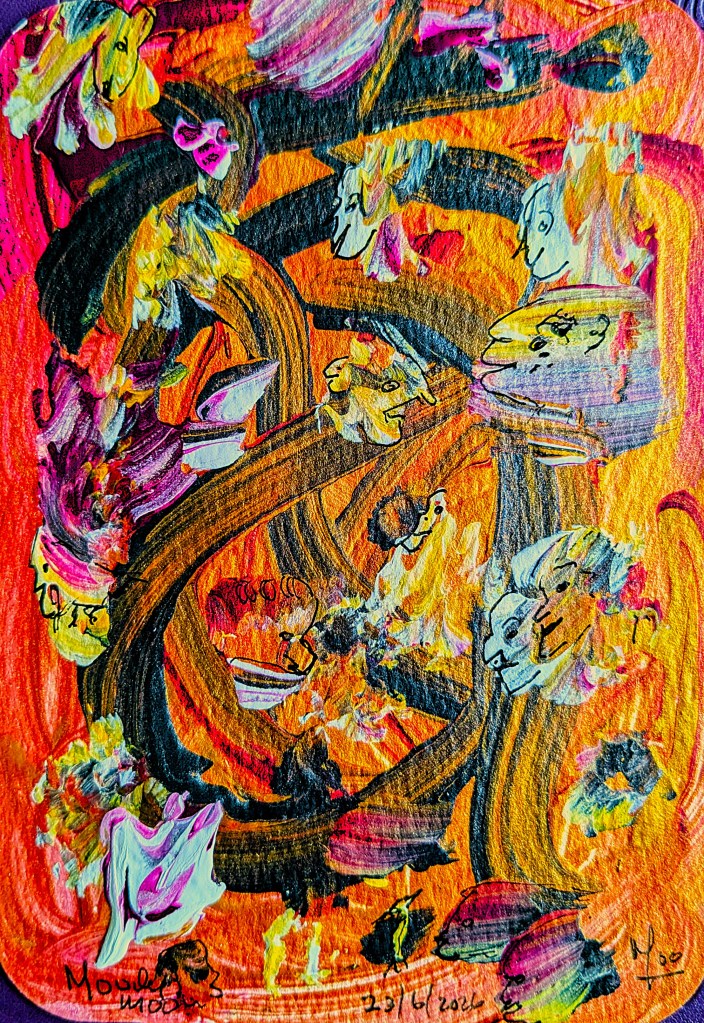
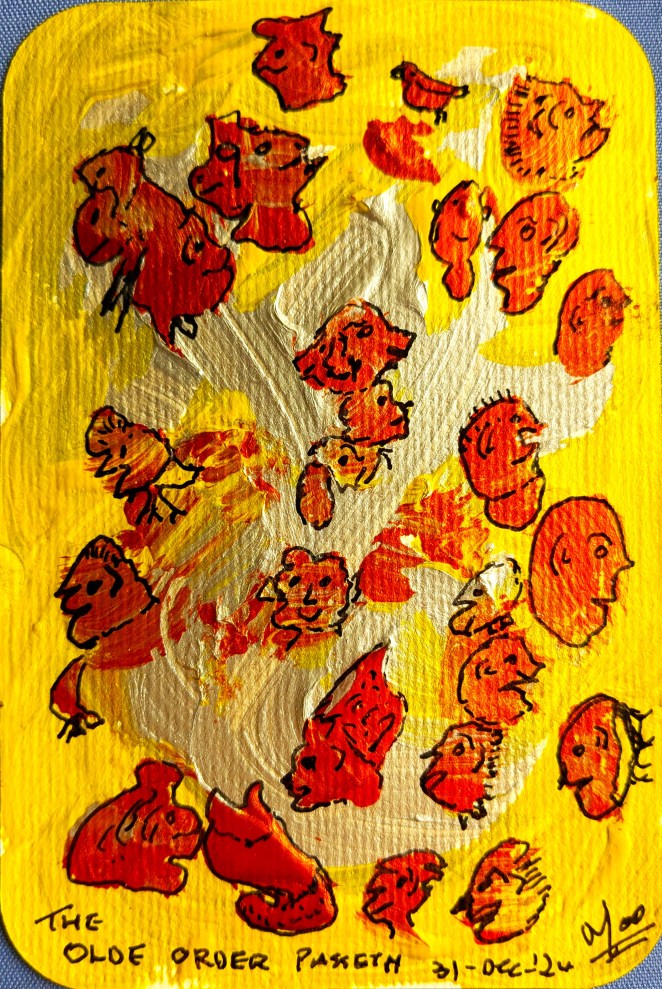
Moo assures me that this painting, unsigned and untitled, is actually his. After yesterday’s doubts, I must believe him. He says it is called U-R-My-Sunshine. He also thinks it would be a great painting to go with this strange little poem that crept somehow out of my head and landed on my page. It reminds me somewhat of the church cat – it crept into the crypt, crapped, and crept out again. “Oh what a naughty pussy cat.” Who U-R is up to the reader / viewer apparently. I doubt that I am his sunshine after what I said about him yesterday. Oh sorry. You didn’t read that blog? Well, shame on you! You’ve got to do your homework if you’re going to keep up with me and Moo.

What is A Jack Pine sonnet, you ask? Well, I don’t have a clue. But now that my other buddy, Ryan, has introduced me to AI, I will ask my AI what such a thing might be. Asking now. Hang on to your seats. It tells me it’s thinking. Aha! Here’s what I think it thinks it thinks.

AI says – A jackpine sonnet is an irregular, spikey poetic form created by Canadian poet Milton Acorn (from neighboring PEI), in the 1970’s. It typically acts as a 14-line sonnet with 7-13 syllables per line, but allows for flexible line counts (e.g., 12, 18, or 20), using internal and consecutive rhymes rather than strict, traditional rhyme schemes.

Key Aspects of the Jackpine Sonnet:

  • Origin: Developed by Milton Acorn, often known as the “People’s Poet,” as a uniquely Canadian, gritty form of expression.
  • Structure: While it aims for roughly 14 lines, it can vary in length based on the needs of the poem.
  • Rhyme and Rhythm: Uses internal rhymes (rhymes within a line) or consecutive end-rhymes (e.g., AABB) rather than standard sonnet structures.
  • Style: It is designed to be “irregular and spikey like a jack pine tree,” focusing on structure and integrity rather than rigid adherence to traditional verse rules.

So, now you know what a Jack Pine sonnet is. But I bet you’ve never heard of Milton Acorn! I have. Here’s the poem I wrote about one of my meetings with him. You can find it in The Nature of Art.

Milton Acorn

“Oy,” he waved strong carpenter’s hands, “Make this
work.” I typed in my code and the machine
came to life. “Go away,” he pushed me out
and slammed the copier room door behind my back.

Later, my secretary came in and caught him,
his face pressed to the glass. He pushed the button,
lights flashed, the machine whirred and copies emerged.

In his hand he held images of his feet,
arms, legs, head, all of his body parts.
“Tape, not masking, clear tape, 3M.”
Flustered she fled, brought Scotch tape,
watched as he stuck himself together.

Over lunch he showed me his work:
a self-portrait, shadowy and cloudy,
whiskered and worn, smelling still of printer’s ink.
That’s how I remember him: unique, stately,
unmistakeable, uncouth, unseemly:
a jack pine growing in its own self-image.

Farewell, my dear friend, Milton.
And that is how I remember you.

Nights

Nights

There are nights
when the trees
seem to whisper
your name,

cautioning you
against the wind’s
knife edge.

“What have I done,”
you ask,
“to merit this?”

The soft fall
of burnt brown leaves
weeps over
your woodland grave.

You will walk
these woods
no more, save
on a frosty night

when deer shiver
beneath naked trees
and the moonbeam’s
icy blade.

Comment:

Poems arrive, as silent as the deer that troop through my garden. Some times they hurry past, and catch them if you can. Sometimes, they stay, wait, nibble at an overhanging branch. Just when you think you can reach out and grasp them, they sense the bark of a dog, the sigh of the wind through leafless trees. You blink, and they have gone.

Was your camera ready? Was your note book open, your pen in your hand? Or did they flit away like dreams in the morning when the sun comes into the bedroom and sparks diamond fires from the lashes that guard your eyes?

Spring Cleaning

Spring Cleaning

Sun’s yellow duster
arrived late this year
gray cobwebs still
clutter my mind

I try to brush them away
with clumsy fingers
but stubbornly they stick
and cling and will not go

Spring came in with snow
gales and icy rain

Warm winds will soon
spring showers bring
to revive cold clay
and help things grow

Comment:

We have lived in this house for 37 years, but only once have I seen ducks land on the snow-covered lawn. Whatever were they thinking? Good question – do ducks think? They are living beings, so of course they do. But I am totally unaware of what they think nor am I able to understand the nature of their mental computations.

We share this world with so many creatures that we do not understand. I wonder sometimes if they understand us. Who knows? If we cannot speak their multiple languages, if we cannot enter their culture and their minds, if we see them as nothing but food and devour them as fast as we can, never thinking of them at all, save as more or less savoury items on our dinner plate — les meurtiers et les victimes, as Albert Camus wrote. Murderers and victims – and we are both. Murderers of our victims and victims ourselves to our unbounded greed.

House of Dreams 5 & 6

House of Dreams

5

A leaf lies down
in a broken
corner
and fills me
with a sudden
silence.

I revise
our scrimshaw history
carving fresh tales
on the ivory
of new found bones.

6

A vixen
hunts for my remains.

She digs deep
at midnight
unearthing
the decaying teeth
you buried with
my borrowed
head.

Comment:

None of this makes sense. Why should it? Don’t ask me to explain it to you. Who am I to tell you what to think and what to do? You are not in elementary school now. Teacher is not leaning over you, teaching you how to shape letters with a pen, telling you to color in red, or yellow, or orange.

Learning – tell me what have you learned? Have you learned to think for yourself? Have you learned that life is mysterious, joyful, sad? Do you not know it can also be incredibly dangerous? Fear not the thunder. Rejoice in the rain and snow. Open your eyes to the world around you and be joyous wherever you go.

Meditation

I am the gatherer of words,
the weaver of wooly clouds.

I am the sheep dog
who shepherds the flock
in and out of the field.

I am the corgi
who snaps at the heels
of cows and pigs,
too small to be noticed.

I am the butterfly
turned into an eagle
who soars into the sky
and gazes on the sun
with an open eye.

Tell me,
my friend,
what and who
are you?

House of Dreams 3 & 4

House of Dreams
3 & 4

3

The light fails
fast, I hold up
shorn stumps
of flowers
for the night
wind to heal.

The pale magnolia
bleeds into summer:
white petals
melting on the lawn
like snow.

Sparrow sings
an afterlife
built of spring
branches.

4

Pressed between
the pages of my dream:
a lingering scent –
the death of last
year’s delphiniums –
the tall tree
toppled in the yard –
a crab apple flower-

a shard of grass
as brittle
as a bitter tongue
at winter’s
beginning.

Comment:

“La poesía se explica sola, si no, no se explica.” Pedro Salinas. Poetry explains itself. If it doesn’t, it can’t be explained.

This quote suggests that the poem is a self-contained entity that must be accepted and understood on its own terms. This is particularly true when metaphor rules and feelings and meaning are contained within the poem’s enunciation. In addition, the musicality of words can never be ignored. The rhythm they bear within them speaks for itself.

Show don’t tell – easy advice, but what exactly does it mean? So many people say so many different things. A cliché is always the simplest form of criticism.

“I don’t understand your poem,” Moo tells me.
“Neither do I,” I reply, “and I wrote it.”

“I don’t understand your painting,” I tell Moo.
“Neither do I,” Moo replies. “And I painted it.”

Words of wisdom.

Breathe deep.
Look and listen.
Don’t think.
Feel.

Hear the smell of color.
Touch the emanating light.
Taste the dry leaves crackling.

See the words shaping,
carving themselves
deep into your dream.

Rage, Rage 59

Rage, Rage
59

You cannot hide
when the black angel comes
and knocks on your door.

“Wait a minute,” you say,
“While I change my clothes
and comb my hair.”

But he is there before you,
in the clothes closet,
pulling your arm.
You move to the bathroom
to brush your teeth.

Now,” says the angel.

Your eyes mist over.
You know you are there,
but you can no longer see
your reflection in the mirror.

Comment:

The last poem in the series and Rage, Rage against the dying of the light is over and done. Many of you will recognize the title from Dylan Thomas’s poem Do not go gentle into that dark night. I guess the theme itself has become part of the Welsh culture. And now we have exported it to New Brunswick, Canada, and perhaps beyond.

I bought The Black Angel, pictured above, in Avila, Spain. It is a plaster cast of one of the Angels in Roger Van der Leyden’s paintings, if I remember correctly. Here is the angel’s face in close up.

She or he brings a promise of rest and peace, a freedom from earthbound woes and sorrows. She stands on the shelf above the fireplace insert in our sitting room and brings blessings to the house. I look at her every time I light the fire. And she smiles down and blesses me. I think of her as a lady, but her peace and beauty outweigh any formal signs of sex.

As for that reflection in the mirror, well, I don’t have one of me. But her is a photo to reflect upon:

Raining in Avila and puddles in the street. Now you see me, now you don’t. But I am there, holding the camera, and looking down at the water where —- rain has stopped play. The bails have been removed. Old Father Time has gone back to the Pavilion at Lord’s, and the cricket game is over for the day.

Rage, Rage 48


Rage, Rage
48

I carry memories
and scars like a snail
wears its shell
and I leave behind me
a slither of silver words.

I’m a broken gramophone,
needle stuck in a groove
repeating the same verses
again and again.
This repetition
drives me insane.

My thoughts just drift.
My body is a ship
in the doldrums,
no wind to fill its sails.

I pick up my paint brush
and paint myself –
lonely and blue
as idle as a long-lost lamb,
alone with nothing to do.

Comment:

The alienation of an alien nation – and I wonder if they really are here, those aliens. So many strange happenings in my life. The silver slither of words drags me through so many lost moments in time. Fray Luis de León, I spoke to him last night, asked me the question – “Es más que un breve punto / este bajo y torpe suelo comparado / con aquel gran transunto / do vive mejorado / todo lo que es, lo que será, lo que ha pasado?”

It’s a lovely verse in Spanish, but not so easy to translate into English. Let’s try – first, word for word – “Is it more than a small dot this low and stupid soil compared with that great sky world where now lives improved all that is, all that will be, and all that has happened?”

A comment on the translation – first, the length of the sentence and the way in which it is complicated by inversions and ideas expressed in words which have little direct translation. Then there is the expression – 1. a small dot – un breve punto – a short moment in time. 2. low and stupid soil – este bajo y torpe suelo – clumsy earth below. That clarifies, a little the meaning. 3. that great sky world – aquel gran transunto – that great sky above. 4. where – do [short for donde – to keep the syllable count] – where – 5. lives improved – vive mejorado – lives a better life.

Here goes: “Is this clumsy earth below more than a short moment in time compared with that great sky above where now lives a better life all that is, all that will be, and all that has happened?” Not great, but we can live with it.

As Miguel de Cervantes said “To read in translation is to look at the reverse side of a tapestry.” So, to imagine the real side of the tapestry we need to count our syllables – they don’t match. We need to measure the length of our lines. They don’t match. We need to sharpen our metaphors and images – they don’t really match. And, last but not least, we have to imagine the Platonic, Terra-Centric universe in which the sun moves around the earth and the earth is the centre of all life.

I should add the cultural association of words. In every language, each word has an “associative field of cultural meanings”. Those “associative fields” differ from language to language. So, even getting the verbal meaning correct means that you do not necessarily get the cultural associations right. In fact, it’s almost impossible to do so. It’s a fascinating world and one which I have explored in various academic articles.

I would like to take cultural meanings a step further. In Don Quixote, II, 11 – I quote from J. M. Cohen’s Penguin translation of 1950 (rpt 1961) – Don Quixote says to Sancho ” … if I remember rightly, you said that she [Dulcinea] had eyes like pearls, and eyes like pearls suit a sea-bream better than a lady” (p. 533). I will leave aside, for now, Sancho’s comic mixing of the Petrarchan metaphors and concentrate on the single word sea-bream. To compare someone’s eyes to those of a sea-bream is comical in English. However, the word has several associative fields in Spanish which are worthy of deeper study. Secondary meanings of a sea-bream – besugo – include 1. a mild insult, as in no seas besugo / don’t be a fool / an idiot / stupid. 2. Diálogo de besugos – two people talking and neither one listening to the other. 3. Ojos de besugo – a blank or dazed expression. Quite simply, the translation besugo > sea-bream functions at the literal level, but by no means at the cultural level of the associative fields.

Alas, some days I’m a broken gramophone, needle stuck in a groove, repeating the same things again and again. Maybe one day I will get them right. And maybe I won’t. Better minds than mine have struggled with translating Spanish (poetry) into English (poetry), and most have failed. Many, dismally. We won’t mention names. Sometimes the best translations are not translations at all, but poems that recreate the original in the target language. I am quite happy with my translation of the meaning of Fray Luis de León’s poem – but how sad would be any attempt to transfer the verse form from Spanish to English? Five lines of seven and eleven syllables each – wow! Go for it. But remember – fools rush in where angels fear to tread.

Never mind. Maybe tonight I’ll have another little chat with Fray Luis de León and Miguel de Cervantes, Quevedo too, if I am lucky. Maybe their English will be good enough to give me a few hints. I’ll let you know later if any one of them does come to visit.

Monet at Giverny

Monet at Giverny

1

his lily pond
a mirror shattering
shards of clouds
flames beneath the lilies
fractured fish

2
the executioner stripes evening
a cross the sacrificed horizon
in blood we were born
in earth will we rest
our flesh turned to bread
empurpled this imperial wine
streaming with day’s death
these troubled waters

3
green footprints the lily pads
a halo
this drowned man’s beard
liquescent
like the gods
he dreamed
he walked dry over water
flowering goldfish
this thin line of cloud

4
maples flash ruby thoughts
ripples flowing outwards
as heavy as a stone at Stonehenge
this altar tumbling downwards
through a liquid sky

5
wisteria and his curly blue locks
Narcissus clad in an abyss of lilies
imperial his reflection and perilous
slowly he slides to sleep
merging into his imaged dream
a vaulted cathedral
his earthbound ribs
the blood space immaculate

6
night and day and sun and clouds
leapfrogging over water
something survives
sepia tints
dreaming on and on
exotic this sudden movement
Carassius auratus flowering

7
Clos Normand and the Grande Allée
closed to him now
folded his flowers
their petals tight at his nightfall
dark their colours
mourning for his mornings of light
fled far from him now

8
can we soften this sunstroke of brightness
le roi soleil threatening to blind us?
rey de oros
the sun glow braiding itself
an aureate palette
a susurration of leaves

9
the lady of the lake
holding out her hand
handing him an apple
l’offrande du coeur
a scarlet heart of flame
monochromatic this island
brown earth in a crimson lake
the world reborn in tulips

10
especially
when the dying sun
molten fire spreading
a limpid light
sky brimming over into pond
trapped in low clouds
a slash of colour here
and there a tree
a fountain of gold
the sun an apple
blushing
on a setting branch

11
silver-white the money plant
moonlight between fine-tuned fingers
its rattle of seeds
blunt the moon’s bite
raked from water
gaunt its gesture
matched ripples
face to face
with the moon

12
upside down these clouds
bright in their winter boats
the night wind blows
clean dry bones
across the sky

13
fish aloft like birds
skimming wet sunshine
spring’s first swallow
rising from the depths
to snatch a golden note
quivering in the air

14
thunder raises dark ripples
lightning a forked tongue
insinuated into paradise
an apple tossed away
caution thrown over the shoulder
as sharp as salt

15
winds of change
that first bite
too bitter to remember

16
timeless this tide
this ebb and flow
oh great pond-serpent
biting your own tail
forever

Comment:

A real Golden Oldie and going back a long way. I just re-discovered it. Funny how these things become lost and abandoned. Then they resurface. This is from Though Lovers Be Lost, available online should you wish to continue with its poetry!

Click on the link below to purchase the book

Though Lovers Be Lost
Print Edition

Rage, Rage 44 & 45

Rage, Rage
44

But all is not lost.
Highlights of the day:
waking to birdsong,
making it safely to the bathroom,
shaving without cutting my face.

I step high to get into the shower
and wash my body
without dropping the soap.

I emerge
without slipping or falling
thanks to the safety rails
Extra-Mural
inserted in the walls.

I stand on the bath mat
and dry with my towel
those parts of the body
that are now
so difficult to reach,
especially between
my far-off toes.

45

I pull my shirt over
still-wet, sticky patches,
damp from the shower,
and negotiate each trouser leg
without catching
my toe nails in a fold.

I tug at the pulleys
of the machine
that helps my socks
to glide onto my feet.

I force those swollen feet
into undersize shoes
and hobble
to the top of the stairs.

Banister in one hand,
cane in the other,
I lurch down them,
descending with caution
one step at a time.

Comment:

I lurch down the stairs, descending with caution, one step at a time. Indeed I do. That whole process of getting up, washing, dressing, going down stairs, takes me a good half hour, sometimes more. I do things in order, one after another, each step the same every day. That way, I remember everything and forget nothing. Easier said than done! I often forget something, or do something out of order, and then I get muddled and I stand there befuddled. Muddled and befuddled. Not a good way to start the day.

Moo sometimes visits and watches me as I struggle with my clothes. He has been known to help, especially when my back is still wet and my shirt won’t go on, or my feet get stuck in my pants or my socks. Usually, though, he’s very good. He sits or stands there quietly, just watching. I think some of his paintings come from some of my struggles. I know the titles do. When I am muddled and befuddled he says I am all shook up. he says that’s where the painting comes from. I’m not so sure about that. I think he has a secret liking for Elvis Presley.

Funny going back over those old songs from the fifties and sixties. Long gone are the days when boarding school boys stuck their chewing gum on their bedposts overnight. I remember when we used to dare each other to sing ‘does your chewing gum lose its flavor’ in the school chapel during the morning service. I remember once having a bet with a friend how many Hallelujahs there were in the Hallelujah chorus. We dared each other to sing the number we chose. His number was higher than mine, and I remember his voice, singing out a lone solo Hallelujah and shattering the deafening silence of the packed school chapel.

And those limericks – “There was a young boy in the choir, whose voice rose up higher and higher. One Saturday night it rose right out of sight and we found it next day on the spire.” And that might be the only non-filthy Limerick that this old man can remember. Oh dear – all those songs we sang on the school bus!

Rage, Rage 38

Rage, Rage
38

Now, my heart is once more
a time-bomb ticking
beneath her fingers.

I dream of walking tall,
with her by my side,
in the youthful paradise
of a distant,
long-promised land.

My tom-tom heart,
softening clay,
putty beneath her fingers,
thumps out a hoodoo
voodoo beat on its drum.

Victor Sylvester,
and his orchestra,
Sundays on BBC radio,
announces his signature rhythm –
slow, slow, quick, quick, slow
my mind waltzes to the music
plucked from my heart strings.

Wild winds blow in from the shore
buffeting my heart, breaking it apart.
Blown open, in spite of my dreams,
my secret is not a secret anymore.

Comment:

Absent without leave, I have chased the dreams of rugby and cricket and abandoned my poetry until another today. And here I am, a week after St. David’s Day, still dreaming, still raging, still recalling so many things.

Wild winds blow in from the shore buffeting my heart, breaking it apart. You can see, in the photo above, the wind tugging at the waves. A lurid sky fills with heavy clouds and oncoming rain. My heart is out there somewhere, wave-washed, blown open by the simple beauty of wind and sea.

How many now recall Victor Sylvester on BBC Radio on a Sunday afternoon? Or the Billy Cotton Band Show? That was our Sunday afternoon entertainment long before we had TV. You can’t imagine it, can you? A world without TV. So many things fade away from far too many people.

Who now will talk of my Voce and my Larwood, long ago? How many saw Hammond at his best, with his imperial cover drive? Ken Jones? Cliff Jones? JJ and JPR? Lloyd and Bleddyn? Old visions, buffet my heart, breaking it apart. Frank Worrall in Swansea at St. Helen’s. Everton De Courcy Weekes at Bristol, in the County Ground. I have the photos. I have the memories. And I have a broken heart when I remember things, some personal, some not, that so few people do.