Two Poems

1
The Day Before
My Birthday

Warm air.
Cold snow.
Grey ghosts of memory
drift beneath the trees.

If it were fall …
… if the sun were to shine …
rainbows would grace
the spun webs of spiders
clinging to the trees.

If, if, if …

A warm winter day,
or so they say,
snow diminishing,
a wind from the south,
up from Florida,
rain on its way.

My birthday tomorrow.
The temperature to fall
way below the date.

-16C on January 16.

My fate
to be a winter baby,
to never know
what the weather
will be like
on that date.

2
My Birthday

I won’t sit here
with head in hands
fearing the future
or brooding on the past.

Every day I survive
is a bonus now,
each sunrise
a celestial celebration.

I welcome daylight
with open arms and now,
on my birthday,
I will accept
all gifts with joy.

Sunshine floods through me.
It fills me with hope.
Its beacon beams .
A full tide of love
overflows in my heart.

Comment:

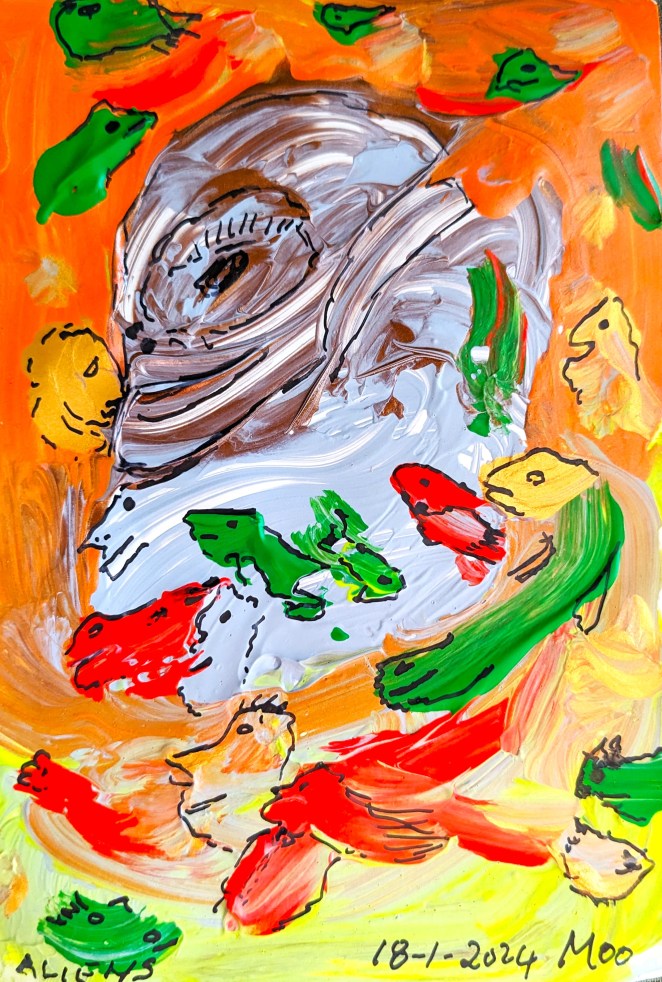
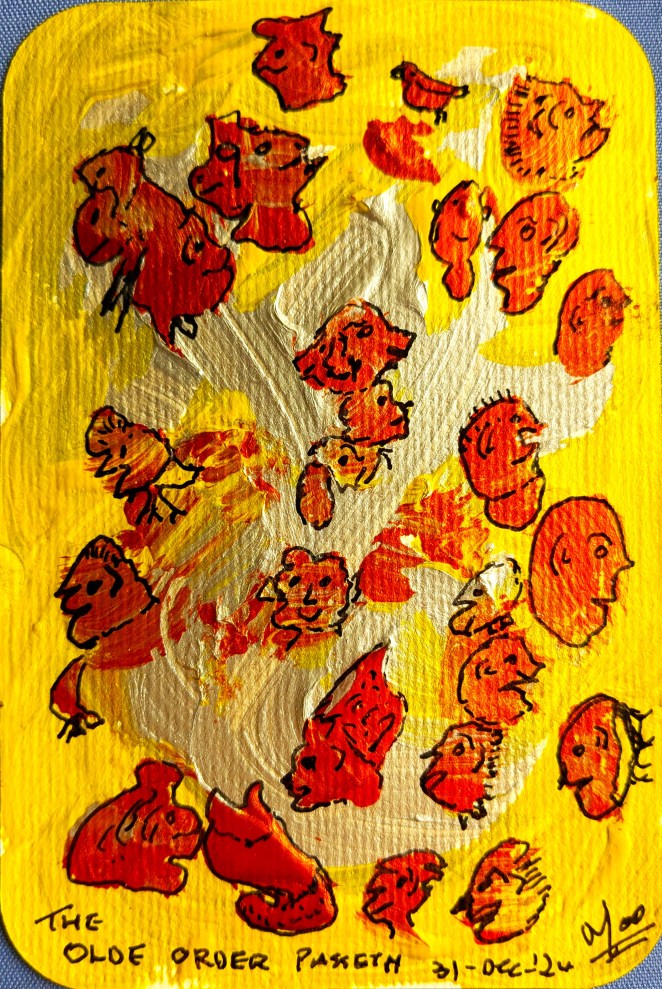
Bilbo Baggins gave away presents on his birthday. Today it is my birthday and I have joined with Moo to give away two poems, the first written yesterday, and the second today. Moo painted the picture, as always, and presented it to me for my birthday. A nice gift. Thank you, Moo.

I got some other nice gifts too. In the local superstore I discovered Polvorones. I have never seen them there before. It is a long time since I have seen them here in New Brunswick. So, what a lovey find that was. Tengo polvorones.

I don’t make New Year’s Resolutions. That’s why I never break them. That said, I do intend, and Moo agrees with me, to start posting regularly once more. So hang on to your hats – and let’s see how long that intention lasts.

Rage, Rage 7

Rage, Rage
7

Blood of my blood,
my daughter’s daughter,
time is not on our side.
 
I sometimes wonder
if I’ll survive,
if you and I
will ever meet again.

When we talk online
I see you trying
to understand, to hold
my image in your mind,
to figure out this shadow
that moves and talks
on the computer screen.

Words, born from old Welsh
melodies, bring poetry
to my heart, place music
on my lips.

But they fall short,
and fail to satisfy
my need to reach out
and hold you.

In spite of that I still survive
and live in hopes to see you
in our realities of flesh and blood.

Commentary:

When I first came to Canada, such a long time ago, I communicated with home by means of air mail letters written on special air mail paper that came in very thin, foldable envelopes. Very rarely I communicated by means of very expensive telephone calls of a limited three minute duration. How times have changed. Now via Skype (as was), Team (as is), Messenger, FaceTime, and other means, we can have unlimited face to face conversations, free of charge, with people on the other side of the world. And yet, face to face and screen to screen, there is still something missing. The cat senses it. She stares at the screen and sniffs – then she bristles and hisses. She fails to understand a known voice that has sound and movement but no smell.

And yet, what we now have is so much better than what we had before. Communication is so much easier. We have generated a generation that works in the audio-visual world, not in my preferred world of written verbalization. How we have changed. I can do so many things, in my head, that the younger generation cannot do, even with pen or pencil and paper. However, when my computer fails me, or my cell phone acts up, it is to that younger generation I go, because they dominate this new world in which we live.

I gave one of my academic articles to a friend the other week. “I can’t read this,” he said. “Tell me, what’s it all about?” I started to explain. “Hold on,” he said. He asked his AI program to read my article and generate, in words a 14 year old could understand, the main contents of my not-so-easy-to-read academic writing and thinking. About thirty seconds later, the analyzed contents appeared on the screen before him. I threw my mind back to when Coles Notes were forbidden. “Anybody caught using Coles Notes will be given an automatic F.” Then I looked at my own article, analyzed perfectly, and set out in the very way I had planned it, albeit with a simplified vocabulary – and the longer words explained in a sort of appendix. Quite simply, I was blown away.

Then my mind went back to my childhood in Wales. No running water, no electricity, no indoor toilets, no telephones, no television, a radio with limited stations and programming … imagine what we have come from – imagine where we are going. My only questions – will we control it or will it control us? And you know what it is. The clarion call goes out across the centuries. – Quis custodiet ipsos custodies? Who shall guard the guards? Who shall police the police? Who shall program the programmers? Each generation must find its own answers to those questions. And the sooner you do it, the better because it’s not going to be my problem for much longer!

Rage, Rage 2 & 3


Rage, Rage
2

These problems start the day
you realize you are alone.
Your beloved goes away,
for a holiday,
to be with your daughter
and grandchild.

Now the house and the cat
are yours, and yours alone.
No problem you say and
everyone believes you.

You jumped in the car,
drove daughter, and child,
holidays done,
to the airport.

Your beloved went with them,
her holiday about to begin.
And that’s when it all began.

3

When I come back home
from leaving them at the airport,
the front door stands open.

I thought I had closed it
when we left.
I tip-toe in and call out
“Is anybody there?”

Echo answers me –
‘… there, there, there …”

Commentary:

Raymond Guy LeBlanc, one of my favorite Acadian poets, published his poetry book, Cri de Terre, in 1972. My painter friend Moo, who also likes Acadian poetry, borrowed the title and changed it slightly when he painted this painting – Cri de Coeur. Earth Cry / Heart Cry.
What is all creativity, visual of verbal, but a cry from the land or a cry from the heart? Sometimes it is more than a cry – it becomes a clarion call, a shout out, a calling out.

So many of us are born with creativity in our hearts. So few of us carry that creativity, be it verbal or visual, into the adult world, a world that all too often grinds us down and sifts us out. We become grey people in grey clothing sitting behind grey desks beneath artificial lighting, doing grey jobs that slowly turn us into nine to five (or longer) dusts.

Moo has promised me a series of red paintings for this sequence. We shall see how he does. Red for anger, red for age, a red flag for danger, a red rag to wave at the raging bull of life, to provoke it, then bring it under control.

Nadolig Llawen – Welsh for Have a Joyous Festive Season. You can add other languages, as you wish. But above all remember Pedro Calderon de la Barca’s words – “Life is a dream and dreams are nothing but dreams.” One day, we shall all wake up. Artists and dreamers, grey ghosts and people of straw and dust.


Rage, Rage 1

Rage, Rage
1

Old age creeps up on you,
slowly, ambushes you,
catches you unawares.

At first, you don’t believe
that it’s real.
You ignore the signs,
pretend they aren’t there.

Then comes a knock on the door.
There, did you hear it?
Around you your body’s house
slumbers in comfort.

You lose your footing,
but you do not fall.
Your book drops to the floor,
you bend down and pick it up.

Everything is as it always was.
Or is it? One of your friends
slips and falls down the stairs.

You descend the stairs
with more care than usual.
No, you don’t need a cane.
Nor special shoes and socks.

You convince yourself that
all is well. And so it is,
for a little while longer.

Commentary:

Rage, Rage
against the dying of the light

Dylan Thomas’s famous poem celebrates the passing of his father. “Do not go gentle into that good night, / old age should burn and rave at close of day. Rage, rage against the dying of the light.”

I am no Dylan Thomas, although I am still a Swansea boy at heart and, as my paternal grandfather used to sing while at the fighting front during WWI – “and still I live in hopes to see Swansea Town once more.”

Alas, I never will see Swansea Town, save in my dreams, for Swansea Town is no longer a town. It is now Swansea City and no, I will not be leaving Island View again, not even to return to Wales, the land of my fathers. But I can and do age, and ageing is a strange and very personal experience. These pages contain the thoughts that occur to me, in my solitude, as I come to terms with my diminishing existence.

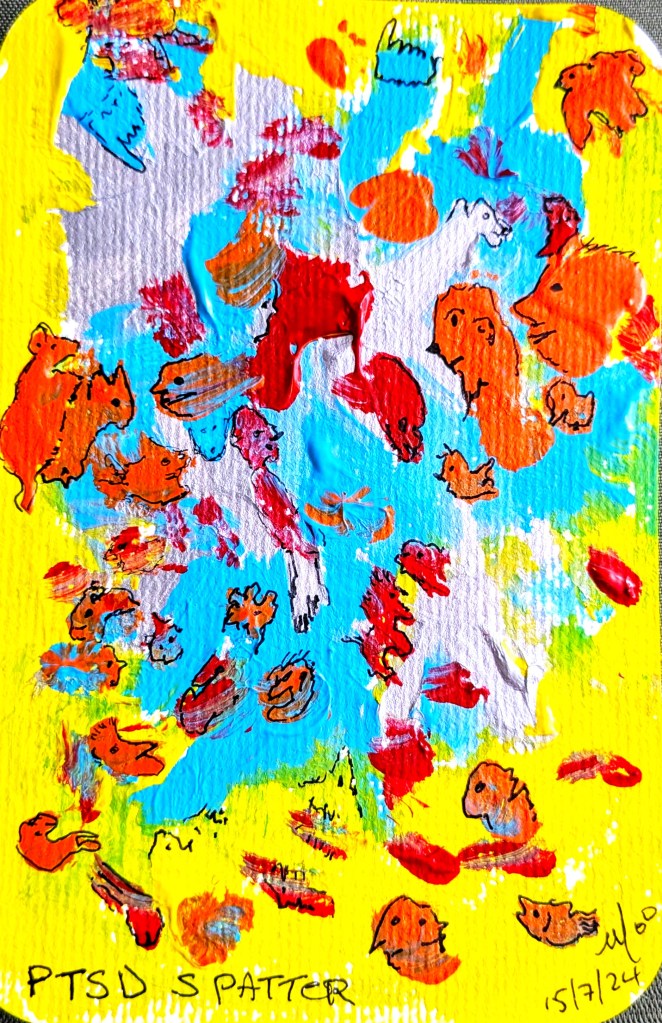
Moo has been very silently recently. But when he saw this poem he climbed out of the woodwork where he had been hiding like a silent spider and he said “Roger, have I got just the painting for you.” The painting is also called Rage, Rage – make of that what you will.

Carved in Stone 72 & 73

Carved in Stone
72

Is this world I create real?
Of course it isn’t.

It exists only in my head,
and on the page,
but perhaps, one day,
you too will see
the things I have seen.

Yet the world I describe
is as unreal as the words
from which it is woven.

73

Heraclitus once wrote
we can never bathe
in the same river twice
.

This is the Catch 22
faced by all poets,
to remember,
and to try to recreate.

Shadow hands on cave walls,
colored pictographs on gesso,
hieroglyphics on papyrus,
ink on paper, raw words,
and in the end,
everything reduced
to these three little letters
carved in stone –

RIP

Commentary:

If you have read this far, we have walked a long journey together – 73 verses that comment on life and the meaning of life. Hard reading in places, easy in others. I trust you have enjoyed the journey and found some stops and resting points along the way in which to contemplate the ways in which the threads of your own life intermingle with mine.

Throughout this journey, I have tried to use a four step process. (1) Verbal – the poems themselves. (2) Visual – photos that intertwine with the verbal. (3) A Commentary – that goes beyond the verbal and visual and opens up the ideas a little more. (4) A Dialog between myself – the poet – and Moo – the visual artist who has so frequently loaned me his paintings when he thinks they illustrate my words.

It’s been a topsy-turvy journey through what Bakhtin calls a world of carnival, where little is at it seems, and the world is turned upside down. That said, we have a clear choice – to slide down the downside of this life, or to scale the upside, to contemplate, with joy and happiness, the world from those heady heights.

Blessings. Pax amorque.
And thank you for travelling with me.

Carved in Stone 69

Carved in Stone
69

Words, words, foundered words,
flotsam and jetsam
that I rescue from the beach.

I find them in the tide mark,
its seaweed filled
with bleached carapaces,
charred wood, old rusted iron,
and the bright bones
of long dead creatures,
polished by the relentless action
of wind and sandpaper sea.

Commentary:

Words, words, foundered words – where do they come from. Good question, but I have no answers. Automatic writing – you put pen to page and scribble for five minutes. Everything that comes into you head. The Surrealists did it. They thought they were in contact with their own subconscious minds, but the written results were c-r-a-p, or any other word that means the same thing. I have seen university teachers request their students to do it, but crap by any other name would smell as sweet.

Poets who said they were not surrealists did it. Lorca and Paz, for example. But they did not publish the automatic writing. They used it as a quarry to seek for the one or two gems that actually surfaced when they had done it. Those they chose. The rest they dismissed as the crap that it was.

So, where do we find our inspiration, our words? I find it in the tide mark, its seaweed filled
with bleached carapaces, charred wood, old rusted iron, and the bright bones of long dead creatures, polished by the relentless action of sea-breeze and sandpaper sea.

Carved in Stone 67 & 68

Carved in Stone
67

At night, on the cool
sea-shore of my dreams,
the calls of shore-birds
at Ste. Luce-sur-Mer
are borne on the wind.

High-pitched, they are,
like the voices of children,
or of men and women,
in distress.

I walk on the sand
at low tide and a lone gull
flies past my head,
battering itself
against the wind’s cage
with outraged, sturdy wings.

68

Sunset.
Sea mists descend.
The church on the headland
steps in and out of darkness.

Shadows gather, persistent.
Gulls surround a lone heron.
It clacks its beak in anger
forcing the gulls to scatter.

These words are not my words.

They came to me in the speech
of birds hidden in the foliage,
or carried on a feathered plume
sprung from the osprey’s wing.

Some came from the click
of the crab’s claw as he dug
deeper into the sand
a refuge where he thought
he could live safely.

Commentary:

Sunset. Sea mists descend. The church on the headland steps in and out of darkness. And so do I. I seek clarity, but there is no clarity when the sea mist descends, just the blurred image and the clouded thought. The cloud of unknowing, one philosopher called it, many years ago, and it is still with us. Especially when the sunlight fades and we are left wandering in the mists of unknowing.

“Is it here, you ask, or over here?” Well, if you do not know, I cannot tell you. But I will ask you this, and think very carefully before you answer – does the answer come from outside of you, given by another, or does it come from the deep, sacred intimacy of your own soul? The answer to that question will tell you all you need to know, one way, or the other.

These words are not my words. They came to me in the speech of birds hidden in the foliage, or carried on a feathered plume sprung from the osprey’s wing. Some came from the click of the crab’s claw as he dug deeper into the sand a refuge where he thought he could live safely. Sunset. Sea mists descend. The church on the headland steps in and out of darkness.

Crystal Liturgy

I

Crystal Liturgy

Here, in the abyss,
where song-birds pluck their notes
and send them, feather-light,
floating through the air,
here, you’ll find no vale of tears,
no fears of shadow-hawks,
for all blackness is abandoned
in the interests of sunlight and song.

Here, the crystal liturgy surges,
upwards from the rejoicing heart,
ever upwards, into the realms of light,
where color and sound alike
brim over with the joy that, yes,
brings release to head and heart.

Here, seven-stringed rainbows reign,
the everlasting harp is tuned and plucked,
and an eternity of music cements
the foundations of earth and sky.

Here, the master musician conducts
his celestial choir, their voices rising,
higher and higher, until they reach
the highest sphere, and song and voice
inspire, then expire, passing from our eyes
and ears into unbounded realms of light.

Here, the seven trumpets will sound
their furious dance, a dance that will announce
the end of this singer, the end of his song,
but never the end of song itself.

Commentary:

Crystal Liturgy is the first poem in the poetry sequence Septets for the End of Time. I will start placing these poems here and you can follow the sequence as it evolves. It consists of 56 poems – seven septets and a coda.

A Note for Readers

Olivier Messiaen is one of my favorite composers. I purchased his Quatuor pour la fin du temps / Quartet for the End of Time in Rimouski, PQ, in 1982 while driving around the Gaspé Peninsula. I was fascinated both by the music and by the words that headed each section. I should note that I have always enjoyed ekphrasis, the verbal description of visual works of art. With Messiaen, I tried to recreate not only the thoughts and images generated in me by his music, but the spaces and repetitions that come from light and dark sounds and birdsong caught in the intervals between notes. This was a new sphere of experimental writing for me and while composing I played first the Quatuor pour la fins du temps / Quartet for the End of Time, then Éclairs sur l’au-delà/ Lightning above the Beyond, and finally Petites esquisses d’oiseaux / Little Sketches of Birds. What I tried to capture came from within my own mind, but the metaphors and images were inspired by listening to Messiaen’s music.

Carved in Stone 65 & 66

Carved in Stone
65

Flames flow sparkling waters,
a cataract of fire,
down church walls
as the Castillo burns.

Fireworks claw upwards
to knock on heaven’s door
and waken the sleeping gods
reminding them
not to forget their people.

A knife edge slices sun
from shadow, heat from cool,
solombra, Paz calls his neologism
with its combination
of sun and shade / sol y sombra.

66

I will never forget the taste and smell
of my own sweat as I walk beneath
the heaviness of a midday sun,
its heat falling vertical
and rebounding in waves
from concrete and cobbles.

I recall the roughness
of hand-hewn stone
heated by that burning sun,
the smoothness of silk
contrasting with the harshness
of tares in hand-woven wool,
marketed in the central square.

Commentary:

Fireworks claw upwards to knock on heaven’s door. The celebrants would buy their rockets in groups of 3, 6, or 12. When the first rocket went up – whoooosh – BANG! – we would wait for the fourth. When the sixth rocket went up, same thing – do they have a full dozen? And when the seventh rocket goes up, indeed, we know they do. Sometimes, we would be woken up in the early morning, as the joyful people returned home after a night of reveling. When that seventh rocket flew skywards – we knew it was useless to try and go back to sleep!

I remember leaving the zócalo one night, turning into a side street, and being met by a wall of people. A whole village, with its accompanying band stood there, waiting. Up went the first rocket, the band started to play, and the dancing broke out. No sleep for the gods that night. Their people needed them and had come knocking on the door. I was always amazed by the way the old gods stood shoulder to shoulder with the new gods of Christianity. The number of people who worshiped both also surprised me.

I last visited Oaxaca in 2001. I wonder how much has changed. I hope the dancing trees never change. Inside them, young children, their eyes peering through the bark, followed the band music. Occasionally, one of them would stop, open his or her tree, and invite you in. Alas, I never had the courage or the skill to accept the invitation. Even by 2001, the traditional carnival figures – monos – were gradually being replaced by Donald Duck and Mickey Mouse. Tragic, in so many ways. I hope they keep the traditions of the rockets and the music and the trees.

People of the Mist
A Poet’s Day in Oaxaca

If you want to read more about Oaxaca
Click here to purchase this book.