Rage, Rage 7

Rage, Rage
7

Blood of my blood,
my daughter’s daughter,
time is not on our side.
 
I sometimes wonder
if I’ll survive,
if you and I
will ever meet again.

When we talk online
I see you trying
to understand, to hold
my image in your mind,
to figure out this shadow
that moves and talks
on the computer screen.

Words, born from old Welsh
melodies, bring poetry
to my heart, place music
on my lips.

But they fall short,
and fail to satisfy
my need to reach out
and hold you.

In spite of that I still survive
and live in hopes to see you
in our realities of flesh and blood.

Commentary:

When I first came to Canada, such a long time ago, I communicated with home by means of air mail letters written on special air mail paper that came in very thin, foldable envelopes. Very rarely I communicated by means of very expensive telephone calls of a limited three minute duration. How times have changed. Now via Skype (as was), Team (as is), Messenger, FaceTime, and other means, we can have unlimited face to face conversations, free of charge, with people on the other side of the world. And yet, face to face and screen to screen, there is still something missing. The cat senses it. She stares at the screen and sniffs – then she bristles and hisses. She fails to understand a known voice that has sound and movement but no smell.

And yet, what we now have is so much better than what we had before. Communication is so much easier. We have generated a generation that works in the audio-visual world, not in my preferred world of written verbalization. How we have changed. I can do so many things, in my head, that the younger generation cannot do, even with pen or pencil and paper. However, when my computer fails me, or my cell phone acts up, it is to that younger generation I go, because they dominate this new world in which we live.

I gave one of my academic articles to a friend the other week. “I can’t read this,” he said. “Tell me, what’s it all about?” I started to explain. “Hold on,” he said. He asked his AI program to read my article and generate, in words a 14 year old could understand, the main contents of my not-so-easy-to-read academic writing and thinking. About thirty seconds later, the analyzed contents appeared on the screen before him. I threw my mind back to when Coles Notes were forbidden. “Anybody caught using Coles Notes will be given an automatic F.” Then I looked at my own article, analyzed perfectly, and set out in the very way I had planned it, albeit with a simplified vocabulary – and the longer words explained in a sort of appendix. Quite simply, I was blown away.

Then my mind went back to my childhood in Wales. No running water, no electricity, no indoor toilets, no telephones, no television, a radio with limited stations and programming … imagine what we have come from – imagine where we are going. My only questions – will we control it or will it control us? And you know what it is. The clarion call goes out across the centuries. – Quis custodiet ipsos custodies? Who shall guard the guards? Who shall police the police? Who shall program the programmers? Each generation must find its own answers to those questions. And the sooner you do it, the better because it’s not going to be my problem for much longer!
Rage, Rage 4

Rage, Rage
4

I walk from room to room,
startled by shadows,
and open doors,
search under the table,
look behind chairs.

Nothing. No one.
The house stands
still and empty,
but for the sadness,
the silent sadness,
that fills each room
with their remembered
presence.

Commentary:

Absence and presence. How many of us feel that something is there, walking beside us, or just behind us? How many feel that an empty room is not empty, but is filled with a presence, something we feel, half-recognize?

I have been in houses, invited for the night, where I would not sleep. Why? I do not know. But I felt a presence, a prescience, if you wish, that filled me with a desire to leave and not to stay.

What is it? Is it other memories, other lives, that impinge upon ours in this current time frame? I do not know. But I do know that there are houses and rooms in which I will not stay. I also know that there are others that throw open warm arms to welcome me.

Look at Moo’s painting(s). How many of them welcome us in? Do some of them shut us out and make us shiver with a fear, not of the unknown, but of the hardly-remembered, that lies in wait to shake us out of this dream which is our present life?

Rage, Rage 2 & 3


Rage, Rage
2

These problems start the day
you realize you are alone.
Your beloved goes away,
for a holiday,
to be with your daughter
and grandchild.

Now the house and the cat
are yours, and yours alone.
No problem you say and
everyone believes you.

You jumped in the car,
drove daughter, and child,
holidays done,
to the airport.

Your beloved went with them,
her holiday about to begin.
And that’s when it all began.

3

When I come back home
from leaving them at the airport,
the front door stands open.

I thought I had closed it
when we left.
I tip-toe in and call out
“Is anybody there?”

Echo answers me –
‘… there, there, there …”

Commentary:

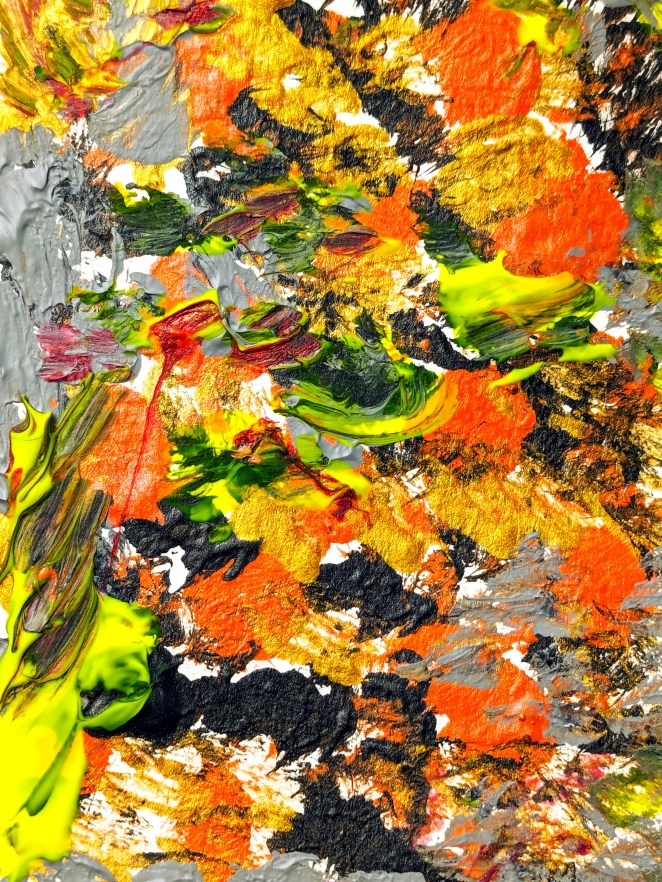
Raymond Guy LeBlanc, one of my favorite Acadian poets, published his poetry book, Cri de Terre, in 1972. My painter friend Moo, who also likes Acadian poetry, borrowed the title and changed it slightly when he painted this painting – Cri de Coeur. Earth Cry / Heart Cry.
What is all creativity, visual of verbal, but a cry from the land or a cry from the heart? Sometimes it is more than a cry – it becomes a clarion call, a shout out, a calling out.

So many of us are born with creativity in our hearts. So few of us carry that creativity, be it verbal or visual, into the adult world, a world that all too often grinds us down and sifts us out. We become grey people in grey clothing sitting behind grey desks beneath artificial lighting, doing grey jobs that slowly turn us into nine to five (or longer) dusts.

Moo has promised me a series of red paintings for this sequence. We shall see how he does. Red for anger, red for age, a red flag for danger, a red rag to wave at the raging bull of life, to provoke it, then bring it under control.

Nadolig Llawen – Welsh for Have a Joyous Festive Season. You can add other languages, as you wish. But above all remember Pedro Calderon de la Barca’s words – “Life is a dream and dreams are nothing but dreams.” One day, we shall all wake up. Artists and dreamers, grey ghosts and people of straw and dust.


Carved in Stone 70 & 71

Carved in Stone
70

Where can I survive
in this harsh world
where poetry and ideas
struggle to be free,
a world in which
the great literary myths
have been destroyed?

Where mass media rules,
sensationalizes, lies,
falsifies the power and glory
of words, now used
not to delight and educate,
but to manipulate.

A treacherous world
in which an evil genius rules
and constantly misleads us.

71

An Age, not of Enlightenment,
but of Endarkenment,
this is not the world
in which I want to live.

My chosen world
is that quiet corner,
outside El Rincón
in the Plaza Zurraquín,
by the Mercado Chico,
in Ávila, Spain,
where leaves and confetti
dance to the wind’s tune.

A world of mystery and dream,
personal perhaps,
but well known to
all of those dreamers
who have the eyes to see
and the heart to stand still
and listen.

Commentary:

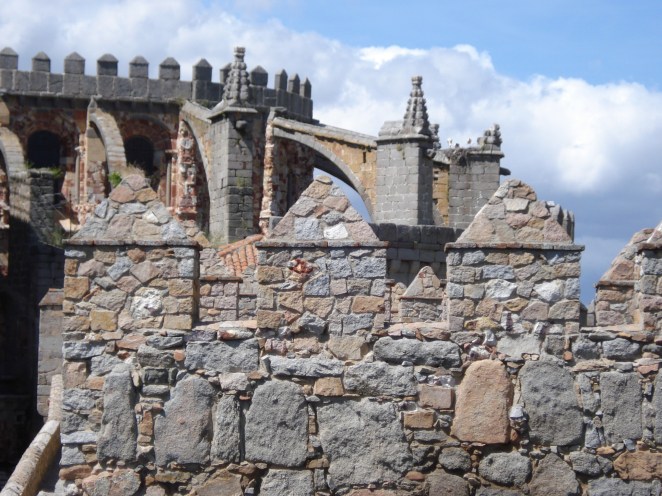
“There is no earth, no heaven, no extended body, no magnitude, no place and that nonetheless I perceive these things and they seem good to me. And this is the most harrowing possibility of all, that our world is commanded by a deity who deceives humanity and we cannot avoid being misled for there may be systematic deception and then all is lost. And even the most reliable information is dubious, for we may be faced with an evil genius who is deceiving us and then there can be no reassurance in the foundations of our knowledge.” René Descartes (1596-1650).

Cervantes wrote about such times in Don Quixote. Do we see what others see? What is truth and what is fiction? How do we approach and understand authority? What do we believe and why do we believe? Are they windmills or giants, wineskins or warriors, a flock of sheep or an invading army? “Only believe, and thou shalt see” – but what do we believe and why do we believe. “The fault, dear Brutus, lies in ourselves, not in the stars, that we are underlings,” Shakespeare, from one of his many plays.

Carved in Stone 67 & 68

Carved in Stone
67

At night, on the cool
sea-shore of my dreams,
the calls of shore-birds
at Ste. Luce-sur-Mer
are borne on the wind.

High-pitched, they are,
like the voices of children,
or of men and women,
in distress.

I walk on the sand
at low tide and a lone gull
flies past my head,
battering itself
against the wind’s cage
with outraged, sturdy wings.

68

Sunset.
Sea mists descend.
The church on the headland
steps in and out of darkness.

Shadows gather, persistent.
Gulls surround a lone heron.
It clacks its beak in anger
forcing the gulls to scatter.

These words are not my words.

They came to me in the speech
of birds hidden in the foliage,
or carried on a feathered plume
sprung from the osprey’s wing.

Some came from the click
of the crab’s claw as he dug
deeper into the sand
a refuge where he thought
he could live safely.

Commentary:

Sunset. Sea mists descend. The church on the headland steps in and out of darkness. And so do I. I seek clarity, but there is no clarity when the sea mist descends, just the blurred image and the clouded thought. The cloud of unknowing, one philosopher called it, many years ago, and it is still with us. Especially when the sunlight fades and we are left wandering in the mists of unknowing.

“Is it here, you ask, or over here?” Well, if you do not know, I cannot tell you. But I will ask you this, and think very carefully before you answer – does the answer come from outside of you, given by another, or does it come from the deep, sacred intimacy of your own soul? The answer to that question will tell you all you need to know, one way, or the other.

These words are not my words. They came to me in the speech of birds hidden in the foliage, or carried on a feathered plume sprung from the osprey’s wing. Some came from the click of the crab’s claw as he dug deeper into the sand a refuge where he thought he could live safely. Sunset. Sea mists descend. The church on the headland steps in and out of darkness.

Carved in Stone 61 & 62

Carved in Stone
61

Water through the water clock,
water off a duck’s back,
the waters of life,
continually flowing,
trapped in our children
and their children,
and the love we create
never lost, just circling,
like the hands of the clock,
like the planets and stars.

But who will wind up
the clockwork universe,
and tend the mechanism
that balances planets and stars?

What will happen
when the clockwork
finally runs down,
the last candle is snuffed,
and the water clock dries up?

62

Whoever, whatever remains
will be left to contemplate
Ozymandias with his two vast
and trunkless legs of stone,
standing in the desert.

“Look on my works,
ye mighty, and despair.”

Commentary:

“Look on my works, ye mighty, and despair.” Well, Moo does have a sense of humor after all. I thought he did. From Ozymandias to the meaning of “works” to the destiny of the work we did. What a journey. It goes from the joy of the children who build a snowman to the warm spring wind that melts him to the crows and the dog who do what crows and doggies do. Intertextuality – the links between verbal and visual and think about it – such strange things happens in Moo’s creative mind.

But what do we leave behind? Think about it. Only the wake of the ship in which we sail. The wake – that white trail we leave behind us, on the surface of the sea, slowly vanishing as we also vanish, pulling away into the unknown that always lies ahead. Moo is right – so many things disappear out of the frame of the painting. “There are no pockets in shrouds” said the preacher in the hospital where I took my father, so long ago for treatment.

And even if there were, how would you fit a snowman, several crows, a cardinal, and the rear end of a dog into the pocket? “Contemplate Ozymandias with his two vast and trunkless legs of stone, standing in the desert. Now contemplate the fate of the snowman. Now look on my works, ye mighty, and despair.”


Dorset Knobs and Old Vinny

Dorset Knobs and Old Vinny

Five Lysol wipes remain in the can.
As rare as hen’s teeth or Dorset Knobs
and old Vinny, they have become precious
items sold in marked up prices online
by people who stocked up at the beginning
of the crisis on commodities they were able
to seize before rationing stepped in
and limited quantities were permitted
to each purchaser who waited patiently,
in line, to enter the super-market.

I place my leather glove on my hand
and move to the gas pump. How many people
have used it, pumping gas with bare hands,
and the metal surface retaining how many germs
who knows for how long? I cannot wear my mask
while pumping gas. Cover my face and they will
not serve me for fear I may flee without paying.
I finish pumping, open the car door, remove
my glove, put on my mask, pick up my cane,
and walk into the gas-station shop to pay.

As I limp towards the door, a man, mask-less,
holds the door open for me, his face less
than a foot from mine. “There you are, sir,”
he says, showing his teeth. “Service with a smile.”

I return to the car, remove a precious sanitizing wipe,
clean my glove, the car door handles, every spot
my gloved hand touched. Then I wipe the handle
of the gas pump and dispose of the precious wipe
in the garbage can nestled between the pumps.

Commentary:

Well, I am willing to place a bet with my favorite bookmaker, at Covey’s Print Shop, that not many of you out there know what Dorset Knobs and Old Vinny is or are. Moo has joined me in my wager and he is willing to bet that very few of you know where the line “où est le papier?” comes from. Even fewer will be able to sing the whole song! Oh dear, our world is only artificially intelligent, not really intelligent. In my teaching days I would ask the class if we were in a smart classroom. “Yes, sir,” they would reply. I’d then walk to the wall, tap it and ask it “What’s 2 + 2?” The wall never answered. I’d try again. “What’s 2 + 2?” – Silence. “Not such a smart classroom then,” I’d say to the students.

But I bet you all remember Covid, the days of taking all sorts of precautions, of wearing masks and gloves, of washing everything that came into the house, of washing hands, and not touching surfaces in public places where the unwashed may have left a winning lottery ticket with your Covid Number upon it. Oh dear, those were indeed the days. And this little poem, a golden oldie, recalls them. Let us hope they do not return. And let us doubly hope they do not return with a mutating or mutated helix of sinister proportions.

Latch-Key Kid

Latch-Key Kid

In one room in my head, I stand on a stool beside my father’s mother helping her to mix the cake she will later bake in the wood-fired oven of her black, cast-iron stove. Every time she mixes a cake, she places a small piece in a dish and bakes it just for me. As a child, I spent hours in that kitchen, watching her cook. When she boiled vegetables, she never threw out the vegetable water, but used it for boiling other vegetables or for making rich, thick, delicious gravy.

Later, with both my parents working, I became a latch-key kid. I spent all day in an otherwise empty house and cooked my own breakfast and lunch. I also prepared supper for my parents so that it would be waiting when they came home. I grew up loving to cook.

When I went abroad to spend my summers in Spain or in France, I spent as much time as possible in the kitchens, watching, listening, learning. The women always had time for a small child. Then men seldom did. Children should be seen and not heard. They just got in the way. That was the male attitude. I learned so much in those kitchens.

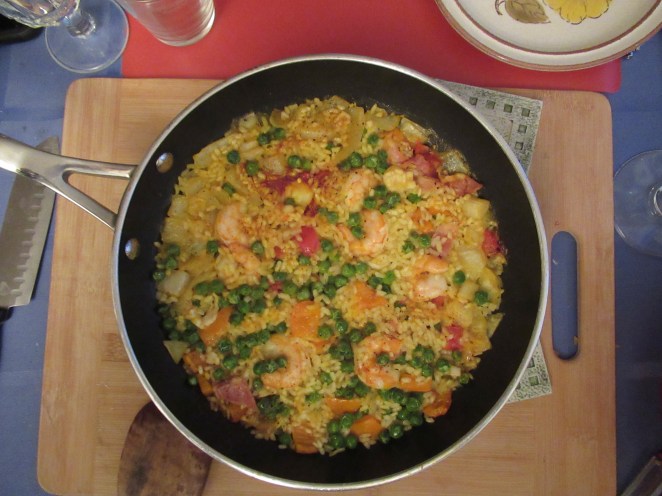
Later, in Santander, my landlady would place one egg, one onion, and one potato beside the stove. It didn’t matter what time I came back from a night out with the boys, my supper was there, a Spanish omelet, una tortilla Española, waiting for me to cook it. Sometimes she left me a piece of chorizo, but I preferred the omelets. I did enjoy making shapes and designs out of the chorizo – that was always fun.

Not many people knew about my cooking skills. One of my aunties always cooked for me. She told me that her husband didn’t even know how to boil an egg. The men in my family seldom cooked, except for my maternal grandfather, who learned how to fend for himself in the trenches and dug-outs during WWI. He taught me how to make stews and soups, rich and nourishing, and always better on the third day. He also told me what he put in them – and you wouldn’t want to know about what he hunted and scavenged to stay alive in those cold, dark days. Nowadays, so many of us just don’t know how lucky we are. I do know how happy and lucky I am, not to be homeless, not to be living out on the streets, dependent on soup kitchens, charity, and fighting the elements just to stay alive.

Carved in Stone 56 & 57

Carved in Stone
56

I stand before the Tzompantli,
the Aztec Skull Racks
in the ruins of the Great Temple
in Mexico City,
and gaze in wonder,
at the multiple meanings
of these decorated deaths.

57

At Teotihuacan,
I climb the Sun Pyramid,
with its carved serpent,
slithering sideways,
as the sun moves.

I heave myself upwards,
panting, sweating,
and when I get to the summit,
I sit there, feet over the edge,
and I feel my heart thumping
as I fight to regain my breath.

Now, I feel purified,
cleansed, sweated dry,
as I watch poor mortals
struggle as I did
to take that final step.

I imagine them laid
on the sacrificial stone,
their chests carved open.

Each beating heart,
when extracted,
will cover altar, priest, and sky,
with a fountain of blood,
so hard those hearts
are pounding. Blood seeds
shoot into the sky
to revive the setting sun
as it drowns in its own blood.

Commentary:

Incredible, looking back, those moments in Mexico when I came face to face with a culture, so old, so alien to me, that I had difficulty coming to terms with it. I do not understand human sacrifice. Nor do I understand the mentality of the conquistadores who held the Aztec Emperor’s feet to the fire and burned them to the bone, leaving him alive. And still he would not tell them the secrets of the kingdom.

“The setting sun as it drowns in its own blood.” A nod to Charles Baudelaire, of course, – “Le soleil s’est noyé dans son sang qui se fige.” Wonderful how these images stay with us. Sunrise – and the sun is born in blood – sunset and the sun sets in its own blood. And was it really true that only the blood of humans, drawn through human sacrifice, sometimes voluntary, sometimes not, would keep the sun in the sky?

And there we go – in blood we were born, in blood we will probably die – all hail the power of blood – unless of course / wrth gwrs – it is contaminated. And what will happen to us then?

Dog Daze

Dog Daze

Memories deceive me with their half-remembered shows, shadow shapes shifting over the walls with a flick of the magician’s fingers. What magic lantern now slips its subtle slides across night’s screen? Desperate I lap at salt-licks of false hope that increase my thirst and drive me deeper into thick, black, tumultuous clouds. A pandemic storm lays waste to the days that dog my mind. Carnivorous canicular, hydropic, it drinks me dry, desiccates my dreams, gnaws me into nothingness. At night a black dog hounds me, sends my head spinning, makes me chase my own tail, round and round. It snaps at dreams, shadows, memories, anything that ghosts through my mind. Hunter home from the hill, I return to find my house empty, my body devastated, my future a foretold mess. Tarot Cards and Tea Leaves are lost in a Mad Hatter’s illusion of a dormouse in a teapot raking runes from an unkempt lawn.

Commentary:

Well, what a muddle. Images flying everywhere, in and out, like Von Richthofen’s flying circus of WWI fame. And look at that last line! Tarot Cards and Tea Leaves are lost in a Mad Hatter’s illusion of a dormouse in a teapot raking runes from an unkempt lawn. No wonder Moo said “Nein!” when I asked him if he had a painting to illustrate this one. In fact, he quoted Salvador Dalí at me: “There’s no difference between you and a madman, except that some days, you aren’t mad.” I guess this implies that some days I am.

“Ah well,” said Mrs. Thomas calling her son Arwel in for tea. Welsh joke. Many won’t get it. Arwel didn’t and he didn’t get his tea either. Never mind. Those things happened a long time ago when the world was so much younger, and, dare I say it, wiser! Actually, there’s nothing wrong with the world itself. The problem, as always, just like the old woman who lived in a shoe, it’s the madmen who inhabit the shoe that are the problem. And when the shoe’s sole needs a nail, who is going to come and glue it back together. Not me, said the red squirrel, laughing. And he always laughs. As soon as it gets cold he tucks into my garage and it’s a devil of a job to get him out again.

What’s worse, he insists on building nests in my car engine. That’s three times now. And it costs money to dig those nests out. Not to mention the mess. First time, I didn’t even know he was in there until the windscreen wiper on the driver’s side started to fail. Then the whole watering system broke down. I took it to the garage, and the garagemen said “I hope you’re getting rent money, you’ve got a tenant.” Anyway, he got rid of the squirrel and the nest. But the little blighter must have followed me home, because a few days later he was back in there again. He’s in there now. I can hear him chuckling as I type this.

Dog Daze, indeed. I wish I had my doggy back. Alas, as you can see from the photo, he crossed the rainbow bridge to his doggy paradise, leaving me to contend with a garage full of ham-fisted red squirrels. No wonder my head is spinning around and I am chasing my own tail, round and round. At least he’s single, that squirrel. I don’t know what I’d do if he got married. I know my maths ain’t no good (nor is my English), but where squirrels are concerned, I am pretty sure that 1 + 1 = 6 or more and a foretold mess.