me crossing the bridge shaking sand from my sandals
a rare event Swansea Bay Station Cline Valley Line a train at the platform
the station master blows his whistle doors close slowly the train goes under the bridge
I stand in a cloud wrapped up half-blinded in huge puffs of smoke
filling my lungs assaulting nostrils and eyes with the sting of cinders the stench of burning coal
sting and stench and that short sharp whistle
they linger and cling unforgettable in my mind’s dark corners
Comment:
Me and my writing buddy also discussed linked poems. This is simply a chain in which each poem links back to another one. Yesterday, we wrote about Swansea Sands and how the poem was generated. Today we can look at the linking between that poem and this one, the old railway bridge that crossed the railway lines by Swansea Bay Station, and led back into Swansea, a town in those days, and the Civic Centre. Note, now, that each of those names could generate further links, further poems in the chain.
When we think of the great chain of being, we think of how all things are linked. From the Great Western Railway (GWR), to the Mumbles Railway, to the Cline Valley Branch line, and beyond. Each poem a railway station along the way. Main line, branch line, express train, goods train … links everywhere, and each link encapsulated in a memory of one kind or another. How could we not write poetry about such things?
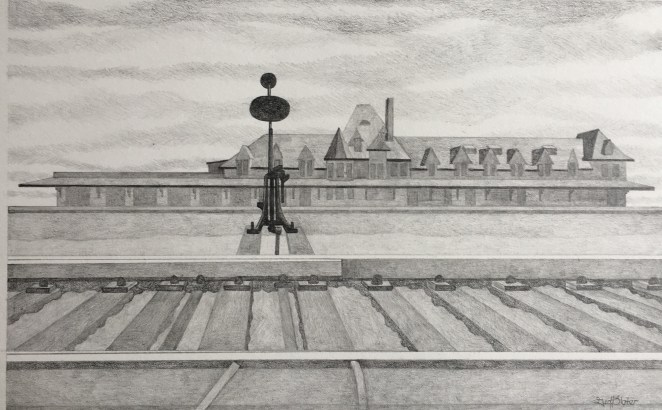
McAdam Railway Station, in New Brunswick, Canada. 60 trains a day used to stop here. Now the station is a landmark, a memory, a place where ghost trains run and shadowy figures run wild up and down the grass grown tracks where the sleepers sleep, their dreams undisturbed. I could write a book of poems about this station. Wait a second, I already have and Geoff Slater, my painting buddy, decorated it for me with his wonderful paintings and drawings. What more can I say? Each link in the chain, a potential poem. Each stop along the way, material enough for a painting, a poem, or a book.
sand in my sandals sand like sandpaper sanding me down
tides rise and fall sea gulls call the bay so big and me so small as tiny as a tiny grain of sand
Comment:
Not Swansea Sands at all, sorry. But a sandy beach all the same, here on the southern shores of New Brunswick, down by St. Andrews. The theme of the poem comes from Blake’s ‘to see the world in a grain of sand’. It might not be Swansea Sands, but there’s a great deal of sand down on the southern shores of NB. I worked on this poem with one of my writing buddies, who visits me regularly. We shared an impromptu creative writing session over the kitchen table in Island View a couple of days ago. Alas, as you probably know, there are no islands in Island View, and there’s not a grain of sea sand in sight. So we improvised.
We started with a central idea – a grain of sand – and from there we talked about how to generate a poem, from scratch so to speak, in three steps.
(1) The first draft.
Write as it comes to you – just write. Just bounce from word to word, line to line, like a supercharged, literate budgie. Take about 3-4 minutes for this. Then read it aloud to partner / writing buddy, checking on sound and rhythm.
(2) Second draft.
– Eliminate words and ideas that do not fit the central image. Remove anything loose or unclear. Then read it aloud to partner / writing buddy, concentrating on sound and rhythm.
(3) Third draft.
Polish and finalize the poem. Sometimes a fourth draft is needed, but in this case we settled with the third draft. At this stage, pay careful attention to the poem’s ending (closure is always difficult). Reorder, add, and polish, as necessary. Then read it aloud to partner / writing buddy, checking on sound and rhythm.
From the initial image – to see the world in a grain of sand – I generated two poems. My partner / writing buddy generated a short story that would fit into their current sequence of childhood memories. Other ideas for further poems also came through.
Conclusions;
Make your poems alive, make them personal, make them an experience!
Remember rhythm. And never forget the necessity of a live reading or series of readings in which you can feel and hear the words.
An alterative to a live reading with a partner / writing buddy is to record your own voice. The recordings can then be sent to friends who can comment on them.
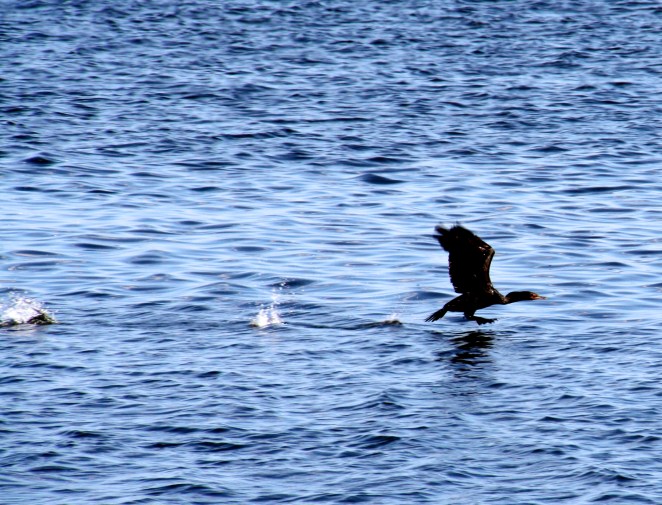
A lone, wind-shaped tree stands on rugged coastal rocks under a cloudy sky
Image generated not by Big Brother but by Little Brother who left the Frying Squad to become a painter and mind-reader
Waist Land
Jack Pine Sonnet
living in a waste land surrounded by books he writes in his journal things false and true in memory of the old days when the world seemed so new
a life built on sand slips through his fingers wouldn’t it be grand if the sand stays and lingers refusing to pass through the hour glass’ waist so time stops to flow
then he could say no leave me alone there’s more sand to fall I don’t want to go
Comment:
It’s a bit like a cliff-hanger, isn’t it? Hanging on by our fingertips and not daring to look at the depths down below. We know they are there, but look, there’s a tiny fossil in the fissure in the rock, so much older than us, we’ve got a long time to go to catch that up. And remember – 80 is not old, if you are a stone!
Treading air – great fun. Not as good as treading warm water in the local YMCA. Just a lovely sense of balance, floating there in the warmth, no weight on arthritic joints, and the world around us amniotic, as it was in the beginning. Ah, those original waters, we have all swum in them, the rich and the poor, the black and the white, and all shades in between. Even King Charles and the late Queen. And remember, they may speak of blue bloods, but all blood is red -and, if you cut us, do we not bleed.
Speaking of bleeding – blood-thinners – my favorite doctor’s latest joke. I cut my arm the other night, getting into bed. Didn’t even notice. Pillows and sheets soaked in blood when I woke up and my scalloped arm, stuck to the sheet, opened itself up and started to bleed again. Feels like seventeenth century Spain, the wounds of the dead man re-open and start to bleed when the assassin appears before him. Certain truth. Obviously 100% guilty.
And they tell me that in South Wales people are adding cooking oil to gasoline to make the petrol go further. Scotland Yard sent the Flying Squad to South Wales to sniff people’s exhaust pipes to see if they were cheating the tax man. I asked my friend – “Is this true?” “Ah, yes,” he said in his lovely Welsh lilt, “and we call them the Frying Squad!”
A well-loved rag doll leans against a wooden post surrounded by blooming roses at twilight.
Big Brother read my mind and painted the picture
Rag Doll
Jack Pine Sonnet
They fought over her whenever they met each one holding her by a leg or an arm
An eternal tug of war a terrestrial dog fight with no truce called and neither giving in
One day they went a step too far and tore the doll in two neither happy with an arm and a leg each
as for the rag doll torn apart in fury she was discarded thrown in the garbage
when nobody was looking one child returned rescued the rag doll sewed her back together and filled her with love
Comment:
Tragic, really, and really tragic. A reversed Judgement of Solomon in so many ways. An Allegory applicable to so many situations in this tiny, overcrowded world of ours. Every night, on the television, we can watch hour after hour of shows like this – minus the last stanza. Some endings can never be happy.
One night, for the fun of it, I counted all the deaths, shooting and murders on selected shows over a three or four hour period. I saw over 150 violent deaths. What sort of legacy are we leaving our children, our grandchildren. And what will their children learn in their turn? Food for thought to be taken three times a day while avoiding exposure to reality – or is this the alternative reality to which we will all be exposed?
I waited until the boys in the dormitory slept. snores, whimpers, children snuffling, crying in their sleep.
I dressed in the dark, crept downstairs, opened the school’s back door, moved silently to the gates, and climbed over them.
I stood at the roadside, stuck out my thumb at the cars that passed, not many at one AM.
A cloudless night, bright stars, dark sky. A sense of imminent freedom washed over me.
The fourth car stopped. A man and a woman. They opened the door, let me in, turned around, and drove me back to school.
I stood in the hall watching the swing of the pendulum as the head master, in pajamas, thanked the couple for bringing me back to school.
That night, he led me quietly back to bed. Every night, for a week, he removed my clothes from the chair beside my bed.
I ran away again and again. No matter where I went my own face stared back at me from the mirror.
One day, I realized I was running from myself. When that happened, the running finally stopped, and I confronted my demons.
Comment:
I guess we are all motivated by flight or fight and I have always believed in the powers of flight – per ardua ad astra – through hardship to the stars, the motto of the Royal Air Force, I believe. Yet running really does no good, especially when we are running from our own interior demons. I hated that particular boarding school, my second, even more than I did my first one. I hated it with a deeply rooted inner loathing that still seethes inside me when I think about it. And that particular ‘first escape’ remains printed indelibly on my mid, every footstep, every floor board that creaked, every shadow that threatened.
Much later in life, while attending my fourth boarding school, one of the slightly better ones, with a strong emphasis on the slightly, my cousin, an unarmed combat instructor, took me in hand. For three weeks we went to Swansea Sands and he put me through basic training. How to break fall, to leg throw, to arm throw. Then he taught me the sacrifice throws, where you go to ground and your opponent follows, you prepared, your opponent not. He taught me about power points and the pointed or sharp edged bones that could do so much damage to the unprepared. He taught me all the multiple choke holds, how to apply them and then the secret of squirming out of them. Monday – Friday, four hours a day, total immersion, three weeks. I learned so much.
After that, I had the choice of flight or fight. However, I no longer saw myself as a victim because I saw those bullies and predators as potential victims. All the vibes had changed. Older, bigger boys no longer bullied me. Everything, in the end, turned out all right!
Rain walks thick lines down the window pane. The waters below the dam churn like white shirts tumbled up and down in nature’s laundromat.
The radio calls for rain, more rain, four inches, they say, in the next two days.
The moose have already migrated to higher, drier ground. They stand on the highway, head to head with cars, stubborn and steaming in the never-ending rain.
Comment:
It’s raining, it’s pouring, the old man is snoring. He bumped his head on the top of the bed and won’t get up until morning.
It is hard to shed the skin the skin once shed can never be worn again
Yesterday is gone today slips slowly by
Tomorrow always comes but never arrives
Who and what am I this child who thrives on sorrow and on a sadness
that grinds those bones to dust and soft silk ash
Tell me if you know what will arrive for this child tomorrow if and when it comes
Comment:
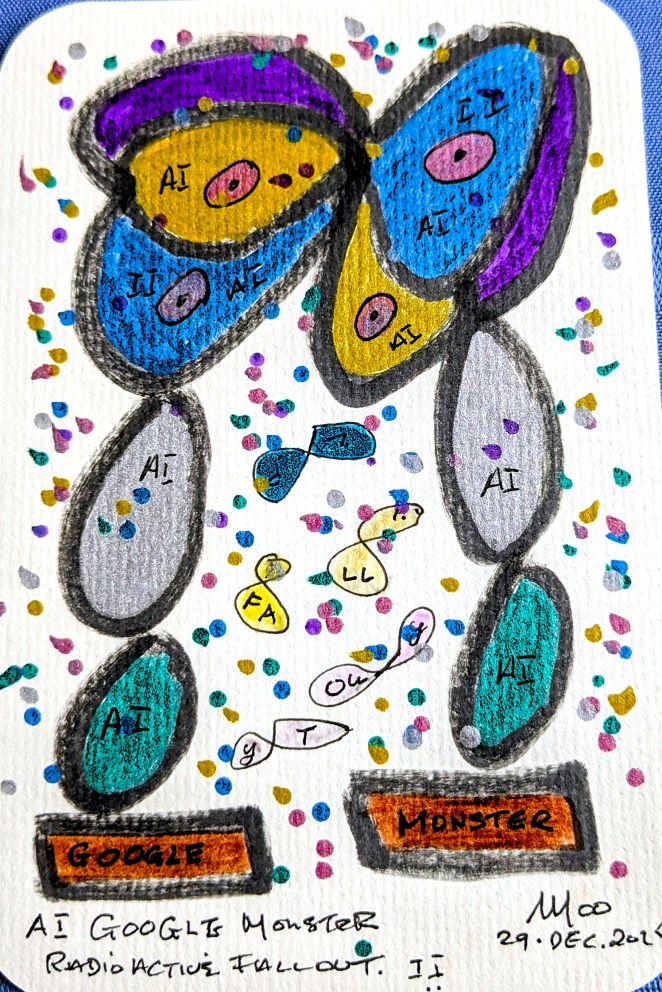
Moo is so happy when I don’t allow Ryan to persuade me to invite AI to paint my thoughts in pictures. “AI?” said Moo. “Have I got a painting for you!” And he showed me the AI Google Monster with its radio active fallout. “Nice,” I said. “I like the look and feel of that.” It looks like a two-eyed cricket bowling machine. It bowls Googlies out of the right eye and Chinamen out of the left one. Alas, we are no longer allowed to use the term Chinaman as it has been labelled ‘disrespectful’.
But what is a Googly? A Googly is an off-break bowled by a right-handed bowler with a leg break action. And a Chinaman is the reverse – a leg break delivered by a left arm bowler with an off-break action. Complicated? You bet it is. But AI and Google have demystified the mysteries of right and left arm wrist spin. Or have they?
It is one thing to know what they are – definition – but another to spot them as they leave the bowler’s hand, and yet another to play them as they whir through the air, then pitch and viciously spin. Of course, just to keep you up to date with Dennis Compton’s Three Card Trick, a top spinner, bowled with exactly the same action will come straight on and not turn at all.
It is hard to spot the spin when the ball is leaving the bowler’s hand, and the spin, once spun, can never be spun again! I am glad we sorted all that out. Oh sweet mysteries of the cricketer’s life. I once asked a top batsman how he spotted the difference between a leg- break, a googly and a top spinner. “I watch which way the stitches are moving when the ball leaves the bowler’s hand.” You need really good eye sight to do that. The Eggs Box, sorry, that’s the Two Ronnies, the X-Box will never do that for you.
But who is Dennis Compton and what is his three card trick? Good question. Dennis Compton, aka The Brylcream Boy, was one of England’s best ever batsman. You can look him up in the 1947 Wisden. Genuine paper pages, crackling as you turn them, much nicer than the metallic voice of AI. Compton was notorious for running out his partners with his three card trick – “Yes! No! Wait!” What do you mean, you don’t understand a word of what I am talking about? You’ve read Jabberwocky, haven’t you? Yes? No? Wait … if you haven’t read it you must do so. Immediately – but not if the slithy toves are gyring and gimbling in the wabe. Go Google it – and when you find it remember to sing “oh frabjous day, calloo, callay” as you chortle in your joy.
Yesterday fled quickly by today limps slowly on and on tomorrow draws near yet never arrives if and when it does it becomes today
As for me I feast on shifting shadows my story a tapestry reversed – hanging back to front unreadable
It is hard to slough your skin the skin once shed can never never be donned again
My body white bone grey gristle no longer wrapped in skin is bonded together by super glue made from my love for you
Comment:
Moo assures me that this painting, unsigned and untitled, is actually his. After yesterday’s doubts, I must believe him. He says it is called U-R-My-Sunshine. He also thinks it would be a great painting to go with this strange little poem that crept somehow out of my head and landed on my page. It reminds me somewhat of the church cat – it crept into the crypt, crapped, and crept out again. “Oh what a naughty pussy cat.” Who U-R is up to the reader / viewer apparently. I doubt that I am his sunshine after what I said about him yesterday. Oh sorry. You didn’t read that blog? Well, shame on you! You’ve got to do your homework if you’re going to keep up with me and Moo.
What is A Jack Pine sonnet, you ask? Well, I don’t have a clue. But now that my other buddy, Ryan, has introduced me to AI, I will ask my AI what such a thing might be. Asking now. Hang on to your seats. It tells me it’s thinking. Aha! Here’s what I think it thinks it thinks.
AI says – A jackpine sonnet is an irregular, spikey poetic form created by Canadian poet Milton Acorn (from neighboring PEI), in the 1970’s. It typically acts as a 14-line sonnet with 7-13 syllables per line, but allows for flexible line counts (e.g., 12, 18, or 20), using internal and consecutive rhymes rather than strict, traditional rhyme schemes.
Key Aspects of the Jackpine Sonnet:
Origin: Developed by Milton Acorn, often known as the “People’s Poet,” as a uniquely Canadian, gritty form of expression.
Structure: While it aims for roughly 14 lines, it can vary in length based on the needs of the poem.
Rhyme and Rhythm: Uses internal rhymes (rhymes within a line) or consecutive end-rhymes (e.g., AABB) rather than standard sonnet structures.
Style: It is designed to be “irregular and spikey like a jack pine tree,” focusing on structure and integrity rather than rigid adherence to traditional verse rules.
So, now you know what a Jack Pine sonnet is. But I bet you’ve never heard of Milton Acorn! I have. Here’s the poem I wrote about one of my meetings with him. You can find it in The Nature of Art.
Milton Acorn
“Oy,” he waved strong carpenter’s hands, “Make this work.” I typed in my code and the machine came to life. “Go away,” he pushed me out and slammed the copier room door behind my back.
Later, my secretary came in and caught him, his face pressed to the glass. He pushed the button, lights flashed, the machine whirred and copies emerged.
In his hand he held images of his feet, arms, legs, head, all of his body parts. “Tape, not masking, clear tape, 3M.” Flustered she fled, brought Scotch tape, watched as he stuck himself together.
Over lunch he showed me his work: a self-portrait, shadowy and cloudy, whiskered and worn, smelling still of printer’s ink. That’s how I remember him: unique, stately, unmistakeable, uncouth, unseemly: a jack pine growing in its own self-image.
Farewell, my dear friend, Milton. And that is how I remember you.
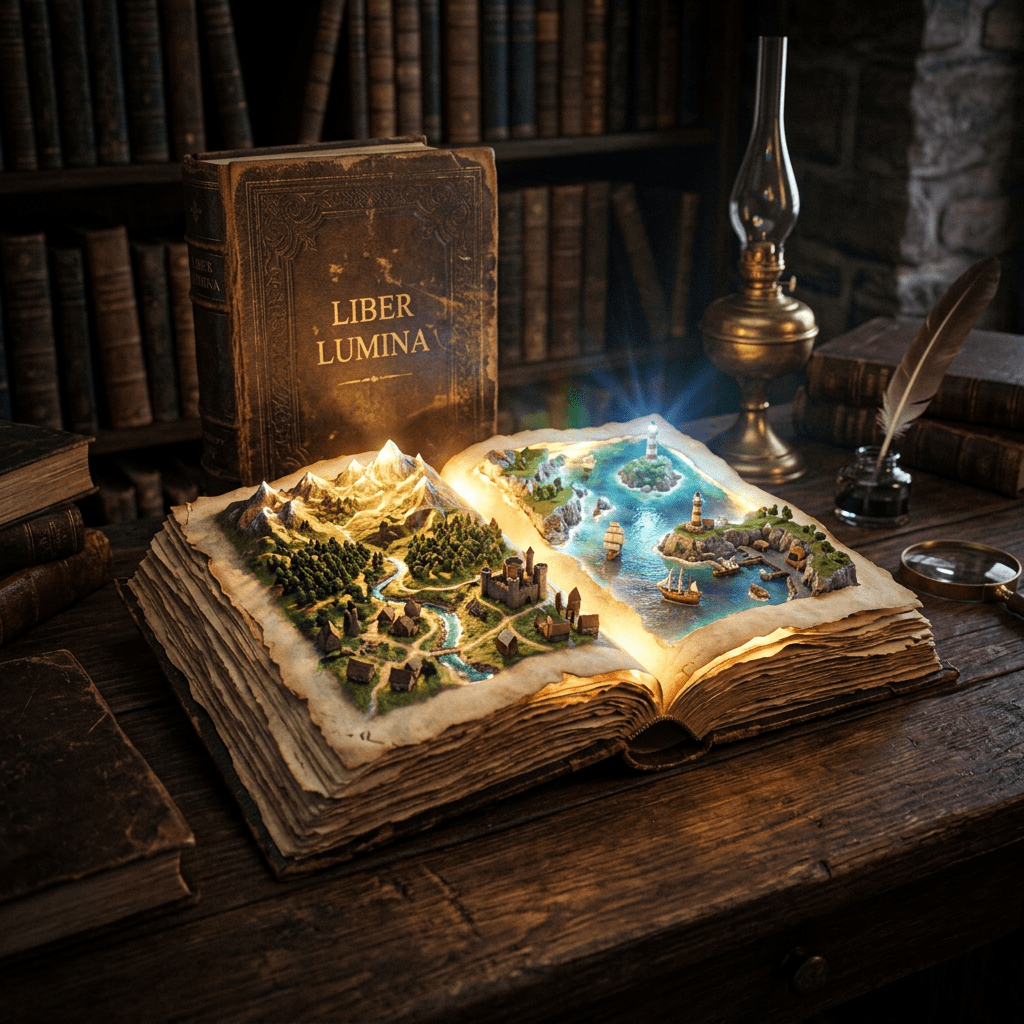
A magical book opens to reveal a glowing 3D map with mountains and sea landscapes.
Image generated by AI
Ryan and Don Roger
14
Tales within a Tale
Don Quixote, the novel, is a tale that tells the story of Don Quixote and his adventures. While the adventures of Don Quixote and Sancho Panza, and their delightful dialogs are the essence of the story, other stories abound. These ‘other stories’ are known, in academia, as the intercalated novels. They are tales told of and by other characters within the main history of the adventures of the ingenious hidalgo. While the characters within some of these intercalated novels mix at one level or another into the story of Don Quixote, some of them do not.
The Tale of Foolish Curiosity, DQI, XXXIII / 33 -XXXV / 35, has very little to do with the story of Don Quixote, other than the fact that our knight is present in the inn while the tale is being told. We know that in Italy, Boccaccio’s Decameron, was a key player in the genre of story-telling. Our friends at AI tell us that “the Decameron is a collection of short stories by the 14th-century Italian author Giovanni Boccaccio (1313–1375). The book is structured as a frame story containing 100 tales told by a group of seven young women and three young men. They are sheltering in a secluded villa outside Florence to escape the Black Death. No television, no radio. They amuse themselves by telling stories. The various tales of love in The Decameron range from the erotic to the tragic. Tales of wit, practical jokes, and life lessons also contribute to the mosaic. In addition to its literary value and widespread influence (for example on Chaucer’s The Canterbury Tales, it provides a document of life at the time. It is considered a masterpiece of early Italian prose.”
What is The Tale of Foolish Curiosity doing in the Quixote?One suggestion is the hinge theory – the tale links thematically to the ideas expressed in the Quixote. We have just met several intercalated novels in which the theme of love plays a major role. TheTale of Foolish Curiosity is a psychological novel, written in the Italianate style favored by Cervantes, that explores the theme of folly in love. A second theory is that The Tale of Foolish Curiosity is there merely for entertainment. A third is that it is there to demonstrate Cervantes’s writing skills. Whichever reason pleases us most, and all can be equally true, we know from DQ2, III /3, that not every reader was happy with the inclusion of this tale in DQI.
In this chapter, Sampson Carrasco, the Bachelor, tells us that “One of the faults they find in this history … is that the author inserted a novel called The Tale of Foolish Curiosity – not that it is bad or badly told, but because it is out of place and has nothing to do with the story of his worship Don Quixote.” In response, our knight replies “Now I believe that the author of my story is no sage but an idle chatterer.” The Tale of Foolish Curiosity is the only intercalated novel criticized in this fashion. Let us take a brief look at the others.
The story of Chrysostom and Marcela (DQI, XII, XIII, XIV) involves our knight errant, for the characters in the intercalated novel, interact with Don Quixote, Marcela, in particular. When she wishes to leave the scene, the young men who love her and follow her against her will wish to follow her, but Don Quixote defends her, and prohibits their pursuit of the shepherdess. In similar fashion, the tale of Cardenio and Lucinda is woven into the narrative of Don Quixote’s adventures, Cardenio appearing in DQI, XXIII, XXIV, and again in XXVII. The first meeting between them (DQI, XXII) is justly famous. Two foolish people, the Ragged Knight and the Knight of the Sad Countenance, meet, embrace, and look deeply into each others mad eyes.
Almost immediately (DQI, XXVIII), Dorothea appears on the scene and starts to tell the tale of her own misfortunes. They are interwoven with the tale of Cardenio and Lucinda, although they are not aware of it. Dorothea learns of the plot to deceive Don Quixote and bring him back to his village and willingly agrees to play the part of a distressed lady in search of a knight errant to rescue her. Don Quixote accedes to her request. When they spend the night at an inn, first they hear The Tale of Foolish Curiosity and the captive, recently escaped from Algiers, appears and tells his tale (DQII, XXXIX, XL, XLI). Yet more adventures occur at the inn, and several more characters weave their own tales into the tale of Don Quixote.
Two clear patterns emerge. (1) Tales that are independent in their majority, of the knight’s story. (2) Tales that are interwoven closely with the adventures of Don Quixote and Sancho Panza. This style of events changes in DQII, after the intervention of ten years (1605-1615) during which Cervantes receives and processes feedback from his many readers. As we will see when we get there, Don Quixote and Sancho become the key figures in what will become the first self-referring novel (more about that later), and all the tales told within DQII will be woven into the stories of what will become, thanks to the split narrative, our two adventurers.
Meanwhile, in 1613, Cervantes published his Novelas ejemplares, a collection of twelve short stories (novellas) that showcase his mastery of narrative beyond Don Quixote. These tales range from realistic depictions of 17th-century Spanish life to idealized, romantic adventures, designed to offer both entertainment and moral instruction. Some critics have speculated that Cervantes might have been thinking of including these novels is an expanded version of DonQuixote. However, if he did have that idea, he certainly abandoned it, given his own criticism of The Tale of Foolish Curiosity. I think, given the quality and expanded dimensions of DQII (1615), we can all be happy that he abandoned that idea!