From Stage to Page

An unrolled parchment scroll showing a sunset windmill sketch on a wooden desk with a quill and inkwell.
A beautifully detailed scroll depicting windmills at sunset rests on a classic wooden desk alongside traditional writing tools.

Image generated by AI.

Ryan and Don Roger

4

Stage to Page

            So many questions – so much to say. Let us begin by stating that Cervantes is one of the most original novelists the world has known. Then we can continue by stating that, in spite of that, like Jean-Baptiste Poquelin, aka Molière, he is not above borrowing his material from other writers. When Molière was asked where he found sources for his plays, he replied “Je les prends où je les trouve.” Cervantes might well have said the same thing.

            The source of the first sortie of Don Quixote is a short play, an entremés, called El Entremés de los Romances. These short, entertaining pieces were often installed between acts of a longer pay to keep the audience amused during the breaks. In this particular one, an old man thinks he is a knight and travels forth quoting the old border ballads and ballads of chivalry as if they were historical truth. Mind you, some of them were, or pretty close to it, especially those that carried news of the reconquest, but not all of them were true by a long way. The old man goes too far with his chivalry, gets a beating, and comes back home, draped over his horse which is led by a neighbor. Sound familiar?

            In classical rhetoric, imitation – imitatio in Latin – was the highest compliment one could pay to another author as it meant he was worth imitating. Today, imitation is considered more a scourge to be avoided, although if you follow the crime and spy shows on TV you will know that the same, or very similar, incidents recur again and again, played out in different stories by different actors.

            So, Cervantes starts out by imitating an older stage play and turning it from a play into a short story. This is creativity, beyond imitation, in itself. In this theory, the first story is in fact a short story, meant originally to stand on its own. This is not my theory, incidentally, I have borrowed it from my own teacher, Geoffrey L. Stagg, the man who introduced me to the scientific study of the Quixote. Stagg took as his evidence the first edition of the book in which he discovered an anomaly. The last sentence of Chapter Five ends in a comma (in the original, and certainly not in my translation by J. M. Cohen. I first read this book in 1965 – 61 years later, it is held together by glue and Scotch tape, a bit like Don Quixote’s helmet and armour!). To continue, the first word of Chapter Six begins with a lower-case letter, as if that word were joined to the last in the previous chapter. The heading of Chapter Six also runs smoothly into that first word as if they were joined. This suggested that in fact the two chapters had been united in a single story and had later been separated as the idea of turning the story into a novel dawned on the author.

            But who is the author of Don Quixote? Miguel de Cervantes, obviously. But who is the narrator of the story? In the first sentence, this first person narrator states ‘a village in la Mancha that I do not wish to name – de cuyo nombre no quiero acordarme in the original Spanish. AI helps us out here. I quote – “Miguel de Cervantes was likely imprisoned in Argamasilla de Alba (specifically in the Cueva de Medrano) around the turn of the 17th century due to disputes arising from his work as a tax collector, or potentially a local dispute with a nobleman. This confinement, stemming from financial irregularities or local drama, is traditionally believed to be where he began writing Don Quixote.”

No wonder Cervantes, the initial narrator, does not wish to name that particular town. A little later, in an effort to embrace the readers and draw them into the text, the narrator uses the first-person plural- our text, followed by we make take itwe do not depart.

We will return to the narrative structure of the novel on many occasions. For the moment, we will leave the matter there. In narrative structure, the real Cervantes is the author. Cervantes, named or unnamed, is the narrator and becomes a part of the narration. I should add that the 1605 version of Don Quixote contains many short stories, that have nothing, or very little to do, with Don Quixote himself. We will return to these intercalated novels, as they are called, when we meet them later in the text.

The Numbers Game

Ryan and Don Roger

3

The Numbers Game

            The numbering of the chapters in Don Quixote is also interesting. While Part I and Part II often retain the Latin numbering, the chapters themselves can be found both with Latin Numbers and standard numbers.

            Latin numbers are based on six letters I, V, X, L, C, D and M. Each has its own value. I = 1, V = 5, X = 10, l = 50, C = 100, D = 500, M = 1000. Most have us have seen Roman numerals on clocks and we are familiar with the numbers from 1-12. I, II, III, IV (4, that is to say one before five), V, VI (6, that is to say one after five), VII, VIII, IX (9, that is to say one before ten), X, XI (11, that is to say one after ten), XII.

            This paradigm governs Latin numbers. XV = 15, XX = 20, XXX = 30, XL (ten before fifty) = 40, L = 50, LX (ten after fifty) = 60, LXX = 70, LXXX = 80, XC (ten before one hundred) = 90, C = 100, CX = 110. The date of my writing this MMXXVI (2026). You will have noticed similar numerical configurations on books and old movies.

            The ancient Celtic numbering system was based on the digits of hands and feet. Counting sheep, for example, or goats, shepherds and goatherds would count up to twenty on their toes and fingers. Then they would carve a notch in a piece of wood. To keep score was to score the notch.

            Something similar happens in Basque jai alai, the happy game.  The scorers score in groups of IIII which they then made into 5 with a line through the numbers IIII. Four groups of 5 made 20 and the 21st notch won the game. That scoring method may have changed, but it is certainly how I learned to score the game in the Basque country (Spain) back in the 1950’s. Curiously, modern French shows the vestigial remains of this – quatre-vingts. Welsh shows a somewhat similar diversity because the Welsh word for twenty is ugain – although it’s technically not the only one, with the alternative dau ddeg (literally two tens) becoming more and more common. A case of plus ça change, plus c’est la même chose.

            And we must never forget the old sterling system of the United Kingdom of Great Britain and Northern Island. £. S. D. aka pounds shillings and pence. 4 farthings = one penny, 12 pennies = one shilling, 20 shillings = one pound.

Our good friends on AI came to our aid with this one. I quote – The pre-decimal British currency system, known as £sd (librae, solidi, denarii), consisted of 12 pence in a shilling and 20 shillings in a pound (£), totaling 240 pence per pound. Used until Decimal Day on February 15, 1971, this system featured various denominations, including farthings, sixpences, florins, half-crowns, and crowns. What about a guinea you ask? Well. That was £1 and 1 shilling. Hence the auctioneer’s delight.

            “What am I bid”?       >         “£20.”             >          “Guineas!”

Our trusted friends on AI sum it up this way – “A guinea was a British gold coin minted between 1663 and 1814, officially valued at 21 shillings (£1.05 in decimal currency) from 1717 onwards. It was the first machine-struck gold coin in Britain, typically worth slightly more than one pound. While no longer in circulation, it is still used in horse racing and some luxury auctions to represent £1.05.”

Luxury auctions – I love that phrase. And here we must leave our luxurious description of, and adventures into, numbers in Don Quixote! Just look where the journey has led us. And remember, in the same way that Cervantes inserted short stories, both spoken and read, that digressed from the main narrative, we can also insert such mental rants and ramblings into our own narrative. And we shall continue to do.

Here’s one, for example. How do you count goats in Wales? Click on these links for two examples. Counting the Goats traditional and Counting the Goats modern. Of course, wrth gwrs, the simplest method of all is to count their legs and divide by four! Try doing that with Latin numerals!


What’s in a Name?

Ryan and Don Roger

2

What’s in a name?

            Don Quixote was first published in Spain in 1605. In 1609, Thomas Shelton translated it into English. By 1611 / 1612 the adjective quixotic, was already in use within English society. An AI search tells us that “In the 17th century, the term quixotic was used to describe a person who does not distinguish between reality and imagination. The etymology of the word began after the publication of Don Quixote in 1605.”

But what does quixotic mean exactly? Another AI search reveals that “Quixotism (adj. quixotic) is impracticality in pursuit of ideals, especially those ideals manifested by rash, lofty and romantic ideas or extravagantly chivalrous action. It also serves to describe an idealism without regard to practicality.”

            Why is this important? Quite simply because in English we say Don Quixote / Quick-sot, not Don Key-hoe-tay a bastardized version of the Spanish. Please note that the adjective, in English, is quixotic not “key-hoe-tay-ic” which is too chaotic to be practical. Note too that the French translators offer us Don Quichotte, while the Italians suggest Don Chisciotte. Both these languages conserve the original pronunciation – a voiceless postalveolar fricative /ʃ/, which is the same sound as the English “sh” in “ship”. This is clear evidence that the X of the original had a different pronunciation in the seventeenth century than it does today.

            My wonderful friends on AI confirm this as follows, and I quote:

In 17th-century Spain, the letter ‘X’ primarily represented a voiceless postalveolar fricative /ʃ/, which is the same sound as the English “sh” in “ship”. During this period, which coincided with the Spanish Golden Age and the “readjustment of the sibilants,” this sound underwent a transformation, shifting from the “sh” sound to the modern velar fricative /x/ (similar to the German ch in loch or the modern Spanish ‘j’). 

Here are the key details about the pronunciation of ‘X’ during that era:

Initial “Sh” Sound: Early in the 17th century (and before), words that are now spelled with ‘j’ or ‘g’ were spelled with ‘x’ and pronounced as “sh.” For example, Don Quixote was pronounced “Don Keesh-o-teh”.

The Sibilant Shift: During the 16th and 17th centuries, the sound /ʃ/ (written as ‘x’) and the voiced /ʒ/ (written as ‘j’) merged into a single voiceless sound /ʃ/. Later in the 17th century, this sound moved backward in the mouth, evolving into the modern velar /x/ (the modern ‘jota’).

And this is just the beginning and what’s in a name? For example, what is the real name of Sancho Panza? Is it Sancho Panza or Sancho Zancas [DQI,9]? How about his wife? Is it Juana Gutierrez or Mary Gutierrez [DQI, 7]? In the same chapter she is called Teresa Panza, the name that stays with her throughout the novel.

And what about Don Quixote himself? Is his real surname Quixada, Quesada, Quexana [DQI,1] or Alonso Quijano el Bueno [DQII,74]? Don Quixada de la Mancha aka Don Quesada de la Mancha aka Don Quexana de la Mancha – and we won’t mention the alternate names he takes – the Knight of the Sad Countenance or the Knight of the Lions!

Fascinating, eh? So, after all that, tell me – what’s in a name?

Rage, Rage 32 & 33

Rage, Rage
32


I miss
the swish and roar
of my incoming,
outgoing breath.

I miss
those Full Moon fingers
tinkling the tides
of my inner being,
making me strive
to keep myself alive.

My body’s house,
devoid of gnomes,
wolves, and pipes,
lies vacant and silent.

The full moon’s
rampant skull
empties the sky of stars
and fills my mind
with cratered shadows.

33

Strange creatures hide in the mist
that overcomes my brain.
I see the sudden flash
of sharp, lusting midnight teeth,

My heart turns into
a time bomb ticking
its irregular beat
in the cavity of my chest.

Am I a victim, then,
as Camus suggests,
or just another assassin?

A suicide bomber, perhaps,
with explosives strapped
inside my rib-cage
rather than round my chest
in a hidden vest?

Tick-a-tock
and tickety-tick-tock,
I can hear and feel
the arrhythmic clock
alarming me
as it arms itself in my chest.”Tick-a-tock
and tickety-tick-tock,
I can hear and feel
the arrhythmic clock
alarming me
as it arms itself in my chest.”

Comment:

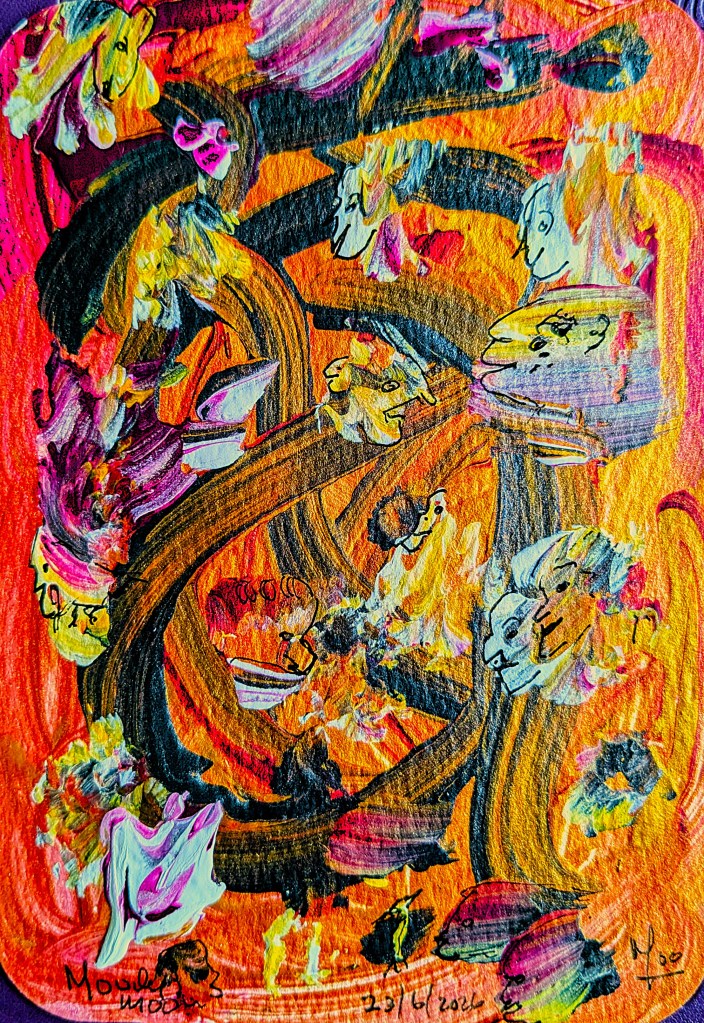
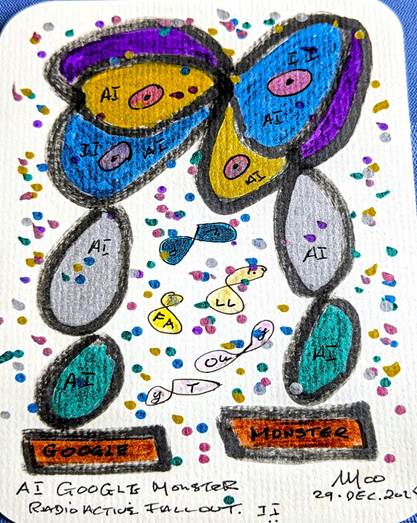
So, Moo has just come back from wherever he’s been and wherever it was, he’s not telling me. However, he does say that I look All Shook Up. And he’s humming Elvis Presley songs at me. And the above painting is his suggestion for me for today. “Thank you, Moo. And welcome back.” He nods at me. “Good to see you two,” he says. “You spelt that wrong,” I tell him. “I didn’t,” he says. “We all know you’re a split personality and I am saying that I am pleased to see both halves of you again.” Oh, dear, you can never win with Moo. He always paints a different angle or comes round in a wiggling circle. “Ha!” he says. “At least I don’t paint myself into corners.”

Am I a victim, then, as Camus suggests, or just another assassin? Interesting suggestion. We are either murderers or victims. But I haven’t murdered anyone, that I am aware of. And I don’t feel myself to be a victim. So what is my dear friend Albert on about? Alas, he isn’t around to ask. I just have to read his books and see myself left wondering.

I guess it was all different in Paris, in the 1940, during the Nazi occupation. Anyone can talk a good game, but what do you do when the Gestapo knock on your door at 2:00 am? Good question. Existence precedes essence. We live. We survive. That’s Jean-Paul Sartre. And so is this – “L’homme n’est rien d’autre que ce qu’il fait.” Man is no more than what he does. So there you have it. It’s never what you say you might do, or how you relate things in respect – it’s all about what you are doing right now. So – ask yourself that vital question – “What am I actually doing?” The answer you give will tell you a lot of things about yourself – if you are honest in what you say.

Rage, Rage 28 & 29

Rage, Rage
28

Two small gnomes
camped, one in each
of my lungs.

All night long
they played
their squeeze-box,
wheeze-box concertinas,
never quite in unison.

Sometimes they stamped
their feet and my body
rattled in time
with their dance steps.

Their wild night music
caught in my throat
and I coughed
unmusical songs
that spluttered
and choked me.

29

This morning, the bailiff,
Mr. Koffdrop, evicted
the two gnomes from my lungs.

Landlord Bodie
placed an ad on Kiji.

He rented the free space
in the left lung
to a tiny bag-piper
who took up residence
by my heart.

All night this piper piped me
a highland pibroch
on his whisky-worn pipes.

Comment:

All night this piper piped – and there is nothing stranger than having a clogged up, congested chest and hearing your own breath whistling in and out of your lungs. It certainly kept me awake. And I lay there remembering all the pipers I have ever heard piping. One very special one, from the Canadian Black Watch, gifted me the last image “a highland pibroch on his whisky-worn pipes”. A flask in his jacket and a nip every now and then to keep the music and the energy flowing. Scotch of course. None of the Japanese or Irish whisky varieties for that kilt-clad friend of mine. I can hear him now, as I type these lines – “A drop before ye go?”

As for the accordion, well, I have always liked the small, hand-held ones – squeeze boxes – wheeze boxes – and did those lungs of mine ever squeeze and wheeze. I called them Mr. Teasy-wheezy and Mr. Teasy-squeezy. And all night long they serenaded me. And I lay there, wide awake, not even drowsing, watching  Orion gradually striding his lonely way towards the western horizon. No rest for those afflicted with the squeezy-wheezy lung syndrome. And long may it stay away.

Wild Life

Wild Life

I see green grass
Small ponds
Winding roads
Patches of sorrow

Turquoise blues 
Hills to climb
Softness
Strength 

Flowers blooming
A small animal
Covered in feathers 

An eye
Keeping watch
Purity of white

Ekphrastic Poem
©
Yolande Essiembre

Comment:

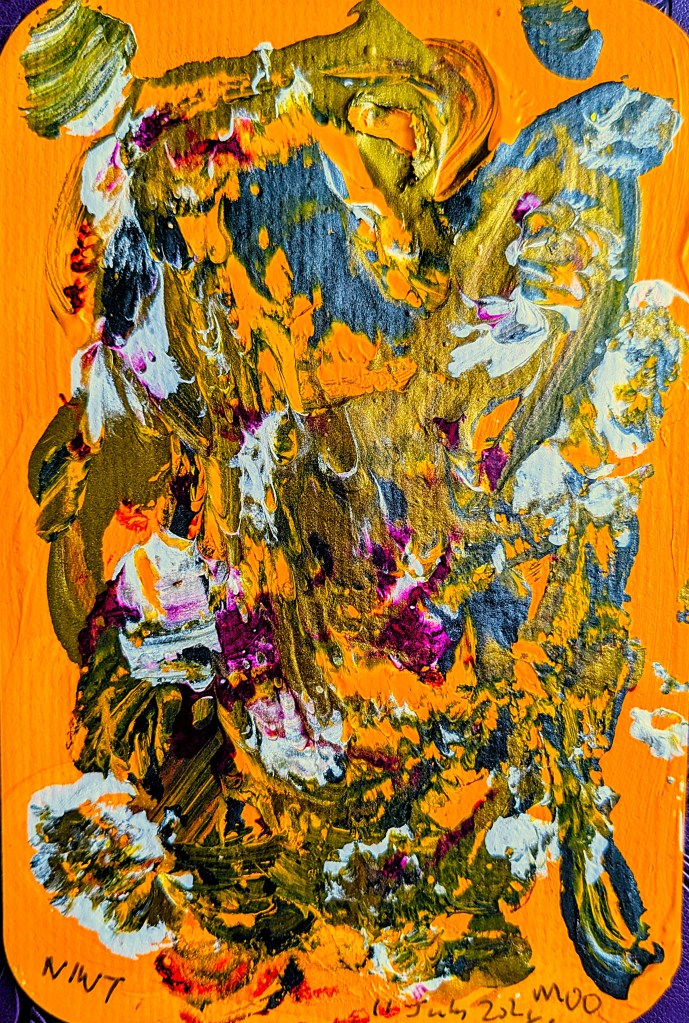
My good friend Yolande Essiembre sent me her Ekphrastic poem after viewing this morning’s painting by Moo. Wild Life II is a better representation of the colours of the original. However, Moo added in some (what he calls!) helpful touches – the black shapes that reinforce the suggestions of the original. Yolande wrote her poem based on Version I – but with the stronger colors of version II. Magic oh what a tangled web we weave when first we practice to deceive. And all artists weave their webs of deceit. As Cervantes says – Tanto la mentira es mejor, cuanto más parece verdadera. / The closer it approaches the truth, the better the lie.

Imitatioimitation – one of the bedrocks of classical rhetoric. “Imitation is the best form of flattery”. Flattery, yes, but what we find, in art above all, is that there exists only one original. However good the copy, the flattery – the imitation, if you prefer – it is never as good as the original. The original of this painting exists in one time and one place. The two deceptions are not the original. In fact, Wild Life I no longer exists because Moo has repainted it. It has turned into Wild Life II.

So many questions – which version do you prefer – I or II? De gustibus non est disputandum. There is no arguing about taste. Which is the better version? Well, each viewer must choose. But remember, each version is a deception, and each deception is a lie. And there is only one original. Oh what a tangled web we weave.

But we can, I hope, agree on one thing – Yolande’s verbal version (which I publish here with her permission) is verbally picture perfect. It is how she sees the painting. It is what the painting means to her.

Thank you so much Yolande. Moo and I hope to publish your words and visions more often. With your permission. we will do so.


Carved in Stone 72 & 73

Carved in Stone
72

Is this world I create real?
Of course it isn’t.

It exists only in my head,
and on the page,
but perhaps, one day,
you too will see
the things I have seen.

Yet the world I describe
is as unreal as the words
from which it is woven.

73

Heraclitus once wrote
we can never bathe
in the same river twice
.

This is the Catch 22
faced by all poets,
to remember,
and to try to recreate.

Shadow hands on cave walls,
colored pictographs on gesso,
hieroglyphics on papyrus,
ink on paper, raw words,
and in the end,
everything reduced
to these three little letters
carved in stone –

RIP

Commentary:

If you have read this far, we have walked a long journey together – 73 verses that comment on life and the meaning of life. Hard reading in places, easy in others. I trust you have enjoyed the journey and found some stops and resting points along the way in which to contemplate the ways in which the threads of your own life intermingle with mine.

Throughout this journey, I have tried to use a four step process. (1) Verbal – the poems themselves. (2) Visual – photos that intertwine with the verbal. (3) A Commentary – that goes beyond the verbal and visual and opens up the ideas a little more. (4) A Dialog between myself – the poet – and Moo – the visual artist who has so frequently loaned me his paintings when he thinks they illustrate my words.

It’s been a topsy-turvy journey through what Bakhtin calls a world of carnival, where little is at it seems, and the world is turned upside down. That said, we have a clear choice – to slide down the downside of this life, or to scale the upside, to contemplate, with joy and happiness, the world from those heady heights.

Blessings. Pax amorque.
And thank you for travelling with me.

Banks of the Seine

Banks of the Seine

Gnawing at the carcass of an old song,
my mind, a mindless dog, chasing its tail,
turning in circles, snapping at the fragment
of its own flesh, flag flourished before it,
tournons, tournons, tournons toujours,
as Apollinaire phrased it, on a day
when I went dogless, walking on a mind-leash
before the Parisian bouquinistes who sold,
along the banks of the Seine, such tempting
merchandise, and me, hands in pockets,
penniless, tempted beyond measure,
by words, set out on pages, wondrous,
pages that, hands free, I turned, and turned,
plucking words, here and there, like a sparrow,
or a pigeon, picks at the crumbs thrown away
by pitying tramps, kings, fallen from chariots,
as Éluard wrote, and me, a pauper among riches,
an Oliver Twist, rising from my trance, hands out,
pleading, “Please, sir, can I have some more?”

Commentary:

Intertextuality – how many different texts can you recognize in this one piece of verse? I can count six reminiscences of other poets, ones that have influenced me to a lesser or greater extent. A couple of novelists lurk in the shadows as well. Fascinating, eh? Do these voices echo in any other ears than mine? Good question – and does it matter if they do or they don’t? The main thing is that they harmonize, the old world with the new, the centuries that went before with the one that is with us now. Quevedo – “Vivo en conversación con los difuntos y escucho con mis ojos con los muertos.” I live in conversation with the defunct and I listen with my eyes to the dead.

And look at that painting. No, not the Banks of the Seine, but the banks of the Fundy, near St. Andrews. And it’s Moo, at his best, doing a cross between a cartoonist, a genuine artist, a surrealist, and an amateur artist who lends his paintings to friends when they want a picture of water, or a river bank, or something or someone else that will add to the intertextuality of his works. Yea, Moo. Go Team Moo, go. Long may you survive and work together.

Carved in Stone 16 & 17

16

The Bulls of Guisando,
pre-historic, unweighable,
the bearers of Roman graffiti,
itself two thousand years old.

Were they carved as boundary markers,
or designed to designate pastures,
for horses, pigs, sheep, and bulls,
all grazing in their stone dreams?

Celtic, pre-Roman,
they speak to my Welsh blood,
and to the Irish soul
that will always be a part of me.

I place my hand
on the dimpled granite hide
and feel time coursing
beneath the stone skin.

Granite ships,
islands in a sea of time,
I sense a heart beating,
something surviving
within the stone.

17

We are powerful people,
we creative artists,
we carvers of stone,
we dreamers,
whether we dream
by day or by night.

Those of us
who dream by day,
often see our day-dreams
come true.

Commentary:

“Those of us who dream by day, often see our day-dreams come true.” Lawrence of Arabia – The Seven Pillars of Wisdom. You recognized the quote of course, wrth gwrs. Intertextuality, the weaving of words through text after text in different combinations according to our time and space. Some of us think we are original, but there are only so many plots to a play, 24 or so, if I remember my Aristotle correctly, and I have changed the number, just to test you. Oh ye of too much faith!

We think we are original, but, as Picasso said, the painters of the cave paintings, all those many years ago, created everything we artists could ever dream of. We all borrow in one way or another and originality is merely a disguised form of borrowing. The faces change, the actors change, the medium changes, the times change, but otherwise, everything else is the same. Sad, really, that we should claim originality (and fresh water) for all that water that has passed under so many bridges.

Welsh blood and Irish soul – not even original, but shared by so many in my family. Add an English education, studies and residence in Spain, France, Mexico, Canada, and the USA, and what do you have? An intellectual mongrel, that does not know its own mother, like so many other mongrels, and that shakes its coat only to shed so many multi-cultural and multi-lingual fleas.

And remember – “Great fleas have lesser fleas upon their backs to bit them, and lesser fleas have smaller fleas, and so ad infinitum.” Intertextuality – they were only playing leap-frog and one jumped over and another jumped over someone else’s back.

Carved in Stone 13

13

What is life?
Is it just an illusion,
as Calderón tells us,
and nothing but a dream?

And what is time?
Does it bend, as Dalí shows us
when his surreal clock breaks into pieces,
time and numbers flying off
as it explodes over a waterfall?

Another clock folds –
a pancake draped
over the bough of a tree.
 
Time – a water clock,
a marked candle,
a grandfather clock,
with Roman numerals,
and time marching,
round and round,
erasing the past,
establishing a future
that will itself
soon be erased.

And what am I
but a moment on time’s clock,
a drop in the clepsydra,
a striation on a flickering candle,
a piece of roughly polished sea-glass
perched on a lonely beach?

Commentary:

Well, Moo has done me proud this time. Two early paintings, both depicting aspects of time, as conceived by Moo. In the first, time is seen as a tick-tock time bomb, or rather a set of tick-tock time-bombs. In the second, in imitation of Salvador Dali (Moo always set his sights high!), a clock going over a water fall and the hours flying off the clock face as time bends. So, tell me if you can, what is time?

Perhaps more important, what is life? Is it a dream, an illusion? And if it is a dream, what happens when we wake up? I know what happens when I wake up – I get up and go pee. Is that to be my final reality? By extension, is life our only reality? Or is our life a series of lives, as some religions would persuade us? And if a cat has nine lives, how many lives do we have? Can they be numbered? Or, like innumerable onions, do we peel away layer after layer? And if so, what is in the centre of the onion when we finally get down that far?

And why do some people write center while others write centre? Is life an illusion, a play? If so does it take place in a theatre or a theater? Or is really a sort of metatheatre or metatheater, life in rings, like the onion, lay after lay, layer after layer? Oh dear, this is all much too complicated. I’ll ask Moo to paint me a painting of life and we’ll see what he comes up with. He’s a bit lazy at the moment and his paint brush has the bends and refuses to cooperate. It’s probably made of cat bristles, and is untrainable and almost impossible to train, let alone to herd. Never mind. We’ll abandon all this for now and give the cat the task of training Moo to paint another painting.