Monkey Meets Pontius Parrot

Monkey Meets Pontius Parrot
(With glorious  memories of Macarronic Latin)

Pontius Parrot is very clever
and very pontifical.
“Pretty Polly!”
He pontificates from his pulpit.

His name isn’t Polly
and he doesn’t have a pulpit
but he parrots words
in Macaronic Latin:
“Caesar adsum jam forte.”

Pontius Parrot is perky at the podium
and bounces up and down,
preening himself self-consciously,
rattling his chains,
shaking his bars,  and speaking Latin:
“Brutus aderat.”

He is marked with shame and scandal.
A dysfunctional family of feathered friends
 has henpecked him until he is black and blue
and he has thrown up copiously:
 “Caesar sic in omnibus.”

He dips his wings in holy water,
calls for some soft soap, 
and washes his feathers and claws.

Poor Pontius Parrot,
he can only say “Repent!”
“Brutus sic in at.”

Commentary:

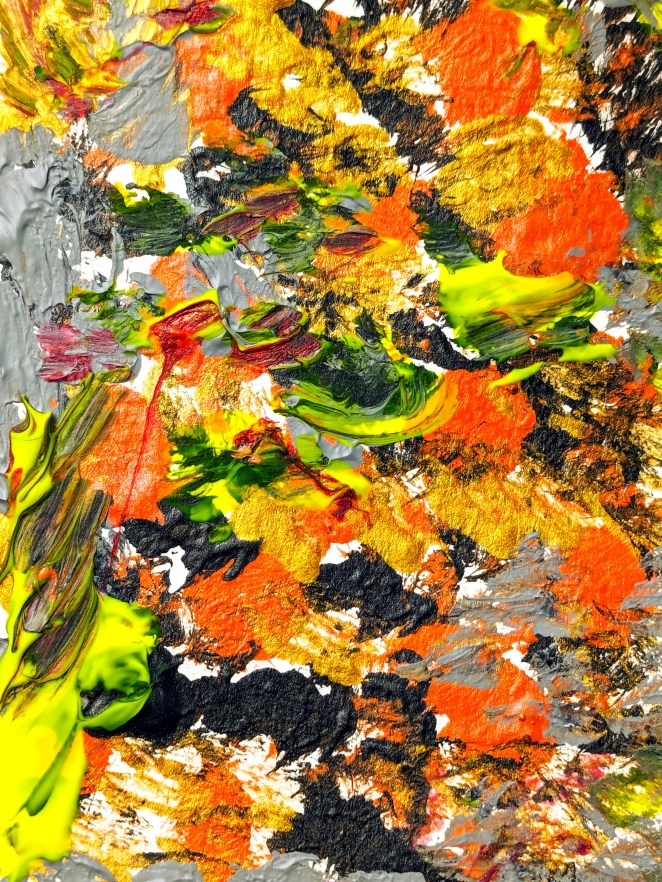
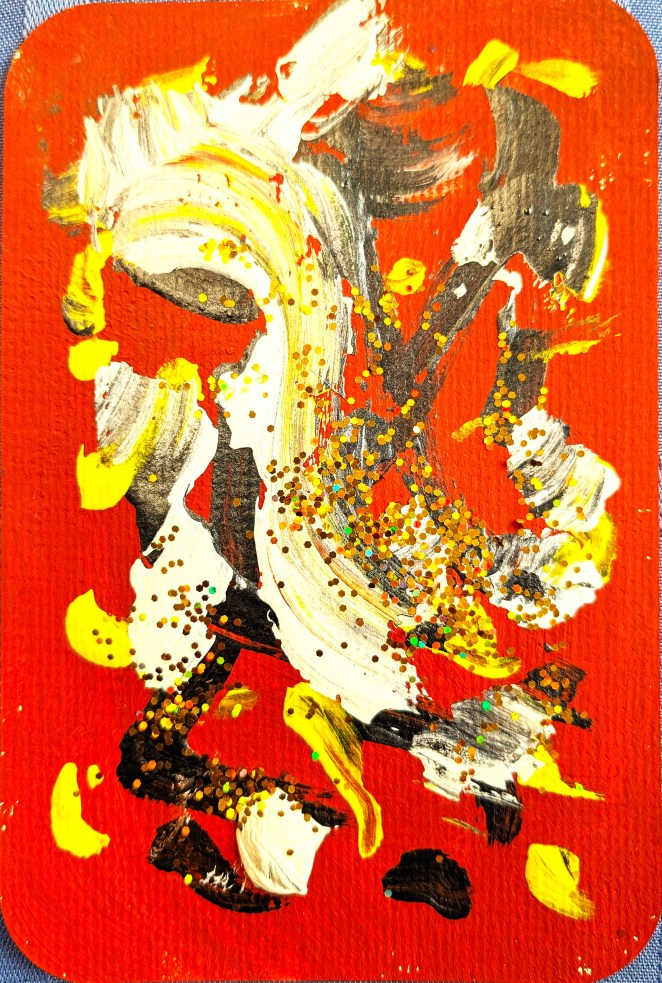
I asked Moo if he had ever painted a parrot, but he told me that he hadn’t. However, one of his favorite viewers, had once called this painting a pile of spaghetti wriggling in tomato sauce and he thought that spaghetti was close enough to macaroni for it to serve as a painting for Bony Macaroni Latin.

I had to explain to him what we mean when we say Macaronic Latin. Back to that boarding school and we used to invent all sorts of Macaronic Latin phrases. They used to cane us with bamboo canes. So here’s the verb paradigm in Latin for ‘to cane a student’. Bendo – whackere- ouchi – sorebum. Of course, it helps if you know what Latin verb paradigms look like. They are easy to remember and are aide memoires for the four main parts of the verb. Bendo – I bend over – first person singular, present tense – whackere – to whack or cane – infinitive – ouchi – I said ‘ouch’ – past tense – sorbum – the inevitable result – past participle.

Now, if we look at the italics in the poem we see a poem within a poem, and that smaller poem is written in Macaronic Latin.

“Caesar adsum jam forte.
Brutus aderat.
 Caesar sic in omnibus.
Brutus sic in at.

Translation

Caesar had some jam for tea.
Brutus had a rat.
Caesar sick in omnibus.
Brutus sick in hat.

Oh never underestimate the ingenuity – linguistic and / or otherwise (and we won’t go into that one right now) – of the bored-to-tears Public Schoolboy. Especially if he is not destined to be a Perfect Prefect like Perfect Prefect Plod – who was never any good at Latin, if I remember well. Neither was I come to think of it. Horrible language, dead and reeks like the dead rat that Brutus ate.

As for the ‘repent’, well, usually, just before he beat you, the master doing the beating would enquire as to your health and ask you if you repented of your sins, crimes, bad language, being cheeky to Perfect Prefect Plod, or whatever else you had done (like smoking or holding a girl’s hand in public instead of a boy’s). You always said ‘yes, of course I do, sir,’ in the vain hope of avoiding a beating. But, bad luck, the cane descended anyway, ouchi was heard, and the victim retired to the bath room to examine his past participle, also known as his sorbum.

I bet you never imagined any of that. Wow! What a great lesson I have taught you today. Think about it all and think about it carefully. Now you know why Pink Floyd sang “We don’t need no education.” But what an education it was. And remember, the Duke of Wellington, Old Nosey, once said ‘my battles were won on the playing fields of the pubic schools of England.’ Oh dear – I hope I got that right. I fear there’s a letter missing somewhere.


Gorilla Drives the Zoo Bus

Gorilla Drives the Zoo Bus

Gorilla drives the same zoo bus
all day, every day;
same starting time, same finishing time,
same route, same stops,
different passengers,
but every passenger the same:
faceless.
Gorilla doesn’t want to know their names.

“Please tender the exact fare!”
Not a penny less, not a penny more,
and he polices every penny.
Bus conductor and master
of every passenger’s destiny,
he opens and shuts the door,
letting passengers on and off the bus,
but only at official stops.

Every passenger has a ticket,
and he punches every ticket
with a neat, round hole.

He never makes mistakes.
He grinds, like God’s own mills,
exceedingly small.

He has spent all his life in uniform.
He has a belt and braces to hold his trousers up.
He’s always prepared for the worst.  

Ten, fifteen, twenty years:
an anonymous wife;
anonymous little babies;
at shift’s end, a pension,
and another bus.

St. Peter’s at the wheel.
He doesn’t want to know
where gorilla wants to go:
he wants to know where he’s been.

Commentary:

Moo didn’t have a painting of a gorilla driving a bus, so he offered me a painting of the passengers instead. Look carefully – you might even find a portrait of me or you in there. Who knows where Moo goes and who he sees? I certainly don’t. Remember Picasso – he used to run downstairs, out into the street, see a face he liked, and run back upstairs and paint it from memory. I wonder if Moo does the same thing. I’d ask him, but if he doesn’t want to answer the question, he just grunts. And I can imagine him grunting at that one.

Anyway, we all know and recognize the gorillas when we meet them. They are totally unimportant, have a miniscule job to do, but do it with absolute authority and the utmost perfection. Like Gorilla – “Not a penny less, not a penny more, and he polices every penny.” – “he opens and shuts the door, letting passengers on and off the bus, but only at official stops.” – “he punches every ticket with a neat, round hole.” – and probably in the exact same spot of every ticket! – “He never makes mistakes.” – and if he does, it’s the passenger who suffers, because ‘Get on, get off, who ever you may be, I am the lord of the bus,’ says he.

What will happen to us at the end of our shift? I really don’t know. And I don’t think anyone else does, either. Will St. Peter be there to greet us? (I don’t know.) Has the Zoo bus replaced the ferry over the River Styx? (I don’t know.) What will we be asked when we get there? (I don’t know.) How will we answer? (I don’t know.) Is there a little book in which all our deeds, good and bad, are written down? (I don’t know.) Are we to be divided into sheep and goats? (I don’t know.) What will poor monkey do when he is turned into a sheep or a goat? (I don’t know.)

So many questions, deep questions, packed into one small poem. Most of those questions unanswerable. But that’s one of the joys of poetry – to open a poem is to open a tin of calamares – there’s always another something or other left in the corner. Look, over there, bottom left, right at the bottom of the can, I spy with my little eye another question. ‘What is that question?’ you ask. Sorry, mate, I’m afraid I don’t know.

Hair Cut

Hair Cut 

Curly locks, wisps of grey and silver,
curve around my ears, cuddle my collar.
I stand in the bathroom, look at my scissors,
glance in the mirror, and start to hack.

I turn my head swiftly from side to side,
watching white hair falling, like snow.

“All done!” I look at myself in the mirror:
hair shorter, still sticking out in clumps,
but some curls still tickle and cling.

Not bad for front and sides. I still
can’t see the back, but if feels fine.
“Right” I say. “I’m ready for the show.”

What show? The one where I sit before
the computer screen and admire myself
before I click in the code, type the password,
and join the virtual meeting that today,
in the pandemic, passes for face to face.

Commentary:

Face to Face – Moo helped me with this one by allowing me to have one of his ‘face to face’ paintings. Thank you, Moo. Sorry I said you weren’t too bright yesterday. And we both got the singer of All Shook Up wrong – it was Tommy Steele of course. Also, as you explained to me, you may not be great at adding two and two and making four, and you may be unenlightened with words, but wow, when you add a colour or two to the palette you are enlightened and enlightening and dazzle people with the lightness of your enlightenment. There – hope we can be friends again now. I would miss your paintings if you withdrew your services.

And this is a Golden Oldie. In 2020, when Covid walked with us, I started cutting my own hair – hacking might be a better word – and I have continued to do so ever since. In fact, I have only been to the barber’s three times since 2020. Each time, the hair lay so thickly upon the floor behind the barber’s chair that we walked knee deep in the white stuff. Great fun. How the young lady made fun of me. Right down the middle of the back of my head she found a large mullet that I couldn’t reach with either hand. She found that so funny. Asked me if I wanted to keep it. Of course, I said no!

I remember those face to face on the computer days. At least we couldn’t catch Covid from an image talking back to us on a screen. I always find those online meetings so difficult and awkward. I love the awkwardness of that word – awkward. The facilitator always began with – ‘Now, let’s all introduce ourselves.’ What on earth do you say on such occasions. ‘Easy,’ Moo told me. ‘I always say “Hi. I’m Moo. I’m a painter.” Nobody bothers me after that. Once somebody asked me what I painted and when I replied ‘houses’, everyone lost interest and the facilitator moved on.’

I always get tongue-tied and can never manage to be coherent. In fact, I am neither coherent nor cohesive and I often fall apart. “Hi! I’m Roger. I’m a writer.” This always opens the doors and the windows to all sorts of questions. ‘What do you write?’ ‘Have you published anything?’ ‘What’s your latest work?’ Of course, if I had any sense – and often I have less sense than Moo – when someone asks me ‘What do you write?’ I should reply. ‘English.’ Or ‘Italics.’ Or ‘Greeting cards.’ That last would be as much of a show stopper as Moo’s response – ‘houses’! Of course, I could get really inventive and say ‘Bilingual jokes for Christmas Crackers.’ Another pet peeve – have you noticed how the French and the English don’t match up? I could have a great old rant about that one. But don’t let’s talk about Fortune Cookies!

And suddenly, we have strayed a log way from the act of getting our hair cut during Covid. But, like many diversions, the journey is often more important than the destination, especially if we are amusing ourselves! And I hope you had some fun and took some joy from my words.

Time Flies

Time Flies

… bends like a boomerang,
flies too rapidly away,
limps back to the hand.

Endless this shuffle of unmarked
days dropping off the calendar.

Hands stop on the clock.
The pendulum swings:
time and tide stand still,
do not move.

The print in my grandma’s house:
seemingly moving seas,
sails swelled out,
the ship stays firm in its frame.

‘As idle as a painted ship
upon a painted ocean.’

Our garden fills
with brightly colored birds
and red and grey squirrels.

Light and dark
switch back and forth
each day
a twin of the day before.

The TV screen hangs out
the daily washing.
Tired, worn out shadow,
their faces boring us
with shallow wit
and hand-me-down wisdom.

Time:
an albatross around the neck,
an emu, an ostrich, a dodo,
an overweight bumble bee,
too clumsy, too heavy to fly.

“Time flies?”
“You can’t.
They fly too fast.”

Commentary:

My friend Moo told me he was ‘all shook up’ when I read him this poem. I don’t think Moo’s too smart. He thought All Shook Up was written by the Rolling Stones when they went out moss gathering during the Fredericton Harvest Festival, but I said no, it was definitely written by Buddy Holly on an off-day when he was playing cricket. It wasn’t okay in those days to play croquet.

The last three lines come from an examination question in the General Paper, “S” Level, as it used to be. “Punctuate this sentence – time flies you can’t they fly too fast” – of course, they should have said, “in exactly the same way we want you to. Corrections and alternative versions will not be accepted.” What did they think I was? A mind-reader? I wasn’t. I was a teenager having a field day in the national examinations. I would love to have been a fly on the wall when they marked my paper.

In the biology exam, they gave each one of us a Brussel Sprout and asked us to draw it and tell us as much as we could about it. Of course, I ate mine, and I said it tasted a little bit dry and needed some salt. Then I drew a mess of potage, all yellow and green with chewed up squiggles, and added “That’s what the sprout probably looks like right now.” I failed that exam too. Didn’t even get a part mark for ingenuity, though the science teacher said I could have a glow of satisfaction. Very useful after lights out in a boarding school, I can tell you.

I can’t remember if Moo went to that school with me or not. I don’t think he did. I think he drifted into my life a little bit later. He wasn’t a painter at that stage, just a half-starved philosopher doomed to live in a garret. Of course, once he started painting houses, he made money. It’s amazing how many people will pay you for painting their houses. Of course, that was before they invented plastic siding.

About now you realize that I live in a strange world all of my own and a lot of people live in it with me. You, too, if you enjoyed reading this. Long may the ‘strange world of me, you, and Moo’ continue. I’d send you a penny for your thoughts, but they have gone out of circulation. I can’t even sing you a song of sixpence these days either. Silver sixpences have walked the dodo path too.

October

October

… and the wind a presence, sudden,
rustling dusty reeds and leaves,
the pond no longer a mirror,
its troubled surface twinkling,
sparking fall sunshine,
fragmenting it into shiny patches.

It’s warm in the car, windows raised
and the fall heat trapped in glass.
Outside, walkers walk hooded now,
gloved, heads battened down
beneath woollen thatches.

A wet dog emerges from the pond,
shakes its rainbow spray
soon to be a tinkle of trembling sparks
when the mercury sinks
and cold weather closes the pond
to all but skaters. Then fall frost will turn
noses blue and winter will start to bite.

Comment:

I was the first to like Moo’s painting, and indeed I do.
I hope someone likes my poem, too.

Pioneer Sky

Pioneer Sky
04 September 2020

Sky and clouds float side
by side in the beaver pond,
mingling shape and color
with the autumn leaves.

When the walking trail
became too crowded,
the beavers left their lodge.
They moved to another pond,
lower down than this one,
and there, where fresh milkweed
grows, they built another dam
and a brand-new lodge.

The great blue heron still
stands on guard, patrolling
his usual watery haunts.
He searches for solitude
in untroubled waters,
weaving his wary way
between white and blue skies
mirrored in the pond below.

Just when I think that life
has become meaningless
I look up at that Pioneer Sky,
celestial blue for hope –
white clouds for purity,
and I seek new meanings.

I also find them
in the rippling patterns
of the Beaver Pond.

Clepsydra 14-15 – Clowns clowning around

Clepsydra 14-15
Clowns clowning around

14

… walking life’s walk
     grey jays in the ash tree
          fresh snow on the ground

at night
     deer track out of the woods
          moon’s dead skull
               chalking its slow path
                    westwards

snow falls
     white upon white
          whirling our world
               back to its cratered life

nothing needed
     other than moonlight on snow
          to ignite us

a white wall of water cascades
     earthwards from the moon
          waters of renewal
               waters of life
                    waters that restore us
and save us
     from the moonbeam’s slicing knife
          that amputates all life …


15

… it is scary tonight
     inside the topsy-turvy
          big-top of my circus world

carnival time
     clowns clowning around
          turning my life
               upside down

is my mind
     a spider-web
          spun by worry and doubt

I remember how
     they pushed me around
          kicked me out
               always the anonymous they

they abandoned me
     told me I was unwanted
          surplus to purpose
               forced me to exit

they told me to forget
     those amniotic waters
          that water world of comfort
               that illusion of reality
                     they had created
                          then threw me onto the street

    I left behind
          their stultified personalities
               with all their stupid rules
                    and blinkered minds
                         that stopped them
                              from seeing straight …

Clepsydra 12 & 13 – Pilgrim in this barren land …

Clepsydra 12 & 13 –
Pilgrim in this barren land …

12

… pilgrim in this barren land
     lost in my wanderings
          the wander-lust still tugging at me

in my back-pack
               dusty with memories
                    photos that only I have seen
                         sepia
                              spotted in places

only I know names and faces
     recall relationships
          a mystery to me, an outsider,
               such images haunt me
                    move me in ways
                         I do not understand

the irregular heart-beat
     of my life walks inside me
          down new corridors of time
               fresh music
                    strums my heart-strings

a heart
     a bridge a time too far
          lost I wander the woods
               searching for things
                    I know I must find
                         my lost self among them …


13

… but to find myself
     I must first lose myself,
          not in a barren land
               nor in the inner depths
                    of my suffering mind
                         nor the deeper depths
                              of another’s body

am I nothing more
     than an offering on the altar
          where nothing alters more
               than this interchange
                    eye to eye
                         mind to mind
                              body to body

will the I ever transform
     into the power of us
          together
               both of us

and are we much more
     than one plus one
          with three or four or more
               conjured from the word
                    that was from the beginning

or is all of this
     nothing more than
          the woven magic of pillow-talk …

Butterflies

Butterflies
Miguel de Unamuno

… butterflies … temporal forms … fluttering …
existing for one sweet day … they perch … spread
their wings … fan us with their beauty … flourish …
catch our attention … then caught by a gust
tear their wings on a thorn … and perish … blink
your eye and they are gone … yet reborn … they
cluster and gather in dusty ditches …
congregate on bees’ balm … smother Black-Eyed
Susan and Cape Daisy … shimmer in shade …
butterflies by day … fireflies by night …
terrestrial stars floating in their forest
firmament … dark tamarack … black oak … bird’s
eye maple … silver birch … impermanence
surrounds us … dances beneath stars … sings with
robins … echoes the owl’s haunting cry …
eternity held briefly in our hands …
then escaping like water or sand … black
words on white paper capturing nothing …
… my dialog … my time … my place … butterflies …

Note: “La poesía da permanencia a las formas temporales del ser / Poetry gives permanence to the temporal forms of the self.” Miguel de Unamuno (1864-1936)

The temporal forms of the self – and so much today is unsettled, changing, insubstantial. I have often wondered how one makes time stop. Is it even possible to do so? Time and tide wait for no man. And why should they? Fray Luis de León – “Con paso silencioso, el cielo vueltas dando, las horas del vivir le va hurtando.” / With silent step, the ever-turning sky, steals away life’s hours. Or Fancisco de Quevedo – “Que sin saber ni cómo, ni adónde, la edad y la salud se hayan huído. Falta la vida, asiste lo vivido, y no hay calamidad que no me ronde.” Without me knowing how or where, age and health have fled. Life is lacking, past life flew by, and there isn’t a calamity that doesn’t hound me.

Ars longa, vis brevis – art endures, life flies by. My translations are freer than usual today, but I too feel like being creative in my own language. So, if we can’t slow time down, what can we do? We can create – poems, paintings, photos. We can read – and translate from one language to another. We can, like butterflies, perch on flowers and enjoy our brief days in the sun. Mindfulness – we can make the most of each moment by living it thoroughly and well. Carpe diem – we can seize each moment of every day and live it to its full measure. And, above all, we can write and read poetry – because, as Unamuno says – Poetry gives permanence to the temporal forms of the self.

On Loneliness

Loneliness

58 What relationships have a positive impact on you?

I think one of my poems answers this question best. I write “one of my poems” but it is really my ‘free’ translation of one of Francisco de Quevedo’s sonnets – Retirado en la paz de estos desiertos. I have changed the poem slightly, but I am sure Don Francisco (1580-1645) will excuse Don Roger’s impoverished effort (2023).

On Loneliness
29 December 2023

Resting in the peace of these small rooms,
with few, but welcome books together,
I live in conversation with my friends,
and listen with my eyes to loving words.

Not always understood, but always there,
they influence and question my affairs,
and with contrasting points of view,
they wake me up, and make me more aware.

The wisdom of these absent friends,
some distant from me just because they’re dead,
lives on and on, thanks to the printed word.

Life flits away, the past can’t be retained.
each hour, once past, is lost and gone,
but with such friends, I’m never left alone.

And there are so many of those literary friends. I still read Rudyard Kipling and I have just finished Kim, Captains Courageous, Stalky and Co., Puck of Pook’s Hill, and Rewards and Fairies. I read these first when I was nine or ten years old, and I return to them regularly. Other friends include Garcilaso de la Vega, Fray Luis de León, St. John of the Cross, Quevedo, Góngora, Calderón, Miguel de Unamuno, Antonio Machado, various members of the Generation of 1898, the majority of the poets from the Generation of 1927… and these are just my Spanish literary friends. I have French friends, English friends, Anglo-Welsh friends, Canadian friends, Mexican friends, and, in translation, many, many more. My relationship with each of these friends has had an impact upon me.

A recent painting, by my friend Moo, is called Fiat Lux – Let There Be Light. It is reminiscent of Dylan Thomas’s poem, Light breaks where no light shines. Intertextuality – Quevedo drew inspiration from the Stoics. I drew inspiration from Quevedo. Moo drew inspiration from Dylan Thomas. The nature of creativity, and its continuing links throughout the ages, shines clearly through these wonderful associations. Long may they continue, and may others enjoy them and be influenced by them as much as I have.

Comment:
The funny thing is that I do not remember writing this blog prompt, nor do I remember having translated Quevedo’s poem into English. I wonder how many other forget-me-nots there are out there. Or, to be more precise, in my books and in my notes. A treasure trove – that’s my guess. Borges wrote of Quevedo that he was more a library than an author, and I am beginning to think that way about my self. A strange world, this, one in which the creator abandons, and then forgets, his creations. Perhaps we should change the image – not so much a library as an orphanage, and so many lost and abandoned orphans wandering around The Little World of Don Rogelio.